

Searching for the types of wild cats in Texas can produce confusing lists because some pages mix native cats, escaped exotic pets, feral house cats, and species known only from old records. A more accurate Texas guide recognizes five native species that are currently present or strongly associated with the state’s history: the bobcat, mountain lion, ocelot, jaguar, and jaguarundi.
Only the bobcat, mountain lion, and ocelot have confirmed present-day wild populations in Texas. The jaguar and jaguarundi are historic Texas cats without established modern populations in the state. Understanding that difference prevents ordinary house cats, black bobcats, and unverified photographs from becoming false records.
What Are the Main Types of Wild Cats in Texas?
Texas currently supports bobcats across much of the state, mountain lions mainly in western and southern regions, and a tiny ocelot population in the Lower Rio Grande Valley. Jaguars once reached Texas but are not established today, while jaguarundis are considered extirpated from the state. All five are native felids rather than domestic or introduced cats.
Quick Comparison of Texas Wild Cats
| Wild Cat | Scientific Name | Texas Status | Best Identification Clue |
|---|---|---|---|
| Bobcat | Lynx rufus | Present and widespread | Medium-sized cat with a short bobbed tail, ear tufts, facial ruff, and spotted or mottled coat |
| Mountain Lion | Puma concolor | Present, mainly in western, southern, and parts of central Texas | Large plain-colored cat with a small head and a very long tail |
| Ocelot | Leopardus pardalis | Present but extremely rare in South Texas | Small spotted cat with chain-like markings, bold facial stripes, and a long ringed tail |
| Jaguar | Panthera onca | Historic in Texas; no established current population | Very large muscular spotted cat with broad head and rosettes containing central dots |
| Jaguarundi | Herpailurus yagouaroundi | Historically present; considered extirpated from Texas | Low-slung cat with short legs, small rounded ears, long body, and very long tail; coat may be gray or reddish |
5 Types of Wild Cats in Texas
1. Bobcat
Scientific name: Lynx rufus. Texas status: Present and widespread. Medium-sized cat with a short bobbed tail, ear tufts, facial ruff, and spotted or mottled coat. Its Texas habitat is best described as most texas habitats, including brush, forest, ranchland, desert edges, and suburbs.
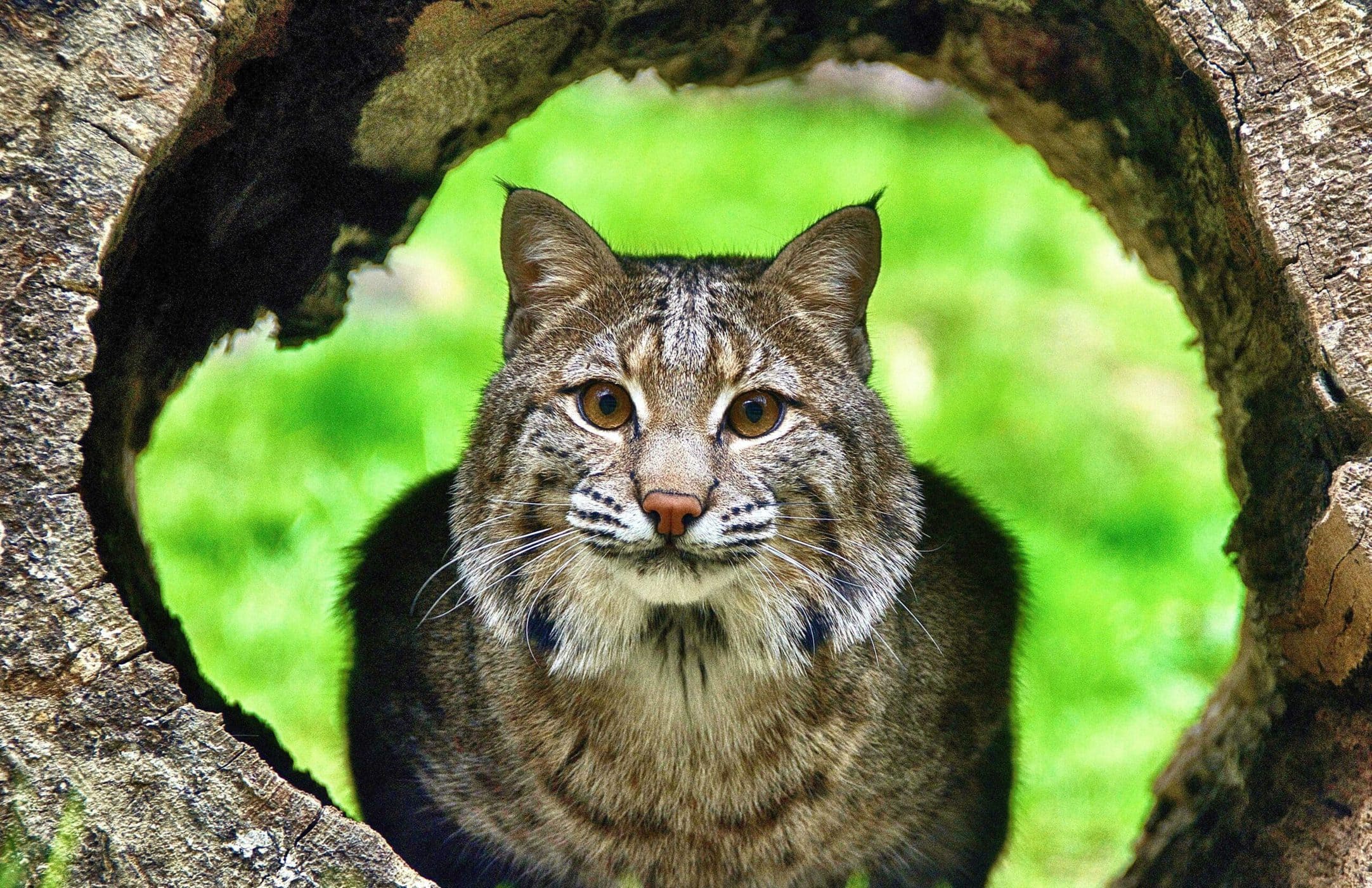
Diet and behavior: Typical prey includes rabbits, rodents, birds, reptiles, and other small animals. Bobcats are the wild cats Texans are most likely to encounter. They adapt well to fragmented habitat and may pass near homes without being seen. Tracks are round, usually lack claw marks, and are much smaller than mountain lion tracks.
Identification tip: The tail is short with a pale or white area underneath near the tip. A domestic cat may have a short tail, but it usually lacks the bobcat’s heavy legs, broad face, and wild movement pattern.
2. Mountain Lion
Scientific name: Puma concolor. Texas status: Present, mainly in western, southern, and parts of central Texas. Large plain-colored cat with a small head and a very long tail. Its Texas habitat is best described as remote mountains, canyons, ranchlands, and brush country.

Diet and behavior: Typical prey includes primarily deer, plus javelina and smaller mammals. Also called cougar or puma, the mountain lion is solitary and usually avoids people. A long tail that nearly reaches the ground is the clearest way to separate it from a bobcat.
Identification tip: Size alone can be misleading in poor light. Confirm the long cylindrical tail, uniform tan coat, and small head. Bobcats have much shorter tails and usually show spots or mottling.
3. Ocelot
Scientific name: Leopardus pardalis. Texas status: Present but extremely rare in South Texas. Small spotted cat with chain-like markings, bold facial stripes, and a long ringed tail. Its Texas habitat is best described as dense thornscrub, especially in the lower rio grande valley.

Diet and behavior: Typical prey includes rodents, rabbits, birds, reptiles, and other small prey. The ocelot is the only currently established spotted tropical cat in Texas. Its survival depends on dense native brush and safe connections between habitat patches.
Identification tip: Ocelots display elongated spots and chain-like markings rather than the simpler small spots of a bobcat. They should never be approached, baited, or pursued for a photograph.
4. Jaguar
Scientific name: Panthera onca. Texas status: Historic in Texas; no established current population. Very large muscular spotted cat with broad head and rosettes containing central dots. Its Texas habitat is best described as historically associated with south texas brushlands and river corridors.

Diet and behavior: Typical prey includes large and medium mammals, reptiles, and other prey. Jaguars historically ranged into Texas from Mexico. Modern claims should be treated cautiously because leopards are not native and large spotted sightings can involve escaped exotic animals, misidentification, or unverified reports.
Identification tip: A jaguar is bulkier than an ocelot, and many rosettes contain one or more dark central spots. Any credible Texas evidence would require expert verification.
5. Jaguarundi
Scientific name: Herpailurus yagouaroundi. Texas status: Historically present; considered extirpated from Texas. Low-slung cat with short legs, small rounded ears, long body, and very long tail; coat may be gray or reddish. Its Texas habitat is best described as dense low thornscrub of the lower rio grande valley.
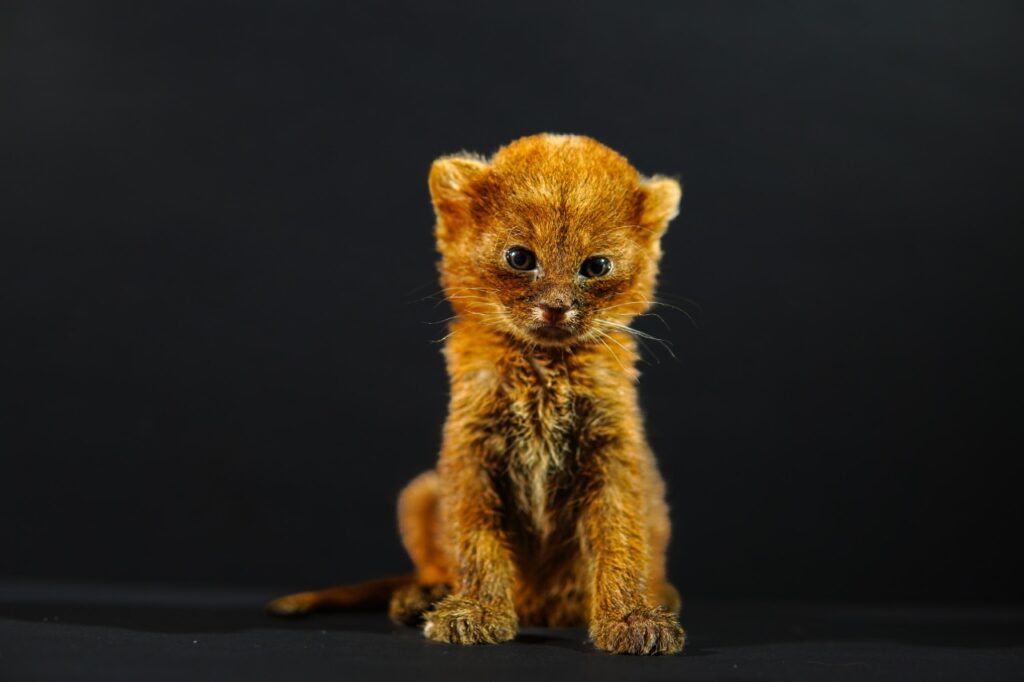
Diet and behavior: Typical prey includes rodents, birds, reptiles, and rabbits. Jaguarundis look more weasel-like than most cats. Texas records are historical, and many reported sightings turn out to be domestic cats, otters, or other similarly shaped animals.
Identification tip: Look for the unusually long body, low posture, small flattened head, and tail longer than that of a typical house cat. Color alone is not enough for identification.
How Are These Wild Cats Classified?
All five belong to the cat family, Felidae. The bobcat belongs to the lynx lineage; the mountain lion and jaguarundi are closer to each other than either is to the jaguar; and the ocelot belongs to a group of small spotted cats from the Americas. The jaguar is the only member of the roaring-cat genus Panthera historically associated with Texas.
Where Do Wild Cats Live in Texas?
Bobcats can use almost every Texas ecoregion. Mountain lions are most consistently associated with West Texas, South Texas, and some rugged central areas. Ocelots depend on dense thornscrub in extreme South Texas. Historic jaguar and jaguarundi records are tied mainly to the southern brushlands and the ecological connection with northeastern Mexico.
How to Identify Texas Wild Cats
- Tail: Bobcats have short tails; mountain lions, ocelots, jaguars, and jaguarundis have long tails.
- Pattern: Ocelots have chain-like markings, jaguars have large rosettes, and adult mountain lions are plain tan.
- Build: Jaguars are massively built, mountain lions are long-legged, and jaguarundis are low-slung.
- Tracks: Cat tracks are round and usually show no claws, but measurements and context are essential.
- Location: A claimed ocelot far from South Texas or a jaguarundi anywhere in the state requires exceptional evidence.
- Photo quality: One blurry image is rarely enough; compare multiple frames, scale, tail length, and gait.
Outdoor Tips for Observing Texas Wild Cats
- Use trail cameras legally and with landowner permission.
- Never bait a cat for photography.
- Keep pets indoors or supervised, especially from dusk to dawn.
- Do not run from a mountain lion; remain upright, face the cat, and follow current agency guidance.
- Give bobcats and ocelots a clear escape path.
- Report rare-cat observations with the original image, exact date, and location details to qualified wildlife authorities.
Safety, Sustainability, and Conservation Notes
Most Texas wild cats avoid people, and sightings are uncommon even where cats are present. Never approach kittens, carcasses, or a feeding cat. Protecting thornscrub, reducing vehicle collisions, controlling free-roaming pets, and maintaining connected habitat are especially important for ocelots. Wildlife laws and reporting procedures can change, so hunters and landowners should check current Texas regulations rather than relying on old summaries.
Fun Facts About Texas Wild Cats
- Bobcats occur across far more of Texas than any other native cat.
- Mountain lions are also called cougars, pumas, and panthers.
- No two ocelots have exactly the same coat pattern.
- Jaguar rosettes often contain central dots.
- Jaguarundis occur in both gray and reddish color forms.
- Young mountain lions have spots that fade as they mature.
- Bobcats can live surprisingly close to cities while remaining unseen.
- Ocelots depend on dense cover rather than open grassland.
- Texas lies at the northern edge of the historic range of several tropical cats.
- A margay is known from an old Texas specimen, but it is not usually included among the state’s five principal current-or-historic native cats.
Frequently Asked Questions
1. How many types of wild cats are in Texas?
Five native species are commonly discussed as current or historic Texas cats: bobcat, mountain lion, ocelot, jaguar, and jaguarundi. Only the first three have confirmed current wild populations in the state.
2. Which wild cats currently live in Texas?
Bobcats, mountain lions, and ocelots currently occur in Texas. Ocelots are limited to a very small area in the far south.
3. What is the most common wild cat in Texas?
The bobcat is the most widespread and commonly encountered native wild cat in Texas.
4. Are mountain lions found in Texas?
Yes. They are most strongly associated with West Texas, South Texas, and rugged ranchland, although occasional records can occur elsewhere.
5. Are cougars and mountain lions the same animal?
Yes. Cougar, puma, panther, and mountain lion are regional names for Puma concolor.
6. Are ocelots still in Texas?
Yes, but they are extremely rare and largely restricted to dense thornscrub in the Lower Rio Grande Valley.
7. Are jaguars currently living in Texas?
Texas has no established modern jaguar population. Jaguars are historically native, and any recent claim requires strong expert verification.
8. Are jaguarundis still in Texas?
Wild jaguarundi populations are considered extirpated from Texas. Unverified sightings continue, but they are not proof of a resident population.
9. Do lynx live in Texas?
Canada lynx are not resident Texas wildlife. The bobcat belongs to the lynx genus and is sometimes casually called a lynx, but it is a different species.
10. Are black panthers found in Texas?
There is no separate black panther species. Mountain lions do not normally occur in a black color form, and verified melanistic jaguars are not part of an established Texas population.
11. How can I tell a bobcat from a mountain lion?
Bobcats are much smaller and have a short tail. Mountain lions are larger, usually plain tan, and have a tail nearly as long as the body.
12. How can I tell an ocelot from a bobcat?
Ocelots have bold elongated chains and stripes, a longer tail, and a more tropical pattern. Bobcats have a short tail and usually smaller spots or mottling.
13. How large is a Texas bobcat?
Adult bobcats are roughly medium-dog sized, though body size varies by sex, age, food, and region.
14. How large is a Texas mountain lion?
Mountain lions are large cats with long bodies and tails. Adult males are generally much heavier than females, but accurate size estimates from sightings are difficult.
15. What do Texas bobcats eat?
They commonly hunt rabbits, rodents, birds, reptiles, and other small animals, with diet varying by habitat and season.
16. What do Texas mountain lions eat?
Deer are major prey, but mountain lions may also take javelina and smaller mammals.
17. What do Texas ocelots eat?
Ocelots feed on rodents, rabbits, birds, reptiles, and other small prey found in dense brush.
18. Are Texas wild cats dangerous to people?
Attacks are rare, but all wild cats deserve distance. Mountain lions require particular awareness because of their size.
19. What should I do if I see a mountain lion?
Do not run. Stay upright, face the animal, make yourself look larger, give it an escape route, secure children and pets, and follow current Texas wildlife guidance.
20. What should I do if I see a bobcat?
Usually, allow it to leave. Do not approach or feed it, and bring small pets indoors.
21. Should I report an ocelot sighting?
Yes. Preserve original photos or video and report the date and exact location to the appropriate wildlife authority without publicizing sensitive habitat details.
22. Can I keep a Texas wild cat as a pet?
Wild cats are unsuitable pets and may be regulated by state, federal, and local law. Their welfare, safety, space, and behavioral needs cannot be met like those of domestic cats.
23. Are feral house cats wild cats?
Feral house cats live without direct care, but they are domestic cats, Felis catus, not native wild-cat species.
24. Do bobcats have short tails naturally?
Yes. The short bobbed tail is a normal species trait, not usually an injury.
25. Do mountain lions roar?
Mountain lions cannot roar like jaguars and lions. They use growls, screams, chirps, and other calls.
26. Why are ocelots rare in Texas?
Major causes include loss and fragmentation of dense thornscrub, road mortality, and isolation of small populations.
27. What is the best evidence for a rare-cat sighting?
Clear original photographs or video showing the whole body, tail, scale, location, and multiple angles are far more useful than a cropped screenshot or memory alone.
28. Was the margay ever found in Texas?
Texas Parks and Wildlife describes an old specimen from Eagle Pass, but the margay is not considered part of the state’s established modern fauna.
29. Where is the best place to learn about Texas wild cats?
Use current material from Texas Parks and Wildlife, federal wildlife agencies, museums, and qualified conservation organizations.
30. How can landowners help Texas wild cats?
Maintain native cover, protect travel corridors, reduce unnecessary brush clearing, use conflict-prevention practices, control free-roaming pets, and report rare species responsibly.
Final Thoughts on types of wild cats in Texas
Learning about types of wild cats in Texas becomes easier when you compare body shape, habitat, behavior, range, and ecological role instead of relying on one feature alone. Use this guide as a practical starting point, observe wildlife responsibly, and confirm difficult identifications with a trusted regional field guide or wildlife agency.
Read more:
30 Types of Wild Cherry Trees