
The phrase types of Cavapoos can refer to size, generation, coat texture, or color. Cavapoos—also called Cavoodles in some countries—are Cavalier King Charles Spaniel–Poodle crosses, so there is no single official list of separate Cavapoo breeds.
This guide explains the most useful categories, including Toy and Miniature sizes, F1 through multigenerational breeding labels, straight-to-curly coats, and common colors. The goal is to help you understand what the terminology can and cannot predict.
What Are the Main Types of Cavapoos?
Cavapoos are most often grouped by size, generation, and coat type. A dog can belong to several categories at once—for example, a Miniature F1B Cavapoo with a curly red coat.
Generation labels explain ancestry, not guaranteed personality or allergy friendliness. Parent health, temperament, adult relatives, and honest breeder records matter more than the label alone.
Cavapoo Types at a Glance
| Category | Examples | What It Tells You | What It Does Not Guarantee |
|---|---|---|---|
| Size | Toy, Miniature, Standard/Larger | Expected body-size range | Exact adult weight |
| Generation | F1, F1B, F1BB, F2, F2B, multigen | Ancestry pathway | Exact coat or temperament |
| Coat | Straight, wavy, curly | Grooming and shedding tendency | Allergy safety |
| Color | Apricot, red, cream, black, chocolate, parti and more | Appearance | Health or personality |
1. Toy Cavapoo
Toy Cavapoos usually come from lines using a Toy Poodle. They are compact companion dogs, but exact adult size varies because the Cavalier King Charles Spaniel side and individual genetics still influence growth. Breeders may use “Toy Cavapoo” differently, so parent size is more useful than the label alone.
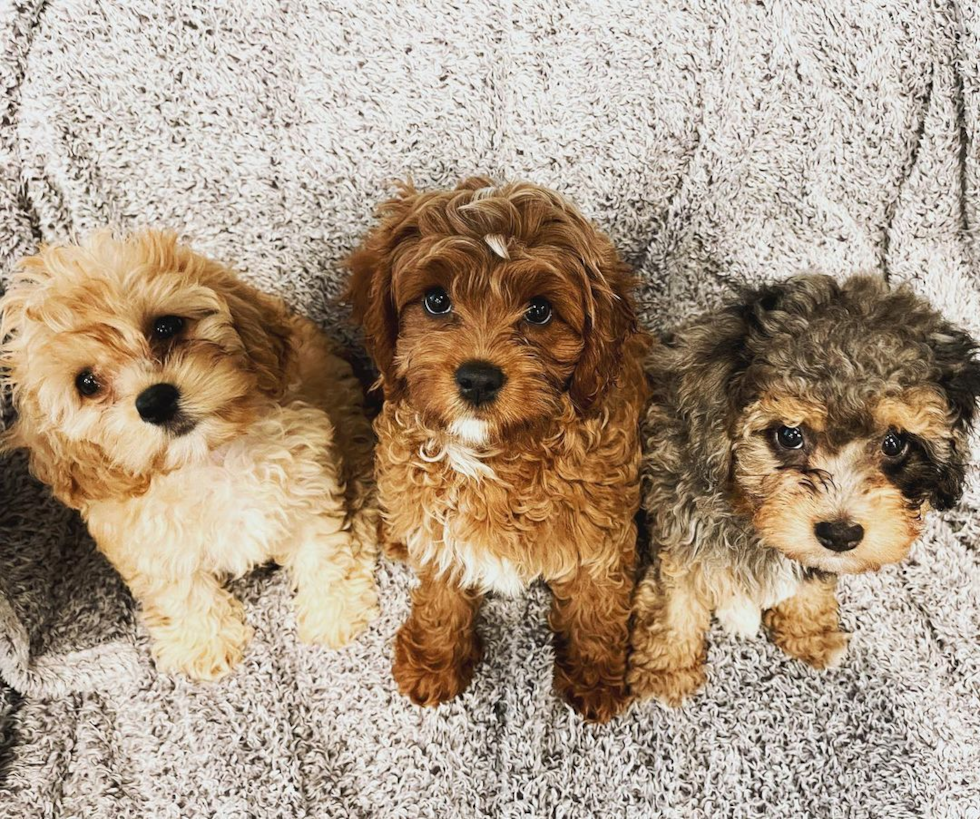
A Toy Cavapoo can fit apartment life well if exercise and enrichment are provided every day. They are often social and people-oriented, and many enjoy short training sessions, food puzzles, and gentle games.
Their small frame makes careful handling important. Harness fit, jumping from furniture, interactions with larger dogs, and play with young children should all be managed thoughtfully.
2. Miniature Cavapoo
Miniature Cavapoos are commonly produced using a Miniature Poodle and are among the most familiar Cavapoo sizes. They often offer a practical balance of portability, sturdiness, and activity for families who want a small-to-medium companion.

Like all Cavapoos, they can vary in build and coat. Some have a looser, more Cavalier-like wave, while others grow a curlier Poodle-influenced coat. Coat type affects grooming more than it predicts temperament.
Mini Cavapoos usually benefit from daily walking, play, training, and close social contact. They are companion dogs rather than decorative lap dogs, and boredom can lead to nuisance behaviors.
3. Standard or Larger Cavapoo
A larger Cavapoo may result when larger Poodles or larger multigenerational lines are used. The term “Standard Cavapoo” is less consistent than Toy or Miniature, and there is no single universal size chart.
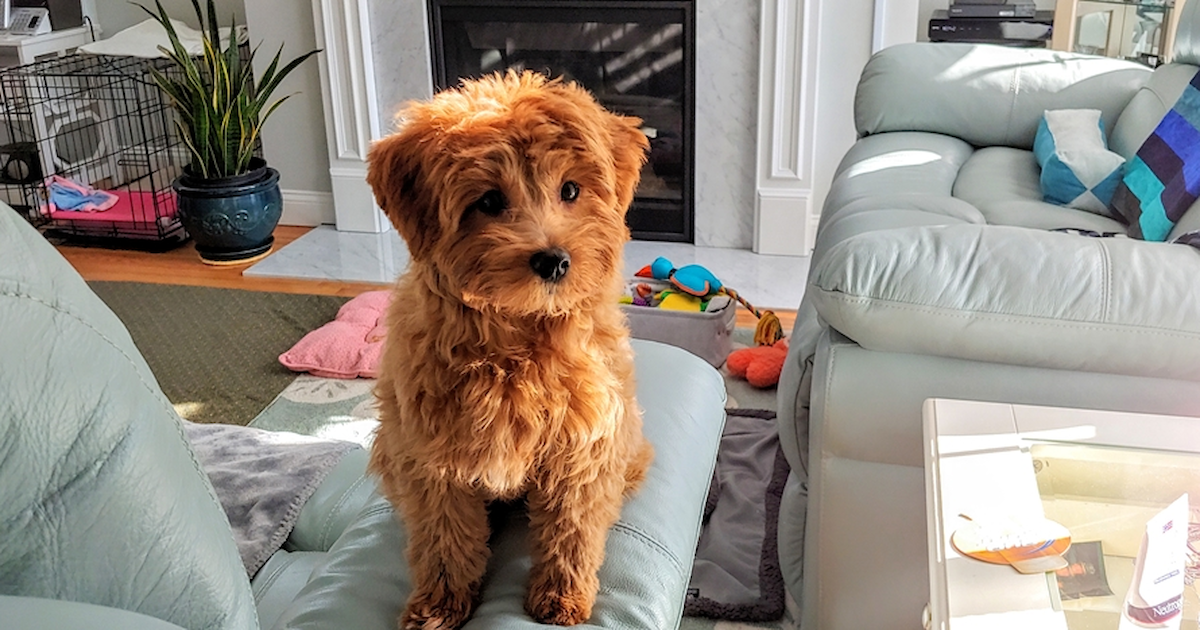
Larger individuals can be attractive to active homes that want more body size for longer walks and outdoor adventures. Owners should still wait for physical maturity before demanding repetitive running or jumping.
As with every Cavapoo size, temperament and health depend on the breeding line. Do not assume that a larger Cavapoo will automatically be calmer, more athletic, or easier to train.
4. F1 Cavapoo
An F1 Cavapoo is a first-generation cross between a Cavalier King Charles Spaniel and a Poodle. It is the most direct version of the cross and may display considerable variation in coat texture and appearance.
F1 puppies can inherit a more silky, looser coat or a denser wavy-to-curly coat. Some shed very little, while others shed more than buyers expect. No generation guarantees an allergy-safe dog.
Because the Cavalier and Poodle have different breed-related health risks, responsible F1 breeding requires meaningful health screening on both parents.
5. F1B Cavapoo
F1B means an F1 Cavapoo has been backcrossed to a parent breed, most often a Poodle. When that is the pairing, the resulting puppies often have a stronger chance of curly, lower-shedding coat traits.
The increased Poodle influence can also affect body shape, muzzle length, energy, and trainability, but none of these are guaranteed in a particular puppy. “75% Poodle” is an ancestry calculation, not a precise prediction of visible traits.
F1B coats can require substantial grooming. Families choosing one to reduce loose hair should also be ready for frequent brushing and clipping.
6. F1BB Cavapoo
An F1BB is usually an F1B bred back again to a Poodle. This generation is often sought by people hoping for a very curly, low-shedding coat, but allergen sensitivity still varies from person to person.
Repeated backcrossing can make some traits more Poodle-like, yet health and temperament should never be judged from a letter code alone. Ask which parent breed was used in every backcross and review the pedigree.
Dense curls need careful coat maintenance. Mats can form close to the skin even when the surface looks fluffy and tidy.
7. F2 Cavapoo
An F2 Cavapoo is usually produced by breeding two F1 Cavapoos. Because both parents carry a mix of Cavalier and Poodle traits, F2 litters may be quite varied in coat, size, and overall appearance.

This generation can include puppies that look more Cavalier-like and others that look more Poodle-like. Predictability depends greatly on the particular family lines and how the breeder selects breeding dogs.
For buyers, the best questions concern the parents, health testing, adult relatives, coat history, and temperament—not whether F2 is “better” than F1.
8. F2B and Other Backcross Cavapoos
F2B and related labels describe later-generation backcrosses. The exact ancestry can vary between breeding programs, so the label should always be accompanied by an understandable pedigree.
These pairings may be used to move coat, size, or appearance in a desired direction. However, percentages should not be used as promises of a specific personality, shedding level, or adult size.
Choose breeders who can explain why a pairing was made and what health and temperament goals they are selecting for.
9. Multigenerational Cavapoo
Multigenerational Cavapoos have Cavapoos in multiple generations of their pedigree. Breeders may use this approach to improve consistency in coat, size, and temperament over time.
There is no single universal definition of “multigen,” so two breeders may use the term differently. A transparent pedigree and information about adult relatives are more meaningful than the label alone.
Well-established lines can be predictable, but quality still depends on rigorous selection, health testing, sound structure, and stable temperament.
10. Straight, Wavy, and Curly-Coated Cavapoos
Cavapoo coats can be straighter and silky, loose and wavy, or more tightly curled. The texture is influenced by inherited coat genes and does not map perfectly to generation labels.
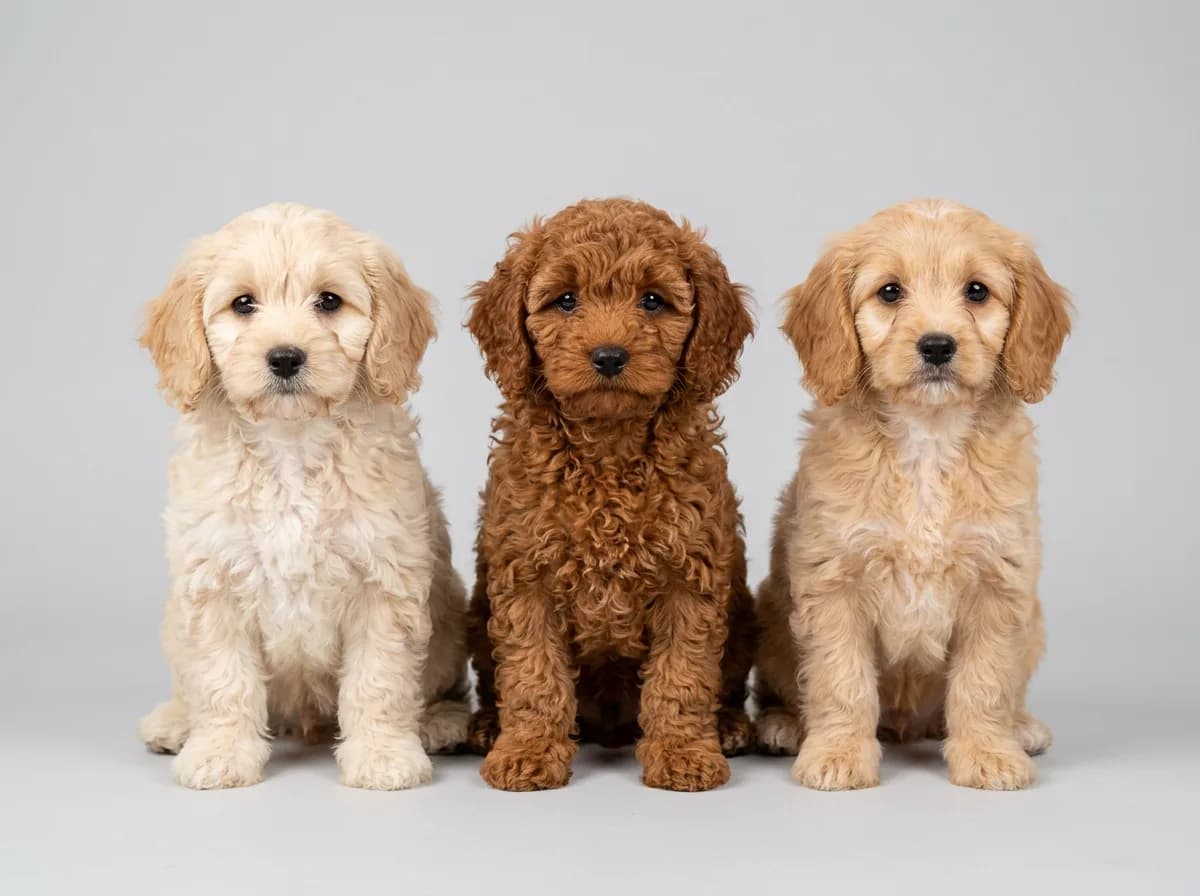
Straighter coats may shed more, while curlier coats can trap loose hair and mat easily. Wavy coats fall between those extremes and are often associated with the classic Cavapoo “teddy bear” look.
Coat texture should be considered a practical care trait. The best coat for you is the one whose brushing, clipping, and shedding level you can manage consistently.
How Are Cavapoo Types Classified?
There is no single Cavapoo registry standard that turns these labels into separate breeds. Size comes mainly from the Poodle size and family line. F-codes describe generation. Coat and color describe appearance. A careful article or breeder should keep these categories separate rather than pretending every combination is its own breed.
Where Did Cavapoos Come From?
Cavapoos were created by crossing the affectionate Cavalier King Charles Spaniel with the intelligent Poodle. Their popularity grew because many families wanted a social companion in a smaller package with the possibility of a lower-shedding coat.
Because the cross can inherit different combinations from two parent breeds, variation is part of the Cavapoo. That is why adult relatives and documented health testing are especially useful when choosing a puppy.
How to Identify Different Types of Cavapoos
- Use the parents’ adult size to understand Toy, Miniature, or larger size expectations.
- Read the pedigree to verify F1, F1B, F2, or multigenerational claims.
- Look at coat texture separately from color.
- Remember that a puppy’s color may lighten and its coat may become curlier or looser with age.
- Do not identify generation from appearance alone.
- Treat unusual-color marketing as secondary to health and temperament.
Practical Care Tips for Cavapoo Owners
- Brush consistently, especially behind the ears, under the collar, in the armpits, and on the legs.
- Use positive-reinforcement training and teach short periods of calm independence.
- Provide daily walks, sniffing, play, and problem-solving activities.
- Dry ears after bathing or swimming and seek veterinary advice for persistent odor or irritation.
- Start tooth brushing, nail handling, and grooming practice in puppyhood.
Health, Breeding, and Responsible Ownership Notes
Cavalier King Charles Spaniels and Poodles each have inherited conditions that responsible breeders screen for. Ask for documented testing appropriate to the exact parents, not a generic promise that the puppies are healthy.
Avoid claims that a generation is guaranteed hypoallergenic or that a rare color is automatically more valuable. A good breeder prioritizes health, stable temperament, sound structure, and lifetime support.
Fun Facts About Cavapoos
- Cavapoo and Cavoodle refer to the same cross in many contexts.
- One litter can contain different coat textures.
- F1 indicates ancestry, not a perfectly half-and-half appearance.
- Many red and apricot coats lighten with age.
- Curly coats can hide mats close to the skin.
- Toy and Miniature labels are more useful when paired with parent sizes.
- Cavalier ancestry can contribute a very people-oriented temperament.
- Poodle ancestry contributes broad coat-color possibilities.
- No coat color predicts a better temperament.
- A Cavapoo can be Toy-sized, F1B, curly-coated, and tricolor all at once.
Final Thoughts on Types of Cavapoos
Understanding types of Cavapoos is easiest when you separate size, generation, coat, and color. Those labels can help you ask better questions, but they should never replace health testing, temperament evaluation, and a realistic plan for grooming and exercise.
Choose the dog that fits your household rather than chasing a trendy generation or rare color.
Frequently Asked Questions
1. How many types of Cavapoos are there?
There is no official fixed number. Cavapoos are commonly grouped by size, generation, coat type, color, and pattern rather than by separate standardized breeds.
2. What are the main Cavapoo sizes?
Toy and Miniature are the most common labels, with some breeders also using Standard or larger Cavapoo for bigger lines.
3. What does F1 Cavapoo mean?
It means a first-generation Cavalier King Charles Spaniel and Poodle cross.
4. What does F1B Cavapoo mean?
It means an F1 Cavapoo has been backcrossed to one of the parent breeds, most commonly a Poodle.
5. What is an F1BB Cavapoo?
It is typically an F1B Cavapoo backcrossed again to a Poodle.
6. What is an F2 Cavapoo?
An F2 is commonly the result of breeding two F1 Cavapoos.
7. What is a multigenerational Cavapoo?
It is a Cavapoo from established lines containing multiple generations of Cavapoo ancestry.
8. Which Cavapoo generation is most Poodle-like?
Backcross generations such as F1B or F1BB may have more Poodle ancestry when the backcross is to a Poodle, but individual traits still vary.
9. Which Cavapoo sheds the least?
Curly, Poodle-influenced coats often shed less visibly, but no generation is guaranteed non-shedding.
10. Are Cavapoos hypoallergenic?
No dog can be guaranteed hypoallergenic. Some Cavapoos may be easier for some allergy-sensitive people, but reactions vary.
11. What coat types do Cavapoos have?
Common textures are straight or silky, wavy, and curly.
12. Do Cavapoo coats change as they grow?
Yes. Texture and color can change as the puppy coat is replaced by the adult coat.
13. Do Cavapoos fade in color?
Many do, especially dogs inheriting Poodle fading genes. Red or apricot puppies may become lighter with age.
14. What colors do Cavapoos come in?
Common colors include apricot, red, cream, gold, black, chocolate, white, Blenheim-like chestnut and white, black and white, tricolor, phantom, and sable.
15. Is merle a standard Cavapoo color?
Merle can occur in some marketed lines, but buyers should ask where the gene entered the pedigree and whether responsible genetic testing was performed.
16. What is a Blenheim Cavapoo?
It is a Cavapoo with chestnut-and-white coloring reminiscent of the Blenheim pattern in Cavalier King Charles Spaniels.
17. Are Cavapoos good apartment dogs?
Many are, as long as they get regular exercise, mental stimulation, training, and social time.
18. How much exercise does a Cavapoo need?
Most need daily activity, but the amount varies with age, size, health, and individual energy.
19. Are Cavapoos easy to train?
They are often intelligent and people-focused, but they still need consistent reward-based training and early socialization.
20. Do Cavapoos bark a lot?
Some are quiet and others are alert barkers. Genetics, socialization, environment, and training all influence vocal behavior.
21. Are Cavapoos good with children?
Many can be excellent family companions when matched appropriately and when children are taught respectful handling.
22. Can Cavapoos live with cats?
Yes, many can, especially with careful introductions and good impulse control.
23. How often should a Cavapoo be brushed?
Several times per week is common, with curly coats often needing more frequent line brushing.
24. How often should a Cavapoo be groomed?
Many owners use a professional grooming schedule of roughly six to eight weeks, adjusted for coat length and home maintenance.
25. Do Cavapoos need ear care?
Yes. Their floppy ears can retain moisture, so regular checks and careful drying after bathing or swimming are useful.
26. What health testing should Cavapoo breeders do?
Testing should address inherited risks in both Cavalier King Charles Spaniels and Poodles, including cardiac, eye, orthopedic, and relevant DNA screening based on the parents used.
27. Is F1 healthier than F1B?
A generation label alone cannot determine health. Parent health, genetic diversity, screening, structure, and breeder selection are more important.
28. Which Cavapoo type is best for allergies?
There is no guaranteed allergy-safe type. A curly backcross may shed less, but an allergy-sensitive person should spend time with similar adult dogs before deciding.
29. What is the difference between a Cavapoo and Cockapoo?
A Cavapoo combines Cavalier King Charles Spaniel and Poodle ancestry; a Cockapoo combines Cocker Spaniel and Poodle ancestry.
30. What is the best type of Cavapoo for a first-time owner?
The best match is a healthy, well-socialized dog whose size, grooming needs, activity level, and temperament fit the household.
Read more:
12 Types of Ragdoll Cats: Colors & Patterns Guide