

People searching for types of Cockapoos are usually trying to understand four different things at once: size, generation, coat texture, and color. Cockapoos are a Cocker Spaniel–Poodle cross, so these labels describe practical variations within the cross rather than separate recognized breeds.
This guide separates the terminology into clear groups, explains what labels such as F1 and F1B actually mean, and shows which differences matter most for grooming, exercise, training, and family life. It also points out where marketing terms such as “teacup” can be misleading.
What Are the Main Types of Cockapoos?
The most useful way to classify Cockapoos is by size (Teacup/Micro, Toy, Miniature, and Standard/Maxi), generation (F1, F1B, F1BB, F2, F2B, F3, and multigenerational), and coat type (straighter, wavy, or curly). These categories overlap, so a dog can be a Miniature F1B Cockapoo with a curly apricot coat at the same time.
No major all-breed registry treats each of these labels as a separate Cockapoo breed. Use the labels as a guide to ancestry and appearance, then evaluate the individual dog.
Cockapoo Types at a Glance
| Category | Type | What It Usually Describes | Key Owner Consideration |
|---|---|---|---|
| Size | Toy | Small Poodle-influenced size | Compact but still active |
| Size | Miniature | Common medium-small size | Versatile family companion |
| Size | Standard/Maxi | Largest common size | More space and exercise capacity |
| Generation | F1 | Cocker Spaniel × Poodle | More first-cross variation |
| Generation | F1B | F1 backcross, usually to Poodle | Often curlier coat |
| Generation | F2/Multigen | Cockapoo-to-Cockapoo lineage | Traits depend on breeding program |
| Coat | Wavy/Curly/Straighter | Texture and grooming needs | Matting and shedding differ |
1. Teacup or Micro Cockapoo
“Teacup” and “micro” are marketing labels rather than universally standardized Cockapoo size classes. They usually describe exceptionally small dogs produced from very small Toy Poodle lines and small Cocker Spaniels or already-small Cockapoos. Because the label has no single registry definition, adult size can vary considerably from breeder to breeder.
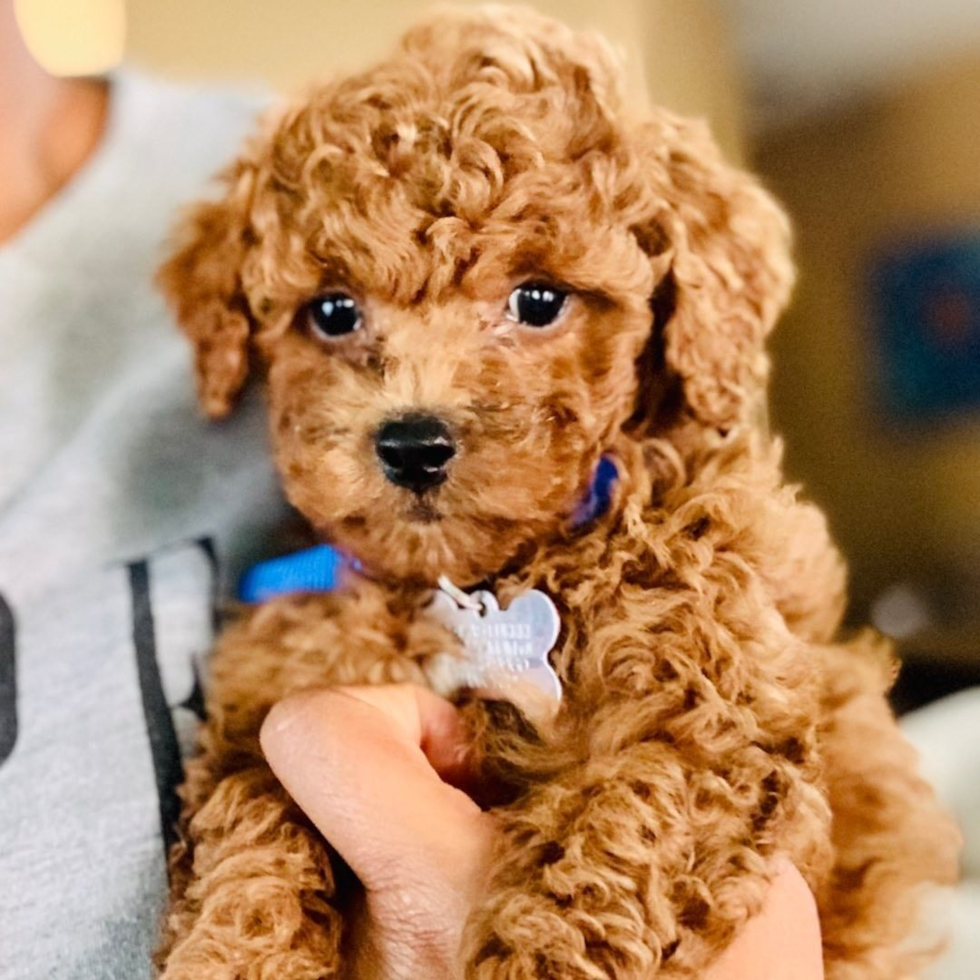
For buyers, the important point is not the label but the actual size, health history, and mature weights of the parents. Very small dogs can be more vulnerable to injury and may need extra care around stairs, young children, rough play, cold weather, and long outdoor adventures. A responsible breeder should discuss realistic adult-size ranges instead of promising an exact tiny weight.
A tiny Cockapoo can still be energetic, clever, social, and grooming-intensive. Small size does not remove the need for training, exercise, coat maintenance, dental care, and regular veterinary checks.
- Treat “teacup” as a descriptive sales term, not a formal breed category.
- Ask for parent weights and health testing rather than relying on a size label.
- Choose safe harnesses and avoid high-impact jumping for very small dogs.
2. Toy Cockapoo
Toy Cockapoos are generally produced using a Toy Poodle in the family line. They are among the smallest commonly discussed Cockapoo sizes and are often chosen by people living in apartments or wanting a compact companion. Their exact adult height and weight are not guaranteed because Cockapoos are crossbred dogs and can inherit size genes from either side.

Toy Cockapoos often have the same broad Cockapoo look as larger individuals: floppy ears, expressive eyes, and a coat that may be loose and wavy or more tightly curled. They still need daily walks, play, and mental work. A small body does not mean a low-energy dog.
When comparing Toy Cockapoos, focus on temperament and structure as much as size. A well-socialized puppy with healthy parents is a better long-term choice than simply selecting the smallest puppy in a litter.
3. Miniature Cockapoo
The Miniature Cockapoo is one of the most common and practical size categories. It usually comes from a Miniature Poodle crossed with a Cocker Spaniel, although later-generation Mini Cockapoos may have two Cockapoo parents. This size often provides a middle ground between easy portability and enough sturdiness for active family life.
Mini Cockapoos are frequently lively, people-oriented, and highly trainable. They can suit walking, light hiking, games, beginner trick training, and family activities when conditioned appropriately. Their spaniel ancestry may also contribute enthusiasm for scent work and exploring outdoors.
Coat maintenance varies with genetics. Wavier coats may shed somewhat more, while curlier coats may trap loose hair but mat more readily. Regular brushing and professional grooming are important regardless of generation.
4. Standard or Maxi Cockapoo
Standard, Maxi, or large Cockapoo generally refers to the largest commonly bred size range, often influenced by a Standard Poodle or a larger Cockapoo line. The terms are not standardized across all breeders, so one breeder’s “Maxi” may overlap another breeder’s “Standard.”
:max_bytes(150000):strip_icc()/cockapoo-red-colored-greenery-223686877-2000-08327a0071b54ddf84c7960069d56d95.jpg)
These dogs can be a good fit for people who want the Cockapoo temperament in a more substantial body. They may have more endurance for longer walks and outdoor activity, but they also require more space, food, grooming time, and physical management than a Toy-sized dog.
Owners should still avoid assuming that size predicts personality. Energy, confidence, prey interest, sociability, and trainability vary by individual and by the traits inherited from the Cocker Spaniel and Poodle families.
5. F1 Cockapoo
An F1 Cockapoo is a first-generation cross between a Cocker Spaniel and a Poodle. In pedigree terms, it is the most direct form of the cross. The puppies inherit genetic material from both parent breeds, but that does not mean every visible trait lands at an exact halfway point.
F1 puppies can vary in coat texture, shedding, size, muzzle shape, ear set, and overall build. Some look more spaniel-like, while others look more poodle-like. This variation is normal in a first-generation cross.
For families choosing an F1, it is useful to meet or study both parents and ask about coat, temperament, orthopedic screening, eye health, and other tests relevant to the parent breeds. Generation labels describe ancestry; they do not guarantee a particular personality or allergy response.
6. F1B Cockapoo
An F1B Cockapoo is a backcross. Most often, an F1 Cockapoo is bred back to a Poodle, although the “B” technically indicates a backcross and breeders should state which parent breed was used. When the backcross is to a Poodle, puppies often have a higher chance of inheriting a curlier, lower-shedding coat.
Lower shedding does not mean allergy-proof. Dog allergens are found in dander, saliva, and other secretions, so no Cockapoo generation can be honestly guaranteed to be hypoallergenic for every person. People with allergies should spend time around similar adult dogs before committing.
F1B coats commonly require consistent brushing and clipping because curls can tangle close to the skin. Grooming needs should be considered before choosing this generation for cosmetic reasons alone.
7. F1BB Cockapoo
An F1BB Cockapoo is produced by backcrossing an F1B again, usually to a Poodle. The label is used to describe ancestry rather than a separate breed. With repeated Poodle backcrossing, coat traits may trend curlier, but individual puppies can still differ.
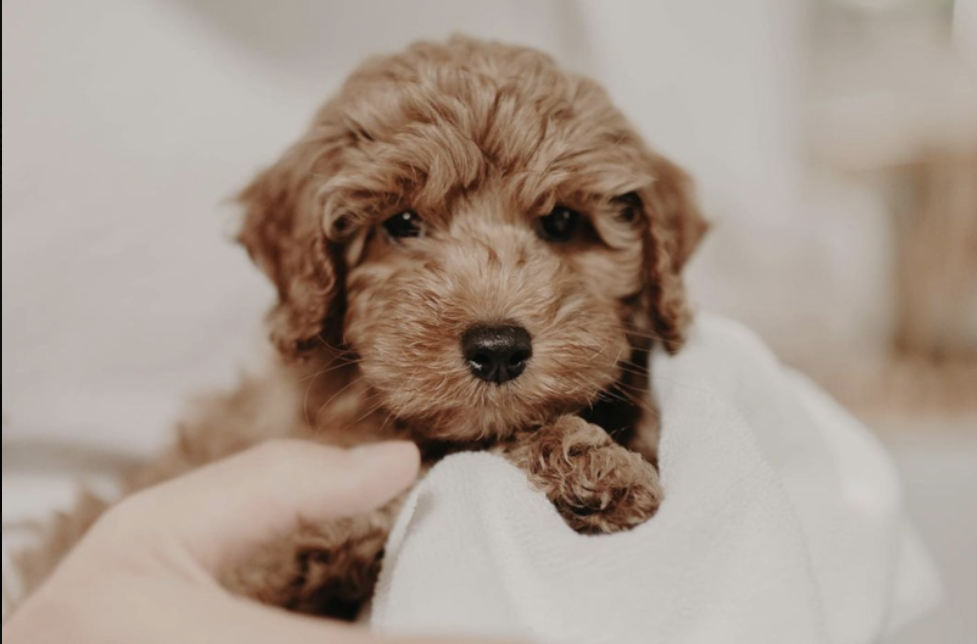
This generation is sometimes marketed to allergy-sensitive homes. That claim should be treated cautiously. A more Poodle-like coat may release less loose hair into the environment, yet allergen production is not eliminated. Grooming also becomes especially important because dense curls can conceal mats.
Prospective owners should ask the breeder for a clear family tree so the letters are not merely marketing shorthand. Health testing of the actual parents matters more than the generation name.
8. F2 Cockapoo
An F2 Cockapoo is typically the result of breeding two F1 Cockapoos. Because both parents already carry a mixture of Cocker Spaniel and Poodle genes, F2 litters can show broad variation in appearance and coat traits.
One puppy may be straighter-coated, another wavier, and another curlier. Shedding can also vary within the same litter. This is why photographs of one F2 Cockapoo should not be used as a promise for all F2 puppies.
An experienced breeder should evaluate coat, structure, temperament, and family health rather than selling F2 as automatically better or worse than F1 or F1B. For owners, the individual dog is more important than the label.
9. F2B Cockapoo
F2B is another backcross label used in multigenerational Cockapoo breeding. The exact parent combination can differ between programs, so buyers should ask for the pedigree instead of assuming a fixed percentage from the label alone.
Breeders may use F2B pairings to increase consistency in coat type, size, or other traits. However, genetics are not a simple visual formula, and percentages do not guarantee that a dog will behave or look a certain way.
If you are comparing F2B puppies, prioritize parent health testing, stable temperament, early socialization, and honest discussion of expected grooming and shedding.
10. Multigenerational Cockapoo
Multigenerational Cockapoos come from established Cockapoo lines rather than a simple first cross. Depending on the breeding program, both parents may be Cockapoos from several generations of selection. The goal is often greater predictability in size, coat, temperament, and overall type.
The term “multigen” still does not describe one universal genetic formula. Different breeders may use different generation thresholds and different parent combinations. A detailed pedigree is therefore more informative than the word alone.
Well-planned multigenerational breeding can select for desirable companion traits, but quality depends on the breeder’s health screening, record keeping, temperament selection, and willingness to avoid exaggerated features.
11. Wavy, Curly, and Straighter-Coated Cockapoos
Coat texture is one of the most noticeable ways owners informally divide Cockapoos. Wavy “fleece” coats are common and create the classic teddy-bear appearance. Curly coats often show stronger Poodle influence, while straighter or looser coats may resemble the Cocker Spaniel side more closely.
Coat texture affects grooming more reliably than it predicts personality. Curly coats can mat quickly and may need frequent line brushing and regular clipping. Straighter coats may release more loose hair but can still tangle around the ears, armpits, collar area, and legs.
Puppy coat is not always a perfect guide to the adult coat. Ask how related adult dogs developed and choose a grooming routine that fits the coat your dog actually grows rather than the coat you hoped for.
How Are Cockapoo Types Classified?
Cockapoo classification is informal and breeder-dependent. Size labels come mainly from the Poodle size used in the family line. Generation labels describe ancestry. Coat and color labels describe visible traits rather than lineage. Because these systems overlap, a single Cockapoo may fit several labels at once.
- Size: Teacup/Micro, Toy, Miniature, Standard/Maxi.
- Generation: F1, F1B, F1BB, F2, F2B, later-generation or multigen.
- Coat: straighter, wavy, curly.
- Color/pattern: solid shades, parti, roan, and other inherited combinations.
Where Did Cockapoos Come From?
Cockapoos were developed as companion dogs by crossing Cocker Spaniels with Poodles. The cross has been bred for decades and is one of the older so-called designer-dog combinations. Because there is no single universal Cockapoo breed standard, appearance and size can vary more than in a long-established closed-studbook breed.
For modern owners, that history explains why breeder transparency matters. The words on an advertisement tell only part of the story; parent health, temperament, pedigree, and early socialization are more useful predictors of the dog you will live with.
How to Identify Different Types of Cockapoos
- Check adult size and the mature weights of the parents instead of relying only on Toy, Mini, or Maxi labels.
- Read the pedigree to understand F1, F1B, F2, or multigenerational ancestry.
- Look at coat texture: straighter coats lie flatter, wavy coats form loose waves, and curly coats form tighter curls.
- Do not use color alone to identify generation or size.
- Expect puppy coats to change as adult coat develops.
- Confirm that “teacup” and similar labels are explained with realistic measurements rather than guaranteed tiny weights.
Practical Care Tips for Cockapoo Owners
Cockapoos are companion dogs with sporting and poodle ancestry, so most do best with a combination of physical exercise, training, sniffing, and social time. Grooming is a major ownership task. Ears, armpits, legs, tail, and collar areas are common matting zones, especially in curlier coats.
- Brush to the skin, not only over the top layer of coat.
- Keep ears dry and clean after swimming or bathing.
- Use reward-based training and begin handling practice early.
- Choose exercise that matches age and body size; puppies should not be pushed into repetitive high-impact work.
- Maintain dental care, nail care, parasite prevention, and regular veterinary checks.
Health, Breeding, and Responsible Ownership Notes
A generation label is not a health certificate. Responsible breeding requires screening that reflects risks found in both parent breeds and in the exact Poodle size used. Ask to see documented results rather than relying on phrases such as “vet checked.”
Avoid breeders who guarantee that a puppy will be completely allergy-free, promise an exact adult size from a marketing label, or select only for unusual color. Temperament, structure, genetic diversity, and health should come first.
Fun Facts About Cockapoos
- A Cockapoo can fit several “type” labels at once.
- The same litter can contain noticeably different coat textures.
- F1 does not mean every trait is exactly 50/50 in appearance.
- Curlier coats may shed less visibly but can mat more easily.
- Cocker Spaniel ancestry can contribute a strong interest in scents and retrieving.
- Poodle ancestry often contributes trainability and a wide range of coat colors.
- Cockapoo puppy color may lighten as the dog matures.
- “Teacup” is not a universally standardized breed size.
- Ear care is important because floppy ears can trap moisture.
- Individual temperament matters more than coat color or generation label.
Final Thoughts on Types of Cockapoos
The easiest way to understand types of Cockapoos is to separate size, generation, coat, and color instead of treating every label as a different breed. For most families, adult size, temperament, health testing, exercise needs, and grooming commitment are more important than chasing a specific generation code.
Choose the individual dog and breeder carefully, and use the terminology as a practical guide rather than a guarantee.
Frequently Asked Questions
1. How many types of Cockapoos are there?
There is no single official number because Cockapoo is a crossbred dog rather than a breed divided into standardized varieties. Owners commonly describe Cockapoos by size, generation, coat texture, and color.
2. What are the four common Cockapoo sizes?
Common labels are Teacup or Micro, Toy, Miniature, and Standard or Maxi. These terms are not universally standardized, so always compare the actual mature sizes of the parents.
3. What is the most common Cockapoo size?
Miniature Cockapoos are very common because Miniature Poodles are frequently used in Cockapoo breeding. Availability varies by region and breeder.
4. What does F1 Cockapoo mean?
F1 means a first-generation cross between a Cocker Spaniel and a Poodle.
5. What does F1B Cockapoo mean?
F1B means a first-generation Cockapoo has been backcrossed to one of the parent breeds, most commonly a Poodle.
6. Is an F1B Cockapoo always 75% Poodle?
That is the common expectation when an F1 is backcrossed to a purebred Poodle, but breeders should still show the actual pedigree. The letter B only tells you that a backcross occurred.
7. What is an F1BB Cockapoo?
It is typically an F1B Cockapoo backcrossed again, usually to a Poodle. The label describes ancestry, not a separate breed.
8. What is an F2 Cockapoo?
An F2 is commonly produced by breeding two F1 Cockapoos. Coat and appearance may be quite variable within the litter.
9. What is a multigenerational Cockapoo?
A multigenerational Cockapoo comes from Cockapoo lines beyond the simple first cross. The exact definition varies among breeding programs.
10. Which Cockapoo generation sheds the least?
Poodle-backcross generations often have a higher chance of curly, lower-shedding coats, but shedding cannot be guaranteed from generation alone.
11. Are Cockapoos hypoallergenic?
No dog is guaranteed hypoallergenic. Some Cockapoos shed less, but allergens also come from dander and saliva.
12. Which Cockapoo coat is easiest to maintain?
No coat is maintenance-free. Looser coats may be easier to brush but can shed more, while curly coats often shed less visibly but mat more easily.
13. How often should a Cockapoo be brushed?
Many Cockapoos benefit from brushing several times per week, and curlier coats may need near-daily attention in high-friction areas.
14. How often does a Cockapoo need professional grooming?
Many owners schedule grooming roughly every six to eight weeks, but the ideal interval depends on coat length, texture, lifestyle, and home brushing.
15. Do Cockapoo colors fade?
Some Cockapoos lighten as they mature, especially when they inherit fading genes from Poodle lines. Puppy color is not always the final adult shade.
16. What colors do Cockapoos come in?
Common colors include cream, buff, apricot, red, black, chocolate, parti, roan, and other combinations inherited from Cocker Spaniel and Poodle lines.
17. Is merle a normal Cockapoo color?
Merle can appear in some lines, but it is not a traditional color of the two core parent breeds in every registry context. Buyers should ask exactly where the merle gene entered the pedigree and whether appropriate genetic testing was done.
18. Are Toy Cockapoos good apartment dogs?
They can be, provided they receive daily exercise, training, enrichment, and companionship. Small size does not mean low activity.
19. Are Standard Cockapoos good for hiking?
Healthy adult Standard or Maxi Cockapoos can be active companions when gradually conditioned, but fitness, weather, terrain, and individual health matter more than size label.
20. Are Cockapoos good with children?
Many are friendly family dogs, but temperament varies. Supervision, respectful handling, training, and matching dog size to the household are important.
21. Do Cockapoos need much exercise?
Most need daily walks plus play and mental enrichment. Exact needs depend on age, health, size, and inherited temperament.
22. Are Cockapoos easy to train?
They are often responsive and people-focused, but consistency and reward-based training are still necessary. Adolescents can be energetic and distractible.
23. Do Cockapoos have a strong prey drive?
Some do, especially if they inherit sporting-dog traits from the Cocker Spaniel side. Early recall training and safe leash management are useful.
24. What health tests should Cockapoo breeders do?
Testing should reflect risks in both Cocker Spaniels and Poodles. Ask for documented orthopedic, eye, and relevant DNA screening appropriate to the exact parent breeds and sizes.
25. Is a smaller Cockapoo healthier?
Not necessarily. Health depends on genetics, structure, breeding decisions, nutrition, veterinary care, and lifestyle, not simply body size.
26. Should I choose a Cockapoo by generation?
Generation can help explain ancestry and possible coat tendencies, but health, temperament, breeder practices, and the individual puppy should carry more weight.
27. Can Cockapoos swim?
Many enjoy water, but ability and confidence vary. Use supervision and a canine life jacket around deep or moving water.
28. Can Cockapoos live with cats?
Many can when introductions are gradual and the dog has appropriate impulse control. Individual prey drive matters.
29. What is the difference between a Cockapoo and a Cavapoo?
A Cockapoo combines Cocker Spaniel and Poodle ancestry, while a Cavapoo combines Cavalier King Charles Spaniel and Poodle ancestry.
30. What is the best type of Cockapoo for a first-time owner?
There is no single best type. Choose a healthy, well-socialized individual whose adult size, energy level, grooming needs, and temperament fit your household.
SEO Title
Meta Description
Suggested URL Slug
types-of-cockapoos