

Searching for different types of meerkats can be confusing because photos often make local populations look like separate species. In modern zoological classification, however, every living meerkat belongs to one species, Suricata suricatta. That species is commonly divided into three recognized subspecies: S. s. suricatta, S. s. majoriae, and S. s. iona.
This guide explains where the three types occur, what is known about their appearance and habitat, and why location is usually more useful than coat color for identifying them. It also covers meerkat behavior, diet, field observation, conservation, and the differences between meerkats and similar southern African mammals.
What Are the Main Types of Meerkats?
There is one living meerkat species and three commonly recognized geographic subspecies. The nominate southern form, Suricata suricatta suricatta, has the broadest familiar range; S. s. majoriae is associated mainly with central and northwestern Namibia; and S. s. iona is known from southwestern Angola. Their boundaries and subtle physical differences are not always easy to determine in the field, so range is the most practical starting point for identification.
| Type | Taxonomic rank | Main reported range | Best identification clue |
|---|---|---|---|
| Southern African meerkat | Suricata suricatta suricatta | South Africa, southern Namibia, and southern Botswana | Geographic location within the southern part of the species’ range |
| Namibian meerkat | Suricata suricatta majoriae | Central and northwestern Namibia | Location in the drier western and northwestern Namibian range |
| Iona meerkat | Suricata suricatta iona | Southwestern Angola | Location near the northern limit of the meerkat’s distribution |
Taxonomy note: Subspecies are regional populations within the same species, not separate species. Scientific treatments may change as researchers compare more specimens and genetic data, so field guides and databases do not always present subspecies in exactly the same way.
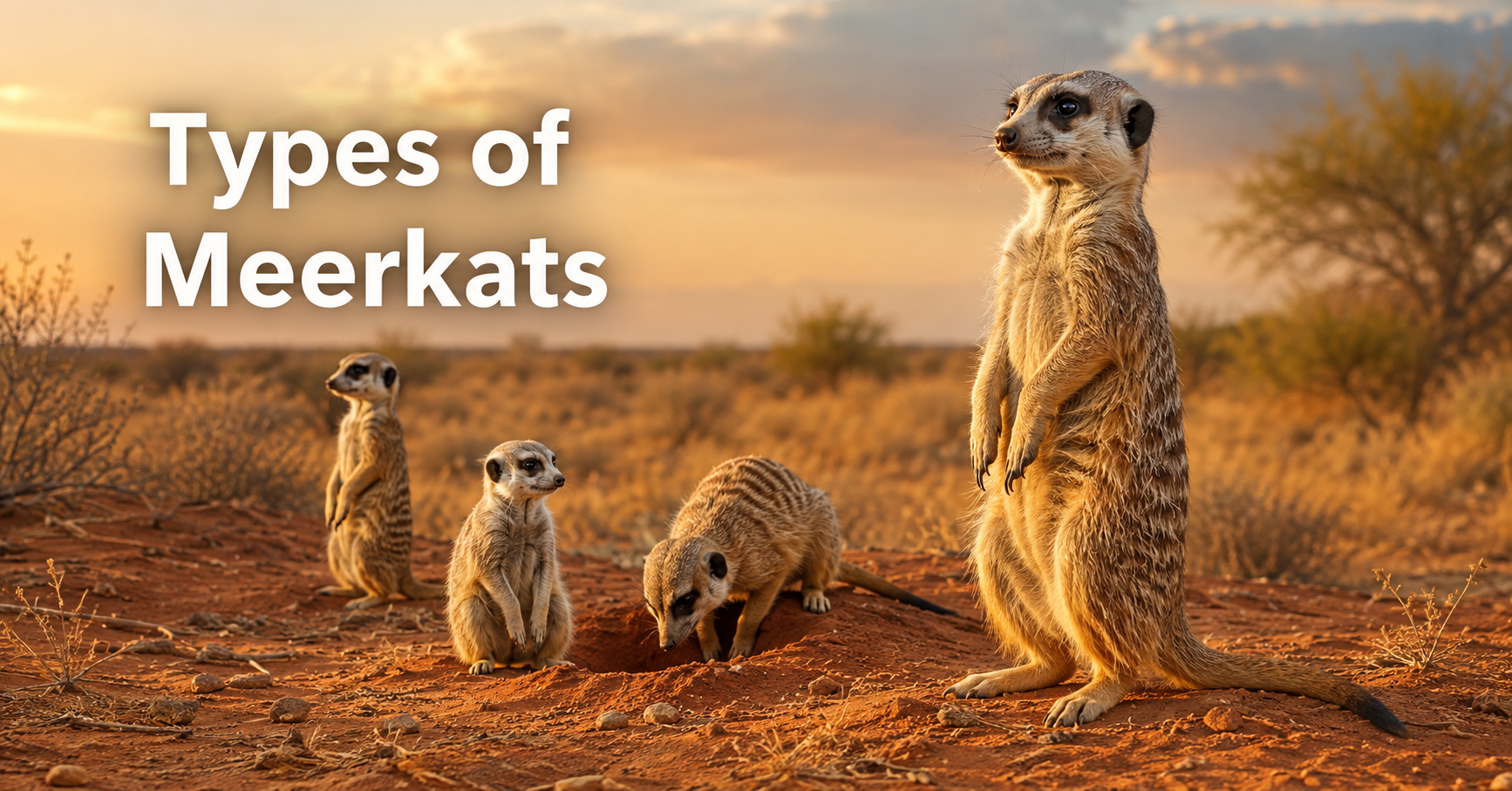
1. Southern African Meerkat
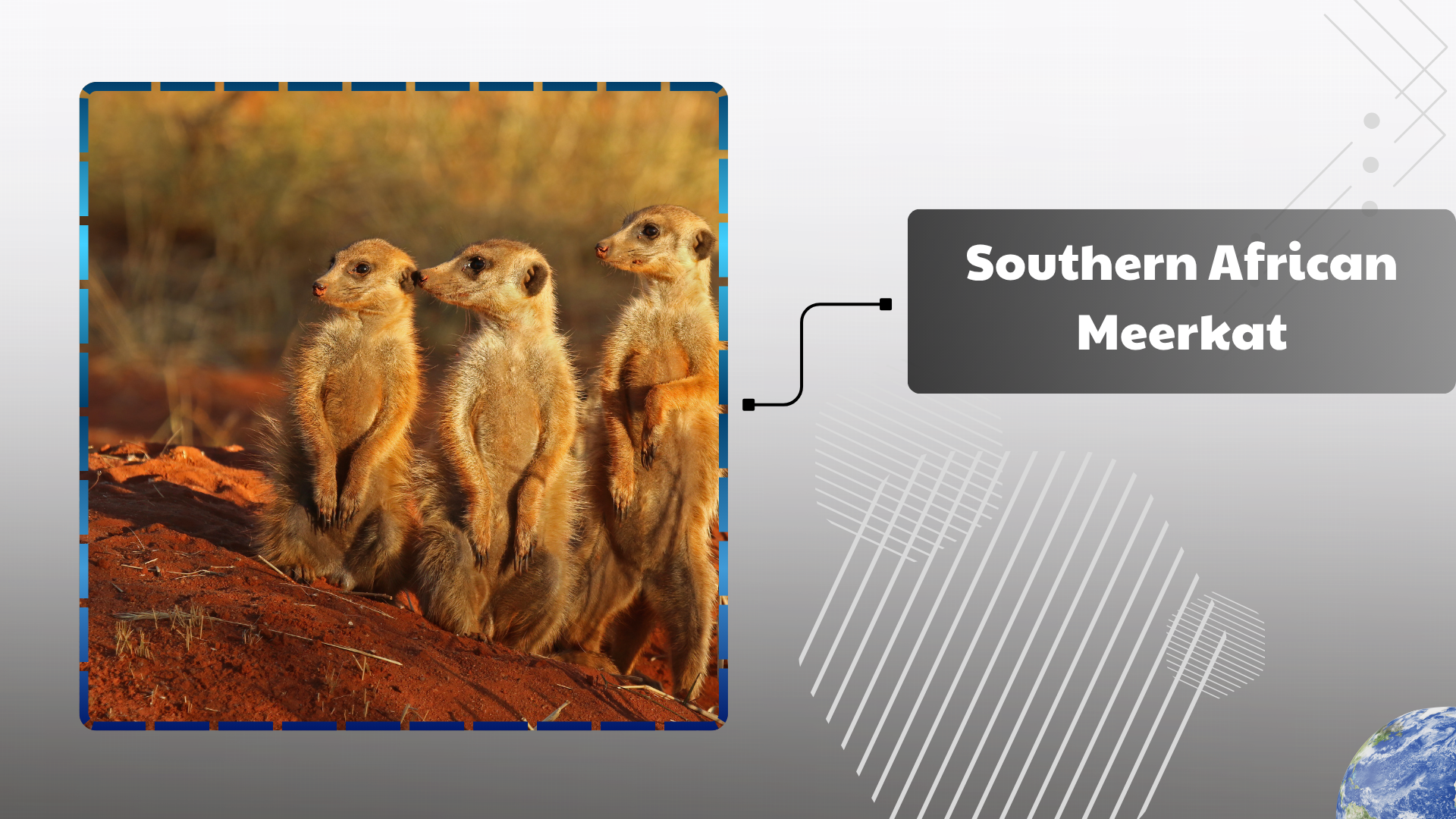
Scientific name: Suricata suricatta suricatta
The southern African meerkat is the nominate subspecies, meaning it carries the same subspecies name as the species. It occurs across much of the southern portion of the meerkat’s range, including South Africa and parts of southern Namibia and southern Botswana. Many well-known images and long-term behavioral studies of Kalahari meerkats concern populations within this broad southern region.
Like all meerkats, it has a slim body, pointed muzzle, small rounded ears, long digging claws, dark eye patches, and a narrow tail with a dark tip. The coat is usually grayish, buff, tan, or brown with darker bands across the back. Color can vary with the individual, age, lighting, dust, and local soil, so a slightly paler or darker coat is not enough to confirm a subspecies.
This meerkat is adapted to dry, open country such as short-grass plains, semiarid scrub, savanna, and stony areas near dry watercourses. It avoids dense forest and is not strictly an animal of bare, shifting desert. A mob depends on a network of burrows and smaller refuge holes, which provide shelter from predators and extreme temperatures.
During the day, group members forage for beetles, larvae, termites, spiders, scorpions, centipedes, and other invertebrates. They may also take lizards, small snakes, eggs, and occasional plant material. One or more animals may pause in an upright position to scan for danger while others search the soil. Different alarm calls can prompt the group to watch, freeze, gather, or rush toward cover.
The southern African form is the type most travelers are likely to encounter at established meerkat-viewing destinations in South Africa or Botswana. Responsible identification should combine a confirmed location with photographs, notes on habitat, and advice from a knowledgeable local guide rather than relying on coat shade alone.
2. Namibian Meerkat
Scientific name: Suricata suricatta majoriae
Suricata suricatta majoriae is the regional form associated mainly with central and northwestern Namibia. Its scientific name is sometimes misspelled as marjoriae in secondary material. For wildlife learners, the important point is that this is a subspecies of the meerkat, not a second full species of Suricata.
The Namibian meerkat follows the familiar meerkat body plan: a low, elongated body for moving close to the ground; strong forelimbs and claws for opening compact soil; dark skin and fur around the eyes; and a long, non-bushy, black-tipped tail used for balance. Descriptions of regional forms may mention differences in build or pelage, but these traits can overlap. Dust, seasonal coat condition, distance, and harsh light make visual separation particularly unreliable.
Its reported range includes very dry landscapes, but meerkats still need ground suitable for burrowing and enough prey to support a social group. They are most useful to search for in open plains, sparse scrub, gravelly country, and dry drainage systems rather than in dune fields without stable den sites. Burrows moderate temperature and give the animals multiple escape routes.
Daily life revolves around cooperative group behavior. The mob emerges after daylight, warms up when conditions are cool, and spreads out to forage while maintaining contact through calls. Individuals dig rapidly when they detect underground prey. Adults and helpers also guard and feed pups, although competition within a group can be intense and the dominant breeding female usually has the greatest reproductive success.
For a field identification, record precise location first. Then photograph the entire animal, back pattern, head, and tail without approaching the den. A sighting in the expected Namibian range can support a tentative subspecies identification, but a photograph alone rarely proves it. Researchers may need specimen measurements, range records, or genetic evidence to draw a firm boundary between neighboring populations.
3. Iona Meerkat
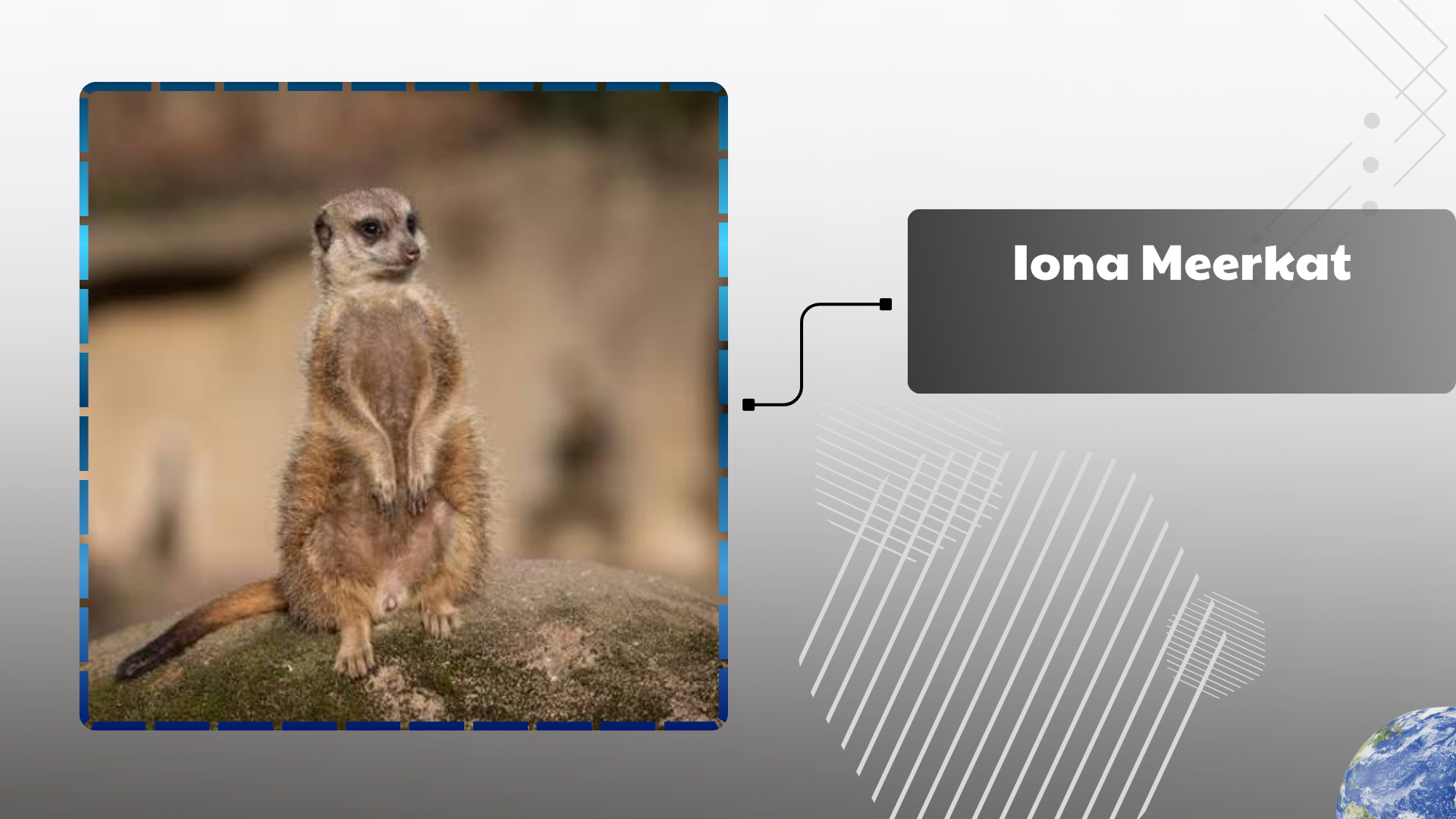
Scientific name: Suricata suricatta iona
The Iona meerkat is the northernmost of the three commonly listed subspecies. It was named from southwestern Angola and is associated particularly with the arid landscapes around the region of Iona. This limited geographic association makes it interesting to biogeographers, but it should not be presented as a completely different kind of animal with unique behavior or care needs.
An Iona meerkat still shows the key features of Suricata suricatta: dark eye patches, a pointed face, short rounded ears, strong front claws, faint to distinct dark bars across the rear back, and a slender dark-tipped tail. Its sandy coat helps it blend into open ground. As with the other forms, there is enough natural variation that color should be treated as supporting information rather than a diagnostic test.
Southwestern Angola includes dry plains, rocky ground, sparse vegetation, and desert-edge environments. Within such a landscape, meerkats favor places that provide workable soil, food, visibility, and safe burrow sites. They forage during the day and reduce exposure to temperature extremes by using underground chambers and adjusting their above-ground activity.
The same social system seen elsewhere is expected: a mob occupies a home range, sleeps communally, cooperates in pup care, and responds to predators through vigilance and alarm calls. Likely threats include raptors and terrestrial carnivores, while encounters between rival meerkat groups may also be dangerous. Their diet is dominated by animal prey found in or on the soil, especially insects and other arthropods.
Identifying S. s. iona responsibly requires reliable locality information from southwestern Angola. Online photographs are frequently reposted with incorrect captions, and zoo meerkats may have incomplete or mixed ancestry records. For this reason, location-backed observations and museum or research records are more dependable than image comparison.
How Are These Wild Animals Classified?
| Rank | Classification | What it means |
|---|---|---|
| Kingdom | Animalia | Meerkats are animals. |
| Phylum | Chordata | They are vertebrates with a spinal column. |
| Class | Mammalia | They have hair and females nurse their young. |
| Order | Carnivora | They belong to the carnivoran mammal lineage, even though their diet is varied. |
| Family | Herpestidae | They are mongooses, not cats or rodents. |
| Genus | Suricata | The meerkat is the only living species in this genus. |
| Species | Suricata suricatta | All living meerkats belong to this species. |
The three types in this guide sit below the species level. A subspecies is a named geographic population that shows taxonomic distinction while remaining part of the same species. All three meerkat subspecies share the core anatomy, ecology, and social behavior of Suricata suricatta.
Where Do Meerkats Live?
Wild meerkats occur in southern Africa, with their core distribution covering parts of South Africa, Namibia, Botswana, and southwestern Angola. Range maps sometimes differ at the margins because confirmed records are uneven and political borders do not define natural habitat.
Suitable meerkat country is generally arid or semiarid, open, and sparsely wooded. Common settings include short-grass plains, savanna, Karoo vegetation, scrub, stony ground, and the edges of dry river channels. Meerkats need soil they can excavate, open sightlines for detecting danger, and enough invertebrate prey. They are often called desert animals, but they are absent from some true desert, forest, and high mountain environments.
A large communal burrow can contain several entrances and connected chambers. Mobs may also use temporary refuge holes while foraging. The underground environment changes temperature more slowly than the surface, allowing the animals to avoid intense daytime heat and cold nights.
How to Identify Different Types of Meerkats
First confirm that the animal is a meerkat. Then use its geographic location to make a cautious subspecies identification. Visual differences between the three forms are subtle, variable, and not well suited to quick identification from a single photograph.
- Shape: Look for a slim, elongated body, pointed muzzle, long legs, and a narrow rather than bushy tail.
- Eyes: Meerkats have conspicuous dark patches around the eyes, which also reduce glare.
- Back pattern: Darker, irregular transverse bands usually cross the rear half of the back.
- Tail: The tail is long, slender, and normally dark at the tip.
- Claws: Long, curved front claws are adapted for digging.
- Size: Adults are small mongooses, with a head-and-body length commonly around 25 to 35 centimeters and a substantial additional tail length.
- Posture: A vigilant meerkat often stands upright on its hind legs, but posture alone is not diagnostic.
- Habitat: Expect open, dry terrain with stable ground for burrows rather than dense forest.
- Behavior: Groups forage on the ground, dig frequently, maintain vocal contact, and use sentinels.
- Range: Use South Africa, Botswana, Namibia, or southwestern Angola locality data to narrow the likely subspecies.
Meerkat vs. Yellow Mongoose
A yellow mongoose usually has a fuller, bushier tail and lacks the meerkat’s strongly marked eye patches and upright sentinel silhouette. Color is not a perfect test because both animals can appear sandy or reddish in bright light.
Meerkat vs. Banded Mongoose
Banded mongooses are larger and heavier, with a broader face and a more robust body. Their dark back bands are typically bolder, and they carry a bushier tail. Meerkats look slimmer and higher-legged.
Meerkat vs. Cape Ground Squirrel
The Cape ground squirrel is a rodent with a large, bushy tail and a conspicuous pale side stripe. A meerkat has a narrow dark-tipped tail, dark eye patches, and the pointed head of a small mongoose.
Meerkat Diet and Foraging Behavior
Meerkats are carnivorans that feed mainly on insects and other small prey. Beetles, grubs, termites, spiders, centipedes, millipedes, and scorpions can all be important. They also eat small reptiles, eggs, and occasional plant matter when available. The exact diet changes with season, rainfall, habitat, and local prey abundance.
A foraging meerkat moves with its nose close to the ground and digs rapidly when it detects prey. Its ears can close to keep out soil. Although mobs cooperate in vigilance and pup care, individuals often defend food they have found. Young animals learn handling skills through experience and interactions with older group members.
Meerkat Social Life and Sentinel Behavior
Meerkats live in social groups called mobs, gangs, or clans. A group may contain several families and can reach around 30 members, although size varies widely. A dominant female commonly produces most of the pups, while other members help babysit, guard, and feed the young.
The famous sentinel is not a permanent job held by one special animal. Different individuals take turns climbing to an elevated spot and scanning while others forage. The guard uses distinct calls to maintain contact or signal danger. Group life is cooperative, but it is not always peaceful: competition for breeding status, eviction, infanticide, and violent encounters with rival mobs are documented parts of meerkat society.
Outdoor Tips for Finding and Observing Meerkats
- Visit a reputable reserve or join a guide who understands local wildlife-viewing rules.
- Search open ground near established burrow systems during the cooler morning hours.
- Stay quiet, move slowly, and allow the animals to choose the distance.
- Use binoculars or a telephoto lens instead of approaching a sentinel or den.
- Never block a burrow entrance or stand between a meerkat and its refuge.
- Do not feed, touch, call to, or imitate alarm calls around wild meerkats.
- Avoid den sites when pups are present unless viewing is managed by trained professionals.
- Record date, coordinates, habitat, group size, and behavior for a useful nature observation.
- Photograph identifying features from several angles without using disruptive flash at close range.
- Follow park regulations and the instructions of local conservation staff.
Safety, Sustainability, and Conservation Notes
The meerkat is globally assessed as Least Concern, and its overall population trend is considered stable. That status does not mean every local group is secure. Drought, changes in rainfall, prey shortages, disease, persecution during rabies-control campaigns, road traffic, and habitat disturbance can affect regional populations.
Wildlife tourism is most helpful when it keeps a respectful distance and supports protected areas or responsible local operators. Habituated animals should never be treated as tame. Meerkats can bite, may carry diseases transmissible to people or domestic animals, and can be stressed when visitors crowd a burrow.
Meerkats are also poor household pets. They are highly social, territorial wild carnivorans that dig, scent-mark, and may become aggressive. Keeping one alone cannot reproduce the complex life of a natural mob, and ownership may be restricted or illegal. Observe them in the wild or in accredited zoological institutions instead of supporting the exotic-pet trade.
Fun Facts About Meerkats
- Meerkats are mongooses, not cats.
- Suricata suricatta is the only living species in the genus Suricata.
- A group of meerkats is often called a mob, gang, or clan.
- The dark patches around their eyes help reduce the glare of strong sunlight.
- Their ears can close while they dig, helping keep soil out.
- Meerkats use different calls for social contact and different kinds of danger.
- Sentinel duty rotates among group members rather than belonging to one permanent guard.
- Burrows buffer the animals from rapid changes in surface temperature.
- Helpers may babysit and feed pups that are not their own.
- Despite their cooperative image, rival mobs can fight fiercely over territory.
Final Thoughts on Types of Meerkats
The most accurate answer to the question of how many types of meerkats exist is one living species with three commonly recognized subspecies: Suricata suricatta suricatta, S. s. majoriae, and S. s. iona. Their geography is clearer than their visual differences, so a reliable location matters more than minor variations in coat color. Wherever you observe them, focus on their dark eye patches, narrow black-tipped tail, digging claws, open-country habitat, and remarkable group behavior while maintaining an ethical distance.
Frequently Asked Questions
1. How many types of meerkats are there?
There is one living meerkat species, Suricata suricatta, with three commonly recognized subspecies. Some sources use “types” informally for different roles, ages, or populations, but those are not separate species.
2. What are the three meerkat subspecies?
They are Suricata suricatta suricatta, Suricata suricatta majoriae, and Suricata suricatta iona. They are primarily distinguished by their geographic distributions.
3. Are the three types separate species?
No. All three are regional forms within the single species Suricata suricatta, and they share the defining anatomy and behavior of meerkats.
4. What is the scientific name of a meerkat?
The scientific name is Suricata suricatta. The first word is the genus and the second identifies the species.
5. Is a meerkat a cat?
No. A meerkat is a member of the mongoose family, Herpestidae. Its common name is misleading because it is not closely related to domestic cats.
6. Where are meerkats found in the wild?
They are native to southern Africa, especially parts of South Africa, Namibia, Botswana, and southwestern Angola. Their distribution is associated with dry, open habitats suitable for burrowing.
7. Do meerkats live in the Sahara?
No. Wild meerkats occur much farther south in Africa. They are often described as desert animals, but they do not naturally inhabit the Sahara.
8. Do meerkats live only in deserts?
No. They occupy semiarid savanna, grassland, scrub, Karoo, open plains, and stony dry country as well as some desert-edge habitats. Stable soil, prey, and visibility are important.
9. How can I identify a meerkat?
Look for a small, slender mongoose with dark eye patches, a pointed snout, darker bands across the rear back, long front claws, and a narrow black-tipped tail. Its upright watch posture is also characteristic.
10. Can you identify a meerkat subspecies from a photo?
Usually not with confidence. Coat and body differences overlap, and lighting can be deceptive. A precise, reliable location is generally more informative than appearance alone.
11. What is the difference between a meerkat and a mongoose?
A meerkat is one particular kind of mongoose. “Mongoose” refers to a larger family containing many species with different sizes, coat patterns, habitats, and social systems.
12. What is the difference between a meerkat and a yellow mongoose?
A yellow mongoose generally has a bushier tail and lacks the meerkat’s bold dark eye patches and strongly upright profile. Both may occur in similar country, so compare several features.
13. What do meerkats eat?
They eat mainly insects and other invertebrates, including beetles, grubs, termites, spiders, centipedes, and scorpions. They also take small reptiles, eggs, and limited plant matter.
14. Are meerkats immune to scorpion venom?
It is safer to say that meerkats are skilled at detecting and handling scorpions and have some tolerance to certain venoms. “Immune to all venom” is an exaggeration.
15. Do meerkats drink water?
They can obtain much of their moisture from prey and water-rich foods, an advantage in dry environments. They may still drink when water is available.
16. Why do meerkats stand up?
Standing raises the head above grass and uneven ground, improving the view of predators, rivals, and group members. They may also stand while warming themselves in the sun.
17. Does one meerkat always act as the guard?
No. Sentinel duty can rotate among group members. An individual scans from an elevated point and gives calls while companions forage nearby.
18. What is a group of meerkats called?
A meerkat group is commonly called a mob, gang, or clan. “Mob” is especially common in wildlife writing.
19. How many meerkats live in a mob?
Group size varies from a few animals to around 30 in many descriptions. Local conditions, reproduction, mortality, immigration, and group splitting all affect the number.
20. Are meerkats friendly?
They are highly social with members of their own mob but can be aggressive toward rivals, unfamiliar meerkats, or people who approach too closely. Social does not mean domesticated.
21. Who leads a meerkat mob?
A dominant breeding female usually holds the central reproductive position, often alongside a dominant male. Meerkat society is strongly shaped by female dominance.
22. Do meerkats help raise each other’s young?
Yes. Nonbreeding group members may guard, babysit, feed, and help teach pups. This cooperative care is one of the species’ best-known behaviors.
23. Where do meerkats sleep?
They sleep together in underground burrows. The tunnels provide protection from predators and soften the extreme temperature changes of dry southern African landscapes.
24. Do meerkats dig their own burrows?
Yes, meerkats are powerful diggers and can build or enlarge complex burrows. They may also occupy or modify burrow systems originally made by other animals.
25. Are meerkats active at night?
Meerkats are primarily diurnal. They forage, groom, bask, and maintain their territory during daylight, then shelter underground at night.
26. How big is a meerkat?
An adult’s head-and-body length is commonly about 25 to 35 centimeters, with a tail roughly 18 to 25 centimeters long. Individuals generally weigh around a kilogram or less, although size varies.
27. What predators hunt meerkats?
Predators include raptors and terrestrial carnivores such as jackals and other medium-sized hunters. The exact predator community varies across the meerkat’s range.
28. Are meerkats endangered?
No. The species is globally classified as Least Concern with a stable overall trend. Individual populations can still decline after severe drought, disease, or local habitat disturbance.
29. Can meerkats be kept as pets?
They should not be treated as household pets. They are territorial, social wild carnivorans with strong digging, scent-marking, and biting behaviors, and private ownership may be illegal.
30. What is the best way to watch wild meerkats?
Use an ethical guided experience or observe quietly from a distance with binoculars. Never feed them, block a burrow, separate a group, or crowd adults with pups.
31. Why do meerkats have dark patches around their eyes?
The dark area helps reduce glare in bright, open environments and may improve visual performance while scanning the sky and horizon.
32. Why do meerkats have long claws?
The long front claws are tools for excavating burrows and digging prey from the soil. Their ears can close during digging to help keep dirt out.
33. Do all meerkats have stripes?
Most show darker, irregular bands across the rear portion of the back, but their visibility varies with the individual, coat condition, angle, and light.
34. Are albino or white meerkats a separate type?
No. An unusually pale individual would represent a color variation or pigment condition, not a separate species or established subspecies.
35. Are zoo meerkats a special type?
No. Zoo meerkats belong to the same species as wild meerkats. Their precise subspecies ancestry may be uncertain unless the institution maintains detailed lineage records.
36. Can the classification of meerkat subspecies change?
Yes. Subspecies boundaries may be revised when taxonomists obtain better genetic samples, measurements, and geographic data. That is why careful guides distinguish established facts from tentative regional labels.