

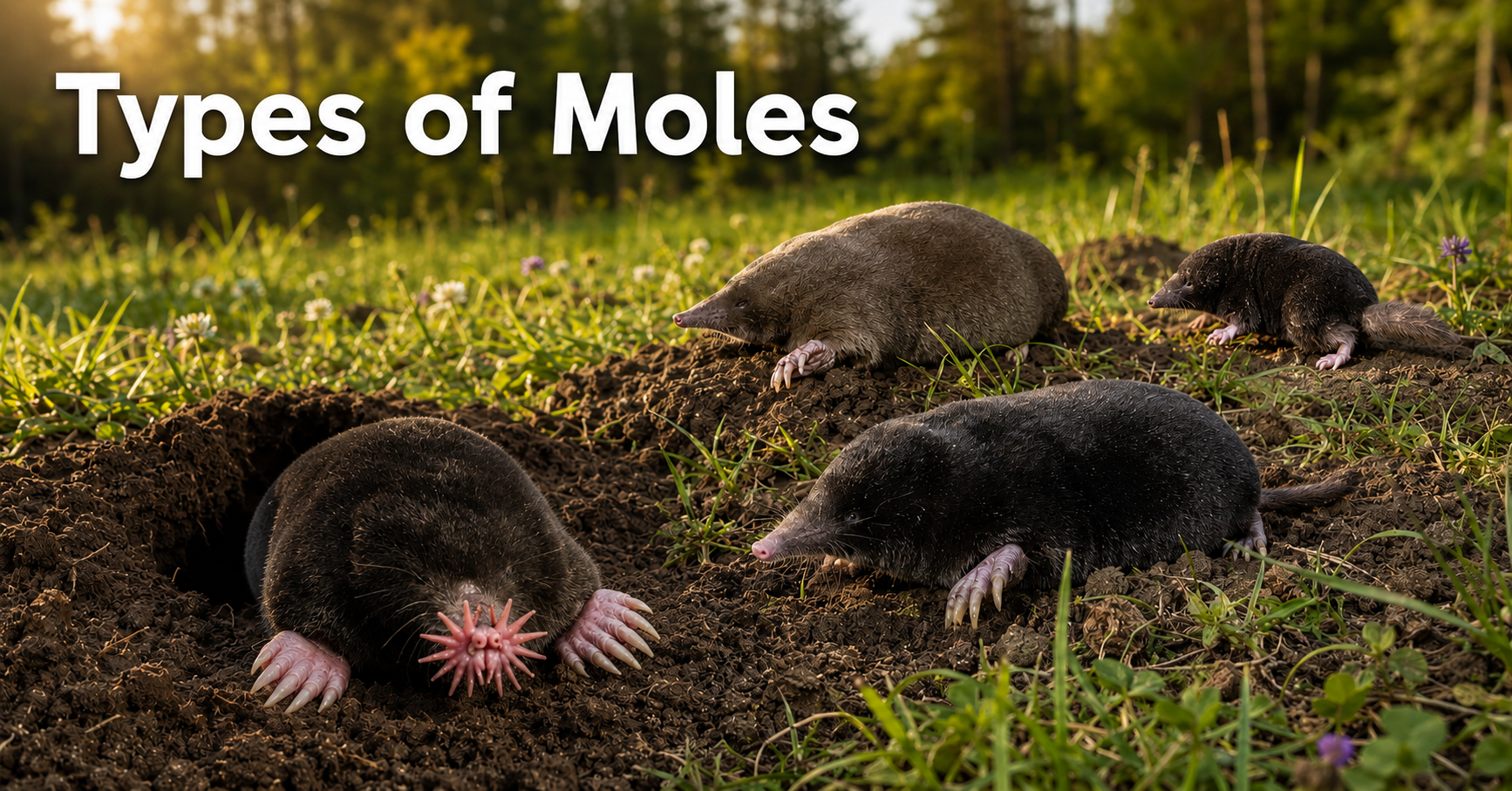
Moles are far more diverse than the familiar velvety animal that leaves ridges across a lawn. The living members of the family Talpidae include powerful underground diggers, tiny shrew moles that spend time above ground, and two unusual semiaquatic desmans. Together, these animals occupy forests, grasslands, farms, mountains, wetlands, and stream banks across North America, Europe, and Asia.
This guide introduces 69 types of moles recognized in a current family-level classification. It explains their scientific relationships, appearance, range, habitat, and distinctive adaptations. Taxonomy changes as new genetic evidence appears, so older references may show a lower total or treat some recently separated species as synonyms. Here, “moles” means all living members of Talpidae; animals merely called moles—such as golden moles, marsupial moles, and naked mole-rats—are not included.
What Are the Main Types of Moles?
The main types are true burrowing moles, shrew moles, and desmans. True moles have broad, outward-facing forefeet and cylindrical bodies built for digging; shrew moles are generally smaller and more surface-active; desmans are streamlined, web-footed talpids associated with freshwater. The 69 species below are arranged by practical group and genus so readers can see both their similarities and their remarkable regional diversity.
Types of Moles at a Glance
| Group | Examples | Main Region | Typical Lifestyle |
|---|---|---|---|
| North American moles | Star-nosed, eastern, Townsend’s | North America | Mostly subterranean; one strongly semiaquatic species |
| Asian and European true moles | Talpa, Mogera, Euroscaptor | Europe and Asia | Powerful underground burrowers |
| Shrew moles | Uropsilus, Urotrichus, Neurotrichus | North America and Asia | Small, slender, and often surface-active |
| Desmans | Russian and Pyrenean desmans | Europe and western Asia | Semiaquatic stream and wetland hunters |
1. Star-Nosed Mole (Condylura cristata)
The star-nosed mole is instantly identifiable by 22 fleshy rays surrounding its nostrils. These highly sensitive appendages let it examine prey with extraordinary speed. Its dark, water-resistant fur, large forefeet, and long, scaly tail further distinguish it from most North American moles.
It inhabits wet meadows, marshes, peatlands, and stream margins in eastern North America. Unlike strictly subterranean species, it swims and dives readily, feeding on worms, insects, crustaceans, mollusks, and other small aquatic animals. Observers should look for tunnels in saturated soil rather than expecting the dry-lawn ridges made by eastern moles.
2. Russian Desman (Desmana moschata)
The Russian desman is one of the largest talpids and looks unlike a conventional mole. It has a flexible trunk-like snout, dense waterproof coat, webbed feet, and a long, laterally flattened tail. Scent glands near the tail produce the musky odor behind its common name.
This semiaquatic species lives around slow rivers, oxbows, and lakes in parts of eastern Europe and western Asia. It hunts aquatic invertebrates and occasionally other small prey. River engineering, wetland loss, entanglement, and habitat fragmentation have caused serious declines, making protection of connected, vegetated waterways especially important.
3. Pyrenean Desman (Galemys pyrenaicus)
The Pyrenean desman is a small stream specialist with a long mobile snout, webbed hind feet, dense fur, and a flattened tail used in swimming. Its unusual silhouette is most likely to be confused with a water shrew, but the elongated snout and swimming adaptations are distinctive.
It occurs in clean, cool, fast-flowing waterways of the Iberian Peninsula and Pyrenean region. Mostly active at night, it searches beneath stones for aquatic insect larvae and other invertebrates. Dams, water extraction, pollution, invasive predators, and disrupted river corridors threaten isolated populations; sightings should be made without entering or disturbing sensitive stream habitat.
4. Medog Mole (Alpiscaptulus medogensis)
The Medog mole is a little-known Himalayan-region talpid described from southeastern Tibet. Its combination of skull, teeth, and genetic characters justified placement in the separate genus Alpiscaptulus. Externally, it resembles a compact dark-furred burrowing mole with enlarged forefeet.
It is associated with moist montane environments in the Medog area, where deep leaf litter and workable soil support subterranean invertebrates. Because it has a restricted known range and is rarely observed, precise details of its ecology remain limited. Responsible accounts should not infer a broad distribution from the few documented localities.
5. Hairy-Tailed Mole (Parascalops breweri)
The hairy-tailed mole is a medium-sized eastern North American species named for the conspicuous hair covering its short tail. It has velvety dark gray fur, a pointed snout, concealed ears, and broad digging forefeet. Compared with the eastern mole, its tail is shorter and noticeably hairier.
It favors cool, well-drained soils in deciduous or mixed woodland, fields, and upland habitats from southeastern Canada into the northeastern United States and Appalachian region. Earthworms and soil invertebrates dominate its diet. Its deeper tunnels may be less obvious than the surface ridges of lawn-dwelling eastern moles.
6. Gansu Mole (Scapanulus oweni)
The Gansu mole is the sole living member of Scapanulus. It is a small, dark, compact burrower with reduced eyes and sturdy forelimbs. Specialists distinguish it from neighboring Asian moles mainly through dental and skull traits, so photographs alone may not allow reliable identification.
Its recorded range lies in central China, particularly mountainous areas with forest, shrub, meadow, and friable soils. It presumably feeds on worms and other subterranean invertebrates, but its natural history is poorly documented. Habitat descriptions and confirmed locality are therefore more dependable identification clues than coat color.
7. Eastern Mole (Scalopus aquaticus)
The eastern mole is the most widespread true mole in much of eastern and central North America. It has silver-gray to brown velvety fur, a pointed pinkish snout, a short nearly naked tail, and huge paddle-like forefeet. Despite the scientific epithet aquaticus, it is primarily terrestrial.
Lawns, pastures, woodland edges, gardens, and fields with moist, workable soil all provide habitat. It constructs shallow feeding runs as well as deeper permanent tunnels and consumes earthworms, beetle larvae, and other invertebrates. Molehills indicate excavated soil, but raised surface ridges are often the easiest field sign.
8. Baja California Mole (Scapanus anthonyi)
This localized mole is associated with the highlands of northern Baja California. Like other Scapanus, it possesses broad digging hands, dense reversible fur, tiny eyes, and a cylindrical body. Its external similarity to related western moles makes range and anatomical study important for identification.
The species is poorly known and occupies a much smaller documented area than the coast or broad-footed mole. Montane soils and suitable invertebrate prey shape its distribution. Because narrow-range mammals can be vulnerable to land-use and climate changes, records should include precise habitat observations without disturbing burrows.
9. Broad-Footed Mole (Scapanus latimanus)
The broad-footed mole is a robust western North American digger named for its exceptionally wide forefeet. Its fur is dark brownish gray to black, while the snout and feet are paler. Taxonomic work has separated some southern populations that older books included within this species.
In its narrower modern sense, it occurs mainly in California and nearby areas, using grassland, woodland, agricultural land, and gardens where soils permit tunneling. It eats earthworms and many kinds of soil arthropods. Range is vital when distinguishing it from the southern broad-footed mole and other Scapanus species.
10. Southern Broad-Footed Mole (Scapanus occultus)
The southern broad-footed mole was long treated as part of Scapanus latimanus. Genetic and morphological evidence supports recognizing it separately. It retains the familiar broad hands, pointed muzzle, concealed ears, and smooth dark fur of western digging moles.
Its distribution centers farther south, including southern California and northern Baja California. It lives underground in appropriate soils across natural and modified landscapes. Identification from a casual sighting is difficult; location and current range maps are more useful than subtle external differences. This split also explains why older regional lists report fewer mole species.
11. Coast Mole (Scapanus orarius)
The coast mole is a small-to-medium western mole with dark velvety fur and a relatively slender build. It is smaller than Townsend’s mole, with which it overlaps in parts of the Pacific Northwest. Measurements of body, skull, and teeth provide more confidence than color alone.
It ranges from southwestern British Columbia through western Washington and Oregon into northern California, especially in lowlands west of major mountain barriers. Meadows, forest openings, pastures, and gardens with damp soil are typical. Its tunnels aerate soil while its feeding reduces populations of many underground invertebrates.
12. Townsend’s Mole (Scapanus townsendii)
Townsend’s mole is the largest North American mole. Adults have a heavy body, very broad forefeet, a pointed snout, and dark gray to black fur that may show a metallic sheen. Its size is the most practical clue where the smaller coast mole also occurs.
It occupies fertile lowlands of the Pacific Northwest, including pastures, prairies, fields, and lawns with deep moist soil. Extensive tunnel systems provide access to earthworms and invertebrate larvae. Although molehills can conflict with landscaping, the animal itself is solitary, native, and ecologically valuable as a soil predator.
13. Darwin’s Mole (Euroscaptor darwini)
Darwin’s mole is an Asian true mole recognized through modern taxonomic study. It has the compact body, reduced external sensory structures, short tail, dark coat, and enlarged forelimbs typical of Euroscaptor. Similar relatives are difficult to separate without measurements or genetics.
Its known distribution is in Southeast Asia, where it occupies moist soils in forested or montane landscapes. The species forages underground for worms and arthropods. Because range boundaries among regional Euroscaptor remain subjects of research, geographic provenance should accompany any scientific record.
14. Greater Chinese Mole (Euroscaptor grandis)
The greater Chinese mole is a comparatively large member of its genus, with dark velvety fur and strongly developed digging limbs. It is one of several Asian moles whose similar outward form reflects the same underground lifestyle rather than easy-to-see species differences.
It is associated with mountainous southwestern China and adjoining areas, using forest soils and upland meadows. It searches tunnel walls and soil layers for earthworms, insects, and other invertebrates. Elevation and locality are among the best field clues, while definitive separation from related taxa often requires specialist examination.
15. Kloss’s Mole (Euroscaptor klossi)
Kloss’s mole is a Southeast Asian burrower with dark, short fur, inconspicuous eyes, and outward-turned forefeet. The body is streamlined for moving through tunnels, and the fur can lie in either direction so the animal can reverse without snagging.
It is found in parts of mainland Southeast Asia, particularly elevated, humid landscapes. Forest floor soils supply its invertebrate prey and protect it from temperature extremes. Its boundaries have been refined as related forms were described, so modern sources may differ substantially from older field guides.
16. Kuznetsov’s Mole (Euroscaptor kuznetsovi)
Kuznetsov’s mole is a recently recognized member of the diverse Southeast Asian Euroscaptor radiation. It resembles its relatives externally: a compact dark body, pointed muzzle, short tail, and large hands equipped with strong claws.
Known from northern Vietnam and nearby portions of southern China, it is linked to moist upland forests. Subtle skull and genetic characteristics are central to its diagnosis. For nature observers, exact locality, elevation, and habitat are more responsible clues than attempting a confident visual identification from a brief encounter.
17. Long-Nosed Mole (Euroscaptor longirostris)
The long-nosed mole takes its name from an elongated, tapered muzzle that helps it probe soil and locate prey. Like other true moles, it has tiny eyes, no obvious external ears, and muscular forequarters supporting sideways digging strokes.
It occurs in parts of China and adjacent mainland Southeast Asia, usually in forested mountains with humid, workable soil. Its exact range has changed as taxonomists split formerly included populations into new species. Current locality data are therefore essential when using the common name “long-nosed mole.”
18. Malayan Mole (Euroscaptor malayanus)
The Malayan mole is a dark-coated underground mammal of the Malay Peninsula’s highlands. Broad forepaws and strong shoulder muscles enable it to excavate feeding tunnels, while its small eyes and ears reduce exposure to soil and abrasion.
Cool, wet montane forests provide its principal habitat. Its restricted and patchy distribution makes it far less familiar than lawn-associated European or North American moles. Forest conversion, road building, and climate-driven changes at elevation deserve attention, although detailed population information remains limited.
19. Himalayan Mole (Euroscaptor micrurus)
The Himalayan mole is a stout burrower with glossy blackish fur, a pointed nose, and a notably short tail. It inhabits the eastern Himalayan region and surrounding uplands, although historical changes in species limits can make older distribution maps appear broader than modern ones.
It digs in forest, meadow, and cultivated soils where rainfall supports abundant worms and insect larvae. Surface ridges and soil mounds may reveal its activity, but several local talpids can create similar signs. Elevation, region, and verified specimens are needed for confident species-level records.
20. Ngoc Linh Mole (Euroscaptor ngoclinhensis)
Named for the Ngoc Linh mountain region of Vietnam, this mole was distinguished using anatomical and molecular evidence. It is a typical compact Euroscaptor, with dark fur, a narrow snout, and shovel-like forefeet, but specialist characters separate it from neighboring species.
Its known range is localized in high-elevation forest. Such mountain endemics may occupy narrow climatic bands and are easy to overlook because they rarely appear above ground. Protecting intact soil, leaf litter, and forest connectivity also protects the invertebrate communities on which this mole depends.
21. Orlov’s Mole (Euroscaptor orlovi)
Orlov’s mole is another recently differentiated Southeast Asian species. Its general appearance is deceptively similar to other long-nosed moles, demonstrating why coat color alone is rarely a sound basis for identifying Asian talpids.
It is documented from northern Vietnam and adjacent areas, principally in moist mountain habitat. Researchers rely on skull proportions, dentition, genetics, and locality to separate it from Kuznetsov’s and long-nosed moles. Its discovery highlights how much cryptic mammal diversity remains in Asian uplands.
22. Small-Toothed Mole (Euroscaptor parvidens)
The small-toothed mole is named for dental traits rather than an obvious field mark. Externally it is a small, dark, velvety mole with a tapered snout and strong forelimbs. Teeth and skull structure are normally required for a reliable distinction from close relatives.
It occurs in southern Vietnam and nearby parts of Southeast Asia, particularly in forested uplands. Soil moisture and prey availability influence where it can tunnel. Because several historical records have been reassigned as taxonomy improved, older statements about its range should be treated cautiously.
23. Subanura Mole (Euroscaptor subanura)
The subanura mole is remarkable for its extremely short tail—its name refers to that reduced feature. Otherwise, it shows the familiar Euroscaptor pattern of dark velvety fur, a pointed muzzle, hidden ears, and large forepaws.
This species is known from Vietnam and has a limited documented distribution in humid forest environments. It feeds below ground on small invertebrates. Its discovery from an area already known to contain other mole species illustrates why careful anatomical and genetic study is necessary instead of assigning every dark Asian mole to a widespread name.
24. Echigo Mole (Mogera etigo)
The Echigo mole is a Japanese endemic known from a restricted part of Honshu. It resembles other Japanese Mogera but can be distinguished through body and skull measurements, genetics, and geography. Its coat is dense and dark, and its hands are strongly adapted for excavation.
It occupies alluvial and lowland soils in its limited range. Habitat alteration and competition at range boundaries may affect local populations. Because narrow distributions create conservation sensitivity, disturbance to confirmed sites should be minimized and observations reported through appropriate wildlife channels.
25. Hainan Mole (Mogera hainana)
The Hainan mole is native to China’s Hainan Island. It is a compact subterranean species with velvety dark fur, a narrow head, reduced eyes, and robust forefeet. Island isolation helped produce anatomical and genetic differences from mainland relatives.
It inhabits suitable forest and cultivated soils where invertebrate prey is available. Knowledge of its abundance and ecology remains incomplete. Hainan locality is the clearest initial clue, since external features overlap greatly with those of other Mogera moles.
26. Small Japanese Mole (Mogera imaizumii)
The small Japanese mole is generally more lightly built than the large Japanese mole. It has dark gray-brown fur, a pointed muzzle, and broad forefeet. Size helps in some areas, but overlap means that locality and anatomical details remain important.
It is native to Japan and uses grassland, woodland, farmland, levees, and gardens. Contact zones with other Japanese moles are especially interesting to biologists studying competition and range change. Its underground diet consists mainly of earthworms and other soil invertebrates.
27. Insular Mole (Mogera insularis)
The insular mole is associated primarily with Taiwan and is one of several island or coastal East Asian Mogera. Its dark coat, short tail, reduced eyes, and broad paws reveal a strongly fossorial life, while diagnostic skull and dental characters separate it from related species.
It occurs in forests, fields, and other places with deep enough soil for tunneling. Taxonomic treatments have varied, and some mainland populations historically assigned to this name are now placed elsewhere. For this reason, modern geographic context is essential when interpreting older records.
28. Kano’s Mole (Mogera kanoana)
Kano’s mole is a small endemic mole of Taiwan’s mountains. It was formerly confused with other regional species but is now recognized through a combination of genetic and morphological evidence. Its body is compact, the fur dark and plush, and the front claws conspicuously developed.
Montane forests and their moist soils provide its main habitat. Elevational isolation may have contributed to its distinctiveness. Because field identification is challenging, reliable records should note elevation and exact region and avoid handling wildlife without authorization.
29. La Touche’s Mole (Mogera latouchei)
La Touche’s mole is a relatively small East Asian species. It has the standard mole profile—tapered snout, cylindrical body, nearly invisible ears, and outward-facing digging hands—but differs from close relatives in cranial, dental, and genetic details.
Its modern range includes parts of southeastern China and northern mainland Southeast Asia, depending on the taxonomic treatment used. It occupies moist forest and agricultural soils and feeds on subterranean invertebrates. Updated checklists are preferable to older maps because several populations have been reassessed.
30. Large Mole (Mogera robusta)
The large mole, also known as the Ussuri mole in some references, is a substantial Mogera of northeastern Asia. Its robust body, broad forefeet, and dark gray or brownish fur fit life in long underground galleries.
It occurs in parts of northeastern China, the Korean Peninsula, and the Russian Far East. Forest, meadow, and farmland soils may all be used where frost-free layers and prey permit digging. Large size and northeastern distribution help separate it from smaller East Asian species, though confirmed identification may require measurements.
31. Sado Mole (Mogera tokudae)
The Sado mole is restricted to Sado Island, Japan. It is a sturdy, dark-furred digger with broad hands and a comparatively large body. Its island range makes geography unusually helpful for identification.
Fields, forest edges, and other soils suitable for tunneling support this endemic mammal. A species with such a small range can be sensitive to major habitat changes or introduced competitors. Protecting a varied landscape and healthy soil fauna is important for its long-term persistence.
32. Senkaku Mole (Mogera uchidai)
The Senkaku mole is one of the most geographically restricted moles, known from a small island in the Senkaku group. It is a small subterranean species diagnosed through its anatomy and isolated locality rather than an easily observed color pattern.
Very little is known about its population or daily ecology. Limited habitat alone makes island endemics vulnerable to disturbance, invasive organisms, and chance events. Its case shows why “types of moles” is not merely a garden-pest topic but also a story of unique and poorly known biodiversity.
33. Large Japanese Mole (Mogera wogura)
The large Japanese mole is robust and generally larger than the small Japanese mole. It has dark velvety fur, broad forefeet, and a short tail. The species has also been called Temminck’s mole, though common-name use varies by source.
It occurs widely in Japan and also in portions of continental East Asia under modern classifications. It favors deep soils in fields, grassland, woodland, and human-modified places. Where it meets smaller endemic moles, competition and range expansion can affect local distribution patterns.
34. Japanese Mountain Mole (Oreoscaptor mizura)
The Japanese mountain mole is the sole species in Oreoscaptor. It is smaller and more slender than many Mogera, with a relatively long tail and features suited to forest-floor and shallow-soil activity.
It inhabits mountainous forests of Japan, often in cooler, less disturbed settings. Its scattered distribution and separation from lowland competitors make it an important indicator of regional mammal diversity. Leaf litter, soft soil, and abundant invertebrates provide both cover and food.
35. White-Tailed Mole (Parascaptor leucura)
The white-tailed mole is named for the pale hairs commonly visible on its tail. Its body is dark and cylindrical, and its forelimbs are enlarged for digging. Tail color can be suggestive, but wear and individual variation make it an imperfect field mark.
It occurs from northeastern South Asia into parts of Myanmar and southwestern China, mainly in moist forests and mountain soils. It forages for worms, insect larvae, and other invertebrates. The animal is rarely seen, so verified range and anatomical traits remain central to identification.
36. Short-Faced Mole (Scaptochirus moschatus)
The short-faced mole is the only living species in Scaptochirus. Compared with long-snouted Asian moles, it has a shorter, broader facial profile. Its thick dark fur, small eyes, and powerful forequarters are classic fossorial adaptations.
It occurs in northern and central China, using grassland, woodland, farmland, and other soils that can support tunnel networks. It eats subterranean invertebrates and may leave mounds in cultivated ground. Regional range and skull form distinguish it from sympatric mole genera.
37. Altai Mole (Talpa altaica)
The Altai mole is a large, dark-furred Eurasian mole of Siberian and Central Asian landscapes. It has broad digging hands and a cylindrical body, but reproductive timing and anatomical details set it apart from the familiar European mole.
It inhabits forests, meadows, and mountain valleys with adequate soil moisture. Cold climates constrain surface activity but underground galleries buffer temperature extremes. Its diet is dominated by earthworms and other invertebrates encountered while expanding and patrolling tunnels.
38. Aquitanian Mole (Talpa aquitania)
The Aquitanian mole was described as a distinct species after genetic and anatomical studies of populations formerly assigned to the European mole. It is externally very similar, with black velvety fur, a pinkish snout, and spade-shaped hands.
It is found in southwestern France and northern Spain. Differences in eyes, skull, dentition, and DNA—not a simple color mark—support its recognition. Readers in western Europe should therefore avoid assuming every mole is Talpa europaea.
39. Blind Mole (Talpa caeca)
The blind mole has eyes covered by skin, a stronger reduction than in many related species. It is generally small, dark, and powerfully built for life below ground. The concealed eyes inspired its common name but do not mean the animal lacks sensory awareness; touch, smell, and vibration are crucial.
It inhabits parts of southeastern Europe, especially mountain meadows and forest soils. Several regional moles overlap in general appearance, so distribution and anatomical study are needed. Moist, deep soils rich in invertebrates support its tunnel systems.
40. Caucasian Mole (Talpa caucasica)
The Caucasian mole is a dark, medium-sized true mole whose eyes are hidden beneath the skin. It resembles other members of the European mole complex, but skull and dental traits help specialists recognize it.
Its range includes the Caucasus and neighboring areas around the Black Sea, where it lives in forest, meadow, and upland soils. Earthworms form a major part of its diet. The region’s complex mountains have promoted isolation and the evolution of several closely related mole lineages.
41. Père David’s Mole (Talpa davidiana)
Père David’s mole is a comparatively large and localized mole of western Asia. It possesses black velvety fur, a strong shoulder girdle, broad forefeet, and a pointed mobile snout. Definitive identification relies on cranial characters and locality.
Populations occur in parts of southeastern Turkey and adjacent regions. Suitable deep soil in upland grassland and open woodland allows tunneling. Because its distribution is fragmented and not fully documented, conservation assessments benefit from verified records rather than generalized range assumptions.
42. European Mole (Talpa europaea)
The European mole is the best-known Old World species. It has black, charcoal, or occasionally paler velvety fur, minute eyes, a pointed pink snout, and enormous outward-turned hands. Adults produce conspicuous molehills while excavating deeper tunnel systems.
It is widespread across much of temperate Europe into western Russia, living in pasture, woodland, farmland, parks, and gardens. It eats mainly earthworms but also insects and other invertebrates. Despite lawn damage, it does not normally eat plant roots; injury occurs indirectly through digging and soil displacement.
43. Hakkari Mole (Talpa hakkariensis)
The Hakkari mole is a recently described species from southeastern Turkey. Like other Talpa, it is dark, cylindrical, and equipped with powerful forelimbs. Its diagnostic distinctions include anatomical and genetic characters rather than conspicuous external markings.
It is known from mountainous Hakkari Province, a biologically complex region where isolation can produce localized lineages. Its full distribution, population size, and ecology require further study. This species is one reason current counts exceed those in older mole articles.
44. Levant Mole (Talpa levantis)
The Levant mole is a small-to-medium dark mole associated with the Black Sea and Caucasus region. Tiny eyes, a tapered snout, and broad forefeet reflect its underground habits. Species boundaries in this complex have been repeatedly revised.
It occupies moist forest, meadow, and agricultural soils in parts of Turkey and surrounding regions under current definitions. Earthworms and arthropods make up much of its food. Range maps should be checked against the date and taxonomic authority because older sources may combine it with neighboring species.
45. Martino’s Mole (Talpa martinorum)
Martino’s mole is a recently recognized Balkan member of the European mole group. To an unaided observer it looks much like other Talpa: dark velvet fur, reduced eyes, no visible ear pinnae, and broad digging hands.
It occurs in parts of southeastern Europe around Thrace and adjoining areas. Genetic evidence and detailed morphology support its separation. Its recognition emphasizes that geographic context is indispensable when identifying outwardly similar underground mammals.
46. Iberian Mole (Talpa occidentalis)
The Iberian mole is usually smaller than the European mole and has eyes covered by skin. Its black fur and digging feet otherwise make the two look similar. Skull, teeth, eye condition, and range provide more dependable distinctions.
It occurs across much of Spain and Portugal, where it uses grasslands, agricultural land, woodland, and other habitats with adequate soil. It feeds largely on earthworms and insect larvae. In the northern Iberian Peninsula, careful attention is needed where ranges of different mole species approach one another.
47. Ognev’s Mole (Talpa ognevi)
Ognev’s mole is a robust species from the Caucasus region. It has dark dense fur, broad forepaws, and a muscular body adapted to pushing soil aside. Older classifications sometimes placed these populations under other Caucasian mole names.
It is associated with moist forest and meadow soils in the western Caucasus and nearby northeastern Turkey. Earthworms and other soil animals are its primary prey. Genetics and measurements are usually necessary to distinguish it confidently from adjacent Talpa species.
48. Roman Mole (Talpa romana)
The Roman mole is a large Italian species with black fur and broad, powerful hands. It differs from the European mole in skull, teeth, and other anatomical traits, even though casual observers may struggle to tell them apart.
It is found mainly in central and southern mainland Italy. Farmland, woodland, pasture, and gardens can all support it when soils are deep enough. Geographic location is the most practical first clue; molecular evidence has also clarified its boundaries with other Italian moles.
49. Balkan Mole (Talpa stankovici)
The Balkan mole is a dark-furred underground species with reduced, skin-covered eyes. Its overall form is similar to the blind mole, but measurements and dental features help separate them.
It occurs in the southern Balkans, including parts of North Macedonia, Albania, Greece, and nearby areas, with exact limits varying among treatments. Mountain meadows, open forest, and moist soils provide habitat. Regional isolation and complex terrain have encouraged diversification among Balkan moles.
50. Street’s Mole (Talpa streeti)
Street’s mole is a localized western Asian Talpa recognized in current mammal classifications. It shares the genus’s velvety coat, pointed muzzle, minute eyes, and spade-like hands. Detailed morphology, genetics, and provenance establish its identity.
Knowledge of its distribution and ecology remains limited compared with that of the European mole. It is associated with suitable upland soils in its known range. Readers should treat specific claims cautiously when they are based on older records that predate recent taxonomic revisions.
51. Talysh Mole (Talpa talyschensis)
The Talysh mole is a small species named for the Talysh region near the southwestern Caspian Sea. It is externally dark and compact, with digging forefeet and strongly reduced eyes.
It inhabits humid forest and foothill soils in Azerbaijan and northern Iran. Its restricted regional distribution helps distinguish it from other Caucasian moles. Forest degradation and soil disturbance may matter locally, but comprehensive population data are still needed.
52. Transcaucasian Mole (Talpa transcaucasica)
The Transcaucasian mole belongs to the group of small, externally similar moles surrounding the Caucasus and Black Sea. Its dark fur, concealed eyes, and powerful forefeet reveal little about species identity without geographic and anatomical context.
It occurs across parts of the Caucasus and neighboring western Asia under current taxonomic limits. Forest, meadow, and cultivated soils may be used. Its status illustrates why taxonomy is dynamic: populations once grouped under a broad name can prove evolutionarily distinct after genetic analysis.
53. Chinese Long-Tailed Mole (Scaptonyx affinis)
This small shrew mole combines a pointed shrew-like face and relatively long tail with modest digging adaptations. It is less specialized for deep underground life than a true mole and may forage in leaf litter as well as shallow tunnels.
It occurs in mountainous parts of China and adjacent regions, mainly in cool, moist forest. Small invertebrates provide its food. Current taxonomy separates several forms once combined within Scaptonyx affinis, so locality is important when evaluating older records.
54. Long-Tailed Shrew Mole (Scaptonyx fusicauda)
The long-tailed shrew mole is slender, dark, and notably long-tailed compared with robust true moles. Its forefeet are capable of digging but are not transformed into the enormous paddles of Talpa or Scapanus.
It inhabits highland forests in southwestern China and parts of the eastern Himalayas. Leaf litter, moss, and loose surface soil allow it to pursue insects, worms, and other tiny prey. It is more likely than a true mole to use surface runways, especially under dense cover.
55. Wang’s Shrew Mole (Scaptonyx wangi)
Wang’s shrew mole is a recently distinguished member of the long-tailed shrew-mole lineage. Its subtle differences from related species involve genetics and anatomy rather than a dramatic visible feature.
It is known from a limited part of southwestern China. Moist montane forest, deep litter, and shallow soil form its working environment. Its recognition demonstrates how surveys and DNA studies continue to reveal hidden mammal diversity in Asian mountains.
56. True’s Shrew Mole (Dymecodon pilirostris)
True’s shrew mole is a tiny Japanese talpid with a slender body, elongated snout, visible-looking tail, and narrow forefeet. It spends more time in leaf litter and shallow passages than heavily fossorial moles do.
It inhabits cool mountain forests, particularly on Honshu, where moss, fallen logs, and litter shelter small invertebrate prey. Its small size and pointed profile can resemble a shrew, but its teeth, skull, and other talpid characters establish its family relationship.
57. American Shrew Mole (Neurotrichus gibbsii)
The American shrew mole is North America’s smallest talpid. It has a long pointed snout, small forefeet, soft dark fur, and a tail much more conspicuous than that of the eastern mole. It can dig but frequently travels through litter and low vegetation.
It occurs in humid forests from southwestern British Columbia through the Pacific Northwest into northern California. It eats insects, worms, centipedes, slugs, and other small animals. Because it makes shallow runways instead of large molehills, its presence is easy to overlook.
58. Japanese Shrew Mole (Urotrichus talpoides)
The Japanese shrew mole is a small, lively talpid with a slender snout, relatively long hairy tail, and forefeet intermediate between those of shrews and true moles. It can burrow but also forages actively in forest litter.
It is widespread in Japan across woodland and brushy habitat, from lowlands into mountains. Worms, insects, spiders, and other invertebrates make up its diet. Compared with the Japanese mountain mole, it is more shrew-like in body proportions and surface behavior.
59. Equivalent-Toothed Shrew Mole (Uropsilus aequodonenia)
This recently recognized Chinese shrew mole is named for diagnostic dental proportions. It has a slender body, long pointed snout, conspicuous tail, and narrow feet, making it look more like a shrew than a true digging mole. Teeth, skull features, genetics, and locality are required for dependable separation from other Uropsilus.
It is associated with cool, moist mountain forest, where it moves through moss, leaf litter, root spaces, and shallow soil in search of tiny invertebrates. Its limited documentation makes precise natural-history claims premature.
60. Anderson’s Shrew Mole (Uropsilus andersoni)
Anderson’s shrew mole is a long-tailed, narrow-footed species from the mountains of central China. Its soft dark fur and elongated muzzle suit a life of probing litter and loose surface soil rather than excavating the heavy galleries produced by true moles.
It inhabits humid montane forest and feeds on insects, worms, and other small invertebrates. Several outwardly similar shrew moles occur in China, so elevation, geographic range, and expert examination matter far more than coat shade.
61. Black-Backed Shrew Mole (Uropsilus atronates)
The black-backed shrew mole has dark dorsal coloration, slender proportions, a long tail, and a pointed snout. Color alone is insufficient because lighting, age, and individual variation can make several Uropsilus species appear similar.
It is native to mountain forests of southwestern China and adjoining areas. Moist litter and loose soil allow it to forage for small invertebrates. Verified locality and diagnostic anatomy are needed for a confident record.
62. Dabie Mountains Shrew Mole (Uropsilus dabieshanensis)
This shrew mole was described from the Dabie Mountains of eastern-central China. Its recognition reflects differences in DNA and morphology within a group once thought to contain fewer, more widespread species. It is a small, long-tailed animal with a narrow snout and modest digging feet.
Montane broadleaf forest, dense litter, and moist ground provide its habitat. Its restricted known distribution makes habitat protection and well-documented observations more important than casual attempts to handle or collect it.
63. Fansipan Shrew Mole (Uropsilus fansipanensis)
Named for the Fansipan mountain region of northern Vietnam, this recently described species extends the known diversity of Uropsilus into Southeast Asia. It resembles a tiny dark shrew with a long tail, but its anatomy and genetics place it among talpids.
It lives in cool, humid high-elevation forest with thick litter and moss. Because the known range is narrow and mountain habitats are sensitive to disturbance and warming, precise locality information should be handled responsibly.
64. Funiu Mountains Shrew Mole (Uropsilus funiushanensis)
The Funiu Mountains shrew mole is another localized Chinese species revealed by detailed taxonomic research. Its slender body, mobile snout, long tail, and small foreclaws distinguish its general form from paddle-footed true moles, though not from other Uropsilus.
It occurs in temperate montane forest in the Funiu range, foraging under leaves and within shallow soil. Locality, measurements, and genetics are central to identification because external field marks are subtle.
65. Gracile Shrew Mole (Uropsilus gracilis)
The gracile shrew mole lives up to its name with a slim body and relatively delicate limbs. It has a pointed face, small eyes, soft dark fur, and a long tail. Unlike a heavily fossorial mole, it is adapted to navigating forest-floor cover and shallow passages.
It occurs in mountain regions of southwestern China and feeds on small soil and litter invertebrates. Historical use of this name was sometimes broad, so current range maps should be preferred when evaluating a record.
66. Huanggang Shrew Mole (Uropsilus huanggangensis)
This species is named for its documented mountain locality in China. It is a small, shrew-like talpid whose distinctiveness was established through morphological and genetic comparisons, not an obvious external marking.
It occupies moist upland forest where litter depth, ground cover, and invertebrate abundance shape microhabitat use. Because it is recently recognized and poorly known, restraint is important when describing its behavior, abundance, or wider distribution.
67. Inquisitive Shrew Mole (Uropsilus investigator)
The inquisitive shrew mole is a long-snouted, long-tailed member of Uropsilus from southwestern China and neighboring Himalayan areas. It lacks the broad shovel hands of true moles and is better suited to working through soft substrates and litter.
Cool, humid mountain forest supports its invertebrate prey. As with other members of the genus, exact range and anatomical evidence are crucial because specimens once assigned to one species have been redistributed among several taxa.
68. Snowy Shrew Mole (Uropsilus nivatus)
The snowy shrew mole is associated with high mountain environments and has the slim body, pointed snout, long tail, and modest foreclaws typical of its genus. Its name refers to its upland setting rather than a white coat.
It is known from southwestern Chinese mountains, where cool forest, moss, leaf litter, and moist shallow soil provide cover. Elevation and locality help distinguish it, but confirmed identification generally requires specialist study.
69. Chinese Shrew Mole (Uropsilus soricipes)
The Chinese shrew mole is the type species of Uropsilus and resembles a true shrew at first glance. Its elongated muzzle, long tail, and narrow feet contrast sharply with the cylindrical body and paddle-like hands of a European mole.
It occurs in forested mountains of central and southwestern China under current taxonomic limits. It searches litter and loose soil for small invertebrates. Older references may apply this name broadly to populations now recognized as separate species.
How Are These Types of Moles Classified?
Moles belong to the mammal order Eulipotyphla and family Talpidae. The family is divided into subfamilies and tribes representing evolutionary branches, not merely different body shapes. Talpinae contains the star-nosed mole, desmans, North American moles, Eurasian true moles, and several shrew-mole lineages. Uropsilinae contains the Asian shrew moles of Uropsilus.
Older sources may place Talpidae in “Insectivora” or “Soricomorpha,” use about 42–59 species, or combine populations that current genetic work separates. A total of 69 reflects the species entries in a current database treatment, but taxonomy is a scientific hypothesis and may change again. Desmans are included because they are genuine talpids. Golden moles belong to Chrysochloridae, marsupial moles to Notoryctidae, and mole-rats are rodents; resemblance among them is convergent evolution.
Where Do Moles Live?
True talpids occur naturally across much of North America, Europe, and Asia. They are absent as native animals from South America, sub-Saharan Africa, Australia, and Antarctica. Moist but aerated soil is ideal for most burrowing species because it is easier to excavate and supports earthworms and other prey.
Habitat varies enormously. Eastern and European moles readily use lawns and farmland, while many recently recognized Asian species are confined to montane forest. Star-nosed moles prefer wetlands, and desmans depend on freshwater. Shrew moles often work through leaf litter and shallow soil rather than living entirely in deep tunnel systems.
How to Identify Different Types of Moles
- Forefeet: True digging moles have broad, outward-facing palms; shrew moles have narrower feet; desmans have webbing for swimming.
- Snout: The star-nosed mole has 22 rays, desmans have long flexible proboscises, and most true moles have simple pointed muzzles.
- Tail: A short nearly naked tail suggests several true moles; hairy, long, or flattened tails point toward other groups.
- Body size: Townsend’s mole is exceptionally large for North America, while American and Asian shrew moles are tiny and slender.
- Habitat: Wetland, rushing stream, dry lawn, coastal lowland, and montane forest each narrow the possibilities.
- Range: Geography is often the strongest clue because many species are externally almost identical but do not occur together.
- Field signs: Raised ridges indicate shallow feeding runs; molehills mark excavated deeper soil; small litter runways may belong to shrew moles.
- Anatomy and genetics: Some Asian and European species cannot be identified reliably without measurements, teeth, skull characters, or DNA.
Outdoor Tips for Finding and Observing Moles
- Search for fresh, moist soil in molehills after rain rather than digging open an occupied tunnel.
- Observe raised feeding ridges from a distance at dawn or dusk; soil sometimes moves as a mole passes underneath.
- Use regional range maps before choosing a species name.
- Photograph field signs with a scale and record habitat, date, and location.
- Near streams, remain on durable surfaces and avoid overturning stones or damaging banks used by desmans.
- Do not handle a mole. Small insect-eating mammals are easily stressed and may bite defensively.
- Ask a local mammal group, museum, extension service, or wildlife agency to verify unusual records.
Moles, Voles, Shrews, and Gophers: What Is the Difference?
| Animal | Diet | Key Features | Typical Signs |
|---|---|---|---|
| Mole | Mostly animal prey such as worms and insects | Pointed snout, tiny eyes, broad forefeet | Raised runs and volcano-like mounds |
| Vole | Mostly grasses, roots, bark, and seeds | Rodent teeth, rounded face, small ears | Surface runways and gnawed plants |
| Shrew | Mostly invertebrates | Long pointed snout, narrow feet | Small surface pathways; few large mounds |
| Pocket gopher | Roots and other plant material | Large incisors, cheek pouches, strong claws | Fan- or crescent-shaped soil mounds |
Safety, Sustainability, and Conservation Notes
Moles are native wildlife, not simply lawn pests. Their digging mixes soil, and their predation affects worms, insects, and other invertebrates. Where conflict occurs, first confirm the animal: plant damage is frequently caused by voles or gophers using mole tunnels. Flattening a small section of runway can help show whether it remains active without excavating the system.
Avoid poisons, flooding, gasoline, smoke, broken glass, and unverified home remedies. These can harm people, pets, soil organisms, groundwater, and non-target wildlife. Laws governing trapping and relocation vary, and relocation may be illegal or fatal to the animal. Exclusion and tolerance are often the lowest-impact solutions; where control is necessary, consult a licensed professional or local wildlife authority.
For threatened desmans and narrow-range Asian or island species, habitat protection is especially important. Clean connected waterways, undisturbed stream banks, intact mountain forest, and healthy soil communities benefit the whole ecosystem. Never collect a rare talpid or publish precise sensitive locality data without guidance from conservation authorities.
Fun Facts About Moles
- Moles are mammals, not rodents.
- Velvety fur can lie in more than one direction, helping a mole reverse in a tight tunnel.
- The star-nosed mole’s nose contains 22 touch-sensitive rays.
- Desmans are talpids adapted to hunting in freshwater.
- Most true moles use a sideways “swimming” stroke to move through soil.
- Mole tunnels can be shallow feeding runs or deeper permanent passages.
- Moles primarily eat animals; they do not usually target garden roots.
- Several visually similar mole species were revealed by DNA research.
- Shrew moles are more surface-active and less powerfully built for digging than true moles.
- Animals called golden moles and marsupial moles are not members of Talpidae.
Final Thoughts on Types of Moles
The 69 types of moles in Talpidae range from familiar lawn tunnelers to mountain shrew moles and endangered freshwater desmans. Forefoot shape, snout, tail, habitat, and especially geographic range provide the best starting clues, but many newly separated species require expert anatomical or genetic identification. Learning the differences helps people appreciate moles as specialized wildlife, respond to yard conflicts responsibly, and recognize the conservation value of healthy soils, forests, wetlands, and streams.
Frequently Asked Questions
1. How many types of moles are there?
The species entries in a current Mammal Diversity Database treatment total 69 living species in Talpidae. Counts differ among references because new species are described, old species are split, and some authorities treat certain populations differently.
2. Are all 69 species true burrowing moles?
No. Talpidae includes strongly fossorial true moles, smaller shrew moles, the semiaquatic star-nosed mole, and two desmans. They share ancestry even though their lifestyles differ.
3. Are moles rodents?
No. Moles belong to Eulipotyphla, while mice, rats, voles, gophers, and mole-rats belong to Rodentia. Moles lack the continuously growing incisors characteristic of rodents.
4. What is the most common mole in the United States?
The eastern mole is the most widespread lawn-associated species across much of the eastern and central United States. Western states have several Scapanus species instead.
5. How many mole species live in North America?
Depending on geographic boundaries and classification, the familiar native set includes the star-nosed, hairy-tailed, eastern, American shrew, Townsend’s, coast, broad-footed, southern broad-footed, and Baja California moles.
6. What kinds of moles live in Europe?
Europe supports several Talpa species, including European, Aquitanian, Iberian, blind, Roman, Balkan, and Martino’s moles. It also supports the Pyrenean desman, while the Russian desman’s range reaches eastern Europe.
7. Where are most mole species found?
Mole diversity is especially high in Asia, which contains numerous Talpa, Mogera, Euroscaptor, and shrew-mole species. Many occupy small mountain or island ranges.
8. Do moles live in Africa?
True moles of Talpidae are not native to sub-Saharan Africa. African golden moles look similar because they evolved for digging, but they belong to a different mammal family.
9. Do moles live in Australia?
Talpid moles do not naturally occur in Australia. Australian marsupial moles are marsupials in the family Notoryctidae and evolved a mole-like form independently.
10. What is the largest type of mole?
The Russian desman is among the largest talpids overall. Among conventional North American digging moles, Townsend’s mole is the largest.
11. What is the smallest type of mole?
Several shrew moles are extremely small. The American shrew mole is the smallest North American talpid, while some Asian shrew moles are similarly tiny.
12. Which mole has a star-shaped nose?
The star-nosed mole has 22 fleshy rays around its nostrils. These structures are touch organs used to detect and evaluate prey rapidly.
13. Which moles can swim?
Star-nosed moles swim well, and Russian and Pyrenean desmans are strongly semiaquatic. Other moles may cross water, but they are not as specialized for aquatic feeding.
14. Are moles blind?
Moles are not universally blind. Most have very small eyes and limited vision, while the eyes of some species are covered by skin. Touch, smell, and sensitivity to vibration are more important underground.
15. Why do moles have such large front feet?
Broad forefeet act like digging paddles. Strong shoulders rotate the hands outward so a true mole can push loosened soil to the sides and move through it efficiently.
16. What do moles eat?
Most eat earthworms, insect larvae, adult insects, and other soil invertebrates. Aquatic talpids also eat freshwater invertebrates and occasionally small vertebrate prey.
17. Do moles eat plant roots?
Moles primarily hunt animal prey and usually do not target roots. Their tunneling can dislodge plants, while voles and gophers using the same area may actually gnaw roots.
18. Why are there molehills?
A mole pushes excess soil to the surface when excavating or repairing deeper tunnels. The resulting mound provides an outlet without requiring the animal to remain exposed for long.
19. What do mole tunnels look like?
Shallow feeding tunnels often appear as raised winding ridges. Deeper travel and nesting tunnels may leave only molehills and are less visible from above.
20. Are moles active at night?
Moles can be active by day and night. Their schedules often consist of repeated feeding and resting periods because the underground environment is largely independent of daylight.
21. Do moles hibernate?
Most moles remain active through winter where soil conditions allow. They may move into deeper tunnels below frozen ground and follow prey to more favorable layers.
22. Are moles solitary?
Most species are mainly solitary and territorial outside the breeding season. Tunnel systems can intersect, but that does not mean a large social colony occupies the lawn.
23. How can I tell a mole from a vole?
A mole has a pointed snout, tiny eyes, and large digging forefeet. A vole is a round-faced plant-eating rodent that makes surface runways and may damage stems, bark, bulbs, or roots.
24. How can I tell a mole from a pocket gopher?
Pocket gophers have prominent rodent incisors and fur-lined cheek pouches. Their mounds are often fan-shaped, whereas many mole mounds are more rounded or volcano-like.
25. Is a mole-rat a mole?
No. Mole-rats are burrowing rodents. Their mole-like name describes lifestyle and appearance, not close evolutionary relationship.
26. Is a golden mole a true mole?
No. Golden moles are African mammals in Chrysochloridae. They independently evolved compact bodies and digging adaptations similar to those of talpid moles.
27. Are moles dangerous to people?
Moles normally avoid people and are not aggressive. Any wild mammal may bite if handled, so observe without touching and keep pets from capturing it.
28. Can moles carry diseases?
Wild moles can carry parasites and pathogens, as other mammals can, but ordinary indirect yard encounters are generally low risk. Avoid bare-handed contact with animals, carcasses, urine, or feces.
29. Are moles good for soil?
Their digging can mix and aerate soil and influence nutrient movement. They also consume invertebrates. Benefits and landscaping conflicts can occur at the same time.
30. Why did a mole suddenly appear in my yard?
Moist soil, abundant prey, seasonal dispersal, or changes in nearby habitat can make new activity noticeable. One animal can build an extensive tunnel system, so many ridges do not necessarily mean many moles.
31. How can I identify the mole in my garden?
Start with country and region, then compare mound form, habitat, forefeet, tail, size, and snout. For similar species, photographs may not be enough; seek help from a regional wildlife expert.
32. Should I dig up a mole to identify it?
No. Digging can injure the animal, destroy habitat, and may violate wildlife rules. Photograph signs, record location, and use non-invasive identification methods.
33. Can moles be kept as pets?
Moles are unsuitable pets. They have specialized diets, high food demands, solitary behavior, and complex digging needs, and keeping native wildlife may be illegal.
34. How long do moles live?
Lifespan varies among species and is hard to measure underground. Many small moles live only a few years in the wild, although some individuals survive longer.
35. How do moles find food in darkness?
They rely heavily on touch, smell, and vibration. Sensitive snouts and facial hairs help locate prey, while tunnel patrols bring them into contact with moving invertebrates.
36. Do all moles make large mounds?
No. Strongly fossorial species often make conspicuous mounds, but shrew moles may use leaf litter and shallow runs. Aquatic desmans do not create lawn-style molehill systems.
37. Why do scientific mole counts change?
Researchers compare DNA, skulls, teeth, anatomy, and geography. A widespread “species” may prove to contain several isolated lineages, while other proposed species may later be combined.
38. Which mole species are threatened?
Risk varies, but freshwater desmans and several narrow-range island or mountain species deserve particular concern. Always consult the latest conservation assessment for a specific species.
39. What is the safest way to manage yard moles?
Confirm the species and actual damage first, tolerate activity where possible, protect vulnerable planting areas with suitable barriers, and follow local law. For serious conflict, use a qualified wildlife professional.
40. What should I do if I find an injured mole?
Keep people and pets away, avoid feeding or treating it, and contact a licensed wildlife rehabilitator or local wildlife authority. Use gloves only if an authority instructs you to move it from immediate danger.