

Mollies are livebearing fishes in the genus Poecilia, but aquarium shops also use the word type for color strains, patterns, fin shapes, body forms, and hybrids. This guide to types of molly fish separates natural species from domestic varieties so readers do not mistake a Dalmatian pattern or lyretail fin for a separate wild species. It also covers appearance, origin, care, breeding, compatibility, and welfare.
What Are the Main Types of Molly Fish?
The best-known natural mollies include the shortfin molly, sailfin molly, Yucatan molly, Amazon molly, and Atlantic molly. Domestic lines include black, Dalmatian, gold dust, marble, silver, golden, orange, platinum, lyretail, sailfin, and balloon forms. Many fancy mollies have mixed ancestry, so Poecilia spp. is often more accurate than assigning every store fish to one species.
Quick Comparison of Molly Fish Types
| No. | Type | Scientific Label | Category | Key Feature |
|---|---|---|---|---|
| 1 | Shortfin Molly | Poecilia sphenops | natural species | compact body and a relatively short dorsal fin |
| 2 | Sailfin Molly | Poecilia latipinna | natural species | a tall sail-like dorsal fin in mature males |
| 3 | Yucatan Molly | Poecilia velifera | natural species | an especially large spotted dorsal sail |
| 4 | Amazon Molly | Poecilia formosa | natural species | a silvery olive body similar to a shortfin molly |
| 5 | Atlantic Molly | Poecilia mexicana | natural species complex | a streamlined gray to olive body |
| 6 | Liberty Molly | Poecilia salvatoris | natural species | red, orange, blue, and black fin markings |
| 7 | Mangrove Molly | Poecilia orri | natural species | a modest gray-brown body adapted to variable salinity |
| 8 | Pacific Molly | Poecilia butleri | natural species | a robust wild-type silver-olive body |
| 9 | Cauca Molly | Poecilia caucana | natural species | a small body with subtle iridescence and dorsal markings |
| 10 | Dwarf Molly | Poecilia chica | natural species | a small slender body with restrained coloration |
| 11 | Broadspotted Molly | Poecilia latipunctata | natural species | broad side spotting and a sailfin-like male profile |
| 12 | Sulphur Molly | Poecilia sulphuraria | specialized natural species | a pale body associated with an extreme habitat |
| 13 | Black Molly | Poecilia spp. | domestic color strain | a velvety solid-black body and fins |
| 14 | Dalmatian Molly | Poecilia spp. | domestic pattern strain | black spots scattered over a white or silver body |
| 15 | Gold Dust Molly | Poecilia spp. | domestic color strain | a gold front blending into a dark rear |
| 16 | Marble Molly | Poecilia spp. | domestic pattern strain | irregular black, white, and gray marbling |
| 17 | Silver Molly | Poecilia spp. | domestic color strain | a bright silver-white body with translucent fins |
| 18 | White Molly | Poecilia spp. | domestic color strain | an opaque white or creamy body |
| 19 | Golden Molly | Poecilia spp. | domestic color strain | a yellow-gold body with orange highlights |
| 20 | Orange Molly | Poecilia spp. | domestic color strain | a solid orange to reddish-orange body |
| 21 | Chocolate Molly | Poecilia spp. | domestic color strain | a warm brown to bronze body |
| 22 | Creamsicle Molly | Poecilia spp. | domestic pattern strain | cream, white, and orange patches |
| 23 | Platinum Molly | Poecilia spp. | domestic color strain | a pale reflective body with metallic sheen |
| 24 | Lyretail Molly | Poecilia spp. | domestic fin strain | elongated upper and lower tail rays |
| 25 | Black Lyretail Molly | Poecilia spp. | combined color and fin strain | solid-black color with extended tail tips |
| 26 | Dalmatian Lyretail Molly | Poecilia spp. | combined pattern and fin strain | black-on-white spotting with a lyre-shaped tail |
| 27 | Gold Dust Lyretail Molly | Poecilia spp. | combined color and fin strain | gold-and-black color with extended tail rays |
| 28 | Balloon Molly | Poecilia spp. | domestic body-shape strain | a shortened rounded body from altered spinal development |
| 29 | Black Balloon Molly | Poecilia spp. | combined body and color strain | a rounded body with solid-black color |
| 30 | Dalmatian Balloon Molly | Poecilia spp. | combined body and pattern strain | a rounded body with black-and-white spotting |
| 31 | Gold Balloon Molly | Poecilia spp. | combined body and color strain | a compact rounded body with yellow-gold color |
| 32 | Black Sailfin Molly | Poecilia spp. | combined sailfin and color strain | dark color with an enlarged male dorsal sail |
| 33 | Dalmatian Sailfin Molly | Poecilia spp. | combined sailfin and pattern strain | black-and-white spotting with a large dorsal fin |
| 34 | Golden Sailfin Molly | Poecilia spp. | combined sailfin and color strain | golden color and a tall sail-like dorsal fin |
1. Shortfin Molly
Shortfin Molly (Poecilia sphenops) is a natural species associated with Mexico and Central America. It is recognized by compact body and a relatively short dorsal fin. Natural species have geographic histories, while domestic forms may combine genes from several molly lineages.
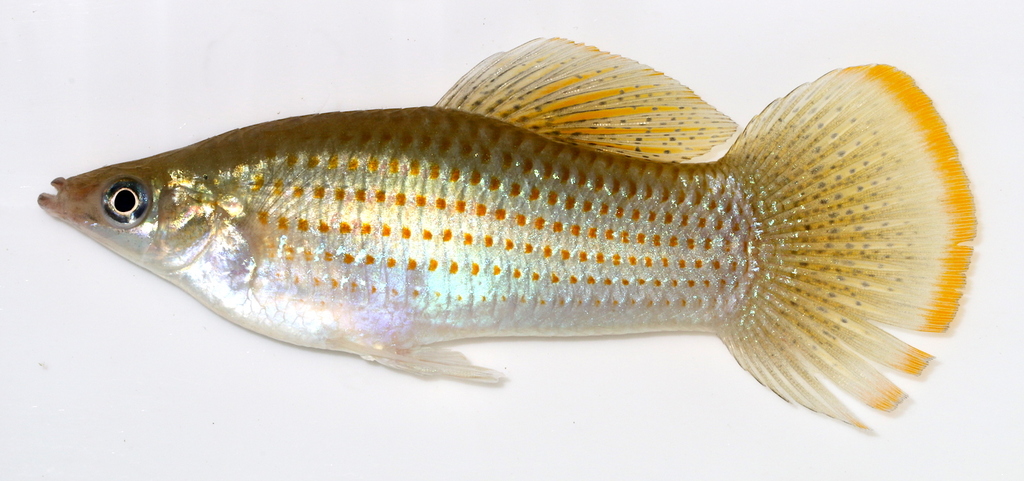
Provide a cycled, planted community tank with stable warm water. Feed a varied diet that includes plant and algae-based material. Mixed-sex groups can produce fry quickly.
2. Sailfin Molly
The Sailfin Molly is best described as a natural species. Its background is the southeastern United States and nearby drainages, and its defining appearance is a tall sail-like dorsal fin in mature males. Store labels can be inconsistent, so body shape, fin structure, and health matter.
Use a spacious tank with mineral-rich water and room for display. Quarantine new fish, maintain stable temperature and mineral balance, and avoid sudden salinity or pH shifts.
3. Yucatan Molly
With an especially large spotted dorsal sail, the Yucatan Molly is easy to notice. It is listed here as a natural species originating from the Yucatán Peninsula. A color or fin label should not automatically be treated as a separate biological species.
Give it more swimming room than small shortfin strains. Keep more females than males when both sexes are present and provide planted refuge.
4. Amazon Molly
Amazon Molly, labeled Poecilia formosa, represents a natural species from northeastern Mexico and southern Texas. The clearest visual clue is a silvery olive body similar to a shortfin molly. Accurate labeling helps aquarists plan size, temperament, breeding, and line preservation.
This all-female lineage is better suited to informed keepers. Healthy mollies swim level, breathe normally, hold fins open, and forage actively.
5. Atlantic Molly
Atlantic Molly (Poecilia mexicana) is a natural species complex associated with Atlantic-slope waters of Mexico and Central America. It is recognized by a streamlined gray to olive body. Natural species have geographic histories, while domestic forms may combine genes from several molly lineages.
Document locality and avoid casual mixing with fancy hybrids. Feed a varied diet that includes plant and algae-based material. Mixed-sex groups can produce fry quickly.
6. Liberty Molly
The Liberty Molly is best described as a natural species. Its background is Pacific-slope Central America, and its defining appearance is red, orange, blue, and black fin markings. Store labels can be inconsistent, so body shape, fin structure, and health matter.
Use cover and space because males can be assertive. Quarantine new fish, maintain stable temperature and mineral balance, and avoid sudden salinity or pH shifts.
7. Mangrove Molly
With a modest gray-brown body adapted to variable salinity, the Mangrove Molly is easy to notice. It is listed here as a natural species originating from Caribbean coastal habitats. A color or fin label should not automatically be treated as a separate biological species.

Stable water quality matters more than adding salt automatically. Keep more females than males when both sexes are present and provide planted refuge.
8. Pacific Molly
Pacific Molly, labeled Poecilia butleri, represents a natural species from Pacific drainages of Mexico and Central America. The clearest visual clue is a robust wild-type silver-olive body. Accurate labeling helps aquarists plan size, temperament, breeding, and line preservation.
Keep documented stock separate from uncertain hybrids. Healthy mollies swim level, breathe normally, hold fins open, and forage actively.
9. Cauca Molly
Cauca Molly (Poecilia caucana) is a natural species associated with northwestern South America. It is recognized by a small body with subtle iridescence and dorsal markings. Natural species have geographic histories, while domestic forms may combine genes from several molly lineages.

Its small size does not eliminate the need for group space. Feed a varied diet that includes plant and algae-based material. Mixed-sex groups can produce fry quickly.
10. Dwarf Molly
The Dwarf Molly is best described as a natural species. Its background is a restricted area of western Mexico, and its defining appearance is a small slender body with restrained coloration. Store labels can be inconsistent, so body shape, fin structure, and health matter.
Maintain rare captive lines responsibly. Quarantine new fish, maintain stable temperature and mineral balance, and avoid sudden salinity or pH shifts.
11. Broadspotted Molly
With broad side spotting and a sailfin-like male profile, the Broadspotted Molly is easy to notice. It is listed here as a natural species originating from a limited region of northeastern Mexico. A color or fin label should not automatically be treated as a separate biological species.
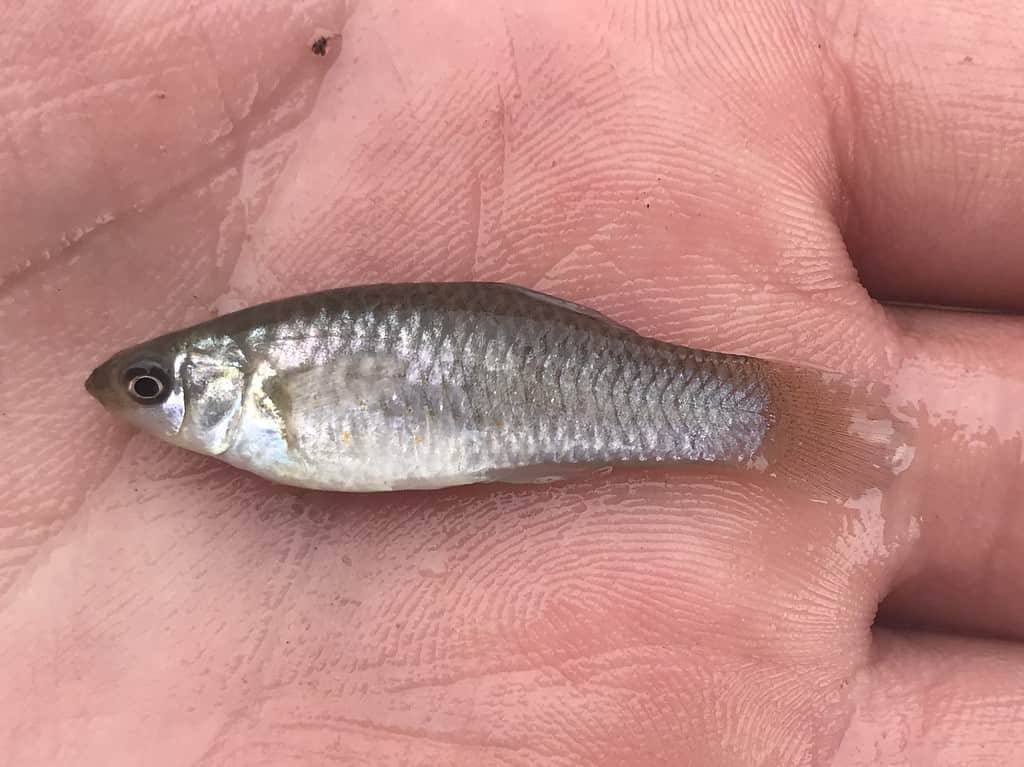
Treat it as a conservation-interest species, not a generic fancy molly. Keep more females than males when both sexes are present and provide planted refuge.
12. Sulphur Molly
Sulphur Molly, labeled Poecilia sulphuraria, represents a specialized natural species from sulfur-rich springs in southern Mexico. The clearest visual clue is a pale body associated with an extreme habitat. Accurate labeling helps aquarists plan size, temperament, breeding, and line preservation.
It is not a routine beginner community fish. Healthy mollies swim level, breathe normally, hold fins open, and forage actively.
13. Black Molly
Black Molly (Poecilia spp.) is a domestic color strain associated with ornamental breeding lines. It is recognized by a velvety solid-black body and fins. Natural species have geographic histories, while domestic forms may combine genes from several molly lineages.
Choose fish with straight spines and steady swimming. Feed a varied diet that includes plant and algae-based material. Mixed-sex groups can produce fry quickly.
14. Dalmatian Molly
The Dalmatian Molly is best described as a domestic pattern strain. Its background is the aquarium trade, and its defining appearance is black spots scattered over a white or silver body. Store labels can be inconsistent, so body shape, fin structure, and health matter.
Pattern density varies; care follows the underlying body type. Quarantine new fish, maintain stable temperature and mineral balance, and avoid sudden salinity or pH shifts.
15. Gold Dust Molly
With a gold front blending into a dark rear, the Gold Dust Molly is easy to notice. It is listed here as a domestic color strain originating from selective aquarium breeding. A color or fin label should not automatically be treated as a separate biological species.
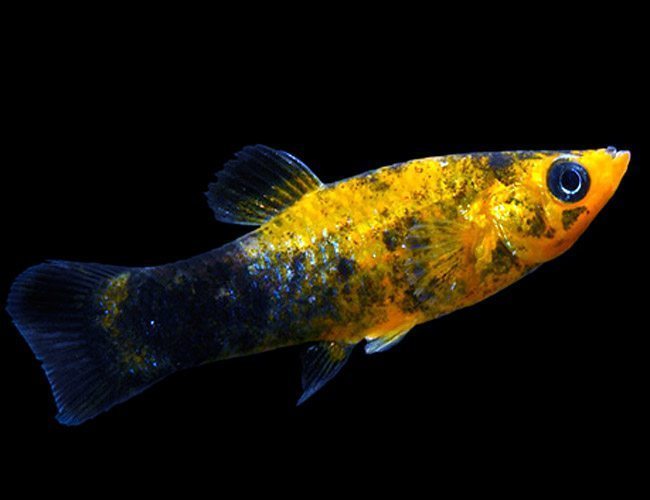
Feed algae-based foods with a varied omnivorous diet. Keep more females than males when both sexes are present and provide planted refuge.
16. Marble Molly
Marble Molly, labeled Poecilia spp., represents a domestic pattern strain from selective aquarium breeding. The clearest visual clue is irregular black, white, and gray marbling. Accurate labeling helps aquarists plan size, temperament, breeding, and line preservation.
Judge health by posture and activity rather than pattern. Healthy mollies swim level, breathe normally, hold fins open, and forage actively.
17. Silver Molly
Silver Molly (Poecilia spp.) is a domestic color strain associated with aquarium breeding. It is recognized by a bright silver-white body with translucent fins. Natural species have geographic histories, while domestic forms may combine genes from several molly lineages.
Pale color makes fin damage easy to notice. Feed a varied diet that includes plant and algae-based material. Mixed-sex groups can produce fry quickly.
18. White Molly
The White Molly is best described as a domestic color strain. Its background is aquarium breeding, and its defining appearance is an opaque white or creamy body. Store labels can be inconsistent, so body shape, fin structure, and health matter.
Dark plants or décor provide useful contrast. Quarantine new fish, maintain stable temperature and mineral balance, and avoid sudden salinity or pH shifts.
19. Golden Molly
With a yellow-gold body with orange highlights, the Golden Molly is easy to notice. It is listed here as a domestic color strain originating from aquarium breeding. A color or fin label should not automatically be treated as a separate biological species.
Color depends on genetics, diet, health, and lighting. Keep more females than males when both sexes are present and provide planted refuge.
20. Orange Molly
Orange Molly, labeled Poecilia spp., represents a domestic color strain from aquarium breeding. The clearest visual clue is a solid orange to reddish-orange body. Accurate labeling helps aquarists plan size, temperament, breeding, and line preservation.
Avoid abrupt temperature and water-chemistry changes. Healthy mollies swim level, breathe normally, hold fins open, and forage actively.
21. Chocolate Molly
Chocolate Molly (Poecilia spp.) is a domestic color strain associated with specialist ornamental lines. It is recognized by a warm brown to bronze body. Natural species have geographic histories, while domestic forms may combine genes from several molly lineages.
Buy from breeders who can describe the parent line. Feed a varied diet that includes plant and algae-based material. Mixed-sex groups can produce fry quickly.
22. Creamsicle Molly
The Creamsicle Molly is best described as a domestic pattern strain. Its background is ornamental breeding, and its defining appearance is cream, white, and orange patches. Store labels can be inconsistent, so body shape, fin structure, and health matter.
The name describes color, not species or adult size. Quarantine new fish, maintain stable temperature and mineral balance, and avoid sudden salinity or pH shifts.
23. Platinum Molly
With a pale reflective body with metallic sheen, the Platinum Molly is easy to notice. It is listed here as a domestic color strain originating from ornamental breeding. A color or fin label should not automatically be treated as a separate biological species.
Clean water helps preserve fin condition and luster. Keep more females than males when both sexes are present and provide planted refuge.
24. Lyretail Molly
Lyretail Molly, labeled Poecilia spp., represents a domestic fin strain from selective breeding across many colors. The clearest visual clue is elongated upper and lower tail rays. Accurate labeling helps aquarists plan size, temperament, breeding, and line preservation.

Avoid aggressive fin-nippers and excessive current. Healthy mollies swim level, breathe normally, hold fins open, and forage actively.
25. Black Lyretail Molly
Black Lyretail Molly (Poecilia spp.) is a combined color and fin strain associated with ornamental breeding. It is recognized by solid-black color with extended tail tips. Natural species have geographic histories, while domestic forms may combine genes from several molly lineages.
Tail rays should be balanced and free from fraying. Feed a varied diet that includes plant and algae-based material. Mixed-sex groups can produce fry quickly.
26. Dalmatian Lyretail Molly
The Dalmatian Lyretail Molly is best described as a combined pattern and fin strain. Its background is ornamental breeding, and its defining appearance is black-on-white spotting with a lyre-shaped tail. Store labels can be inconsistent, so body shape, fin structure, and health matter.
Provide open swimming space and planted refuge. Quarantine new fish, maintain stable temperature and mineral balance, and avoid sudden salinity or pH shifts.
27. Gold Dust Lyretail Molly
With gold-and-black color with extended tail rays, the Gold Dust Lyretail Molly is easy to notice. It is listed here as a combined color and fin strain originating from ornamental breeding. A color or fin label should not automatically be treated as a separate biological species.
Extreme fin extensions should not prevent normal movement. Keep more females than males when both sexes are present and provide planted refuge.
28. Balloon Molly
Balloon Molly, labeled Poecilia spp., represents a domestic body-shape strain from selective breeding. The clearest visual clue is a shortened rounded body from altered spinal development. Accurate labeling helps aquarists plan size, temperament, breeding, and line preservation.
Avoid exaggerated forms because welfare risks can increase. Healthy mollies swim level, breathe normally, hold fins open, and forage actively.
29. Black Balloon Molly
Black Balloon Molly (Poecilia spp.) is a combined body and color strain associated with ornamental breeding. It is recognized by a rounded body with solid-black color. Natural species have geographic histories, while domestic forms may combine genes from several molly lineages.
Prioritize balance, breathing, and feeding ability. Feed a varied diet that includes plant and algae-based material. Mixed-sex groups can produce fry quickly.
30. Dalmatian Balloon Molly
The Dalmatian Balloon Molly is best described as a combined body and pattern strain. Its background is ornamental breeding, and its defining appearance is a rounded body with black-and-white spotting. Store labels can be inconsistent, so body shape, fin structure, and health matter.
Monitor buoyancy, digestion, and pregnancy stress. Quarantine new fish, maintain stable temperature and mineral balance, and avoid sudden salinity or pH shifts.
31. Gold Balloon Molly
With a compact rounded body with yellow-gold color, the Gold Balloon Molly is easy to notice. It is listed here as a combined body and color strain originating from ornamental breeding. A color or fin label should not automatically be treated as a separate biological species.
Use gentle flow and avoid overcrowding. Keep more females than males when both sexes are present and provide planted refuge.
32. Black Sailfin Molly
Black Sailfin Molly, labeled Poecilia spp., represents a combined sailfin and color strain from hybridized ornamental lines. The clearest visual clue is dark color with an enlarged male dorsal sail. Accurate labeling helps aquarists plan size, temperament, breeding, and line preservation.
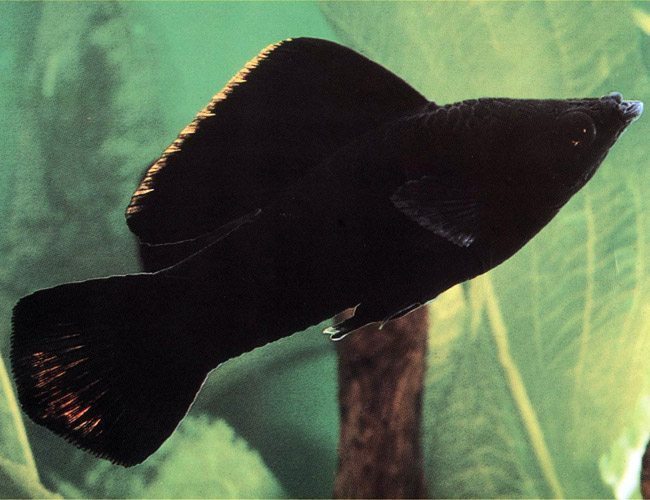
Allow enough tank length for display without conflict. Healthy mollies swim level, breathe normally, hold fins open, and forage actively.
33. Dalmatian Sailfin Molly
Dalmatian Sailfin Molly (Poecilia spp.) is a combined sailfin and pattern strain associated with hybridized ornamental lines. It is recognized by black-and-white spotting with a large dorsal fin. Natural species have geographic histories, while domestic forms may combine genes from several molly lineages.
Mineral-rich stable water and vegetable foods are useful. Feed a varied diet that includes plant and algae-based material. Mixed-sex groups can produce fry quickly.
34. Golden Sailfin Molly
The Golden Sailfin Molly is best described as a combined sailfin and color strain. Its background is hybridized ornamental lines, and its defining appearance is golden color and a tall sail-like dorsal fin. Store labels can be inconsistent, so body shape, fin structure, and health matter.
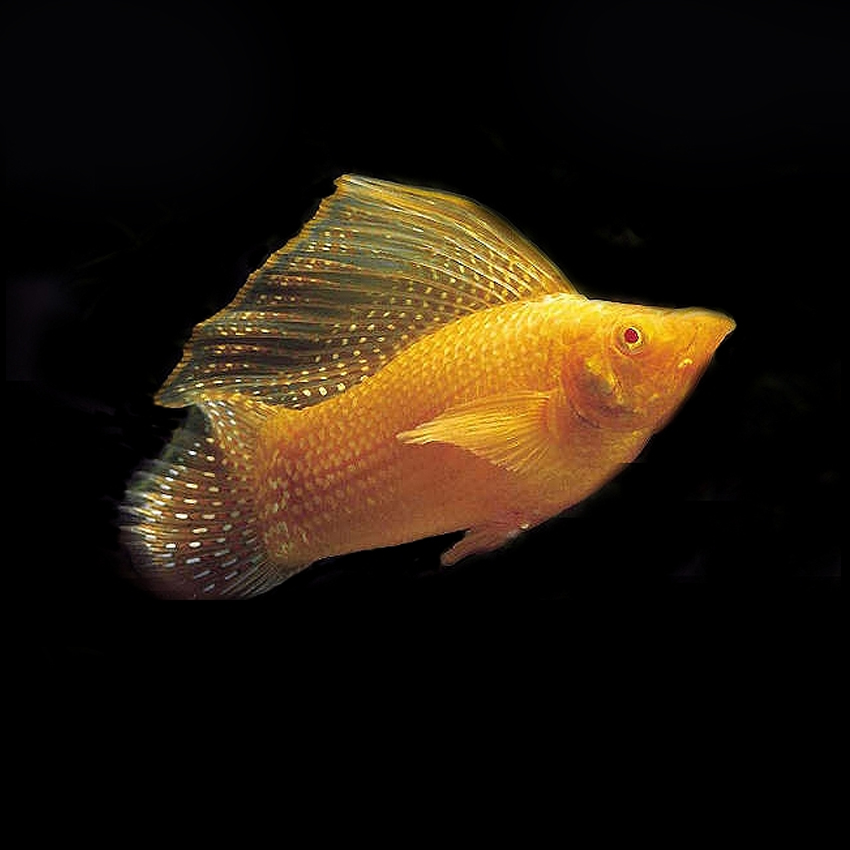
Its larger profile makes a spacious aquarium preferable. Quarantine new fish, maintain stable temperature and mineral balance, and avoid sudden salinity or pH shifts.
How Are These Types of Molly Fish Classified?
Mollies belong to the livebearer family Poeciliidae and genus Poecilia. Natural classification uses anatomy, genetics, distribution, and evolutionary relationships. Aquarium classification is informal and usually describes color, pattern, dorsal-fin size, tail shape, or body form. A black lyretail sailfin molly may carry several descriptive labels while remaining one domestic fish rather than three separate species.
Where Do Molly Fish Live?
Wild mollies occur mainly in warm parts of the Americas, including streams, springs, ponds, coastal lagoons, estuaries, and brackish canals. Different species have different ranges and tolerances. The fact that some mollies tolerate brackish water does not mean every aquarium molly needs salt.
How to Identify Different Types of Molly Fish
- Dorsal fin: Shortfin males have modest fins; sailfin males develop tall display fins.
- Anal fin: Males have a narrow gonopodium; females have a fan-shaped anal fin.
- Pattern: Black, Dalmatian, marble, gold dust, and creamsicle are trade descriptions.
- Tail: Lyretails have elongated upper and lower caudal rays.
- Body: Balloon mollies have a shortened rounded shape.
- Behavior: Healthy fish forage and swim steadily rather than rocking in place.
Aquarium Care Notes
- Use a fully cycled aquarium with consistent filtration.
- Provide open swimming room, plants, and visual barriers.
- Feed quality prepared food plus algae-based material.
- Do not overcrowd; livebearer populations expand rapidly.
- Avoid tankmates that nip long fins.
- Research the underlying species because sailfin forms need more room.
Safety, Sustainability, and Conservation Notes
Never release aquarium mollies into waterways. They may establish outside their native range, compete with local fish, or spread disease. Buy captive-bred fish when possible, quarantine arrivals, and avoid deliberately breeding severe deformities. Rare wild species and locality strains should not be lost through casual hybridization.
Fun Facts About Molly Fish
- Mollies give birth to free-swimming young.
- Females can store sperm for later broods.
- Male sailfins use dorsal fins in displays.
- The Amazon molly is an all-female lineage.
- Many black mollies have hybrid ancestry.
- Dalmatian and marble are patterns, not species.
- Mollies graze algae and biofilm.
- Some wild populations tolerate brackish water.
- Balloon shape comes from altered spinal development.
- Molly taxonomy continues to improve with genetic study.
Final Thoughts on Types of Molly Fish
The most useful way to understand types of molly fish is to separate biology from trade names. Shortfin, sailfin, Yucatan, Amazon, and other wild mollies are natural lineages, while black, Dalmatian, gold dust, lyretail, and sailfin colors are domestic forms. Choose healthy fish with functional body shapes, provide stable water and enough room, manage breeding responsibly, and never release unwanted fish outdoors.
Frequently Asked Questions
1. How many types of molly fish are there?
No single count exists because species, hybrids, colors, patterns, fins, and body forms are often combined.
2. What are the most common molly species?
Shortfin, sailfin, and Yucatan mollies are most often linked to aquarium strains.
3. Are black mollies a separate species?
Usually not; black is a domestic color form.
4. Are Dalmatian mollies a separate species?
No; Dalmatian describes a black-and-white pattern.
5. What is a sailfin molly?
A molly with an enlarged dorsal fin, especially in mature males.
6. What is a lyretail molly?
A molly with elongated upper and lower tail rays.
7. What is a balloon molly?
A selectively bred form with a shortened rounded body.
8. Are balloon mollies healthy?
Some live for years, but the compressed body can increase welfare risks.
9. Do mollies need salt?
Not automatically; suitable water chemistry and husbandry matter more.
10. Are mollies freshwater fish?
Most are freshwater or coastal livebearers, though several tolerate brackish water.
11. How big do mollies get?
Adult size varies; sailfin and Yucatan mollies become larger than many shortfin strains.
12. What tank size do mollies need?
It depends on adult size, group size, activity, and breeding.
13. Should mollies be kept in groups?
Yes, with enough room and a balanced sex ratio.
14. How many females per male?
Several females per male can reduce harassment, but space still matters.
15. How can males and females be identified?
Males have a gonopodium; females have a fan-shaped anal fin.
16. Do mollies lay eggs?
No; they are livebearers.
17. How often do mollies have fry?
Timing varies with temperature, health, age, and strain.
18. Will adults eat fry?
They may, so dense plants or separate space improve survival.
19. What do mollies eat?
Algae, biofilm, plant matter, small invertebrates, and prepared foods.
20. Can mollies live with guppies?
Often yes when water needs and tank size match.
21. Can mollies live with bettas?
Sometimes, but individual aggression and fin-nipping can cause problems.
22. Can different mollies breed together?
Many domestic forms and close species can hybridize.
23. Why is my molly rocking?
It can indicate stress, unsuitable water, temperature problems, or illness.
24. Why are the fins clamped?
Possible causes include stress, poor water, bullying, or disease.
25. Do mollies prefer hard water?
Many common mollies do best in mineral-rich water.
26. Can mollies live in seawater?
Some tolerate high salinity, but seawater is not the default requirement.
27. What is easiest for beginners?
A healthy shortfin domestic molly is often easier than rare wild species or balloon forms.
28. What is the rarest molly?
Several localized wild species are much rarer than commercial color strains.
29. How long do mollies live?
Lifespan depends on genetics, care, diet, disease prevention, and reproductive stress.
30. Should unwanted mollies be released?
No; rehome them through stores, clubs, or responsible keepers.
Read more:
30 Types of Mackerel Fish: Names and Identification