

The phrase types of musk ox usually refers to the two commonly recognized living subspecies: the barren-ground muskox and the white-faced, or Greenland, muskox. Both belong to the same Arctic species, Ovibos moschatus, and their differences are subtle. Geographic origin is generally more useful for identification than coat color or body size alone.
This guide explains the appearance, natural range, habitat, diet, behavior, and conservation of both muskox types. It also separates true subspecies from introduced populations in Alaska, Norway, Russia, and other regions. That distinction matters because an “Alaskan muskox” or “Norwegian muskox” describes where an animal lives today, not a separate scientific type.
What Are the Main Types of Musk Ox?
The two main types of musk ox are the barren-ground muskox (Ovibos moschatus moschatus) and the white-faced or Greenland muskox (Ovibos moschatus wardi). The barren-ground form is native mainly to mainland Arctic Canada, while the white-faced form is associated with Greenland and the Canadian Arctic islands. They can interbreed, and some taxonomists consider their physical differences modest, so location and population history remain central to identification.
Musk Ox Types at a Glance
| Type | Scientific Name | Native Range | Typical Traits | Introduced Descendants |
|---|---|---|---|---|
| Barren-ground muskox | Ovibos moschatus moschatus | Mainland Arctic Canada | Generally larger, often darker-faced, with heavier horn development in mature bulls | Not the main source of most well-known overseas reintroductions |
| White-faced or Greenland muskox | Ovibos moschatus wardi | Greenland and much of the Canadian Arctic Archipelago | Often slightly smaller, with more pale hair on the face, saddle, and lower legs | Source of important reintroduced populations, including those in Alaska and parts of Eurasia |
1. Barren-Ground Muskox
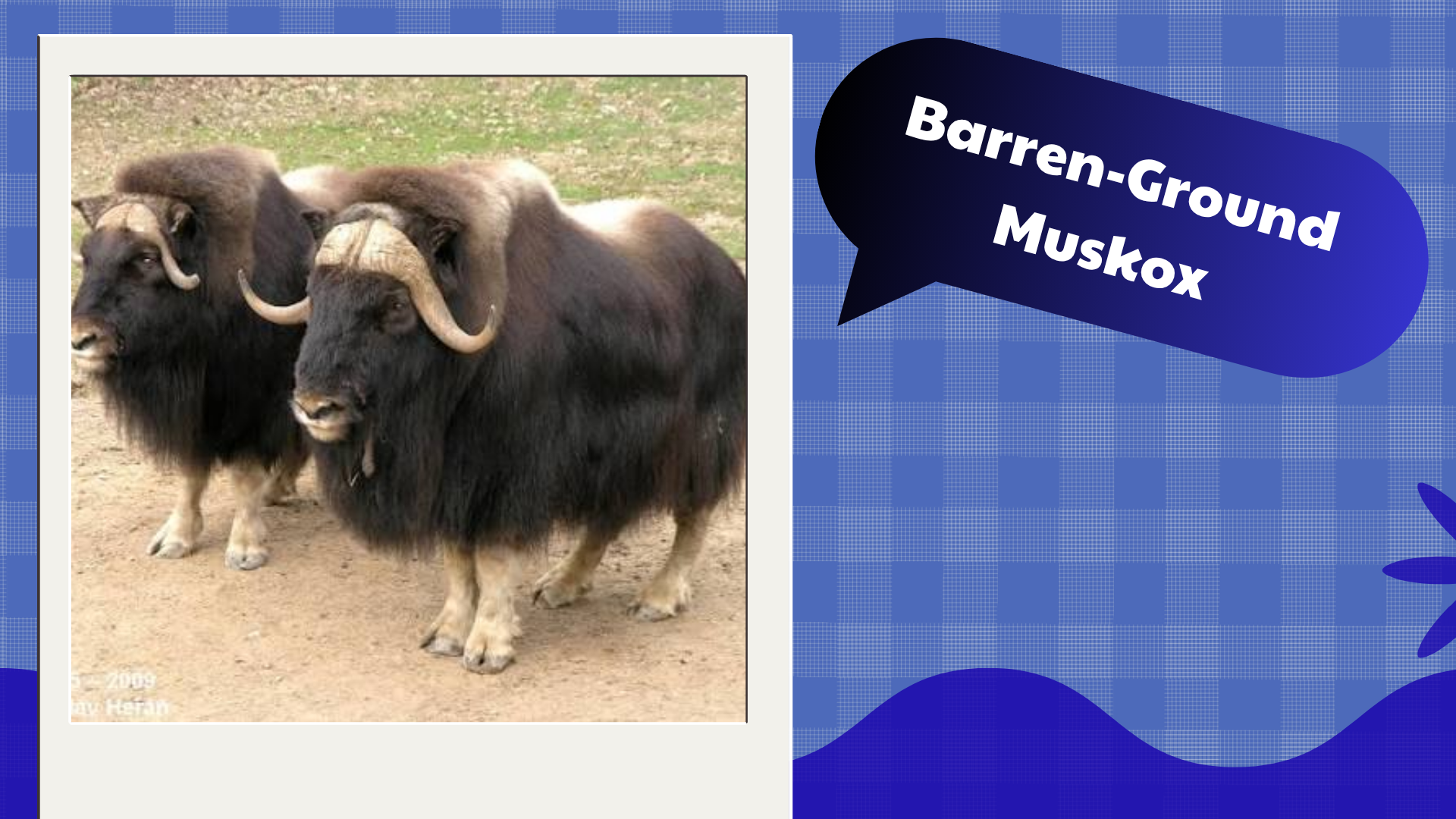
The barren-ground muskox (Ovibos moschatus moschatus) is the nominate subspecies, meaning its scientific subspecies name repeats the species name. It is native chiefly to the mainland tundra of Arctic Canada, particularly areas of Nunavut and the Northwest Territories. Here it occupies open tundra, river valleys, low uplands, and windswept ground where winter forage is not buried beneath deep or heavily crusted snow.
This type is generally described as the larger of the two subspecies. Mature bulls have a stocky body, short legs, a slight shoulder hump, and heavy horns. The horn bases of an adult male broaden across the forehead to form a thick boss, while the horns sweep down beside the head and curve upward at the tips. Cows also have horns, but the bases are narrower and do not form the same massive shield. Long, dark guard hairs hang like a skirt, partly hiding the legs and making the animal appear larger than it is.
Barren-ground muskoxen are Arctic herbivores. During the short growing season, they select grasses, sedges, willows, and nutritious flowering plants. Winter narrows the menu to dry grasses, sedges, twigs, and other vegetation they can uncover with their hooves or muzzle. Unlike caribou, muskoxen do not normally make long seasonal migrations. Their compact build conserves heat but makes deep snow costly to cross, so access to wind-scoured feeding areas is essential.
Herd life provides protection. When wolves or other threats approach, adults may form a line or defensive ring with horns facing outward and calves protected behind them. This behavior is effective against natural predators but historically made grouped animals vulnerable to hunters with firearms. Today, management varies among regions and often combines scientific surveys with Indigenous knowledge and community harvest systems. Changes in icing, snow depth, disease, and forage can affect individual herds even when the species remains widespread.
2. White-Faced or Greenland Muskox
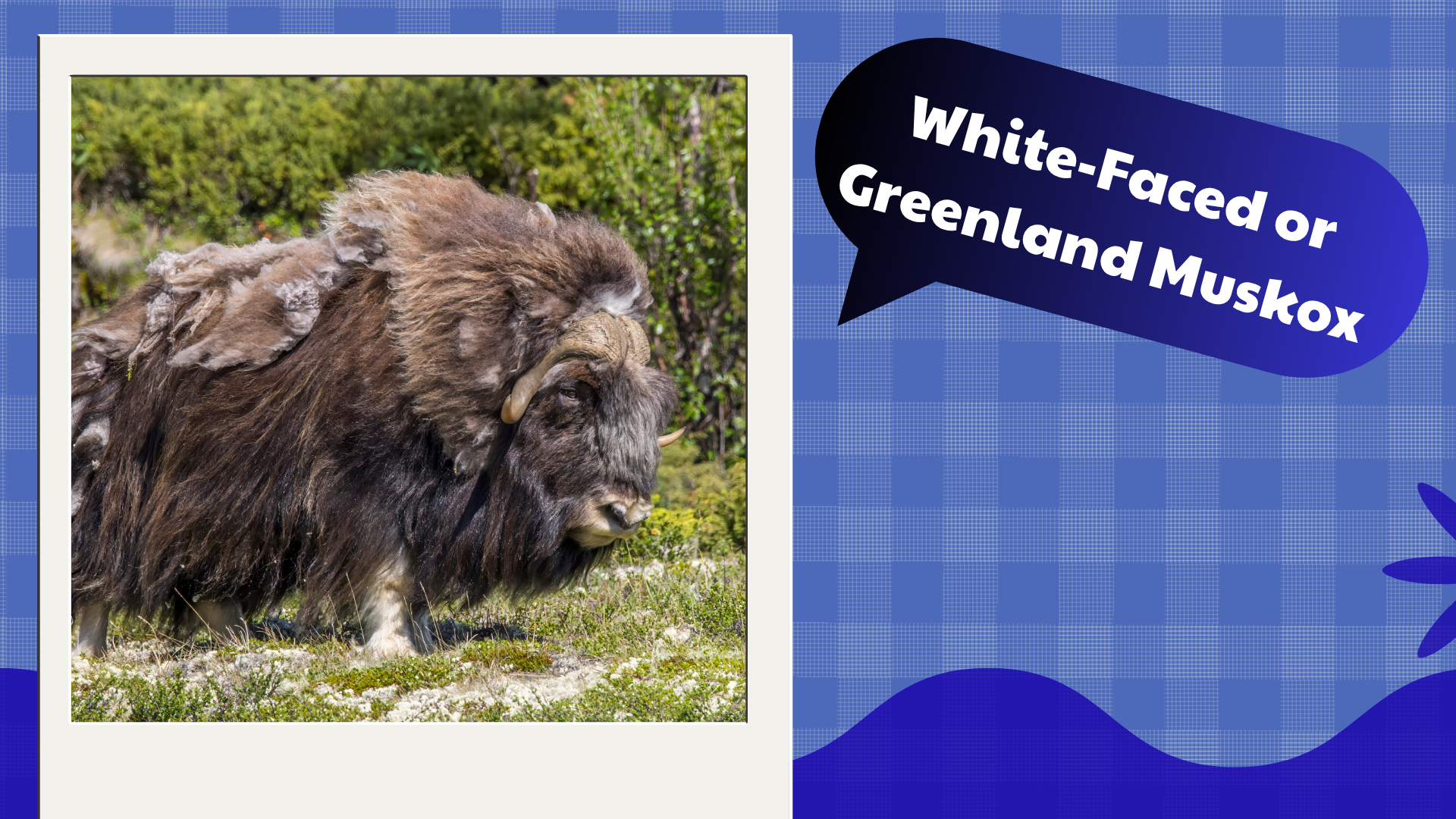
The white-faced muskox (Ovibos moschatus wardi) is also known as the Greenland muskox or island muskox. Its native distribution centers on northern and northeastern Greenland and much of the Canadian Arctic Archipelago. The common name highlights the tendency for pale cream or buff hair to be more noticeable on the forehead and around the face, although coat markings vary and are not a perfect field test.
White-faced muskoxen are often described as slightly smaller than mainland barren-ground animals, with somewhat lighter horn development. Mature bulls still carry substantial horn bosses, and both sexes share the species’ heavy coat, short tail, cloven hooves, and low-slung appearance. A light saddle across the back and pale hair on the lower legs may stand out against the dark brown guard hairs. Age, season, bleaching, lighting, and individual variation can change how these patterns appear, making geographic origin the more dependable clue.
The subspecies survives in polar deserts and tundra where the growing season is brief. It grazes sedges and grasses and browses dwarf willows and other low plants. Beneath the long outer coat is qiviut, an extremely fine insulating underwool that is shed seasonally. The coat, compact body, and ability to reduce heat loss from the legs allow muskoxen to remain in the Arctic year-round rather than migrating south or hibernating.
This subspecies also has an unusually broad modern footprint because animals of Greenland origin were used in restoration and introduction projects. Muskoxen now living wild in Alaska descend from Greenland stock brought to Alaska in the twentieth century after the state’s original muskoxen had disappeared. Populations in Norway and some parts of Russia also trace to translocated animals. These herds are geographically distinct, but they are not new subspecies. Their management may involve population monitoring, regulated harvest, public-safety measures, or efforts to reduce conflict near communities and roads.
How Are These Types of Musk Ox Classified?
The muskox is the only living species in the genus Ovibos. Despite its cattle-like build and English name, it belongs to the caprine branch of the bovid family and is more closely related to goats, sheep, and takins than to true oxen. “Musk” also requires explanation: rutting bulls produce a strong odor, but muskoxen do not possess the specialized musk gland of a musk deer.
| Rank | Classification |
|---|---|
| Kingdom | Animalia |
| Phylum | Chordata |
| Class | Mammalia |
| Order | Artiodactyla |
| Family | Bovidae |
| Tribe | Ovibovini |
| Genus | Ovibos |
| Species | Ovibos moschatus |
Why Do Some Sources Treat Muskoxen as One Type?
The two named subspecies overlap in many physical traits, and the differences between them are often matters of average size, horn mass, facial coloration, and geographic origin rather than sharp diagnostic features. They can interbreed. For those reasons, some references discuss the muskox as a single variable species without emphasizing subspecies, while other zoological sources retain O. m. moschatus and O. m. wardi.
Are Alaskan and Norwegian Muskoxen Separate Types?
No. Alaska, Norway, Sweden, and Russia have well-known introduced or restored populations, but those place names describe modern populations rather than additional subspecies. Many of these herds descend wholly or partly from Greenland-origin white-faced muskoxen. Population origin should be checked before assigning any introduced herd to a subspecies.
Where Do Muskoxen Live?
The natural modern range of the muskox is in Arctic Canada and Greenland. Human-assisted translocations have restored the animal to Alaska and established herds in parts of northern Europe and Russia. Some introductions failed, while others produced lasting populations that now attract wildlife watchers and require active management.
- Arctic mainland: Open tundra, rolling uplands, river corridors, and coastal plains in northern Canada.
- Arctic islands: Polar desert and tundra across parts of the Canadian Arctic Archipelago.
- Greenland: Ice-free coastal and inland tundra where plants are available during the short summer.
- Alaska: Reintroduced populations occur in western and northern parts of the state.
- Northern Eurasia: Introduced herds live in selected areas of Norway, Sweden, and Russia.
Good muskox habitat must provide more than cold temperatures. Winter snow conditions strongly influence access to food. Deep snow costs energy, while hard ice layers may prevent animals from reaching plants. Wind-blown ridges and slopes can be valuable because they remain relatively shallow or free of snow. In summer, productive lowlands and river valleys offer sedges, grasses, and willows that help animals rebuild fat reserves.
How to Identify Different Types of Musk Ox
- Confirm the origin: Native mainland Canadian animals are generally associated with the barren-ground subspecies; Greenland and many Arctic island animals are associated with the white-faced form.
- Check translocation history: An animal’s present country does not necessarily reveal its ancestral subspecies.
- Compare average size: Barren-ground muskoxen tend to be larger, but age, sex, season, and nutrition create overlap.
- Look at the face: The white-faced form often shows more pale hair on the forehead and face, but individual variation limits this clue.
- Study mature bulls: Mainland bulls may average heavier horn bases, yet a single animal should not be identified from horn mass alone.
- Notice the saddle: Both types can show a lighter patch across the back, so a pale saddle identifies the species better than the subspecies.
- Separate sex from type: A cow’s narrower horn bases do not mean she belongs to a different subspecies.
- Use several clues: Reliable identification combines range, known ancestry, body proportions, coat markings, and herd records.
Muskox Versus Bison
A muskox has a shaggy skirt of long guard hair, a short tail, and horns that sweep down before turning upward. A bison is much larger, has a pronounced shoulder hump, and carries shorter horns that project outward and upward. Bison inhabit grasslands, parklands, and some boreal landscapes, while muskoxen are specialists of Arctic and subarctic tundra.
Muskox Versus Yak
Domestic and wild yaks have long hair and live in cold regions, but they are true cattle relatives native to Asia. Yaks usually show a more cattle-like head, a longer tail, and horns that extend outward and upward rather than forming the muskox’s distinctive downward sweep beside the face.
Muskox Versus Caribou
Caribou are longer-legged and grow branching antlers that are shed. Muskoxen are stockier and carry permanent, unbranched horns. Caribou may migrate great distances, whereas muskoxen generally make shorter seasonal movements and conserve energy by remaining within a more limited area.
Outdoor Tips for Finding and Observing Muskoxen
- Choose an established viewing location. Use current information from a park or wildlife agency rather than entering remote tundra without local guidance.
- Scan open ground with binoculars. Muskoxen are large, but their brown coats blend into tundra vegetation and dark rock.
- Stay at least 150 feet away where that rule applies. Local requirements may demand even greater distance, so always follow posted guidance.
- Never approach a cow and calf. Adults can defend young quickly and forcefully.
- Do not walk into a herd’s path. Give the animals room to feed, rest, and move away.
- Keep dogs leashed and distant. Muskoxen may perceive dogs as wolves and respond defensively.
- Watch for warning behavior. Raised heads, direct staring, pawing, head swinging, bunching, or facing toward you indicate that you should retreat calmly.
- Do not run toward or past the herd. Increase distance without sudden movements and place a substantial obstacle between you and the animals if necessary.
- Use a long lens. A close photograph is never worth stressing wildlife or risking injury.
- Prepare for Arctic conditions. Weather, river crossings, visibility, and remoteness can be greater hazards than the animals themselves.
Safety, Sustainability, and Conservation Notes
Muskoxen may appear slow and calm, but they can sprint and use sharp horns with great force. Never crowd, feed, touch, or try to move one. If a muskox reacts to your presence, back away calmly. Keep a building, vehicle, large rock, or other solid barrier available when viewing animals near settlements. Dogs require particular care because their resemblance to a natural predator can provoke a defensive response.
The muskox is assessed globally as a species of relatively low extinction risk, but that broad status does not mean every herd is secure. Severe winters, rain-on-snow events, disease, parasites, predation, harvest pressure, and changing forage can drive regional declines. Management must therefore be based on current herd-level surveys rather than a global label alone.
Muskoxen are important to many northern communities as food, material, cultural heritage, and a managed wildlife resource. Legal subsistence and regulated hunts are governed by local authorities and may be tailored to a specific management unit. Visitors and hunters should use current regulations, respect community practices, avoid disturbing research equipment, and report sick or dead animals when local agencies request observations.
Fun Facts About Musk Ox
- The correct plural forms include both “muskoxen” and “musk oxen.”
- A muskox is more closely related to goats and sheep than to domestic cattle.
- Its genus name, Ovibos, combines the idea of sheep and ox.
- Both bulls and cows carry permanent horns.
- The soft insulating undercoat is called qiviut.
- Long outer guard hairs can hang almost to the ground.
- Muskoxen do not hibernate and remain in cold northern habitat throughout winter.
- A threatened herd may form a defensive line or circle around calves.
- Alaska’s modern wild muskoxen descend from animals reintroduced after the original population disappeared.
- Muskoxen lived alongside now-extinct Ice Age mammals and survived into the modern Arctic.
Final Thoughts on Types of Musk Ox
The two commonly recognized types of musk ox are the barren-ground muskox and the white-faced, or Greenland, muskox. Their differences are real but subtle, and the best identification begins with native range or documented ancestry rather than a quick judgment about color. Alaskan, Norwegian, Swedish, and Russian herds are important modern populations, not additional subspecies. Learning that distinction makes it easier to understand muskox evolution, reintroduction history, and the conservation needs of individual Arctic herds.
Frequently Asked Questions
1. How many types of musk ox are there?
Two living subspecies are commonly recognized: the barren-ground muskox and the white-faced or Greenland muskox. Some authorities emphasize the species as a whole because the differences between the subspecies are limited and variable.
2. What is the scientific name of the musk ox?
The scientific name is Ovibos moschatus. The barren-ground subspecies is O. m. moschatus, and the white-faced subspecies is O. m. wardi.
3. Is “muskox” one word or two?
Both “muskox” and “musk ox” are used in English. Many wildlife agencies use “muskox” as one word, with “muskoxen” as the plural.
4. Are muskoxen really oxen?
No. They are bovids but belong to the caprine evolutionary branch, making them closer to goats and sheep than to domestic cattle. Their heavy build inspired the ox portion of the common name.
5. Why are they called muskoxen?
During the breeding season, dominant bulls produce a strong odor used in reproductive communication. The name does not mean the animal has the same type of musk gland found in musk deer.
6. What is a barren-ground muskox?
It is the mainland subspecies, Ovibos moschatus moschatus, native mainly to Arctic Canada. It is generally larger and may have heavier horn development than the white-faced form.
7. What is a white-faced muskox?
The white-faced muskox, Ovibos moschatus wardi, is associated with Greenland and much of the Canadian Arctic Archipelago. It often shows more pale facial hair and is also called the Greenland or island muskox.
8. Can the two muskox subspecies interbreed?
Yes. They are forms of the same species and can interbreed. This reinforces why their boundary is less distinct than the boundary between separate species.
9. Which type of musk ox is larger?
The barren-ground muskox is generally described as larger on average. There is considerable overlap, and sex, age, nutrition, and local environment strongly influence the size of an individual.
10. Is an Alaskan muskox a separate type?
No. “Alaskan muskox” identifies a modern population, not a recognized subspecies. Alaska’s current animals descend from Greenland-origin stock reintroduced during the twentieth century.
11. Are Norwegian muskoxen native to Norway?
The present Norwegian herd descends from introduced Greenland animals. Muskox relatives occurred in Europe in the distant past, but today’s Norwegian population is the result of modern translocation.
12. Where are muskoxen native?
The surviving natural range is in Arctic Canada and Greenland. Modern wild herds also occur in regions where people restored or introduced the species, including Alaska and parts of northern Eurasia.
13. What habitat do muskoxen prefer?
They use open Arctic tundra, polar desert, river valleys, coastal plains, and windswept uplands. Winter habitat must allow them to reach vegetation without expending too much energy in deep or icy snow.
14. Do muskoxen migrate?
They may make seasonal movements, but they do not usually undertake the enormous migrations associated with many caribou herds. Their compact bodies and shorter legs favor conserving energy within a more limited range.
15. What do muskoxen eat?
Muskoxen eat grasses, sedges, willows, and other tundra plants. Summer provides fresh, nutritious growth, while winter limits them to dry vegetation and woody browse they can uncover beneath snow.
16. How do muskoxen find food in winter?
They use their hooves and muzzles to expose vegetation and often select windswept places where snow is shallow. Thick ice over forage can create serious problems because muskoxen are not built to dig through every hard layer.
17. How do muskoxen stay warm?
A dense layer of qiviut traps insulating air close to the body, while long guard hairs block wind and shed snow. Their stocky form and relatively short legs also reduce heat loss.
18. What is qiviut?
Qiviut is the very fine underwool beneath a muskox’s outer coat. It is shed seasonally and can be collected and spun into exceptionally soft, warm yarn.
19. Do both male and female muskoxen have horns?
Yes. Bulls develop thicker horns and broad bases that nearly meet across the forehead, while cows have narrower bases with a visible hairy space between them.
20. Do muskoxen shed their horns?
No. Their horns are permanent and continue developing over time. This differs from antlers, which animals such as caribou shed and regrow.
21. How can you tell a male muskox from a female?
Adult bulls are usually larger and have much heavier horn bosses across the forehead. Cows have slimmer horns with more space between the bases, although identifying young animals can be difficult at a distance.
22. Why do muskoxen form a circle?
A herd may face outward in a defensive circle when threatened by multiple predators, keeping calves inside. Against a single threat, animals may instead form a line with their horns directed toward it.
23. What animals hunt muskoxen?
Wolves are their best-known natural predators. Bears may also kill muskoxen, while calves are more vulnerable than healthy adults to a wider range of threats.
24. How fast can a muskox run?
A muskox can accelerate much faster than its heavy coat and stocky build suggest. Exact speeds vary among reports, but visitors should never assume they can outrun or safely approach one.
25. How long do muskoxen live?
They commonly live about 12 to 20 years under favorable conditions. Weather, nutrition, disease, predation, and sex all influence survival.
26. Are muskoxen endangered?
The species is not currently considered globally endangered, but population trends vary by region. Some herds can decline because of disease, severe weather, icing, predation, or other local pressures.
27. How does climate change affect muskoxen?
Warmer conditions can alter vegetation, parasites, disease, snow depth, and rain-on-snow events. When rain freezes over winter forage, a hard ice layer may prevent animals from reaching food even when plants remain underneath.
28. Are muskoxen dangerous to people?
They can be dangerous when approached, cornered, chased, or defending calves. Their horns, strength, and speed demand respect, even when the animals appear calm.
29. How far should you stay from a muskox?
Follow the rule set by the local park or wildlife agency. In some Alaskan park areas, guidance calls for staying at least 150 feet away; greater distance is appropriate if an animal reacts to your presence.
30. What is the best way to identify a muskox subspecies?
Use the animal’s native origin or documented population history first, then consider average size, facial markings, and horn development. Appearance alone is not consistently reliable because the two forms overlap.