

The phrase types of rays fish usually refers to the broad and remarkably diverse group of flattened cartilaginous fishes known as rays, skates, sawfish, guitarfishes, wedgefishes, and their relatives. They range from small round rays hidden in beach sand to giant mantas crossing the open ocean.
This guide introduces 40 practical examples with identification clues, habitat notes, feeding behavior, safety information, and conservation context. It also explains why not every ray is a stingray and why body shape, tail structure, underside markings, and geographic range matter when identifying these animals.
What Are the Main Types of Ray Fish?
The main ray groups include stingrays, manta and devil rays, eagle and cownose rays, electric rays, butterfly rays, skates, sawfish, guitarfishes, wedgefishes, and freshwater river rays. All belong to the cartilaginous fish lineage shared with sharks, but their lifestyles differ greatly. Some filter plankton, some crush shellfish, some generate electricity, and others use a saw-like snout to locate and strike prey.
Quick Comparison of the 40 Types of Ray Fish
| No. | Common Name | Scientific Name | Group | Best Identification Clue |
|---|---|---|---|---|
| 1 | Giant Oceanic Manta Ray | Mobula birostris | Manta ray | its immense wingspan and terminal mouth |
| 2 | Reef Manta Ray | Mobula alfredi | Manta ray | the black shoulder patches and individual belly-spot pattern |
| 3 | Chilean Devil Ray | Mobula tarapacana | Devil ray | its long sickle-shaped wings and robust body |
| 4 | Spinetail Devil Ray | Mobula mobular | Devil ray | its devil-ray head lobes and very long pointed pectoral fins |
| 5 | Bentfin Devil Ray | Mobula thurstoni | Devil ray | the bent, falcate fin tips |
| 6 | Spotted Eagle Ray | Aetobatus narinari | Eagle ray | the white-spotted back and duckbill-shaped snout |
| 7 | Ocellated Eagle Ray | Aetobatus ocellatus | Eagle ray | its ring-like dorsal markings |
| 8 | Bat Ray | Myliobatis californica | Eagle ray | the solid dark back and angular wing shape |
| 9 | Cownose Ray | Rhinoptera bonasus | Cownose ray | the bilobed forehead |
| 10 | Bullnose Ray | Myliobatis freminvillei | Eagle ray | the smooth, rounded bull-like snout |
| 11 | Southern Stingray | Hypanus americanus | Whiptail stingray | its angular disc and long whip tail |
| 12 | Atlantic Stingray | Hypanus sabinus | Whiptail stingray | the long pointed snout on a relatively small disc |
| 13 | Roughtail Stingray | Bathytoshia centroura | Whiptail stingray | the coarse, thorny tail |
| 14 | Short-Tail Stingray | Bathytoshia brevicaudata | Whiptail stingray | the unusually short tail relative to the huge disc |
| 15 | Pelagic Stingray | Pteroplatytrygon violacea | Whiptail stingray | the uniformly dark body and pelagic setting |
| 16 | Bluespotted Ribbontail Ray | Taeniura lymma | Ribbontail ray | the vivid blue spots and tail stripes |
| 17 | Blue-Spotted Maskray | Neotrygon kuhlii species complex | Maskray | the dark mask across the eyes plus scattered blue spots |
| 18 | Round Stingray | Urobatis halleri | Round ray | the almost round body |
| 19 | Yellow Stingray | Urobatis jamaicensis | Round ray | the yellow-and-dark rosette pattern |
| 20 | Ocellate River Stingray | Potamotrygon motoro | Freshwater river ray | the bold ocellated spots |
| 21 | Black Diamond River Stingray | Potamotrygon leopoldi | Freshwater river ray | the black-and-white polka-dot pattern |
| 22 | Giant Freshwater Stingray | Urogymnus polylepis | Freshwater whipray | its massive plain disc and very long tail |
| 23 | Porcupine Ray | Urogymnus asperrimus | Whiptail stingray | the rough, porcupine-like body surface |
| 24 | Mangrove Whipray | Urogymnus granulatus | Whiptail stingray | its robust disc and mangrove-associated habitat |
| 25 | Marbled Whipray | Himantura oxyrhyncha | Whiptail stingray | the marbled disc and needle-like snout |
| 26 | Broad Cowtail Ray | Pastinachus ater | Cowtail ray | the broad tail fold |
| 27 | Longtail Butterfly Ray | Gymnura poecilura | Butterfly ray | the very broad wings and thin tail |
| 28 | Spiny Butterfly Ray | Gymnura altavela | Butterfly ray | the broad butterfly-shaped disc with a short tail |
| 29 | Atlantic Torpedo | Tetronarce nobiliana | Electric ray | the bulky circular body and robust tail |
| 30 | Pacific Electric Ray | Tetronarce californica | Electric ray | the thick torpedo shape |
| 31 | Lesser Electric Ray | Narcine bancroftii | Electric ray | the small circular disc and compact tail |
| 32 | Common Skate Complex | Dipturus batis species complex | Skate | the very large size and sharply pointed snout |
| 33 | Thornback Ray | Raja clavata | Skate | the row of prominent thorns along the back and tail |
| 34 | Little Skate | Leucoraja erinacea | Skate | its small size and rounded snout |
| 35 | Clearnose Skate | Rostroraja eglanteria | Skate | the see-through windows beside the snout |
| 36 | Smalltooth Sawfish | Pristis pectinata | Sawfish | the toothed saw and lack of a lower tail lobe |
| 37 | Largetooth Sawfish | Pristis pristis | Sawfish | the widely spaced large rostral teeth |
| 38 | Bowmouth Guitarfish | Rhina ancylostoma | Wedgefish | the rounded striped head and tall shark-like fins |
| 39 | Common Guitarfish | Rhinobatos rhinobatos | Guitarfish | the guitar-shaped outline |
| 40 | Shovelnose Guitarfish | Pseudobatos productus | Guitarfish | the long shovel-shaped head |
1. Giant Oceanic Manta Ray
Giant Oceanic Manta Ray (Mobula birostris) is a manta ray recognized by a huge diamond-shaped disc, long pointed wings, and forward-facing cephalic lobes. It occurs in tropical, subtropical, and warm-temperate open seas worldwide. Typical food includes zooplankton and small schooling organisms filtered from the water. Its size is best described as very large, with one of the broadest wingspans among rays.
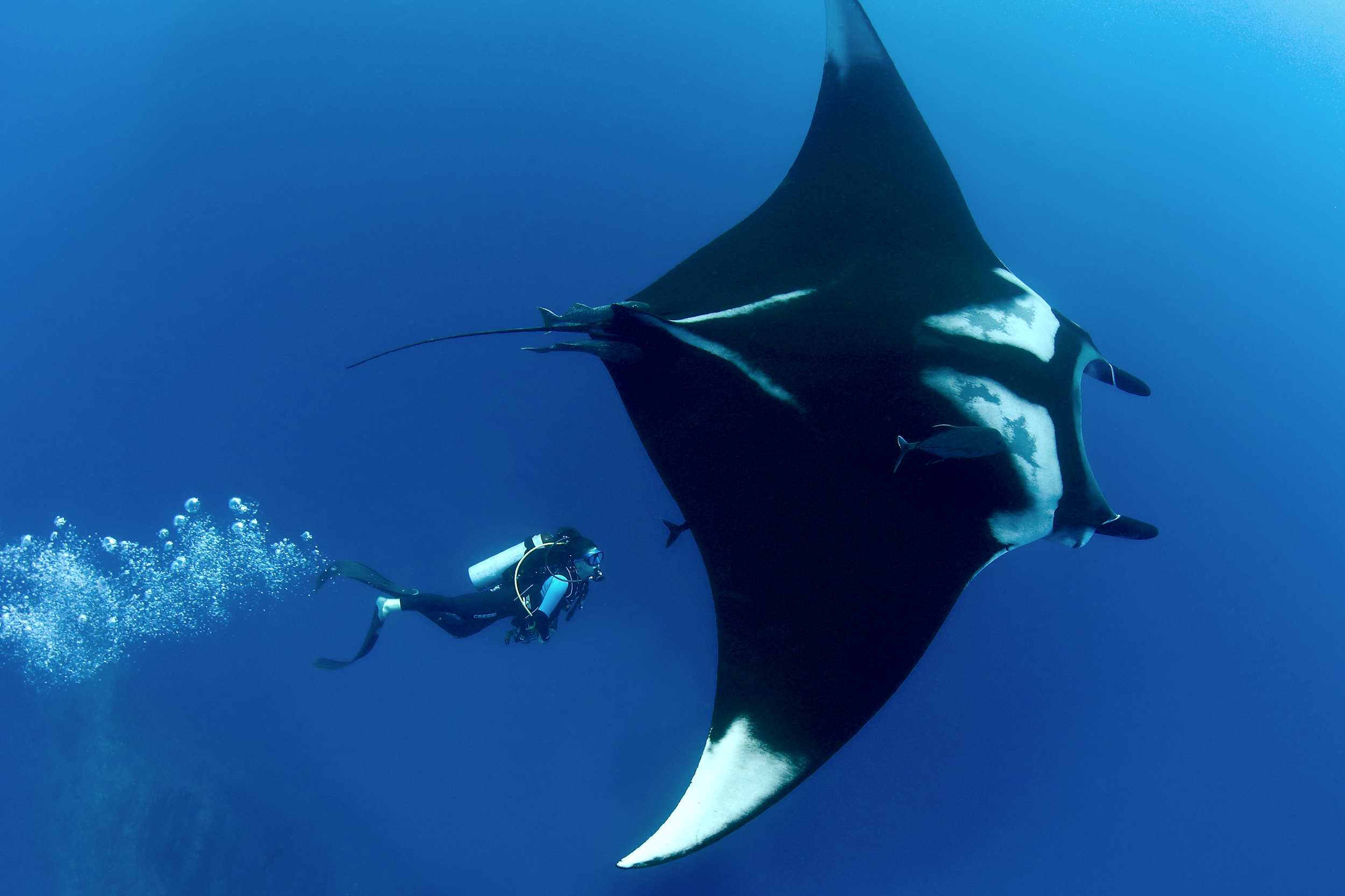
It is a wide-ranging filter feeder that may visit cleaning stations and productive offshore areas. Observe from a distance and never block its swimming path. The quickest field clue is its immense wingspan and terminal mouth.
2. Reef Manta Ray
Among the most distinctive rays, Reef Manta Ray (Mobula alfredi) belongs to the manta ray group and is identified by a broad black-and-white disc with distinctive belly markings and curled head lobes. It occurs in tropical reefs, lagoons, and island shelves across the Indo-Pacific. Typical food includes plankton gathered during feeding loops and surface feeding. Its size is best described as very large but generally smaller than the giant oceanic manta.
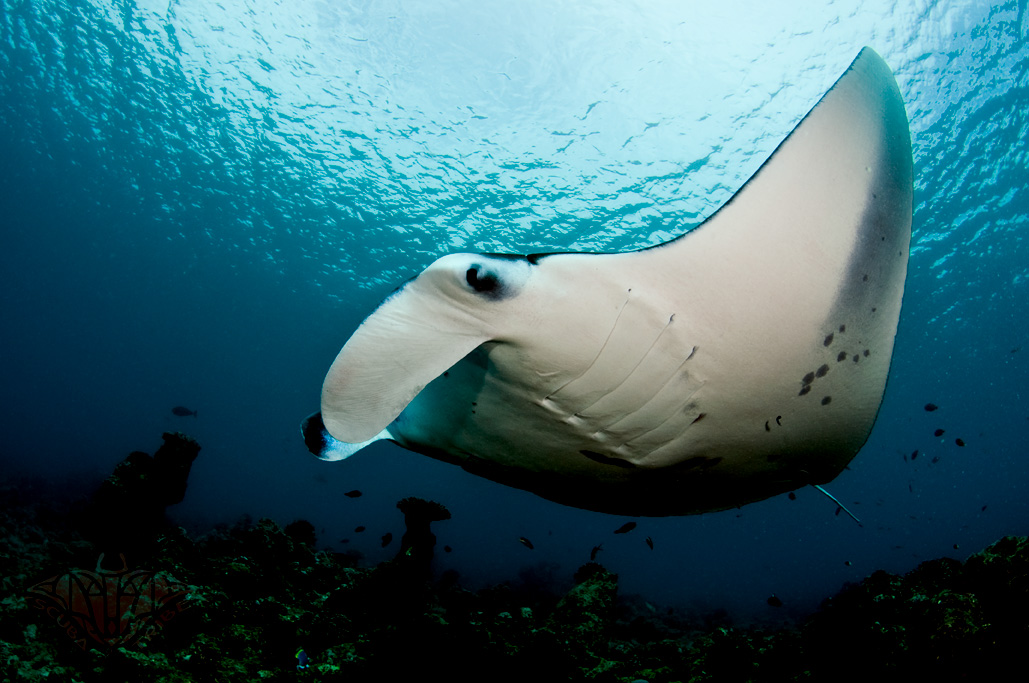
Individuals can often be recognized by their unique ventral spot patterns. Responsible tourism avoids touching, chasing, or crowding feeding animals. The quickest field clue is the black shoulder patches and individual belly-spot pattern.
3. Chilean Devil Ray
Chilean Devil Ray (Mobula tarapacana) shows how varied batoid fishes can be: long swept-back fins, a projecting head, and a darker upper surface. It occurs in warm oceanic waters in several major oceans. Typical food includes plankton and small pelagic prey. Its size is best described as large and strongly built.

This oceanic ray is capable of deep dives despite often being seen near the surface. Its offshore lifestyle makes direct observation uncommon. The quickest field clue is its long sickle-shaped wings and robust body.
4. Spinetail Devil Ray
Look for pointed wings, paired cephalic lobes, and a slender tail with a small spine when identifying Spinetail Devil Ray (Mobula mobular), a member of the devil ray group. It occurs in warm offshore and coastal waters of the Atlantic, Mediterranean, and adjoining seas. Typical food includes small fishes and planktonic organisms. Its size is best described as large.
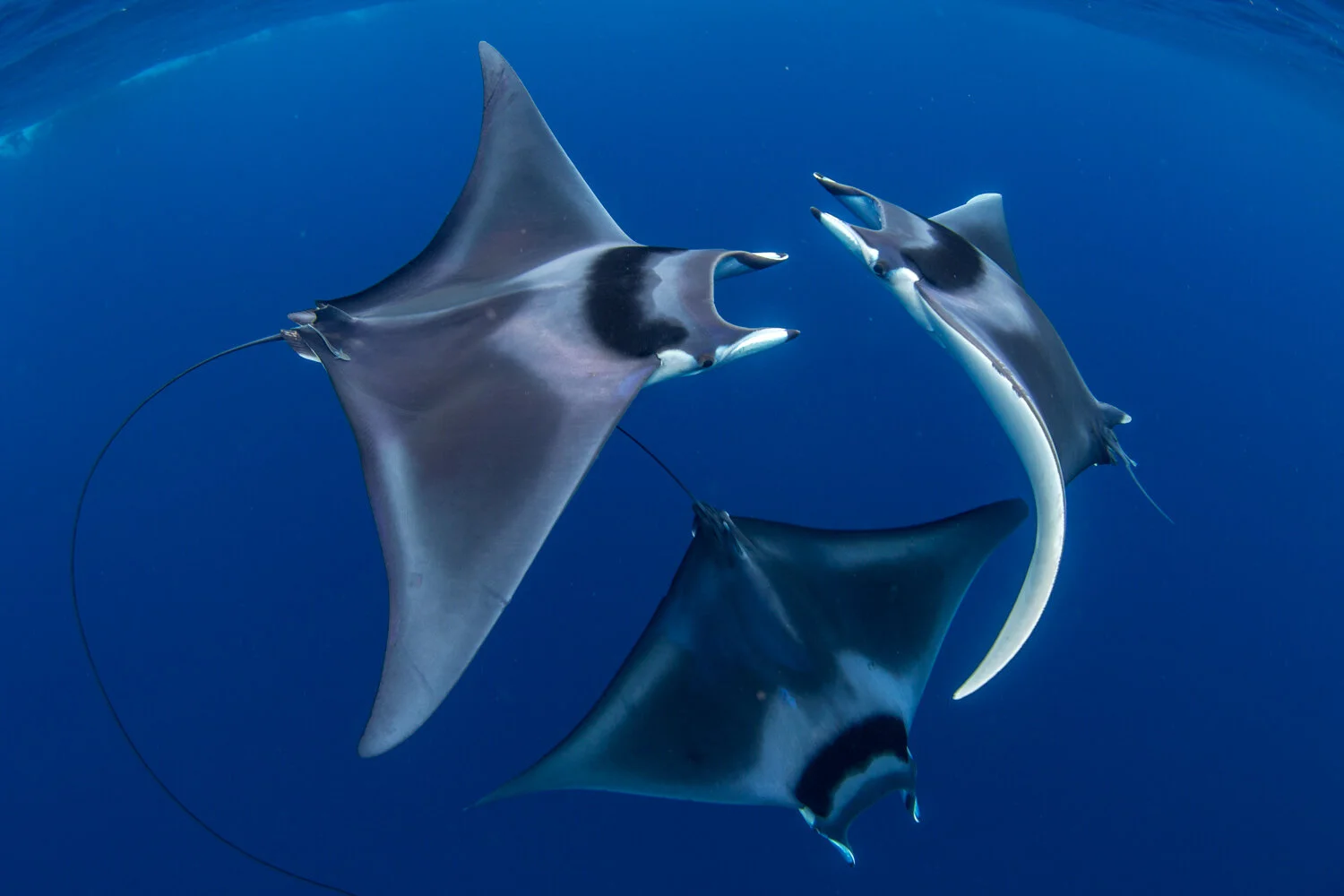
It travels through open water and may form groups where food is concentrated. Many mobulid rays are vulnerable to fishing pressure. The quickest field clue is its devil-ray head lobes and very long pointed pectoral fins.
5. Bentfin Devil Ray
Bentfin Devil Ray (Mobula thurstoni) is a devil ray recognized by a compact disc with noticeably curved fin tips and a dark dorsal surface. It occurs in tropical and subtropical oceans around the world. Typical food includes plankton and small schooling fishes. Its size is best described as medium to large for a devil ray.
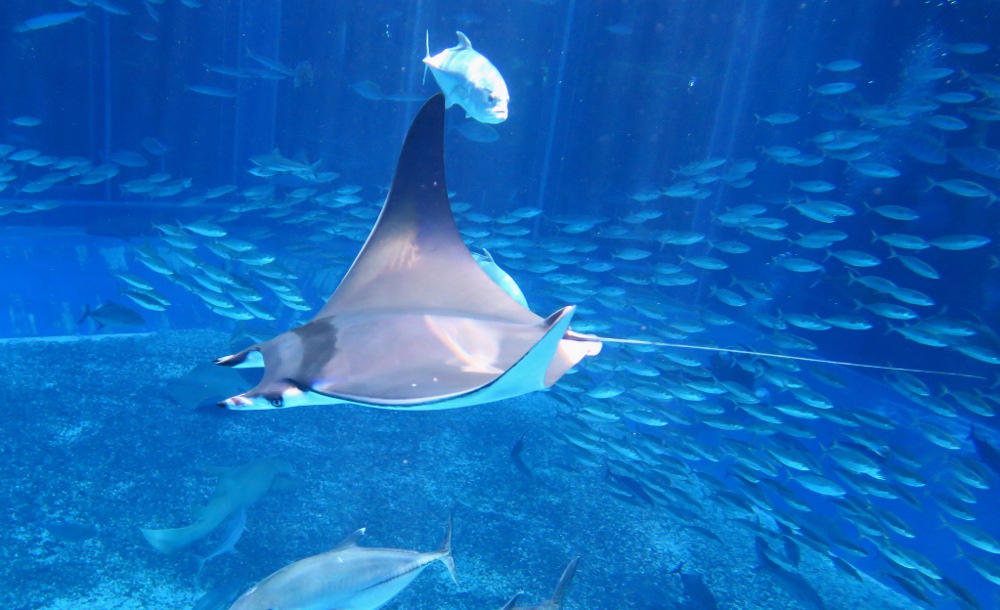
It is often associated with productive surface waters and pelagic feeding zones. Do not confuse it with similarly shaped mobulid rays without checking fin shape and markings. The quickest field clue is the bent, falcate fin tips.
6. Spotted Eagle Ray
Among the most distinctive rays, Spotted Eagle Ray (Aetobatus narinari) belongs to the eagle ray group and is identified by a dark back covered in white spots, a projecting snout, and a very long whip-like tail. It occurs in warm coastal seas, coral reefs, bays, and sandy flats. Typical food includes mollusks, crustaceans, and other bottom-dwelling prey. Its size is best described as large and wide-winged.
It often appears to fly through the water and may leap above the surface. Give resting or feeding rays plenty of space. The quickest field clue is the white-spotted back and duckbill-shaped snout.
7. Ocellated Eagle Ray
Ocellated Eagle Ray (Aetobatus ocellatus) shows how varied batoid fishes can be: pale rings and spots scattered across a dark disc. It occurs in the tropical Indo-West Pacific, including reef slopes and coastal flats. Typical food includes hard-shelled benthic animals crushed with dental plates. Its size is best described as large.
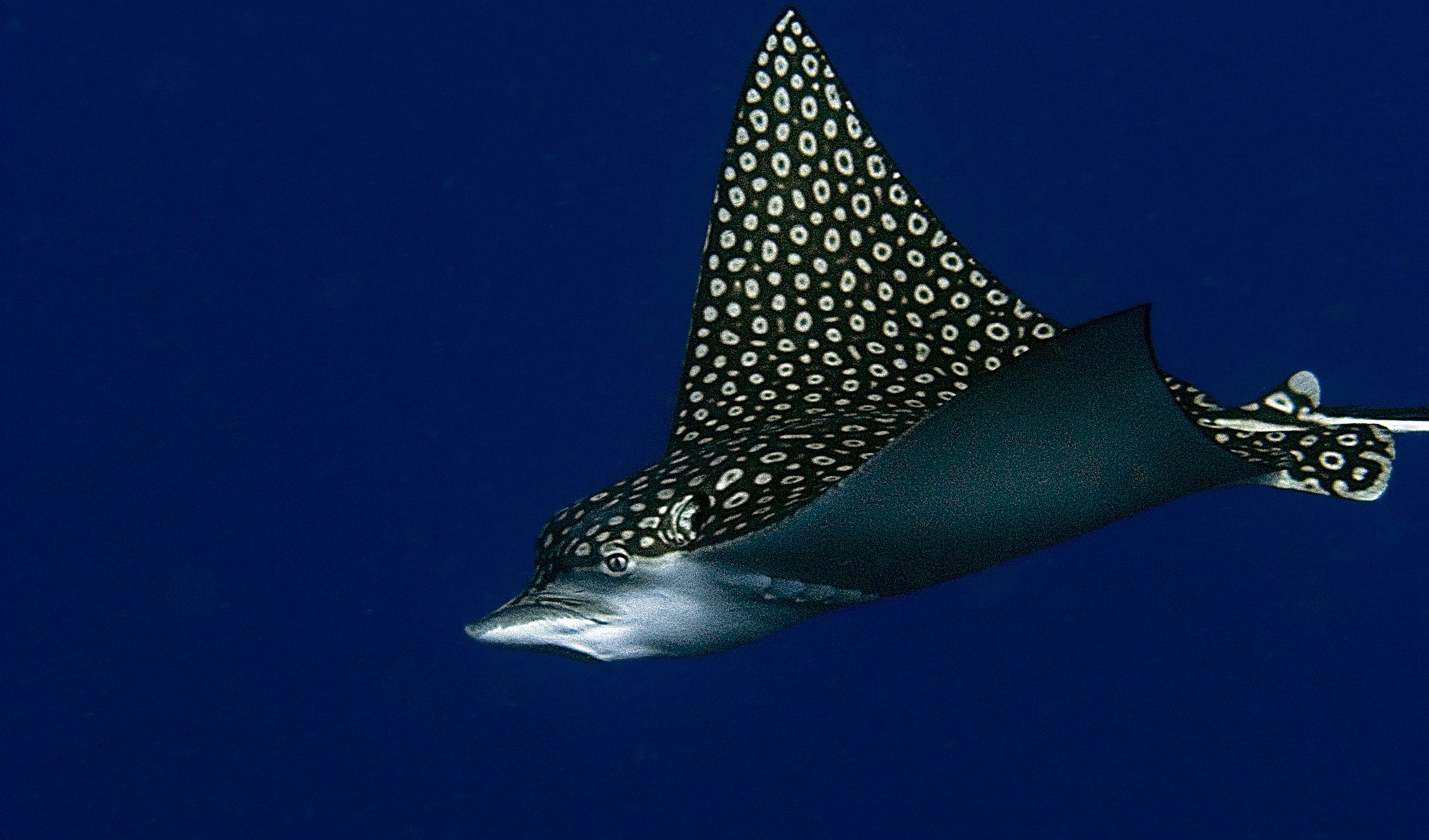
It was historically confused with other spotted eagle rays, so regional range matters. Identification should use both pattern and location. The quickest field clue is its ring-like dorsal markings.
8. Bat Ray
Look for a broad triangular disc, raised head, and plain dark upper surface when identifying Bat Ray (Myliobatis californica), a member of the eagle ray group. It occurs in eastern Pacific bays, kelp edges, estuaries, and sandy coastal bottoms. Typical food includes clams, crabs, worms, and small benthic animals. Its size is best described as medium to large.
It uses powerful wing beats to uncover prey and is common in some shallow bays. Shuffle feet in shallow water where rays may be buried. The quickest field clue is the solid dark back and angular wing shape.
9. Cownose Ray
Cownose Ray (Rhinoptera bonasus) is a cownose ray recognized by a notched, cow-like forehead and pointed wings. It occurs in western Atlantic coastal waters, estuaries, and migrating nearshore schools. Typical food includes bivalves, crustaceans, and bottom invertebrates. Its size is best described as medium to large.
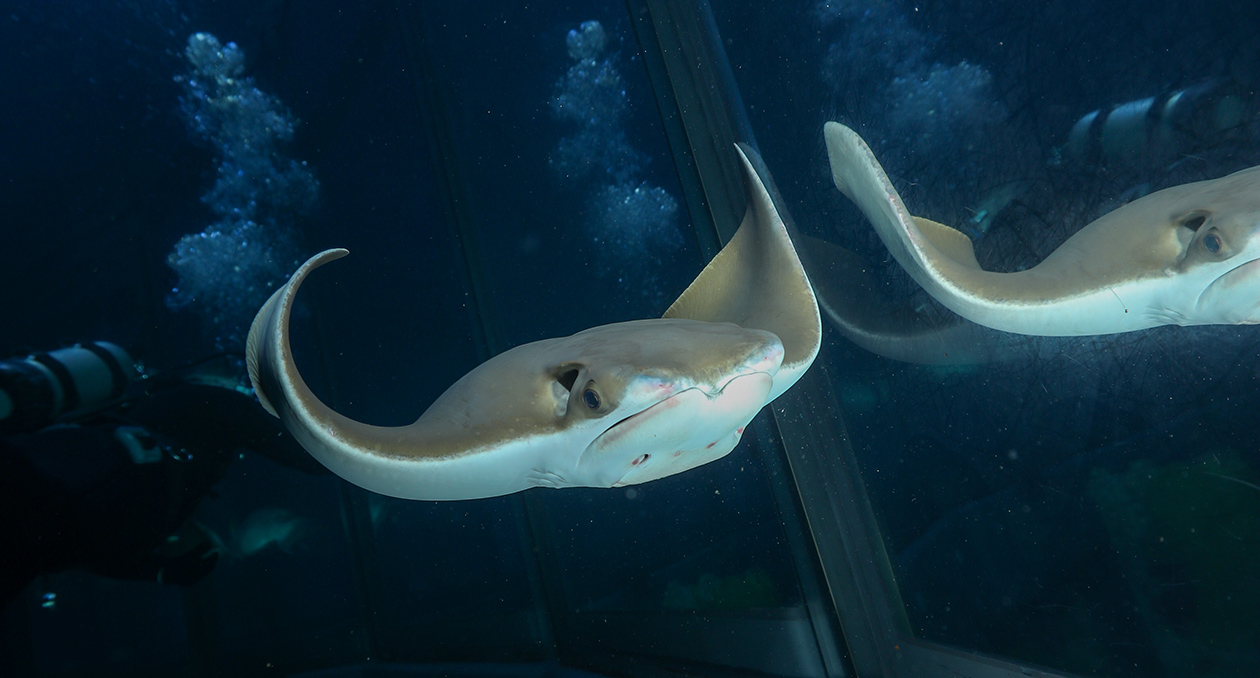
Large schools can move through bays and coastal waters during seasonal migrations. Schooling behavior is striking, but boats should not cut through dense groups. The quickest field clue is the bilobed forehead.
10. Bullnose Ray
Among the most distinctive rays, Bullnose Ray (Myliobatis freminvillei) belongs to the eagle ray group and is identified by a rounded protruding snout and broad pointed wings. It occurs in western Atlantic coastal waters over sand, mud, and seagrass. Typical food includes mollusks and crustaceans. Its size is best described as medium.
Its head profile separates it from the more deeply notched cownose ray. Color alone is unreliable because it can vary. The quickest field clue is the smooth, rounded bull-like snout.
11. Southern Stingray
Southern Stingray (Hypanus americanus) shows how varied batoid fishes can be: a diamond-shaped disc, pointed corners, and a long serrated spine-bearing tail. It occurs in the western Atlantic, Caribbean reefs, lagoons, and sandy flats. Typical food includes worms, crustaceans, mollusks, and small fishes. Its size is best described as large.
It often lies partly buried in sand by day and forages after disturbance or at dusk. Never touch or step over a resting stingray. The quickest field clue is its angular disc and long whip tail.
12. Atlantic Stingray
Look for a small rounded diamond-shaped disc with an elongated pointed snout when identifying Atlantic Stingray (Hypanus sabinus), a member of the whiptail stingray group. It occurs in western Atlantic estuaries, coastal shallows, and some freshwater rivers. Typical food includes small crustaceans, worms, and insect larvae. Its size is best described as small compared with many marine stingrays.
It tolerates low salinity better than many rays and can enter freshwater. Its camouflage makes careful wading important. The quickest field clue is the long pointed snout on a relatively small disc.
13. Roughtail Stingray
Roughtail Stingray (Bathytoshia centroura) is a whiptail stingray recognized by a heavy dark disc and rough thorn-like structures along the tail. It occurs in Atlantic coastal and deeper shelf waters. Typical food includes benthic fishes, crustaceans, and mollusks. Its size is best described as very large.
The roughened tail distinguishes adults from smoother-tailed stingrays. Its size and defensive spine demand substantial distance. The quickest field clue is the coarse, thorny tail.
14. Short-Tail Stingray
Among the most distinctive rays, Short-Tail Stingray (Bathytoshia brevicaudata) belongs to the whiptail stingray group and is identified by a thick, broad disc paired with a comparatively short muscular tail. It occurs in temperate southern oceans, bays, reefs, and continental shelves. Typical food includes bottom fishes, cephalopods, and crustaceans. Its size is best described as very large and heavy-bodied.
It is among the heaviest stingrays and may visit shallow cleaning areas. Large individuals should never be approached closely. The quickest field clue is the unusually short tail relative to the huge disc.
15. Pelagic Stingray
Pelagic Stingray (Pteroplatytrygon violacea) shows how varied batoid fishes can be: a dark violet-brown disc with rounded wings and a long tail. It occurs in open tropical and warm-temperate oceans far from the bottom. Typical food includes squid, small fishes, and pelagic crustaceans. Its size is best described as medium.
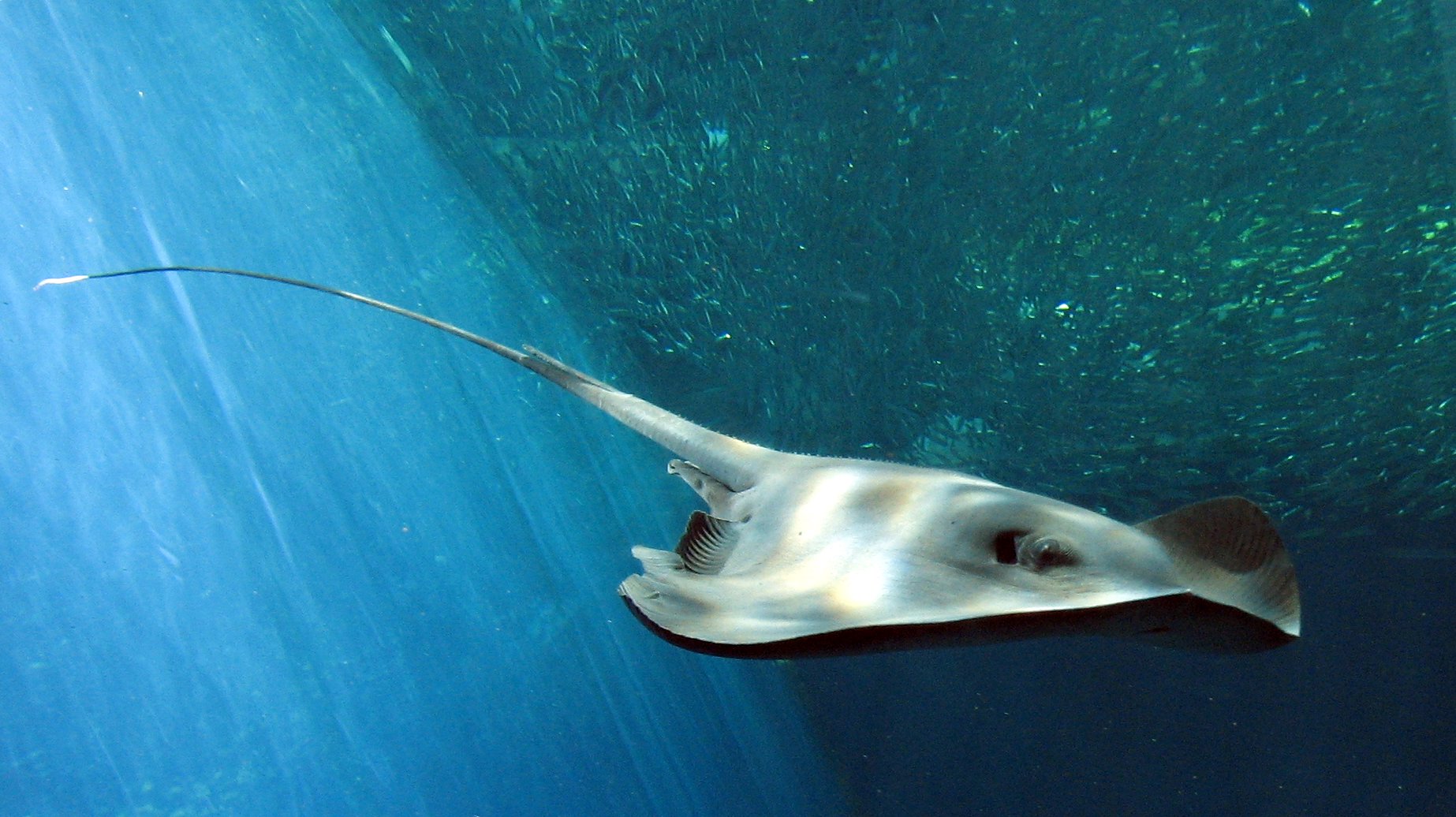
Unlike most stingrays, it spends much of its life in the open water column. Its offshore habitat is the key context for identification. The quickest field clue is the uniformly dark body and pelagic setting.
16. Bluespotted Ribbontail Ray
Look for electric-blue spots on a yellow-brown disc and blue stripes along the tail when identifying Bluespotted Ribbontail Ray (Taeniura lymma), a member of the ribbontail ray group. It occurs in shallow Indo-Pacific coral reefs and sandy reef flats. Typical food includes small crustaceans, worms, and fishes. Its size is best described as small to medium.
It is one of the easiest rays to identify visually and often shelters beneath ledges. Bright coloration does not mean it is safe to handle. The quickest field clue is the vivid blue spots and tail stripes.
17. Blue-Spotted Maskray
Blue-Spotted Maskray (Neotrygon kuhlii species complex) is a maskray recognized by blue spots, a dark eye-mask pattern, and a smaller oval disc. It occurs in Indo-Pacific sand flats, lagoons, and reef margins. Typical food includes small bottom invertebrates. Its size is best described as small to medium.

The common trade name can cover several closely related species, making locality important. Avoid assigning a precise species from color alone. The quickest field clue is the dark mask across the eyes plus scattered blue spots.
18. Round Stingray
Among the most distinctive rays, Round Stingray (Urobatis halleri) belongs to the round ray group and is identified by a nearly circular disc with mottled brown patterning and a short tail. It occurs in shallow eastern Pacific bays, beaches, and sandy bottoms. Typical food includes worms, crustaceans, and small mollusks. Its size is best described as small.
It often buries beneath a thin layer of sand in water used by swimmers. The stingray shuffle is especially useful in its range. The quickest field clue is the almost round body.
19. Yellow Stingray
Yellow Stingray (Urobatis jamaicensis) shows how varied batoid fishes can be: a circular disc marked with yellowish rosettes and dark mottling. It occurs in the Caribbean and western Atlantic on reef-adjacent sand and seagrass. Typical food includes small crustaceans and worms. Its size is best described as small.

Its ornate camouflage is highly effective against mixed sand and vegetation. Look rather than touch; it can remain motionless when approached. The quickest field clue is the yellow-and-dark rosette pattern.
20. Ocellate River Stingray
Look for large orange or yellow eye-like spots on a brown circular disc when identifying Ocellate River Stingray (Potamotrygon motoro), a member of the freshwater river ray group. It occurs in South American river basins, floodplains, and sandy freshwater channels. Typical food includes aquatic insects, crustaceans, mollusks, and fishes. Its size is best described as medium to large.
It is one of the best-known freshwater stingrays and requires expert-level aquarium care. Freshwater rays still possess venomous tail spines. The quickest field clue is the bold ocellated spots.
21. Black Diamond River Stingray
Black Diamond River Stingray (Potamotrygon leopoldi) is a freshwater river ray recognized by white circular spots sharply contrasting with a black disc. It occurs in the Xingu River basin in Brazil. Typical food includes benthic invertebrates and small fishes. Its size is best described as medium to large.
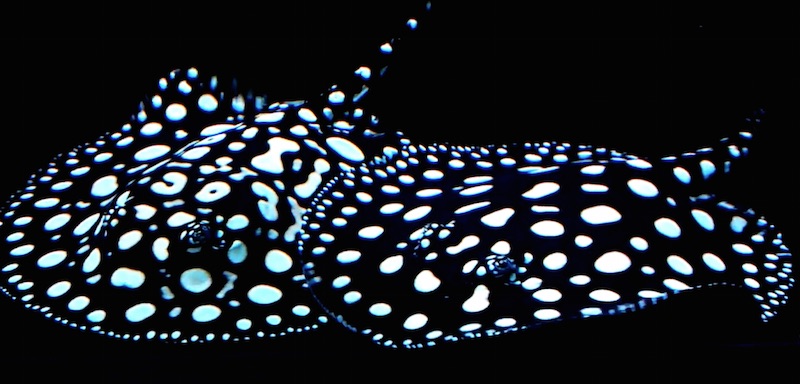
Its striking pattern makes it highly sought after in specialist aquariums. It needs a very large footprint, pristine water, and experienced care. The quickest field clue is the black-and-white polka-dot pattern.
22. Giant Freshwater Stingray
Among the most distinctive rays, Giant Freshwater Stingray (Urogymnus polylepis) belongs to the freshwater whipray group and is identified by a plain broad disc and an extremely long whip-like tail. It occurs in large rivers and estuaries in South and Southeast Asia. Typical food includes fish, crustaceans, and other river-bottom prey. Its size is best described as enormous.
It is one of the largest freshwater fishes and depends on healthy river habitat. Conservation concerns and its defensive spine make hands-off observation essential. The quickest field clue is its massive plain disc and very long tail.
23. Porcupine Ray
Porcupine Ray (Urogymnus asperrimus) shows how varied batoid fishes can be: a thick round disc covered in coarse thorny denticles rather than a tail sting. It occurs in tropical Indo-Pacific reefs, lagoons, and sandy bottoms. Typical food includes mollusks, worms, and crustaceans. Its size is best described as large.

Its armor-like skin is unusual among stingrays. Although it lacks the typical stinging spine, it should never be handled. The quickest field clue is the rough, porcupine-like body surface.
24. Mangrove Whipray
Look for a thick oval disc, dark upper surface, and pale-spotted or plain coloration when identifying Mangrove Whipray (Urogymnus granulatus), a member of the whiptail stingray group. It occurs in Indo-Pacific mangroves, estuaries, lagoons, and coastal flats. Typical food includes crustaceans, worms, and small fishes. Its size is best described as large.
It is closely tied to sheltered coastal habitats, especially mangrove systems. Habitat loss can affect this localized coastal species. The quickest field clue is its robust disc and mangrove-associated habitat.
25. Marbled Whipray
Marbled Whipray (Himantura oxyrhyncha) is a whiptail stingray recognized by fine marbling across a pointed disc and an exceptionally long tail. It occurs in freshwater and estuarine systems in parts of Southeast Asia. Typical food includes river-bottom invertebrates and small fishes. Its size is best described as medium to large.
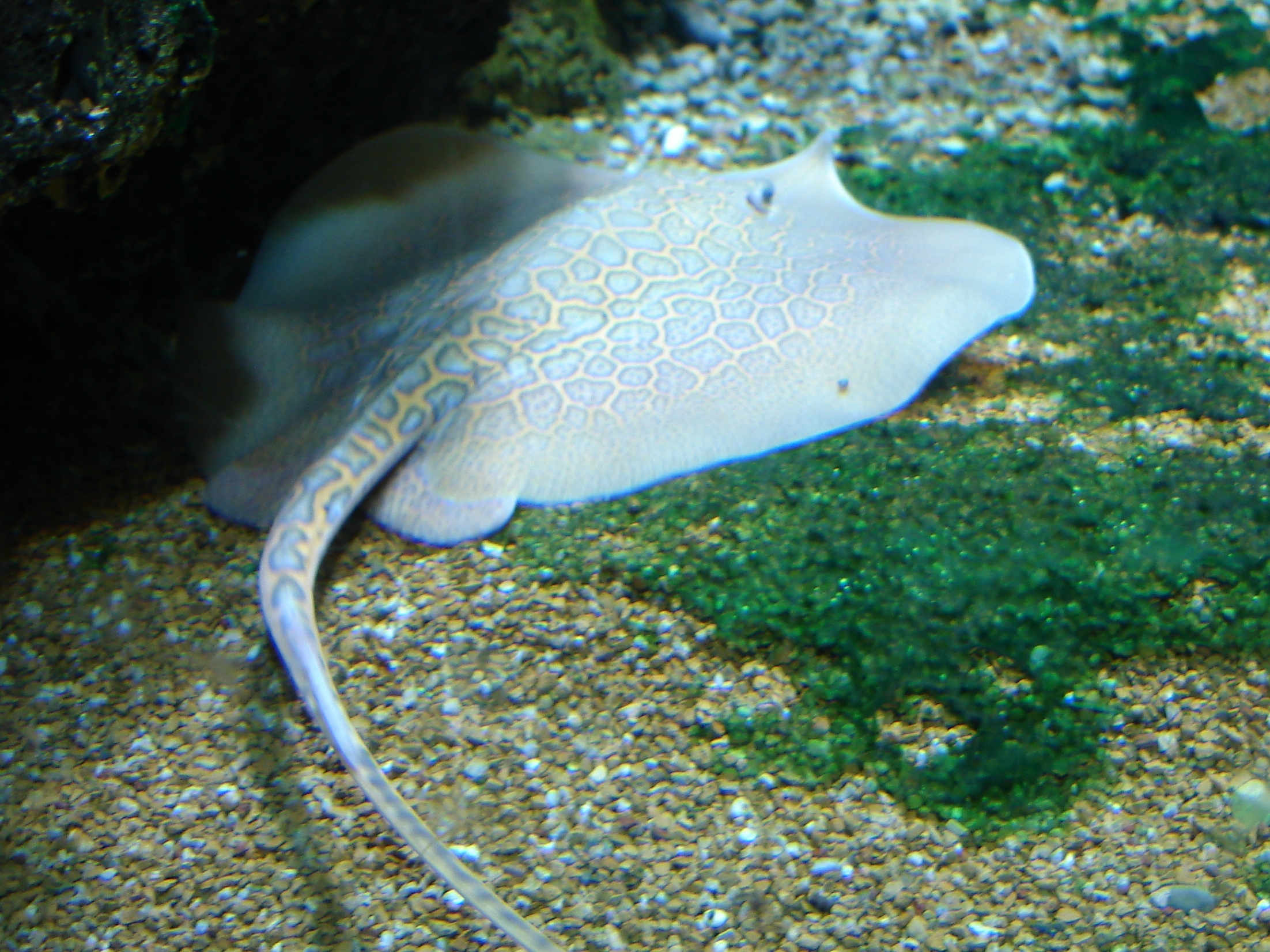
Its long pointed snout and intricate pattern help distinguish it from rounder river rays. Freshwater identification is difficult and should use locality. The quickest field clue is the marbled disc and needle-like snout.
26. Broad Cowtail Ray
Among the most distinctive rays, Broad Cowtail Ray (Pastinachus ater) belongs to the cowtail ray group and is identified by a broad rhomboid disc and a thick tail with a prominent skin fold. It occurs in the Indo-Pacific over coastal sand, mud, reefs, and estuaries. Typical food includes mollusks, crustaceans, and worms. Its size is best described as large.
The fold under the tail resembles a flag or cow tail, giving the group its name. It can be difficult to see when buried. The quickest field clue is the broad tail fold.
27. Longtail Butterfly Ray
Longtail Butterfly Ray (Gymnura poecilura) shows how varied batoid fishes can be: an extremely wide wing-like disc with small spots and a slender tail. It occurs in tropical Indo-West Pacific sandy and muddy coastal bottoms. Typical food includes small fishes and benthic invertebrates. Its size is best described as medium to large.

Its disc is much wider than it is long, producing a butterfly silhouette. Butterfly rays can disappear beneath loose sediment. The quickest field clue is the very broad wings and thin tail.
28. Spiny Butterfly Ray
Look for a broad rounded disc, short tail, and small dorsal spine when identifying Spiny Butterfly Ray (Gymnura altavela), a member of the butterfly ray group. It occurs in warm Atlantic and Mediterranean coastal waters. Typical food includes fishes, crustaceans, and mollusks. Its size is best described as large.
It favors soft bottoms where its flat shape provides camouflage. Populations are sensitive to bycatch in some regions. The quickest field clue is the broad butterfly-shaped disc with a short tail.
29. Atlantic Torpedo
Atlantic Torpedo (Tetronarce nobiliana) is a electric ray recognized by a thick rounded disc, stout tail, and two dorsal fins. It occurs in Atlantic continental shelves and slopes, sometimes at considerable depth. Typical food includes fishes stunned with electrical discharge. Its size is best described as large.
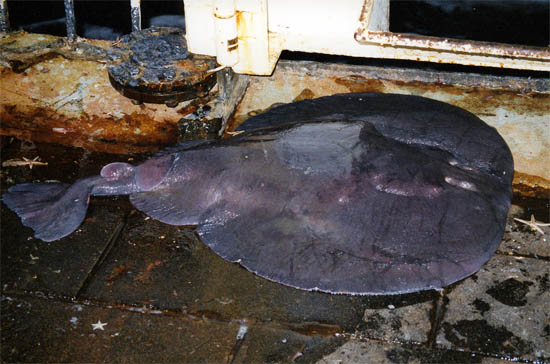
Specialized electric organs can generate powerful pulses for defense and feeding. Never handle an electric ray, even if it appears inactive. The quickest field clue is the bulky circular body and robust tail.
30. Pacific Electric Ray
Among the most distinctive rays, Pacific Electric Ray (Tetronarce californica) belongs to the electric ray group and is identified by a smooth rounded disc and muscular tail with prominent dorsal fins. It occurs in the eastern Pacific from coastal reefs to deeper slopes. Typical food includes fishes captured with electric shocks. Its size is best described as medium to large.
It may hover above the bottom or rest on rocky and sandy substrates. Its electrical defense can injure a person. The quickest field clue is the thick torpedo shape.
31. Lesser Electric Ray
Lesser Electric Ray (Narcine bancroftii) shows how varied batoid fishes can be: a small rounded disc with a short stout tail and paired dorsal fins. It occurs in western Atlantic and Caribbean sandy shallows and seagrass. Typical food includes worms and small benthic invertebrates. Its size is best described as small.

Its electric discharge is weaker than that of the largest torpedo rays but still defensive. Hands-off observation is the only safe approach. The quickest field clue is the small circular disc and compact tail.
32. Common Skate Complex
Look for a large angular disc, pointed snout, and thorny upper surface when identifying Common Skate Complex (Dipturus batis species complex), a member of the skate group. It occurs in northeastern Atlantic continental shelves and slopes. Typical food includes fishes and crustaceans. Its size is best described as very large.
What was once treated as one species is now recognized as a complex, so names may vary by source. Large skates are vulnerable to fishing pressure and should be released carefully where required. The quickest field clue is the very large size and sharply pointed snout.
33. Thornback Ray
Thornback Ray (Raja clavata) is a skate recognized by a kite-shaped disc with numerous thorns and variable spots or mottling. It occurs in the eastern Atlantic, Mediterranean, and nearby shelf waters. Typical food includes crustaceans, small fishes, and mollusks. Its size is best described as medium to large.
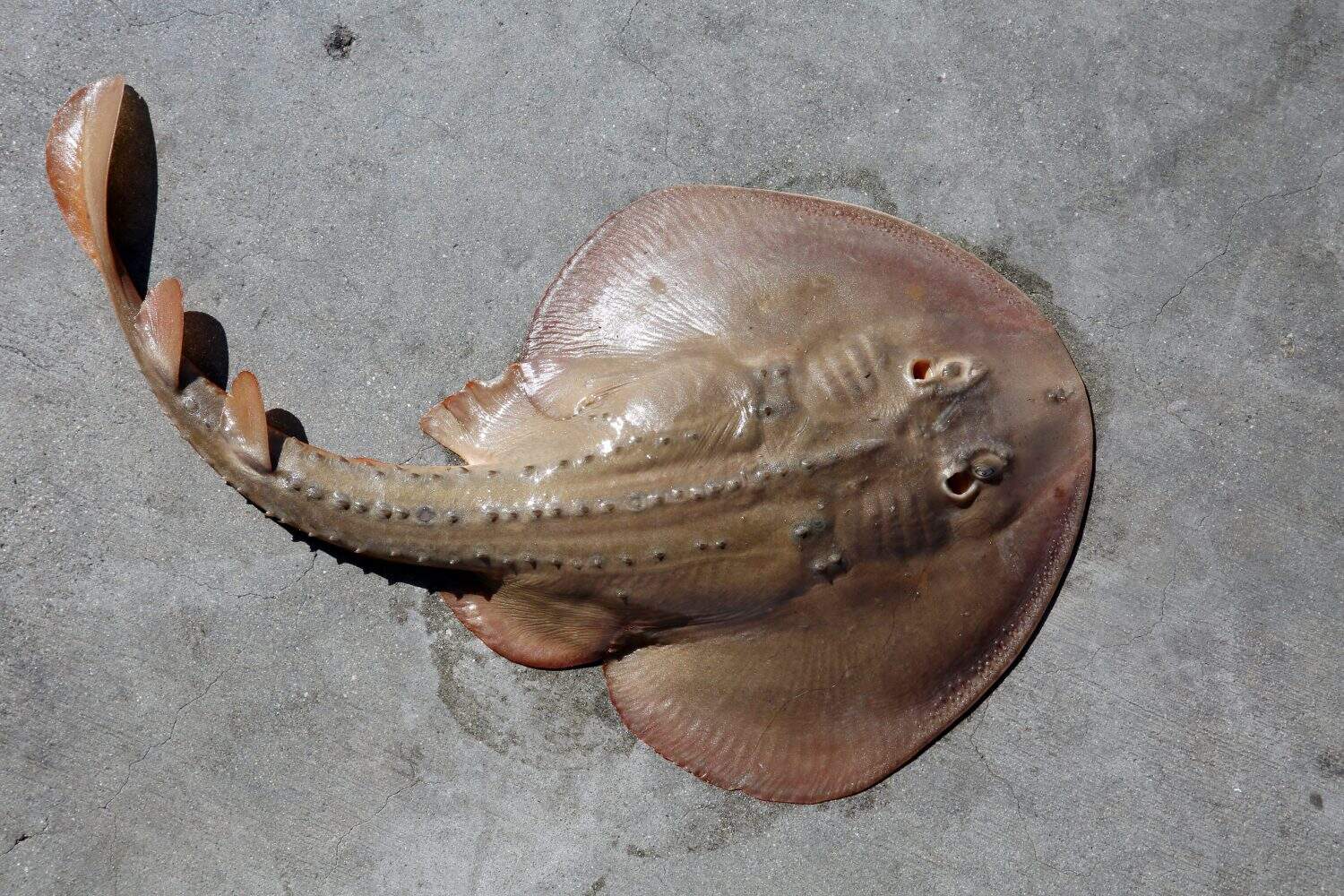
Despite the common name, it is a skate rather than a true stingray. Handle only when necessary and protect both the animal and its rough skin. The quickest field clue is the row of prominent thorns along the back and tail.
34. Little Skate
Among the most distinctive rays, Little Skate (Leucoraja erinacea) belongs to the skate group and is identified by a small rounded diamond-shaped disc with mottled gray-brown color. It occurs in northwestern Atlantic coastal shelves over sand and gravel. Typical food includes small crustaceans, worms, and fishes. Its size is best described as small.
Its egg cases are sometimes found washed ashore as mermaid’s purses. Egg cases may be empty, but living ones should be returned gently to the water. The quickest field clue is its small size and rounded snout.
35. Clearnose Skate
Clearnose Skate (Rostroraja eglanteria) shows how varied batoid fishes can be: translucent pale patches on either side of a pointed snout. It occurs in western Atlantic coastal waters over sand and shell bottoms. Typical food includes shrimp, crabs, mollusks, and small fishes. Its size is best described as medium.

The clear areas near the snout are visible even in moderately turbid water. It is commonly captured as bycatch in some fisheries. The quickest field clue is the see-through windows beside the snout.
36. Smalltooth Sawfish
Look for a shark-like body and long flat rostrum edged with relatively small teeth when identifying Smalltooth Sawfish (Pristis pectinata), a member of the sawfish group. It occurs in tropical western Atlantic coastal waters, estuaries, and river mouths. Typical food includes fishes and crustaceans detected and struck with the rostrum. Its size is best described as very large.
Sawfishes are rays, not sharks, despite their shark-like body shape. This critically endangered species must be left undisturbed and reported where programs request sightings. The quickest field clue is the toothed saw and lack of a lower tail lobe.
37. Largetooth Sawfish
Largetooth Sawfish (Pristis pristis) is a sawfish recognized by a broad saw-like rostrum with large widely spaced teeth. It occurs in tropical rivers, estuaries, and coastal seas in several regions. Typical food includes fishes and crustaceans. Its size is best described as very large.
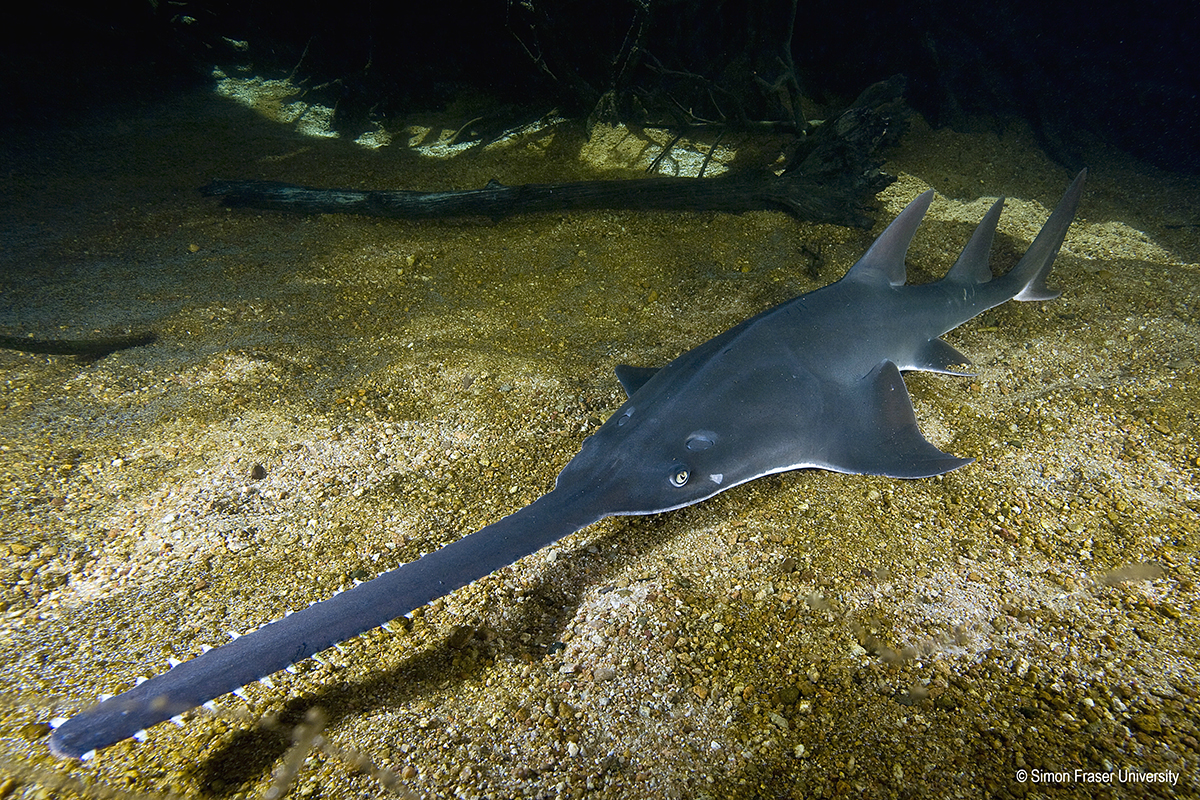
It can move between fresh and salt water and historically occupied major tropical river systems. It is highly threatened and protected in many places. The quickest field clue is the widely spaced large rostral teeth.
38. Bowmouth Guitarfish
Among the most distinctive rays, Bowmouth Guitarfish (Rhina ancylostoma) belongs to the wedgefish group and is identified by a rounded bow-shaped head, shark-like tail, and rows of prominent ridges. It occurs in tropical Indo-West Pacific reefs, sand flats, and coastal shelves. Typical food includes crustaceans and bottom fishes. Its size is best described as large.
It combines a ray-like flattened head with a powerful shark-like rear body. Wedgefishes are among the ray groups heavily affected by targeted fisheries. The quickest field clue is the rounded striped head and tall shark-like fins.
39. Common Guitarfish
Common Guitarfish (Rhinobatos rhinobatos) shows how varied batoid fishes can be: a pointed triangular head blending into an elongated shark-like body. It occurs in the eastern Atlantic and Mediterranean over sandy or muddy bottoms. Typical food includes crustaceans, mollusks, and small fishes. Its size is best described as medium to large.

Its shape is intermediate between a classic skate and a shark. Many guitarfishes are threatened by bycatch and fin fisheries. The quickest field clue is the guitar-shaped outline.
40. Shovelnose Guitarfish
Look for a long pointed shovel-like snout and flattened forebody with a shark-like tail when identifying Shovelnose Guitarfish (Pseudobatos productus), a member of the guitarfish group. It occurs in the eastern Pacific on sandy beaches, bays, and coastal shelves. Typical food includes crabs, worms, and small fishes. Its size is best described as medium to large.
It often rests on sand where its brown coloration blends with the bottom. Local fishing rules may regulate harvest and size. The quickest field clue is the long shovel-shaped head.
How Are These Types of Ray Fish Classified?
Rays belong to the batoid branch of cartilaginous fishes. Modern classification uses anatomy and genetic relationships rather than grouping every flattened fish under one common label. Stingrays and their close relatives usually have enlarged wing-like pectoral fins fused to the head, gill openings underneath, and specialized teeth or feeding structures.
- Manta and devil rays are active open-water filter feeders.
- Eagle and cownose rays are strong swimmers that often eat hard-shelled prey.
- Whiptail, round, and river stingrays spend much of their time near the bottom.
- Electric rays use specialized organs to produce electrical discharges.
- Skates commonly have thorny tails and lay egg cases.
- Sawfish, guitarfishes, and wedgefishes combine a flattened front body with a shark-like rear body.
Where Do Rays Live?
Rays occupy nearly every major aquatic setting. Marine species live on coral reefs, sandy bays, deep continental slopes, cold shelves, estuaries, and the open ocean. Freshwater stingrays occur in major South American rivers, while giant freshwater whiprays and some sawfish use tropical Asian river and estuary systems.
Habitat is often as useful as color. A dark ray swimming far offshore may be a pelagic species, while a circular patterned ray on a coral sand flat is more likely to be a bottom-dwelling stingray. River basin, coastline, depth, and substrate should always be checked before making a confident identification.
How to Identify Different Types of Rays
- Disc shape: compare circular, diamond, triangular, and extremely wide butterfly-like outlines.
- Snout: note whether it is pointed, rounded, notched, duckbill-shaped, or extended into a saw.
- Tail: check length, thickness, skin folds, thorns, dorsal fins, and the presence of a spine.
- Pattern: record spots, rings, marbling, bands, or transparent patches without relying on color alone.
- Swimming style: mantas and eagle rays flap through open water, while many stingrays stay close to the bottom.
- Habitat: freshwater, reef, estuary, beach, deep shelf, and open ocean point toward different groups.
- Underside markings: manta rays can sometimes be identified individually from ventral spot patterns.
Outdoor Tips for Finding and Observing Rays
Search calm sandy flats, seagrass edges, reef cleaning stations, tidal channels, and clear river shallows from a respectful distance. Polarized glasses can reduce surface glare, while slow movement helps prevent disturbing buried rays. Snorkelers and divers should remain beside rather than above feeding animals so the ray retains an open path.
Never chase, touch, ride, feed, or surround a ray. In shallow water, use the stingray shuffle and avoid placing hands into holes or beneath ledges. Follow local wildlife-tour rules, fishing restrictions, and protected-area guidance.
Safety, Sustainability, and Conservation Notes
Most ray injuries occur when a person accidentally steps on or handles a defensive animal. Give rays room, avoid the tail, and seek prompt medical care after a sting because wounds can involve puncture trauma, retained fragments, infection risk, and intense pain.
Many rays reproduce slowly, so population losses can take years to reverse. Support science-based fishing limits, bycatch reduction, mangrove and reef protection, and traceable seafood. Do not buy wildlife products made from threatened rays, and never release aquarium animals into natural waters.
Fun Facts About Rays
- Rays and sharks share cartilage-based skeletons.
- Manta rays are filter feeders and do not have a stinging tail barb.
- Many rays breathe through spiracles located behind the eyes.
- Some skate egg cases wash ashore as mermaid’s purses.
- Electric rays can produce defensive electrical pulses.
- Sawfish are rays even though their rear bodies look shark-like.
- Freshwater stingrays live entirely in river systems.
- Eagle rays can crush mollusk shells with plate-like teeth.
- A ray’s underside contains the mouth and gill slits.
- Individual manta rays can be recognized from belly markings.
Final Thoughts on Types of Rays Fish
Learning the major types of rays fish makes it easier to separate mantas from stingrays, skates from sawfish, and bottom-dwellers from open-ocean swimmers. Focus on disc shape, snout, tail, pattern, behavior, and location, then observe without touching or crowding the animal. Every responsible sighting can become a useful lesson in marine and freshwater diversity.
Frequently Asked Questions
1. Are rays fish?
Yes. Rays are cartilaginous fishes related to sharks. Their skeletons are made mainly of cartilage rather than true bone.
2. What is the difference between a ray and a stingray?
A stingray is one type of ray. The broader ray group also includes skates, manta rays, devil rays, electric rays, sawfish, guitarfishes, wedgefishes, and butterfly rays.
3. How many species of rays are there?
Scientists recognize hundreds of living ray and skate species. Exact totals change as new species are described and older groups are revised.
4. Do all rays have venomous stingers?
No. Many stingrays have one or more defensive tail spines, but manta rays, most skates, electric rays, guitarfishes, and sawfish do not have the typical stingray barb.
5. Are manta rays dangerous to people?
Manta rays are not aggressive and lack a stinging tail spine. The main safety rule is to avoid touching, chasing, riding, or blocking them.
6. Which ray is the largest?
The giant oceanic manta ray is generally regarded as the largest living ray by disc width. It is a plankton-feeding ocean traveler.
7. Can rays live in freshwater?
Yes. South American river stingrays are fully freshwater, and several other rays can enter rivers or tolerate brackish water.
8. What do rays eat?
Diet depends on the group. Mantas filter plankton, eagle rays crush shellfish, stingrays probe for bottom invertebrates, and electric rays often capture fish.
9. How do rays find prey under sand?
Rays use smell, touch, the lateral line, and electroreception to detect movement and weak electrical fields produced by hidden animals.
10. Why do rays bury themselves?
Burial provides camouflage, protection, and a good ambush position. It also helps some species rest without attracting attention.
11. What should I do if I see a ray while swimming?
Keep a respectful distance, do not touch it, and give it a clear escape route. In shallow sandy water, shuffle your feet instead of taking high steps.
12. Why is the stingray shuffle recommended?
Sliding your feet can gently alert a buried ray and encourage it to move away, reducing the chance of stepping directly on its back or tail.
13. Are skates and rays the same?
Skates are a branch of the broader ray lineage. Many skates lay egg cases and have thorny tails, while many stingrays give birth to live young and possess a tail spine.
14. What is a mermaid’s purse?
A mermaid’s purse is the tough egg case produced by many skates and some sharks. Empty cases are often found on beaches.
15. Are sawfish sharks or rays?
Sawfish are rays. Their flattened head, ventral gill slits, and other anatomical features place them with batoid fishes.
16. What makes an electric ray electric?
Modified muscle tissue forms electric organs that can release pulses. The discharge is used for defense, prey capture, or both.
17. Can ray species be identified by color alone?
Usually not. Pattern, disc shape, snout, tail, habitat, geographic range, and underside markings should all be considered.
18. Do rays jump out of the water?
Some eagle rays, cownose rays, devil rays, and mantas may leap or breach. The exact reason can involve communication, parasite removal, escape, or other behavior.
19. How do manta rays feed?
They swim with their mouths open while cephalic lobes help direct plankton-rich water toward the gill filters.
20. Do rays have teeth?
Yes, but tooth shape varies. Many bottom-feeding rays have flattened dental plates for crushing shells, while other species have smaller pointed teeth.
21. Can rays breathe while resting on the bottom?
Many bottom-dwelling rays draw water through spiracles behind the eyes, allowing them to ventilate the gills without taking in much sand.
22. Are ray tails used for swimming?
Most rays generate thrust mainly with the enlarged pectoral fins. The tail helps with balance and may carry defensive structures.
23. Why are many ray species threatened?
Slow growth, late maturity, small litters, habitat loss, and capture in targeted or accidental fisheries can make populations slow to recover.
24. Is it safe to keep rays in a home aquarium?
Most rays are unsuitable for ordinary home aquariums. They require specialized systems, large floor space, expert water management, and species-specific legal and welfare considerations.
25. Can freshwater stingrays be kept with other fish?
Specialists sometimes keep compatible large fish with freshwater rays, but tankmates must not nip, outcompete, or be small enough to be eaten. Expert planning is essential.
26. What is the easiest way to distinguish a skate from a stingray?
A practical clue is the tail: skates often have a thicker thorny tail without a venomous sting, while many stingrays have a whip-like tail with a defensive spine.
27. Where are rays most commonly seen?
Depending on species, rays occur on sandy flats, coral reefs, estuaries, river channels, continental shelves, and the open ocean.
28. Should a hooked ray be lifted by the tail?
No. Support and release methods should minimize handling, keep the animal in water when possible, and follow local fisheries guidance.
29. Do rays lay eggs or give birth?
Both strategies occur. Most skates lay egg cases, while many stingrays and manta rays give birth to live young after embryos develop inside the mother.
30. What is the best way to help ray conservation?
Choose responsibly sourced seafood, follow fishing regulations, reduce plastic and line pollution, support habitat protection, and use ethical wildlife operators.
Read more:
30 Types of Pleco Fish: Size, Diet and Care