

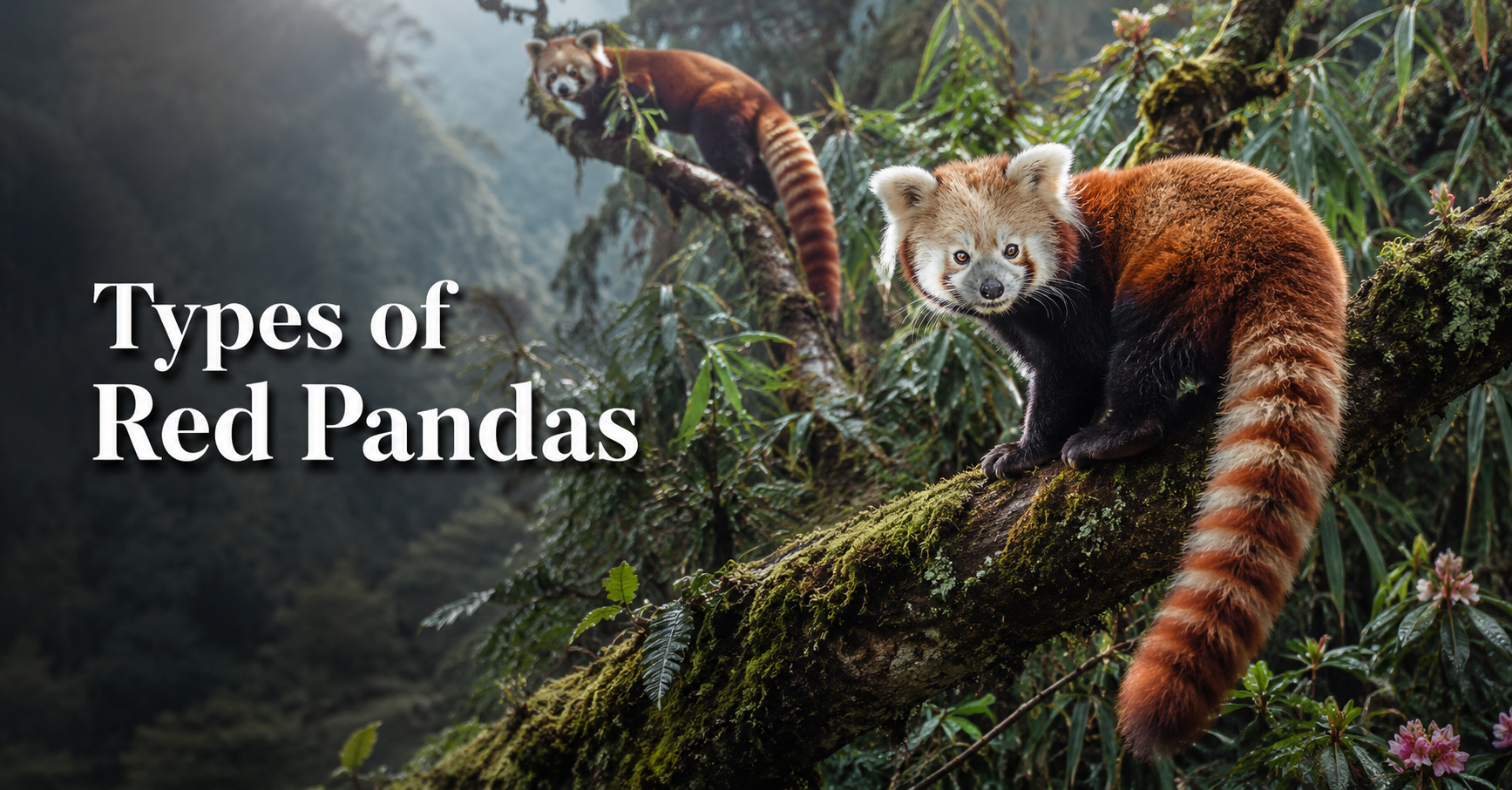
There are two recognized types of red pandas: the Himalayan red panda and the Chinese red panda. They share the same bamboo-rich mountain habitat, reddish coat, masked face, and long ringed tail, but they differ in appearance, geographic range, genetics, and conservation needs.
Scientists do not yet use one universal classification. Many authorities describe them as two subspecies of Ailurus fulgens, while genomic research supports recognizing them as two separate species. This guide explains both types of red pandas, how to distinguish them, where they live, what they eat, and why protecting each lineage matters.
What Are the Main Types of Red Pandas?
The two main types are the Himalayan red panda and the Chinese red panda. Under the traditional classification, they are named Ailurus fulgens fulgens and Ailurus fulgens styani. Under the two-species model, they are called Ailurus fulgens and Ailurus styani. The Chinese form is generally larger and darker, while the Himalayan form usually has paler facial coloring.
| Feature | Himalayan Red Panda | Chinese Red Panda |
|---|---|---|
| Common scientific treatment | Ailurus fulgens fulgens or Ailurus fulgens | Ailurus fulgens styani or Ailurus styani |
| Alternative name | Western red panda | Styan’s red panda or eastern red panda |
| Typical coat | Generally lighter and more orange-red | Usually darker, richer red |
| Face | Paler forehead and softer markings | Stronger red facial markings |
| Tail | Rings may appear less sharply defined | Tail rings often show greater contrast |
| General build | Usually smaller and lighter | Usually larger and heavier |
| Main range | Nepal, Bhutan, India, and southern Tibet | China, northern Myanmar, and areas east of the Siang River |
1. Himalayan Red Panda
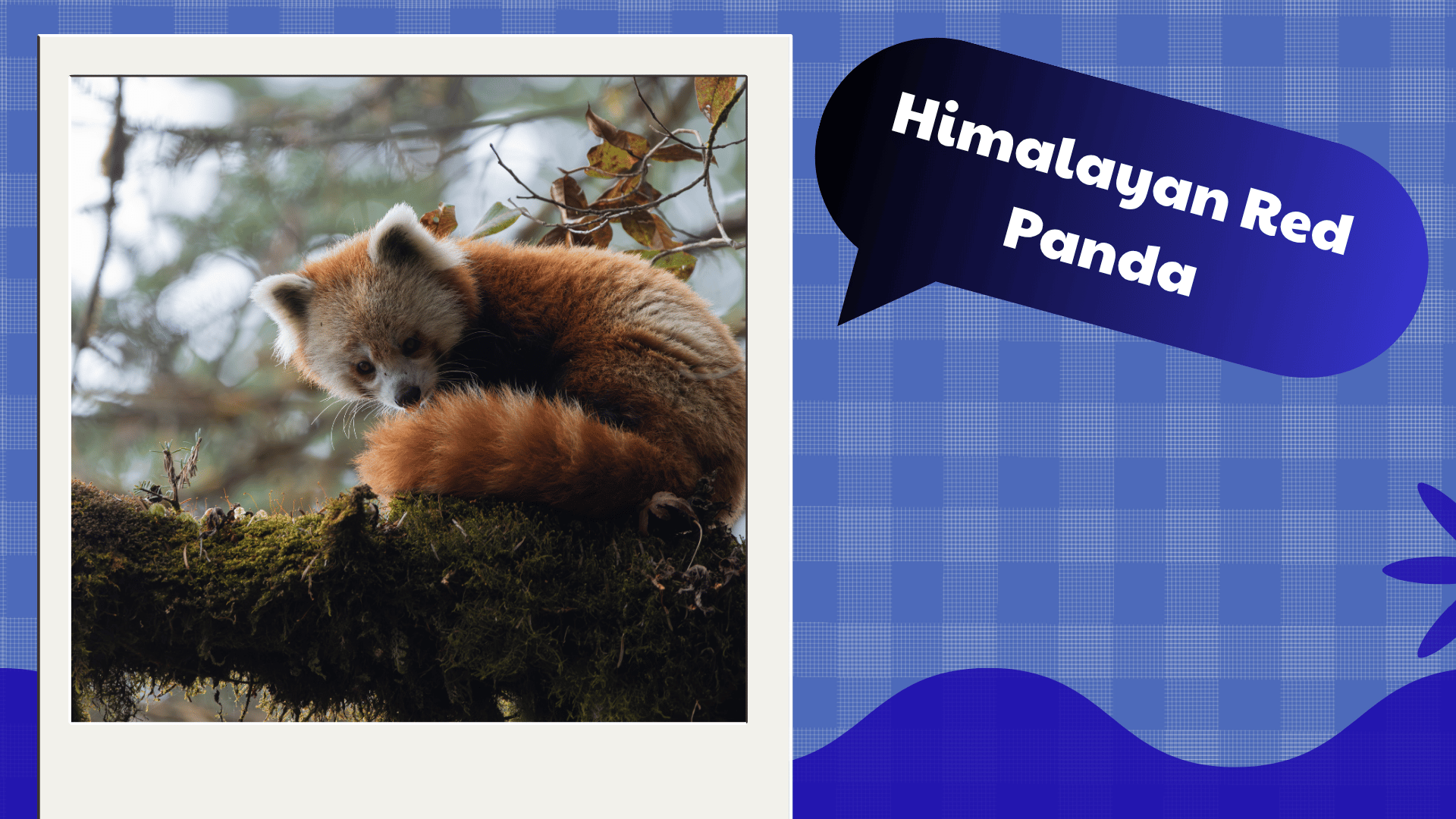
The Himalayan red panda is the western form of red panda. It is traditionally classified as Ailurus fulgens fulgens, although researchers who recognize two species usually shorten its name to Ailurus fulgens. Its range follows suitable mountain forests through Nepal, Bhutan, northeastern India, and parts of southern Tibet.
This red panda generally has a lighter orange-red or cinnamon-colored back than its Chinese relative. Its forehead is often pale, and the boundary between the white and reddish areas of its face may appear softer. Its tail is long and bushy, with alternating reddish and buff rings that can be less strongly contrasted than those of the Chinese form. However, coat color varies among individuals, lighting conditions, seasons, and ages, so appearance alone cannot confirm identity.
The Himalayan red panda lives in cool temperate forests with a thick bamboo understory. Suitable habitat commonly contains mature trees, fallen logs, nearby water, and connected canopy cover. Trees provide sleeping places, escape routes, nesting cavities, and protection from predators. The animals can rotate their ankles in a way that helps them descend tree trunks headfirst.
Bamboo leaves and tender shoots make up most of the diet. Red pandas may also consume fruit, flowers, roots, insects, eggs, and other small food items when available. Despite belonging to the order Carnivora, they have adapted to a diet dominated by plants. Because bamboo provides limited energy, red pandas conserve energy by resting for long periods and becoming most active during cooler parts of the day.
The Himalayan lineage may have lower genetic diversity than the Chinese lineage, making small and isolated populations especially vulnerable. Habitat fragmentation, livestock grazing, forest-product collection, roads, domestic dogs, and accidental trapping all threaten its survival. Protecting corridors between mountain forests is therefore as important as conserving individual protected areas.
2. Chinese Red Panda
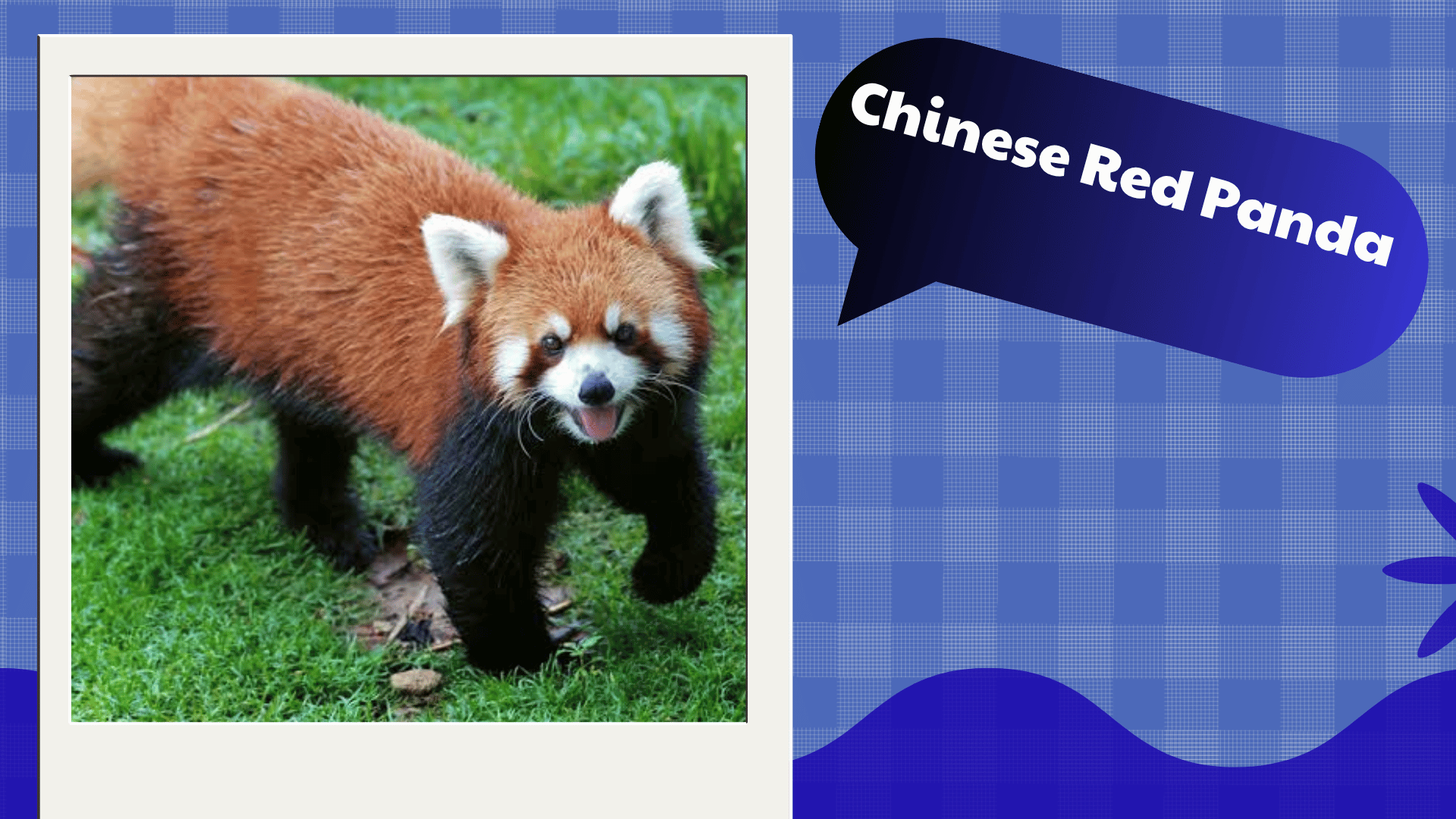
The Chinese red panda is traditionally known as Ailurus fulgens styani. It is also called Styan’s red panda, after the naturalist Frederick William Styan. Researchers who follow the two-species classification refer to it as Ailurus styani. Its principal range includes the mountain forests of southwestern China and northern Myanmar, with populations associated with areas east of the Siang or Yarlung Tsangpo river system.
Chinese red pandas are generally larger and more robust than Himalayan red pandas. Their coats often have a deeper red or chestnut tone, while the face may show stronger reddish markings and less extensive white coloration. The rings on the tail are frequently darker and more distinct. The forehead may look more curved, and the muzzle can appear more sloping, although these features are difficult to judge without a direct comparison.
This type inhabits cool, moist mountain forests containing bamboo, mature trees, logs, and dense vegetation. Important habitat occurs in Sichuan and Yunnan, including parts of the Hengduan and Qionglai mountain systems. In some Chinese forests, red pandas and giant pandas occupy the same broad landscape. They may use different slopes, vegetation structures, and parts of the bamboo habitat, reducing direct competition.
Like the Himalayan form, the Chinese red panda spends much of its time in trees. Its curved, semi-retractile claws provide a strong grip, while its long tail helps with balance. Thick fur covers the body and even the soles of the feet, offering insulation in cold and snowy environments.
The Chinese red panda eats mainly nutritious bamboo leaves and seasonal shoots. It is most active around dawn and dusk, although activity varies with weather, temperature, food availability, and human disturbance. Adults are normally solitary outside the breeding season and communicate through scent marks, body postures, and quiet vocalizations.
Although this lineage may retain greater genetic diversity than the Himalayan lineage, it remains threatened by forest loss, fragmentation, roads, poaching, and human activity. Its potentially distinct evolutionary history means it should be managed carefully rather than treated as interchangeable with Himalayan red pandas.
Are There One or Two Red Panda Species?
The safest answer is that there are two clearly differentiated red panda lineages, but their formal taxonomic rank remains debated. Traditional taxonomy recognizes one species, Ailurus fulgens, divided into two subspecies.
A major 2020 population-genomics study reported substantial genetic separation and supported recognizing the Himalayan and Chinese lineages as two phylogenetic species. Other scientific references and conservation organizations continue to use the one-species, two-subspecies system. Even the Smithsonian’s red panda information discusses evidence for two distinct species while listing the genus and species as Ailurus fulgens.
For general readers, “two types of red pandas” is accurate and easy to understand. When scientific precision is important, the classification system being used should always be stated.
How Are Red Pandas Classified?
| Taxonomic Rank | Classification |
|---|---|
| Kingdom | Animalia |
| Phylum | Chordata |
| Class | Mammalia |
| Order | Carnivora |
| Superfamily | Musteloidea |
| Family | Ailuridae |
| Genus | Ailurus |
| Species under traditional classification | Ailurus fulgens |
Red pandas are the only living representatives of the family Ailuridae. They are not bears and are not close relatives of giant pandas. Their broader evolutionary group, Musteloidea, also contains the families that include raccoons, skunks, weasels, otters, and badgers.
The red panda and giant panda independently developed enlarged wrist bones that function like false thumbs for gripping bamboo. This is an example of similar adaptations evolving in animals that are not close relatives.
Where Do the Two Types of Red Pandas Live?
Wild red pandas occur in a narrow band of mountainous habitat across Nepal, India, Bhutan, China, and Myanmar. They favor cool temperate forests where bamboo grows beneath a canopy of trees.
Himalayan Red Panda Range
- Nepal
- Bhutan
- Northeastern India
- Southern Tibet
- Areas generally west of the proposed Siang River boundary
Chinese Red Panda Range
- Sichuan Province in China
- Yunnan Province in China
- Parts of southeastern Tibet
- Northern Myanmar
- Areas generally east of the proposed geographic boundary
The animals do not live throughout these countries. Their populations are restricted to scattered areas with the correct elevation, climate, bamboo supply, forest structure, and access to water. Fragmentation can prevent red pandas from moving between otherwise suitable forests.
How to Identify Different Types of Red Pandas
- Coat color: Himalayan red pandas tend to look lighter, while Chinese red pandas are often deeper red.
- Body size: The Chinese form is generally larger and heavier.
- Facial markings: Himalayan animals often have paler faces; Chinese animals may show stronger reddish markings.
- Forehead shape: The Himalayan form may have a straighter facial profile, while the Chinese form can appear more curved.
- Tail pattern: Tail rings are frequently more contrasting on Chinese red pandas.
- Geographic range: Location is often more informative than coat color.
- Genetics: DNA analysis is the most reliable method for assigning uncertain individuals to a lineage.
Visual identification should be treated as an informed estimate. Individual variation and captive ancestry can make some red pandas difficult to classify from photographs alone.
What Do Red Pandas Eat?
Both types of red pandas feed primarily on bamboo. They selectively eat tender shoots and nutritious leaf tips instead of consuming large amounts of woody stems. Their diet may also include fruit, flowers, roots, acorns, insects, eggs, and occasional small animals.
A red panda has the digestive system of a carnivore rather than the specialized multi-chambered stomach of many plant-eating mammals. It cannot extract energy from bamboo efficiently, so it must spend considerable time feeding while limiting unnecessary activity.
Red Panda Behavior and Adaptations
Red pandas are skilled climbers that use trees for resting, escaping danger, nesting, and traveling through their habitat. Their sharp claws, flexible ankles, fur-covered feet, and balancing tails are valuable adaptations for life in cold mountain forests.
They are usually solitary except during breeding and when mothers care for cubs. Individuals mark their surroundings with urine and scent secretions. They can also communicate with whistles, twitters, squeals, grunts, and defensive huffs.
Activity often increases around dawn and dusk. During cold weather, a red panda may curl into a ball and cover its face with its tail. In warmer conditions, it may stretch along a branch to release heat.
Outdoor Tips for Observing Red Pandas Responsibly
- Join a licensed local guide who follows wildlife-viewing rules.
- Remain on established trails to reduce damage to bamboo and forest vegetation.
- Observe from a distance with binoculars or a telephoto lens.
- Never feed, call, chase, or attempt to touch a wild red panda.
- Avoid surrounding an animal or blocking its route to a tree.
- Keep noise low and limit the size of the viewing group.
- Do not reveal sensitive den or nesting locations publicly.
- Support community-based ecotourism that benefits people living near red panda habitat.
- Follow all protected-area regulations and instructions from local guides.
- Leave plants, bamboo, tracks, droppings, and other natural evidence undisturbed.
Safety, Sustainability, and Conservation Notes
Red pandas are endangered, and their wild populations are declining. Major threats include habitat loss, forest fragmentation, bamboo degradation, livestock grazing, road construction, accidental capture in traps, poaching, and disturbance from people and domestic dogs.
Climate change may alter the cool, moist conditions needed by mountain forests and their bamboo understories. Because suitable habitat is naturally limited, movement corridors between forest fragments are essential.
Red pandas are wild animals and do not make suitable pets. Buying one, promoting private ownership, or sharing content connected with illegal wildlife sales can contribute to trafficking and animal suffering. Ethical conservation focuses on protecting wild habitat, supporting local communities, maintaining scientifically managed zoo populations, and preserving the genetic identity of both lineages.
Fun Facts About Red Pandas
- Red pandas were scientifically described before giant pandas.
- They are the only living members of the family Ailuridae.
- Their reddish coats provide camouflage among mosses and lichens.
- A long tail helps a red panda balance while climbing.
- The tail can also wrap around the body for warmth.
- Red pandas can climb down tree trunks headfirst.
- Fur covers the soles of their feet and provides insulation.
- They use a modified wrist bone as a false thumb.
- Despite belonging to Carnivora, they eat a mostly bamboo-based diet.
- Red pandas and giant pandas are not close relatives.
Final Thoughts on Types of Red Pandas
There are two main types of red pandas: the Himalayan red panda and the Chinese red panda. They can be compared by their coat color, facial markings, body size, tail pattern, geographic range, and genetics. Scientists disagree on whether they should be ranked as two subspecies or two separate species, but both represent important evolutionary lineages.
Protecting bamboo forests, wildlife corridors, and local conservation programs will give both types the best chance of surviving. Anyone hoping to observe red pandas should choose responsible wildlife experiences that keep the animals and their habitat undisturbed.
Frequently Asked Questions
1. How many types of red pandas are there?
There are two living types: the Himalayan red panda and the Chinese red panda.
2. What are the two types of red pandas called?
They are called the Himalayan red panda and the Chinese red panda, which is also known as Styan’s red panda.
3. Are there two red panda species or two subspecies?
Traditional taxonomy recognizes two subspecies, while several genomic studies support treating them as two phylogenetic species. The issue remains under scientific discussion.
4. What is the scientific name of the Himalayan red panda?
It is written as Ailurus fulgens fulgens under the subspecies system or Ailurus fulgens under the two-species system.
5. What is the scientific name of the Chinese red panda?
It is commonly written as Ailurus fulgens styani. Under the two-species classification, it is Ailurus styani.
6. Which type of red panda is larger?
The Chinese red panda is generally larger and more robust, although individual sizes overlap.
7. Which red panda has darker fur?
Chinese red pandas usually have deeper red fur and more strongly contrasting tail rings.
8. How can you tell the two types apart?
Look at coat color, facial markings, body size, tail-ring contrast, and geographic origin. DNA testing provides the most reliable identification.
9. Where do Himalayan red pandas live?
They occur mainly in Nepal, Bhutan, northeastern India, and southern Tibet.
10. Where do Chinese red pandas live?
They are primarily associated with southwestern China and northern Myanmar, including suitable mountain forests east of the proposed lineage boundary.
11. What separates the two red panda lineages?
Genetic research identifies the Siang or Yarlung Tsangpo river system as an important geographic boundary between them.
12. Are red pandas related to giant pandas?
No. Giant pandas are bears, while red pandas belong to their own family, Ailuridae.
13. Are red pandas related to raccoons?
They are not raccoons, but both belong to the broader musteloid branch of the order Carnivora.
14. Why are they called pandas?
The origin is uncertain, but the word may be connected to a local term referring to an animal that eats bamboo.
15. What do red pandas eat?
They eat mainly bamboo leaves and shoots, supplemented by fruit, flowers, roots, insects, eggs, and occasional small animals.
16. Are red pandas carnivores or herbivores?
They belong to the order Carnivora but follow a predominantly plant-based diet centered on bamboo.
17. How big is a red panda?
An adult’s body is roughly comparable in size to a large domestic cat, but its long, bushy tail makes it appear longer.
18. Why do red pandas have long tails?
The tail provides balance in trees and can be wrapped around the body for insulation in cold weather.
19. Can red pandas climb trees?
Yes. They are excellent climbers and can descend trunks headfirst using flexible ankles and curved claws.
20. Are red pandas nocturnal?
They can be active at night, but they are often described as crepuscular because activity frequently peaks around dawn and dusk.
21. Do red pandas live alone?
Adults are usually solitary except during breeding. Mothers remain with their cubs until the young become independent.
22. Where do red pandas sleep?
They commonly rest on tree branches, inside tree cavities, or in other sheltered positions above the ground.
23. How do red pandas stay warm?
They have dense fur, hair-covered feet, and bushy tails that can cover the face and body.
24. Do red pandas have false thumbs?
Yes. An enlarged wrist bone acts like a thumb and helps them grasp bamboo stems.
25. Are red pandas endangered?
Yes. The red panda is listed as Endangered, with habitat destruction and fragmentation among its most serious threats.
26. How many red pandas remain in the wild?
A precise current count is not available because red pandas are secretive and occupy difficult mountain terrain. Available evidence indicates a small and declining population.
27. What animals prey on red pandas?
Potential predators include leopards, martens, and other capable mountain carnivores. Domestic dogs can also attack them.
28. Can a red panda be kept as a pet?
No. Red pandas are protected wild animals with specialized dietary, environmental, and behavioral needs.
29. Do red pandas attack humans?
They generally avoid people, but any frightened or cornered wild animal may bite or scratch in self-defense.
30. Can the two types of red pandas breed together?
Individuals from the two lineages may be biologically capable of breeding, but conservation programs carefully manage ancestry because mixing genetically distinct populations can complicate conservation.
31. Do zoos keep both types of red pandas?
Yes, but not every zoo clearly identifies the lineage on public signs. Accredited breeding programs use ancestry records to manage animals responsibly.
32. What colors can red pandas be?
Their coats range from orange-red to deep chestnut, with dark legs, pale facial areas, and alternating rings on the tail.
33. Do red pandas change color in winter?
They do not undergo a dramatic seasonal color change, although coat condition, lighting, and seasonal fur growth can affect their appearance.
34. How long do red pandas live?
Lifespan varies, but individuals under professional human care can live well into their teens and sometimes longer.
35. How many cubs do red pandas have?
A female commonly gives birth to one or two cubs, although larger litters are possible.
36. When are red panda cubs born?
In the Northern Hemisphere, births generally occur in late spring or summer, when tender bamboo growth is available.
37. Can red pandas swim?
They may be physically capable of swimming when necessary, but they are primarily adapted for climbing and life in forested mountains.
38. Why do red pandas stand on their hind legs?
Standing can help them appear larger when threatened and allows them to raise their forepaws defensively.
39. Why are red pandas important?
They are a unique evolutionary lineage and a flagship for conserving Himalayan and southwestern Chinese mountain forests.
40. How can people help protect red pandas?
People can support reputable conservation groups, avoid wildlife products, choose responsible ecotourism, reduce unsustainable consumption, and share accurate information about illegal pet ownership.
SEO Title
2 Types of Red Pandas: Differences, Range, and Facts
Meta Description
Discover the two types of red pandas, their key differences, habitats, identification features, behavior, diet, and conservation status.
Suggested URL Slug
types-of-red-pandas
2 Types of Red Pandas: Differences, Range, and Facts
There are two recognized types of red pandas: the Himalayan red panda and the Chinese red panda. They share the same bamboo-rich mountain habitat, reddish coat, masked face, and long ringed tail, but they differ in appearance, geographic range, genetics, and conservation needs.
Scientists do not yet use one universal classification. Many authorities describe them as two subspecies of Ailurus fulgens, while genomic research supports recognizing them as two separate species. This guide explains both types of red pandas, how to distinguish them, where they live, what they eat, and why protecting each lineage matters.
What Are the Main Types of Red Pandas?
The two main types are the Himalayan red panda and the Chinese red panda. Under the traditional classification, they are named Ailurus fulgens fulgens and Ailurus fulgens styani. Under the two-species model, they are called Ailurus fulgens and Ailurus styani. The Chinese form is generally larger and darker, while the Himalayan form usually has paler facial coloring.
| Feature | Himalayan Red Panda | Chinese Red Panda |
|---|---|---|
| Common scientific treatment | Ailurus fulgens fulgens or Ailurus fulgens | Ailurus fulgens styani or Ailurus styani |
| Alternative name | Western red panda | Styan’s red panda or eastern red panda |
| Typical coat | Generally lighter and more orange-red | Usually darker, richer red |
| Face | Paler forehead and softer markings | Stronger red facial markings |
| Tail | Rings may appear less sharply defined | Tail rings often show greater contrast |
| General build | Usually smaller and lighter | Usually larger and heavier |
| Main range | Nepal, Bhutan, India, and southern Tibet | China, northern Myanmar, and areas east of the Siang River |
1. Himalayan Red Panda
The Himalayan red panda is the western form of red panda. It is traditionally classified as Ailurus fulgens fulgens, although researchers who recognize two species usually shorten its name to Ailurus fulgens. Its range follows suitable mountain forests through Nepal, Bhutan, northeastern India, and parts of southern Tibet.
This red panda generally has a lighter orange-red or cinnamon-colored back than its Chinese relative. Its forehead is often pale, and the boundary between the white and reddish areas of its face may appear softer. Its tail is long and bushy, with alternating reddish and buff rings that can be less strongly contrasted than those of the Chinese form. However, coat color varies among individuals, lighting conditions, seasons, and ages, so appearance alone cannot confirm identity.
The Himalayan red panda lives in cool temperate forests with a thick bamboo understory. Suitable habitat commonly contains mature trees, fallen logs, nearby water, and connected canopy cover. Trees provide sleeping places, escape routes, nesting cavities, and protection from predators. The animals can rotate their ankles in a way that helps them descend tree trunks headfirst.
Bamboo leaves and tender shoots make up most of the diet. Red pandas may also consume fruit, flowers, roots, insects, eggs, and other small food items when available. Despite belonging to the order Carnivora, they have adapted to a diet dominated by plants. Because bamboo provides limited energy, red pandas conserve energy by resting for long periods and becoming most active during cooler parts of the day.
The Himalayan lineage may have lower genetic diversity than the Chinese lineage, making small and isolated populations especially vulnerable. Habitat fragmentation, livestock grazing, forest-product collection, roads, domestic dogs, and accidental trapping all threaten its survival. Protecting corridors between mountain forests is therefore as important as conserving individual protected areas.
2. Chinese Red Panda
The Chinese red panda is traditionally known as Ailurus fulgens styani. It is also called Styan’s red panda, after the naturalist Frederick William Styan. Researchers who follow the two-species classification refer to it as Ailurus styani. Its principal range includes the mountain forests of southwestern China and northern Myanmar, with populations associated with areas east of the Siang or Yarlung Tsangpo river system.
Chinese red pandas are generally larger and more robust than Himalayan red pandas. Their coats often have a deeper red or chestnut tone, while the face may show stronger reddish markings and less extensive white coloration. The rings on the tail are frequently darker and more distinct. The forehead may look more curved, and the muzzle can appear more sloping, although these features are difficult to judge without a direct comparison.
This type inhabits cool, moist mountain forests containing bamboo, mature trees, logs, and dense vegetation. Important habitat occurs in Sichuan and Yunnan, including parts of the Hengduan and Qionglai mountain systems. In some Chinese forests, red pandas and giant pandas occupy the same broad landscape. They may use different slopes, vegetation structures, and parts of the bamboo habitat, reducing direct competition.
Like the Himalayan form, the Chinese red panda spends much of its time in trees. Its curved, semi-retractile claws provide a strong grip, while its long tail helps with balance. Thick fur covers the body and even the soles of the feet, offering insulation in cold and snowy environments.
The Chinese red panda eats mainly nutritious bamboo leaves and seasonal shoots. It is most active around dawn and dusk, although activity varies with weather, temperature, food availability, and human disturbance. Adults are normally solitary outside the breeding season and communicate through scent marks, body postures, and quiet vocalizations.
Although this lineage may retain greater genetic diversity than the Himalayan lineage, it remains threatened by forest loss, fragmentation, roads, poaching, and human activity. Its potentially distinct evolutionary history means it should be managed carefully rather than treated as interchangeable with Himalayan red pandas.
Are There One or Two Red Panda Species?
The safest answer is that there are two clearly differentiated red panda lineages, but their formal taxonomic rank remains debated. Traditional taxonomy recognizes one species, Ailurus fulgens, divided into two subspecies.
A major 2020 population-genomics study reported substantial genetic separation and supported recognizing the Himalayan and Chinese lineages as two phylogenetic species. Other scientific references and conservation organizations continue to use the one-species, two-subspecies system. Even the Smithsonian’s red panda information discusses evidence for two distinct species while listing the genus and species as Ailurus fulgens.
For general readers, “two types of red pandas” is accurate and easy to understand. When scientific precision is important, the classification system being used should always be stated.
How Are Red Pandas Classified?
| Taxonomic Rank | Classification |
|---|---|
| Kingdom | Animalia |
| Phylum | Chordata |
| Class | Mammalia |
| Order | Carnivora |
| Superfamily | Musteloidea |
| Family | Ailuridae |
| Genus | Ailurus |
| Species under traditional classification | Ailurus fulgens |
Red pandas are the only living representatives of the family Ailuridae. They are not bears and are not close relatives of giant pandas. Their broader evolutionary group, Musteloidea, also contains the families that include raccoons, skunks, weasels, otters, and badgers.
The red panda and giant panda independently developed enlarged wrist bones that function like false thumbs for gripping bamboo. This is an example of similar adaptations evolving in animals that are not close relatives.
Where Do the Two Types of Red Pandas Live?
Wild red pandas occur in a narrow band of mountainous habitat across Nepal, India, Bhutan, China, and Myanmar. They favor cool temperate forests where bamboo grows beneath a canopy of trees.
Himalayan Red Panda Range
- Nepal
- Bhutan
- Northeastern India
- Southern Tibet
- Areas generally west of the proposed Siang River boundary
Chinese Red Panda Range
- Sichuan Province in China
- Yunnan Province in China
- Parts of southeastern Tibet
- Northern Myanmar
- Areas generally east of the proposed geographic boundary
The animals do not live throughout these countries. Their populations are restricted to scattered areas with the correct elevation, climate, bamboo supply, forest structure, and access to water. Fragmentation can prevent red pandas from moving between otherwise suitable forests.
How to Identify Different Types of Red Pandas
- Coat color: Himalayan red pandas tend to look lighter, while Chinese red pandas are often deeper red.
- Body size: The Chinese form is generally larger and heavier.
- Facial markings: Himalayan animals often have paler faces; Chinese animals may show stronger reddish markings.
- Forehead shape: The Himalayan form may have a straighter facial profile, while the Chinese form can appear more curved.
- Tail pattern: Tail rings are frequently more contrasting on Chinese red pandas.
- Geographic range: Location is often more informative than coat color.
- Genetics: DNA analysis is the most reliable method for assigning uncertain individuals to a lineage.
Visual identification should be treated as an informed estimate. Individual variation and captive ancestry can make some red pandas difficult to classify from photographs alone.
What Do Red Pandas Eat?
Both types of red pandas feed primarily on bamboo. They selectively eat tender shoots and nutritious leaf tips instead of consuming large amounts of woody stems. Their diet may also include fruit, flowers, roots, acorns, insects, eggs, and occasional small animals.
A red panda has the digestive system of a carnivore rather than the specialized multi-chambered stomach of many plant-eating mammals. It cannot extract energy from bamboo efficiently, so it must spend considerable time feeding while limiting unnecessary activity.
Red Panda Behavior and Adaptations
Red pandas are skilled climbers that use trees for resting, escaping danger, nesting, and traveling through their habitat. Their sharp claws, flexible ankles, fur-covered feet, and balancing tails are valuable adaptations for life in cold mountain forests.
They are usually solitary except during breeding and when mothers care for cubs. Individuals mark their surroundings with urine and scent secretions. They can also communicate with whistles, twitters, squeals, grunts, and defensive huffs.
Activity often increases around dawn and dusk. During cold weather, a red panda may curl into a ball and cover its face with its tail. In warmer conditions, it may stretch along a branch to release heat.
Outdoor Tips for Observing Red Pandas Responsibly
- Join a licensed local guide who follows wildlife-viewing rules.
- Remain on established trails to reduce damage to bamboo and forest vegetation.
- Observe from a distance with binoculars or a telephoto lens.
- Never feed, call, chase, or attempt to touch a wild red panda.
- Avoid surrounding an animal or blocking its route to a tree.
- Keep noise low and limit the size of the viewing group.
- Do not reveal sensitive den or nesting locations publicly.
- Support community-based ecotourism that benefits people living near red panda habitat.
- Follow all protected-area regulations and instructions from local guides.
- Leave plants, bamboo, tracks, droppings, and other natural evidence undisturbed.
Safety, Sustainability, and Conservation Notes
Red pandas are endangered, and their wild populations are declining. Major threats include habitat loss, forest fragmentation, bamboo degradation, livestock grazing, road construction, accidental capture in traps, poaching, and disturbance from people and domestic dogs.
Climate change may alter the cool, moist conditions needed by mountain forests and their bamboo understories. Because suitable habitat is naturally limited, movement corridors between forest fragments are essential.
Red pandas are wild animals and do not make suitable pets. Buying one, promoting private ownership, or sharing content connected with illegal wildlife sales can contribute to trafficking and animal suffering. Ethical conservation focuses on protecting wild habitat, supporting local communities, maintaining scientifically managed zoo populations, and preserving the genetic identity of both lineages.
Fun Facts About Red Pandas
- Red pandas were scientifically described before giant pandas.
- They are the only living members of the family Ailuridae.
- Their reddish coats provide camouflage among mosses and lichens.
- A long tail helps a red panda balance while climbing.
- The tail can also wrap around the body for warmth.
- Red pandas can climb down tree trunks headfirst.
- Fur covers the soles of their feet and provides insulation.
- They use a modified wrist bone as a false thumb.
- Despite belonging to Carnivora, they eat a mostly bamboo-based diet.
- Red pandas and giant pandas are not close relatives.
Final Thoughts on Types of Red Pandas
There are two main types of red pandas: the Himalayan red panda and the Chinese red panda. They can be compared by their coat color, facial markings, body size, tail pattern, geographic range, and genetics. Scientists disagree on whether they should be ranked as two subspecies or two separate species, but both represent important evolutionary lineages.
Protecting bamboo forests, wildlife corridors, and local conservation programs will give both types the best chance of surviving. Anyone hoping to observe red pandas should choose responsible wildlife experiences that keep the animals and their habitat undisturbed.
Frequently Asked Questions
1. How many types of red pandas are there?
There are two living types: the Himalayan red panda and the Chinese red panda.
2. What are the two types of red pandas called?
They are called the Himalayan red panda and the Chinese red panda, which is also known as Styan’s red panda.
3. Are there two red panda species or two subspecies?
Traditional taxonomy recognizes two subspecies, while several genomic studies support treating them as two phylogenetic species. The issue remains under scientific discussion.
4. What is the scientific name of the Himalayan red panda?
It is written as Ailurus fulgens fulgens under the subspecies system or Ailurus fulgens under the two-species system.
5. What is the scientific name of the Chinese red panda?
It is commonly written as Ailurus fulgens styani. Under the two-species classification, it is Ailurus styani.
6. Which type of red panda is larger?
The Chinese red panda is generally larger and more robust, although individual sizes overlap.
7. Which red panda has darker fur?
Chinese red pandas usually have deeper red fur and more strongly contrasting tail rings.
8. How can you tell the two types apart?
Look at coat color, facial markings, body size, tail-ring contrast, and geographic origin. DNA testing provides the most reliable identification.
9. Where do Himalayan red pandas live?
They occur mainly in Nepal, Bhutan, northeastern India, and southern Tibet.
10. Where do Chinese red pandas live?
They are primarily associated with southwestern China and northern Myanmar, including suitable mountain forests east of the proposed lineage boundary.
11. What separates the two red panda lineages?
Genetic research identifies the Siang or Yarlung Tsangpo river system as an important geographic boundary between them.
12. Are red pandas related to giant pandas?
No. Giant pandas are bears, while red pandas belong to their own family, Ailuridae.
13. Are red pandas related to raccoons?
They are not raccoons, but both belong to the broader musteloid branch of the order Carnivora.
14. Why are they called pandas?
The origin is uncertain, but the word may be connected to a local term referring to an animal that eats bamboo.
15. What do red pandas eat?
They eat mainly bamboo leaves and shoots, supplemented by fruit, flowers, roots, insects, eggs, and occasional small animals.
16. Are red pandas carnivores or herbivores?
They belong to the order Carnivora but follow a predominantly plant-based diet centered on bamboo.
17. How big is a red panda?
An adult’s body is roughly comparable in size to a large domestic cat, but its long, bushy tail makes it appear longer.
18. Why do red pandas have long tails?
The tail provides balance in trees and can be wrapped around the body for insulation in cold weather.
19. Can red pandas climb trees?
Yes. They are excellent climbers and can descend trunks headfirst using flexible ankles and curved claws.
20. Are red pandas nocturnal?
They can be active at night, but they are often described as crepuscular because activity frequently peaks around dawn and dusk.
21. Do red pandas live alone?
Adults are usually solitary except during breeding. Mothers remain with their cubs until the young become independent.
22. Where do red pandas sleep?
They commonly rest on tree branches, inside tree cavities, or in other sheltered positions above the ground.
23. How do red pandas stay warm?
They have dense fur, hair-covered feet, and bushy tails that can cover the face and body.
24. Do red pandas have false thumbs?
Yes. An enlarged wrist bone acts like a thumb and helps them grasp bamboo stems.
25. Are red pandas endangered?
Yes. The red panda is listed as Endangered, with habitat destruction and fragmentation among its most serious threats.
26. How many red pandas remain in the wild?
A precise current count is not available because red pandas are secretive and occupy difficult mountain terrain. Available evidence indicates a small and declining population.
27. What animals prey on red pandas?
Potential predators include leopards, martens, and other capable mountain carnivores. Domestic dogs can also attack them.
28. Can a red panda be kept as a pet?
No. Red pandas are protected wild animals with specialized dietary, environmental, and behavioral needs.
29. Do red pandas attack humans?
They generally avoid people, but any frightened or cornered wild animal may bite or scratch in self-defense.
30. Can the two types of red pandas breed together?
Individuals from the two lineages may be biologically capable of breeding, but conservation programs carefully manage ancestry because mixing genetically distinct populations can complicate conservation.
31. Do zoos keep both types of red pandas?
Yes, but not every zoo clearly identifies the lineage on public signs. Accredited breeding programs use ancestry records to manage animals responsibly.
32. What colors can red pandas be?
Their coats range from orange-red to deep chestnut, with dark legs, pale facial areas, and alternating rings on the tail.
33. Do red pandas change color in winter?
They do not undergo a dramatic seasonal color change, although coat condition, lighting, and seasonal fur growth can affect their appearance.
34. How long do red pandas live?
Lifespan varies, but individuals under professional human care can live well into their teens and sometimes longer.
35. How many cubs do red pandas have?
A female commonly gives birth to one or two cubs, although larger litters are possible.
36. When are red panda cubs born?
In the Northern Hemisphere, births generally occur in late spring or summer, when tender bamboo growth is available.
37. Can red pandas swim?
They may be physically capable of swimming when necessary, but they are primarily adapted for climbing and life in forested mountains.
38. Why do red pandas stand on their hind legs?
Standing can help them appear larger when threatened and allows them to raise their forepaws defensively.
39. Why are red pandas important?
They are a unique evolutionary lineage and a flagship for conserving Himalayan and southwestern Chinese mountain forests.
40. How can people help protect red pandas?
People can support reputable conservation groups, avoid wildlife products, choose responsible ecotourism, reduce unsustainable consumption, and share accurate information about illegal pet ownership.