

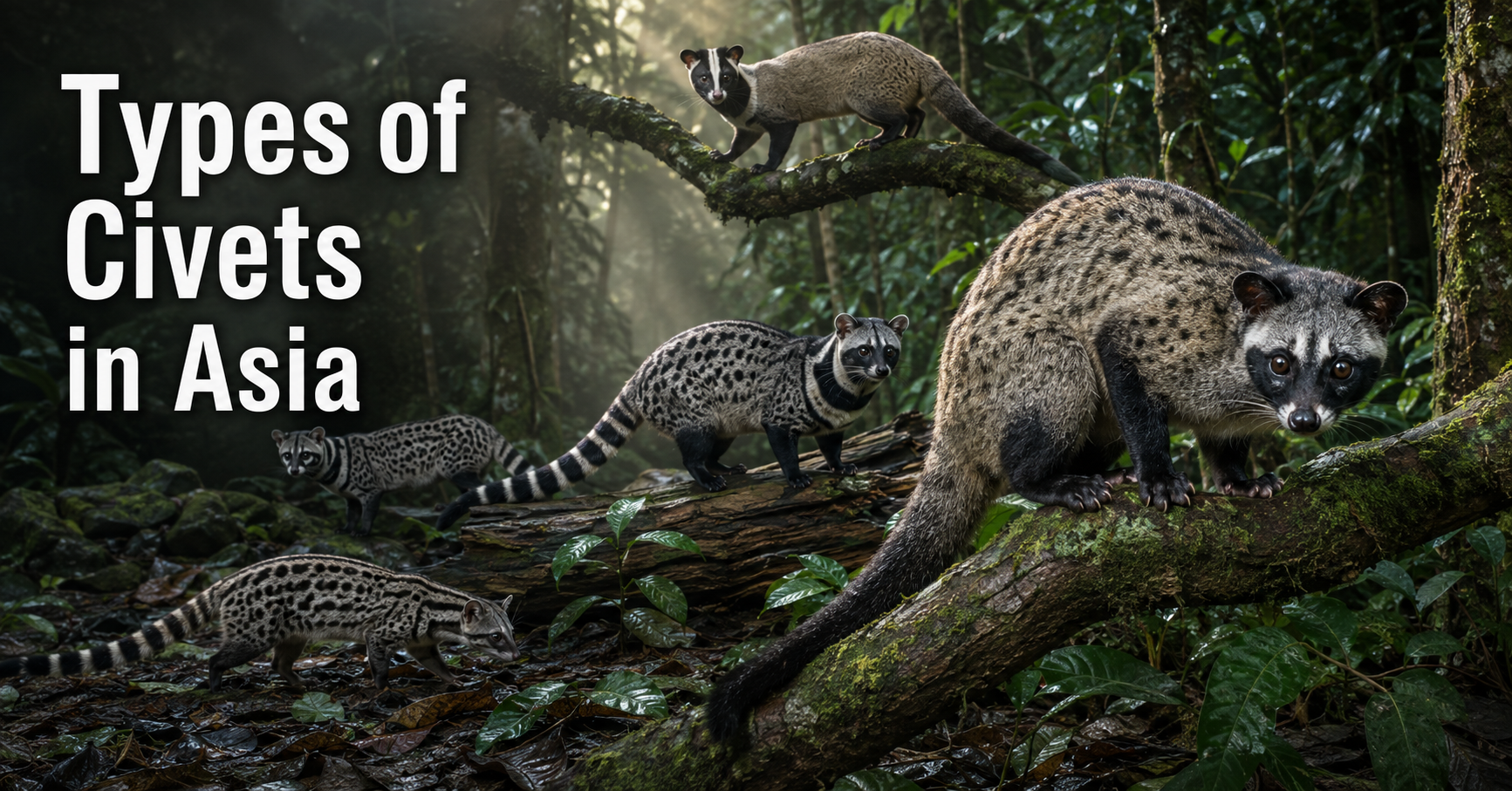
Asia is home to 18 living civet species in the family Viverridae, including true civets, palm civets, the semiaquatic otter civet, and the unusual binturong. These secretive mammals occur from India and Sri Lanka through southern China and mainland Southeast Asia to the Philippines, Borneo, Sumatra, and Sulawesi.
This guide to the types of civets in Asia follows the current species recognized by the American Society of Mammalogists’ Mammal Diversity Database. It covers appearance, range, habitat, diet, behavior, identification features, and conservation concerns. Recent taxonomic changes explain why some older sources list fewer Asian civet species.
What Are the Main Types of Civets in Asia?
The 18 Asian civets include five species in the genus Paradoxurus, three other palm civets, the binturong, five specialized civets in the subfamily Hemigalinae, four large civets in the genus Viverra, and the small Indian civet. Most are nocturnal omnivores, but their lifestyles range from highly arboreal fruit eaters to ground-foraging hunters and wetland specialists.
| No. | Common Name | Scientific Name | Main Range | Conservation Status |
|---|---|---|---|---|
| 1 | Northern Palm Civet | Paradoxurus hermaphroditus | South Asia and mainland Southeast Asia | Least Concern |
| 2 | Southern Palm Civet | Paradoxurus musanga | Malay Peninsula, Sumatra, and nearby islands | Not separately assessed |
| 3 | Philippine Palm Civet | Paradoxurus philippinensis | Philippines and parts of the Sunda region | Not Evaluated |
| 4 | Golden Palm Civet | Paradoxurus zeylonensis | Sri Lanka | Least Concern |
| 5 | Brown Palm Civet | Paradoxurus jerdoni | Western Ghats of India | Least Concern |
| 6 | Masked Palm Civet | Paguma larvata | Himalayas, China, and Southeast Asia | Least Concern |
| 7 | Small-toothed Palm Civet | Arctogalidia trivirgata | Mainland and island Southeast Asia | Least Concern |
| 8 | Binturong | Arctictis binturong | South and Southeast Asia | Vulnerable |
| 9 | Owston’s Civet | Chrotogale owstoni | Vietnam, Laos, and southern China | Endangered |
| 10 | Banded Palm Civet | Hemigalus derbyanus | Sundaland and parts of mainland Southeast Asia | Near Threatened |
| 11 | Hose’s Palm Civet | Diplogale hosei | Borneo | Vulnerable |
| 12 | Otter Civet | Cynogale bennettii | Sumatra, Borneo, and the Malay Peninsula | Endangered |
| 13 | Sulawesi Palm Civet | Macrogalidia musschenbroekii | Sulawesi | Vulnerable |
| 14 | Large Indian Civet | Viverra zibetha | South, East, and Southeast Asia | Least Concern |
| 15 | Large-spotted Civet | Viverra megaspila | Mainland Southeast Asia | Endangered |
| 16 | Malayan Civet | Viverra tangalunga | Malay Peninsula, Sumatra, Borneo, and nearby islands | Least Concern |
| 17 | Malabar Large-spotted Civet | Viverra civettina | Western Ghats of India | Critically Endangered |
| 18 | Small Indian Civet | Viverricula indica | South, East, and Southeast Asia | Least Concern |
1. Northern Palm Civet
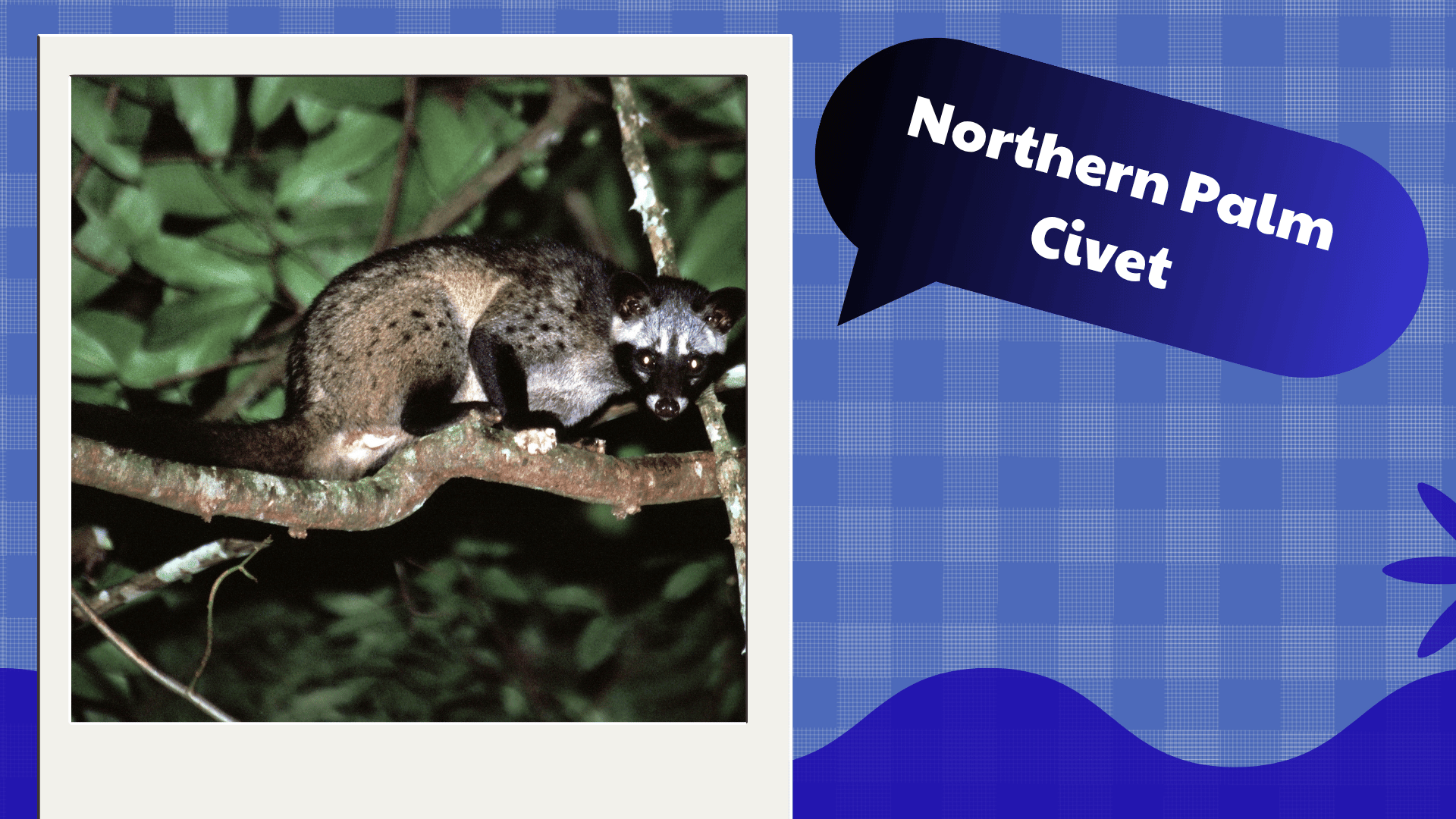
The northern palm civet, Paradoxurus hermaphroditus, is frequently called the Asian palm civet or common palm civet. Current taxonomy applies the northern palm civet name more specifically after several regional populations were separated into additional species.
This civet has a long, stocky body covered in coarse grayish or brownish fur. Its face usually displays pale markings around the eyes and forehead, while its muzzle, feet, ears, and much of the tail are dark. Rows of spots or broken stripes may appear along the back.
Northern palm civets occupy forests, plantations, gardens, farms, and sometimes urban neighborhoods across South and mainland Southeast Asia. They are skilled climbers but also travel on the ground. Most activity occurs at night.
Fruit forms an important part of the diet, supplemented by insects, small vertebrates, eggs, and other available foods. By carrying and excreting seeds, wild civets can contribute to forest regeneration. However, the species is heavily captured for the pet trade, meat markets, and caged civet-coffee production.
2. Southern Palm Civet
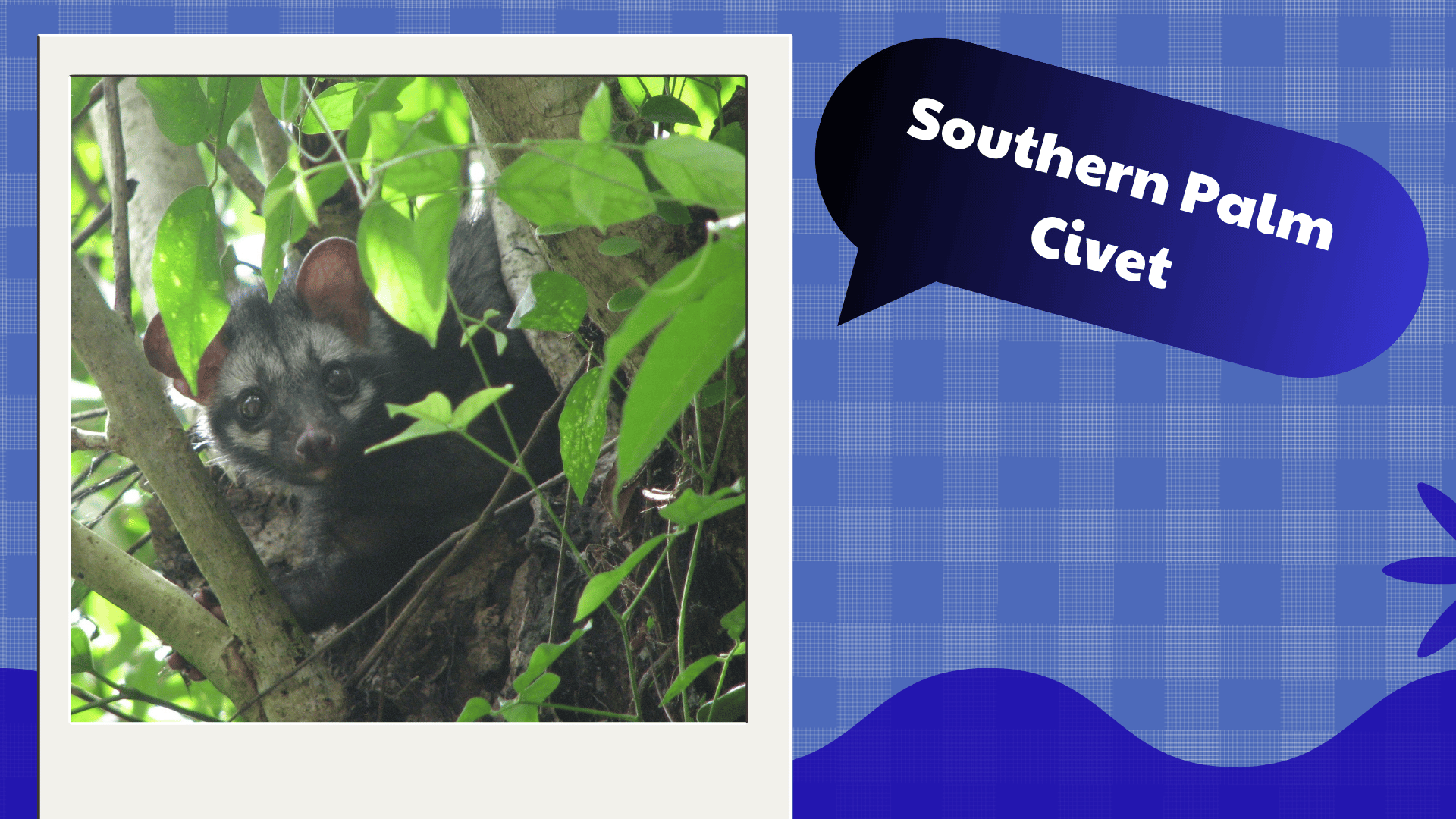
The southern palm civet, Paradoxurus musanga, was historically included within the broadly defined Asian palm civet. Modern mammal taxonomy recognizes it as a separate species associated with the Malay Peninsula, Sumatra, and parts of the Sunda region.
Its appearance resembles that of the northern palm civet: an elongated body, pointed muzzle, dark legs, long tail, and grayish-brown coat marked with dark spots or lines. Regional variation makes visual separation difficult. Geographic origin and genetic analysis are more dependable than coat pattern alone.
Southern palm civets use tropical forest, secondary woodland, plantations, and other habitats with fruiting trees. They can climb efficiently and often rest in tree cavities, dense vegetation, or sheltered structures during daylight.
The diet is omnivorous and includes fruit, insects, small animals, and occasionally human-grown crops. Their tolerance of modified environments does not eliminate threats from hunting, wildlife markets, road traffic, and forest fragmentation. Because many conservation assessments predate the taxonomic split, the status of this species requires further study.
3. Philippine Palm Civet
The Philippine palm civet, Paradoxurus philippinensis, is another lineage formerly grouped with the Asian palm civet. It is associated primarily with the Philippines, although the precise natural and human-assisted history of palm civets on different islands is complicated.
This species has a narrow, catlike face, dark muzzle, relatively short legs, and a long tail. Its coat is usually grayish to brown, with dark dorsal markings that vary considerably among individuals and island populations.
Philippine palm civets are nocturnal and adaptable. They may occur in forest, secondary vegetation, agricultural areas, coconut groves, and habitats close to settlements. Their climbing ability allows them to feed and shelter above ground, but they regularly forage on the forest floor.
Fruit is a major food source, while insects and small vertebrates provide additional protein. The species is not yet separately evaluated on the IUCN Red List, partly because older surveys treated it as part of a wider species. Research is needed to clarify its distribution, population trends, and relationship with other Paradoxurus civets.
4. Golden Palm Civet
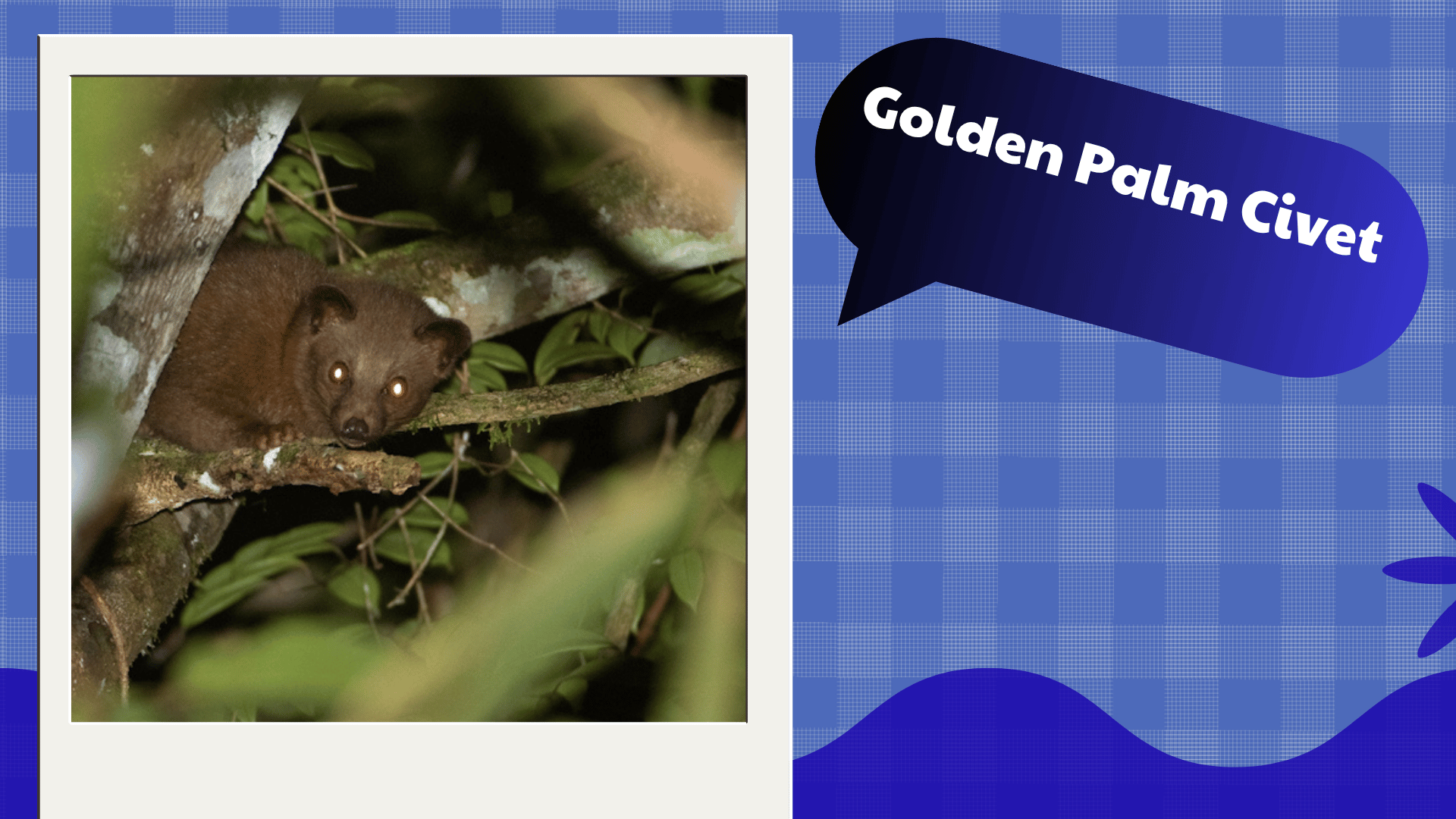
The golden palm civet, Paradoxurus zeylonensis, is found only in Sri Lanka. Its endemic status makes it one of the island’s distinctive mammals and means that its entire global population depends on habitat within one country.
As its name suggests, this civet often has a golden-brown, reddish, or warm olive coat. Some individuals are relatively uniform, while others show darker markings. Its body is slender, its muzzle is pointed, and its tail is long but generally lacks the strong rings seen on some other civets.
The golden palm civet inhabits wet-zone forests, montane forests, intermediate-zone woodland, home gardens, and some agricultural landscapes. It is primarily nocturnal and arboreal, although it may descend to the ground to cross open areas or locate food.
Fruit makes up much of its diet, giving the animal an ecological role as a seed disperser. Small animals and invertebrates may also be eaten. Despite its current Least Concern listing, forest loss, road deaths, hunting, and conflict around fruit trees can affect local populations. Sri Lankan palm civet taxonomy remains an active area of research.
5. Brown Palm Civet
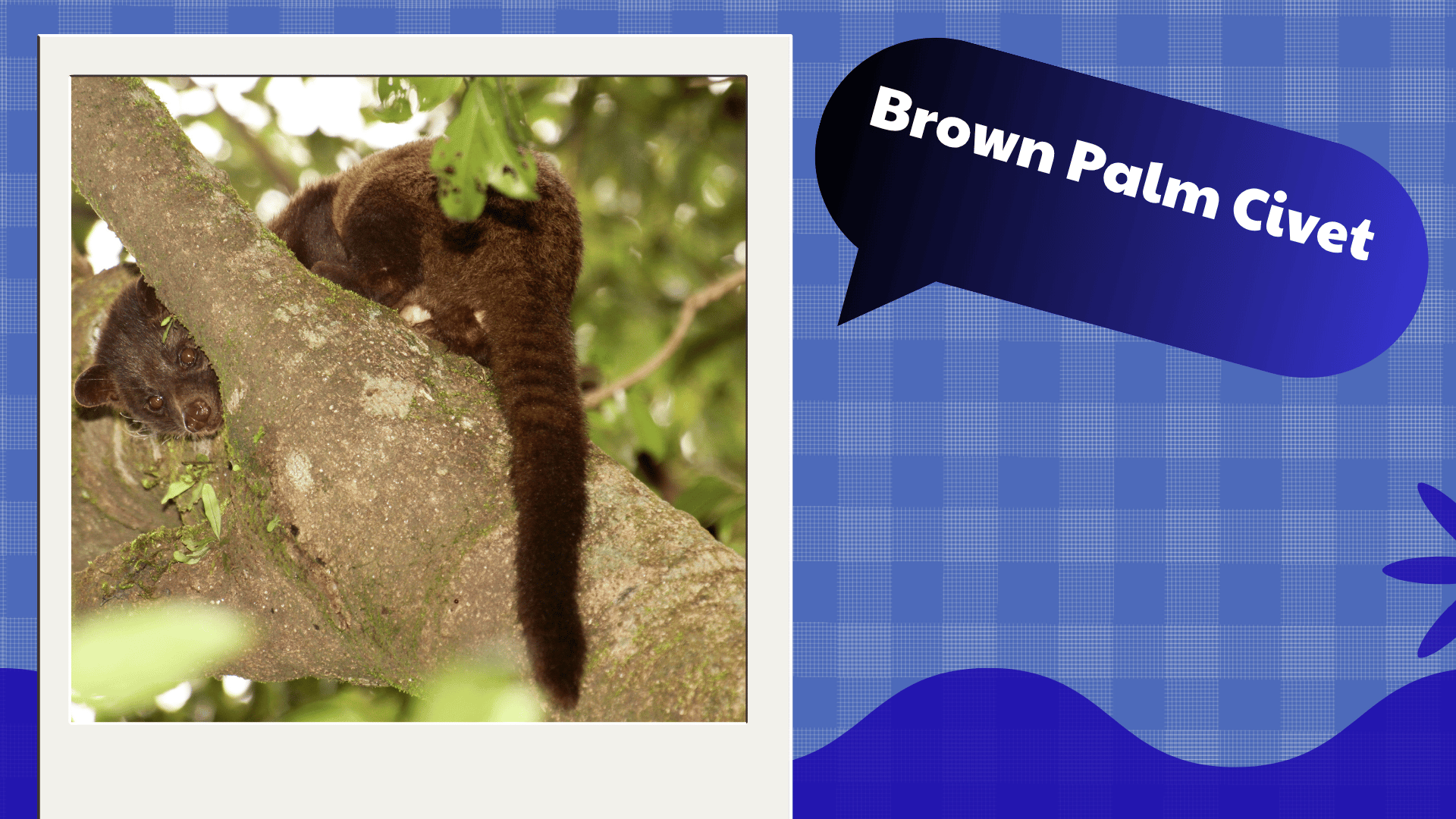
The brown palm civet, Paradoxurus jerdoni, is endemic to the Western Ghats of southern India. It is also known as Jerdon’s palm civet and is closely associated with the region’s moist evergreen forests.
This civet has a mostly uniform dark brown coat, sometimes with slightly darker legs and tail. It lacks the bold spots and stripes of many other Asian civets. Its long body, rounded ears, pointed muzzle, and extended tail reflect its strongly arboreal lifestyle.
Brown palm civets spend much of the night moving through the forest canopy in search of ripe fruit. They can also use shaded coffee and cardamom plantations when these retain native trees and connections to natural forest. Their droppings may contain numerous intact seeds.
Although fruit dominates the diet, the animals may consume insects and small vertebrates. Forest fragmentation is a significant concern because isolated canopy patches restrict movement. Maintaining native trees, forest corridors, and wildlife-friendly farms can help support this Western Ghats specialist.
6. Masked Palm Civet
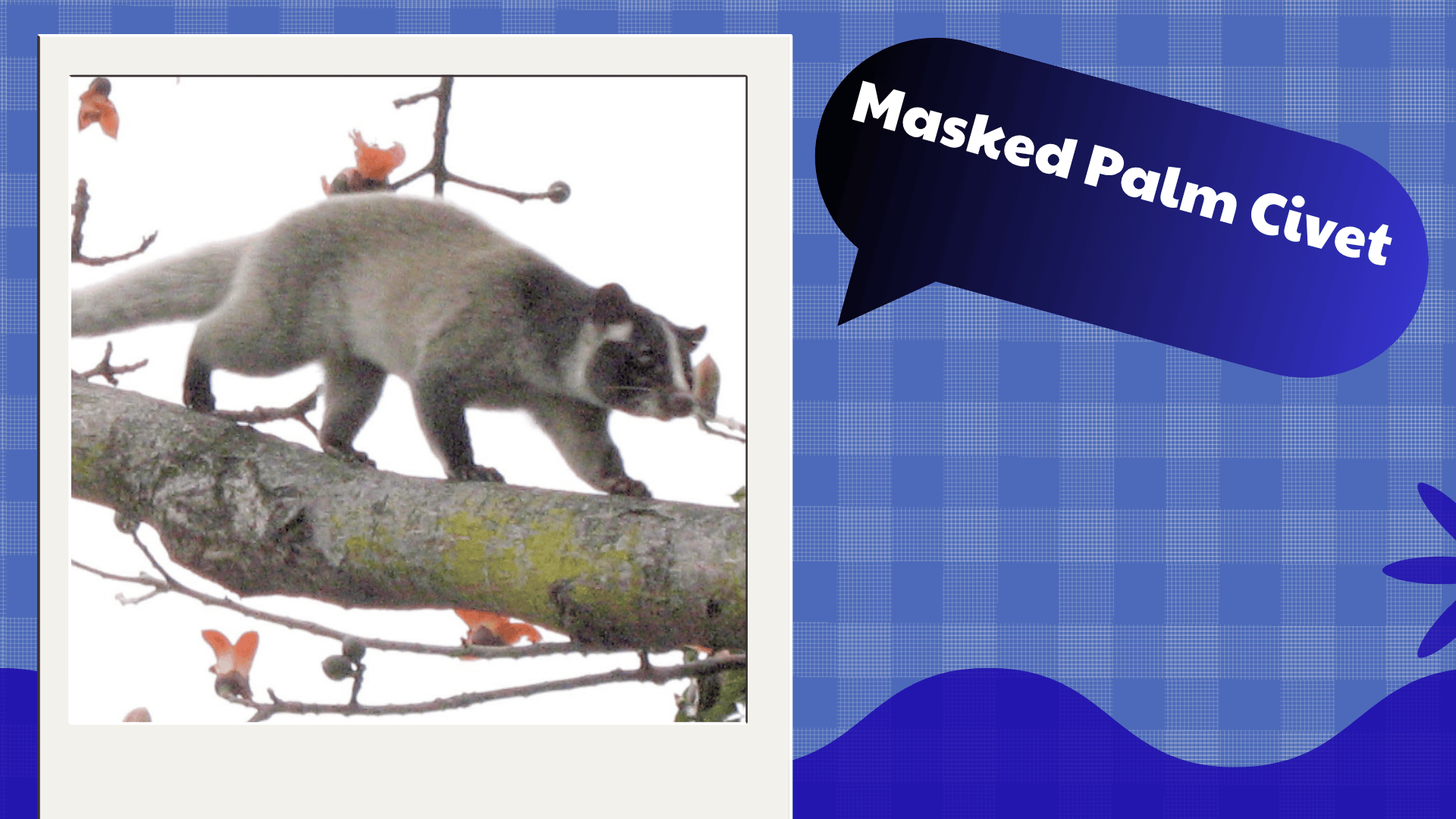
The masked palm civet, Paguma larvata, has one of the widest distributions of any Asian civet. It occurs from the Himalayan foothills through China and much of mainland Southeast Asia, with populations on several large islands.
The body is usually plain gray, brown, or buff rather than heavily spotted. Its most recognizable feature is a contrasting facial pattern consisting of a pale central stripe, dark areas around the eyes, and pale patches near the ears or cheeks. The long tail is normally dark toward the tip.
Masked palm civets inhabit tropical and subtropical forests, montane woodland, plantations, orchards, and suburban environments. They climb well but also move confidently on the ground. Individuals are generally solitary and most active after dark.
The species eats fruit, insects, birds, rodents, and other small animals. Its adaptability supports a broad distribution, but it is still hunted and traded for meat and as an exotic pet. Close contact between captured wildlife, domestic animals, and people also creates avoidable animal-welfare and disease risks.
7. Small-toothed Palm Civet
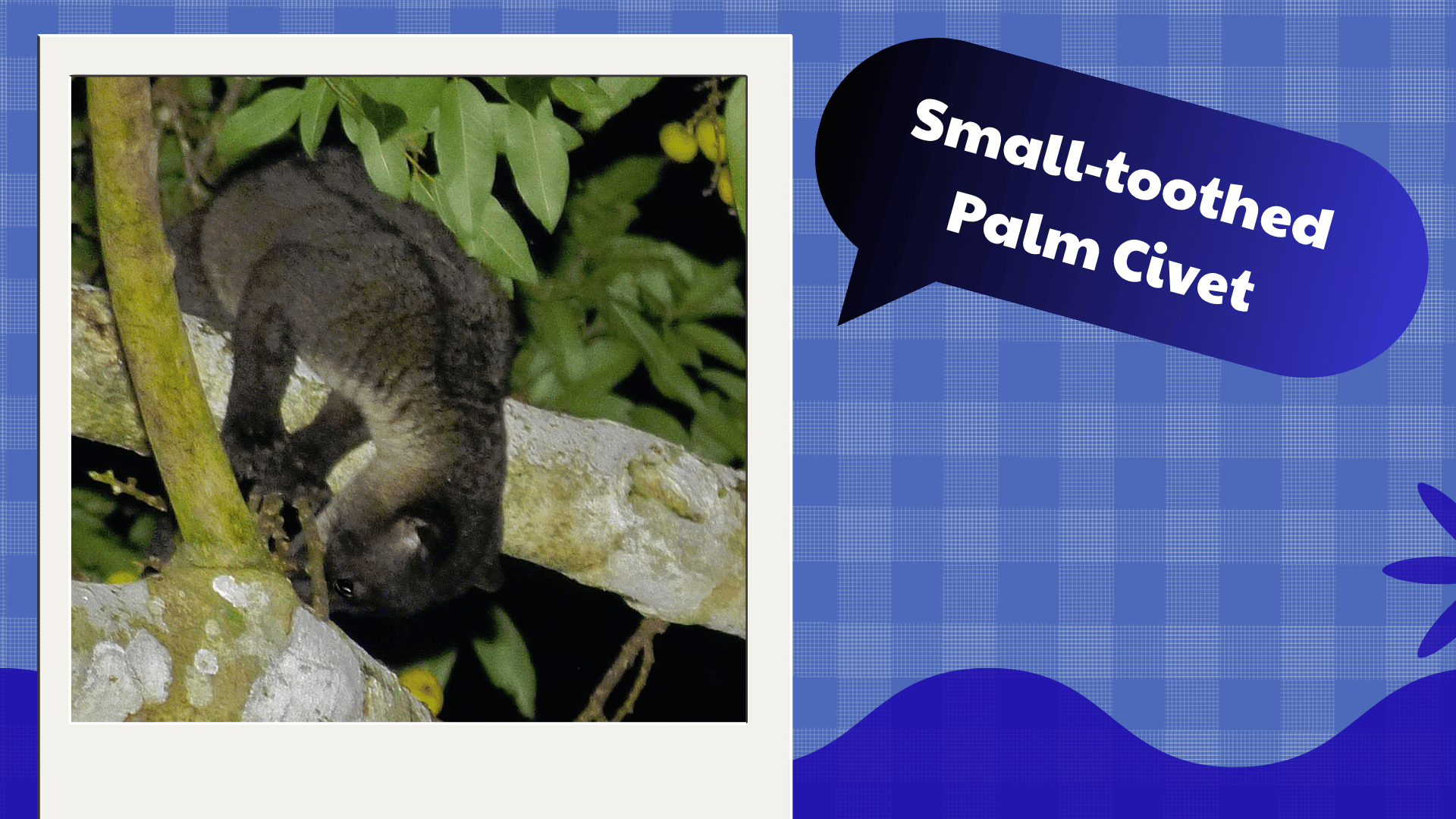
The small-toothed palm civet, Arctogalidia trivirgata, is a slender, highly arboreal species from Southeast Asia. It occurs in forested areas of the mainland and on islands including Borneo and Sumatra.
This civet typically has a pale gray, buff, or brown body marked by three dark stripes running along the back. Its muzzle is narrow, its eyes are large, and its long tail assists with balance in the canopy. Males and females may differ slightly in color.
Small-toothed palm civets favor tropical forest and are rarely observed on the ground. They move through branches at night, feeding on fruit and small animals. Their teeth and narrow facial structure help distinguish them from stockier palm civets.
Because the species is nocturnal and spends much of its life high in trees, population data remain limited. Deforestation and canopy fragmentation reduce suitable habitat. Camera traps positioned on elevated branches can reveal this species more effectively than ground-based surveys alone.
8. Binturong
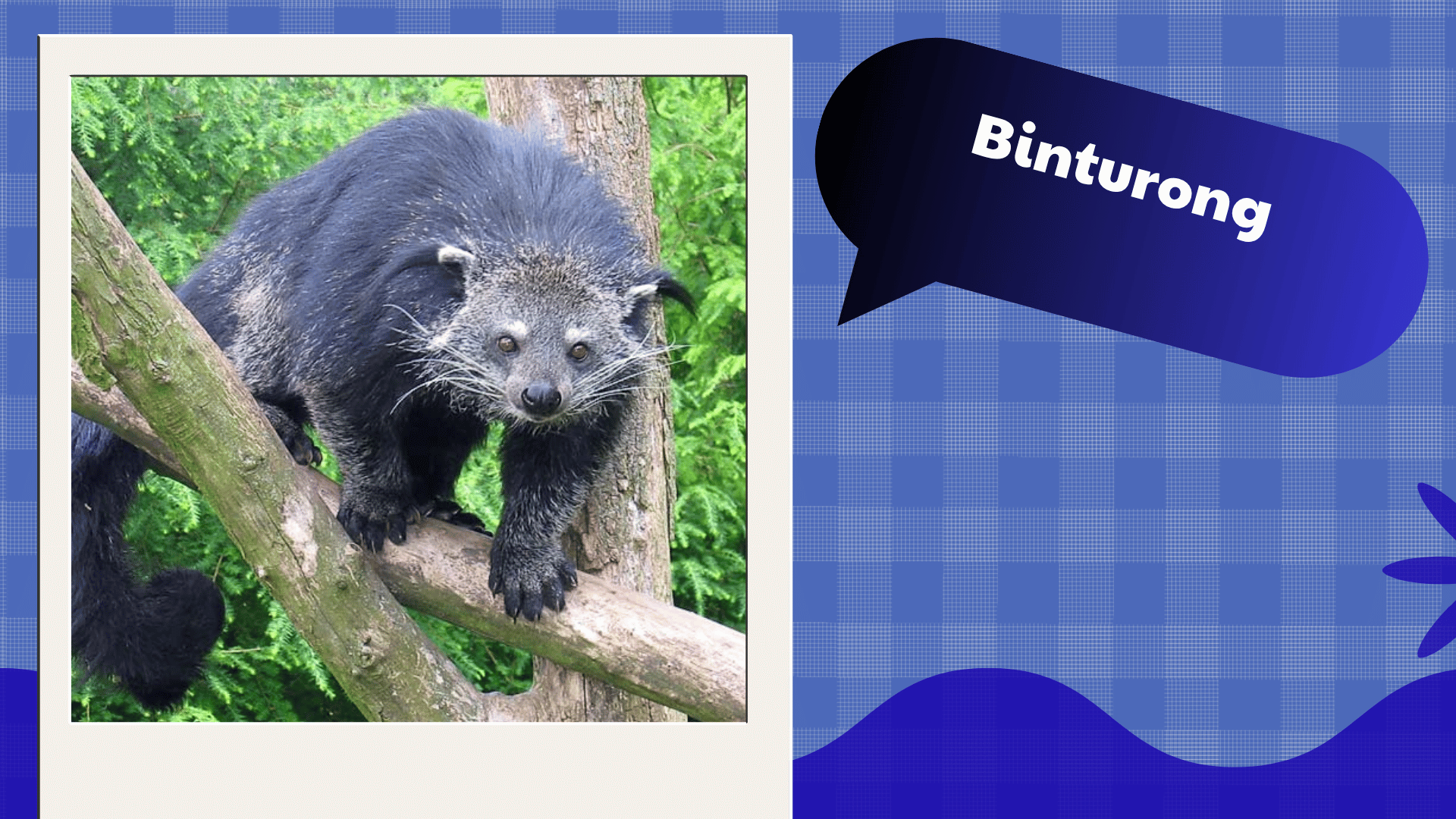
The binturong, Arctictis binturong, is the largest Asian viverrid. It is widely called the bearcat, although it is neither a bear nor a cat. Its heavy build, shaggy black coat, pale whiskers, and muscular tail make it unlike any other civet.
A binturong has a prehensile tail capable of gripping branches. This is an exceptional adaptation among Old World carnivores. It moves deliberately through the canopy and can rotate its hind feet to improve its grip when climbing downward.
Binturongs occur in forests from northeastern South Asia through mainland Southeast Asia to parts of Indonesia and the Philippines. They are predominantly arboreal and rely on large trees for travel, shelter, feeding, and reproduction.
Fruit, especially figs, is central to the diet, although eggs, insects, birds, and small mammals may also be consumed. Binturongs are important seed dispersers. Habitat loss, hunting, and wildlife trafficking have led to a Vulnerable classification. Their scent is often compared to buttered popcorn because of a chemical compound in their urine.
9. Owston’s Civet
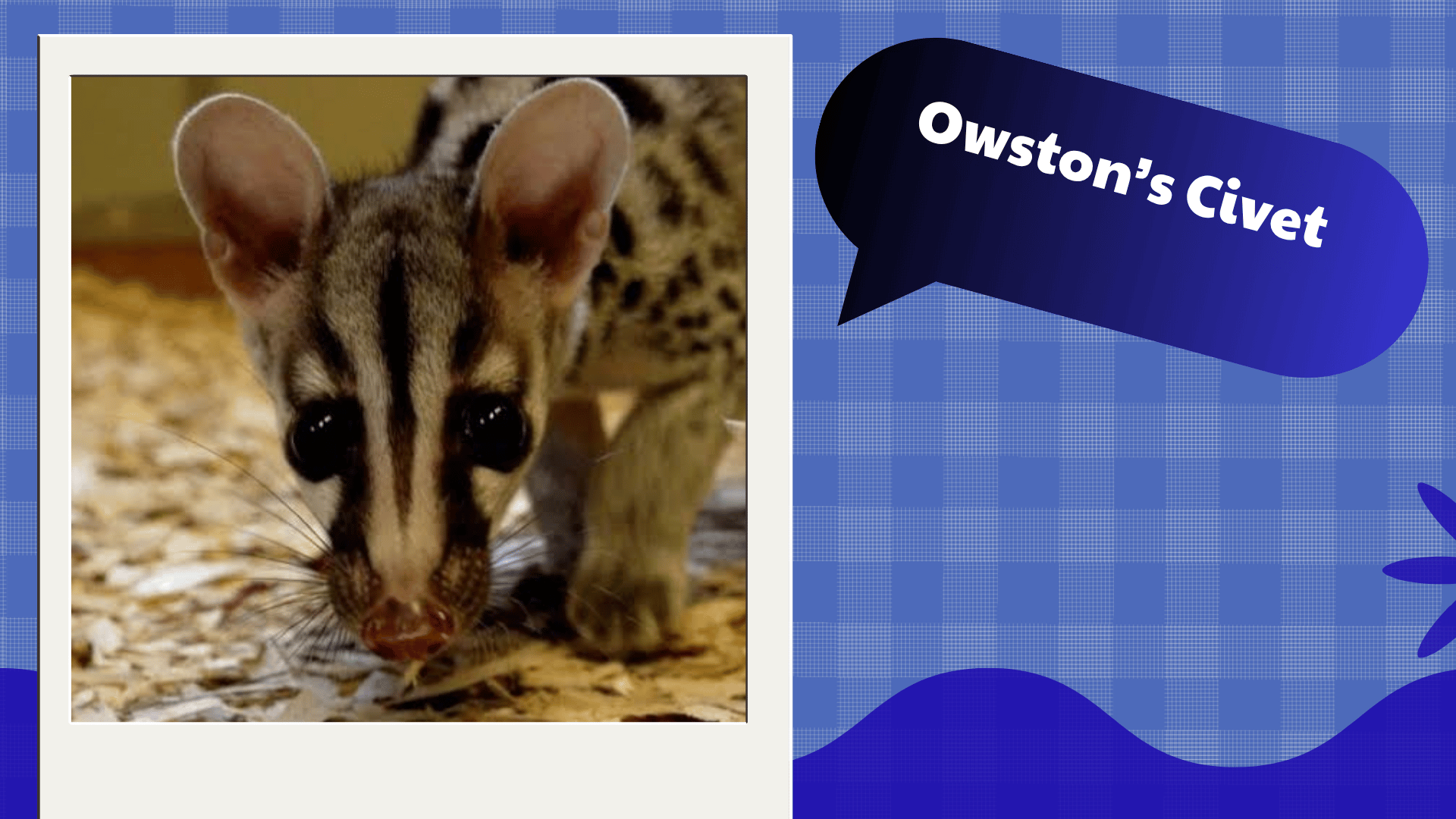
Owston’s civet, Chrotogale owstoni, is one of Asia’s most visually distinctive and threatened civets. Its confirmed range centers on Vietnam and Laos, with records from southern China and possible occurrence near neighboring border regions.
It has a pale gray or buff body crossed by broad black bands. Dark spots appear on the neck and limbs, while the long tail carries bold rings. Its elongated muzzle is narrower than that of a banded palm civet.
Owston’s civets forage mainly on the ground in evergreen forest, secondary woodland, and landscapes containing dense vegetation near streams. Earthworms appear to be important prey, accompanied by insects, small vertebrates, and fruit.
The species is Endangered. Snaring is a particularly serious threat because wire traps set for other animals can kill civets indiscriminately. Habitat loss and wildlife trade add further pressure. Protecting Owston’s civet requires snare removal, law enforcement, habitat conservation, community cooperation, and carefully managed breeding programs.
10. Banded Palm Civet
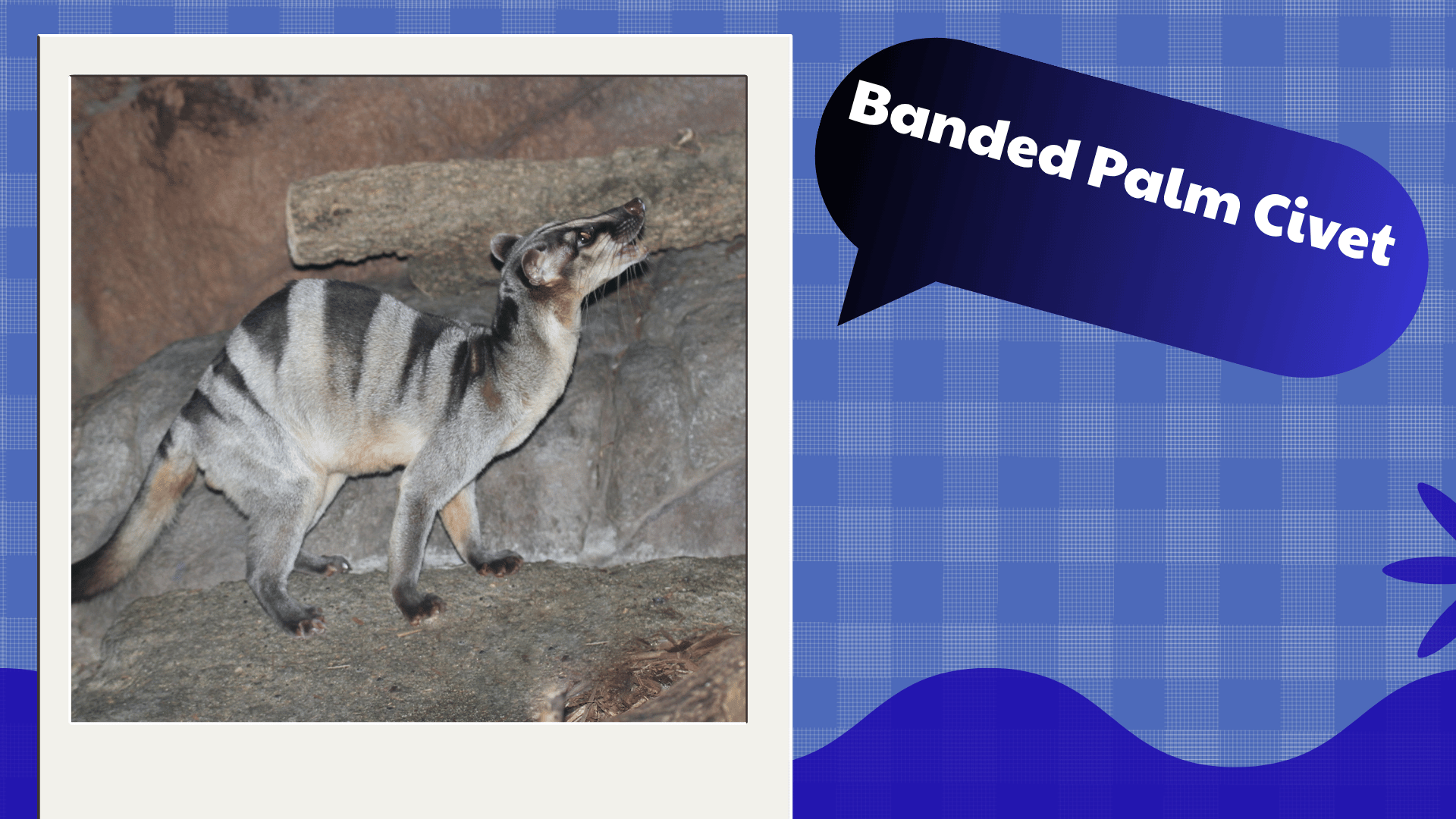
The banded palm civet, Hemigalus derbyanus, occurs in parts of the Malay Peninsula, Sumatra, Borneo, and nearby portions of mainland Southeast Asia. Its clean banded pattern makes it relatively easy to recognize in a clear camera-trap photograph.
The coat is pale buff or grayish, crossed by several broad dark bands. Dark stripes extend along the head and neck, and the pointed face ends in a dark nose. Its body is slender with short legs and a long tail.
Despite its name, this civet often forages on or close to the ground. It searches forest floors, stream margins, and fallen logs for insects, worms, crustaceans, and small vertebrates. It can climb when resting or escaping danger.
Banded palm civets depend on tropical forest and are sensitive to extensive land conversion. Forest fragmentation, logging, plantations, and hunting have contributed to a Near Threatened classification. Their pattern may resemble Owston’s civet, but the latter generally shows additional spots and occurs farther north in Indochina.
11. Hose’s Palm Civet
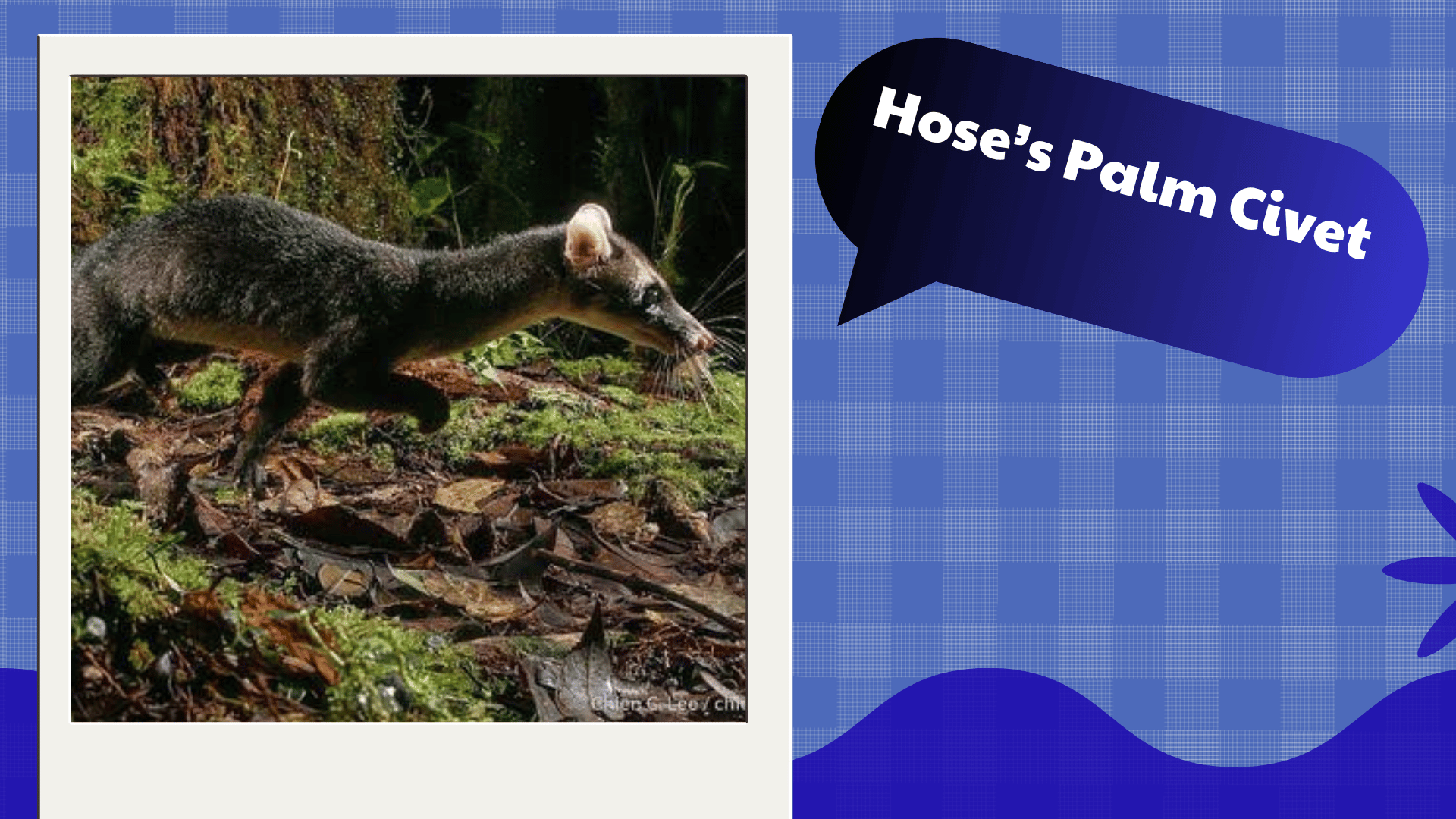
Hose’s palm civet, Diplogale hosei, is a rare and poorly known Bornean endemic. It has been recorded in Brunei, Indonesian Kalimantan, and Malaysian Borneo, often in upland or montane forest.
The species has dark brown to almost black upperparts and a contrasting pale face, throat, chest, and inner legs. Its narrow body and long muzzle resemble other members of the Hemigalinae subfamily, but it lacks broad transverse bands.
Only a limited number of observations and camera-trap records exist. Available evidence suggests that it spends substantial time on the ground and may forage near streams or moist forest areas. Its diet probably includes insects and other small animals, but many ecological details remain uncertain.
Hose’s palm civet is classified as Vulnerable. Forest conversion, logging, roads, and habitat fragmentation are its main known threats. The shortage of records should not be interpreted as proof of extremely low abundance everywhere, but it makes changes in population size difficult to measure.
12. Otter Civet
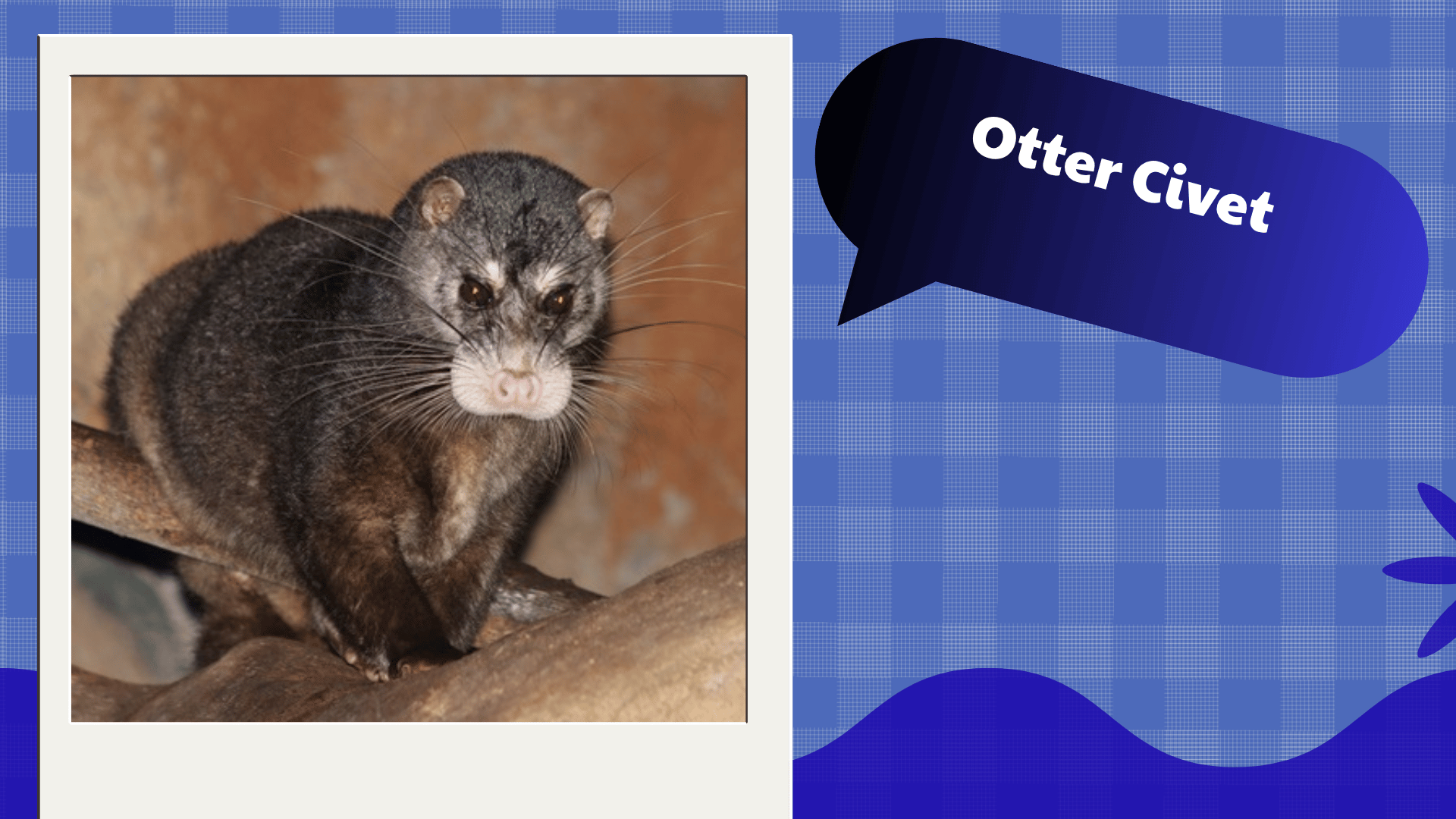
The otter civet, Cynogale bennettii, is a semiaquatic forest civet found primarily in Sumatra, Borneo, and the Malay Peninsula. Its broad muzzle, small ears, webbed feet, and long whiskers are adaptations for feeding around water.
Its coat is dark brown or blackish and appears dense and rough. The eyes and nostrils sit relatively high on the head, helping the animal remain alert while moving through shallow water. Despite its name, it is a civet rather than a true otter.
Otter civets inhabit swamp forest, peatlands, stream edges, and other wet forest environments. They are believed to hunt fish, frogs, crustaceans, mollusks, insects, and small vertebrates. Their secretive nocturnal behavior makes direct observation exceptionally difficult.
The species is Endangered because lowland wetlands are being drained, logged, burned, and converted to plantations. Water pollution and the loss of streamside vegetation further reduce habitat quality. Conserving intact peat swamps and forested waterways is essential for its survival.
13. Sulawesi Palm Civet
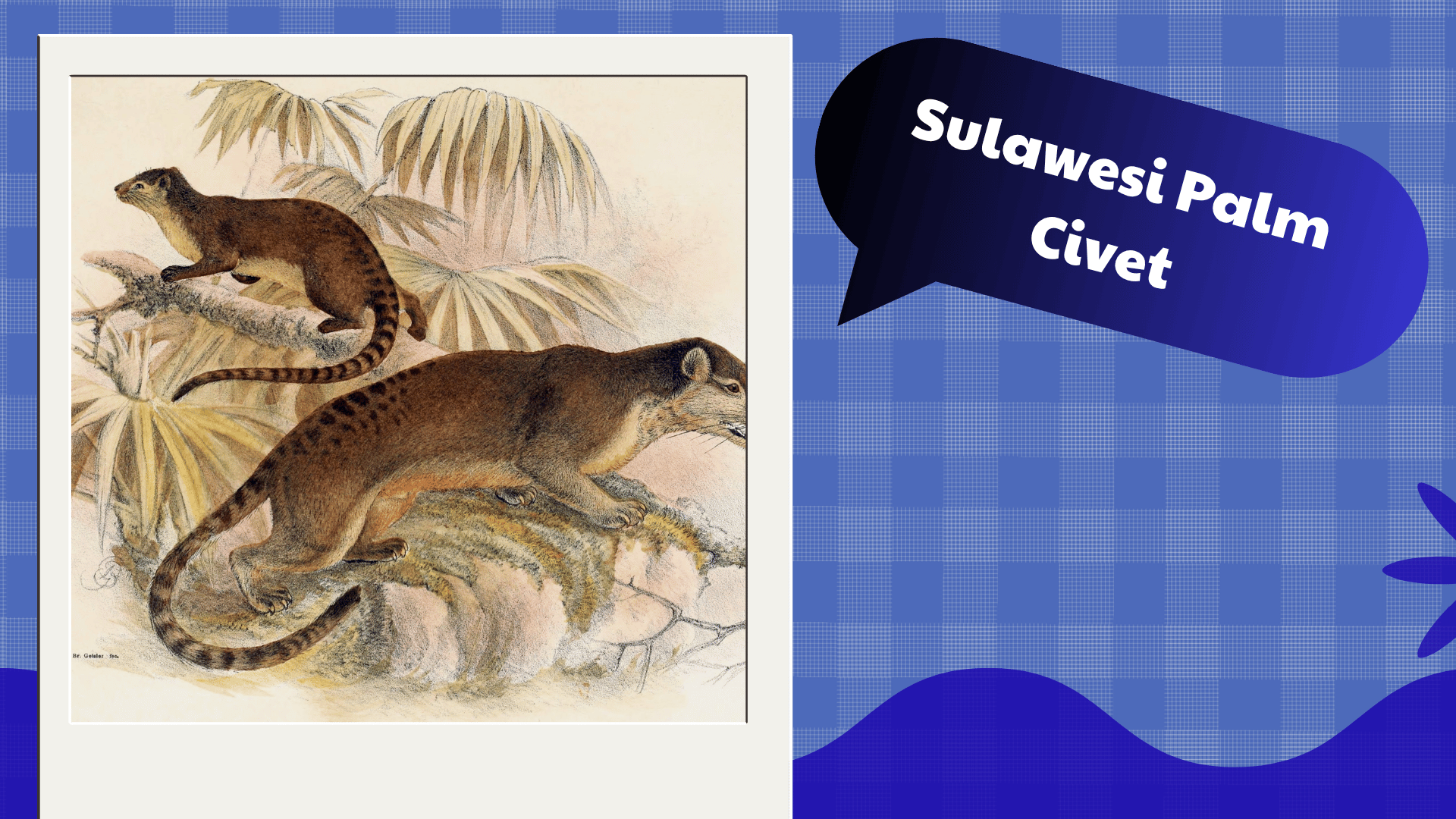
The Sulawesi palm civet, Macrogalidia musschenbroekii, is endemic to the Indonesian island of Sulawesi. It is one of the island’s largest native carnivorous mammals and represents a unique evolutionary lineage.
This civet has a long body covered in dark brown or chestnut fur. Subtle spots or stripes may be visible along the sides, while the tail often shows faint banding. Its face is relatively narrow, with short rounded ears and pale markings near the eyes.
The species uses lowland and montane forest, including some disturbed forest where adequate cover remains. It is mostly nocturnal and can climb, but camera traps frequently record it moving along the ground.
Fruit is important in its diet, supplemented by small mammals, birds, eggs, reptiles, and invertebrates. The Sulawesi palm civet is Vulnerable because of continuing forest loss, habitat fragmentation, hunting, and its restricted island range. Protecting connected forest across different elevations will help populations respond to environmental change.
14. Large Indian Civet
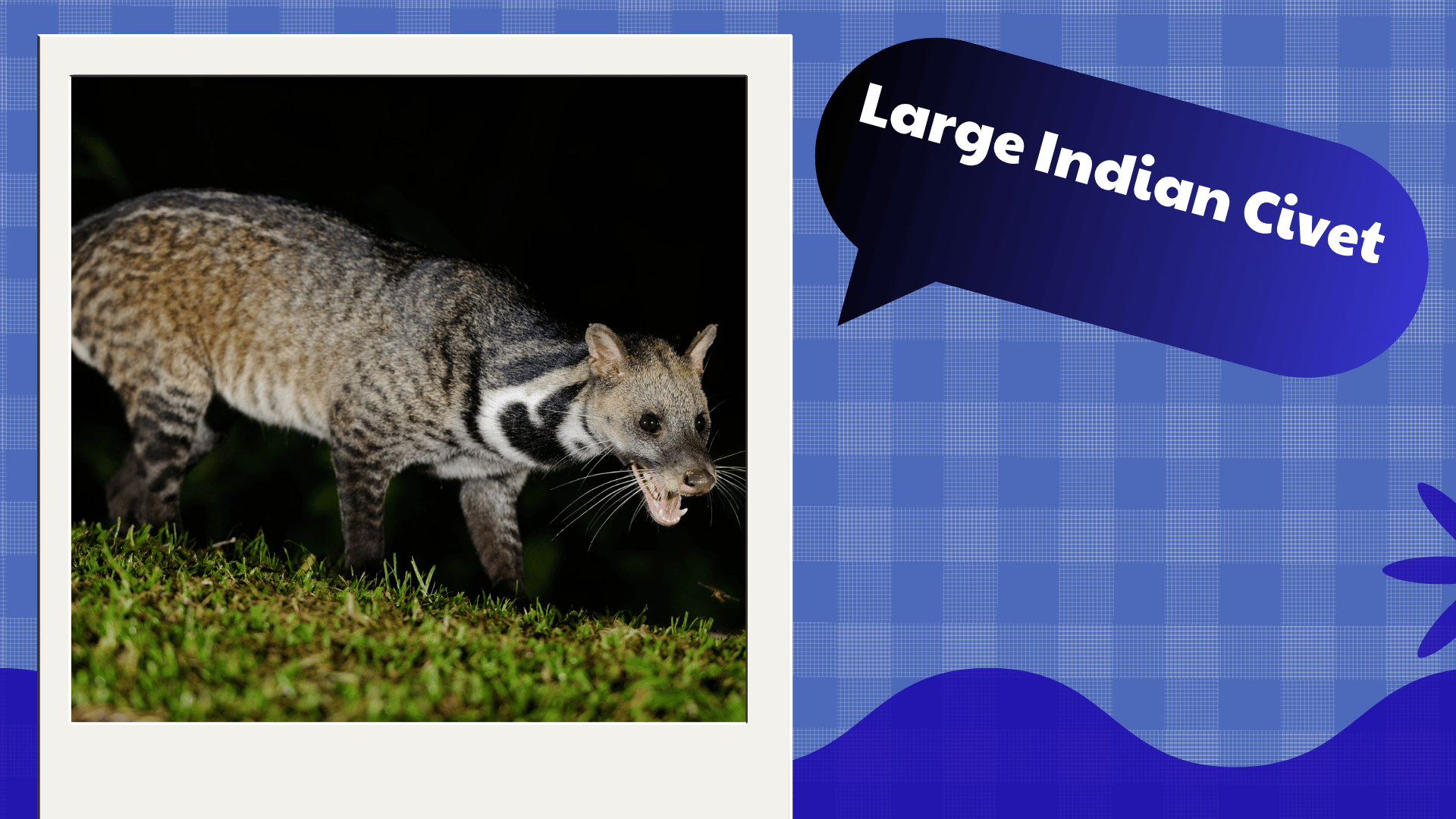
The large Indian civet, Viverra zibetha, is a robust, primarily terrestrial civet found across parts of South, East, and Southeast Asia. It inhabits northeastern India, Nepal, Bhutan, southern China, and portions of mainland Southeast Asia.
Its grayish coat is covered with black spots and stripes. A prominent black-and-white pattern marks the neck, and a dark erectile crest runs along the back. The tail has contrasting black and pale rings. Its size and bold neck markings help separate it from smaller palm civets.
Large Indian civets use forest, grassland edges, scrub, agricultural mosaics, and areas close to water. They forage on the ground at night and rest in dense cover or sheltered sites during the day.
The diet includes rodents, birds, reptiles, amphibians, insects, crabs, fruit, and carrion. Although globally listed as Least Concern, populations may be declining in heavily hunted or deforested regions. Snares, wildlife markets, road deaths, and habitat loss remain local threats.
15. Large-spotted Civet
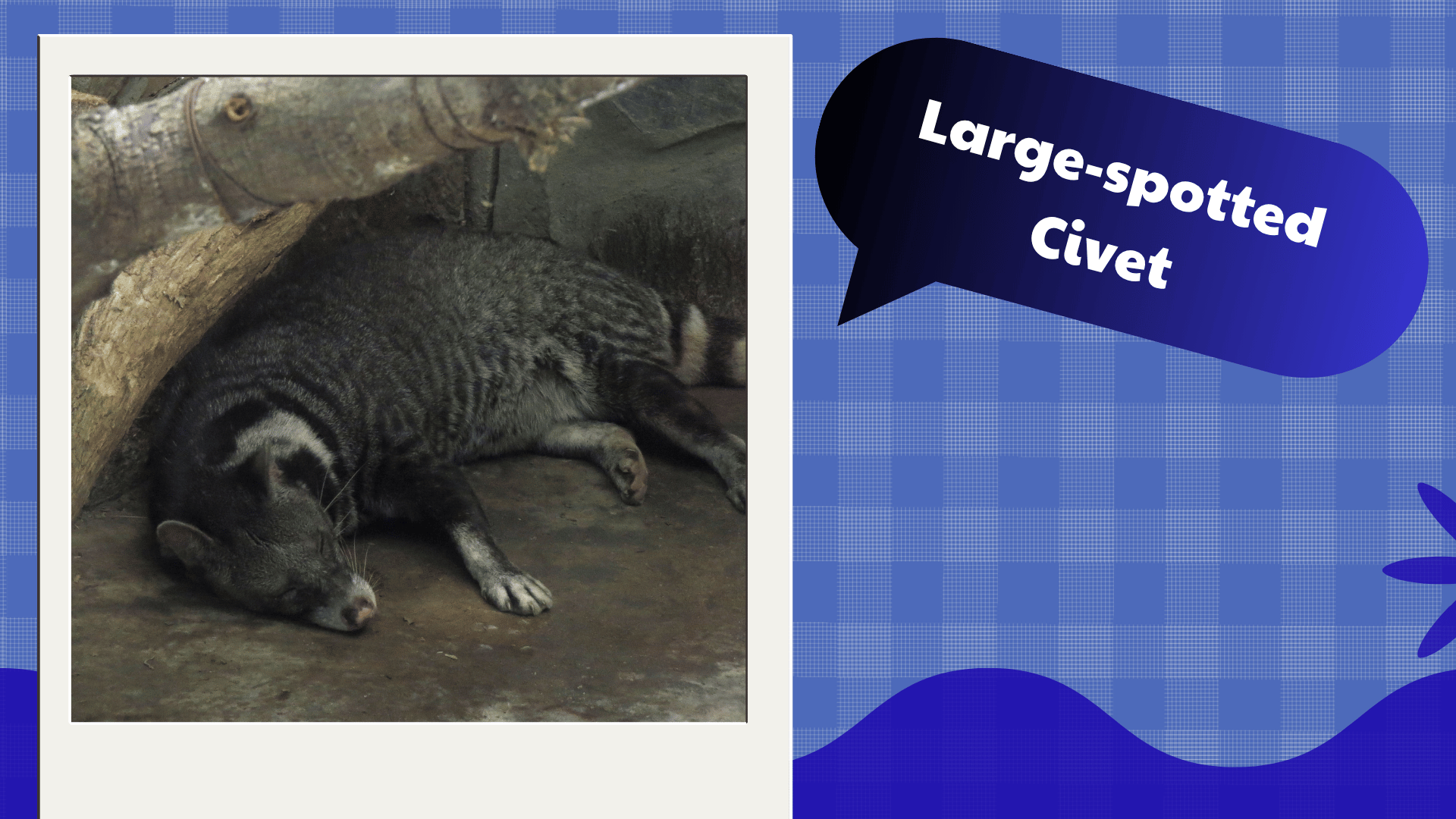
The large-spotted civet, Viverra megaspila, is a rare ground-dwelling species of mainland Southeast Asia. Its known range includes parts of Myanmar, Thailand, Laos, Cambodia, Vietnam, and Peninsular Malaysia, although it is absent or extremely scarce in many former locations.
This civet has large, irregular dark spots on a pale gray or tawny background. Dark bands cross the neck, and the tail is ringed. It resembles the large Indian civet but generally shows larger, more widely spaced body markings and differences in foot structure.
Large-spotted civets are associated with lowland forest, deciduous forest, grassland mosaics, and wetland margins. They forage mainly on the ground for small animals, insects, crabs, fruit, and other available foods.
The species is Endangered. Widespread snaring is a major danger throughout its range, while agricultural expansion and forest conversion continue to eliminate habitat. Lowland protected areas with effective anti-snaring programs are particularly important.
16. Malayan Civet
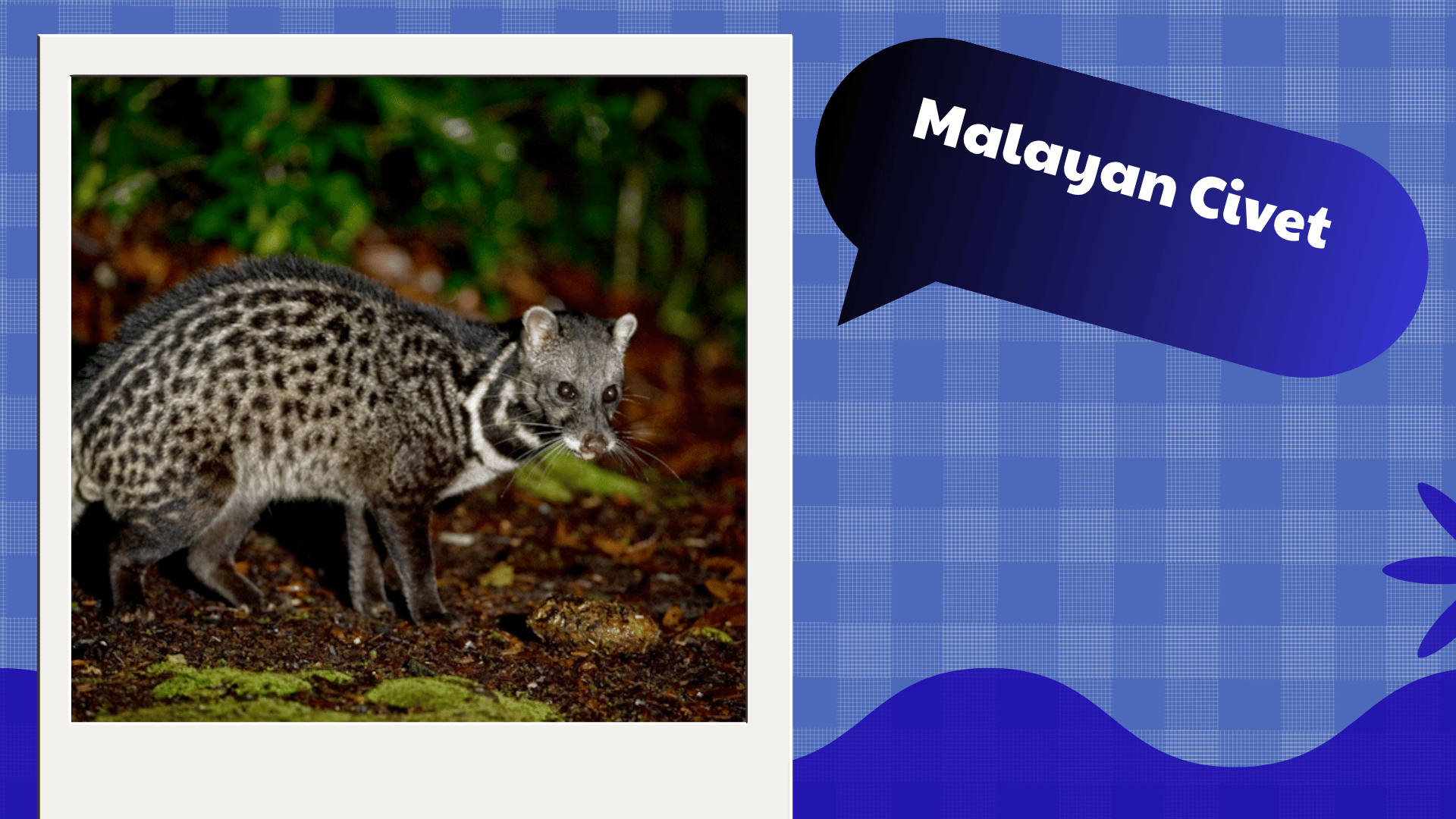
The Malayan civet, Viverra tangalunga, is also known as the Malay civet or Oriental civet. It occurs on the Malay Peninsula, Sumatra, Borneo, and several neighboring islands, although people may have introduced it to parts of its current island range.
Its grayish or buff coat displays numerous black spots. Several black-and-white bands mark the neck, a dark crest runs along the spine, and the tail carries bold rings. It is smaller and more lightly built than the large Indian civet.
Malayan civets occupy primary forest, logged forest, plantations, scrub, and rural landscapes. They are nocturnal and mainly terrestrial, often walking along trails and roads that later make convenient camera-trap locations.
They eat insects, rodents, reptiles, amphibians, fruit, and carrion. Their ability to use disturbed habitat contributes to a Least Concern status, but hunting, road traffic, and forest conversion still reduce local populations. Presence in plantations does not mean that extensive monocultures provide the same ecological value as natural forest.
17. Malabar Large-spotted Civet
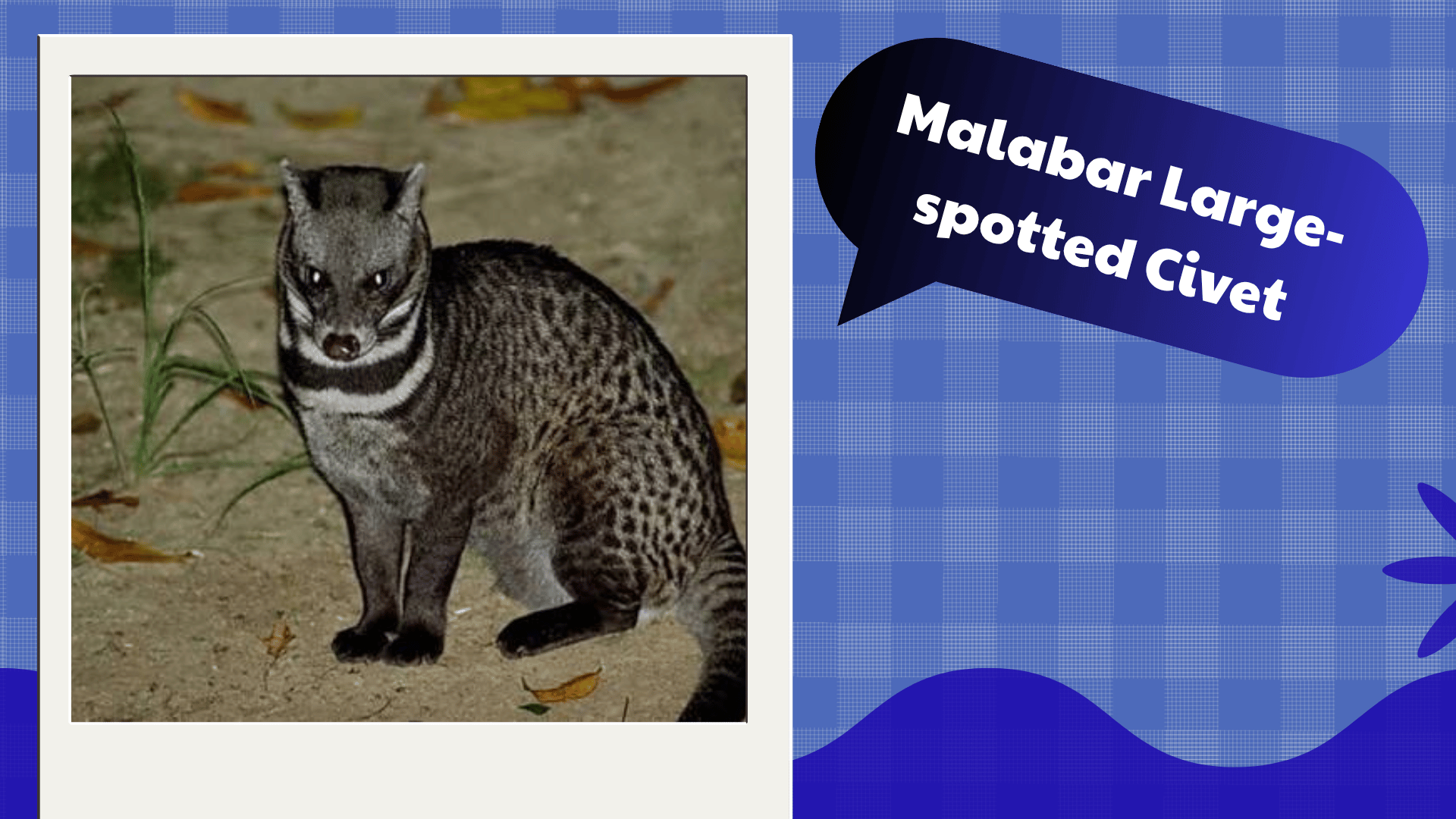
The Malabar large-spotted civet, Viverra civettina, is historically associated with the lowlands and foothills of India’s Western Ghats. It is listed as Critically Endangered, but its current survival and taxonomic status are surrounded by exceptional uncertainty.
Museum specimens show a grayish civet with large dark markings, black neck bands, a dorsal crest, dark feet, and a ringed tail. It closely resembles the large-spotted civet, leading some researchers to question whether it represents a separate species.
No recent field survey has produced widely accepted photographic, genetic, or physical confirmation of a surviving wild population. Reported sightings are difficult to verify because large Indian civets, small Indian civets, mongooses, and domestic animals may be misidentified in poor light.
Potential habitat has been heavily altered by agriculture, development, roads, and expanding settlements. If the Malabar civet survives, it is likely among the rarest mammals in Asia. Future confirmation should rely on clear camera-trap evidence, genetic material, or expert examination rather than an unverified observation.
18. Small Indian Civet
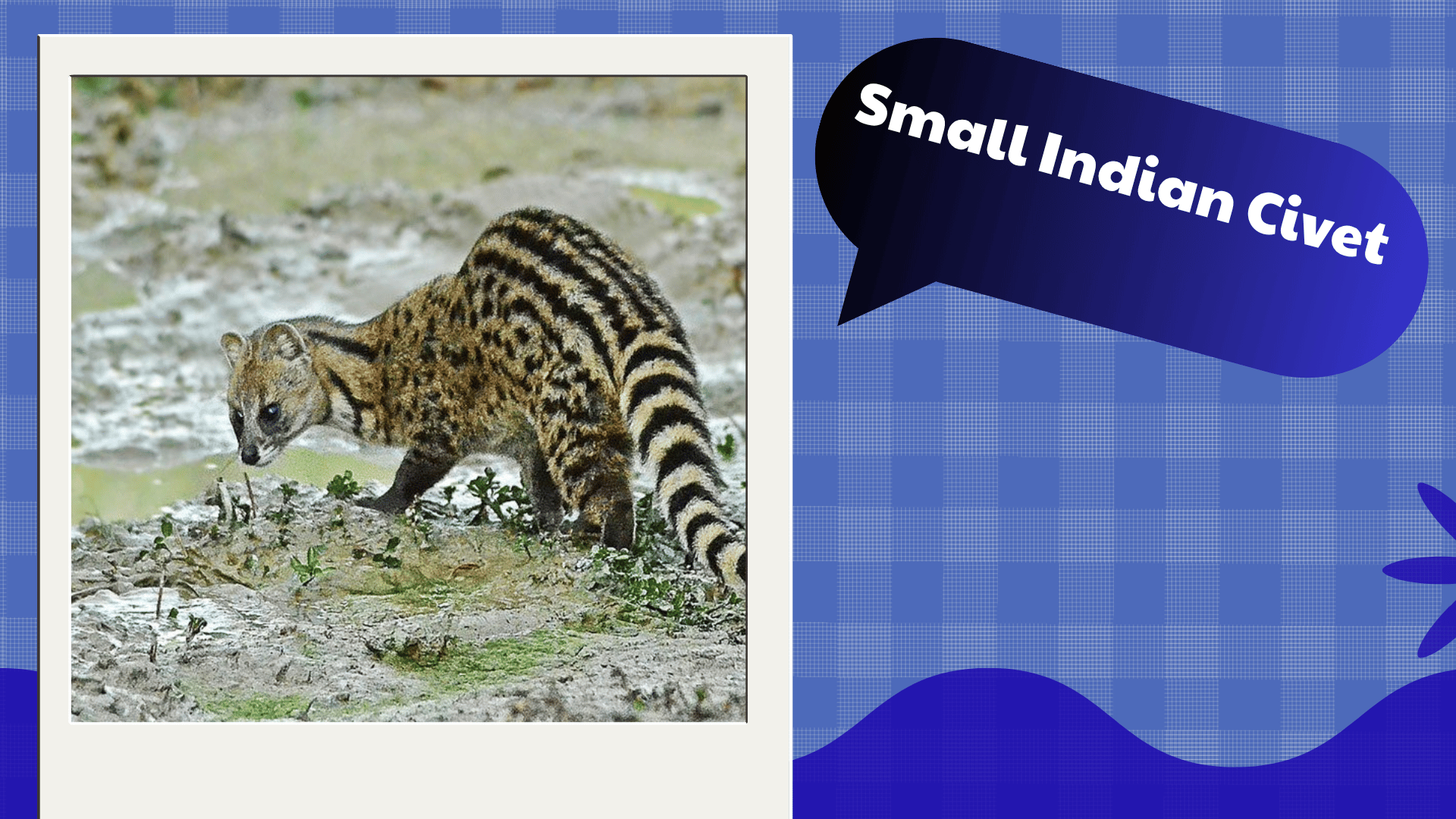
The small Indian civet, Viverricula indica, is a widespread terrestrial species ranging from South Asia through southern China and mainland Southeast Asia. Populations also occur on several islands, some of which may result from historical introductions.
It has a slender body, pointed muzzle, short legs, and a grayish or sandy coat marked with dark spots and narrow stripes. The tail displays multiple black-and-white rings. It is much smaller and more delicately built than species in the genus Viverra.
Small Indian civets use grassland, scrub, open forest, agricultural areas, village edges, and secondary habitats. They usually forage alone at night and rest in burrows, thick vegetation, rock crevices, or other sheltered sites.
The diet is highly varied and includes rodents, insects, reptiles, amphibians, birds, eggs, fruit, and carrion. The species is globally listed as Least Concern because of its large range and adaptability. Nevertheless, it is frequently killed on roads, caught in traps, hunted, or persecuted near poultry enclosures.
How Are These Asian Civets Classified?
All 18 species belong to the family Viverridae within the catlike branch of the order Carnivora. Asian civets are divided among three main subfamilies.
Paradoxurinae
This group contains the binturong and the more arboreal palm civets. Many are strongly fruit-eating and play important roles in seed dispersal. It includes Paradoxurus, Paguma, Arctogalidia, and Arctictis.
Hemigalinae
These specialized Southeast Asian civets include Owston’s civet, the banded palm civet, Hose’s palm civet, the otter civet, and the Sulawesi palm civet. Several have narrow ranges or unusual ecological adaptations.
Viverrinae
The Asian members of this subfamily are the four Viverra species and the small Indian civet. They are usually more terrestrial, with spotted coats, ringed tails, and well-developed scent glands.
Asian linsangs are sometimes grouped with civets in older books, but modern genetic evidence places them in the separate family Prionodontidae. Mongooses, genets, and the African palm civet should also not be counted as Asian civet species.
Why Do Some Sources List Fewer Asian Civet Species?
Older classifications commonly recognized 15 Asian viverrid civets. Current taxonomy divides the former Asian palm civet complex into the northern palm civet, southern palm civet, and Philippine palm civet, bringing the practical total to 18.
Species numbers may change again as researchers study DNA, museum specimens, geographic variation, and isolated island populations. The golden palm civet complex in Sri Lanka and the status of the Malabar civet are two areas where further evidence may refine classification.
Where Do Asian Civets Live?
Asian civets occupy an exceptionally wide range of habitats:
- Tropical lowland rainforest
- Montane and cloud forest
- Dry and deciduous forest
- Peat swamp and freshwater swamp forest
- Streamside vegetation and wetlands
- Grassland, scrub, and forest edges
- Traditional farms and shaded plantations
- Orchards, gardens, and suburban areas
Borneo, Sumatra, the Malay Peninsula, mainland Indochina, Sri Lanka, India’s Western Ghats, the Philippines, and Sulawesi are especially important centers of civet diversity or endemism.
How to Identify Different Types of Civets in Asia
- Body shape: Palm civets are often elongated and adapted for climbing, while Viverra civets tend to be larger and more terrestrial.
- Coat pattern: Look for spots, longitudinal stripes, transverse bands, or a plain coat.
- Facial markings: The masked palm civet has a strong facial mask, while Asian palm civets show smaller pale patches.
- Tail: Note its length, thickness, rings, and whether it can grip branches.
- Dorsal crest: Large civets in the genus Viverra have an erectile crest along the back.
- Feet: Webbed feet suggest the otter civet, while a prehensile tail strongly identifies the binturong.
- Habitat: Wetland, canopy, forest floor, and mountain habitat can narrow the possibilities.
- Geographic location: Endemic species such as the golden, brown, Sulawesi, and Hose’s palm civets have restricted ranges.
- Activity: Most species are nocturnal, so camera traps are often more useful than daytime searches.
- Scale: Nearby vegetation, trail width, or other animals can help estimate body size in photographs.
Outdoor Tips for Finding and Observing Civets
- Visit with an experienced local wildlife guide.
- Search quietly around fruiting trees after dark where legal.
- Use a red-filtered light instead of repeatedly shining a bright beam at an animal.
- Watch forest trails, stream margins, and canopy crossings from a respectful distance.
- Never bait civets with food for photography.
- Do not approach dens, resting sites, or mothers with young.
- Avoid handling droppings or other biological material.
- Do not publish the precise location of a rare species.
- Follow protected-area rules concerning night walks and camera traps.
- Support tours that employ local guides and contribute to habitat protection.
Safety, Sustainability, and Conservation Notes
Civets normally avoid people, but a cornered, injured, or captured animal may bite and scratch. Never handle a wild civet or attempt an unsupervised rescue. Contact a licensed wildlife authority or trained rehabilitator when an animal is trapped or injured.
Forest loss, indiscriminate snaring, wildlife markets, road traffic, and the exotic-pet trade threaten Asian civets. Wetland specialists and species with small island or mountain ranges are especially vulnerable.
Caged civet-coffee production raises serious welfare concerns. Wild civets may be confined individually in small cages, fed an unbalanced diet, and exposed to chronic stress. Consumers should not assume that labels such as “wild,” “ethical,” or “sustainable” are reliable without credible independent verification.
Responsible conservation protects natural habitats, removes snares, reduces wildlife trafficking, and supports communities living near civet populations. Civets should remain wild animals rather than tourist props or household pets.
Fun Facts About Asian Civets
- The binturong is one of the few Old World carnivores with a prehensile tail.
- Binturong scent is often compared to buttered popcorn.
- Many palm civets disperse the seeds of forest fruits.
- The otter civet has webbed feet and adaptations for feeding around water.
- Most civets are solitary and nocturnal.
- Civets belong to the catlike branch of Carnivora but are not cats.
- The golden palm civet occurs naturally only in Sri Lanka.
- Hose’s palm civet and the Sulawesi palm civet are island endemics.
- Several civet species remain poorly known because they are difficult to observe.
- Asian linsangs resemble civets but belong to a different family.
Final Thoughts on Types of Civets in Asia
The 18 types of civets in Asia demonstrate how varied this often-overlooked mammal family can be. The group ranges from adaptable northern palm civets living near towns to endangered wetland specialists, rare island endemics, boldly patterned ground hunters, and the tree-dwelling binturong.
Coat pattern, body size, tail shape, habitat, and geographic range are the most useful field-identification clues. Ethical observation and habitat protection are essential because many civets face forest loss, snaring, traffic, and wildlife trade. Learning to recognize them can help these secretive carnivores receive the conservation attention they deserve.
Frequently Asked Questions
1. How many types of civets live in Asia?
Current mammal taxonomy recognizes 18 living Asian species in the family Viverridae when recently separated palm civet species are included.
2. What is a civet?
A civet is a small or medium-sized catlike carnivorous mammal. Most species have elongated bodies, pointed muzzles, scent glands, and long tails.
3. Are civets cats?
No. Civets and cats both belong to the feliform, or catlike, branch of Carnivora, but they belong to different families.
4. Where are civets found in Asia?
They occur across South, East, and Southeast Asia, from India and Sri Lanka to southern China, the Philippines, Borneo, Sumatra, and Sulawesi.
5. What is the most common Asian civet?
The northern or Asian palm civet and the small Indian civet are among the most widespread and adaptable species.
6. What is the largest civet in Asia?
The binturong is the largest Asian member of the family Viverridae.
7. What is the smallest Asian civet?
The small Indian civet is among the smallest, although body sizes overlap with some palm civets.
8. What is a palm civet?
Palm civets are generally climbing civets associated with forests and fruiting trees. The name describes an ecological group rather than one genus.
9. Is the binturong a civet?
Yes. The binturong belongs to Viverridae and is closely related to Asian palm civets.
10. Is a binturong a bear or a cat?
It is neither. “Bearcat” is only a nickname.
11. Are Asian linsangs civets?
No. They were formerly classified with civets but are now placed in the separate family Prionodontidae.
12. Are mongooses types of civets?
No. Mongooses belong to the family Herpestidae.
13. Are civets nocturnal?
Most Asian civets are primarily nocturnal, although activity can vary with habitat, weather, food, and human disturbance.
14. Do civets climb trees?
Most can climb, but palm civets and binturongs are especially well adapted to arboreal life. Large Viverra civets spend more time on the ground.
15. What do Asian civets eat?
Their diets may include fruit, insects, rodents, birds, reptiles, amphibians, eggs, crabs, worms, and carrion.
16. Do civets help forests?
Fruit-eating species disperse seeds through their droppings and can contribute to forest regeneration.
17. Do civets spray like skunks?
Civets possess scent glands and can release strong-smelling secretions, but they are not skunks and do not use exactly the same defensive system.
18. Are civets dangerous to people?
Wild civets normally avoid humans. They may bite or scratch if trapped, handled, or cornered.
19. Can civets carry diseases?
Like other wild mammals, civets may carry pathogens or parasites. Avoid direct contact and never handle droppings with bare hands.
20. Can civets be kept as pets?
They are unsuitable pets because they are nocturnal, scent-marking wild carnivores with complex welfare needs. Ownership may also be illegal.
21. What is civet coffee?
Civet coffee is made from coffee fruits eaten and excreted by palm civets. Commercial caged production is associated with major animal-welfare concerns.
22. Which civet produces kopi luwak?
Asian palm civets in the Paradoxurus group are most commonly associated with kopi luwak production.
23. Are civets endangered?
Conservation status varies. Some are Least Concern, while the binturong is Vulnerable and several specialized civets are Endangered or Critically Endangered.
24. What is the rarest civet in Asia?
The Malabar large-spotted civet is listed as Critically Endangered and may be extremely rare or possibly no longer surviving. Its status remains uncertain.
25. Which Asian civets are Endangered?
Owston’s civet, the otter civet, and the large-spotted civet are among the species currently listed as Endangered.
26. Why are civets threatened?
Major causes include deforestation, wetland drainage, snaring, hunting, roads, pet trafficking, meat markets, and capture for civet-coffee production.
27. Which civet is adapted to water?
The otter civet is the most strongly semiaquatic species, with webbed feet, a broad muzzle, and features suited to hunting near water.
28. Which civets are endemic to islands?
The golden palm civet is endemic to Sri Lanka, the Sulawesi palm civet to Sulawesi, and Hose’s palm civet to Borneo.
29. How can I identify a masked palm civet?
Look for a mostly plain gray or brown body combined with a pale central facial stripe and contrasting dark patches around the eyes.
30. How can I identify a binturong?
Its large size, shaggy black fur, prominent pale whiskers, rounded ears, and thick prehensile tail are unmistakable.
31. What is the difference between a palm civet and a true civet?
Palm civets are generally more arboreal and fruit-oriented. Species in Viverra and Viverricula are usually more terrestrial and often have heavily spotted coats.
32. How can Owston’s civet be distinguished from a banded palm civet?
Owston’s civet normally has additional dark spots on its neck and limbs, a narrower muzzle, and an Indochinese range.
33. Why are there different totals for Asian civet species?
Species totals depend on the taxonomic reference. Recent classifications split the former Asian palm civet into multiple species.
34. Do civets live in cities?
Adaptable species such as masked and northern palm civets may enter gardens, roofs, and urban green spaces. Most rare forest specialists avoid cities.
35. What should I do if a civet enters my roof?
Do not trap or poison it. Remove accessible food, secure entry points only after the animal has left, and contact a wildlife professional if young may be present.
36. Do civets attack chickens?
Some civets may take eggs or small poultry when an enclosure is accessible. Secure housing is safer and more effective than killing wildlife.
37. Can civets swim?
Many can swim when necessary, while the otter civet has the strongest adaptations for aquatic environments.
38. How do researchers study civets?
Researchers use camera traps, tracks, droppings, genetic samples, radio or GPS collars, interviews, and museum specimens.
39. Why are civets difficult to observe?
Most are solitary, nocturnal, quiet, and well camouflaged. Arboreal species may remain hidden high in dense forest canopies.
40. How can people help conserve Asian civets?
Support habitat protection, avoid wildlife products and exotic pets, choose responsible tourism, report illegal trade, and back conservation programs that remove snares.