

Sea fish range from tiny reef specialists and schooling forage fish to tuna, billfish, sharks, rays, flatfish, and deep-sea predators. This guide presents 40 types of sea fish that represent coral reefs, open water, coastal zones, the seafloor, polar seas, and deep ocean habitats. The profiles explain scientific names, ranges, relative size, diet, identification features, fishing or aquarium relevance, and conservation concerns.
What Are the Main Types of Sea Fish?
The main habitat-based types of sea fish are reef fish, coastal fish, pelagic fish, demersal fish, deep-sea fish, sharks, and rays. Reef fish often have specialized shapes and colors, pelagic fish are built for sustained swimming, and demersal fish live close to the seabed. This guide uses 40 representative species rather than claiming to list the many thousands of marine fish worldwide.
Quick Comparison of 40 Sea Fish
| Fish | Scientific Name | Group | Relative Size | Typical Habitat |
|---|---|---|---|---|
| Ocellaris Clownfish | Amphiprion ocellaris | reef fish | small | coral reefs with host anemones |
| Regal Blue Tang | Paracanthurus hepatus | reef fish | medium | coral reefs and clear lagoons |
| Flame Angelfish | Centropyge loricula | reef fish | small | rocky and coral reefs |
| Moorish Idol | Zanclus cornutus | reef fish | medium | reefs, lagoons, and rocky coasts |
| Copperband Butterflyfish | Chelmon rostratus | reef fish | medium | coral reefs and estuaries |
| Mandarinfish | Synchiropus splendidus | reef fish | small | sheltered reefs and lagoons |
| Red Lionfish | Pterois volitans | reef predator | large | reefs, ledges, and wrecks |
| Titan Triggerfish | Balistoides viridescens | reef fish | large | reef flats and lagoons |
| Humphead Wrasse | Cheilinus undulatus | reef fish | very large | coral reefs and reef slopes |
| Stoplight Parrotfish | Sparisoma viride | reef herbivore | large | coral reefs |
| Yellowfin Tuna | Thunnus albacares | pelagic fish | very large | open tropical and subtropical seas |
| Atlantic Bluefin Tuna | Thunnus thynnus | pelagic fish | very large | open Atlantic and Mediterranean waters |
| Skipjack Tuna | Katsuwonus pelamis | pelagic fish | large | warm open oceans |
| Swordfish | Xiphias gladius | pelagic billfish | very large | open temperate and tropical seas |
| Atlantic Sailfish | Istiophorus albicans | pelagic billfish | very large | warm open and coastal waters |
| Blue Marlin | Makaira nigricans | pelagic billfish | very large | open tropical and subtropical Atlantic |
| Common Dolphinfish | Coryphaena hippurus | pelagic fish | large | warm open seas and floating-object habitats |
| Great Barracuda | Sphyraena barracuda | coastal pelagic predator | very large | reefs, seagrass, mangroves, and open coastal water |
| Atlantic Mackerel | Scomber scombrus | pelagic schooling fish | medium | coastal and open shelf waters |
| European Sardine | Sardina pilchardus | pelagic forage fish | small | coastal shelf waters |
| Atlantic Herring | Clupea harengus | pelagic forage fish | small to medium | coastal and offshore shelf waters |
| European Anchovy | Engraulis encrasicolus | pelagic forage fish | small | coastal waters and estuaries |
| Atlantic Cod | Gadus morhua | demersal fish | large | continental shelves and banks |
| Haddock | Melanogrammus aeglefinus | demersal fish | large | cold shelf waters |
| Pacific Halibut | Hippoglossus stenolepis | demersal flatfish | very large | continental shelf and slope |
| European Plaice | Pleuronectes platessa | demersal flatfish | medium | sandy and muddy seabeds |
| Nassau Grouper | Epinephelus striatus | reef predator | large | coral reefs and rocky ledges |
| Giant Trevally | Caranx ignobilis | reef and coastal predator | very large | reefs, passes, and open coastal waters |
| Northern Red Snapper | Lutjanus campechanus | reef-associated fish | large | reefs, banks, and hard bottom |
| Common Dentex | Dentex dentex | reef and rocky-bottom predator | large | rocky coasts and offshore banks |
| Red Mullet | Mullus barbatus | benthic fish | small to medium | sand and mud bottoms |
| John Dory | Zeus faber | demersal fish | large | shelf waters near reefs and soft bottoms |
| Ocean Sunfish | Mola mola | pelagic fish | very large | open temperate and tropical seas |
| Whale Shark | Rhincodon typus | pelagic shark | very large | warm open and coastal seas |
| Great White Shark | Carcharodon carcharias | pelagic-coastal shark | very large | temperate coastal and offshore waters |
| Spotted Eagle Ray | Aetobatus narinari | ray | very large | reefs, bays, and coastal lagoons |
| Manta Ray | Mobula birostris | pelagic ray | very large | open tropical and subtropical seas |
| Atlantic Flyingfish | Cheilopogon melanurus | pelagic fish | small to medium | warm surface waters |
| Antarctic Toothfish | Dissostichus mawsoni | deep cold-water fish | very large | continental shelf and slope |
| Orange Roughy | Hoplostethus atlanticus | deep-sea fish | medium | seamounts and continental slopes |
1. Ocellaris Clownfish
Scientific name: Amphiprion ocellaris. Ocellaris Clownfish is a small reef fish associated with coral reefs with host anemones in eastern Indian Ocean and western Pacific. Its clearest identification feature is orange body with three white bars. That combination of color, body shape, habitat, and behavior is more reliable than color alone when comparing similar fish.
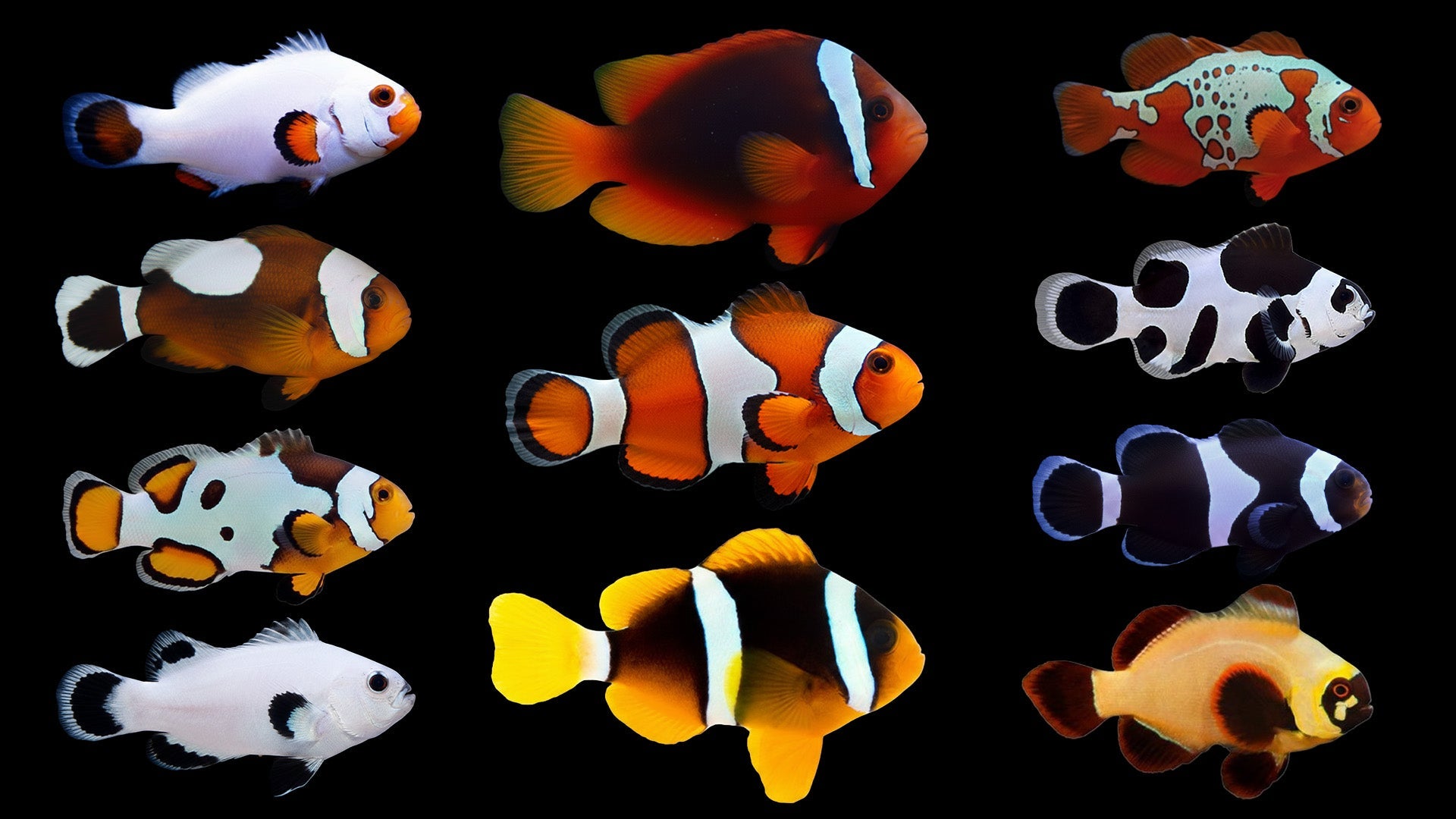
In the wild, it feeds mainly on zooplankton, algae, and small benthic foods. For readers interested in fishing, wildlife observation, food fish, or aquariums, it matters because it is a well-known anemone-associated fish. Always check adult size, water conditions, legal harvest rules, and conservation guidance before collecting, keeping, or targeting this species.
2. Regal Blue Tang
Scientific name: Paracanthurus hepatus. Regal Blue Tang is a medium reef fish associated with coral reefs and clear lagoons in Indo-Pacific. Its clearest identification feature is blue body, black palette pattern, and yellow tail. That combination of color, body shape, habitat, and behavior is more reliable than color alone when comparing similar fish.
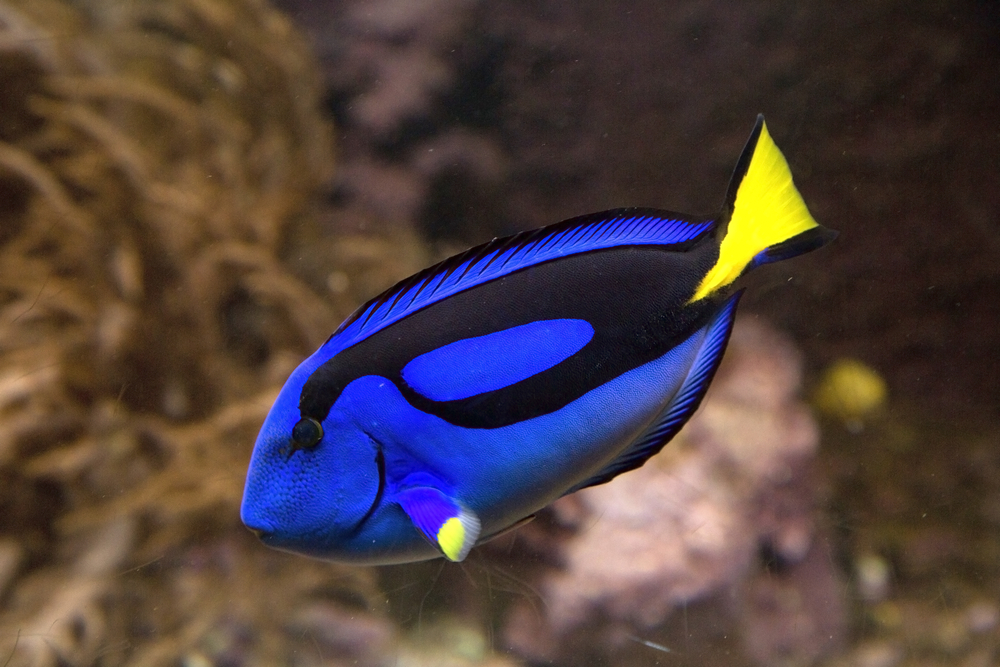
In the wild, it feeds mainly on algae and zooplankton. For readers interested in fishing, wildlife observation, food fish, or aquariums, it matters because it is an active grazer that needs substantial swimming space. Always check adult size, water conditions, legal harvest rules, and conservation guidance before collecting, keeping, or targeting this species.
3. Flame Angelfish
Scientific name: Centropyge loricula. Flame Angelfish is a small reef fish associated with rocky and coral reefs in central and western Pacific. Its clearest identification feature is red-orange body with black bars. That combination of color, body shape, habitat, and behavior is more reliable than color alone when comparing similar fish.
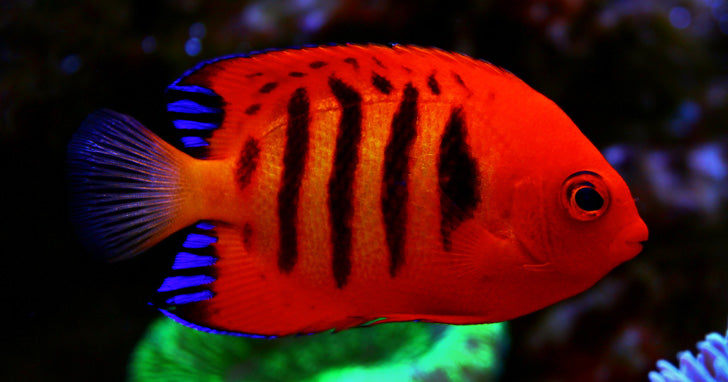
In the wild, it feeds mainly on algae and tiny invertebrates. For readers interested in fishing, wildlife observation, food fish, or aquariums, it matters because it is a colorful dwarf angelfish. Always check adult size, water conditions, legal harvest rules, and conservation guidance before collecting, keeping, or targeting this species.
4. Moorish Idol
Scientific name: Zanclus cornutus. Moorish Idol is a medium reef fish associated with reefs, lagoons, and rocky coasts in Indo-Pacific. Its clearest identification feature is black, white, and yellow bands with a long dorsal streamer. That combination of color, body shape, habitat, and behavior is more reliable than color alone when comparing similar fish.
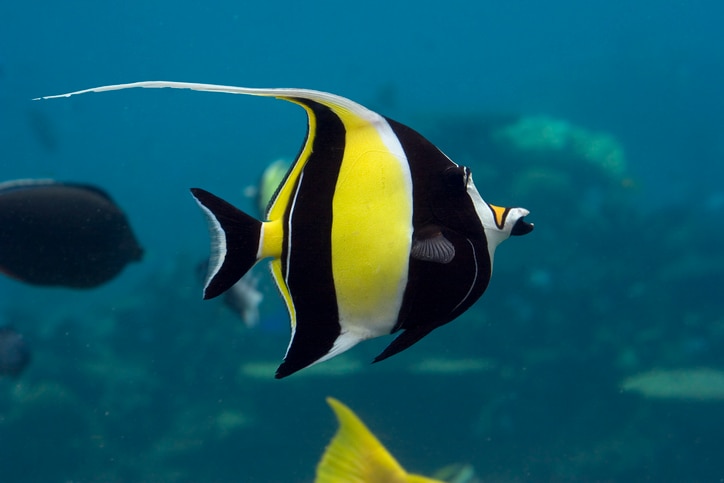
In the wild, it feeds mainly on sponges, algae, and benthic invertebrates. For readers interested in fishing, wildlife observation, food fish, or aquariums, it matters because it is beautiful but difficult to maintain in captivity. Always check adult size, water conditions, legal harvest rules, and conservation guidance before collecting, keeping, or targeting this species.
5. Copperband Butterflyfish
Scientific name: Chelmon rostratus. Copperband Butterflyfish is a medium reef fish associated with coral reefs and estuaries in Indo-West Pacific. Its clearest identification feature is long snout and copper vertical bands. That combination of color, body shape, habitat, and behavior is more reliable than color alone when comparing similar fish.

In the wild, it feeds mainly on worms and small benthic invertebrates. For readers interested in fishing, wildlife observation, food fish, or aquariums, it matters because it is specialized feeder. Always check adult size, water conditions, legal harvest rules, and conservation guidance before collecting, keeping, or targeting this species.
6. Mandarinfish
Scientific name: Synchiropus splendidus. Mandarinfish is a small reef fish associated with sheltered reefs and lagoons in western Pacific. Its clearest identification feature is psychedelic blue, green, and orange patterns. That combination of color, body shape, habitat, and behavior is more reliable than color alone when comparing similar fish.
In the wild, it feeds mainly on tiny crustaceans. For readers interested in fishing, wildlife observation, food fish, or aquariums, it matters because it is needs abundant natural microfauna. Always check adult size, water conditions, legal harvest rules, and conservation guidance before collecting, keeping, or targeting this species.
7. Red Lionfish
Scientific name: Pterois volitans. Red Lionfish is a large reef predator associated with reefs, ledges, and wrecks in Indo-Pacific; invasive western Atlantic. Its clearest identification feature is striped body and venomous fanlike spines. That combination of color, body shape, habitat, and behavior is more reliable than color alone when comparing similar fish.
In the wild, it feeds mainly on fish and crustaceans. For readers interested in fishing, wildlife observation, food fish, or aquariums, it matters because it is a visually striking predator. Always check adult size, water conditions, legal harvest rules, and conservation guidance before collecting, keeping, or targeting this species.
8. Titan Triggerfish
Scientific name: Balistoides viridescens. Titan Triggerfish is a large reef fish associated with reef flats and lagoons in Indo-Pacific. Its clearest identification feature is massive head and heavy teeth. That combination of color, body shape, habitat, and behavior is more reliable than color alone when comparing similar fish.

In the wild, it feeds mainly on mollusks, crustaceans, and echinoderms. For readers interested in fishing, wildlife observation, food fish, or aquariums, it matters because it is can be territorial near nests. Always check adult size, water conditions, legal harvest rules, and conservation guidance before collecting, keeping, or targeting this species.
9. Humphead Wrasse
Scientific name: Cheilinus undulatus. Humphead Wrasse is a very large reef fish associated with coral reefs and reef slopes in Indo-Pacific. Its clearest identification feature is large forehead hump and thick lips. That combination of color, body shape, habitat, and behavior is more reliable than color alone when comparing similar fish.
In the wild, it feeds mainly on mollusks, crustaceans, and fish. For readers interested in fishing, wildlife observation, food fish, or aquariums, it matters because it is a protected reef giant in many places. Always check adult size, water conditions, legal harvest rules, and conservation guidance before collecting, keeping, or targeting this species.
10. Stoplight Parrotfish
Scientific name: Sparisoma viride. Stoplight Parrotfish is a large reef herbivore associated with coral reefs in western Atlantic. Its clearest identification feature is adult males show green and bright yellow-pink markings. That combination of color, body shape, habitat, and behavior is more reliable than color alone when comparing similar fish.
In the wild, it feeds mainly on algae scraped from reef surfaces. For readers interested in fishing, wildlife observation, food fish, or aquariums, it matters because it is important in reef grazing. Always check adult size, water conditions, legal harvest rules, and conservation guidance before collecting, keeping, or targeting this species.
11. Yellowfin Tuna
Scientific name: Thunnus albacares. Yellowfin Tuna is a very large pelagic fish associated with open tropical and subtropical seas in worldwide tropical oceans. Its clearest identification feature is streamlined body with yellow finlets. That combination of color, body shape, habitat, and behavior is more reliable than color alone when comparing similar fish.
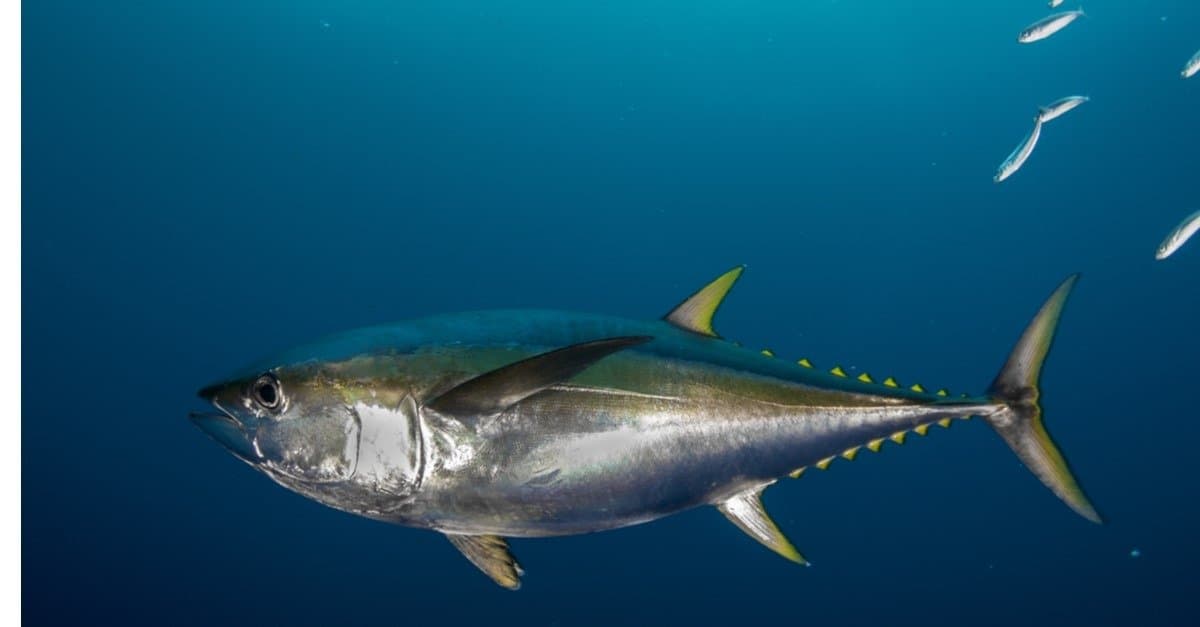
In the wild, it feeds mainly on fish, squid, and crustaceans. For readers interested in fishing, wildlife observation, food fish, or aquariums, it matters because it is a fast oceanic predator and major fishery species. Always check adult size, water conditions, legal harvest rules, and conservation guidance before collecting, keeping, or targeting this species.
12. Atlantic Bluefin Tuna
Scientific name: Thunnus thynnus. Atlantic Bluefin Tuna is a very large pelagic fish associated with open Atlantic and Mediterranean waters in Atlantic Ocean and Mediterranean. Its clearest identification feature is deep-bodied tuna with powerful crescent tail. That combination of color, body shape, habitat, and behavior is more reliable than color alone when comparing similar fish.
In the wild, it feeds mainly on schooling fish and squid. For readers interested in fishing, wildlife observation, food fish, or aquariums, it matters because it is long-distance migrant requiring careful fishery management. Always check adult size, water conditions, legal harvest rules, and conservation guidance before collecting, keeping, or targeting this species.
13. Skipjack Tuna
Scientific name: Katsuwonus pelamis. Skipjack Tuna is a large pelagic fish associated with warm open oceans in tropical and subtropical oceans. Its clearest identification feature is dark horizontal belly stripes. That combination of color, body shape, habitat, and behavior is more reliable than color alone when comparing similar fish.
In the wild, it feeds mainly on small fish, squid, and crustaceans. For readers interested in fishing, wildlife observation, food fish, or aquariums, it matters because it is the main tuna used in much canned tuna. Always check adult size, water conditions, legal harvest rules, and conservation guidance before collecting, keeping, or targeting this species.
14. Swordfish
Scientific name: Xiphias gladius. Swordfish is a very large pelagic billfish associated with open temperate and tropical seas in worldwide. Its clearest identification feature is flat swordlike bill and tall juvenile dorsal fin. That combination of color, body shape, habitat, and behavior is more reliable than color alone when comparing similar fish.
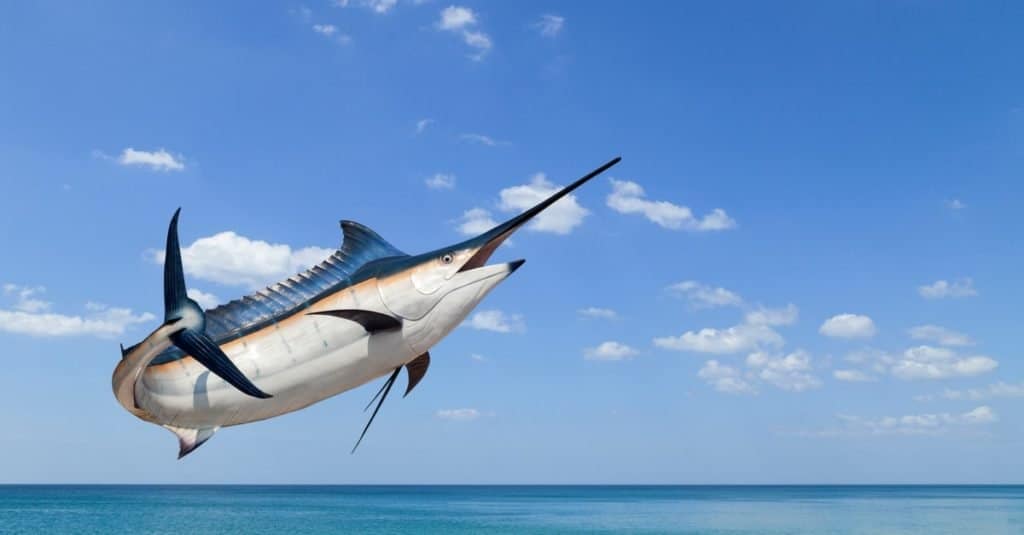
In the wild, it feeds mainly on fish and squid. For readers interested in fishing, wildlife observation, food fish, or aquariums, it matters because it is a deep-diving migratory predator. Always check adult size, water conditions, legal harvest rules, and conservation guidance before collecting, keeping, or targeting this species.
15. Atlantic Sailfish
Scientific name: Istiophorus albicans. Atlantic Sailfish is a very large pelagic billfish associated with warm open and coastal waters in Atlantic Ocean. Its clearest identification feature is enormous sail-like dorsal fin. That combination of color, body shape, habitat, and behavior is more reliable than color alone when comparing similar fish.
In the wild, it feeds mainly on schooling fish and squid. For readers interested in fishing, wildlife observation, food fish, or aquariums, it matters because it is famous for speed and spectacular surface behavior. Always check adult size, water conditions, legal harvest rules, and conservation guidance before collecting, keeping, or targeting this species.
16. Blue Marlin
Scientific name: Makaira nigricans. Blue Marlin is a very large pelagic billfish associated with open tropical and subtropical Atlantic in Atlantic Ocean. Its clearest identification feature is long bill and cobalt-blue upper body. That combination of color, body shape, habitat, and behavior is more reliable than color alone when comparing similar fish.
In the wild, it feeds mainly on tuna, mackerel, and squid. For readers interested in fishing, wildlife observation, food fish, or aquariums, it matters because it is a powerful oceanic game fish. Always check adult size, water conditions, legal harvest rules, and conservation guidance before collecting, keeping, or targeting this species.
17. Common Dolphinfish
Scientific name: Coryphaena hippurus. Common Dolphinfish is a large pelagic fish associated with warm open seas and floating-object habitats in worldwide tropical and subtropical oceans. Its clearest identification feature is brilliant green-blue and gold coloration. That combination of color, body shape, habitat, and behavior is more reliable than color alone when comparing similar fish.
:max_bytes(150000):strip_icc()/bull-dolphin-or-mahi-mahi--482194845-5c2b85b646e0fb00011dd9fe.jpg)
In the wild, it feeds mainly on fish and squid. For readers interested in fishing, wildlife observation, food fish, or aquariums, it matters because it is also known as mahi-mahi. Always check adult size, water conditions, legal harvest rules, and conservation guidance before collecting, keeping, or targeting this species.
18. Great Barracuda
Scientific name: Sphyraena barracuda. Great Barracuda is a very large coastal pelagic predator associated with reefs, seagrass, mangroves, and open coastal water in tropical Atlantic and Indo-Pacific. Its clearest identification feature is long body, large teeth, and dark side bars. That combination of color, body shape, habitat, and behavior is more reliable than color alone when comparing similar fish.
In the wild, it feeds mainly on fish and squid. For readers interested in fishing, wildlife observation, food fish, or aquariums, it matters because it is an ambush predator. Always check adult size, water conditions, legal harvest rules, and conservation guidance before collecting, keeping, or targeting this species.
19. Atlantic Mackerel
Scientific name: Scomber scombrus. Atlantic Mackerel is a medium pelagic schooling fish associated with coastal and open shelf waters in North Atlantic. Its clearest identification feature is wavy dark lines across a blue-green back. That combination of color, body shape, habitat, and behavior is more reliable than color alone when comparing similar fish.
In the wild, it feeds mainly on plankton and small fish. For readers interested in fishing, wildlife observation, food fish, or aquariums, it matters because it is a fast schooling food fish. Always check adult size, water conditions, legal harvest rules, and conservation guidance before collecting, keeping, or targeting this species.
20. European Sardine
Scientific name: Sardina pilchardus. European Sardine is a small pelagic forage fish associated with coastal shelf waters in northeastern Atlantic and Mediterranean. Its clearest identification feature is silver body and dense schools. That combination of color, body shape, habitat, and behavior is more reliable than color alone when comparing similar fish.

In the wild, it feeds mainly on plankton. For readers interested in fishing, wildlife observation, food fish, or aquariums, it matters because it is a key prey and food fish. Always check adult size, water conditions, legal harvest rules, and conservation guidance before collecting, keeping, or targeting this species.
21. Atlantic Herring
Scientific name: Clupea harengus. Atlantic Herring is a small to medium pelagic forage fish associated with coastal and offshore shelf waters in North Atlantic. Its clearest identification feature is silvery body and huge schools. That combination of color, body shape, habitat, and behavior is more reliable than color alone when comparing similar fish.
In the wild, it feeds mainly on plankton. For readers interested in fishing, wildlife observation, food fish, or aquariums, it matters because it is ecologically important to predators and fisheries. Always check adult size, water conditions, legal harvest rules, and conservation guidance before collecting, keeping, or targeting this species.
22. European Anchovy
Scientific name: Engraulis encrasicolus. European Anchovy is a small pelagic forage fish associated with coastal waters and estuaries in eastern Atlantic, Mediterranean, and Black Sea. Its clearest identification feature is slender silver body and large mouth. That combination of color, body shape, habitat, and behavior is more reliable than color alone when comparing similar fish.
In the wild, it feeds mainly on plankton. For readers interested in fishing, wildlife observation, food fish, or aquariums, it matters because it is used fresh, salted, and preserved. Always check adult size, water conditions, legal harvest rules, and conservation guidance before collecting, keeping, or targeting this species.
23. Atlantic Cod
Scientific name: Gadus morhua. Atlantic Cod is a large demersal fish associated with continental shelves and banks in North Atlantic. Its clearest identification feature is chin barbel and pale lateral line. That combination of color, body shape, habitat, and behavior is more reliable than color alone when comparing similar fish.

In the wild, it feeds mainly on fish and benthic invertebrates. For readers interested in fishing, wildlife observation, food fish, or aquariums, it matters because it is a historic cold-water fishery species. Always check adult size, water conditions, legal harvest rules, and conservation guidance before collecting, keeping, or targeting this species.
24. Haddock
Scientific name: Melanogrammus aeglefinus. Haddock is a large demersal fish associated with cold shelf waters in North Atlantic. Its clearest identification feature is dark shoulder blotch and black lateral line. That combination of color, body shape, habitat, and behavior is more reliable than color alone when comparing similar fish.
In the wild, it feeds mainly on benthic invertebrates and small fish. For readers interested in fishing, wildlife observation, food fish, or aquariums, it matters because it is a lean white-fleshed food fish. Always check adult size, water conditions, legal harvest rules, and conservation guidance before collecting, keeping, or targeting this species.
25. Pacific Halibut
Scientific name: Hippoglossus stenolepis. Pacific Halibut is a very large demersal flatfish associated with continental shelf and slope in North Pacific. Its clearest identification feature is both eyes on one side and a diamond-shaped body. That combination of color, body shape, habitat, and behavior is more reliable than color alone when comparing similar fish.
In the wild, it feeds mainly on fish, crabs, and squid. For readers interested in fishing, wildlife observation, food fish, or aquariums, it matters because it is one of the largest flatfishes. Always check adult size, water conditions, legal harvest rules, and conservation guidance before collecting, keeping, or targeting this species.
26. European Plaice
Scientific name: Pleuronectes platessa. European Plaice is a medium demersal flatfish associated with sandy and muddy seabeds in northeastern Atlantic. Its clearest identification feature is orange spots on the upper side. That combination of color, body shape, habitat, and behavior is more reliable than color alone when comparing similar fish.
In the wild, it feeds mainly on worms, shellfish, and crustaceans. For readers interested in fishing, wildlife observation, food fish, or aquariums, it matters because it is a common shelf-sea flatfish. Always check adult size, water conditions, legal harvest rules, and conservation guidance before collecting, keeping, or targeting this species.
27. Nassau Grouper
Scientific name: Epinephelus striatus. Nassau Grouper is a large reef predator associated with coral reefs and rocky ledges in western Atlantic. Its clearest identification feature is pale body with dark vertical bars. That combination of color, body shape, habitat, and behavior is more reliable than color alone when comparing similar fish.
In the wild, it feeds mainly on fish and crustaceans. For readers interested in fishing, wildlife observation, food fish, or aquariums, it matters because it is forms vulnerable spawning aggregations. Always check adult size, water conditions, legal harvest rules, and conservation guidance before collecting, keeping, or targeting this species.
28. Giant Trevally
Scientific name: Caranx ignobilis. Giant Trevally is a very large reef and coastal predator associated with reefs, passes, and open coastal waters in Indo-Pacific. Its clearest identification feature is deep powerful body that darkens with age. That combination of color, body shape, habitat, and behavior is more reliable than color alone when comparing similar fish.
In the wild, it feeds mainly on fish, crustaceans, and cephalopods. For readers interested in fishing, wildlife observation, food fish, or aquariums, it matters because it is a prized sport fish. Always check adult size, water conditions, legal harvest rules, and conservation guidance before collecting, keeping, or targeting this species.
29. Northern Red Snapper
Scientific name: Lutjanus campechanus. Northern Red Snapper is a large reef-associated fish associated with reefs, banks, and hard bottom in western Atlantic and Gulf of Mexico. Its clearest identification feature is pink-red body and pointed profile. That combination of color, body shape, habitat, and behavior is more reliable than color alone when comparing similar fish.
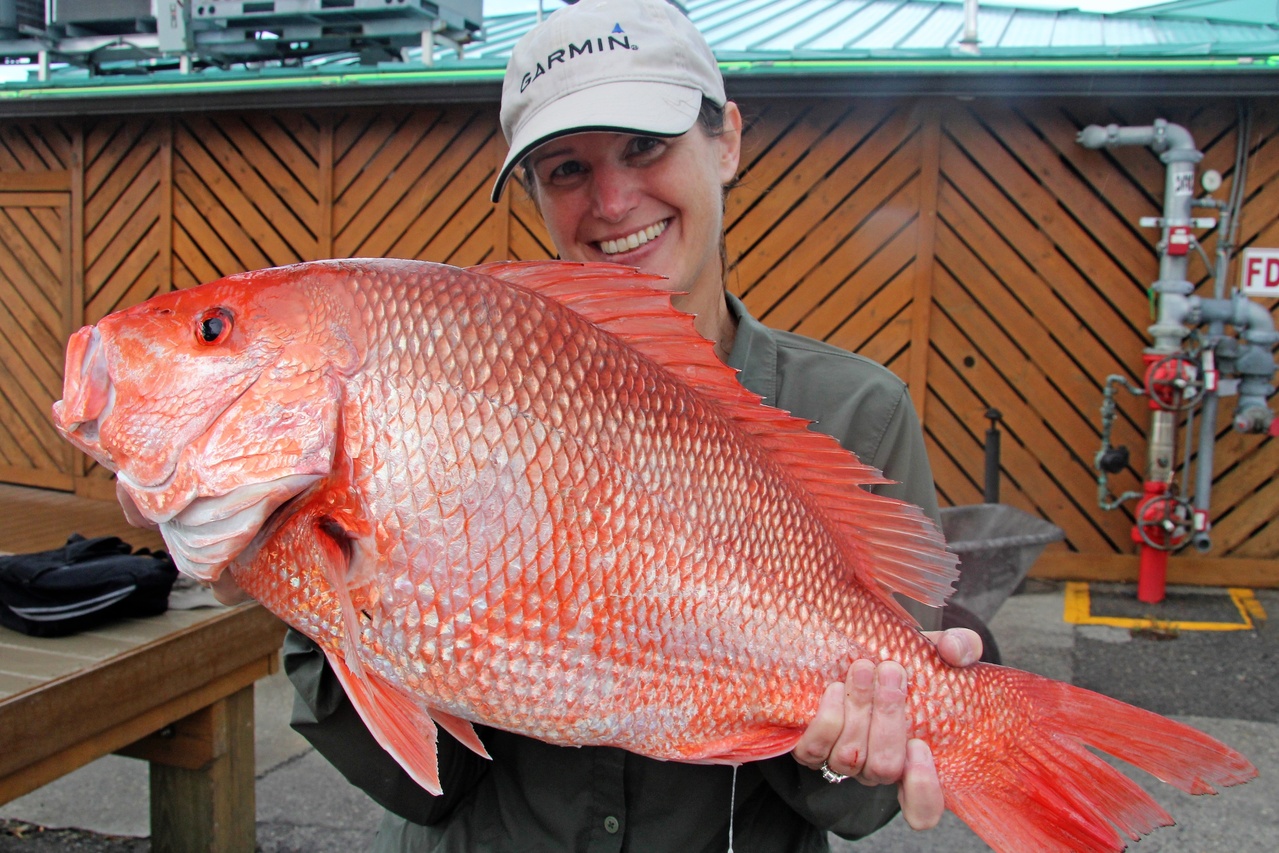
In the wild, it feeds mainly on fish and crustaceans. For readers interested in fishing, wildlife observation, food fish, or aquariums, it matters because it is important to managed fisheries. Always check adult size, water conditions, legal harvest rules, and conservation guidance before collecting, keeping, or targeting this species.
30. Common Dentex
Scientific name: Dentex dentex. Common Dentex is a large reef and rocky-bottom predator associated with rocky coasts and offshore banks in eastern Atlantic and Mediterranean. Its clearest identification feature is large canine teeth and silvery-pink body. That combination of color, body shape, habitat, and behavior is more reliable than color alone when comparing similar fish.
In the wild, it feeds mainly on fish and squid. For readers interested in fishing, wildlife observation, food fish, or aquariums, it matters because it is a Mediterranean sport and food fish. Always check adult size, water conditions, legal harvest rules, and conservation guidance before collecting, keeping, or targeting this species.
31. Red Mullet
Scientific name: Mullus barbatus. Red Mullet is a small to medium benthic fish associated with sand and mud bottoms in eastern Atlantic and Mediterranean. Its clearest identification feature is chin barbels used to search sediment. That combination of color, body shape, habitat, and behavior is more reliable than color alone when comparing similar fish.
In the wild, it feeds mainly on worms and crustaceans. For readers interested in fishing, wildlife observation, food fish, or aquariums, it matters because it is a colorful bottom-feeding goatfish. Always check adult size, water conditions, legal harvest rules, and conservation guidance before collecting, keeping, or targeting this species.
32. John Dory
Scientific name: Zeus faber. John Dory is a large demersal fish associated with shelf waters near reefs and soft bottoms in Atlantic, Indian, and Pacific Oceans. Its clearest identification feature is deep flattened body with a dark side spot. That combination of color, body shape, habitat, and behavior is more reliable than color alone when comparing similar fish.
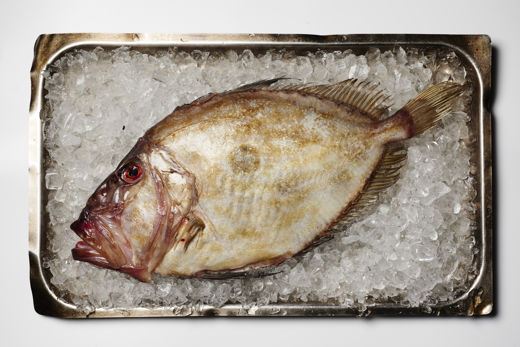
In the wild, it feeds mainly on fish and squid. For readers interested in fishing, wildlife observation, food fish, or aquariums, it matters because it is an ambush predator with protrusible jaws. Always check adult size, water conditions, legal harvest rules, and conservation guidance before collecting, keeping, or targeting this species.
33. Ocean Sunfish
Scientific name: Mola mola. Ocean Sunfish is a very large pelagic fish associated with open temperate and tropical seas in worldwide. Its clearest identification feature is disc-shaped body with a shortened tail. That combination of color, body shape, habitat, and behavior is more reliable than color alone when comparing similar fish.
In the wild, it feeds mainly on jellyfish and other gelatinous prey. For readers interested in fishing, wildlife observation, food fish, or aquariums, it matters because it is often basks near the surface. Always check adult size, water conditions, legal harvest rules, and conservation guidance before collecting, keeping, or targeting this species.
34. Whale Shark
Scientific name: Rhincodon typus. Whale Shark is a very large pelagic shark associated with warm open and coastal seas in tropical and warm-temperate oceans. Its clearest identification feature is checkerboard spots and broad head. That combination of color, body shape, habitat, and behavior is more reliable than color alone when comparing similar fish.
In the wild, it feeds mainly on plankton and small schooling fish. For readers interested in fishing, wildlife observation, food fish, or aquariums, it matters because it is the largest living fish and a filter feeder. Always check adult size, water conditions, legal harvest rules, and conservation guidance before collecting, keeping, or targeting this species.
35. Great White Shark
Scientific name: Carcharodon carcharias. Great White Shark is a very large pelagic-coastal shark associated with temperate coastal and offshore waters in major oceans. Its clearest identification feature is robust body and triangular serrated teeth. That combination of color, body shape, habitat, and behavior is more reliable than color alone when comparing similar fish.
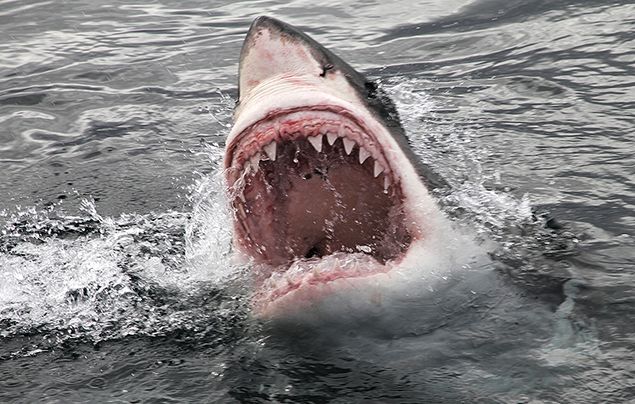
In the wild, it feeds mainly on fish and marine mammals. For readers interested in fishing, wildlife observation, food fish, or aquariums, it matters because it is a wide-ranging apex predator. Always check adult size, water conditions, legal harvest rules, and conservation guidance before collecting, keeping, or targeting this species.
36. Spotted Eagle Ray
Scientific name: Aetobatus narinari. Spotted Eagle Ray is a very large ray associated with reefs, bays, and coastal lagoons in tropical Atlantic. Its clearest identification feature is dark back with white spots and a long tail. That combination of color, body shape, habitat, and behavior is more reliable than color alone when comparing similar fish.
In the wild, it feeds mainly on mollusks and crustaceans. For readers interested in fishing, wildlife observation, food fish, or aquariums, it matters because it is often swims in open water above reefs. Always check adult size, water conditions, legal harvest rules, and conservation guidance before collecting, keeping, or targeting this species.
37. Manta Ray
Scientific name: Mobula birostris. Manta Ray is a very large pelagic ray associated with open tropical and subtropical seas in worldwide. Its clearest identification feature is broad wings and forward cephalic lobes. That combination of color, body shape, habitat, and behavior is more reliable than color alone when comparing similar fish.
In the wild, it feeds mainly on plankton. For readers interested in fishing, wildlife observation, food fish, or aquariums, it matters because it is a large filter-feeding ray. Always check adult size, water conditions, legal harvest rules, and conservation guidance before collecting, keeping, or targeting this species.
38. Atlantic Flyingfish
Scientific name: Cheilopogon melanurus. Atlantic Flyingfish is a small to medium pelagic fish associated with warm surface waters in Atlantic Ocean. Its clearest identification feature is enlarged pectoral fins used for gliding. That combination of color, body shape, habitat, and behavior is more reliable than color alone when comparing similar fish.
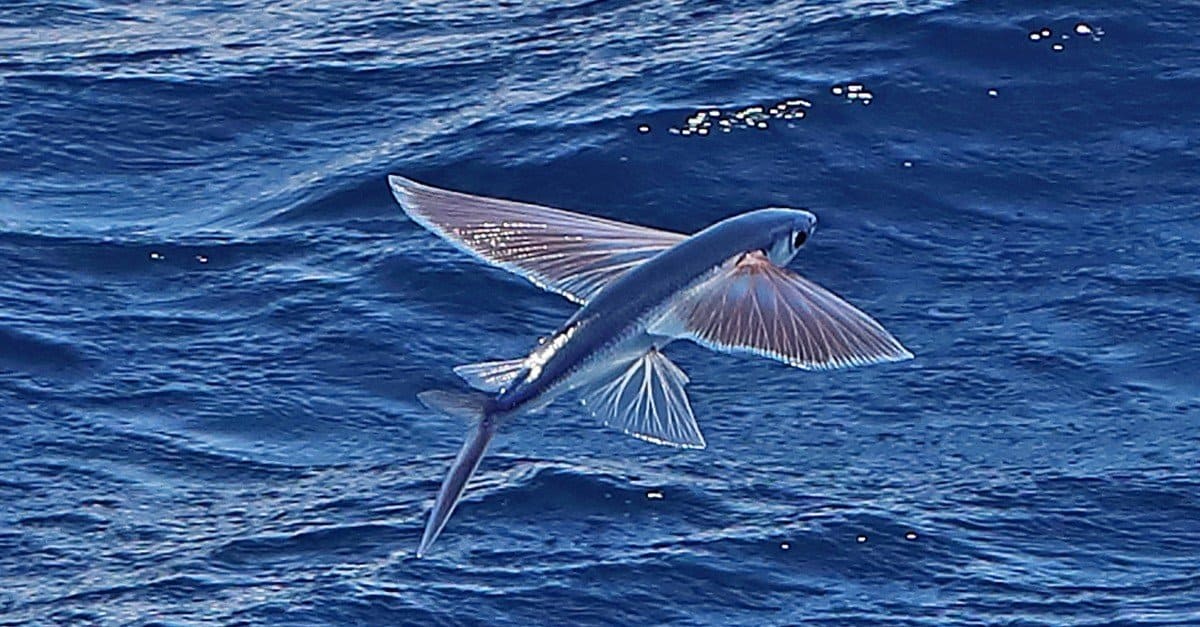
In the wild, it feeds mainly on zooplankton. For readers interested in fishing, wildlife observation, food fish, or aquariums, it matters because it is escapes predators by leaving the water. Always check adult size, water conditions, legal harvest rules, and conservation guidance before collecting, keeping, or targeting this species.
39. Antarctic Toothfish
Scientific name: Dissostichus mawsoni. Antarctic Toothfish is a very large deep cold-water fish associated with continental shelf and slope in Southern Ocean. Its clearest identification feature is thick body adapted to freezing water. That combination of color, body shape, habitat, and behavior is more reliable than color alone when comparing similar fish.
In the wild, it feeds mainly on fish and squid. For readers interested in fishing, wildlife observation, food fish, or aquariums, it matters because it is a top predator in Antarctic marine food webs. Always check adult size, water conditions, legal harvest rules, and conservation guidance before collecting, keeping, or targeting this species.
40. Orange Roughy
Scientific name: Hoplostethus atlanticus. Orange Roughy is a medium deep-sea fish associated with seamounts and continental slopes in temperate oceans. Its clearest identification feature is orange-red body and large eyes. That combination of color, body shape, habitat, and behavior is more reliable than color alone when comparing similar fish.
In the wild, it feeds mainly on small fish and crustaceans. For readers interested in fishing, wildlife observation, food fish, or aquariums, it matters because it is exceptionally slow-growing and long-lived. Always check adult size, water conditions, legal harvest rules, and conservation guidance before collecting, keeping, or targeting this species.
How Are These Types of Fish Classified?
Marine fishes include bony fishes and cartilaginous fishes. They can also be grouped ecologically as reef-associated, coastal, pelagic, demersal, deepwater, polar, estuarine, or migratory. These habitat groups are practical for beginners, but they overlap: many species move between reefs, mangroves, open water, and deeper areas during their lives.
Where Do Sea Fish Live?
Sea fish occupy coral reefs, mangroves, seagrass beds, estuaries, rocky coasts, continental shelves, open-ocean surface waters, deep slopes, seamounts, polar seas, and the dark deep ocean. Temperature, salinity, pressure, oxygen, light, currents, substrate, and food supply shape where each species can survive.
How to Identify Different Types of Sea Fish
- Body profile: Streamlined tuna differ from flattened halibut, disc-shaped rays, deep-bodied reef fish, and elongated barracuda.
- Fin placement: Billfish, triggerfish, flatfish, sharks, and rays have distinctive fin arrangements.
- Mouth and teeth: Grazers, filter feeders, plankton pickers, and predators have different mouth structures.
- Color pattern: Reef fish often use bars, spots, eye marks, and contrasting fins.
- Swimming zone: Surface schools, midwater migrants, reef residents, and bottom fish behave differently.
- Geographic range: Ocean basin and water temperature eliminate many look-alike possibilities.
Ocean Observation, Fishing, and Aquarium Tips
- Observe marine fish without touching coral, feeding wildlife, or blocking cleaning stations.
- Use a regional field guide and note depth, habitat, and behavior as well as color.
- Follow local marine protected-area, fishing, boating, and wildlife rules.
- Research adult size and feeding needs before buying any marine aquarium fish.
- Choose traceable seafood and check current regional sustainability advice.
Safety, Sustainability, and Conservation Notes
- Coral reefs, mangroves, seagrass, estuaries, and open-ocean food webs are connected.
- Plastic, fishing gear, nutrient runoff, warming, and habitat damage affect marine fish differently.
- Large slow-growing sharks, rays, groupers, tuna, and deep-sea fish require careful management.
- Never release aquarium organisms or water into the ocean.
- Support legal, traceable fishing and avoid wildlife products from protected species.
Fun Facts About Sea Fish
- The whale shark is the largest living fish and feeds by filtering plankton.
- Flyingfish glide above the surface using enlarged fins.
- Flatfish begin life with one eye on each side before one eye migrates.
- Tuna can maintain parts of their body warmer than surrounding water.
- Moorish idols are difficult aquarium fish despite their popularity.
- Deep-sea red fish may appear dark because red light does not penetrate far.
- Manta rays are filter feeders, not dangerous hunters.
- Parrotfish help shape reef surfaces while grazing algae.
- Some reef fish change sex during their lives.
- Marine fish migrations can connect distant countries and ocean basins.
Final Thoughts on types of sea fish
These 40 types of sea fish show how body shape, habitat, diet, movement, and range are connected. Use multiple features for identification, research aquarium species before purchase, follow current fishing rules, and choose seafood from transparent sources. Responsible ocean recreation and habitat protection help keep marine fish communities diverse.
Frequently Asked Questions
1. What does the term “types of sea fish” mean?
It is a broad phrase for fish that live in marine or ocean water. It includes bony fish, sharks, rays, reef fish, pelagic fish, and bottom fish.
2. How many types of sea fish are covered in this guide?
This guide profiles 40 carefully selected examples. The number is a practical editorial list, not a claim that only 40 such fish exist worldwide.
3. Are all types of sea fish closely related?
No. Marine fish belong to many evolutionary groups and families. Their shared feature is living in saltwater for all or most of their life cycle.
4. Which is the easiest types of sea fish to identify?
Ocellaris Clownfish is a useful starting point because orange body with three white bars. However, identification should also consider body shape, fin placement, range, and habitat.
5. Which types of sea fish is the largest in this list?
Whale shark is the largest species in the list. Large tuna, billfish, sharks, manta rays, halibut, and ocean sunfish are also very large.
6. Which types of sea fish is the smallest in this list?
Mandarinfish, clownfish, anchovies, and several small reef species are among the smallest listed.
7. Where do types of sea fish live?
They live from shallow mangroves and reefs to open-ocean surface waters, continental shelves, polar seas, deep slopes, and seamounts.
8. What do types of sea fish eat?
Marine fish may graze algae, filter plankton, pick small invertebrates, crush shellfish, or hunt squid, fish, and marine mammals.
9. Can types of sea fish live in freshwater?
Most cannot live permanently in freshwater, although some marine and estuarine species tolerate changing salinity.
10. Can types of sea fish live in saltwater?
Yes. All species in this guide are marine or strongly sea-associated.
11. Are any types of sea fish suitable for home aquariums?
Some small reef fish are kept in marine aquariums, but many sea fish become too large, migrate widely, or have specialized diets.
12. Do types of sea fish need to be kept in groups?
Sardines, herring, anchovies, mackerel, tuna, and many reef fish school, while groupers, lionfish, and some sharks may be solitary.
13. How can beginners identify types of sea fish?
Begin with body shape, fin arrangement, mouth position, color pattern, adult size, and habitat. Photograph the fish from the side when possible and compare it with a regional field guide rather than relying on a single color.
14. Can fish color change with age or season?
Yes. Many fish change color as they mature, breed, migrate, become stressed, or move between habitats. Lighting and water clarity also affect how color appears.
15. Why are scientific names useful?
Common names vary between countries and fisheries. A scientific name points to one recognized species and helps prevent confusion between unrelated fish that share a similar nickname.
16. Are any types of sea fish dangerous to handle?
Some have venomous spines, sharp teeth, strong tails, or large size. Wildlife should be observed without touching or feeding.
17. Can people eat types of sea fish?
Many are important seafood species, but not all are edible or legal to harvest. Check species, source, advisories, and sustainability.
18. How should edible fish be stored?
Keep fresh fish cold immediately after capture or purchase, use clean food-safe containers, and follow local food-safety guidance. Refrigerate promptly and freeze portions that will not be used soon.
19. How can anglers fish responsibly for these species?
Follow current seasons, size limits, bag limits, protected-area rules, and gear restrictions. Use appropriate tackle, minimize handling, release unwanted fish quickly, and never transport live fish between waters.
20. Why should fish never be released from an aquarium?
Released aquarium fish can become invasive, spread disease, or die from unsuitable conditions. Rehome unwanted fish through a responsible aquarium store, club, rescue, or experienced keeper.
21. How does habitat loss affect these fish?
Dams, polluted runoff, sedimentation, wetland loss, reef damage, and coastal development can remove feeding, nursery, and spawning habitat. Species with small ranges are often especially vulnerable.
22. Are color-based fish names always accurate?
No. Names based on red, silver, black, or blue may describe only one life stage, sex, regional form, or market appearance. Taxonomy and location provide a more dependable identification.
23. What equipment helps with fish identification?
A camera, polarized sunglasses, regional field guide, ruler or measuring board, and notes about depth, water type, substrate, and location are useful. Handle wild fish only when legal and necessary.
24. Should I use an identification app?
An app can narrow the possibilities, but it should not be the only source for legal harvest or conservation decisions. Confirm important identifications with an authoritative regional guide or fisheries agency.
25. What is the most common identification mistake?
The most common mistake is choosing a species from color alone. Similar species may differ in fin rays, tail shape, mouth size, body proportions, spots, stripes, or geographic range.
26. Do juvenile fish look like adults?
Not always. Juveniles may have bars, spots, or colors that disappear with age, and some move from sheltered nursery areas to deeper adult habitats.
27. Are wild populations stable?
Some populations are healthy, while others are depleted or protected. Status depends on species, region, habitat condition, and fishery management.
28. Can climate change affect their distribution?
Yes. Warming water, altered river flow, ocean acidification, oxygen loss, and changing food webs can shift suitable habitat. Effects vary by species and region.
29. What should I check before buying one as a pet?
Confirm the exact species, adult size, social behavior, diet, water chemistry, temperature, tank length, filtration, and legal status. Avoid buying fish that cannot be housed responsibly for their full lifespan.
30. What is the best way to learn more about types of sea fish?
Use regional fish guides, museum and university resources, fisheries agencies, responsible aquarium organizations, and direct observation. Keep notes and compare several identification features at once.
Read more:
40 Types of Electric Fish: Species and Shocking Facts