

Shrews are easy to mistake for mice, yet these quick, sharp-toothed mammals belong to a very different branch of the mammal family tree. The many types of shrews include tiny hunters that weigh only a few grams, muscular diggers, desert specialists, stream swimmers, island endemics, and even species with reinforced spines. Their shared pointed snout hides an extraordinary range of ecological adaptations.
This guide introduces 80 scientifically recognized species from around the world. It covers white-toothed, red-toothed, African, short-tailed, small-eared, mole, forest, desert, and water shrews, with practical notes on appearance, range, habitat, behavior, conservation, and field identification. The list is a representative guide rather than a claim that only 80 species exist: current mammal taxonomy recognizes more than 500 living members of the family Soricidae.
What Are the Main Types of Shrews?
Living shrews are commonly organized into three subfamilies: Crocidurinae, the white-toothed shrews; Myosoricinae, a mostly African group that includes mouse and mole shrews; and Soricinae, the red-toothed shrews and several specialized lineages. Useful ecological types include terrestrial leaf-litter hunters, burrowing mole shrews, dry-country gray shrews, forest specialists, short-tailed predators, and aquatic water shrews. These categories help beginners, but formal identification depends on anatomy, distribution, and modern taxonomy.
Quick Comparison of the Major Shrew Groups
| Group | Typical Clues | Representative Species | Typical Setting |
|---|---|---|---|
| White-toothed shrews | Unpigmented tooth tips; many have visible ears | Etruscan, Asian house, common white-toothed | Forest, scrub, farms, gardens, islands |
| Red-toothed shrews | Iron-pigmented tooth tips; often long-tailed | Common, masked, Arctic, tundra | Woodland, meadow, tundra, mountains |
| Short-tailed and small-eared shrews | Stocky body; tail and ears reduced | Northern short-tailed, least, Goldman’s | Soil, litter, grassland, cloud forest |
| Mole and long-clawed shrews | Strong forelimbs and enlarged claws | Chinese mole, Aberdare mole, Pearson’s | Soft mountain soil and deep litter |
| Water shrews | Dense fur; fringed or broadened feet | Eurasian, American, Himalayan | Streams, springs, marshes, lake margins |
| Dry-country shrews | Paler coat; exposed ears; heat avoidance | Piebald, desert gray, large-eared gray | Desert, scrub, rocky drylands |
| African forest and mouse shrews | Dense coat; many cryptic species | Greater forest, Johnston’s, Kihaule’s | Rainforest and montane forest litter |
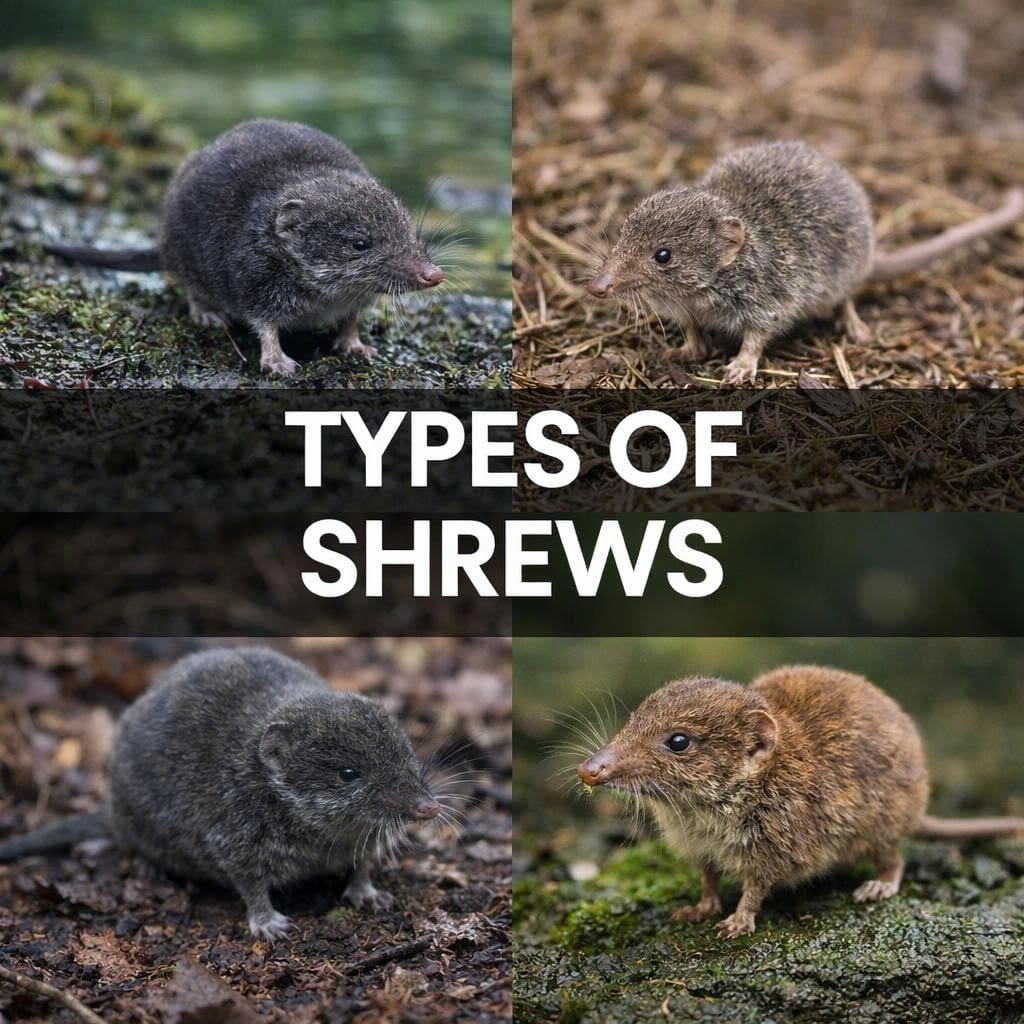
80 Types of Shrews Around the World
The following profiles use current accepted names and deliberately span different evolutionary groups and habitats. Common names can change, and several species cannot be identified confidently without technical examination.
1. Etruscan Shrew
The Etruscan Shrew (Suncus etruscus) is a minute hunter and one of the clearest examples of how diverse true shrews can be. Its exceptionally small body and rapid hunting movements make it the classic example of how extreme a shrew metabolism can be.
It belongs to the white-toothed shrew radiation, whose teeth lack the dark iron-rich tips seen in many Sorex species. The distinction is not normally visible on a moving animal, so field identification also uses body size, tail length, ear exposure, coat texture, habitat, and range. Like most relatives, it probes litter and soil with a flexible snout for invertebrate prey.
Ecologically, this animal is a small but intense predator. By consuming larvae and other invertebrates, it moves energy from the soil and litter into the diets of owls, snakes, and mammalian carnivores. Its presence is easy to overlook because activity is broken into short bouts and much of the hunting occurs beneath cover. A fleeting daytime sighting does not necessarily mean the animal is sick; many shrews alternate activity and rest throughout the full 24-hour cycle.
The current database distribution includes Afghanistan, Albania, Algeria, Azerbaijan, Bahrain, Bangladesh, Bhutan, Bosnia and Herzegovina, Bulgaria, China, Croatia, Cyprus, Egypt, France, Georgia, Greece, India, Iran, Iraq, Israel, Italy, Jordan, Laos, Lebanon, Libya, Malaysia, Malta, Montenegro, Morocco, Myanmar, Nepal, North Macedonia, Oman, Pakistan, Palestine, Portugal, Slovenia, Spain, Sri Lanka, Syria, Tajikistan, Thailand, Tunisia, Turkey, Turkmenistan, Uzbekistan, Vietnam, Yemen, Armenia?, Brunei?, Indonesia?, Kuwait?. Its recorded assessment is Least Concern. That label should be read together with range size and data quality: a widespread Least Concern species can decline locally, while a Data Deficient or Not Evaluated species may simply be too poorly known for confidence. Shrews are affected by drainage, forest clearing, pesticide exposure, altered stream flow, fire, invasive predators, and fragmentation in different combinations.
For responsible observation, watch quietly at the edge of suitable cover, examine tracks or camera footage, and avoid dismantling logs, moss beds, banks, or burrows. A photograph rarely proves the species because many shrews converge on the same gray-brown shape. Do not handle a live animal: stress can be dangerous to an animal with such a high metabolism, and some shrews can bite. Museum-quality measurements and regional keys remain the standard for difficult identifications. A careful genus-level identification is more valuable than an unsupported species name based on a blurred image.
2. Asian House Shrew
Among the most instructive types of shrews is the Asian House Shrew (Suncus murinus), a human-associated generalist. This comparatively large musk shrew often lives around buildings, farms, drains, and gardens and has been transported beyond much of its native range.
It belongs to the white-toothed shrew radiation, whose teeth lack the dark iron-rich tips seen in many Sorex species. The distinction is not normally visible on a moving animal, so field identification also uses body size, tail length, ear exposure, coat texture, habitat, and range. Like most relatives, it probes litter and soil with a flexible snout for invertebrate prey.
Season and weather can change what an observer sees. Damp conditions often bring prey nearer the surface, while cold or drought pushes the shrew toward sheltered microhabitats. It does not survive by eating “anything” indiscriminately: prey choice reflects body size, jaw strength, local invertebrates, and competition. The species also serves as prey, so dense ground cover is both a pantry and protection from aerial and terrestrial hunters.
The current database distribution includes Afghanistan, Bangladesh, Bhutan, Brunei, Cambodia, China, East Timor, India, Indonesia, Laos, Malaysia, Myanmar, Nepal, Pakistan, Singapore, Sri Lanka, Thailand, Vietnam. Its recorded assessment is Least Concern. That label should be read together with range size and data quality: a widespread Least Concern species can decline locally, while a Data Deficient or Not Evaluated species may simply be too poorly known for confidence. Shrews are affected by drainage, forest clearing, pesticide exposure, altered stream flow, fire, invasive predators, and fragmentation in different combinations.
For responsible observation, watch quietly at the edge of suitable cover, examine tracks or camera footage, and avoid dismantling logs, moss beds, banks, or burrows. A photograph rarely proves the species because many shrews converge on the same gray-brown shape. Do not handle a live animal: stress can be dangerous to an animal with such a high metabolism, and some shrews can bite. Museum-quality measurements and regional keys remain the standard for difficult identifications. A careful genus-level identification is more valuable than an unsupported species name based on a blurred image.
3. Least Dwarf Shrew
The Least Dwarf Shrew, scientifically named Suncus infinitesimus, stands out as a tiny African insectivore. Its minute proportions separate it from the much larger house shrew, although a reliable record still depends on measurements and teeth.
It belongs to the white-toothed shrew radiation, whose teeth lack the dark iron-rich tips seen in many Sorex species. The distinction is not normally visible on a moving animal, so field identification also uses body size, tail length, ear exposure, coat texture, habitat, and range. Like most relatives, it probes litter and soil with a flexible snout for invertebrate prey.
The long snout works as a rapidly moving sensory probe rather than a digging pick. Whiskers contact leaves, stones, prey, and tunnel walls, while scent and sound add information in darkness. Once prey is located, the sharp teeth grip and slice instead of gnawing. This equipment explains why a shrew is ecologically different from a mouse even when the two animals occupy the same patch of grass or forest floor.
The current database distribution includes Cameroon, Central African Republic, Eswatini, Kenya, South Africa. Its recorded assessment is Least Concern. That label should be read together with range size and data quality: a widespread Least Concern species can decline locally, while a Data Deficient or Not Evaluated species may simply be too poorly known for confidence. Shrews are affected by drainage, forest clearing, pesticide exposure, altered stream flow, fire, invasive predators, and fragmentation in different combinations.
For responsible observation, watch quietly at the edge of suitable cover, examine tracks or camera footage, and avoid dismantling logs, moss beds, banks, or burrows. A photograph rarely proves the species because many shrews converge on the same gray-brown shape. Do not handle a live animal: stress can be dangerous to an animal with such a high metabolism, and some shrews can bite. Museum-quality measurements and regional keys remain the standard for difficult identifications. A careful genus-level identification is more valuable than an unsupported species name based on a blurred image.
4. Climbing Shrew
Few shrews illustrate the idea of a long-tailed climber as well as the Climbing Shrew (Suncus megalurus). A notably long tail and climbing ability distinguish it from the ground-bound image many people have of shrews.
It belongs to the white-toothed shrew radiation, whose teeth lack the dark iron-rich tips seen in many Sorex species. The distinction is not normally visible on a moving animal, so field identification also uses body size, tail length, ear exposure, coat texture, habitat, and range. Like most relatives, it probes litter and soil with a flexible snout for invertebrate prey.
Its daily life is best imagined as a sequence of short searches, captures, rests, and renewed searches. High energy demand rewards habitats with many small prey items and dependable shelter. Individuals are commonly solitary outside breeding or family contexts, and scent or vocal signals help manage encounters. The ecological details vary by species, so claims about exact food intake, heart rate, or lifespan should not be transferred automatically from one famous shrew to every member of Soricidae.
The current database distribution includes Angola, Cameroon, Central African Republic, Cote d’Ivoire, Democratic Republic of the Congo, Ethiopia, Ghana, Guinea, Kenya, Liberia, Malawi, Mozambique, Nigeria, Rwanda, Sierra Leone, Tanzania, Togo, Uganda, Zambia, Zimbabwe, Benin?, Burundi?. Its recorded assessment is Least Concern. That label should be read together with range size and data quality: a widespread Least Concern species can decline locally, while a Data Deficient or Not Evaluated species may simply be too poorly known for confidence. Shrews are affected by drainage, forest clearing, pesticide exposure, altered stream flow, fire, invasive predators, and fragmentation in different combinations.
For responsible observation, watch quietly at the edge of suitable cover, examine tracks or camera footage, and avoid dismantling logs, moss beds, banks, or burrows. A photograph rarely proves the species because many shrews converge on the same gray-brown shape. Do not handle a live animal: stress can be dangerous to an animal with such a high metabolism, and some shrews can bite. Museum-quality measurements and regional keys remain the standard for difficult identifications. A careful genus-level identification is more valuable than an unsupported species name based on a blurred image.
5. Sri Lankan Shrew
The Sri Lankan Shrew (Suncus fellowesgordoni) is a Sri Lankan endemic and one of the clearest examples of how diverse true shrews can be. Its restricted island distribution makes habitat continuity more important than its small size might suggest.
It belongs to the white-toothed shrew radiation, whose teeth lack the dark iron-rich tips seen in many Sorex species. The distinction is not normally visible on a moving animal, so field identification also uses body size, tail length, ear exposure, coat texture, habitat, and range. Like most relatives, it probes litter and soil with a flexible snout for invertebrate prey.
A useful identification record describes more than color. Note whether the animal ran on the surface or emerged from soil, whether its tail was held straight or raised, how the ears compared with the fur, and whether the site was rocky, grassy, forested, or aquatic. Scale is also essential; a nearby leaf, stone, or track can make a photograph far more informative without requiring capture.
The current database distribution includes Sri Lanka. Its recorded assessment is Endangered. That label should be read together with range size and data quality: a widespread Least Concern species can decline locally, while a Data Deficient or Not Evaluated species may simply be too poorly known for confidence. Shrews are affected by drainage, forest clearing, pesticide exposure, altered stream flow, fire, invasive predators, and fragmentation in different combinations.
For responsible observation, watch quietly at the edge of suitable cover, examine tracks or camera footage, and avoid dismantling logs, moss beds, banks, or burrows. A photograph rarely proves the species because many shrews converge on the same gray-brown shape. Do not handle a live animal: stress can be dangerous to an animal with such a high metabolism, and some shrews can bite. Museum-quality measurements and regional keys remain the standard for difficult identifications. A careful genus-level identification is more valuable than an unsupported species name based on a blurred image.
6. Piebald Shrew
Among the most instructive types of shrews is the Piebald Shrew (Diplomesodon pulchellus), a piebald desert specialist. Bold white patches on a gray-brown coat make this one of the few shrews that can sometimes be recognized by pattern alone.
Unlike the stereotype of a moisture-dependent shrew, this species is adapted to comparatively dry ground. Pale or patterned fur, exposed ears, sheltering in crevices, and activity during cooler hours can reduce the challenges of heat and water loss. It hunts insects and other small invertebrates beneath shrubs, rocks, fallen vegetation, or the edges of burrows.
Shrews can respond quickly to changes in food and cover, yet that does not make every population resilient. Species occupying broad climatic zones have more options than an endemic confined to one island, peak, or watershed. Conserving a patchwork of moist refuges, natural litter, and connected vegetation is often more effective than focusing on the animal alone, because those features support its prey and safe travel routes.
The current database distribution includes Kazakhstan, Russia, Turkmenistan, Uzbekistan. Its recorded assessment is Least Concern. That label should be read together with range size and data quality: a widespread Least Concern species can decline locally, while a Data Deficient or Not Evaluated species may simply be too poorly known for confidence. Shrews are affected by drainage, forest clearing, pesticide exposure, altered stream flow, fire, invasive predators, and fragmentation in different combinations.
For responsible observation, watch quietly at the edge of suitable cover, examine tracks or camera footage, and avoid dismantling logs, moss beds, banks, or burrows. A photograph rarely proves the species because many shrews converge on the same gray-brown shape. Do not handle a live animal: stress can be dangerous to an animal with such a high metabolism, and some shrews can bite. Museum-quality measurements and regional keys remain the standard for difficult identifications. A careful genus-level identification is more valuable than an unsupported species name based on a blurred image.
7. Kelaart’s Long-clawed Shrew
The Kelaart’s Long-clawed Shrew, scientifically named Feroculus feroculus, stands out as a wetland digger. Broad feet and unusually long claws suit a life in saturated highland ground, stream margins, and marshy vegetation.
Its compact proportions, reduced external ears, sturdy shoulder region, and enlarged foreclaws reflect a greater reliance on digging than is typical for surface-running shrews. It searches moist soil, moss, and deep litter for worms and arthropods. Because it is seldom visible above ground, observers should rely on location and expert examination rather than assuming every short-tailed animal is this species.
A local field guide may use a different common name or an older scientific combination. That is not necessarily an error: mammal classification is revised as new specimens and genetic evidence appear. For dependable records, keep the scientific name, date, location, and source together. This makes an observation interpretable even if the accepted genus or species boundary changes later.
The current database distribution includes India, Sri Lanka. Its recorded assessment is Endangered. That label should be read together with range size and data quality: a widespread Least Concern species can decline locally, while a Data Deficient or Not Evaluated species may simply be too poorly known for confidence. Shrews are affected by drainage, forest clearing, pesticide exposure, altered stream flow, fire, invasive predators, and fragmentation in different combinations.
For responsible observation, watch quietly at the edge of suitable cover, examine tracks or camera footage, and avoid dismantling logs, moss beds, banks, or burrows. A photograph rarely proves the species because many shrews converge on the same gray-brown shape. Do not handle a live animal: stress can be dangerous to an animal with such a high metabolism, and some shrews can bite. Museum-quality measurements and regional keys remain the standard for difficult identifications. A careful genus-level identification is more valuable than an unsupported species name based on a blurred image.
8. Palawan Moss Shrew
Few shrews illustrate the idea of a moss-forest specialist as well as the Palawan Moss Shrew (Palawanosorex muscorum). Known from Palawan, it represents the distinctive small-mammal fauna of cool, mossy Philippine mountains.
It belongs to the white-toothed shrew radiation, whose teeth lack the dark iron-rich tips seen in many Sorex species. The distinction is not normally visible on a moving animal, so field identification also uses body size, tail length, ear exposure, coat texture, habitat, and range. Like most relatives, it probes litter and soil with a flexible snout for invertebrate prey.
Finding one individual does not reveal population size. Shrews can be abundant but rarely seen, or scarce while occasionally conspicuous along a path. Ethical surveys therefore use repeatable methods and appropriate permits rather than casual capture. For a nature watcher, the most valuable contribution is a well-documented observation submitted to a suitable biodiversity project, with sensitive locations obscured when a threatened endemic is involved.
The current database distribution includes Philippines. Its recorded assessment is Near Threatened. That label should be read together with range size and data quality: a widespread Least Concern species can decline locally, while a Data Deficient or Not Evaluated species may simply be too poorly known for confidence. Shrews are affected by drainage, forest clearing, pesticide exposure, altered stream flow, fire, invasive predators, and fragmentation in different combinations.
For responsible observation, watch quietly at the edge of suitable cover, examine tracks or camera footage, and avoid dismantling logs, moss beds, banks, or burrows. A photograph rarely proves the species because many shrews converge on the same gray-brown shape. Do not handle a live animal: stress can be dangerous to an animal with such a high metabolism, and some shrews can bite. Museum-quality measurements and regional keys remain the standard for difficult identifications. A careful genus-level identification is more valuable than an unsupported species name based on a blurred image.
9. Rwenzori Shrew
The Rwenzori Shrew (Ruwenzorisorex suncoides) is a Rwenzori mountain endemic and one of the clearest examples of how diverse true shrews can be. Its dense, dark pelage and robust feet suit cool, wet equatorial highlands.
This species belongs to an Old World lineage whose members are often concentrated in humid forest, highland grassland, or deep leaf litter. A pointed mobile snout, tiny eyes, soft dense fur, and sharp predatory teeth are typical. Reliable separation from similar species may require skull, tooth, chromosome, or DNA evidence, especially where several small shrews share one forest floor.
Ecologically, this animal is a small but intense predator. By consuming larvae and other invertebrates, it moves energy from the soil and litter into the diets of owls, snakes, and mammalian carnivores. Its presence is easy to overlook because activity is broken into short bouts and much of the hunting occurs beneath cover. A fleeting daytime sighting does not necessarily mean the animal is sick; many shrews alternate activity and rest throughout the full 24-hour cycle.
The current database distribution includes Burundi, Democratic Republic of the Congo, Rwanda, Uganda. Its recorded assessment is Vulnerable. That label should be read together with range size and data quality: a widespread Least Concern species can decline locally, while a Data Deficient or Not Evaluated species may simply be too poorly known for confidence. Shrews are affected by drainage, forest clearing, pesticide exposure, altered stream flow, fire, invasive predators, and fragmentation in different combinations.
For responsible observation, watch quietly at the edge of suitable cover, examine tracks or camera footage, and avoid dismantling logs, moss beds, banks, or burrows. A photograph rarely proves the species because many shrews converge on the same gray-brown shape. Do not handle a live animal: stress can be dangerous to an animal with such a high metabolism, and some shrews can bite. Museum-quality measurements and regional keys remain the standard for difficult identifications. A careful genus-level identification is more valuable than an unsupported species name based on a blurred image.
10. Armored Hero Shrew
Among the most instructive types of shrews is the Armored Hero Shrew (Scutisorex somereni), a armored-spine specialist. Interlocking, reinforced lumbar vertebrae form one of the most remarkable backbones known in any mammal.
This species belongs to an Old World lineage whose members are often concentrated in humid forest, highland grassland, or deep leaf litter. A pointed mobile snout, tiny eyes, soft dense fur, and sharp predatory teeth are typical. Reliable separation from similar species may require skull, tooth, chromosome, or DNA evidence, especially where several small shrews share one forest floor.
Season and weather can change what an observer sees. Damp conditions often bring prey nearer the surface, while cold or drought pushes the shrew toward sheltered microhabitats. It does not survive by eating “anything” indiscriminately: prey choice reflects body size, jaw strength, local invertebrates, and competition. The species also serves as prey, so dense ground cover is both a pantry and protection from aerial and terrestrial hunters.
The current database distribution includes Burundi, Democratic Republic of the Congo, Rwanda, Uganda. Its recorded assessment is Least Concern. That label should be read together with range size and data quality: a widespread Least Concern species can decline locally, while a Data Deficient or Not Evaluated species may simply be too poorly known for confidence. Shrews are affected by drainage, forest clearing, pesticide exposure, altered stream flow, fire, invasive predators, and fragmentation in different combinations.
For responsible observation, watch quietly at the edge of suitable cover, examine tracks or camera footage, and avoid dismantling logs, moss beds, banks, or burrows. A photograph rarely proves the species because many shrews converge on the same gray-brown shape. Do not handle a live animal: stress can be dangerous to an animal with such a high metabolism, and some shrews can bite. Museum-quality measurements and regional keys remain the standard for difficult identifications. A careful genus-level identification is more valuable than an unsupported species name based on a blurred image.
11. Thor’s Hero Shrew
The Thor’s Hero Shrew, scientifically named Scutisorex thori, stands out as a transitional hero shrew. Its reinforced spine is less extreme than that of the armored hero shrew and helps illuminate how this unusual anatomy evolved.
This species belongs to an Old World lineage whose members are often concentrated in humid forest, highland grassland, or deep leaf litter. A pointed mobile snout, tiny eyes, soft dense fur, and sharp predatory teeth are typical. Reliable separation from similar species may require skull, tooth, chromosome, or DNA evidence, especially where several small shrews share one forest floor.
The long snout works as a rapidly moving sensory probe rather than a digging pick. Whiskers contact leaves, stones, prey, and tunnel walls, while scent and sound add information in darkness. Once prey is located, the sharp teeth grip and slice instead of gnawing. This equipment explains why a shrew is ecologically different from a mouse even when the two animals occupy the same patch of grass or forest floor.
The current database distribution includes Democratic Republic of the Congo. Its recorded assessment is Data Deficient. That label should be read together with range size and data quality: a widespread Least Concern species can decline locally, while a Data Deficient or Not Evaluated species may simply be too poorly known for confidence. Shrews are affected by drainage, forest clearing, pesticide exposure, altered stream flow, fire, invasive predators, and fragmentation in different combinations.
For responsible observation, watch quietly at the edge of suitable cover, examine tracks or camera footage, and avoid dismantling logs, moss beds, banks, or burrows. A photograph rarely proves the species because many shrews converge on the same gray-brown shape. Do not handle a live animal: stress can be dangerous to an animal with such a high metabolism, and some shrews can bite. Museum-quality measurements and regional keys remain the standard for difficult identifications. A careful genus-level identification is more valuable than an unsupported species name based on a blurred image.
12. Pearson’s Long-clawed Shrew
Few shrews illustrate the idea of a long-clawed montane endemic as well as the Pearson’s Long-clawed Shrew (Solisorex pearsoni). Long foreclaws and a restricted Sri Lankan highland range point to specialized foraging in deep litter and soft soil.
Its compact proportions, reduced external ears, sturdy shoulder region, and enlarged foreclaws reflect a greater reliance on digging than is typical for surface-running shrews. It searches moist soil, moss, and deep litter for worms and arthropods. Because it is seldom visible above ground, observers should rely on location and expert examination rather than assuming every short-tailed animal is this species.
Its daily life is best imagined as a sequence of short searches, captures, rests, and renewed searches. High energy demand rewards habitats with many small prey items and dependable shelter. Individuals are commonly solitary outside breeding or family contexts, and scent or vocal signals help manage encounters. The ecological details vary by species, so claims about exact food intake, heart rate, or lifespan should not be transferred automatically from one famous shrew to every member of Soricidae.
The current database distribution includes Sri Lanka. Its recorded assessment is Endangered. That label should be read together with range size and data quality: a widespread Least Concern species can decline locally, while a Data Deficient or Not Evaluated species may simply be too poorly known for confidence. Shrews are affected by drainage, forest clearing, pesticide exposure, altered stream flow, fire, invasive predators, and fragmentation in different combinations.
For responsible observation, watch quietly at the edge of suitable cover, examine tracks or camera footage, and avoid dismantling logs, moss beds, banks, or burrows. A photograph rarely proves the species because many shrews converge on the same gray-brown shape. Do not handle a live animal: stress can be dangerous to an animal with such a high metabolism, and some shrews can bite. Museum-quality measurements and regional keys remain the standard for difficult identifications. A careful genus-level identification is more valuable than an unsupported species name based on a blurred image.
13. Greater Large-headed Shrew
The Greater Large-headed Shrew (Paracrocidura maxima) is a large-headed forest hunter and one of the clearest examples of how diverse true shrews can be. A broad skull and powerful jaws set large-headed shrews apart from many slender-snouted relatives.
This species belongs to an Old World lineage whose members are often concentrated in humid forest, highland grassland, or deep leaf litter. A pointed mobile snout, tiny eyes, soft dense fur, and sharp predatory teeth are typical. Reliable separation from similar species may require skull, tooth, chromosome, or DNA evidence, especially where several small shrews share one forest floor.
A useful identification record describes more than color. Note whether the animal ran on the surface or emerged from soil, whether its tail was held straight or raised, how the ears compared with the fur, and whether the site was rocky, grassy, forested, or aquatic. Scale is also essential; a nearby leaf, stone, or track can make a photograph far more informative without requiring capture.
The current database distribution includes Burundi, Democratic Republic of the Congo, Rwanda, Uganda. Its recorded assessment is Least Concern. That label should be read together with range size and data quality: a widespread Least Concern species can decline locally, while a Data Deficient or Not Evaluated species may simply be too poorly known for confidence. Shrews are affected by drainage, forest clearing, pesticide exposure, altered stream flow, fire, invasive predators, and fragmentation in different combinations.
For responsible observation, watch quietly at the edge of suitable cover, examine tracks or camera footage, and avoid dismantling logs, moss beds, banks, or burrows. A photograph rarely proves the species because many shrews converge on the same gray-brown shape. Do not handle a live animal: stress can be dangerous to an animal with such a high metabolism, and some shrews can bite. Museum-quality measurements and regional keys remain the standard for difficult identifications. A careful genus-level identification is more valuable than an unsupported species name based on a blurred image.
14. Phillips’ Congo Shrew
Among the most instructive types of shrews is the Phillips’ Congo Shrew (Congosorex phillipsorum), a critically restricted forest shrew. Very few records and a tiny known range make this one of the most conservation-sensitive species in the guide.
This species belongs to an Old World lineage whose members are often concentrated in humid forest, highland grassland, or deep leaf litter. A pointed mobile snout, tiny eyes, soft dense fur, and sharp predatory teeth are typical. Reliable separation from similar species may require skull, tooth, chromosome, or DNA evidence, especially where several small shrews share one forest floor.
Shrews can respond quickly to changes in food and cover, yet that does not make every population resilient. Species occupying broad climatic zones have more options than an endemic confined to one island, peak, or watershed. Conserving a patchwork of moist refuges, natural litter, and connected vegetation is often more effective than focusing on the animal alone, because those features support its prey and safe travel routes.
The current database distribution includes Tanzania. Its recorded assessment is Critically Endangered. That label should be read together with range size and data quality: a widespread Least Concern species can decline locally, while a Data Deficient or Not Evaluated species may simply be too poorly known for confidence. Shrews are affected by drainage, forest clearing, pesticide exposure, altered stream flow, fire, invasive predators, and fragmentation in different combinations.
For responsible observation, watch quietly at the edge of suitable cover, examine tracks or camera footage, and avoid dismantling logs, moss beds, banks, or burrows. A photograph rarely proves the species because many shrews converge on the same gray-brown shape. Do not handle a live animal: stress can be dangerous to an animal with such a high metabolism, and some shrews can bite. Museum-quality measurements and regional keys remain the standard for difficult identifications. A careful genus-level identification is more valuable than an unsupported species name based on a blurred image.
15. Greater Forest Shrew
The Greater Forest Shrew, scientifically named Sylvisorex ollula, stands out as a large African forest shrew. Its relatively large build is useful when separating it from smaller forest shrews occurring in the same region.
This species belongs to an Old World lineage whose members are often concentrated in humid forest, highland grassland, or deep leaf litter. A pointed mobile snout, tiny eyes, soft dense fur, and sharp predatory teeth are typical. Reliable separation from similar species may require skull, tooth, chromosome, or DNA evidence, especially where several small shrews share one forest floor.
A local field guide may use a different common name or an older scientific combination. That is not necessarily an error: mammal classification is revised as new specimens and genetic evidence appear. For dependable records, keep the scientific name, date, location, and source together. This makes an observation interpretable even if the accepted genus or species boundary changes later.
The current database distribution includes Cameroon, Central African Republic, Democratic Republic of the Congo, Equatorial Guinea, Gabon, Nigeria, Republic of the Congo. Its recorded assessment is Least Concern. That label should be read together with range size and data quality: a widespread Least Concern species can decline locally, while a Data Deficient or Not Evaluated species may simply be too poorly known for confidence. Shrews are affected by drainage, forest clearing, pesticide exposure, altered stream flow, fire, invasive predators, and fragmentation in different combinations.
For responsible observation, watch quietly at the edge of suitable cover, examine tracks or camera footage, and avoid dismantling logs, moss beds, banks, or burrows. A photograph rarely proves the species because many shrews converge on the same gray-brown shape. Do not handle a live animal: stress can be dangerous to an animal with such a high metabolism, and some shrews can bite. Museum-quality measurements and regional keys remain the standard for difficult identifications. A careful genus-level identification is more valuable than an unsupported species name based on a blurred image.
16. Johnston’s Forest Shrew
Few shrews illustrate the idea of a widespread forest-floor species as well as the Johnston’s Forest Shrew (Sylvisorex johnstoni). It occupies humid Central and East African forests and illustrates the diversity hidden in leaf litter.
This species belongs to an Old World lineage whose members are often concentrated in humid forest, highland grassland, or deep leaf litter. A pointed mobile snout, tiny eyes, soft dense fur, and sharp predatory teeth are typical. Reliable separation from similar species may require skull, tooth, chromosome, or DNA evidence, especially where several small shrews share one forest floor.
Finding one individual does not reveal population size. Shrews can be abundant but rarely seen, or scarce while occasionally conspicuous along a path. Ethical surveys therefore use repeatable methods and appropriate permits rather than casual capture. For a nature watcher, the most valuable contribution is a well-documented observation submitted to a suitable biodiversity project, with sensitive locations obscured when a threatened endemic is involved.
The current database distribution includes Burundi, Cameroon, Central African Republic, Democratic Republic of the Congo, Equatorial Guinea, Gabon, Republic of the Congo, Rwanda, Tanzania, Uganda. Its recorded assessment is Least Concern. That label should be read together with range size and data quality: a widespread Least Concern species can decline locally, while a Data Deficient or Not Evaluated species may simply be too poorly known for confidence. Shrews are affected by drainage, forest clearing, pesticide exposure, altered stream flow, fire, invasive predators, and fragmentation in different combinations.
For responsible observation, watch quietly at the edge of suitable cover, examine tracks or camera footage, and avoid dismantling logs, moss beds, banks, or burrows. A photograph rarely proves the species because many shrews converge on the same gray-brown shape. Do not handle a live animal: stress can be dangerous to an animal with such a high metabolism, and some shrews can bite. Museum-quality measurements and regional keys remain the standard for difficult identifications. A careful genus-level identification is more valuable than an unsupported species name based on a blurred image.
17. South African Mouse Shrew
The South African Mouse Shrew (Myosorex varius) is a southern African mouse shrew and one of the clearest examples of how diverse true shrews can be. Soft pelage and a mouse-like outline belie the pointed snout and predatory teeth of a true shrew.
This species belongs to an Old World lineage whose members are often concentrated in humid forest, highland grassland, or deep leaf litter. A pointed mobile snout, tiny eyes, soft dense fur, and sharp predatory teeth are typical. Reliable separation from similar species may require skull, tooth, chromosome, or DNA evidence, especially where several small shrews share one forest floor.
Ecologically, this animal is a small but intense predator. By consuming larvae and other invertebrates, it moves energy from the soil and litter into the diets of owls, snakes, and mammalian carnivores. Its presence is easy to overlook because activity is broken into short bouts and much of the hunting occurs beneath cover. A fleeting daytime sighting does not necessarily mean the animal is sick; many shrews alternate activity and rest throughout the full 24-hour cycle.
The current database distribution includes Eswatini, Lesotho, South Africa. Its recorded assessment is Least Concern. That label should be read together with range size and data quality: a widespread Least Concern species can decline locally, while a Data Deficient or Not Evaluated species may simply be too poorly known for confidence. Shrews are affected by drainage, forest clearing, pesticide exposure, altered stream flow, fire, invasive predators, and fragmentation in different combinations.
For responsible observation, watch quietly at the edge of suitable cover, examine tracks or camera footage, and avoid dismantling logs, moss beds, banks, or burrows. A photograph rarely proves the species because many shrews converge on the same gray-brown shape. Do not handle a live animal: stress can be dangerous to an animal with such a high metabolism, and some shrews can bite. Museum-quality measurements and regional keys remain the standard for difficult identifications. A careful genus-level identification is more valuable than an unsupported species name based on a blurred image.
18. Kihaule’s Mouse Shrew
Among the most instructive types of shrews is the Kihaule’s Mouse Shrew (Myosorex kihaulei), a Eastern Arc endemic. Its narrow Tanzanian mountain distribution links its future closely to the survival of moist montane forest.
This species belongs to an Old World lineage whose members are often concentrated in humid forest, highland grassland, or deep leaf litter. A pointed mobile snout, tiny eyes, soft dense fur, and sharp predatory teeth are typical. Reliable separation from similar species may require skull, tooth, chromosome, or DNA evidence, especially where several small shrews share one forest floor.
Season and weather can change what an observer sees. Damp conditions often bring prey nearer the surface, while cold or drought pushes the shrew toward sheltered microhabitats. It does not survive by eating “anything” indiscriminately: prey choice reflects body size, jaw strength, local invertebrates, and competition. The species also serves as prey, so dense ground cover is both a pantry and protection from aerial and terrestrial hunters.
The current database distribution includes Tanzania. Its recorded assessment is Endangered. That label should be read together with range size and data quality: a widespread Least Concern species can decline locally, while a Data Deficient or Not Evaluated species may simply be too poorly known for confidence. Shrews are affected by drainage, forest clearing, pesticide exposure, altered stream flow, fire, invasive predators, and fragmentation in different combinations.
For responsible observation, watch quietly at the edge of suitable cover, examine tracks or camera footage, and avoid dismantling logs, moss beds, banks, or burrows. A photograph rarely proves the species because many shrews converge on the same gray-brown shape. Do not handle a live animal: stress can be dangerous to an animal with such a high metabolism, and some shrews can bite. Museum-quality measurements and regional keys remain the standard for difficult identifications. A careful genus-level identification is more valuable than an unsupported species name based on a blurred image.
19. Aberdare Mole Shrew
The Aberdare Mole Shrew, scientifically named Surdisorex norae, stands out as a subterranean alpine shrew. Reduced ears, strong forefeet, and a compact body reflect a mole-like life in Kenyan mountain soils.
Its compact proportions, reduced external ears, sturdy shoulder region, and enlarged foreclaws reflect a greater reliance on digging than is typical for surface-running shrews. It searches moist soil, moss, and deep litter for worms and arthropods. Because it is seldom visible above ground, observers should rely on location and expert examination rather than assuming every short-tailed animal is this species.
The long snout works as a rapidly moving sensory probe rather than a digging pick. Whiskers contact leaves, stones, prey, and tunnel walls, while scent and sound add information in darkness. Once prey is located, the sharp teeth grip and slice instead of gnawing. This equipment explains why a shrew is ecologically different from a mouse even when the two animals occupy the same patch of grass or forest floor.
The current database distribution includes Kenya. Its recorded assessment is Least Concern. That label should be read together with range size and data quality: a widespread Least Concern species can decline locally, while a Data Deficient or Not Evaluated species may simply be too poorly known for confidence. Shrews are affected by drainage, forest clearing, pesticide exposure, altered stream flow, fire, invasive predators, and fragmentation in different combinations.
For responsible observation, watch quietly at the edge of suitable cover, examine tracks or camera footage, and avoid dismantling logs, moss beds, banks, or burrows. A photograph rarely proves the species because many shrews converge on the same gray-brown shape. Do not handle a live animal: stress can be dangerous to an animal with such a high metabolism, and some shrews can bite. Museum-quality measurements and regional keys remain the standard for difficult identifications. A careful genus-level identification is more valuable than an unsupported species name based on a blurred image.
20. Mount Kenya Mole Shrew
Few shrews illustrate the idea of a Mount Kenya mole shrew as well as the Mount Kenya Mole Shrew (Surdisorex polulus). This localized digger is better identified by range and specialized anatomy than by a quick surface sighting.
Its compact proportions, reduced external ears, sturdy shoulder region, and enlarged foreclaws reflect a greater reliance on digging than is typical for surface-running shrews. It searches moist soil, moss, and deep litter for worms and arthropods. Because it is seldom visible above ground, observers should rely on location and expert examination rather than assuming every short-tailed animal is this species.
Its daily life is best imagined as a sequence of short searches, captures, rests, and renewed searches. High energy demand rewards habitats with many small prey items and dependable shelter. Individuals are commonly solitary outside breeding or family contexts, and scent or vocal signals help manage encounters. The ecological details vary by species, so claims about exact food intake, heart rate, or lifespan should not be transferred automatically from one famous shrew to every member of Soricidae.
The current database distribution includes Kenya. Its recorded assessment is Data Deficient. That label should be read together with range size and data quality: a widespread Least Concern species can decline locally, while a Data Deficient or Not Evaluated species may simply be too poorly known for confidence. Shrews are affected by drainage, forest clearing, pesticide exposure, altered stream flow, fire, invasive predators, and fragmentation in different combinations.
For responsible observation, watch quietly at the edge of suitable cover, examine tracks or camera footage, and avoid dismantling logs, moss beds, banks, or burrows. A photograph rarely proves the species because many shrews converge on the same gray-brown shape. Do not handle a live animal: stress can be dangerous to an animal with such a high metabolism, and some shrews can bite. Museum-quality measurements and regional keys remain the standard for difficult identifications. A careful genus-level identification is more valuable than an unsupported species name based on a blurred image.
21. Nagaland Shrew
The Nagaland Shrew (Nagasorex albidens) is a white-toothed Asian mountain shrew and one of the clearest examples of how diverse true shrews can be. Known from Nagaland, it is a reminder that shrew taxonomy is still changing as mountain faunas are studied.
This species belongs to an Old World lineage whose members are often concentrated in humid forest, highland grassland, or deep leaf litter. A pointed mobile snout, tiny eyes, soft dense fur, and sharp predatory teeth are typical. Reliable separation from similar species may require skull, tooth, chromosome, or DNA evidence, especially where several small shrews share one forest floor.
A useful identification record describes more than color. Note whether the animal ran on the surface or emerged from soil, whether its tail was held straight or raised, how the ears compared with the fur, and whether the site was rocky, grassy, forested, or aquatic. Scale is also essential; a nearby leaf, stone, or track can make a photograph far more informative without requiring capture.
The current database distribution includes India. Its recorded assessment is Not Evaluated. That label should be read together with range size and data quality: a widespread Least Concern species can decline locally, while a Data Deficient or Not Evaluated species may simply be too poorly known for confidence. Shrews are affected by drainage, forest clearing, pesticide exposure, altered stream flow, fire, invasive predators, and fragmentation in different combinations.
For responsible observation, watch quietly at the edge of suitable cover, examine tracks or camera footage, and avoid dismantling logs, moss beds, banks, or burrows. A photograph rarely proves the species because many shrews converge on the same gray-brown shape. Do not handle a live animal: stress can be dangerous to an animal with such a high metabolism, and some shrews can bite. Museum-quality measurements and regional keys remain the standard for difficult identifications. A careful genus-level identification is more valuable than an unsupported species name based on a blurred image.
22. Chinese Mole Shrew
Among the most instructive types of shrews is the Chinese Mole Shrew (Anourosorex squamipes), a Chinese mole shrew. A very short tail, concealed ears, and broad scaly feet give it a compact burrowing profile.
Its compact proportions, reduced external ears, sturdy shoulder region, and enlarged foreclaws reflect a greater reliance on digging than is typical for surface-running shrews. It searches moist soil, moss, and deep litter for worms and arthropods. Because it is seldom visible above ground, observers should rely on location and expert examination rather than assuming every short-tailed animal is this species.
Shrews can respond quickly to changes in food and cover, yet that does not make every population resilient. Species occupying broad climatic zones have more options than an endemic confined to one island, peak, or watershed. Conserving a patchwork of moist refuges, natural litter, and connected vegetation is often more effective than focusing on the animal alone, because those features support its prey and safe travel routes.
The current database distribution includes China, Laos, Myanmar, Thailand, Vietnam. Its recorded assessment is Least Concern. That label should be read together with range size and data quality: a widespread Least Concern species can decline locally, while a Data Deficient or Not Evaluated species may simply be too poorly known for confidence. Shrews are affected by drainage, forest clearing, pesticide exposure, altered stream flow, fire, invasive predators, and fragmentation in different combinations.
For responsible observation, watch quietly at the edge of suitable cover, examine tracks or camera footage, and avoid dismantling logs, moss beds, banks, or burrows. A photograph rarely proves the species because many shrews converge on the same gray-brown shape. Do not handle a live animal: stress can be dangerous to an animal with such a high metabolism, and some shrews can bite. Museum-quality measurements and regional keys remain the standard for difficult identifications. A careful genus-level identification is more valuable than an unsupported species name based on a blurred image.
23. Giant Mole Shrew
The Giant Mole Shrew, scientifically named Anourosorex schmidi, stands out as a giant mole shrew. Larger size within its genus and fossorial proportions distinguish this Himalayan-region species.
Its compact proportions, reduced external ears, sturdy shoulder region, and enlarged foreclaws reflect a greater reliance on digging than is typical for surface-running shrews. It searches moist soil, moss, and deep litter for worms and arthropods. Because it is seldom visible above ground, observers should rely on location and expert examination rather than assuming every short-tailed animal is this species.
A local field guide may use a different common name or an older scientific combination. That is not necessarily an error: mammal classification is revised as new specimens and genetic evidence appear. For dependable records, keep the scientific name, date, location, and source together. This makes an observation interpretable even if the accepted genus or species boundary changes later.
The current database distribution includes Bhutan, China, India. Its recorded assessment is Data Deficient. That label should be read together with range size and data quality: a widespread Least Concern species can decline locally, while a Data Deficient or Not Evaluated species may simply be too poorly known for confidence. Shrews are affected by drainage, forest clearing, pesticide exposure, altered stream flow, fire, invasive predators, and fragmentation in different combinations.
For responsible observation, watch quietly at the edge of suitable cover, examine tracks or camera footage, and avoid dismantling logs, moss beds, banks, or burrows. A photograph rarely proves the species because many shrews converge on the same gray-brown shape. Do not handle a live animal: stress can be dangerous to an animal with such a high metabolism, and some shrews can bite. Museum-quality measurements and regional keys remain the standard for difficult identifications. A careful genus-level identification is more valuable than an unsupported species name based on a blurred image.
24. Sichuan Short-tailed Shrew
Few shrews illustrate the idea of a Asian short-tailed shrew as well as the Sichuan Short-tailed Shrew (Blarinella quadraticauda). Its stocky body and short tail resemble North American short-tailed shrews through convergence rather than close generic identity.
Its compact proportions, reduced external ears, sturdy shoulder region, and enlarged foreclaws reflect a greater reliance on digging than is typical for surface-running shrews. It searches moist soil, moss, and deep litter for worms and arthropods. Because it is seldom visible above ground, observers should rely on location and expert examination rather than assuming every short-tailed animal is this species.
Finding one individual does not reveal population size. Shrews can be abundant but rarely seen, or scarce while occasionally conspicuous along a path. Ethical surveys therefore use repeatable methods and appropriate permits rather than casual capture. For a nature watcher, the most valuable contribution is a well-documented observation submitted to a suitable biodiversity project, with sensitive locations obscured when a threatened endemic is involved.
The current database distribution includes China, Vietnam. Its recorded assessment is Near Threatened. That label should be read together with range size and data quality: a widespread Least Concern species can decline locally, while a Data Deficient or Not Evaluated species may simply be too poorly known for confidence. Shrews are affected by drainage, forest clearing, pesticide exposure, altered stream flow, fire, invasive predators, and fragmentation in different combinations.
For responsible observation, watch quietly at the edge of suitable cover, examine tracks or camera footage, and avoid dismantling logs, moss beds, banks, or burrows. A photograph rarely proves the species because many shrews converge on the same gray-brown shape. Do not handle a live animal: stress can be dangerous to an animal with such a high metabolism, and some shrews can bite. Museum-quality measurements and regional keys remain the standard for difficult identifications. A careful genus-level identification is more valuable than an unsupported species name based on a blurred image.
25. Himalayan Large-clawed Shrew
The Himalayan Large-clawed Shrew (Soriculus nigrescens) is a Himalayan large-clawed shrew and one of the clearest examples of how diverse true shrews can be. Enlarged claws help it work through moist mountain soil and litter for invertebrate prey.
Its compact proportions, reduced external ears, sturdy shoulder region, and enlarged foreclaws reflect a greater reliance on digging than is typical for surface-running shrews. It searches moist soil, moss, and deep litter for worms and arthropods. Because it is seldom visible above ground, observers should rely on location and expert examination rather than assuming every short-tailed animal is this species.
Ecologically, this animal is a small but intense predator. By consuming larvae and other invertebrates, it moves energy from the soil and litter into the diets of owls, snakes, and mammalian carnivores. Its presence is easy to overlook because activity is broken into short bouts and much of the hunting occurs beneath cover. A fleeting daytime sighting does not necessarily mean the animal is sick; many shrews alternate activity and rest throughout the full 24-hour cycle.
The current database distribution includes Bhutan, China, India, Nepal, Myanmar?. Its recorded assessment is Least Concern. That label should be read together with range size and data quality: a widespread Least Concern species can decline locally, while a Data Deficient or Not Evaluated species may simply be too poorly known for confidence. Shrews are affected by drainage, forest clearing, pesticide exposure, altered stream flow, fire, invasive predators, and fragmentation in different combinations.
For responsible observation, watch quietly at the edge of suitable cover, examine tracks or camera footage, and avoid dismantling logs, moss beds, banks, or burrows. A photograph rarely proves the species because many shrews converge on the same gray-brown shape. Do not handle a live animal: stress can be dangerous to an animal with such a high metabolism, and some shrews can bite. Museum-quality measurements and regional keys remain the standard for difficult identifications. A careful genus-level identification is more valuable than an unsupported species name based on a blurred image.
26. Northern Short-tailed Shrew
Among the most instructive types of shrews is the Northern Short-tailed Shrew (Blarina brevicauda), a venomous North American generalist. Glands in the lower jaw produce venomous saliva that helps subdue prey and maintain live food caches.
Its North American or Middle American lineage combines a tapered snout with small eyes and ears partly hidden by fur. Short-tailed and small-eared forms often look deceptively alike, and several were separated only after detailed anatomical or genetic work. In the field, range, tail proportion, foot size, habitat, and overall color are safer clues than size by itself.
Season and weather can change what an observer sees. Damp conditions often bring prey nearer the surface, while cold or drought pushes the shrew toward sheltered microhabitats. It does not survive by eating “anything” indiscriminately: prey choice reflects body size, jaw strength, local invertebrates, and competition. The species also serves as prey, so dense ground cover is both a pantry and protection from aerial and terrestrial hunters.
The current database distribution includes Canada, United States. Its recorded assessment is Least Concern. That label should be read together with range size and data quality: a widespread Least Concern species can decline locally, while a Data Deficient or Not Evaluated species may simply be too poorly known for confidence. Shrews are affected by drainage, forest clearing, pesticide exposure, altered stream flow, fire, invasive predators, and fragmentation in different combinations.
For responsible observation, watch quietly at the edge of suitable cover, examine tracks or camera footage, and avoid dismantling logs, moss beds, banks, or burrows. A photograph rarely proves the species because many shrews converge on the same gray-brown shape. Do not handle a live animal: stress can be dangerous to an animal with such a high metabolism, and some shrews can bite. Museum-quality measurements and regional keys remain the standard for difficult identifications. A careful genus-level identification is more valuable than an unsupported species name based on a blurred image.
27. Southern Short-tailed Shrew
The Southern Short-tailed Shrew, scientifically named Blarina carolinensis, stands out as a southern short-tailed shrew. A stocky gray body and abbreviated tail are useful clues, but skull or genetic evidence may be needed where related species approach one another.
Its North American or Middle American lineage combines a tapered snout with small eyes and ears partly hidden by fur. Short-tailed and small-eared forms often look deceptively alike, and several were separated only after detailed anatomical or genetic work. In the field, range, tail proportion, foot size, habitat, and overall color are safer clues than size by itself.
The long snout works as a rapidly moving sensory probe rather than a digging pick. Whiskers contact leaves, stones, prey, and tunnel walls, while scent and sound add information in darkness. Once prey is located, the sharp teeth grip and slice instead of gnawing. This equipment explains why a shrew is ecologically different from a mouse even when the two animals occupy the same patch of grass or forest floor.
The current database distribution includes United States. Its recorded assessment is Least Concern. That label should be read together with range size and data quality: a widespread Least Concern species can decline locally, while a Data Deficient or Not Evaluated species may simply be too poorly known for confidence. Shrews are affected by drainage, forest clearing, pesticide exposure, altered stream flow, fire, invasive predators, and fragmentation in different combinations.
For responsible observation, watch quietly at the edge of suitable cover, examine tracks or camera footage, and avoid dismantling logs, moss beds, banks, or burrows. A photograph rarely proves the species because many shrews converge on the same gray-brown shape. Do not handle a live animal: stress can be dangerous to an animal with such a high metabolism, and some shrews can bite. Museum-quality measurements and regional keys remain the standard for difficult identifications. A careful genus-level identification is more valuable than an unsupported species name based on a blurred image.
28. Elliot’s Short-tailed Shrew
Few shrews illustrate the idea of a prairie-region short-tailed shrew as well as the Elliot’s Short-tailed Shrew (Blarina hylophaga). This central North American species is outwardly similar to its relatives and is often separated through geography and technical characters.
Its North American or Middle American lineage combines a tapered snout with small eyes and ears partly hidden by fur. Short-tailed and small-eared forms often look deceptively alike, and several were separated only after detailed anatomical or genetic work. In the field, range, tail proportion, foot size, habitat, and overall color are safer clues than size by itself.
Its daily life is best imagined as a sequence of short searches, captures, rests, and renewed searches. High energy demand rewards habitats with many small prey items and dependable shelter. Individuals are commonly solitary outside breeding or family contexts, and scent or vocal signals help manage encounters. The ecological details vary by species, so claims about exact food intake, heart rate, or lifespan should not be transferred automatically from one famous shrew to every member of Soricidae.
The current database distribution includes United States. Its recorded assessment is Least Concern. That label should be read together with range size and data quality: a widespread Least Concern species can decline locally, while a Data Deficient or Not Evaluated species may simply be too poorly known for confidence. Shrews are affected by drainage, forest clearing, pesticide exposure, altered stream flow, fire, invasive predators, and fragmentation in different combinations.
For responsible observation, watch quietly at the edge of suitable cover, examine tracks or camera footage, and avoid dismantling logs, moss beds, banks, or burrows. A photograph rarely proves the species because many shrews converge on the same gray-brown shape. Do not handle a live animal: stress can be dangerous to an animal with such a high metabolism, and some shrews can bite. Museum-quality measurements and regional keys remain the standard for difficult identifications. A careful genus-level identification is more valuable than an unsupported species name based on a blurred image.
29. North American Least Shrew
The North American Least Shrew (Cryptotis parvus) is a least shrew and one of the clearest examples of how diverse true shrews can be. Its tiny body, very short tail, and preference for grassy cover give it a distinctive ecological profile among North American shrews.
Its North American or Middle American lineage combines a tapered snout with small eyes and ears partly hidden by fur. Short-tailed and small-eared forms often look deceptively alike, and several were separated only after detailed anatomical or genetic work. In the field, range, tail proportion, foot size, habitat, and overall color are safer clues than size by itself.
A useful identification record describes more than color. Note whether the animal ran on the surface or emerged from soil, whether its tail was held straight or raised, how the ears compared with the fur, and whether the site was rocky, grassy, forested, or aquatic. Scale is also essential; a nearby leaf, stone, or track can make a photograph far more informative without requiring capture.
The current database distribution includes Canada, United States. Its recorded assessment is Least Concern. That label should be read together with range size and data quality: a widespread Least Concern species can decline locally, while a Data Deficient or Not Evaluated species may simply be too poorly known for confidence. Shrews are affected by drainage, forest clearing, pesticide exposure, altered stream flow, fire, invasive predators, and fragmentation in different combinations.
For responsible observation, watch quietly at the edge of suitable cover, examine tracks or camera footage, and avoid dismantling logs, moss beds, banks, or burrows. A photograph rarely proves the species because many shrews converge on the same gray-brown shape. Do not handle a live animal: stress can be dangerous to an animal with such a high metabolism, and some shrews can bite. Museum-quality measurements and regional keys remain the standard for difficult identifications. A careful genus-level identification is more valuable than an unsupported species name based on a blurred image.
30. Goldman’s Broad-clawed Shrew
Among the most instructive types of shrews is the Goldman’s Broad-clawed Shrew (Cryptotis goldmani), a broad-clawed mountain shrew. Wide forefeet and long claws reveal a stronger digging specialization than in typical small-eared shrews.
Its North American or Middle American lineage combines a tapered snout with small eyes and ears partly hidden by fur. Short-tailed and small-eared forms often look deceptively alike, and several were separated only after detailed anatomical or genetic work. In the field, range, tail proportion, foot size, habitat, and overall color are safer clues than size by itself.
Shrews can respond quickly to changes in food and cover, yet that does not make every population resilient. Species occupying broad climatic zones have more options than an endemic confined to one island, peak, or watershed. Conserving a patchwork of moist refuges, natural litter, and connected vegetation is often more effective than focusing on the animal alone, because those features support its prey and safe travel routes.
The current database distribution includes Mexico. Its recorded assessment is Least Concern. That label should be read together with range size and data quality: a widespread Least Concern species can decline locally, while a Data Deficient or Not Evaluated species may simply be too poorly known for confidence. Shrews are affected by drainage, forest clearing, pesticide exposure, altered stream flow, fire, invasive predators, and fragmentation in different combinations.
For responsible observation, watch quietly at the edge of suitable cover, examine tracks or camera footage, and avoid dismantling logs, moss beds, banks, or burrows. A photograph rarely proves the species because many shrews converge on the same gray-brown shape. Do not handle a live animal: stress can be dangerous to an animal with such a high metabolism, and some shrews can bite. Museum-quality measurements and regional keys remain the standard for difficult identifications. A careful genus-level identification is more valuable than an unsupported species name based on a blurred image.
31. Nelson’s Small-eared Shrew
The Nelson’s Small-eared Shrew, scientifically named Cryptotis nelsoni, stands out as a volcano endemic. Its known distribution around the San Martín Tuxtla volcano makes precise locality information central to identification and conservation.
Its North American or Middle American lineage combines a tapered snout with small eyes and ears partly hidden by fur. Short-tailed and small-eared forms often look deceptively alike, and several were separated only after detailed anatomical or genetic work. In the field, range, tail proportion, foot size, habitat, and overall color are safer clues than size by itself.
A local field guide may use a different common name or an older scientific combination. That is not necessarily an error: mammal classification is revised as new specimens and genetic evidence appear. For dependable records, keep the scientific name, date, location, and source together. This makes an observation interpretable even if the accepted genus or species boundary changes later.
The current database distribution includes Mexico. Its recorded assessment is Critically Endangered. That label should be read together with range size and data quality: a widespread Least Concern species can decline locally, while a Data Deficient or Not Evaluated species may simply be too poorly known for confidence. Shrews are affected by drainage, forest clearing, pesticide exposure, altered stream flow, fire, invasive predators, and fragmentation in different combinations.
For responsible observation, watch quietly at the edge of suitable cover, examine tracks or camera footage, and avoid dismantling logs, moss beds, banks, or burrows. A photograph rarely proves the species because many shrews converge on the same gray-brown shape. Do not handle a live animal: stress can be dangerous to an animal with such a high metabolism, and some shrews can bite. Museum-quality measurements and regional keys remain the standard for difficult identifications. A careful genus-level identification is more valuable than an unsupported species name based on a blurred image.
32. Mexican Shrew
Few shrews illustrate the idea of a giant Mexican shrew as well as the Mexican Shrew (Megasorex gigas). The only species in its genus is large for a shrew and associated with warm western Mexican habitats.
Its North American or Middle American lineage combines a tapered snout with small eyes and ears partly hidden by fur. Short-tailed and small-eared forms often look deceptively alike, and several were separated only after detailed anatomical or genetic work. In the field, range, tail proportion, foot size, habitat, and overall color are safer clues than size by itself.
Finding one individual does not reveal population size. Shrews can be abundant but rarely seen, or scarce while occasionally conspicuous along a path. Ethical surveys therefore use repeatable methods and appropriate permits rather than casual capture. For a nature watcher, the most valuable contribution is a well-documented observation submitted to a suitable biodiversity project, with sensitive locations obscured when a threatened endemic is involved.
The current database distribution includes Mexico. Its recorded assessment is Least Concern. That label should be read together with range size and data quality: a widespread Least Concern species can decline locally, while a Data Deficient or Not Evaluated species may simply be too poorly known for confidence. Shrews are affected by drainage, forest clearing, pesticide exposure, altered stream flow, fire, invasive predators, and fragmentation in different combinations.
For responsible observation, watch quietly at the edge of suitable cover, examine tracks or camera footage, and avoid dismantling logs, moss beds, banks, or burrows. A photograph rarely proves the species because many shrews converge on the same gray-brown shape. Do not handle a live animal: stress can be dangerous to an animal with such a high metabolism, and some shrews can bite. Museum-quality measurements and regional keys remain the standard for difficult identifications. A careful genus-level identification is more valuable than an unsupported species name based on a blurred image.
33. Desert Gray Shrew
The Desert Gray Shrew (Notiosorex crawfordi) is a desert survivor and one of the clearest examples of how diverse true shrews can be. Large exposed ears, pale gray fur, and physiological tolerance of dry country distinguish it from moisture-loving woodland shrews.
Unlike the stereotype of a moisture-dependent shrew, this species is adapted to comparatively dry ground. Pale or patterned fur, exposed ears, sheltering in crevices, and activity during cooler hours can reduce the challenges of heat and water loss. It hunts insects and other small invertebrates beneath shrubs, rocks, fallen vegetation, or the edges of burrows.
Ecologically, this animal is a small but intense predator. By consuming larvae and other invertebrates, it moves energy from the soil and litter into the diets of owls, snakes, and mammalian carnivores. Its presence is easy to overlook because activity is broken into short bouts and much of the hunting occurs beneath cover. A fleeting daytime sighting does not necessarily mean the animal is sick; many shrews alternate activity and rest throughout the full 24-hour cycle.
The current database distribution includes Mexico, United States. Its recorded assessment is Least Concern. That label should be read together with range size and data quality: a widespread Least Concern species can decline locally, while a Data Deficient or Not Evaluated species may simply be too poorly known for confidence. Shrews are affected by drainage, forest clearing, pesticide exposure, altered stream flow, fire, invasive predators, and fragmentation in different combinations.
For responsible observation, watch quietly at the edge of suitable cover, examine tracks or camera footage, and avoid dismantling logs, moss beds, banks, or burrows. A photograph rarely proves the species because many shrews converge on the same gray-brown shape. Do not handle a live animal: stress can be dangerous to an animal with such a high metabolism, and some shrews can bite. Museum-quality measurements and regional keys remain the standard for difficult identifications. A careful genus-level identification is more valuable than an unsupported species name based on a blurred image.
34. Large-eared Gray Shrew
Among the most instructive types of shrews is the Large-eared Gray Shrew (Notiosorex evotis), a large-eared gray shrew. Prominent ears and a gray coat are useful field clues in arid and seasonally dry western Mexican landscapes.
Unlike the stereotype of a moisture-dependent shrew, this species is adapted to comparatively dry ground. Pale or patterned fur, exposed ears, sheltering in crevices, and activity during cooler hours can reduce the challenges of heat and water loss. It hunts insects and other small invertebrates beneath shrubs, rocks, fallen vegetation, or the edges of burrows.
Season and weather can change what an observer sees. Damp conditions often bring prey nearer the surface, while cold or drought pushes the shrew toward sheltered microhabitats. It does not survive by eating “anything” indiscriminately: prey choice reflects body size, jaw strength, local invertebrates, and competition. The species also serves as prey, so dense ground cover is both a pantry and protection from aerial and terrestrial hunters.
The current database distribution includes Mexico. Its recorded assessment is Least Concern. That label should be read together with range size and data quality: a widespread Least Concern species can decline locally, while a Data Deficient or Not Evaluated species may simply be too poorly known for confidence. Shrews are affected by drainage, forest clearing, pesticide exposure, altered stream flow, fire, invasive predators, and fragmentation in different combinations.
For responsible observation, watch quietly at the edge of suitable cover, examine tracks or camera footage, and avoid dismantling logs, moss beds, banks, or burrows. A photograph rarely proves the species because many shrews converge on the same gray-brown shape. Do not handle a live animal: stress can be dangerous to an animal with such a high metabolism, and some shrews can bite. Museum-quality measurements and regional keys remain the standard for difficult identifications. A careful genus-level identification is more valuable than an unsupported species name based on a blurred image.
35. Himalayan Water Shrew
The Himalayan Water Shrew, scientifically named Chimarrogale himalayica, stands out as a stream hunter. Fringed feet, water-repellent fur, and a streamlined profile support underwater pursuit of aquatic invertebrates.
Look for a sleek body, dense fur, feet adapted for propulsion, and a close association with streams, springs, marshes, or lake margins. Aquatic shrews still breathe air and nest on land; they enter water to hunt insect larvae, crustaceans, worms, and sometimes other small aquatic animals. Water quality, bank cover, current, altitude, and geographic range are therefore more informative than coat color alone.
The long snout works as a rapidly moving sensory probe rather than a digging pick. Whiskers contact leaves, stones, prey, and tunnel walls, while scent and sound add information in darkness. Once prey is located, the sharp teeth grip and slice instead of gnawing. This equipment explains why a shrew is ecologically different from a mouse even when the two animals occupy the same patch of grass or forest floor.
The current database distribution includes Bhutan, China, India, Laos, Myanmar, Nepal, Vietnam. Its recorded assessment is Least Concern. That label should be read together with range size and data quality: a widespread Least Concern species can decline locally, while a Data Deficient or Not Evaluated species may simply be too poorly known for confidence. Shrews are affected by drainage, forest clearing, pesticide exposure, altered stream flow, fire, invasive predators, and fragmentation in different combinations.
For responsible observation, watch quietly at the edge of suitable cover, examine tracks or camera footage, and avoid dismantling logs, moss beds, banks, or burrows. A photograph rarely proves the species because many shrews converge on the same gray-brown shape. Do not handle a live animal: stress can be dangerous to an animal with such a high metabolism, and some shrews can bite. Museum-quality measurements and regional keys remain the standard for difficult identifications. A careful genus-level identification is more valuable than an unsupported species name based on a blurred image.
36. Japanese Water Shrew
Few shrews illustrate the idea of a Japanese aquatic endemic as well as the Japanese Water Shrew (Chimarrogale platycephala). This island water shrew depends on clean, structurally complex streams with cover along the banks.
Look for a sleek body, dense fur, feet adapted for propulsion, and a close association with streams, springs, marshes, or lake margins. Aquatic shrews still breathe air and nest on land; they enter water to hunt insect larvae, crustaceans, worms, and sometimes other small aquatic animals. Water quality, bank cover, current, altitude, and geographic range are therefore more informative than coat color alone.
Its daily life is best imagined as a sequence of short searches, captures, rests, and renewed searches. High energy demand rewards habitats with many small prey items and dependable shelter. Individuals are commonly solitary outside breeding or family contexts, and scent or vocal signals help manage encounters. The ecological details vary by species, so claims about exact food intake, heart rate, or lifespan should not be transferred automatically from one famous shrew to every member of Soricidae.
The current database distribution includes Japan. Its recorded assessment is Least Concern. That label should be read together with range size and data quality: a widespread Least Concern species can decline locally, while a Data Deficient or Not Evaluated species may simply be too poorly known for confidence. Shrews are affected by drainage, forest clearing, pesticide exposure, altered stream flow, fire, invasive predators, and fragmentation in different combinations.
For responsible observation, watch quietly at the edge of suitable cover, examine tracks or camera footage, and avoid dismantling logs, moss beds, banks, or burrows. A photograph rarely proves the species because many shrews converge on the same gray-brown shape. Do not handle a live animal: stress can be dangerous to an animal with such a high metabolism, and some shrews can bite. Museum-quality measurements and regional keys remain the standard for difficult identifications. A careful genus-level identification is more valuable than an unsupported species name based on a blurred image.
37. Bornean Water Shrew
The Bornean Water Shrew (Chimarrogale phaeura) is a rare Bornean water shrew and one of the clearest examples of how diverse true shrews can be. A narrow known range and dependence on stream systems make intact watershed habitat especially important.
Look for a sleek body, dense fur, feet adapted for propulsion, and a close association with streams, springs, marshes, or lake margins. Aquatic shrews still breathe air and nest on land; they enter water to hunt insect larvae, crustaceans, worms, and sometimes other small aquatic animals. Water quality, bank cover, current, altitude, and geographic range are therefore more informative than coat color alone.
A useful identification record describes more than color. Note whether the animal ran on the surface or emerged from soil, whether its tail was held straight or raised, how the ears compared with the fur, and whether the site was rocky, grassy, forested, or aquatic. Scale is also essential; a nearby leaf, stone, or track can make a photograph far more informative without requiring capture.
The current database distribution includes Malaysia, Indonesia?. Its recorded assessment is Endangered. That label should be read together with range size and data quality: a widespread Least Concern species can decline locally, while a Data Deficient or Not Evaluated species may simply be too poorly known for confidence. Shrews are affected by drainage, forest clearing, pesticide exposure, altered stream flow, fire, invasive predators, and fragmentation in different combinations.
For responsible observation, watch quietly at the edge of suitable cover, examine tracks or camera footage, and avoid dismantling logs, moss beds, banks, or burrows. A photograph rarely proves the species because many shrews converge on the same gray-brown shape. Do not handle a live animal: stress can be dangerous to an animal with such a high metabolism, and some shrews can bite. Museum-quality measurements and regional keys remain the standard for difficult identifications. A careful genus-level identification is more valuable than an unsupported species name based on a blurred image.
38. Elegant Water Shrew
Among the most instructive types of shrews is the Elegant Water Shrew (Nectogale elegans), a web-footed water shrew. Broad, fringed feet and a flattened tail create one of the strongest aquatic body plans in the family.
Look for a sleek body, dense fur, feet adapted for propulsion, and a close association with streams, springs, marshes, or lake margins. Aquatic shrews still breathe air and nest on land; they enter water to hunt insect larvae, crustaceans, worms, and sometimes other small aquatic animals. Water quality, bank cover, current, altitude, and geographic range are therefore more informative than coat color alone.
Shrews can respond quickly to changes in food and cover, yet that does not make every population resilient. Species occupying broad climatic zones have more options than an endemic confined to one island, peak, or watershed. Conserving a patchwork of moist refuges, natural litter, and connected vegetation is often more effective than focusing on the animal alone, because those features support its prey and safe travel routes.
The current database distribution includes China. Its recorded assessment is Least Concern. That label should be read together with range size and data quality: a widespread Least Concern species can decline locally, while a Data Deficient or Not Evaluated species may simply be too poorly known for confidence. Shrews are affected by drainage, forest clearing, pesticide exposure, altered stream flow, fire, invasive predators, and fragmentation in different combinations.
For responsible observation, watch quietly at the edge of suitable cover, examine tracks or camera footage, and avoid dismantling logs, moss beds, banks, or burrows. A photograph rarely proves the species because many shrews converge on the same gray-brown shape. Do not handle a live animal: stress can be dangerous to an animal with such a high metabolism, and some shrews can bite. Museum-quality measurements and regional keys remain the standard for difficult identifications. A careful genus-level identification is more valuable than an unsupported species name based on a blurred image.
39. Eurasian Water Shrew
The Eurasian Water Shrew, scientifically named Neomys fodiens, stands out as a Eurasian water shrew. Stiff fringes on the feet and tail improve propulsion, while venomous saliva helps it handle active prey.
Look for a sleek body, dense fur, feet adapted for propulsion, and a close association with streams, springs, marshes, or lake margins. Aquatic shrews still breathe air and nest on land; they enter water to hunt insect larvae, crustaceans, worms, and sometimes other small aquatic animals. Water quality, bank cover, current, altitude, and geographic range are therefore more informative than coat color alone.
A local field guide may use a different common name or an older scientific combination. That is not necessarily an error: mammal classification is revised as new specimens and genetic evidence appear. For dependable records, keep the scientific name, date, location, and source together. This makes an observation interpretable even if the accepted genus or species boundary changes later.
The current database distribution includes Albania, Austria, Belarus, Belgium, Bosnia and Herzegovina, Bulgaria, China, Croatia, Czech Republic, Denmark, Estonia, Finland, France, Germany, Greece, Hungary, Italy, Kazakhstan, Kosovo, Kyrgyzstan, Latvia, Liechtenstein, Lithuania, Luxembourg, Moldova, Mongolia, Montenegro, Netherlands, North Korea, North Macedonia, Norway, Poland, Romania, Russia, Serbia, Slovakia, Slovenia, Spain, Sweden, Switzerland, Turkey, Ukraine, United Kingdom. Its recorded assessment is Least Concern. That label should be read together with range size and data quality: a widespread Least Concern species can decline locally, while a Data Deficient or Not Evaluated species may simply be too poorly known for confidence. Shrews are affected by drainage, forest clearing, pesticide exposure, altered stream flow, fire, invasive predators, and fragmentation in different combinations.
For responsible observation, watch quietly at the edge of suitable cover, examine tracks or camera footage, and avoid dismantling logs, moss beds, banks, or burrows. A photograph rarely proves the species because many shrews converge on the same gray-brown shape. Do not handle a live animal: stress can be dangerous to an animal with such a high metabolism, and some shrews can bite. Museum-quality measurements and regional keys remain the standard for difficult identifications. A careful genus-level identification is more valuable than an unsupported species name based on a blurred image.
40. Iberian Water Shrew
Few shrews illustrate the idea of a Iberian water-edge shrew as well as the Iberian Water Shrew (Neomys anomalus). It is generally less strongly aquatic than the Eurasian water shrew and often forages along marshes and slower waters.
Look for a sleek body, dense fur, feet adapted for propulsion, and a close association with streams, springs, marshes, or lake margins. Aquatic shrews still breathe air and nest on land; they enter water to hunt insect larvae, crustaceans, worms, and sometimes other small aquatic animals. Water quality, bank cover, current, altitude, and geographic range are therefore more informative than coat color alone.
Finding one individual does not reveal population size. Shrews can be abundant but rarely seen, or scarce while occasionally conspicuous along a path. Ethical surveys therefore use repeatable methods and appropriate permits rather than casual capture. For a nature watcher, the most valuable contribution is a well-documented observation submitted to a suitable biodiversity project, with sensitive locations obscured when a threatened endemic is involved.
The current database distribution includes France, Portugal, Spain. Its recorded assessment is Least Concern. That label should be read together with range size and data quality: a widespread Least Concern species can decline locally, while a Data Deficient or Not Evaluated species may simply be too poorly known for confidence. Shrews are affected by drainage, forest clearing, pesticide exposure, altered stream flow, fire, invasive predators, and fragmentation in different combinations.
For responsible observation, watch quietly at the edge of suitable cover, examine tracks or camera footage, and avoid dismantling logs, moss beds, banks, or burrows. A photograph rarely proves the species because many shrews converge on the same gray-brown shape. Do not handle a live animal: stress can be dangerous to an animal with such a high metabolism, and some shrews can bite. Museum-quality measurements and regional keys remain the standard for difficult identifications. A careful genus-level identification is more valuable than an unsupported species name based on a blurred image.
41. American Water Shrew
The American Water Shrew (Sorex palustris) is a American water shrew and one of the clearest examples of how diverse true shrews can be. Air trapped by stiff foot hairs assists swimming and can help this shrew skitter briefly across the water surface.
Look for a sleek body, dense fur, feet adapted for propulsion, and a close association with streams, springs, marshes, or lake margins. Aquatic shrews still breathe air and nest on land; they enter water to hunt insect larvae, crustaceans, worms, and sometimes other small aquatic animals. Water quality, bank cover, current, altitude, and geographic range are therefore more informative than coat color alone.
Ecologically, this animal is a small but intense predator. By consuming larvae and other invertebrates, it moves energy from the soil and litter into the diets of owls, snakes, and mammalian carnivores. Its presence is easy to overlook because activity is broken into short bouts and much of the hunting occurs beneath cover. A fleeting daytime sighting does not necessarily mean the animal is sick; many shrews alternate activity and rest throughout the full 24-hour cycle.
The current database distribution includes Canada, United States. Its recorded assessment is Least Concern. That label should be read together with range size and data quality: a widespread Least Concern species can decline locally, while a Data Deficient or Not Evaluated species may simply be too poorly known for confidence. Shrews are affected by drainage, forest clearing, pesticide exposure, altered stream flow, fire, invasive predators, and fragmentation in different combinations.
For responsible observation, watch quietly at the edge of suitable cover, examine tracks or camera footage, and avoid dismantling logs, moss beds, banks, or burrows. A photograph rarely proves the species because many shrews converge on the same gray-brown shape. Do not handle a live animal: stress can be dangerous to an animal with such a high metabolism, and some shrews can bite. Museum-quality measurements and regional keys remain the standard for difficult identifications. A careful genus-level identification is more valuable than an unsupported species name based on a blurred image.
42. Marsh Shrew
Among the most instructive types of shrews is the Marsh Shrew (Sorex bendirii), a Pacific marsh specialist. Large hind feet with bristly margins and a dark coat are adaptations for wet forests, marshes, and stream edges.
Look for a sleek body, dense fur, feet adapted for propulsion, and a close association with streams, springs, marshes, or lake margins. Aquatic shrews still breathe air and nest on land; they enter water to hunt insect larvae, crustaceans, worms, and sometimes other small aquatic animals. Water quality, bank cover, current, altitude, and geographic range are therefore more informative than coat color alone.
Season and weather can change what an observer sees. Damp conditions often bring prey nearer the surface, while cold or drought pushes the shrew toward sheltered microhabitats. It does not survive by eating “anything” indiscriminately: prey choice reflects body size, jaw strength, local invertebrates, and competition. The species also serves as prey, so dense ground cover is both a pantry and protection from aerial and terrestrial hunters.
The current database distribution includes Canada, United States. Its recorded assessment is Least Concern. That label should be read together with range size and data quality: a widespread Least Concern species can decline locally, while a Data Deficient or Not Evaluated species may simply be too poorly known for confidence. Shrews are affected by drainage, forest clearing, pesticide exposure, altered stream flow, fire, invasive predators, and fragmentation in different combinations.
For responsible observation, watch quietly at the edge of suitable cover, examine tracks or camera footage, and avoid dismantling logs, moss beds, banks, or burrows. A photograph rarely proves the species because many shrews converge on the same gray-brown shape. Do not handle a live animal: stress can be dangerous to an animal with such a high metabolism, and some shrews can bite. Museum-quality measurements and regional keys remain the standard for difficult identifications. A careful genus-level identification is more valuable than an unsupported species name based on a blurred image.
43. Common Shrew
The Common Shrew, scientifically named Sorex araneus, stands out as a familiar European red-toothed shrew. Dark iron-rich tips on the teeth and a three-toned coat help separate it from white-toothed shrews.
As a red-toothed shrew, it has iron-enriched pigmentation on the tips of parts of its dentition. Most observers will notice the long pointed snout, small concealed ears, velvety coat, and relatively long tail first. It hunts among litter, roots, moss, logs, and stones, using touch, smell, and hearing far more than vision.
The long snout works as a rapidly moving sensory probe rather than a digging pick. Whiskers contact leaves, stones, prey, and tunnel walls, while scent and sound add information in darkness. Once prey is located, the sharp teeth grip and slice instead of gnawing. This equipment explains why a shrew is ecologically different from a mouse even when the two animals occupy the same patch of grass or forest floor.
The current database distribution includes Albania, Austria, Belarus, Belgium, Bosnia and Herzegovina, Bulgaria, Croatia, Czech Republic, Denmark, Estonia, Finland, France, Germany, Greece, Hungary, Italy, Kazakhstan, Kosovo, Latvia, Liechtenstein, Lithuania, Luxembourg, Moldova, Mongolia, Montenegro, Netherlands, North Macedonia, Norway, Poland, Romania, Russia, Serbia, Slovakia, Slovenia, Spain, Sweden, Switzerland, Turkey, Ukraine, United Kingdom. Its recorded assessment is Least Concern. That label should be read together with range size and data quality: a widespread Least Concern species can decline locally, while a Data Deficient or Not Evaluated species may simply be too poorly known for confidence. Shrews are affected by drainage, forest clearing, pesticide exposure, altered stream flow, fire, invasive predators, and fragmentation in different combinations.
For responsible observation, watch quietly at the edge of suitable cover, examine tracks or camera footage, and avoid dismantling logs, moss beds, banks, or burrows. A photograph rarely proves the species because many shrews converge on the same gray-brown shape. Do not handle a live animal: stress can be dangerous to an animal with such a high metabolism, and some shrews can bite. Museum-quality measurements and regional keys remain the standard for difficult identifications. A careful genus-level identification is more valuable than an unsupported species name based on a blurred image.
44. Arctic Shrew
Few shrews illustrate the idea of a tricolored northern shrew as well as the Arctic Shrew (Sorex arcticus). Adults often show a dark back, warmer brown sides, and paler belly, producing a useful three-band pattern.
As a red-toothed shrew, it has iron-enriched pigmentation on the tips of parts of its dentition. Most observers will notice the long pointed snout, small concealed ears, velvety coat, and relatively long tail first. It hunts among litter, roots, moss, logs, and stones, using touch, smell, and hearing far more than vision.
Its daily life is best imagined as a sequence of short searches, captures, rests, and renewed searches. High energy demand rewards habitats with many small prey items and dependable shelter. Individuals are commonly solitary outside breeding or family contexts, and scent or vocal signals help manage encounters. The ecological details vary by species, so claims about exact food intake, heart rate, or lifespan should not be transferred automatically from one famous shrew to every member of Soricidae.
The current database distribution includes Canada, United States. Its recorded assessment is Least Concern. That label should be read together with range size and data quality: a widespread Least Concern species can decline locally, while a Data Deficient or Not Evaluated species may simply be too poorly known for confidence. Shrews are affected by drainage, forest clearing, pesticide exposure, altered stream flow, fire, invasive predators, and fragmentation in different combinations.
For responsible observation, watch quietly at the edge of suitable cover, examine tracks or camera footage, and avoid dismantling logs, moss beds, banks, or burrows. A photograph rarely proves the species because many shrews converge on the same gray-brown shape. Do not handle a live animal: stress can be dangerous to an animal with such a high metabolism, and some shrews can bite. Museum-quality measurements and regional keys remain the standard for difficult identifications. A careful genus-level identification is more valuable than an unsupported species name based on a blurred image.
45. Masked Shrew
The Masked Shrew (Sorex cinereus) is a masked shrew and one of the clearest examples of how diverse true shrews can be. A long bicolored tail, gray-brown coat, and broad northern distribution make this a key North American comparison species.
As a red-toothed shrew, it has iron-enriched pigmentation on the tips of parts of its dentition. Most observers will notice the long pointed snout, small concealed ears, velvety coat, and relatively long tail first. It hunts among litter, roots, moss, logs, and stones, using touch, smell, and hearing far more than vision.
A useful identification record describes more than color. Note whether the animal ran on the surface or emerged from soil, whether its tail was held straight or raised, how the ears compared with the fur, and whether the site was rocky, grassy, forested, or aquatic. Scale is also essential; a nearby leaf, stone, or track can make a photograph far more informative without requiring capture.
The current database distribution includes Canada, United States. Its recorded assessment is Least Concern. That label should be read together with range size and data quality: a widespread Least Concern species can decline locally, while a Data Deficient or Not Evaluated species may simply be too poorly known for confidence. Shrews are affected by drainage, forest clearing, pesticide exposure, altered stream flow, fire, invasive predators, and fragmentation in different combinations.
For responsible observation, watch quietly at the edge of suitable cover, examine tracks or camera footage, and avoid dismantling logs, moss beds, banks, or burrows. A photograph rarely proves the species because many shrews converge on the same gray-brown shape. Do not handle a live animal: stress can be dangerous to an animal with such a high metabolism, and some shrews can bite. Museum-quality measurements and regional keys remain the standard for difficult identifications. A careful genus-level identification is more valuable than an unsupported species name based on a blurred image.
46. Eurasian Pygmy Shrew
Among the most instructive types of shrews is the Eurasian Pygmy Shrew (Sorex minutus), a Eurasian pygmy shrew. A tail proportionally longer than that of the common shrew helps identify this tiny, active species.
As a red-toothed shrew, it has iron-enriched pigmentation on the tips of parts of its dentition. Most observers will notice the long pointed snout, small concealed ears, velvety coat, and relatively long tail first. It hunts among litter, roots, moss, logs, and stones, using touch, smell, and hearing far more than vision.
Shrews can respond quickly to changes in food and cover, yet that does not make every population resilient. Species occupying broad climatic zones have more options than an endemic confined to one island, peak, or watershed. Conserving a patchwork of moist refuges, natural litter, and connected vegetation is often more effective than focusing on the animal alone, because those features support its prey and safe travel routes.
The current database distribution includes Albania, Austria, Belarus, Belgium, Bosnia and Herzegovina, Bulgaria, China, Croatia, Czech Republic, Denmark, Estonia, Finland, France, Germany, Greece, Hungary, India, Ireland, Italy, Kazakhstan, Kosovo, Kyrgyzstan, Latvia, Liechtenstein, Lithuania, Luxembourg, Moldova, Montenegro, Netherlands, North Macedonia, Norway, Pakistan, Poland, Portugal, Romania, Russia, Serbia, Slovakia, Slovenia, Spain, Sweden, Switzerland, Turkey, Ukraine, United Kingdom, Armenia?, Azerbaijan?, Georgia?, Nepal?. Its recorded assessment is Least Concern. That label should be read together with range size and data quality: a widespread Least Concern species can decline locally, while a Data Deficient or Not Evaluated species may simply be too poorly known for confidence. Shrews are affected by drainage, forest clearing, pesticide exposure, altered stream flow, fire, invasive predators, and fragmentation in different combinations.
For responsible observation, watch quietly at the edge of suitable cover, examine tracks or camera footage, and avoid dismantling logs, moss beds, banks, or burrows. A photograph rarely proves the species because many shrews converge on the same gray-brown shape. Do not handle a live animal: stress can be dangerous to an animal with such a high metabolism, and some shrews can bite. Museum-quality measurements and regional keys remain the standard for difficult identifications. A careful genus-level identification is more valuable than an unsupported species name based on a blurred image.
47. Eurasian Least Shrew
The Eurasian Least Shrew, scientifically named Sorex minutissimus, stands out as a Holarctic miniature. One of the smallest red-toothed shrews, it ranges across northern Eurasia and reaches North America.
As a red-toothed shrew, it has iron-enriched pigmentation on the tips of parts of its dentition. Most observers will notice the long pointed snout, small concealed ears, velvety coat, and relatively long tail first. It hunts among litter, roots, moss, logs, and stones, using touch, smell, and hearing far more than vision.
A local field guide may use a different common name or an older scientific combination. That is not necessarily an error: mammal classification is revised as new specimens and genetic evidence appear. For dependable records, keep the scientific name, date, location, and source together. This makes an observation interpretable even if the accepted genus or species boundary changes later.
The current database distribution includes Canada, China, Estonia, Finland, Japan, Kazakhstan, Mongolia, North Korea, Norway, Russia, Sweden, United States. Its recorded assessment is Least Concern. That label should be read together with range size and data quality: a widespread Least Concern species can decline locally, while a Data Deficient or Not Evaluated species may simply be too poorly known for confidence. Shrews are affected by drainage, forest clearing, pesticide exposure, altered stream flow, fire, invasive predators, and fragmentation in different combinations.
For responsible observation, watch quietly at the edge of suitable cover, examine tracks or camera footage, and avoid dismantling logs, moss beds, banks, or burrows. A photograph rarely proves the species because many shrews converge on the same gray-brown shape. Do not handle a live animal: stress can be dangerous to an animal with such a high metabolism, and some shrews can bite. Museum-quality measurements and regional keys remain the standard for difficult identifications. A careful genus-level identification is more valuable than an unsupported species name based on a blurred image.
48. Tundra Shrew
Few shrews illustrate the idea of a tundra-zone shrew as well as the Tundra Shrew (Sorex tundrensis). This cold-climate species spans Eurasia and northwestern North America in open tundra, meadow, and shrubby habitats.
As a red-toothed shrew, it has iron-enriched pigmentation on the tips of parts of its dentition. Most observers will notice the long pointed snout, small concealed ears, velvety coat, and relatively long tail first. It hunts among litter, roots, moss, logs, and stones, using touch, smell, and hearing far more than vision.
Finding one individual does not reveal population size. Shrews can be abundant but rarely seen, or scarce while occasionally conspicuous along a path. Ethical surveys therefore use repeatable methods and appropriate permits rather than casual capture. For a nature watcher, the most valuable contribution is a well-documented observation submitted to a suitable biodiversity project, with sensitive locations obscured when a threatened endemic is involved.
The current database distribution includes Canada, China, Kazakhstan, Mongolia, North Korea, Russia, South Korea, United States. Its recorded assessment is Least Concern. That label should be read together with range size and data quality: a widespread Least Concern species can decline locally, while a Data Deficient or Not Evaluated species may simply be too poorly known for confidence. Shrews are affected by drainage, forest clearing, pesticide exposure, altered stream flow, fire, invasive predators, and fragmentation in different combinations.
For responsible observation, watch quietly at the edge of suitable cover, examine tracks or camera footage, and avoid dismantling logs, moss beds, banks, or burrows. A photograph rarely proves the species because many shrews converge on the same gray-brown shape. Do not handle a live animal: stress can be dangerous to an animal with such a high metabolism, and some shrews can bite. Museum-quality measurements and regional keys remain the standard for difficult identifications. A careful genus-level identification is more valuable than an unsupported species name based on a blurred image.
49. Smoky Shrew
The Smoky Shrew (Sorex fumeus) is a smoky woodland shrew and one of the clearest examples of how diverse true shrews can be. A dark, smoky coat and long tail fit its life in cool, moist eastern North American forests.
As a red-toothed shrew, it has iron-enriched pigmentation on the tips of parts of its dentition. Most observers will notice the long pointed snout, small concealed ears, velvety coat, and relatively long tail first. It hunts among litter, roots, moss, logs, and stones, using touch, smell, and hearing far more than vision.
Ecologically, this animal is a small but intense predator. By consuming larvae and other invertebrates, it moves energy from the soil and litter into the diets of owls, snakes, and mammalian carnivores. Its presence is easy to overlook because activity is broken into short bouts and much of the hunting occurs beneath cover. A fleeting daytime sighting does not necessarily mean the animal is sick; many shrews alternate activity and rest throughout the full 24-hour cycle.
The current database distribution includes Canada, United States. Its recorded assessment is Least Concern. That label should be read together with range size and data quality: a widespread Least Concern species can decline locally, while a Data Deficient or Not Evaluated species may simply be too poorly known for confidence. Shrews are affected by drainage, forest clearing, pesticide exposure, altered stream flow, fire, invasive predators, and fragmentation in different combinations.
For responsible observation, watch quietly at the edge of suitable cover, examine tracks or camera footage, and avoid dismantling logs, moss beds, banks, or burrows. A photograph rarely proves the species because many shrews converge on the same gray-brown shape. Do not handle a live animal: stress can be dangerous to an animal with such a high metabolism, and some shrews can bite. Museum-quality measurements and regional keys remain the standard for difficult identifications. A careful genus-level identification is more valuable than an unsupported species name based on a blurred image.
50. Rock Shrew
Among the most instructive types of shrews is the Rock Shrew (Sorex dispar), a rock-crevice specialist. A long tail and narrow body help it move through talus and rocky forest slopes.
As a red-toothed shrew, it has iron-enriched pigmentation on the tips of parts of its dentition. Most observers will notice the long pointed snout, small concealed ears, velvety coat, and relatively long tail first. It hunts among litter, roots, moss, logs, and stones, using touch, smell, and hearing far more than vision.
Season and weather can change what an observer sees. Damp conditions often bring prey nearer the surface, while cold or drought pushes the shrew toward sheltered microhabitats. It does not survive by eating “anything” indiscriminately: prey choice reflects body size, jaw strength, local invertebrates, and competition. The species also serves as prey, so dense ground cover is both a pantry and protection from aerial and terrestrial hunters.
The current database distribution includes Canada, United States. Its recorded assessment is Least Concern. That label should be read together with range size and data quality: a widespread Least Concern species can decline locally, while a Data Deficient or Not Evaluated species may simply be too poorly known for confidence. Shrews are affected by drainage, forest clearing, pesticide exposure, altered stream flow, fire, invasive predators, and fragmentation in different combinations.
For responsible observation, watch quietly at the edge of suitable cover, examine tracks or camera footage, and avoid dismantling logs, moss beds, banks, or burrows. A photograph rarely proves the species because many shrews converge on the same gray-brown shape. Do not handle a live animal: stress can be dangerous to an animal with such a high metabolism, and some shrews can bite. Museum-quality measurements and regional keys remain the standard for difficult identifications. A careful genus-level identification is more valuable than an unsupported species name based on a blurred image.
51. Ornate Shrew
The Ornate Shrew, scientifically named Sorex ornatus, stands out as a California mosaic-habitat shrew. This western species varies geographically and is tied to moist cover within otherwise dry landscapes.
As a red-toothed shrew, it has iron-enriched pigmentation on the tips of parts of its dentition. Most observers will notice the long pointed snout, small concealed ears, velvety coat, and relatively long tail first. It hunts among litter, roots, moss, logs, and stones, using touch, smell, and hearing far more than vision.
The long snout works as a rapidly moving sensory probe rather than a digging pick. Whiskers contact leaves, stones, prey, and tunnel walls, while scent and sound add information in darkness. Once prey is located, the sharp teeth grip and slice instead of gnawing. This equipment explains why a shrew is ecologically different from a mouse even when the two animals occupy the same patch of grass or forest floor.
The current database distribution includes Mexico, United States. Its recorded assessment is Least Concern. That label should be read together with range size and data quality: a widespread Least Concern species can decline locally, while a Data Deficient or Not Evaluated species may simply be too poorly known for confidence. Shrews are affected by drainage, forest clearing, pesticide exposure, altered stream flow, fire, invasive predators, and fragmentation in different combinations.
For responsible observation, watch quietly at the edge of suitable cover, examine tracks or camera footage, and avoid dismantling logs, moss beds, banks, or burrows. A photograph rarely proves the species because many shrews converge on the same gray-brown shape. Do not handle a live animal: stress can be dangerous to an animal with such a high metabolism, and some shrews can bite. Museum-quality measurements and regional keys remain the standard for difficult identifications. A careful genus-level identification is more valuable than an unsupported species name based on a blurred image.
52. Vagrant Shrew
Few shrews illustrate the idea of a variable western shrew as well as the Vagrant Shrew (Sorex vagrans). Its broad western range and subtle variation make location, tail proportions, and measurements important identification tools.
As a red-toothed shrew, it has iron-enriched pigmentation on the tips of parts of its dentition. Most observers will notice the long pointed snout, small concealed ears, velvety coat, and relatively long tail first. It hunts among litter, roots, moss, logs, and stones, using touch, smell, and hearing far more than vision.
Its daily life is best imagined as a sequence of short searches, captures, rests, and renewed searches. High energy demand rewards habitats with many small prey items and dependable shelter. Individuals are commonly solitary outside breeding or family contexts, and scent or vocal signals help manage encounters. The ecological details vary by species, so claims about exact food intake, heart rate, or lifespan should not be transferred automatically from one famous shrew to every member of Soricidae.
The current database distribution includes Canada, United States. Its recorded assessment is Least Concern. That label should be read together with range size and data quality: a widespread Least Concern species can decline locally, while a Data Deficient or Not Evaluated species may simply be too poorly known for confidence. Shrews are affected by drainage, forest clearing, pesticide exposure, altered stream flow, fire, invasive predators, and fragmentation in different combinations.
For responsible observation, watch quietly at the edge of suitable cover, examine tracks or camera footage, and avoid dismantling logs, moss beds, banks, or burrows. A photograph rarely proves the species because many shrews converge on the same gray-brown shape. Do not handle a live animal: stress can be dangerous to an animal with such a high metabolism, and some shrews can bite. Museum-quality measurements and regional keys remain the standard for difficult identifications. A careful genus-level identification is more valuable than an unsupported species name based on a blurred image.
53. Long-clawed Shrew
The Long-clawed Shrew (Sorex unguiculatus) is a powerful litter digger and one of the clearest examples of how diverse true shrews can be. Exceptionally long foreclaws allow it to excavate prey from soil and deep leaf litter.
As a red-toothed shrew, it has iron-enriched pigmentation on the tips of parts of its dentition. Most observers will notice the long pointed snout, small concealed ears, velvety coat, and relatively long tail first. It hunts among litter, roots, moss, logs, and stones, using touch, smell, and hearing far more than vision.
A useful identification record describes more than color. Note whether the animal ran on the surface or emerged from soil, whether its tail was held straight or raised, how the ears compared with the fur, and whether the site was rocky, grassy, forested, or aquatic. Scale is also essential; a nearby leaf, stone, or track can make a photograph far more informative without requiring capture.
The current database distribution includes China, Japan, Russia, North Korea?. Its recorded assessment is Least Concern. That label should be read together with range size and data quality: a widespread Least Concern species can decline locally, while a Data Deficient or Not Evaluated species may simply be too poorly known for confidence. Shrews are affected by drainage, forest clearing, pesticide exposure, altered stream flow, fire, invasive predators, and fragmentation in different combinations.
For responsible observation, watch quietly at the edge of suitable cover, examine tracks or camera footage, and avoid dismantling logs, moss beds, banks, or burrows. A photograph rarely proves the species because many shrews converge on the same gray-brown shape. Do not handle a live animal: stress can be dangerous to an animal with such a high metabolism, and some shrews can bite. Museum-quality measurements and regional keys remain the standard for difficult identifications. A careful genus-level identification is more valuable than an unsupported species name based on a blurred image.
54. Alpine Shrew
Among the most instructive types of shrews is the Alpine Shrew (Sorex alpinus), a European mountain specialist. A dark coat and very long tail suit wet, rocky mountain sites and streamside crevices.
As a red-toothed shrew, it has iron-enriched pigmentation on the tips of parts of its dentition. Most observers will notice the long pointed snout, small concealed ears, velvety coat, and relatively long tail first. It hunts among litter, roots, moss, logs, and stones, using touch, smell, and hearing far more than vision.
Shrews can respond quickly to changes in food and cover, yet that does not make every population resilient. Species occupying broad climatic zones have more options than an endemic confined to one island, peak, or watershed. Conserving a patchwork of moist refuges, natural litter, and connected vegetation is often more effective than focusing on the animal alone, because those features support its prey and safe travel routes.
The current database distribution includes Albania, Austria, Bosnia and Herzegovina, Croatia, Czech Republic, France, Germany, Hungary, Italy, Liechtenstein, Montenegro, Poland, Romania, Serbia, Slovakia, Slovenia, Spain, Switzerland, Ukraine. Its recorded assessment is Near Threatened. That label should be read together with range size and data quality: a widespread Least Concern species can decline locally, while a Data Deficient or Not Evaluated species may simply be too poorly known for confidence. Shrews are affected by drainage, forest clearing, pesticide exposure, altered stream flow, fire, invasive predators, and fragmentation in different combinations.
For responsible observation, watch quietly at the edge of suitable cover, examine tracks or camera footage, and avoid dismantling logs, moss beds, banks, or burrows. A photograph rarely proves the species because many shrews converge on the same gray-brown shape. Do not handle a live animal: stress can be dangerous to an animal with such a high metabolism, and some shrews can bite. Museum-quality measurements and regional keys remain the standard for difficult identifications. A careful genus-level identification is more valuable than an unsupported species name based on a blurred image.
55. Eastern Pygmy Shrew
The Eastern Pygmy Shrew, scientifically named Sorex hoyi, stands out as a eastern North American pygmy. Its minute size is striking, yet technical measurements are safer than size alone for identification.
As a red-toothed shrew, it has iron-enriched pigmentation on the tips of parts of its dentition. Most observers will notice the long pointed snout, small concealed ears, velvety coat, and relatively long tail first. It hunts among litter, roots, moss, logs, and stones, using touch, smell, and hearing far more than vision.
A local field guide may use a different common name or an older scientific combination. That is not necessarily an error: mammal classification is revised as new specimens and genetic evidence appear. For dependable records, keep the scientific name, date, location, and source together. This makes an observation interpretable even if the accepted genus or species boundary changes later.
The current database distribution includes Canada, United States. Its recorded assessment is Least Concern. That label should be read together with range size and data quality: a widespread Least Concern species can decline locally, while a Data Deficient or Not Evaluated species may simply be too poorly known for confidence. Shrews are affected by drainage, forest clearing, pesticide exposure, altered stream flow, fire, invasive predators, and fragmentation in different combinations.
For responsible observation, watch quietly at the edge of suitable cover, examine tracks or camera footage, and avoid dismantling logs, moss beds, banks, or burrows. A photograph rarely proves the species because many shrews converge on the same gray-brown shape. Do not handle a live animal: stress can be dangerous to an animal with such a high metabolism, and some shrews can bite. Museum-quality measurements and regional keys remain the standard for difficult identifications. A careful genus-level identification is more valuable than an unsupported species name based on a blurred image.
56. Southeastern Shrew
Few shrews illustrate the idea of a southeastern lowland shrew as well as the Southeastern Shrew (Sorex longirostris). Warm reddish-brown upperparts and a long snout suit dense cover in the southeastern United States.
As a red-toothed shrew, it has iron-enriched pigmentation on the tips of parts of its dentition. Most observers will notice the long pointed snout, small concealed ears, velvety coat, and relatively long tail first. It hunts among litter, roots, moss, logs, and stones, using touch, smell, and hearing far more than vision.
Finding one individual does not reveal population size. Shrews can be abundant but rarely seen, or scarce while occasionally conspicuous along a path. Ethical surveys therefore use repeatable methods and appropriate permits rather than casual capture. For a nature watcher, the most valuable contribution is a well-documented observation submitted to a suitable biodiversity project, with sensitive locations obscured when a threatened endemic is involved.
The current database distribution includes United States. Its recorded assessment is Least Concern. That label should be read together with range size and data quality: a widespread Least Concern species can decline locally, while a Data Deficient or Not Evaluated species may simply be too poorly known for confidence. Shrews are affected by drainage, forest clearing, pesticide exposure, altered stream flow, fire, invasive predators, and fragmentation in different combinations.
For responsible observation, watch quietly at the edge of suitable cover, examine tracks or camera footage, and avoid dismantling logs, moss beds, banks, or burrows. A photograph rarely proves the species because many shrews converge on the same gray-brown shape. Do not handle a live animal: stress can be dangerous to an animal with such a high metabolism, and some shrews can bite. Museum-quality measurements and regional keys remain the standard for difficult identifications. A careful genus-level identification is more valuable than an unsupported species name based on a blurred image.
57. Merriam’s Shrew
The Merriam’s Shrew (Sorex merriami) is a dry-country red-toothed shrew and one of the clearest examples of how diverse true shrews can be. Unlike many members of its genus, it often occupies sagebrush, grassland, and other comparatively dry habitats.
As a red-toothed shrew, it has iron-enriched pigmentation on the tips of parts of its dentition. Most observers will notice the long pointed snout, small concealed ears, velvety coat, and relatively long tail first. It hunts among litter, roots, moss, logs, and stones, using touch, smell, and hearing far more than vision.
Ecologically, this animal is a small but intense predator. By consuming larvae and other invertebrates, it moves energy from the soil and litter into the diets of owls, snakes, and mammalian carnivores. Its presence is easy to overlook because activity is broken into short bouts and much of the hunting occurs beneath cover. A fleeting daytime sighting does not necessarily mean the animal is sick; many shrews alternate activity and rest throughout the full 24-hour cycle.
The current database distribution includes Canada, United States. Its recorded assessment is Least Concern. That label should be read together with range size and data quality: a widespread Least Concern species can decline locally, while a Data Deficient or Not Evaluated species may simply be too poorly known for confidence. Shrews are affected by drainage, forest clearing, pesticide exposure, altered stream flow, fire, invasive predators, and fragmentation in different combinations.
For responsible observation, watch quietly at the edge of suitable cover, examine tracks or camera footage, and avoid dismantling logs, moss beds, banks, or burrows. A photograph rarely proves the species because many shrews converge on the same gray-brown shape. Do not handle a live animal: stress can be dangerous to an animal with such a high metabolism, and some shrews can bite. Museum-quality measurements and regional keys remain the standard for difficult identifications. A careful genus-level identification is more valuable than an unsupported species name based on a blurred image.
58. Pribilof Island Shrew
Among the most instructive types of shrews is the Pribilof Island Shrew (Sorex pribilofensis), a island endemic. Restricted to Saint Paul Island in the Pribilofs, it has one of the narrowest ranges among northern shrews.
As a red-toothed shrew, it has iron-enriched pigmentation on the tips of parts of its dentition. Most observers will notice the long pointed snout, small concealed ears, velvety coat, and relatively long tail first. It hunts among litter, roots, moss, logs, and stones, using touch, smell, and hearing far more than vision.
Season and weather can change what an observer sees. Damp conditions often bring prey nearer the surface, while cold or drought pushes the shrew toward sheltered microhabitats. It does not survive by eating “anything” indiscriminately: prey choice reflects body size, jaw strength, local invertebrates, and competition. The species also serves as prey, so dense ground cover is both a pantry and protection from aerial and terrestrial hunters.
The current database distribution includes United States. Its recorded assessment is Endangered. That label should be read together with range size and data quality: a widespread Least Concern species can decline locally, while a Data Deficient or Not Evaluated species may simply be too poorly known for confidence. Shrews are affected by drainage, forest clearing, pesticide exposure, altered stream flow, fire, invasive predators, and fragmentation in different combinations.
For responsible observation, watch quietly at the edge of suitable cover, examine tracks or camera footage, and avoid dismantling logs, moss beds, banks, or burrows. A photograph rarely proves the species because many shrews converge on the same gray-brown shape. Do not handle a live animal: stress can be dangerous to an animal with such a high metabolism, and some shrews can bite. Museum-quality measurements and regional keys remain the standard for difficult identifications. A careful genus-level identification is more valuable than an unsupported species name based on a blurred image.
59. Sclater’s Shrew
The Sclater’s Shrew, scientifically named Sorex sclateri, stands out as a Mexican cloud-forest rarity. Its critically endangered status reflects a tiny known range in threatened high-elevation habitat.
As a red-toothed shrew, it has iron-enriched pigmentation on the tips of parts of its dentition. Most observers will notice the long pointed snout, small concealed ears, velvety coat, and relatively long tail first. It hunts among litter, roots, moss, logs, and stones, using touch, smell, and hearing far more than vision.
The long snout works as a rapidly moving sensory probe rather than a digging pick. Whiskers contact leaves, stones, prey, and tunnel walls, while scent and sound add information in darkness. Once prey is located, the sharp teeth grip and slice instead of gnawing. This equipment explains why a shrew is ecologically different from a mouse even when the two animals occupy the same patch of grass or forest floor.
The current database distribution includes Mexico. Its recorded assessment is Critically Endangered. That label should be read together with range size and data quality: a widespread Least Concern species can decline locally, while a Data Deficient or Not Evaluated species may simply be too poorly known for confidence. Shrews are affected by drainage, forest clearing, pesticide exposure, altered stream flow, fire, invasive predators, and fragmentation in different combinations.
For responsible observation, watch quietly at the edge of suitable cover, examine tracks or camera footage, and avoid dismantling logs, moss beds, banks, or burrows. A photograph rarely proves the species because many shrews converge on the same gray-brown shape. Do not handle a live animal: stress can be dangerous to an animal with such a high metabolism, and some shrews can bite. Museum-quality measurements and regional keys remain the standard for difficult identifications. A careful genus-level identification is more valuable than an unsupported species name based on a blurred image.
60. Greater Striped Shrew
Few shrews illustrate the idea of a boldly striped Chinese shrew as well as the Greater Striped Shrew (Sorex cylindricauda). A dark stripe running along the back makes this mountain species unusually distinctive.
As a red-toothed shrew, it has iron-enriched pigmentation on the tips of parts of its dentition. Most observers will notice the long pointed snout, small concealed ears, velvety coat, and relatively long tail first. It hunts among litter, roots, moss, logs, and stones, using touch, smell, and hearing far more than vision.
Its daily life is best imagined as a sequence of short searches, captures, rests, and renewed searches. High energy demand rewards habitats with many small prey items and dependable shelter. Individuals are commonly solitary outside breeding or family contexts, and scent or vocal signals help manage encounters. The ecological details vary by species, so claims about exact food intake, heart rate, or lifespan should not be transferred automatically from one famous shrew to every member of Soricidae.
The current database distribution includes China. Its recorded assessment is Least Concern. That label should be read together with range size and data quality: a widespread Least Concern species can decline locally, while a Data Deficient or Not Evaluated species may simply be too poorly known for confidence. Shrews are affected by drainage, forest clearing, pesticide exposure, altered stream flow, fire, invasive predators, and fragmentation in different combinations.
For responsible observation, watch quietly at the edge of suitable cover, examine tracks or camera footage, and avoid dismantling logs, moss beds, banks, or burrows. A photograph rarely proves the species because many shrews converge on the same gray-brown shape. Do not handle a live animal: stress can be dangerous to an animal with such a high metabolism, and some shrews can bite. Museum-quality measurements and regional keys remain the standard for difficult identifications. A careful genus-level identification is more valuable than an unsupported species name based on a blurred image.
61. Siberian Large-toothed Shrew
The Siberian Large-toothed Shrew (Sorex daphaenodon) is a large-toothed northern shrew and one of the clearest examples of how diverse true shrews can be. A relatively robust skull and dentition distinguish it within the red-toothed shrew radiation of northern Asia.
As a red-toothed shrew, it has iron-enriched pigmentation on the tips of parts of its dentition. Most observers will notice the long pointed snout, small concealed ears, velvety coat, and relatively long tail first. It hunts among litter, roots, moss, logs, and stones, using touch, smell, and hearing far more than vision.
A useful identification record describes more than color. Note whether the animal ran on the surface or emerged from soil, whether its tail was held straight or raised, how the ears compared with the fur, and whether the site was rocky, grassy, forested, or aquatic. Scale is also essential; a nearby leaf, stone, or track can make a photograph far more informative without requiring capture.
The current database distribution includes China, Kazakhstan, Mongolia, North Korea, Russia. Its recorded assessment is Least Concern. That label should be read together with range size and data quality: a widespread Least Concern species can decline locally, while a Data Deficient or Not Evaluated species may simply be too poorly known for confidence. Shrews are affected by drainage, forest clearing, pesticide exposure, altered stream flow, fire, invasive predators, and fragmentation in different combinations.
For responsible observation, watch quietly at the edge of suitable cover, examine tracks or camera footage, and avoid dismantling logs, moss beds, banks, or burrows. A photograph rarely proves the species because many shrews converge on the same gray-brown shape. Do not handle a live animal: stress can be dangerous to an animal with such a high metabolism, and some shrews can bite. Museum-quality measurements and regional keys remain the standard for difficult identifications. A careful genus-level identification is more valuable than an unsupported species name based on a blurred image.
62. Greater White-toothed Shrew
Among the most instructive types of shrews is the Greater White-toothed Shrew (Crocidura russula), a common European white-toothed shrew. Pale, unpigmented tooth tips and frequent use of gardens, hedges, and buildings contrast with red-toothed Sorex species.
It belongs to the white-toothed shrew radiation, whose teeth lack the dark iron-rich tips seen in many Sorex species. The distinction is not normally visible on a moving animal, so field identification also uses body size, tail length, ear exposure, coat texture, habitat, and range. Like most relatives, it probes litter and soil with a flexible snout for invertebrate prey.
Shrews can respond quickly to changes in food and cover, yet that does not make every population resilient. Species occupying broad climatic zones have more options than an endemic confined to one island, peak, or watershed. Conserving a patchwork of moist refuges, natural litter, and connected vegetation is often more effective than focusing on the animal alone, because those features support its prey and safe travel routes.
The current database distribution includes Algeria, Belgium, France, Germany, Italy, Luxembourg, Morocco, Netherlands, Portugal, Spain, Switzerland. Its recorded assessment is Least Concern. That label should be read together with range size and data quality: a widespread Least Concern species can decline locally, while a Data Deficient or Not Evaluated species may simply be too poorly known for confidence. Shrews are affected by drainage, forest clearing, pesticide exposure, altered stream flow, fire, invasive predators, and fragmentation in different combinations.
For responsible observation, watch quietly at the edge of suitable cover, examine tracks or camera footage, and avoid dismantling logs, moss beds, banks, or burrows. A photograph rarely proves the species because many shrews converge on the same gray-brown shape. Do not handle a live animal: stress can be dangerous to an animal with such a high metabolism, and some shrews can bite. Museum-quality measurements and regional keys remain the standard for difficult identifications. A careful genus-level identification is more valuable than an unsupported species name based on a blurred image.
63. Lesser White-toothed Shrew
The Lesser White-toothed Shrew, scientifically named Crocidura suaveolens, stands out as a lesser white-toothed shrew. Small size and a long, sparsely haired tail are useful clues across its broad Eurasian range.
It belongs to the white-toothed shrew radiation, whose teeth lack the dark iron-rich tips seen in many Sorex species. The distinction is not normally visible on a moving animal, so field identification also uses body size, tail length, ear exposure, coat texture, habitat, and range. Like most relatives, it probes litter and soil with a flexible snout for invertebrate prey.
A local field guide may use a different common name or an older scientific combination. That is not necessarily an error: mammal classification is revised as new specimens and genetic evidence appear. For dependable records, keep the scientific name, date, location, and source together. This makes an observation interpretable even if the accepted genus or species boundary changes later.
The current database distribution includes Belarus, China, Iran, Kazakhstan, Kyrgyzstan, Moldova, Mongolia, Russia, Tajikistan, Turkmenistan, Ukraine, Uzbekistan, Afghanistan?. Its recorded assessment is Least Concern. That label should be read together with range size and data quality: a widespread Least Concern species can decline locally, while a Data Deficient or Not Evaluated species may simply be too poorly known for confidence. Shrews are affected by drainage, forest clearing, pesticide exposure, altered stream flow, fire, invasive predators, and fragmentation in different combinations.
For responsible observation, watch quietly at the edge of suitable cover, examine tracks or camera footage, and avoid dismantling logs, moss beds, banks, or burrows. A photograph rarely proves the species because many shrews converge on the same gray-brown shape. Do not handle a live animal: stress can be dangerous to an animal with such a high metabolism, and some shrews can bite. Museum-quality measurements and regional keys remain the standard for difficult identifications. A careful genus-level identification is more valuable than an unsupported species name based on a blurred image.
64. Bicolored White-toothed Shrew
Few shrews illustrate the idea of a strongly bicolored shrew as well as the Bicolored White-toothed Shrew (Crocidura leucodon). A sharp boundary between dark upperparts and a pale underside creates a memorable two-tone appearance.
It belongs to the white-toothed shrew radiation, whose teeth lack the dark iron-rich tips seen in many Sorex species. The distinction is not normally visible on a moving animal, so field identification also uses body size, tail length, ear exposure, coat texture, habitat, and range. Like most relatives, it probes litter and soil with a flexible snout for invertebrate prey.
Finding one individual does not reveal population size. Shrews can be abundant but rarely seen, or scarce while occasionally conspicuous along a path. Ethical surveys therefore use repeatable methods and appropriate permits rather than casual capture. For a nature watcher, the most valuable contribution is a well-documented observation submitted to a suitable biodiversity project, with sensitive locations obscured when a threatened endemic is involved.
The current database distribution includes Albania, Armenia, Austria, Azerbaijan, Belarus, Belgium, Bosnia and Herzegovina, Bulgaria, Croatia, Czech Republic, France, Georgia, Germany, Greece, Hungary, Israel, Italy, Kosovo, Lebanon, Liechtenstein, Luxembourg, Moldova, Montenegro, Netherlands, North Macedonia, Palestine, Poland, Romania, Russia, Serbia, Slovakia, Slovenia, Switzerland, Syria, Turkey, Ukraine. Its recorded assessment is Least Concern. That label should be read together with range size and data quality: a widespread Least Concern species can decline locally, while a Data Deficient or Not Evaluated species may simply be too poorly known for confidence. Shrews are affected by drainage, forest clearing, pesticide exposure, altered stream flow, fire, invasive predators, and fragmentation in different combinations.
For responsible observation, watch quietly at the edge of suitable cover, examine tracks or camera footage, and avoid dismantling logs, moss beds, banks, or burrows. A photograph rarely proves the species because many shrews converge on the same gray-brown shape. Do not handle a live animal: stress can be dangerous to an animal with such a high metabolism, and some shrews can bite. Museum-quality measurements and regional keys remain the standard for difficult identifications. A careful genus-level identification is more valuable than an unsupported species name based on a blurred image.
65. African Giant White-toothed Shrew
The African Giant White-toothed Shrew (Crocidura olivieri) is a African giant white-toothed shrew and one of the clearest examples of how diverse true shrews can be. Its large body, broad distribution, and ability to use disturbed ground make it one of Africa’s most conspicuous shrews.
It belongs to the white-toothed shrew radiation, whose teeth lack the dark iron-rich tips seen in many Sorex species. The distinction is not normally visible on a moving animal, so field identification also uses body size, tail length, ear exposure, coat texture, habitat, and range. Like most relatives, it probes litter and soil with a flexible snout for invertebrate prey.
Ecologically, this animal is a small but intense predator. By consuming larvae and other invertebrates, it moves energy from the soil and litter into the diets of owls, snakes, and mammalian carnivores. Its presence is easy to overlook because activity is broken into short bouts and much of the hunting occurs beneath cover. A fleeting daytime sighting does not necessarily mean the animal is sick; many shrews alternate activity and rest throughout the full 24-hour cycle.
The current database distribution includes Angola, Benin, Botswana, Burkina Faso, Burundi, Cameroon, Central African Republic, Chad, Cote d’Ivoire, Democratic Republic of the Congo, Egypt, Equatorial Guinea, Ethiopia, Gabon, Gambia, Ghana, Guinea, Guinea-Bissau, Kenya, Liberia, Malawi, Mali, Mozambique, Namibia, Niger, Nigeria, Republic of the Congo, Rwanda, Senegal, Sierra Leone, South Sudan, Sudan, Tanzania, Togo, Uganda, Zambia, Zimbabwe, Mauritania?, Somalia?. Its recorded assessment is Least Concern. That label should be read together with range size and data quality: a widespread Least Concern species can decline locally, while a Data Deficient or Not Evaluated species may simply be too poorly known for confidence. Shrews are affected by drainage, forest clearing, pesticide exposure, altered stream flow, fire, invasive predators, and fragmentation in different combinations.
For responsible observation, watch quietly at the edge of suitable cover, examine tracks or camera footage, and avoid dismantling logs, moss beds, banks, or burrows. A photograph rarely proves the species because many shrews converge on the same gray-brown shape. Do not handle a live animal: stress can be dangerous to an animal with such a high metabolism, and some shrews can bite. Museum-quality measurements and regional keys remain the standard for difficult identifications. A careful genus-level identification is more valuable than an unsupported species name based on a blurred image.
66. Asian Gray White-toothed Shrew
Among the most instructive types of shrews is the Asian Gray White-toothed Shrew (Crocidura attenuata), a widespread Asian white-toothed shrew. This adaptable species occupies a wide arc of southern and eastern Asia and can occur near cultivation.
It belongs to the white-toothed shrew radiation, whose teeth lack the dark iron-rich tips seen in many Sorex species. The distinction is not normally visible on a moving animal, so field identification also uses body size, tail length, ear exposure, coat texture, habitat, and range. Like most relatives, it probes litter and soil with a flexible snout for invertebrate prey.
Season and weather can change what an observer sees. Damp conditions often bring prey nearer the surface, while cold or drought pushes the shrew toward sheltered microhabitats. It does not survive by eating “anything” indiscriminately: prey choice reflects body size, jaw strength, local invertebrates, and competition. The species also serves as prey, so dense ground cover is both a pantry and protection from aerial and terrestrial hunters.
The current database distribution includes China, India, Laos, Myanmar, Nepal, Thailand, Vietnam. Its recorded assessment is Least Concern. That label should be read together with range size and data quality: a widespread Least Concern species can decline locally, while a Data Deficient or Not Evaluated species may simply be too poorly known for confidence. Shrews are affected by drainage, forest clearing, pesticide exposure, altered stream flow, fire, invasive predators, and fragmentation in different combinations.
For responsible observation, watch quietly at the edge of suitable cover, examine tracks or camera footage, and avoid dismantling logs, moss beds, banks, or burrows. A photograph rarely proves the species because many shrews converge on the same gray-brown shape. Do not handle a live animal: stress can be dangerous to an animal with such a high metabolism, and some shrews can bite. Museum-quality measurements and regional keys remain the standard for difficult identifications. A careful genus-level identification is more valuable than an unsupported species name based on a blurred image.
67. Andaman White-toothed Shrew
The Andaman White-toothed Shrew, scientifically named Crocidura andamanensis, stands out as a island rainforest endemic. A highly restricted Andaman distribution and severe conservation status make it far less secure than widespread congeners.
It belongs to the white-toothed shrew radiation, whose teeth lack the dark iron-rich tips seen in many Sorex species. The distinction is not normally visible on a moving animal, so field identification also uses body size, tail length, ear exposure, coat texture, habitat, and range. Like most relatives, it probes litter and soil with a flexible snout for invertebrate prey.
The long snout works as a rapidly moving sensory probe rather than a digging pick. Whiskers contact leaves, stones, prey, and tunnel walls, while scent and sound add information in darkness. Once prey is located, the sharp teeth grip and slice instead of gnawing. This equipment explains why a shrew is ecologically different from a mouse even when the two animals occupy the same patch of grass or forest floor.
The current database distribution includes Andaman and Nicobar Islands. Its recorded assessment is Critically Endangered. That label should be read together with range size and data quality: a widespread Least Concern species can decline locally, while a Data Deficient or Not Evaluated species may simply be too poorly known for confidence. Shrews are affected by drainage, forest clearing, pesticide exposure, altered stream flow, fire, invasive predators, and fragmentation in different combinations.
For responsible observation, watch quietly at the edge of suitable cover, examine tracks or camera footage, and avoid dismantling logs, moss beds, banks, or burrows. A photograph rarely proves the species because many shrews converge on the same gray-brown shape. Do not handle a live animal: stress can be dangerous to an animal with such a high metabolism, and some shrews can bite. Museum-quality measurements and regional keys remain the standard for difficult identifications. A careful genus-level identification is more valuable than an unsupported species name based on a blurred image.
68. Canarian White-toothed Shrew
Few shrews illustrate the idea of a volcanic-island shrew as well as the Canarian White-toothed Shrew (Crocidura canariensis). Native to the eastern Canary Islands, it uses dry rocky terrain that would be unsuitable for many forest shrews.
It belongs to the white-toothed shrew radiation, whose teeth lack the dark iron-rich tips seen in many Sorex species. The distinction is not normally visible on a moving animal, so field identification also uses body size, tail length, ear exposure, coat texture, habitat, and range. Like most relatives, it probes litter and soil with a flexible snout for invertebrate prey.
Its daily life is best imagined as a sequence of short searches, captures, rests, and renewed searches. High energy demand rewards habitats with many small prey items and dependable shelter. Individuals are commonly solitary outside breeding or family contexts, and scent or vocal signals help manage encounters. The ecological details vary by species, so claims about exact food intake, heart rate, or lifespan should not be transferred automatically from one famous shrew to every member of Soricidae.
The current database distribution includes Canary Islands. Its recorded assessment is Endangered. That label should be read together with range size and data quality: a widespread Least Concern species can decline locally, while a Data Deficient or Not Evaluated species may simply be too poorly known for confidence. Shrews are affected by drainage, forest clearing, pesticide exposure, altered stream flow, fire, invasive predators, and fragmentation in different combinations.
For responsible observation, watch quietly at the edge of suitable cover, examine tracks or camera footage, and avoid dismantling logs, moss beds, banks, or burrows. A photograph rarely proves the species because many shrews converge on the same gray-brown shape. Do not handle a live animal: stress can be dangerous to an animal with such a high metabolism, and some shrews can bite. Museum-quality measurements and regional keys remain the standard for difficult identifications. A careful genus-level identification is more valuable than an unsupported species name based on a blurred image.
69. Goliath White-toothed Shrew
The Goliath White-toothed Shrew (Crocidura goliath) is a Central African giant and one of the clearest examples of how diverse true shrews can be. Large size and a long skull support the name “goliath,” although it remains a secretive leaf-litter predator.
It belongs to the white-toothed shrew radiation, whose teeth lack the dark iron-rich tips seen in many Sorex species. The distinction is not normally visible on a moving animal, so field identification also uses body size, tail length, ear exposure, coat texture, habitat, and range. Like most relatives, it probes litter and soil with a flexible snout for invertebrate prey.
A useful identification record describes more than color. Note whether the animal ran on the surface or emerged from soil, whether its tail was held straight or raised, how the ears compared with the fur, and whether the site was rocky, grassy, forested, or aquatic. Scale is also essential; a nearby leaf, stone, or track can make a photograph far more informative without requiring capture.
The current database distribution includes Cameroon, Central African Republic, Democratic Republic of the Congo, Equatorial Guinea, Gabon, Republic of the Congo. Its recorded assessment is Least Concern. That label should be read together with range size and data quality: a widespread Least Concern species can decline locally, while a Data Deficient or Not Evaluated species may simply be too poorly known for confidence. Shrews are affected by drainage, forest clearing, pesticide exposure, altered stream flow, fire, invasive predators, and fragmentation in different combinations.
For responsible observation, watch quietly at the edge of suitable cover, examine tracks or camera footage, and avoid dismantling logs, moss beds, banks, or burrows. A photograph rarely proves the species because many shrews converge on the same gray-brown shape. Do not handle a live animal: stress can be dangerous to an animal with such a high metabolism, and some shrews can bite. Museum-quality measurements and regional keys remain the standard for difficult identifications. A careful genus-level identification is more valuable than an unsupported species name based on a blurred image.
70. Large White-toothed Shrew
Among the most instructive types of shrews is the Large White-toothed Shrew (Crocidura dracula), a large Indochinese shrew. Its memorable common name refers to its size and taxonomic history, not blood feeding.
It belongs to the white-toothed shrew radiation, whose teeth lack the dark iron-rich tips seen in many Sorex species. The distinction is not normally visible on a moving animal, so field identification also uses body size, tail length, ear exposure, coat texture, habitat, and range. Like most relatives, it probes litter and soil with a flexible snout for invertebrate prey.
Shrews can respond quickly to changes in food and cover, yet that does not make every population resilient. Species occupying broad climatic zones have more options than an endemic confined to one island, peak, or watershed. Conserving a patchwork of moist refuges, natural litter, and connected vegetation is often more effective than focusing on the animal alone, because those features support its prey and safe travel routes.
The current database distribution includes China, Laos, Myanmar, Vietnam. Its recorded assessment is Not Evaluated. That label should be read together with range size and data quality: a widespread Least Concern species can decline locally, while a Data Deficient or Not Evaluated species may simply be too poorly known for confidence. Shrews are affected by drainage, forest clearing, pesticide exposure, altered stream flow, fire, invasive predators, and fragmentation in different combinations.
For responsible observation, watch quietly at the edge of suitable cover, examine tracks or camera footage, and avoid dismantling logs, moss beds, banks, or burrows. A photograph rarely proves the species because many shrews converge on the same gray-brown shape. Do not handle a live animal: stress can be dangerous to an animal with such a high metabolism, and some shrews can bite. Museum-quality measurements and regional keys remain the standard for difficult identifications. A careful genus-level identification is more valuable than an unsupported species name based on a blurred image.
71. Sunda White-toothed Shrew
The Sunda White-toothed Shrew, scientifically named Crocidura monticola, stands out as a small Sunda generalist. This compact island shrew occurs across parts of Indonesia and represents a complex group shaped by island geography.
It belongs to the white-toothed shrew radiation, whose teeth lack the dark iron-rich tips seen in many Sorex species. The distinction is not normally visible on a moving animal, so field identification also uses body size, tail length, ear exposure, coat texture, habitat, and range. Like most relatives, it probes litter and soil with a flexible snout for invertebrate prey.
A local field guide may use a different common name or an older scientific combination. That is not necessarily an error: mammal classification is revised as new specimens and genetic evidence appear. For dependable records, keep the scientific name, date, location, and source together. This makes an observation interpretable even if the accepted genus or species boundary changes later.
The current database distribution includes Indonesia. Its recorded assessment is Least Concern. That label should be read together with range size and data quality: a widespread Least Concern species can decline locally, while a Data Deficient or Not Evaluated species may simply be too poorly known for confidence. Shrews are affected by drainage, forest clearing, pesticide exposure, altered stream flow, fire, invasive predators, and fragmentation in different combinations.
For responsible observation, watch quietly at the edge of suitable cover, examine tracks or camera footage, and avoid dismantling logs, moss beds, banks, or burrows. A photograph rarely proves the species because many shrews converge on the same gray-brown shape. Do not handle a live animal: stress can be dangerous to an animal with such a high metabolism, and some shrews can bite. Museum-quality measurements and regional keys remain the standard for difficult identifications. A careful genus-level identification is more valuable than an unsupported species name based on a blurred image.
72. Greater Ryukyu White-toothed Shrew
Few shrews illustrate the idea of a Ryukyu island endemic as well as the Greater Ryukyu White-toothed Shrew (Crocidura orii). Known from Japan’s southern islands, it is vulnerable to habitat change and pressures associated with introduced predators.
It belongs to the white-toothed shrew radiation, whose teeth lack the dark iron-rich tips seen in many Sorex species. The distinction is not normally visible on a moving animal, so field identification also uses body size, tail length, ear exposure, coat texture, habitat, and range. Like most relatives, it probes litter and soil with a flexible snout for invertebrate prey.
Finding one individual does not reveal population size. Shrews can be abundant but rarely seen, or scarce while occasionally conspicuous along a path. Ethical surveys therefore use repeatable methods and appropriate permits rather than casual capture. For a nature watcher, the most valuable contribution is a well-documented observation submitted to a suitable biodiversity project, with sensitive locations obscured when a threatened endemic is involved.
The current database distribution includes Japan. Its recorded assessment is Endangered. That label should be read together with range size and data quality: a widespread Least Concern species can decline locally, while a Data Deficient or Not Evaluated species may simply be too poorly known for confidence. Shrews are affected by drainage, forest clearing, pesticide exposure, altered stream flow, fire, invasive predators, and fragmentation in different combinations.
For responsible observation, watch quietly at the edge of suitable cover, examine tracks or camera footage, and avoid dismantling logs, moss beds, banks, or burrows. A photograph rarely proves the species because many shrews converge on the same gray-brown shape. Do not handle a live animal: stress can be dangerous to an animal with such a high metabolism, and some shrews can bite. Museum-quality measurements and regional keys remain the standard for difficult identifications. A careful genus-level identification is more valuable than an unsupported species name based on a blurred image.
73. Nicobar White-toothed Shrew
The Nicobar White-toothed Shrew (Crocidura nicobarica) is a critically endangered island shrew and one of the clearest examples of how diverse true shrews can be. Its confinement to the Nicobar Islands gives it little buffer against forest loss or other local disturbances.
It belongs to the white-toothed shrew radiation, whose teeth lack the dark iron-rich tips seen in many Sorex species. The distinction is not normally visible on a moving animal, so field identification also uses body size, tail length, ear exposure, coat texture, habitat, and range. Like most relatives, it probes litter and soil with a flexible snout for invertebrate prey.
Ecologically, this animal is a small but intense predator. By consuming larvae and other invertebrates, it moves energy from the soil and litter into the diets of owls, snakes, and mammalian carnivores. Its presence is easy to overlook because activity is broken into short bouts and much of the hunting occurs beneath cover. A fleeting daytime sighting does not necessarily mean the animal is sick; many shrews alternate activity and rest throughout the full 24-hour cycle.
The current database distribution includes Andaman and Nicobar Islands. Its recorded assessment is Critically Endangered. That label should be read together with range size and data quality: a widespread Least Concern species can decline locally, while a Data Deficient or Not Evaluated species may simply be too poorly known for confidence. Shrews are affected by drainage, forest clearing, pesticide exposure, altered stream flow, fire, invasive predators, and fragmentation in different combinations.
For responsible observation, watch quietly at the edge of suitable cover, examine tracks or camera footage, and avoid dismantling logs, moss beds, banks, or burrows. A photograph rarely proves the species because many shrews converge on the same gray-brown shape. Do not handle a live animal: stress can be dangerous to an animal with such a high metabolism, and some shrews can bite. Museum-quality measurements and regional keys remain the standard for difficult identifications. A careful genus-level identification is more valuable than an unsupported species name based on a blurred image.
74. Harenna White-toothed Shrew
Among the most instructive types of shrews is the Harenna White-toothed Shrew (Crocidura harenna), a Ethiopian forest endemic. Known from a very restricted montane forest area, it ranks among the most threatened African white-toothed shrews.
It belongs to the white-toothed shrew radiation, whose teeth lack the dark iron-rich tips seen in many Sorex species. The distinction is not normally visible on a moving animal, so field identification also uses body size, tail length, ear exposure, coat texture, habitat, and range. Like most relatives, it probes litter and soil with a flexible snout for invertebrate prey.
Season and weather can change what an observer sees. Damp conditions often bring prey nearer the surface, while cold or drought pushes the shrew toward sheltered microhabitats. It does not survive by eating “anything” indiscriminately: prey choice reflects body size, jaw strength, local invertebrates, and competition. The species also serves as prey, so dense ground cover is both a pantry and protection from aerial and terrestrial hunters.
The current database distribution includes Ethiopia. Its recorded assessment is Critically Endangered. That label should be read together with range size and data quality: a widespread Least Concern species can decline locally, while a Data Deficient or Not Evaluated species may simply be too poorly known for confidence. Shrews are affected by drainage, forest clearing, pesticide exposure, altered stream flow, fire, invasive predators, and fragmentation in different combinations.
For responsible observation, watch quietly at the edge of suitable cover, examine tracks or camera footage, and avoid dismantling logs, moss beds, banks, or burrows. A photograph rarely proves the species because many shrews converge on the same gray-brown shape. Do not handle a live animal: stress can be dangerous to an animal with such a high metabolism, and some shrews can bite. Museum-quality measurements and regional keys remain the standard for difficult identifications. A careful genus-level identification is more valuable than an unsupported species name based on a blurred image.
75. Kivu Long-haired White-toothed Shrew
The Kivu Long-haired White-toothed Shrew, scientifically named Crocidura lanosa, stands out as a woolly highland shrew. Long, dense fur is consistent with cool Albertine Rift mountains and gives the species its distinctive common name.
It belongs to the white-toothed shrew radiation, whose teeth lack the dark iron-rich tips seen in many Sorex species. The distinction is not normally visible on a moving animal, so field identification also uses body size, tail length, ear exposure, coat texture, habitat, and range. Like most relatives, it probes litter and soil with a flexible snout for invertebrate prey.
The long snout works as a rapidly moving sensory probe rather than a digging pick. Whiskers contact leaves, stones, prey, and tunnel walls, while scent and sound add information in darkness. Once prey is located, the sharp teeth grip and slice instead of gnawing. This equipment explains why a shrew is ecologically different from a mouse even when the two animals occupy the same patch of grass or forest floor.
The current database distribution includes Democratic Republic of the Congo, Rwanda. Its recorded assessment is Vulnerable. That label should be read together with range size and data quality: a widespread Least Concern species can decline locally, while a Data Deficient or Not Evaluated species may simply be too poorly known for confidence. Shrews are affected by drainage, forest clearing, pesticide exposure, altered stream flow, fire, invasive predators, and fragmentation in different combinations.
For responsible observation, watch quietly at the edge of suitable cover, examine tracks or camera footage, and avoid dismantling logs, moss beds, banks, or burrows. A photograph rarely proves the species because many shrews converge on the same gray-brown shape. Do not handle a live animal: stress can be dangerous to an animal with such a high metabolism, and some shrews can bite. Museum-quality measurements and regional keys remain the standard for difficult identifications. A careful genus-level identification is more valuable than an unsupported species name based on a blurred image.
76. Malayan White-toothed Shrew
Few shrews illustrate the idea of a Malay Peninsula forest shrew as well as the Malayan White-toothed Shrew (Crocidura malayana). A tropical forest distribution helps separate it from the larger, human-associated Asian house shrew.
It belongs to the white-toothed shrew radiation, whose teeth lack the dark iron-rich tips seen in many Sorex species. The distinction is not normally visible on a moving animal, so field identification also uses body size, tail length, ear exposure, coat texture, habitat, and range. Like most relatives, it probes litter and soil with a flexible snout for invertebrate prey.
Its daily life is best imagined as a sequence of short searches, captures, rests, and renewed searches. High energy demand rewards habitats with many small prey items and dependable shelter. Individuals are commonly solitary outside breeding or family contexts, and scent or vocal signals help manage encounters. The ecological details vary by species, so claims about exact food intake, heart rate, or lifespan should not be transferred automatically from one famous shrew to every member of Soricidae.
The current database distribution includes Indonesia, Malaysia, Singapore, Thailand. Its recorded assessment is Least Concern. That label should be read together with range size and data quality: a widespread Least Concern species can decline locally, while a Data Deficient or Not Evaluated species may simply be too poorly known for confidence. Shrews are affected by drainage, forest clearing, pesticide exposure, altered stream flow, fire, invasive predators, and fragmentation in different combinations.
For responsible observation, watch quietly at the edge of suitable cover, examine tracks or camera footage, and avoid dismantling logs, moss beds, banks, or burrows. A photograph rarely proves the species because many shrews converge on the same gray-brown shape. Do not handle a live animal: stress can be dangerous to an animal with such a high metabolism, and some shrews can bite. Museum-quality measurements and regional keys remain the standard for difficult identifications. A careful genus-level identification is more valuable than an unsupported species name based on a blurred image.
77. Phu Quoc White-toothed Shrew
The Phu Quoc White-toothed Shrew (Crocidura phuquocensis) is a Vietnamese island endemic and one of the clearest examples of how diverse true shrews can be. Known from Phu Quoc, this species illustrates how island populations can carry unique mammal diversity.
It belongs to the white-toothed shrew radiation, whose teeth lack the dark iron-rich tips seen in many Sorex species. The distinction is not normally visible on a moving animal, so field identification also uses body size, tail length, ear exposure, coat texture, habitat, and range. Like most relatives, it probes litter and soil with a flexible snout for invertebrate prey.
A useful identification record describes more than color. Note whether the animal ran on the surface or emerged from soil, whether its tail was held straight or raised, how the ears compared with the fur, and whether the site was rocky, grassy, forested, or aquatic. Scale is also essential; a nearby leaf, stone, or track can make a photograph far more informative without requiring capture.
The current database distribution includes Vietnam. Its recorded assessment is Vulnerable. That label should be read together with range size and data quality: a widespread Least Concern species can decline locally, while a Data Deficient or Not Evaluated species may simply be too poorly known for confidence. Shrews are affected by drainage, forest clearing, pesticide exposure, altered stream flow, fire, invasive predators, and fragmentation in different combinations.
For responsible observation, watch quietly at the edge of suitable cover, examine tracks or camera footage, and avoid dismantling logs, moss beds, banks, or burrows. A photograph rarely proves the species because many shrews converge on the same gray-brown shape. Do not handle a live animal: stress can be dangerous to an animal with such a high metabolism, and some shrews can bite. Museum-quality measurements and regional keys remain the standard for difficult identifications. A careful genus-level identification is more valuable than an unsupported species name based on a blurred image.
78. Sri Lankan White-toothed Shrew
Among the most instructive types of shrews is the Sri Lankan White-toothed Shrew (Crocidura miya), a Sri Lankan endemic. Its restricted range and endangered status make intact lowland and foothill habitat especially significant.
It belongs to the white-toothed shrew radiation, whose teeth lack the dark iron-rich tips seen in many Sorex species. The distinction is not normally visible on a moving animal, so field identification also uses body size, tail length, ear exposure, coat texture, habitat, and range. Like most relatives, it probes litter and soil with a flexible snout for invertebrate prey.
Shrews can respond quickly to changes in food and cover, yet that does not make every population resilient. Species occupying broad climatic zones have more options than an endemic confined to one island, peak, or watershed. Conserving a patchwork of moist refuges, natural litter, and connected vegetation is often more effective than focusing on the animal alone, because those features support its prey and safe travel routes.
The current database distribution includes Sri Lanka. Its recorded assessment is Endangered. That label should be read together with range size and data quality: a widespread Least Concern species can decline locally, while a Data Deficient or Not Evaluated species may simply be too poorly known for confidence. Shrews are affected by drainage, forest clearing, pesticide exposure, altered stream flow, fire, invasive predators, and fragmentation in different combinations.
For responsible observation, watch quietly at the edge of suitable cover, examine tracks or camera footage, and avoid dismantling logs, moss beds, banks, or burrows. A photograph rarely proves the species because many shrews converge on the same gray-brown shape. Do not handle a live animal: stress can be dangerous to an animal with such a high metabolism, and some shrews can bite. Museum-quality measurements and regional keys remain the standard for difficult identifications. A careful genus-level identification is more valuable than an unsupported species name based on a blurred image.
79. Dsinezumi White-toothed Shrew
The Dsinezumi White-toothed Shrew, scientifically named Crocidura dsinezumi, stands out as a Japanese white-toothed shrew. This native Japanese species occupies varied ground cover and should not be confused with introduced house shrews.
It belongs to the white-toothed shrew radiation, whose teeth lack the dark iron-rich tips seen in many Sorex species. The distinction is not normally visible on a moving animal, so field identification also uses body size, tail length, ear exposure, coat texture, habitat, and range. Like most relatives, it probes litter and soil with a flexible snout for invertebrate prey.
A local field guide may use a different common name or an older scientific combination. That is not necessarily an error: mammal classification is revised as new specimens and genetic evidence appear. For dependable records, keep the scientific name, date, location, and source together. This makes an observation interpretable even if the accepted genus or species boundary changes later.
The current database distribution includes Japan. Its recorded assessment is Least Concern. That label should be read together with range size and data quality: a widespread Least Concern species can decline locally, while a Data Deficient or Not Evaluated species may simply be too poorly known for confidence. Shrews are affected by drainage, forest clearing, pesticide exposure, altered stream flow, fire, invasive predators, and fragmentation in different combinations.
For responsible observation, watch quietly at the edge of suitable cover, examine tracks or camera footage, and avoid dismantling logs, moss beds, banks, or burrows. A photograph rarely proves the species because many shrews converge on the same gray-brown shape. Do not handle a live animal: stress can be dangerous to an animal with such a high metabolism, and some shrews can bite. Museum-quality measurements and regional keys remain the standard for difficult identifications. A careful genus-level identification is more valuable than an unsupported species name based on a blurred image.
80. Indochinese White-toothed Shrew
Few shrews illustrate the idea of a Indochinese regional species as well as the Indochinese White-toothed Shrew (Crocidura indochinensis). Its distribution across mainland Southeast Asian uplands makes geography an important part of identification.
It belongs to the white-toothed shrew radiation, whose teeth lack the dark iron-rich tips seen in many Sorex species. The distinction is not normally visible on a moving animal, so field identification also uses body size, tail length, ear exposure, coat texture, habitat, and range. Like most relatives, it probes litter and soil with a flexible snout for invertebrate prey.
Finding one individual does not reveal population size. Shrews can be abundant but rarely seen, or scarce while occasionally conspicuous along a path. Ethical surveys therefore use repeatable methods and appropriate permits rather than casual capture. For a nature watcher, the most valuable contribution is a well-documented observation submitted to a suitable biodiversity project, with sensitive locations obscured when a threatened endemic is involved.
The current database distribution includes China, Laos, Myanmar, Thailand, Vietnam. Its recorded assessment is Least Concern. That label should be read together with range size and data quality: a widespread Least Concern species can decline locally, while a Data Deficient or Not Evaluated species may simply be too poorly known for confidence. Shrews are affected by drainage, forest clearing, pesticide exposure, altered stream flow, fire, invasive predators, and fragmentation in different combinations.
For responsible observation, watch quietly at the edge of suitable cover, examine tracks or camera footage, and avoid dismantling logs, moss beds, banks, or burrows. A photograph rarely proves the species because many shrews converge on the same gray-brown shape. Do not handle a live animal: stress can be dangerous to an animal with such a high metabolism, and some shrews can bite. Museum-quality measurements and regional keys remain the standard for difficult identifications. A careful genus-level identification is more valuable than an unsupported species name based on a blurred image.
How Are These Wild Animals Classified?
True shrews belong to the family Soricidae within the mammal order Eulipotyphla, together with close relatives such as moles, hedgehogs, gymnures, solenodons, and desmans. Older books may place them in “Insectivora,” but that historical grouping is no longer the preferred modern order. Shrews are not rodents: they lack the continuously growing, chisel-shaped incisors that define mice and rats.
The three living shrew subfamilies are Crocidurinae, Myosoricinae, and Soricinae. Crocidurinae contains the enormous white-toothed genus Crocidura as well as Suncus and several unusual genera. Myosoricinae includes African mouse shrews, Congo shrews, and African mole shrews, plus the recently recognized Asian genus Nagasorex. Soricinae contains Sorex, short-tailed Blarina, small-eared Cryptotis, water shrews, Asian mole shrews, and other lineages.
Taxonomy continues to change as researchers compare DNA, chromosomes, skulls, teeth, and geographically separated populations. A name used in an older field guide may now refer to several species, or a species may move to a different genus. For that reason, scientific names and database dates matter when building a life list or interpreting a conservation report.
Where Do Shrews Live?
True shrews occur naturally across most of North America, Central America, northern South America, Europe, Asia, and Africa. They are absent as native land mammals from Australia and most of South America, and they do not occupy Antarctica. Humans have introduced a few adaptable species, especially the Asian house shrew, to islands and ports beyond their original range.
Most species favor habitats that supply dense cover and a steady crop of invertebrates: moist leaf litter, moss, stream banks, grass tussocks, rotting wood, and soft soil. Exceptions are important. Gray shrews and piebald shrews cope with dry scrub or desert, mole shrews spend much of their time underground, and water shrews dive in cold streams. Elevation can separate close relatives, particularly in tropical mountains where one species may be confined to a single forest block.
How to Identify Different Types of Shrews
- Confirm it is a shrew: look for a flexible pointed snout, tiny eyes, five toes, and sharp teeth rather than rodent incisors.
- Check tail proportion: long-tailed Sorex species differ from stocky Blarina, Cryptotis, and mole shrews.
- Notice the feet: fringes suggest swimming; enlarged claws suggest digging; broad hind feet may indicate wetland use.
- Study coat pattern: Arctic and bicolored shrews show useful color zones, while the piebald shrew has conspicuous white markings.
- Use the habitat: a shrew beside a fast mountain stream has a different shortlist from one in desert scrub.
- Record the exact location: many island and mountain species have extremely small ranges.
- Do not rely on size alone: age, sex, posture, and perspective make tiny mammals hard to judge.
- Treat photographs cautiously: tooth counts, skull proportions, chromosomes, or DNA may be required for a defensible species identification.
Outdoor Tips for Finding and Observing Shrews
- Listen and watch at dawn, dusk, or after rain, when moist ground can bring invertebrate prey close to the surface.
- Scan the edges of leaf litter, logs, stone walls, grassy runways, and streamside vegetation without pulling the habitat apart.
- Use a trail camera or video set low to the ground; motion footage reveals snout shape, gait, and tail proportion better than a single photograph.
- Record date, coordinates, elevation, weather, habitat, apparent size, and behavior immediately.
- Do not offer food, use glue traps, flood burrows, or keep a wild shrew as a pet.
- If a shrew enters a building, remove attractants and provide a safe exit; consult a wildlife professional when exclusion is difficult.
Safety, Sustainability, and Conservation Notes
Shrews usually avoid people and are not a meaningful danger when left alone. Some lineages, including short-tailed and certain water shrews, produce venomous saliva for subduing prey, but human bites are uncommon and should be handled like any wild-mammal bite: wash the area and seek medical advice. Never pick up a live shrew with bare hands. Domestic cats can kill shrews even when they do not eat them, so keeping cats supervised or indoors benefits local small wildlife.
Habitat protection is the more important issue. Retaining leaf litter, fallen wood, native ground cover, clean stream margins, and connected forest protects both shrews and the invertebrates they eat. Use pesticides only when necessary and according to the label. Island endemics, cloud-forest species, and stream specialists can be disproportionately vulnerable because they cannot simply move to another habitat when a small area is altered.
Fun Facts About Shrews
- Shrews are closer to moles and hedgehogs than to mice.
- The Etruscan shrew is among the smallest living terrestrial mammals by mass.
- Many shrews must feed repeatedly through both day and night because of their high metabolism.
- Red-toothed shrews strengthen parts of their teeth with iron-rich pigment.
- Some water shrews trap air in their fur and around fringed feet while swimming.
- Northern short-tailed shrews use venomous saliva to immobilize prey.
- Armored hero shrews have exceptionally reinforced lower spines.
- Young white-toothed shrews may travel in a “caravan,” each holding the tail base of the animal ahead.
- Some species make ultrasonic calls, apparently useful for close-range orientation rather than bat-like aerial hunting.
- More than 500 living shrew species are recognized in current mammal taxonomy.
Final Thoughts on Types of Shrews
The world’s types of shrews are far more varied than their small gray bodies first suggest. Tooth pigmentation separates major lineages, while feet, tail, coat, habitat, and geography reveal swimmers, diggers, climbers, desert hunters, and forest specialists. The safest field identification combines several clues and accepts that some species require expert examination. Observing them without handling or disturbing cover is the best way to appreciate these fast-moving predators and protect the miniature habitats on which they depend.
Frequently Asked Questions
1. What is a shrew?
A shrew is a small predatory mammal in the family Soricidae. Most have a pointed mobile snout, tiny eyes, sharp teeth, soft fur, and a very high metabolism.
2. Are shrews rodents?
No. Shrews belong to Eulipotyphla, whereas mice, rats, and voles are rodents. Rodents have continuously growing chisel-like incisors; shrews have a set of sharp teeth adapted to gripping and cutting animal prey.
3. How many types of shrews are there?
Taxonomic totals change as species are split, combined, or newly described. The current Mammal Diversity Database recognizes more than 500 living species in Soricidae, so this guide’s 80 species are a representative selection.
4. What are the three main shrew subfamilies?
They are Crocidurinae, Myosoricinae, and Soricinae. They are often summarized as white-toothed shrews, African shrew lineages, and red-toothed shrews, although each contains additional ecological diversity.
5. What is the smallest shrew?
The Etruscan shrew is widely cited among the smallest living terrestrial mammals by mass. Exact records vary because adult weight changes with age, condition, and measurement methods.
6. What is the largest shrew?
Several species compete depending on whether body mass or length is used. The Asian house shrew and some giant white-toothed shrews are among the largest familiar living shrews.
7. Why do shrews eat so often?
Their small bodies lose heat quickly, and their active hunting lifestyle demands energy. Many species feed frequently around the clock, although the claim that every shrew must eat its full body weight daily is too broad for all species.
8. What do shrews eat?
Most eat insects, spiders, centipedes, worms, snails, and other invertebrates. Larger species may take amphibians, small rodents, fish, or other vertebrates, while some also consume seeds, fruit, fungi, or carrion opportunistically.
9. Are shrews venomous?
Some are. Venomous saliva is best documented in lineages such as short-tailed shrews and certain water shrews. It helps subdue prey, but venom is not a defining feature of every shrew species.
10. Can a shrew bite hurt a person?
A frightened shrew can bite, and any wild-animal bite can introduce bacteria. Avoid handling one; if bitten, wash the wound promptly and obtain appropriate medical advice.
11. Are shrews blind?
No, but most have very small eyes and limited vision. Touch through the whiskers, hearing, smell, and close-range spatial cues are generally more useful in their dark, cluttered habitats.
12. Do shrews use echolocation?
Some shrews produce ultrasonic calls that may help assess nearby spaces. Evidence does not support treating this as the same sophisticated prey-targeting sonar used by bats.
13. Do shrews hibernate?
Most do not. They remain active and must find food in winter. Some northern species undergo seasonal changes in body and skull size that reduce energy needs, a phenomenon associated with Dehnel’s effect.
14. How long do shrews live?
Many live only about one to two years in the wild, although lifespan varies. High metabolism, predators, weather, food shortages, and breeding costs contribute to rapid turnover.
15. Where do shrews live?
They occupy much of Africa, Eurasia, and North and Central America, with a smaller native presence in northern South America. Habitats range from rainforest and tundra to desert scrub and mountain streams.
16. Are shrews native to Australia?
No true shrews are native to Australia. Animals there that seem shrew-like belong to other mammal groups, and introduced Soricidae should not be confused with native marsupials.
17. Are there shrews in South America?
Yes, but their native distribution is concentrated in the northwestern part of the continent, especially Andean countries. Most belong to the small-eared shrew genus Cryptotis.
18. What is a white-toothed shrew?
It is a shrew in Crocidurinae whose tooth tips lack the dark iron pigmentation typical of red-toothed shrews. The group includes Crocidura, Suncus, and several specialized genera.
19. What is a red-toothed shrew?
It is a member of Soricinae with iron-rich reddish or dark pigmentation on parts of the teeth. The pigment strengthens the enamel in zones that receive heavy wear.
20. How can I tell a shrew from a mouse?
A shrew usually has a much more pointed, flexible snout, smaller eyes, and sharp teeth. A mouse has prominent ears and gnawing incisors, and its face generally looks less elongated.
21. How can I tell a shrew from a mole?
Moles typically have powerful outward-turned forefeet, a heavier digging body, and extremely reduced eyes. Shrews are generally slimmer with less specialized feet, although mole shrews blur the distinction superficially.
22. Are elephant shrews true shrews?
No. Elephant shrews, or sengis, belong to Macroscelidea and are evolutionarily distinct African mammals. Their long snouts explain the common name but do not place them in Soricidae.
23. Are tree shrews true shrews?
No. Tree shrews belong to Scandentia. They are larger, more squirrel-like animals from South and Southeast Asia and are not members of the true shrew family.
24. Are otter shrews true shrews?
No. Otter shrews are aquatic afrotherian mammals in Potamogalidae. True water shrews belong to Soricidae and evolved aquatic features independently.
25. Can shrews swim?
Many can cross water, while specialized water shrews are excellent swimmers and divers. Fringed feet, dense water-resistant fur, and flattened or keeled tails improve aquatic performance.
26. Can shrews climb?
Some climb vegetation, logs, or low branches well. The climbing shrew is especially notable for its long tail and scansorial behavior, but climbing ability varies across species.
27. Do shrews dig burrows?
Many use shallow tunnels or runways and may occupy burrows made by other animals. Mole shrews and broad-clawed shrews have stronger digging adaptations and spend more time working through soil.
28. Why do shrews smell musky?
Scent glands produce secretions used in communication and may make some shrews unpalatable to predators. The odor can explain why a cat kills a shrew but leaves the body uneaten.
29. Are shrews dangerous to pets?
They are not normally a serious threat, though a cornered animal may bite. Cats and dogs are much more dangerous to shrews than shrews are to them.
30. Should shrews be kept as pets?
No. Wild shrews have demanding diets, high stress sensitivity, specialized habitat needs, and possible legal protection. They should be observed in the wild or cared for only by licensed professionals.
31. What should I do if a shrew enters my house?
Close interior doors, remove pets, and provide a clear route outside if possible. Seal small entry gaps only after confirming no animal is trapped, and use humane professional help rather than glue traps or poison.
32. Do shrews damage gardens?
Usually not. By eating many insects, slugs, and other invertebrates, they can be beneficial. Their small tunnels and surface runways rarely cause the kind of plant damage associated with some rodents.
33. Do shrews carry disease?
Like all wildlife, shrews can carry parasites and microorganisms, but casual outdoor observation presents little risk. Avoid bare-handed contact with live or dead animals and keep food areas inaccessible to wildlife.
34. Why are water shrews important indicators?
Because they depend on aquatic prey, clean water, and intact bank cover, their presence can reflect a functioning stream ecosystem. Absence alone, however, does not prove pollution because detection is difficult.
35. Why are island shrews vulnerable?
Island species often have tiny ranges and limited places to escape fire, storms, habitat loss, disease, or invasive predators. A disturbance affecting one island can influence most of a species’ global population.
36. What threatens shrews?
Threats vary by species and include forest clearing, wetland drainage, stream alteration, pesticides, severe fire, invasive predators, road development, and climate-driven habitat shifts.
37. Are shrews protected by law?
Protection differs by country and species. Some are broadly protected as native mammals, while threatened endemics may have stronger rules. Check local wildlife regulations before trapping, handling, or collecting.
38. How do scientists identify cryptic shrew species?
They combine skull and tooth measurements, external proportions, chromosomes, DNA, vocal or ecological information, and geographic evidence. This integrative approach is essential where species look nearly identical.
39. Why do shrew scientific names change?
New genetic data and better sampling reveal hidden lineages or show that named populations belong together. Researchers may split species, combine them, or move them to a different genus to reflect evolutionary history.
40. What is the best way to observe a shrew ethically?
Watch quietly without handling, feeding, trapping, or destroying cover. Record photographs or video, location, habitat, and behavior, then consult a current regional guide or wildlife expert.