

Electric fish can produce biological electric fields using specialized organs. Some deliver strong shocks for hunting and defense, while many weakly electric species use gentle signals for navigation, object detection, and communication. This guide profiles 40 types of electric fish from South American knifefishes, African mormyrids and electric catfish, and marine electric rays.
What Are the Main Types of Electric Fish?
The main types of electric fish are strongly electric fish and weakly electric fish. Electric eels, electric catfish, and many electric rays can produce strong discharges, while most knifefishes and mormyrids generate weaker fields used mainly for electrolocation and communication. These abilities evolved independently in several fish lineages.
Quick Comparison of 40 Electric Fish
| Fish | Scientific Name | Group | Relative Size | Typical Habitat |
|---|---|---|---|---|
| Electric Eel | Electrophorus electricus | strongly electric knifefish | very large | slow rivers, floodplains, and swamps |
| Volta’s Electric Eel | Electrophorus voltai | strongly electric knifefish | very large | clear and rocky rivers |
| Vari’s Electric Eel | Electrophorus varii | strongly electric knifefish | very large | slow, low-oxygen floodplain waters |
| Banded Knifefish | Gymnotus carapo | weakly electric knifefish | large | streams, swamps, and vegetated margins |
| Omar’s Banded Knifefish | Gymnotus omarorum | weakly electric knifefish | large | lagoons and slow streams |
| Tiger Knifefish | Gymnotus inaequilabiatus | weakly electric knifefish | large | rivers and floodplain lakes |
| Black Ghost Knifefish | Apteronotus albifrons | weakly electric knifefish | large | fast and slow tributaries with cover |
| Brown Ghost Knifefish | Apteronotus leptorhynchus | weakly electric knifefish | medium | rocky streams and river channels |
| Longtail Knifefish | Sternopygus macrurus | weakly electric knifefish | large | rivers and floodplains |
| Glass Knifefish | Eigenmannia virescens | weakly electric knifefish | medium | slow streams and floodplains |
| Longsnout Knifefish | Rhamphichthys rostratus | weakly electric knifefish | large | deep river channels and floodplains |
| Rondo Sand Knifefish | Gymnorhamphichthys rondoni | weakly electric knifefish | medium | sandy river bottoms |
| Western Hypopomid Knifefish | Brachyhypopomus occidentalis | weakly electric knifefish | small to medium | slow streams and marshes |
| Brown Knifefish | Hypopomus artedi | weakly electric knifefish | medium | blackwater streams and swamps |
| Peter’s Elephantnose Fish | Gnathonemus petersii | mormyrid | medium | slow rivers with muddy or sandy bottoms |
| Baby Whale Fish | Brienomyrus brachyistius | mormyrid | medium | rivers and floodplains |
| Tamandua Knifefish | Campylomormyrus tamandua | mormyrid | large | large rivers |
| Bottlenose Mormyrid | Mormyrus rume | mormyrid | large | large rivers and lakes |
| Bulldog Fish | Marcusenius macrolepidotus | mormyrid | medium | rivers, lakes, and floodplains |
| Dwarf Stonebasher | Pollimyrus isidori | mormyrid | small | slow rivers and swampy margins |
| Bane Mormyrid | Petrocephalus bane | mormyrid | small | rivers and floodplains |
| Cornish Jack | Mormyrops anguilloides | mormyrid | very large | large rivers and lakes |
| Electric Catfish | Malapterurus electricus | strongly electric catfish | large | rivers and lakes |
| Smallmouth Electric Catfish | Malapterurus microstoma | strongly electric catfish | large | rivers |
| Marbled Electric Ray | Torpedo marmorata | strongly electric ray | large | sand, seagrass, and rocky coastal bottoms |
| Common Torpedo | Torpedo torpedo | strongly electric ray | medium | shallow sandy and muddy seabeds |
| Atlantic Torpedo | Tetronarce nobiliana | strongly electric ray | very large | coastal and offshore waters |
| Pacific Electric Ray | Tetronarce californica | strongly electric ray | large | rocky reefs and sandy bottoms |
| Brazilian Electric Ray | Narcine brasiliensis | electric ray | medium | sandy coastal bottoms |
| Lesser Electric Ray | Narcine bancroftii | electric ray | small to medium | shallow sand and seagrass |
| Japanese Sleeper Ray | Narke japonica | electric ray | small | sandy coastal waters |
| Onefin Electric Ray | Narke capensis | electric ray | small | continental shelf bottoms |
| Finless Sleeper Ray | Temera hardwickii | electric ray | small | shallow muddy bottoms |
| Ocellated Electric Ray | Diplobatis ommata | electric ray | small | sandy and rocky coastal bottoms |
| Australian Numbfish | Hypnos monopterygius | electric ray | medium | shallow sand, estuaries, and coastal waters |
| Japanese Electric Ray | Tetronarce tokionis | strongly electric ray | large | deep coastal and offshore bottoms |
| Sleeper Electric Ray | Crassinarke dormitor | electric ray | small | continental shelf bottoms |
| Nile Elephantfish | Mormyrus kannume | mormyrid | large | large rivers and lakes |
| Senegal Bulldog Fish | Marcusenius senegalensis | mormyrid | medium | rivers and floodplains |
| Soudan Mormyrid | Petrocephalus soudanensis | mormyrid | small | rivers and floodplain waters |
1. Electric Eel
Scientific name: Electrophorus electricus. Electric Eel is a very large strongly electric knifefish associated with slow rivers, floodplains, and swamps in Guiana Shield and lower Amazon region. Its clearest identification feature is long scaleless body and powerful high-voltage discharge. That combination of color, body shape, habitat, and behavior is more reliable than color alone when comparing similar fish.
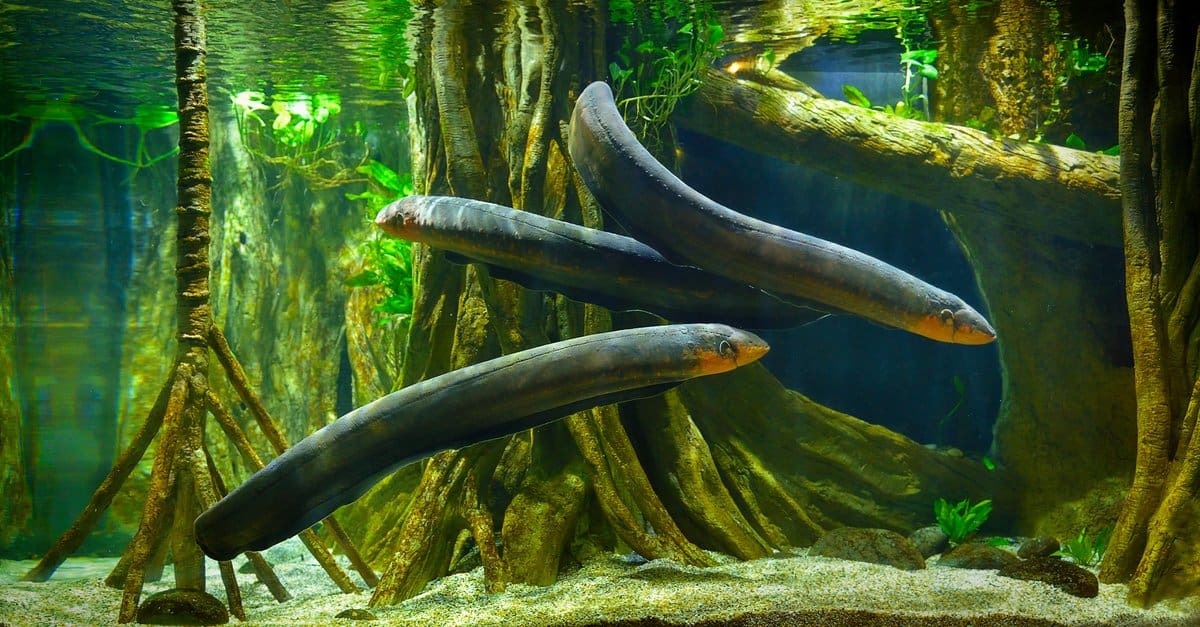
In the wild, it feeds mainly on fish and aquatic animals. For readers interested in fishing, wildlife observation, food fish, or aquariums, it matters because it is uses electricity for hunting, defense, and sensing. Always check adult size, water conditions, legal harvest rules, and conservation guidance before collecting, keeping, or targeting this species.
2. Volta’s Electric Eel
Scientific name: Electrophorus voltai. Volta’s Electric Eel is a very large strongly electric knifefish associated with clear and rocky rivers in Brazilian Shield rivers. Its clearest identification feature is one of three recognized electric eel species and capable of very strong discharges. That combination of color, body shape, habitat, and behavior is more reliable than color alone when comparing similar fish.
In the wild, it feeds mainly on fish and aquatic animals. For readers interested in fishing, wildlife observation, food fish, or aquariums, it matters because it is a large apex electric predator. Always check adult size, water conditions, legal harvest rules, and conservation guidance before collecting, keeping, or targeting this species.
3. Vari’s Electric Eel
Scientific name: Electrophorus varii. Vari’s Electric Eel is a very large strongly electric knifefish associated with slow, low-oxygen floodplain waters in lowland Amazon basin. Its clearest identification feature is adapted to murky lowland habitats. That combination of color, body shape, habitat, and behavior is more reliable than color alone when comparing similar fish.
In the wild, it feeds mainly on fish and aquatic animals. For readers interested in fishing, wildlife observation, food fish, or aquariums, it matters because it is uses air breathing and electric hunting. Always check adult size, water conditions, legal harvest rules, and conservation guidance before collecting, keeping, or targeting this species.
4. Banded Knifefish
Scientific name: Gymnotus carapo. Banded Knifefish is a large weakly electric knifefish associated with streams, swamps, and vegetated margins in South and Central America. Its clearest identification feature is dark vertical bands and a continuous underside fin. That combination of color, body shape, habitat, and behavior is more reliable than color alone when comparing similar fish.
In the wild, it feeds mainly on invertebrates and small fish. For readers interested in fishing, wildlife observation, food fish, or aquariums, it matters because it is uses weak pulses for navigation and communication. Always check adult size, water conditions, legal harvest rules, and conservation guidance before collecting, keeping, or targeting this species.
5. Omar’s Banded Knifefish
Scientific name: Gymnotus omarorum. Omar’s Banded Knifefish is a large weakly electric knifefish associated with lagoons and slow streams in Uruguay and southern Brazil. Its clearest identification feature is banded body and pulse-type electric signals. That combination of color, body shape, habitat, and behavior is more reliable than color alone when comparing similar fish.

In the wild, it feeds mainly on invertebrates and small fish. For readers interested in fishing, wildlife observation, food fish, or aquariums, it matters because it is widely studied for territorial electrocommunication. Always check adult size, water conditions, legal harvest rules, and conservation guidance before collecting, keeping, or targeting this species.
6. Tiger Knifefish
Scientific name: Gymnotus inaequilabiatus. Tiger Knifefish is a large weakly electric knifefish associated with rivers and floodplain lakes in South America. Its clearest identification feature is elongated tigerlike bars. That combination of color, body shape, habitat, and behavior is more reliable than color alone when comparing similar fish.
In the wild, it feeds mainly on fish and invertebrates. For readers interested in fishing, wildlife observation, food fish, or aquariums, it matters because it is active mostly in dim conditions. Always check adult size, water conditions, legal harvest rules, and conservation guidance before collecting, keeping, or targeting this species.
7. Black Ghost Knifefish
Scientific name: Apteronotus albifrons. Black Ghost Knifefish is a large weakly electric knifefish associated with fast and slow tributaries with cover in Amazon and Orinoco basins. Its clearest identification feature is black body with white tail bands. That combination of color, body shape, habitat, and behavior is more reliable than color alone when comparing similar fish.
In the wild, it feeds mainly on worms, insects, and small fish. For readers interested in fishing, wildlife observation, food fish, or aquariums, it matters because it is a wave-type electric fish popular in large aquariums. Always check adult size, water conditions, legal harvest rules, and conservation guidance before collecting, keeping, or targeting this species.
8. Brown Ghost Knifefish
Scientific name: Apteronotus leptorhynchus. Brown Ghost Knifefish is a medium weakly electric knifefish associated with rocky streams and river channels in northern South America. Its clearest identification feature is brown body with a pale tail band. That combination of color, body shape, habitat, and behavior is more reliable than color alone when comparing similar fish.

In the wild, it feeds mainly on insect larvae and small invertebrates. For readers interested in fishing, wildlife observation, food fish, or aquariums, it matters because it is known for complex electric communication. Always check adult size, water conditions, legal harvest rules, and conservation guidance before collecting, keeping, or targeting this species.
9. Longtail Knifefish
Scientific name: Sternopygus macrurus. Longtail Knifefish is a large weakly electric knifefish associated with rivers and floodplains in Central and South America. Its clearest identification feature is long compressed body and wave-type discharge. That combination of color, body shape, habitat, and behavior is more reliable than color alone when comparing similar fish.
In the wild, it feeds mainly on invertebrates and small fish. For readers interested in fishing, wildlife observation, food fish, or aquariums, it matters because it is uses electric fields to navigate at night. Always check adult size, water conditions, legal harvest rules, and conservation guidance before collecting, keeping, or targeting this species.
10. Glass Knifefish
Scientific name: Eigenmannia virescens. Glass Knifefish is a medium weakly electric knifefish associated with slow streams and floodplains in South America. Its clearest identification feature is translucent body and constant wave-type signal. That combination of color, body shape, habitat, and behavior is more reliable than color alone when comparing similar fish.
In the wild, it feeds mainly on small invertebrates. For readers interested in fishing, wildlife observation, food fish, or aquariums, it matters because it is can adjust frequency to reduce signal interference. Always check adult size, water conditions, legal harvest rules, and conservation guidance before collecting, keeping, or targeting this species.
11. Longsnout Knifefish
Scientific name: Rhamphichthys rostratus. Longsnout Knifefish is a large weakly electric knifefish associated with deep river channels and floodplains in South America. Its clearest identification feature is long tubular snout and ribbonlike body. That combination of color, body shape, habitat, and behavior is more reliable than color alone when comparing similar fish.
In the wild, it feeds mainly on worms and benthic invertebrates. For readers interested in fishing, wildlife observation, food fish, or aquariums, it matters because it is probes sediment while electrolocating. Always check adult size, water conditions, legal harvest rules, and conservation guidance before collecting, keeping, or targeting this species.
12. Rondo Sand Knifefish
Scientific name: Gymnorhamphichthys rondoni. Rondo Sand Knifefish is a medium weakly electric knifefish associated with sandy river bottoms in Amazon basin. Its clearest identification feature is slender body and pointed snout, often burying in sand. That combination of color, body shape, habitat, and behavior is more reliable than color alone when comparing similar fish.
In the wild, it feeds mainly on small benthic invertebrates. For readers interested in fishing, wildlife observation, food fish, or aquariums, it matters because it is a nocturnal substrate specialist. Always check adult size, water conditions, legal harvest rules, and conservation guidance before collecting, keeping, or targeting this species.
13. Western Hypopomid Knifefish
Scientific name: Brachyhypopomus occidentalis. Western Hypopomid Knifefish is a small to medium weakly electric knifefish associated with slow streams and marshes in Central America and northwestern South America. Its clearest identification feature is slender body and pulse-type signals. That combination of color, body shape, habitat, and behavior is more reliable than color alone when comparing similar fish.
In the wild, it feeds mainly on insect larvae and small crustaceans. For readers interested in fishing, wildlife observation, food fish, or aquariums, it matters because it is uses electricity for close-range sensing. Always check adult size, water conditions, legal harvest rules, and conservation guidance before collecting, keeping, or targeting this species.
14. Brown Knifefish
Scientific name: Hypopomus artedi. Brown Knifefish is a medium weakly electric knifefish associated with blackwater streams and swamps in Guianas and northern South America. Its clearest identification feature is brown camouflage and low-amplitude electric pulses. That combination of color, body shape, habitat, and behavior is more reliable than color alone when comparing similar fish.

In the wild, it feeds mainly on small invertebrates. For readers interested in fishing, wildlife observation, food fish, or aquariums, it matters because it is well adapted to cluttered habitats. Always check adult size, water conditions, legal harvest rules, and conservation guidance before collecting, keeping, or targeting this species.
15. Peter’s Elephantnose Fish
Scientific name: Gnathonemus petersii. Peter’s Elephantnose Fish is a medium mormyrid associated with slow rivers with muddy or sandy bottoms in West and Central Africa. Its clearest identification feature is downcurved chin extension and weak electric organ. That combination of color, body shape, habitat, and behavior is more reliable than color alone when comparing similar fish.
In the wild, it feeds mainly on worms and insect larvae. For readers interested in fishing, wildlife observation, food fish, or aquariums, it matters because it is uses electrolocation to find food. Always check adult size, water conditions, legal harvest rules, and conservation guidance before collecting, keeping, or targeting this species.
16. Baby Whale Fish
Scientific name: Brienomyrus brachyistius. Baby Whale Fish is a medium mormyrid associated with rivers and floodplains in West and Central Africa. Its clearest identification feature is rounded head and pulse-type electrical signals. That combination of color, body shape, habitat, and behavior is more reliable than color alone when comparing similar fish.
In the wild, it feeds mainly on small invertebrates. For readers interested in fishing, wildlife observation, food fish, or aquariums, it matters because it is communicates with species-specific pulses. Always check adult size, water conditions, legal harvest rules, and conservation guidance before collecting, keeping, or targeting this species.
17. Tamandua Knifefish
Scientific name: Campylomormyrus tamandua. Tamandua Knifefish is a large mormyrid associated with large rivers in Congo basin. Its clearest identification feature is extremely long curved snout. That combination of color, body shape, habitat, and behavior is more reliable than color alone when comparing similar fish.

In the wild, it feeds mainly on benthic invertebrates. For readers interested in fishing, wildlife observation, food fish, or aquariums, it matters because it is uses its snout and electric sense to search the bottom. Always check adult size, water conditions, legal harvest rules, and conservation guidance before collecting, keeping, or targeting this species.
18. Bottlenose Mormyrid
Scientific name: Mormyrus rume. Bottlenose Mormyrid is a large mormyrid associated with large rivers and lakes in West and Central Africa. Its clearest identification feature is long snout and deep body. That combination of color, body shape, habitat, and behavior is more reliable than color alone when comparing similar fish.
In the wild, it feeds mainly on benthic invertebrates and small fish. For readers interested in fishing, wildlife observation, food fish, or aquariums, it matters because it is produces weak pulses for electrolocation. Always check adult size, water conditions, legal harvest rules, and conservation guidance before collecting, keeping, or targeting this species.
19. Bulldog Fish
Scientific name: Marcusenius macrolepidotus. Bulldog Fish is a medium mormyrid associated with rivers, lakes, and floodplains in southern and eastern Africa. Its clearest identification feature is blunt head and silvery-brown body. That combination of color, body shape, habitat, and behavior is more reliable than color alone when comparing similar fish.
In the wild, it feeds mainly on insect larvae and crustaceans. For readers interested in fishing, wildlife observation, food fish, or aquariums, it matters because it is a widespread weakly electric African fish. Always check adult size, water conditions, legal harvest rules, and conservation guidance before collecting, keeping, or targeting this species.
20. Dwarf Stonebasher
Scientific name: Pollimyrus isidori. Dwarf Stonebasher is a small mormyrid associated with slow rivers and swampy margins in West and Central Africa. Its clearest identification feature is small body and pulse communication. That combination of color, body shape, habitat, and behavior is more reliable than color alone when comparing similar fish.

In the wild, it feeds mainly on tiny invertebrates. For readers interested in fishing, wildlife observation, food fish, or aquariums, it matters because it is forms social electric signal networks. Always check adult size, water conditions, legal harvest rules, and conservation guidance before collecting, keeping, or targeting this species.
21. Bane Mormyrid
Scientific name: Petrocephalus bane. Bane Mormyrid is a small mormyrid associated with rivers and floodplains in West Africa. Its clearest identification feature is short rounded snout and silvery body. That combination of color, body shape, habitat, and behavior is more reliable than color alone when comparing similar fish.
In the wild, it feeds mainly on insects and crustaceans. For readers interested in fishing, wildlife observation, food fish, or aquariums, it matters because it is a compact weakly electric species. Always check adult size, water conditions, legal harvest rules, and conservation guidance before collecting, keeping, or targeting this species.
22. Cornish Jack
Scientific name: Mormyrops anguilloides. Cornish Jack is a very large mormyrid associated with large rivers and lakes in sub-Saharan Africa. Its clearest identification feature is long predatory body and powerful jaws. That combination of color, body shape, habitat, and behavior is more reliable than color alone when comparing similar fish.
In the wild, it feeds mainly on fish and crustaceans. For readers interested in fishing, wildlife observation, food fish, or aquariums, it matters because it is one of the largest mormyrids. Always check adult size, water conditions, legal harvest rules, and conservation guidance before collecting, keeping, or targeting this species.
23. Electric Catfish
Scientific name: Malapterurus electricus. Electric Catfish is a large strongly electric catfish associated with rivers and lakes in West and Central Africa. Its clearest identification feature is rounded scaleless body and electric organ beneath the skin. That combination of color, body shape, habitat, and behavior is more reliable than color alone when comparing similar fish.
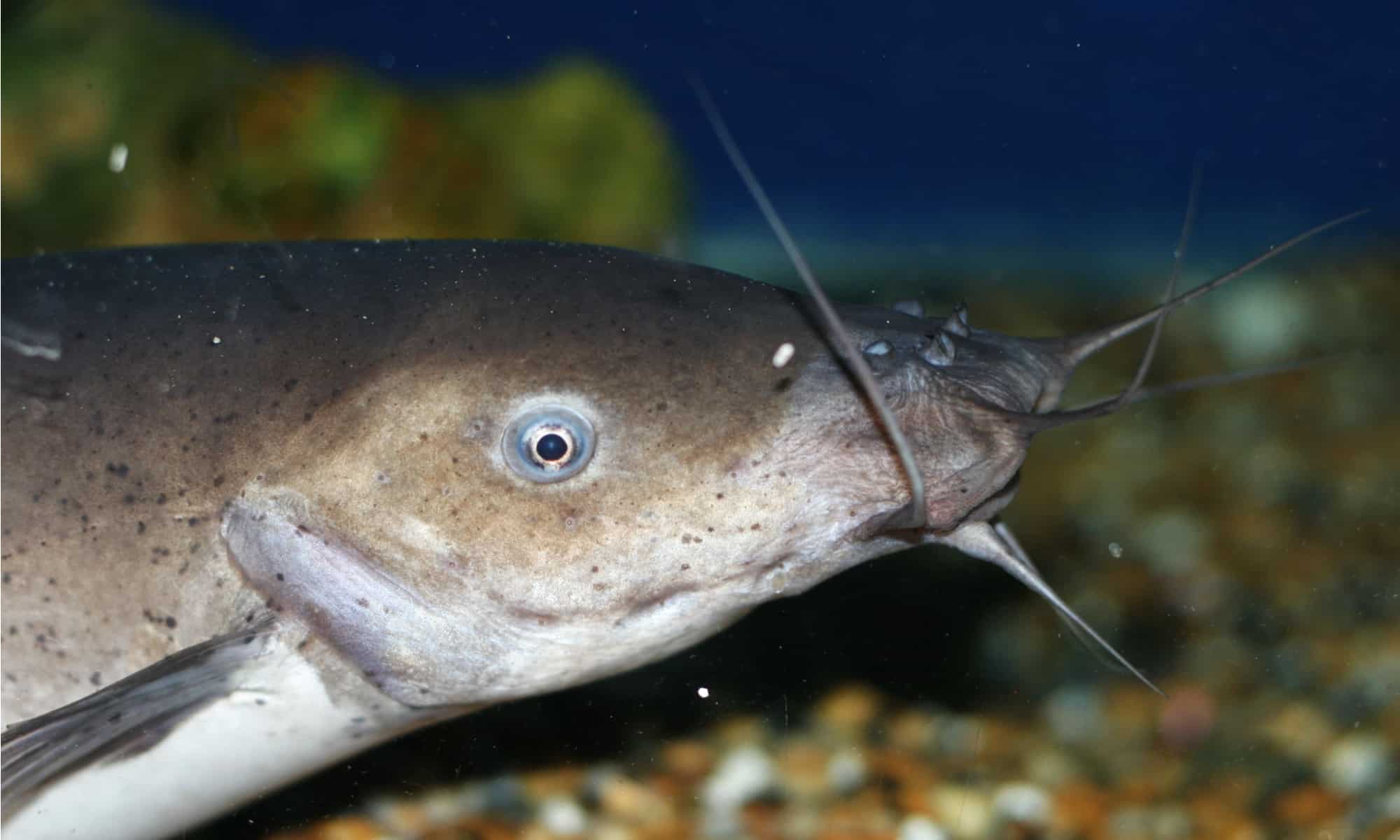
In the wild, it feeds mainly on fish and aquatic animals. For readers interested in fishing, wildlife observation, food fish, or aquariums, it matters because it is delivers strong defensive and predatory shocks. Always check adult size, water conditions, legal harvest rules, and conservation guidance before collecting, keeping, or targeting this species.
24. Smallmouth Electric Catfish
Scientific name: Malapterurus microstoma. Smallmouth Electric Catfish is a large strongly electric catfish associated with rivers in Congo basin. Its clearest identification feature is small mouth relative to the head. That combination of color, body shape, habitat, and behavior is more reliable than color alone when comparing similar fish.
In the wild, it feeds mainly on fish and invertebrates. For readers interested in fishing, wildlife observation, food fish, or aquariums, it matters because it is a less familiar member of the electric catfish family. Always check adult size, water conditions, legal harvest rules, and conservation guidance before collecting, keeping, or targeting this species.
25. Marbled Electric Ray
Scientific name: Torpedo marmorata. Marbled Electric Ray is a large strongly electric ray associated with sand, seagrass, and rocky coastal bottoms in eastern Atlantic and Mediterranean. Its clearest identification feature is mottled disc and paired electric organs. That combination of color, body shape, habitat, and behavior is more reliable than color alone when comparing similar fish.
In the wild, it feeds mainly on fish and crustaceans. For readers interested in fishing, wildlife observation, food fish, or aquariums, it matters because it is buries itself and shocks prey. Always check adult size, water conditions, legal harvest rules, and conservation guidance before collecting, keeping, or targeting this species.
26. Common Torpedo
Scientific name: Torpedo torpedo. Common Torpedo is a medium strongly electric ray associated with shallow sandy and muddy seabeds in eastern Atlantic and Mediterranean. Its clearest identification feature is round disc with distinctive blue eye spots. That combination of color, body shape, habitat, and behavior is more reliable than color alone when comparing similar fish.
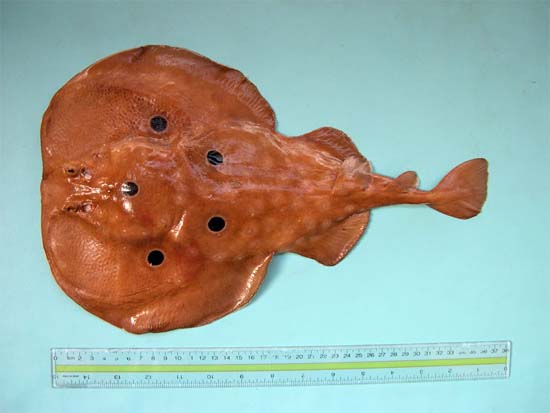
In the wild, it feeds mainly on fish and crustaceans. For readers interested in fishing, wildlife observation, food fish, or aquariums, it matters because it is capable of a strong defensive discharge. Always check adult size, water conditions, legal harvest rules, and conservation guidance before collecting, keeping, or targeting this species.
27. Atlantic Torpedo
Scientific name: Tetronarce nobiliana. Atlantic Torpedo is a very large strongly electric ray associated with coastal and offshore waters in Atlantic Ocean. Its clearest identification feature is large dark rounded disc. That combination of color, body shape, habitat, and behavior is more reliable than color alone when comparing similar fish.
In the wild, it feeds mainly on fish. For readers interested in fishing, wildlife observation, food fish, or aquariums, it matters because it is one of the largest electric rays. Always check adult size, water conditions, legal harvest rules, and conservation guidance before collecting, keeping, or targeting this species.
28. Pacific Electric Ray
Scientific name: Tetronarce californica. Pacific Electric Ray is a large strongly electric ray associated with rocky reefs and sandy bottoms in northeastern Pacific. Its clearest identification feature is dark rounded disc and thick tail. That combination of color, body shape, habitat, and behavior is more reliable than color alone when comparing similar fish.
In the wild, it feeds mainly on fish. For readers interested in fishing, wildlife observation, food fish, or aquariums, it matters because it is can produce a powerful shock. Always check adult size, water conditions, legal harvest rules, and conservation guidance before collecting, keeping, or targeting this species.
29. Brazilian Electric Ray
Scientific name: Narcine brasiliensis. Brazilian Electric Ray is a medium electric ray associated with sandy coastal bottoms in western Atlantic. Its clearest identification feature is round disc with brown spots. That combination of color, body shape, habitat, and behavior is more reliable than color alone when comparing similar fish.

In the wild, it feeds mainly on worms and crustaceans. For readers interested in fishing, wildlife observation, food fish, or aquariums, it matters because it is uses a weaker discharge than large torpedo rays. Always check adult size, water conditions, legal harvest rules, and conservation guidance before collecting, keeping, or targeting this species.
30. Lesser Electric Ray
Scientific name: Narcine bancroftii. Lesser Electric Ray is a small to medium electric ray associated with shallow sand and seagrass in western Atlantic. Its clearest identification feature is round disc and spotted pattern. That combination of color, body shape, habitat, and behavior is more reliable than color alone when comparing similar fish.
In the wild, it feeds mainly on worms and small crustaceans. For readers interested in fishing, wildlife observation, food fish, or aquariums, it matters because it is often lies buried in shallow water. Always check adult size, water conditions, legal harvest rules, and conservation guidance before collecting, keeping, or targeting this species.
31. Japanese Sleeper Ray
Scientific name: Narke japonica. Japanese Sleeper Ray is a small electric ray associated with sandy coastal waters in northwestern Pacific. Its clearest identification feature is soft rounded disc and short tail. That combination of color, body shape, habitat, and behavior is more reliable than color alone when comparing similar fish.
In the wild, it feeds mainly on worms and crustaceans. For readers interested in fishing, wildlife observation, food fish, or aquariums, it matters because it is a compact benthic electric ray. Always check adult size, water conditions, legal harvest rules, and conservation guidance before collecting, keeping, or targeting this species.
32. Onefin Electric Ray
Scientific name: Narke capensis. Onefin Electric Ray is a small electric ray associated with continental shelf bottoms in southeastern Atlantic. Its clearest identification feature is single dorsal fin and rounded disc. That combination of color, body shape, habitat, and behavior is more reliable than color alone when comparing similar fish.

In the wild, it feeds mainly on benthic invertebrates. For readers interested in fishing, wildlife observation, food fish, or aquariums, it matters because it is a little-known electric ray. Always check adult size, water conditions, legal harvest rules, and conservation guidance before collecting, keeping, or targeting this species.
33. Finless Sleeper Ray
Scientific name: Temera hardwickii. Finless Sleeper Ray is a small electric ray associated with shallow muddy bottoms in Indo-West Pacific. Its clearest identification feature is lacks dorsal fins and has a rounded body. That combination of color, body shape, habitat, and behavior is more reliable than color alone when comparing similar fish.
In the wild, it feeds mainly on small benthic invertebrates. For readers interested in fishing, wildlife observation, food fish, or aquariums, it matters because it is one of the smallest electric rays. Always check adult size, water conditions, legal harvest rules, and conservation guidance before collecting, keeping, or targeting this species.
34. Ocellated Electric Ray
Scientific name: Diplobatis ommata. Ocellated Electric Ray is a small electric ray associated with sandy and rocky coastal bottoms in eastern Pacific. Its clearest identification feature is bold eye-like spots on the disc. That combination of color, body shape, habitat, and behavior is more reliable than color alone when comparing similar fish.
In the wild, it feeds mainly on small crustaceans and worms. For readers interested in fishing, wildlife observation, food fish, or aquariums, it matters because it is camouflages against the seabed. Always check adult size, water conditions, legal harvest rules, and conservation guidance before collecting, keeping, or targeting this species.
35. Australian Numbfish
Scientific name: Hypnos monopterygius. Australian Numbfish is a medium electric ray associated with shallow sand, estuaries, and coastal waters in Australia. Its clearest identification feature is pear-shaped body and short tail. That combination of color, body shape, habitat, and behavior is more reliable than color alone when comparing similar fish.

In the wild, it feeds mainly on fish and crustaceans. For readers interested in fishing, wildlife observation, food fish, or aquariums, it matters because it is can produce a numbing shock. Always check adult size, water conditions, legal harvest rules, and conservation guidance before collecting, keeping, or targeting this species.
36. Japanese Electric Ray
Scientific name: Tetronarce tokionis. Japanese Electric Ray is a large strongly electric ray associated with deep coastal and offshore bottoms in northwestern Pacific. Its clearest identification feature is broad dark disc and heavy body. That combination of color, body shape, habitat, and behavior is more reliable than color alone when comparing similar fish.
In the wild, it feeds mainly on fish. For readers interested in fishing, wildlife observation, food fish, or aquariums, it matters because it is a deepwater torpedo ray. Always check adult size, water conditions, legal harvest rules, and conservation guidance before collecting, keeping, or targeting this species.
37. Sleeper Electric Ray
Scientific name: Crassinarke dormitor. Sleeper Electric Ray is a small electric ray associated with continental shelf bottoms in western Pacific. Its clearest identification feature is thick rounded disc. That combination of color, body shape, habitat, and behavior is more reliable than color alone when comparing similar fish.
In the wild, it feeds mainly on benthic invertebrates. For readers interested in fishing, wildlife observation, food fish, or aquariums, it matters because it is a poorly known electric ray. Always check adult size, water conditions, legal harvest rules, and conservation guidance before collecting, keeping, or targeting this species.
38. Nile Elephantfish
Scientific name: Mormyrus kannume. Nile Elephantfish is a large mormyrid associated with large rivers and lakes in Nile basin and East Africa. Its clearest identification feature is elongated snout and deep silvery body. That combination of color, body shape, habitat, and behavior is more reliable than color alone when comparing similar fish.
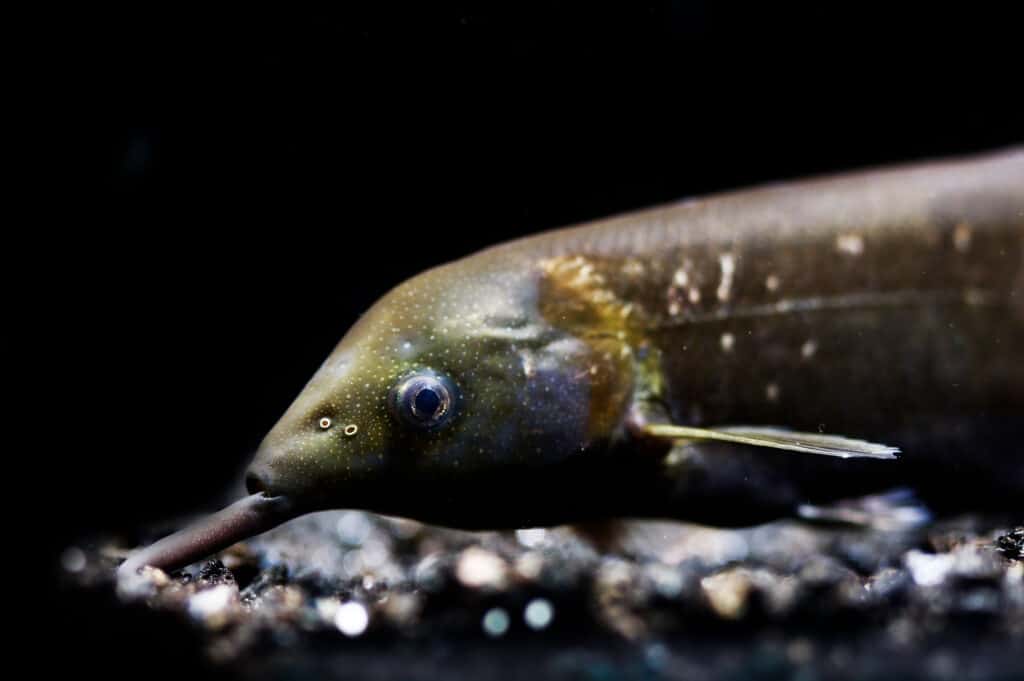
In the wild, it feeds mainly on benthic invertebrates and small fish. For readers interested in fishing, wildlife observation, food fish, or aquariums, it matters because it is uses weak electric pulses in often-turbid water. Always check adult size, water conditions, legal harvest rules, and conservation guidance before collecting, keeping, or targeting this species.
39. Senegal Bulldog Fish
Scientific name: Marcusenius senegalensis. Senegal Bulldog Fish is a medium mormyrid associated with rivers and floodplains in West Africa. Its clearest identification feature is blunt snout and compact body. That combination of color, body shape, habitat, and behavior is more reliable than color alone when comparing similar fish.
In the wild, it feeds mainly on insect larvae and crustaceans. For readers interested in fishing, wildlife observation, food fish, or aquariums, it matters because it is communicates and navigates with pulse-type discharges. Always check adult size, water conditions, legal harvest rules, and conservation guidance before collecting, keeping, or targeting this species.
40. Soudan Mormyrid
Scientific name: Petrocephalus soudanensis. Soudan Mormyrid is a small mormyrid associated with rivers and floodplain waters in Nile and West African basins. Its clearest identification feature is short head and silvery body. That combination of color, body shape, habitat, and behavior is more reliable than color alone when comparing similar fish.
In the wild, it feeds mainly on small aquatic invertebrates. For readers interested in fishing, wildlife observation, food fish, or aquariums, it matters because it is a schooling weakly electric species. Always check adult size, water conditions, legal harvest rules, and conservation guidance before collecting, keeping, or targeting this species.
How Are These Types of Fish Classified?
Electric fish are not one family. South American gymnotiform knifefishes include electric eels and many weakly electric species. African mormyrids and electric catfish evolved their own electric organs. Marine electric rays form several genera within the electric-ray groups. The repeated evolution of electric organs is a classic example of convergent evolution.
Where Do Electric Fish Live?
Weakly electric knifefishes and mormyrids often live in dark, muddy, vegetated, or nocturnal freshwater habitats where vision is limited. Electric eels use rivers, swamps, and floodplains in tropical South America. Electric catfish occupy African rivers and lakes. Electric rays rest on sandy, muddy, rocky, or seagrass-covered marine bottoms from shallow coasts to deeper shelves.
How to Identify Different Types of Electric Fish
- Body form: Knifefishes are elongated, mormyrids often have unusual snouts, catfish are rounded, and electric rays have flattened discs.
- Electric strength: Strong species use shocks for prey and defense; weak species use low-power fields primarily for sensing and communication.
- Signal type: Weak electric fish may produce pulse-type or continuous wave-type discharges.
- Habitat: Freshwater knifefish and mormyrids differ clearly from bottom-dwelling marine electric rays.
- Movement: Knifefishes often swim using a long anal fin and can move backward precisely.
- Safety: Never identify a strongly electric fish by touching it.
Observation and Aquarium Care Notes
- Do not handle electric eels, electric catfish, or electric rays.
- Specialist weakly electric aquarium fish need large mature systems, cover, stable water, and compatible tank mates.
- Avoid metal tools and direct hand contact when a strongly electric species may be present.
- Use public aquariums, scientific videos, and field guides for safe observation.
- Never collect or transport electric fish without permits and expert procedures.
Safety, Sustainability, and Conservation Notes
- Do not disturb or capture electric rays buried in shallow sand.
- Protect floodplains, blackwater streams, African river systems, and coastal seabeds.
- Never release captive electric fish into the wild.
- Avoid buying species whose adult size or electrical risk cannot be managed safely.
- Support research and habitat protection for poorly known electric fish.
Fun Facts About Electric Fish
- Electric eels are knifefishes, not true eels.
- Three living species of electric eel are currently recognized.
- Weak electric fish can sense distortions in their self-generated field.
- Some species communicate identity, sex, dominance, or courtship through electric pulses.
- Wave-type fish can shift signal frequency to reduce interference.
- Mormyrids include more than 200 species.
- Electric organs commonly evolved from modified muscle tissue.
- Electric rays have paired electric organs in the disc.
- Black ghost knifefish can swim backward using its long underside fin.
- Bioelectricity evolved independently in multiple fish lineages.
Final Thoughts on types of electric fish
These 40 types of electric fish range from powerful electric eels, catfish, and rays to subtle knifefishes and mormyrids that communicate and navigate with weak fields. Their biology is fascinating, but strongly electric species require distance, expertise, and strict safety. Accurate identification, responsible aquarium choices, and protection of river and seabed habitats are essential.
Frequently Asked Questions
1. What does the term “types of electric fish” mean?
It means fish that generate an electric field or discharge using specialized electric organs. Some produce strong shocks, while others produce weak signals.
2. How many types of electric fish are covered in this guide?
This guide profiles 40 carefully selected examples. The number is a practical editorial list, not a claim that only 40 such fish exist worldwide.
3. Are all types of electric fish closely related?
No. Electric abilities evolved independently in South American knifefishes, African mormyrids, electric catfish, and electric rays.
4. Which is the easiest types of electric fish to identify?
Electric Eel is a useful starting point because long scaleless body and powerful high-voltage discharge. However, identification should also consider body shape, fin placement, range, and habitat.
5. Which types of electric fish is the largest in this list?
Electric eels, Atlantic torpedo rays, and several large mormyrids are among the largest examples in the guide.
6. Which types of electric fish is the smallest in this list?
Finless sleeper rays, small Petrocephalus mormyrids, and dwarf weakly electric fishes are among the smallest.
7. Where do types of electric fish live?
They live in tropical rivers, floodplains, swamps, lakes, blackwater streams, sandy coasts, seagrass beds, rocky bottoms, and continental shelves.
8. What do types of electric fish eat?
Most eat insects, worms, crustaceans, or fish. Strongly electric predators may stun prey, while weak fish use electrolocation to find small food items.
9. Can types of electric fish live in freshwater?
Yes. Electric eels, gymnotiform knifefishes, mormyrids, and electric catfish are freshwater fish.
10. Can types of electric fish live in saltwater?
Yes. Electric rays are marine fish, although their habitats range from shallow coasts to deeper offshore bottoms.
11. Are any types of electric fish suitable for home aquariums?
Some weakly electric knifefishes and mormyrids are kept by experienced aquarists. Strongly electric species are unsafe and unsuitable for normal home aquariums.
12. Do types of electric fish need to be kept in groups?
Social behavior varies. Some mormyrids school, while many knifefishes and strongly electric predators can be territorial or solitary.
13. How can beginners identify types of electric fish?
Begin with body shape, fin arrangement, mouth position, color pattern, adult size, and habitat. Photograph the fish from the side when possible and compare it with a regional field guide rather than relying on a single color.
14. Can fish color change with age or season?
Yes. Many fish change color as they mature, breed, migrate, become stressed, or move between habitats. Lighting and water clarity also affect how color appears.
15. Why are scientific names useful?
Common names vary between countries and fisheries. A scientific name points to one recognized species and helps prevent confusion between unrelated fish that share a similar nickname.
16. Are any types of electric fish dangerous to handle?
Yes. Electric eels, electric catfish, and torpedo rays can deliver strong shocks. Never touch or deliberately provoke them.
17. Can people eat types of electric fish?
They are not a standard seafood category. Local use varies, but safety, legality, and correct identification must come first.
18. How should edible fish be stored?
Keep fresh fish cold immediately after capture or purchase, use clean food-safe containers, and follow local food-safety guidance. Refrigerate promptly and freeze portions that will not be used soon.
19. How can anglers fish responsibly for these species?
Follow current seasons, size limits, bag limits, protected-area rules, and gear restrictions. Use appropriate tackle, minimize handling, release unwanted fish quickly, and never transport live fish between waters.
20. Why should fish never be released from an aquarium?
Released aquarium fish can become invasive, spread disease, or die from unsuitable conditions. Rehome unwanted fish through a responsible aquarium store, club, rescue, or experienced keeper.
21. How does habitat loss affect these fish?
Dams, polluted runoff, sedimentation, wetland loss, reef damage, and coastal development can remove feeding, nursery, and spawning habitat. Species with small ranges are often especially vulnerable.
22. Are color-based fish names always accurate?
No. Names based on red, silver, black, or blue may describe only one life stage, sex, regional form, or market appearance. Taxonomy and location provide a more dependable identification.
23. What equipment helps with fish identification?
A camera, polarized sunglasses, regional field guide, ruler or measuring board, and notes about depth, water type, substrate, and location are useful. Handle wild fish only when legal and necessary.
24. Should I use an identification app?
An app can narrow the possibilities, but it should not be the only source for legal harvest or conservation decisions. Confirm important identifications with an authoritative regional guide or fisheries agency.
25. What is the most common identification mistake?
The most common mistake is choosing a species from color alone. Similar species may differ in fin rays, tail shape, mouth size, body proportions, spots, stripes, or geographic range.
26. Do juvenile fish look like adults?
Not always. Juveniles may have bars, spots, or colors that disappear with age, and some move from sheltered nursery areas to deeper adult habitats.
27. Are wild populations stable?
Many species are poorly studied. Habitat loss, pollution, dams, coastal damage, and collection may affect local populations.
28. Can climate change affect their distribution?
Yes. Warming water, altered river flow, ocean acidification, oxygen loss, and changing food webs can shift suitable habitat. Effects vary by species and region.
29. What should I check before buying one as a pet?
Confirm the exact species, adult size, social behavior, diet, water chemistry, temperature, tank length, filtration, and legal status. Avoid buying fish that cannot be housed responsibly for their full lifespan.
30. What is the best way to learn more about types of electric fish?
Use regional fish guides, museum and university resources, fisheries agencies, responsible aquarium organizations, and direct observation. Keep notes and compare several identification features at once.
SEO Title
40 Types of Electric Fish: Species and Shocking Facts
Meta Description
Discover 40 types of electric fish, including electric eels, knifefish, mormyrids, catfish, and electric rays.
Suggested URL Slug
types-of-electric-fish