

Wondering what kinds of squirrels you’ll spot while exploring Missouri’s forests, parks or suburban yards? In this friendly guide we’ll explore 8 types of squirrels in Missouri, giving you a clear, beginner‑friendly rundown of eight squirrel species you might encounter in the Show Me State. Whether you’re a casual wildlife enthusiast or a budding nature‑watcher, you’ll learn how to spot, identify, and appreciate these critters in Missouri — from tree‑dwellers to ground burrowers.
1. Eastern Gray Squirrel (Sciurus carolinensis)
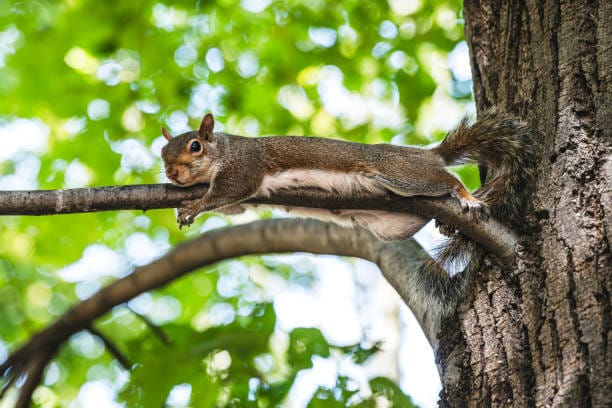
Physical Characteristics & Identification Tips
The Eastern Gray Squirrel is a moderately sized tree squirrel common in Missouri. With a body plus tail length typically between 14 and 21 inches, and weight around 1–2 pounds, it’s smaller than Missouri’s largest tree squirrels.
Its fur is mostly gray on the back and sides, with white underparts and often a white‑tipped, bushy tail. Some populations may include darker or even melanistic (black) individuals.
Look for its bright white underbelly, the large ears, bushy tail, and the way it flicks that tail when alarmed.
Because it spends time in trees, you’ll often see it bounding along branches, crossing yards, or foraging in leaf‑litter.
Behavior
Eastern Gray Squirrels are diurnal — active during the daylight hours, especially early morning and late afternoon.
They spend much of their time foraging for nuts, seeds, buds and sometimes fruit — and they are famous for their caching behaviour: burying nuts and remembering where they hid them.
When threatened, they typically dash up a tree, using their strong hind legs and bushy tail to help balance. They may vocalize, flick their tail, or ‘freeze’ before bolt mode.
In suburban yards, they’ll often run across lawns, chase each other, or chase away other squirrels from preferred feeding spots.
Habitat and Range
In Missouri, Eastern Gray Squirrels are widespread across much of the state, especially where mature hardwood forests (oaks, hickories) exist, and even in urban parks or neighborhoods with large trees.
They favour forests with dense understory or tree cover, though they’ll adapt well to suburban and city settings given ample food and trees.
Because they are tree‑inhabitants, you’ll find them in branch networks, tree cavities, leaf‑nests and sometimes attic spaces in older homes.
Diet
Gray squirrels eat a varied diet: acorns and other tree nuts (oaks, hickories, walnuts), buds in early spring, fruit, seeds, sometimes bird eggs or insects if they come across them.Their caching behaviour is important: during good mast years (lots of nuts) they will bury many nuts in shallow caches and rely on those through lean seasons.
Reproduction and Life Cycle
In Missouri, the mating season for tree squirrels like the gray squirrel typically starts in late December or early January, and a second period runs from late May into July. Gestation lasts roughly 38–45 days. Litters commonly contain 2–3 young, though the range can run up to 8 in good conditions. Young are born hairless and blind, eyes open around 4–5 weeks, and they leave the nest at about 6–7 weeks. By a few months they are independent.
Fun Facts / Unique Traits
– They are excellent memory users: they recall many cached nut‑locations, though they also rely on decoy caches.
– Some populations include black (melanistic) individuals, which may cope better with cold.
– In some suburban yards you’ll see “waste piles” of cracked nutshells under trees — a tell‑tale sign of their presence.
– Because they adapt well to urban spaces, they are one of the most frequently seen squirrels in Missouri.
Human Interaction
Gray squirrels are often welcomed in backyards and parks — fun to watch, especially with squirrels racing across lawns or climbing trees.
On the flip side, they can become pests: chewing wiring, getting into attics or chimneys, particularly in older homes.
If you enjoy watching them, leave feeders and nuts at a safe distance from homes and ensure attic entry points are closed. Encourage them in the yard but discourage them from entering living spaces.
—
2. Eastern Fox Squirrel (Sciurus niger)
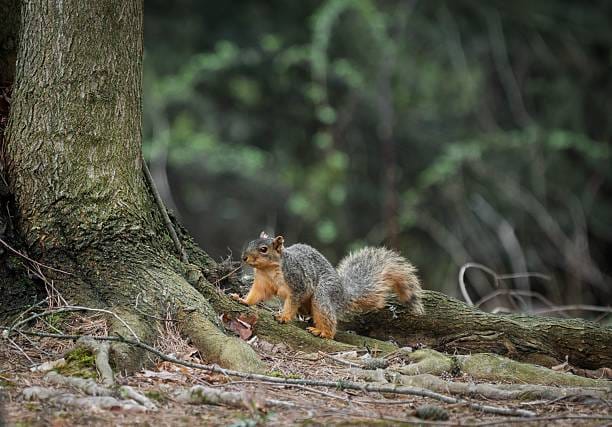
Physical Characteristics & Identification Tips
The Fox Squirrel is the largest tree squirrel species in Missouri. Adult length (nose to tail tip) runs about 19–29 inches, and weight may range 1–3 pounds.
The coloring often has a reddish‑yellow mix, especially on the sides or tail fringe, but colour morphs vary widely — black, pale gray, and even white individuals exist.
Key identification: big body, robust limbs, longer than average bushy tail, often a reddish tinge, especially underlighting. If you see a big squirrel that dwarfs typical gray squirrels, it’s likely a Fox Squirrel.
Behavior
Fox Squirrels are comfortable on the ground as well as in trees — they often forage on the forest floor for acorns, nuts and cornstalks.
They are somewhat bold in suburban settings, and due to their size and ground foraging habit, they sometimes dominate smaller squirrels.
They build both leaf nests (“dreys”) in forked branches and also use tree cavities. They may maintain both simultaneously.
Habitat and Range
In Missouri, Fox Squirrels occur throughout, but they prefer open woodlots, edges, ridge tops, hedgerows, farm woodlots and even suburban yards with large trees.
They are more tolerant of open areas than Gray Squirrels, which prefer denser forest cover.
Diet
Their diet overlaps a lot with gray squirrels: acorns, hickory nuts, walnuts, field corn, fruit, bud shoots. In open spots they’ll forage on the ground for farm crop residuals or open woodland plants.
Because of their size, they can crack larger nuts and may dominate access to mast in certain habitats.
Reproduction and Life Cycle
Much like other tree squirrels, Fox Squirrels in Missouri have two breeding seasons: first in late winter/early spring, second in late spring/early summer. Gestation ~40–45 days. Typical litter size: 2–4, but can vary.
Young become independent by late summer and the adults continue active year‑round (they do *not* hibernate).
Fun Facts / Unique Traits
– Because of their size and bold ground foraging, they are sometimes called “field squirrels” or “woodlot squirrels”.
– They can sometimes be seen at greater distances from trees than other squirrels because of their ground foraging habits.
– Their size makes them popular as a game species historically in Missouri woodlots.
Human Interaction
In rural or suburban yards, Fox Squirrels may eat corn, bird‑feeder contents, or dig around in garden borders. They may chew wood or wiring when accessing attics (though less commonly than smaller tree squirrels).
For nature watchers, spotting a Fox Squirrel gives an “aha” moment: you see a big, bold squirrel that isn’t just darting in trees but often struts across the ground.
—
3. Southern Flying Squirrel (Glaucomys volans)
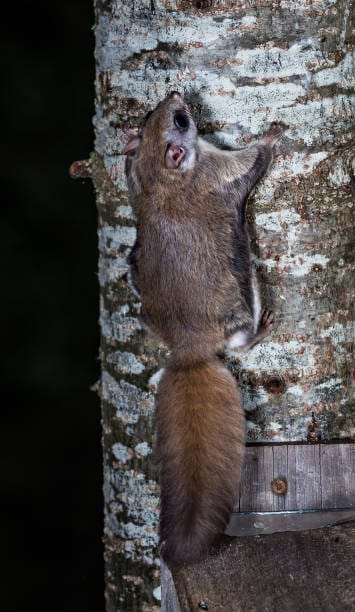
Physical Characteristics & Identification Tips
The Southern Flying Squirrel is much smaller than the tree squirrels above — total length ~8–11 inches including tail.
Its dorsal fur is gray to brownish, underside is pale cream or white. Key recognition feature: the patagium — a loose flap of skin that stretches between fore‑ and hindlimbs, enabling gliding.
Large eyes, broad flat tail (used as a rudder during glides). Because of its nocturnal habits and small size, you’ll rarely see it in full daylight.
Behavior
As its name implies, the flying squirrel doesn’t truly fly but glides from tree to tree. They launch from a high perch, spread limbs, stretch the gliding membrane and coast to another trunk or branch.
They are primarily nocturnal — active at night, when few other squirrel species move. This makes them harder to spot, but if you do, you’ll see silent glides and maybe tree‑to‑tree leaps at dusk.
They often nest in tree cavities or abandoned woodpecker holes; during cold periods they may den communally (several individuals together) for warmth.
Habitat and Range
They live throughout Missouri, but they are the only “flying” squirrel species you’ll find here. Their preferred habitats are mature deciduous forests (oak‑hickory) with plenty of old trees, snags (dead trees) and cavities. Suburban or park settings with older trees may also harbour them, though you’ll need to be patient and perhaps observe at twilight or night.
Diet
Flying squirrels feed on nuts, acorns, seeds, fruit, buds but also a surprising array of insects, mushrooms, tree sap, bird eggs, nestlings and even small vertebrates when available. They may cache food as well, though their gliding lifestyle means they often move between trees frequently rather than staying put.
Reproduction and Life Cycle
Adults reach sexual maturity in their first year. The female may have one or two litters per year, each with around 2–7 young. Gestation is ~40 days.
Young are born furless and blind, develop fur after a few weeks, learn to glide months later. Because they are nocturnal and elusive, many aspects of their life in Missouri remain lightly documented.
Fun Facts / Unique Traits
– You may hear one before you see one: a soft chitter or squeak at night high in the tree canopy.
– Their glides can cover 30–40 feet or more between trees — a silent dash through the night sky.
– Shared denning habit in winter is a social twist unusual among many squirrels.
Human Interaction
Because they nest in cavities, flying squirrels may occasionally make their way into attics or chimneys in older homes — though they are less conspicuous than gray or fox squirrels.
For backyard watchers: placing a “flying squirrel box” (a nest box designed for them) can allow observation (via a small camera or at dusk) of these fascinating nocturnal gliders.
—
4. Eastern Chipmunk (Tamias striatus)
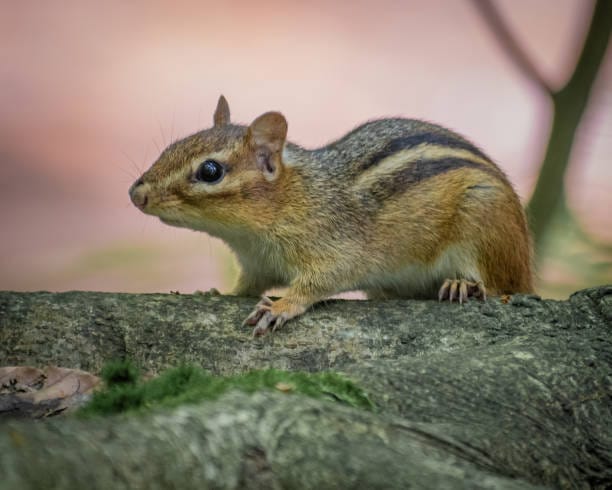
Physical Characteristics & Identification Tips
The Eastern Chipmunk is smaller than the typical tree squirrels, with an adult length maybe 8‑12 inches including tail.
It sports distinctive striping: five dark stripes (on a brownish background) along each side of its back, with pale stripes in between. Its tail is not quite as bushy as the large tree squirrels.
Look for its cheek‑pouches (used to carry food), its dimpling cheeks, and its habit of darting in and out of burrows rather than high tree branches.
Behavior
Chipmunks are diurnal and fast. Their behaviours include rapid darts across open ground, climbing low shrubs and trees, and retreating into burrows when threatened.
They stash food in cheek pouches, then carry it to their underground storage chambers — they are excellent hoarders.
Unlike larger tree squirrels, chipmunks tend to stay closer to the ground, though they will climb.
(Note: altered spelling intended) – correct to
Habitat and Range
In Missouri, the Eastern Chipmunk occurs across forest edges, wooded lots, brushy borders, suburban gardens, rock piles and old walls. Because they burrow, they prefer spots where the soil is loosely packed, with cover and access to forest or shrub zones.
Diet
Chipmunks eat nuts, seeds, berries, insect larvae, small fruits — and occasionally small vertebrates or bird eggs. Their cheek‑pouch behaviour and underground caching make them a distinct character among squirrels.
Reproduction and Life Cycle
Chipmunks may breed twice a year (spring and summer), producing litters of 4–5 young on average. They prepare burrow chambers for nesting, foraging, and storing. The young emerge and begin independent life after several weeks. Because they stay near the burrow system, chipmunks are often easier to observe than some of the more tree‑bound squirrels.
Fun Facts / Unique Traits
– Their cheek pouches let them haul multiple nuts at once, sometimes up to several times their head size.
– If you spot a small animal running across the lawn and disappearing into a hole near a rock wall, you’ve probably seen a chipmunk.
– They’re often early risers in spring and can be seen scurrying even before dawn in quiet woods.
Human Interaction
Chipmunks are popular backyard wildlife — many people enjoy watching them between rocks or walls, carrying food, chasing each other.
On the other hand, they can dig under decks or patios, sometimes causing structural issues if left unchecked. If you enjoy them, provide some cover and keep feeders somewhat elevated to avoid conflicts.
—
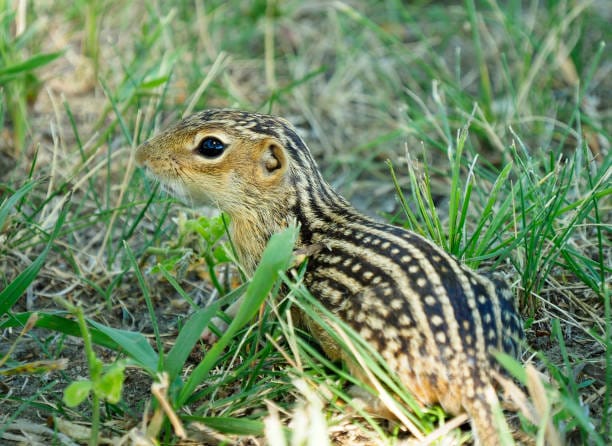
5. Thirteen‑Lined Ground Squirrel (Ictidomys tridecemlineatus)
Physical Characteristics & Identification Tips
This ground squirrel is smaller and more slender compared to its tree‑dwelling cousins: body length about 7 to 12.5 inches; tail about 2½ to 5 inches.
Its name gives it away: it has 13 alternating light (yellowish to white) and dark (blackish or reddish brown) stripes running from head to rump.
Large eyes, small ears set low, and a less bushy tail than tree squirrels help distinguish it. When in open grassland you may spot it standing upright like a “sentinel” on its hind legs.
Behavior
These squirrels are diurnal and spend a lot of time “on the lookout,” standing upright, scanning for predators — hence their other nickname “squinny.”
They live in burrow systems with multiple entrances, often in colonies though less social than prairie‑dogs.
They hibernate for long stretches (up to 3–4 months or more) during winter, plugging their burrow entrances and staying underground until spring.
Habitat and Range
In Missouri, the Thirteen‑Lined Ground Squirrel occurs primarily in the northern and western prairie zones, open grasslands and rights‑of‑way with short grasses.
They prefer open terrain because their warning‑post posture and quick dash into burrows work best in low vegetation.
Diet
They eat a mix of seeds, grains, insects (grasshoppers, cicadas, crickets), and sometimes small vertebrates. In good years they may store seeds in their burrow.
They often double their body weight in late summer to prepare for hibernation.
Reproduction and Life Cycle
After emerging from hibernation in spring, they breed quickly; gestation may be ~28 days; litters of 4–14 young are typical. Young leave burrow after ~5–6 weeks.
Because of hibernation, their active above‑ground season is relatively short compared to tree squirrels.
Fun Facts / Unique Traits
– Their tell‑tale stripes make them stand out.
– They may plug their burrow entrances with sod or grass at night for safety.
– Their standing posture in open grass is so characteristic it’s often used in wildlife photography.
Human Interaction
In open prairie yards or golf courses you may spot them. They can sometimes dig up vegetable gardens or disturb turf, but they also eat many insects and help aerate the soil. When re‑landscaping open fields, try to preserve patches of short grass and ground cover so they have escape routes rather than just open lawn.
—
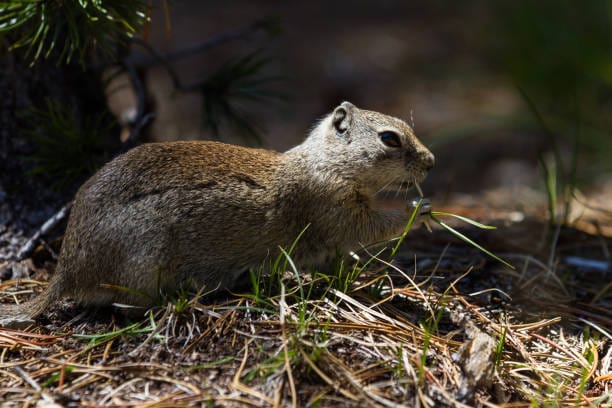
6. Franklin’s Ground Squirrel (Poliocitellus franklinii)
Physical Characteristics & Identification Tips
Franklin’s Ground Squirrel is a mid‑sized ground squirrel: length ~14–16½ inches including tail; tail about 4–6 inches.
Upperparts are brownish‑gray speckled with black, underside yellowish or buff; tail black/gray mixed, less bushy than tree squirrels. Small ears; large claws for digging.
Look for this species in prairie‑woodland edge habitats — its colour pattern and behaviour differ markedly from tree‑squirrels.
Behavior
Franklin’s Ground Squirrels are diurnal but elusive; they spend most of their lives beneath ground in burrows, emerging to forage.
They may form loose colonies of 10–12 individuals, and their burrow systems are large and deep compared to those of the thirteen‑lined ground squirrel. They hibernate from late August or October until early spring; during this time they call out musical whistling sounds heard when they emerge.
Habitat and Range
In Missouri, Franklin’s Ground Squirrel occurs in the northern tier – in prairie‑woodland edges, tallgrass prairie remnants, fencerows, roadsides. Because its habitat is declining, sightings are rarer.
Diet
About 75 % of their diet is plant‑based (seeds, fruits, roots, green vegetation); the remaining ~25 % is animal matter: insects, small mammals, bird eggs, even small rabbits.
They thus play both herbivore and carnivore roles in their ecosystems.
Reproduction and Life Cycle
After emerging from hibernation in early spring (April), they mate; gestation ~28 days; litters of ~4–11 young (average ~7) born in May/June. Young are weaned in about a month and are independent before winter.
Males typically live only 1–2 years; females may survive 4–5 years in the wild.
Fun Facts / Unique Traits
– Their whistling call earned them the nickname “whistling ground squirrel”.
– Their burrowing and hibernation help aerate soils, benefit earthworms and other soil fauna.
– Because they require tallgrass prairie remnants, their presence is an indicator of ecosystem health.
Human Interaction
Due to habitat loss, this squirrel is less common and thus less frequently encountered by casual observers. But if you’re out in northern Missouri prairies or old fencerows you may glimpse one. They may dig in lawns or fields, but their ecological role is largely positive (soil aeration, insect control). For land‑managers, preserving prairie patches helps these animals persist.
7. Woodchuck (Marmota monax) – also called Groundhog
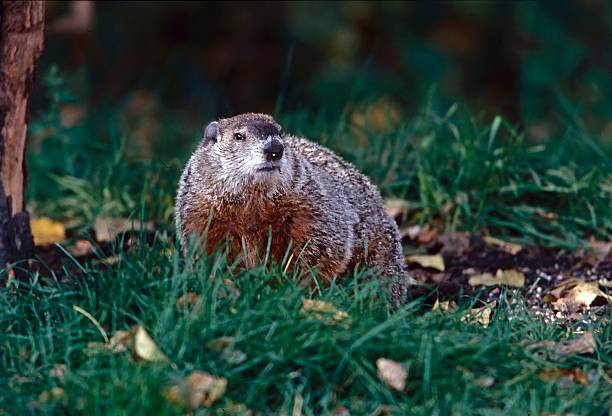
Michigan, USA. October
Physical Characteristics & Identification Tips
The Woodchuck is the largest “squirrel family” member you’ll find in Missouri. Length varies roughly 16–32 inches; weight up to 14 pounds in some cases. Stocky body, short limbs, coarse fur (mix of gray, black, tan or reddish‑tints), flatish tail (~3.75–7.5 in length) compared with tree squirrels.
Look for the large head, chunky build, and burrow entrance (often with piled dirt) in open fields or wood‑edge habitats.
Behavior
Woodchucks are mainly ground‑dwellers and proficient burrowers. They hibernate during the winter, entering their burrow systems by late October and emerging in early February or later.
When above ground they may sun themselves on rocks, logs, or burrow mounds, squeal or whistle when threatened, and often stand upright to survey. They may climb low into trees for fruit but mostly stay terrestrial.
Habitat and Range
In Missouri, woodchucks occur in open grass‑fields, edges of forests, farm fields, pastures, and brushy wood‑edges — anywhere the soil is diggable and there is some cover.
Their burrow systems may include multiple chambers, entrances and exits; old burrows provide shelter for other mammals (skunks, rabbits) when vacated.
Diet
They are primarily herbivores: grasses, clover, crops (corn, soybeans), leaves, flowers, fruits. Occasionally they may eat invertebrates. Their herbivory and burrowing can cause damage to fields or pastures.
They often climb onto a rock or mound near their burrow entrance to look for danger.
(typo fixed to)
Reproduction and Life Cycle
Breeding begins mid‑February after emerging from hibernation; litter size averages 4–5 young. Young are born in the burrow, and the mother cares for them until they are weaned and emerge.
Because they hibernate, their active season is shorter.
Fun Facts / Unique Traits
– Woodchucks are perhaps best known from the folklore Groundhog Day — when one emerges from its burrow and “sees its shadow.”
– Their burrow systems create homes for other animals once vacated — beneficial ecological role.
– They have large front claws specialised for digging and mound‑making.
Human Interaction
Humans often encounter woodchucks on farms, gardens, lawns or pastures. They may eat garden vegetables, dig burrows near human infrastructure. On the other hand, wildlife‑watchers enjoy spotting their massive burrow mounds, or watching them sun themselves on logs. If you have a woodchuck problem, consider fencing small gardens, planting deterrent plants, or relocating following local wildlife regulations.
—
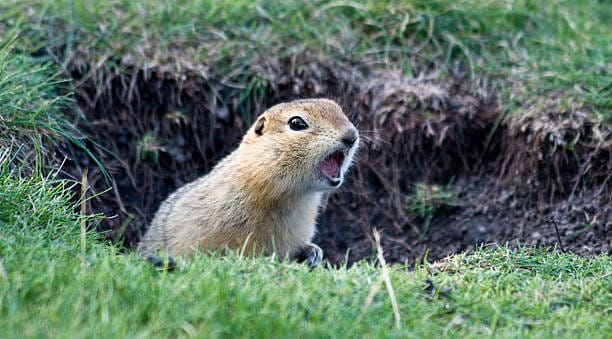
8. Ground Squirrels
Physical Characteristics & Identification Tips
This category covers lesser‑known ground squirrels or prairie sciurids documented in Missouri, such as smaller burrow‑dwelling squirrels that may resemble prairie dogs or ground squirrels in the Sciuridae family. These typically have shorter tails, stockier bodies, and live subterranean lives.
Behavior
They forage on open ground, burrow deeply, may live in colonies, and often hibernate or enter torpor in winter. Their sighting is less common compared to tree squirrels, so spotting them requires patience and knowledge of prairie habitats.
Habitat and Range
These squirrels occupy remnant grasslands, prairie patches, fencerows and edges of woods in Missouri’s northern and western prairie regions. Because habitats are fragmented, their populations are more restricted.
Diet
They eat seeds, grasses, insects, small invertebrates, sometimes small vertebrates. Their role in the ecosystem includes soil aeration via burrowing and seed dispersal.
Reproduction and Life Cycle
Many follow a single‑litter yearly rhythm, emerge after hibernation in spring, and live in burrow systems that may contain storage chambers. Their life cycle is adapted to open‑ground, seasonal habitats.
Fun Facts / Unique Traits
– These ground squirrels act as “ecosystem engineers” by burrowing, loosening soils, creating habitats for other species.
– Their low‑profile behaviour makes them less visible, but once you know where to look (open grassland, roadside margins) you may spot one.
– Their decline in Missouri underscores how important prairie and open‑grass habitats are.
Human Interaction
These squirrels may dig up lawns or disturb turf or garden borders; but they also provide benefits such as insect control and soil health. For landowners, maintaining grassland strips or prairie patches helps support their presence and contributes to biodiversity.
FAQ’s
Are there squirrels in Missouri?
Yes! Missouri is home to several squirrel species. You’ll commonly see gray squirrels, fox squirrels, and even some flying squirrels in forests, parks, and suburban neighborhoods.
What is the bulkiest squirrel in Missouri?
The bulkiest squirrel in Missouri is the fox squirrel. They can weigh up to 2 pounds and are larger than the more common gray squirrels.
Where do fox squirrels live in Missouri?
Fox squirrels prefer open woodlands, farmlands, and park areas. They often nest in large trees or abandoned woodpecker holes and are quite adaptable to suburban areas.
What do squirrels eat in Missouri?
Squirrels are opportunistic eaters. They mostly eat nuts, seeds, fruits, and acorns, but they’ll also nibble on bird eggs, fungi, and even garden vegetables when available.
What is the most common squirrel in Missouri?
The eastern gray squirrel is the most common. You’ll see them in almost every city park, backyard, and forested area in the state.
Is it illegal to worry squirrels in Missouri?
Yes, intentionally harming, harassing, or worrying squirrels can be illegal. Missouri has wildlife protection laws, so it’s best to observe squirrels from a safe distance and not disturb them.
How rare are black squirrels in Missouri?
Black squirrels are uncommon but not unheard of. They are a melanistic form of the eastern gray squirrel and are mostly found in specific areas with established populations.
Can you have a squirrel as a pet in Missouri?
No, it’s illegal to keep wild squirrels as pets in Missouri. They are protected under state wildlife laws, and caring for them requires special permits.
Are squirrels protected in Missouri?
Yes, squirrels are protected by Missouri’s wildlife laws. Hunting is allowed only during regulated seasons, and certain species have extra protections.
What month do squirrels have babies in Missouri?
Most squirrels in Missouri have two breeding seasons per year: spring (around February to April) and late summer (around June to August). Each litter usually has 2–4 babies.
Do flying squirrels live in Missouri?
Yes, Missouri is home to the southern flying squirrel. They are nocturnal and live in forests, often nesting in tree cavities.
What town in Missouri has white squirrels?
Maryville, Missouri, is famous for its white squirrels. They are rare and have become a local attraction, with the town even celebrating them in festivals.
Conclusion
We’ve taken a tour of eight wonderful “types of squirrels in Missouri” — from large tree‑dwellers like the Eastern Gray and Fox Squirrel, to the gliding southern flyer, to the ground‑burrowing champions like the Thirteen‑Lined, Franklin’s Ground Squirrel and the mighty woodchuck. Each one plays a vital role in Missouri’s ecosystems, from planting and burying nuts, to aerating soil, to entertaining backyard watchers.
If you’re in Missouri and keen to observe squirrels, here are a few friendly tips: keep a pair of binoculars handy, look under and around old trees and forest edges, explore morning or late afternoon for tree species and dusk for gliders, preserve patches of native trees and prairie grass, and respect wildlife by watching from a distance rather than intervening.
Want to dive deeper? Consider getting a field‑guide for Missouri mammals (for example from the Missouri Department of Conservation), join a local nature‑walk, or set up a simple trail‑camera near a squirrel feeder or woodland edge. Observing these animals enriches our appreciation of nature and shows how interconnected life is.
Thanks for reading! I hope this article helps you recognize and appreciate the variety of squirrels in Missouri — and inspires more outdoor adventures. Whether you’re watching a gliding flying squirrel at dusk or spotting a chipmunk dart under a rock, you’ll know what you’re looking at. Happy squirrel‑watching out there in Missouri’s woods and meadows — and don’t forget to keep an eye out for new arrivals on the list of squirrels in Missouri.
Read more:
- 12 Types of Squirrels in Canada (Pictures And Identification)
- Squirrel Hunting in the Rain: The Ultimate Guide
- What Do Squirrels Eat? 50 Foods They Love the Most
- 18 Types of Squirrels in Idaho (Pictures And Identification)
- 8 Types of Squirrels in Arizona (Pictures And Identification)
- What Is The Best Time To Go Squirrel Hunting?
- How to Trap Squirrels
- 8 Types of Squirrels in Massachusetts (Pictures And Identification)
- 10 Types of Squirrels in Texas (Pictures and Identification)
- 15 Types of Squirrels in Wisconsin (Pictures and Identification)
- 5 Types of Squirrels in Indiana (Pictures And Identification)
- 8 Types of Squirrels in Illinois (Pictures and Identification)
- 10 Types of Squirrels in New York | Identification and Facts
- 8 Squirrels in Ohio (Pictures And Identification)
- 10 Types of Squirrels in Michigan (Pictures And Identification)