

From white-coated runners on Arctic tundra to enormous-eared jackrabbits in sun-baked deserts, the world’s types of hares are far more varied than their familiar long-legged outline suggests. Every true hare belongs to the genus Lepus, but each species reflects a different landscape: mountain heath, tropical savanna, coastal dune, boreal forest, open farmland, or high Asian plateau. Knowing those links between body shape, coat, range, and habitat makes hare identification much more reliable than color alone.
This guide covers all 35 living species recognized in the American Society of Mammalogists’ Mammal Diversity Database version 2.5. That current taxonomy includes several recently separated species that older lists place within the Cape hare or black-tailed jackrabbit. For every species, you will find its scientific name, useful field marks, range, habitat, behavior, diet, and conservation context. You will also learn why a jackrabbit is really a hare, how hares differ from rabbits, and how to watch these fast, easily disturbed mammals responsibly.
What Are the Main Types of Hares?
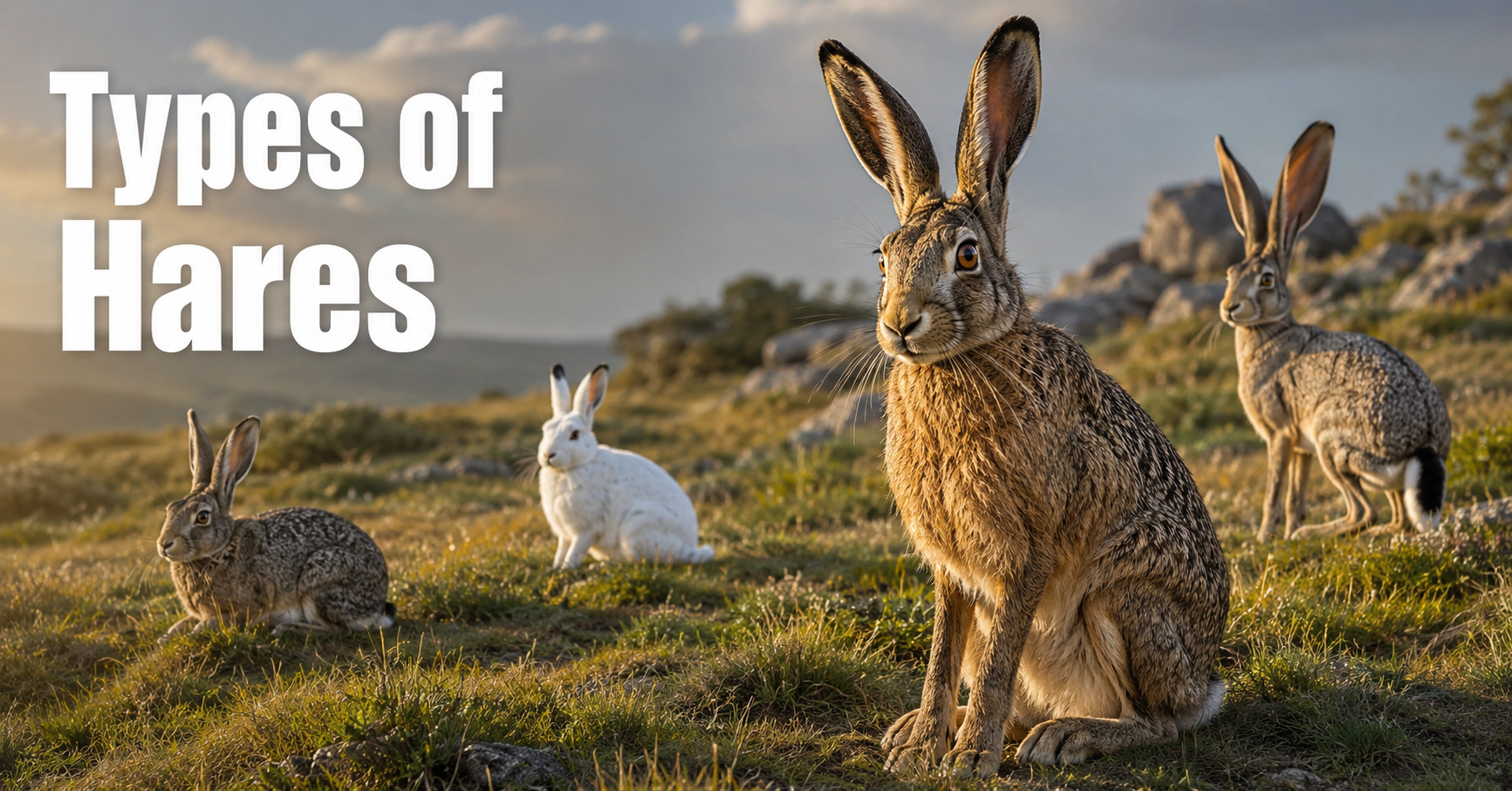
The main types of hares are the 35 living species in the genus Lepus, including familiar animals such as the European hare, snowshoe hare, Arctic hare, and black-tailed jackrabbit. They occur naturally across Africa, Eurasia, and North America, while people have introduced some species elsewhere. Cold-region hares often have compact ears, broad feet, and seasonally white coats, whereas desert and savanna species tend to have longer ears that help release heat. The word “jackrabbit” is a North American common name, not a separate biological group.
Types of Hares at a Glance
| No. | Common Name | Scientific Name | Native Range | Current Global Status |
|---|---|---|---|---|
| 1 | Antelope jackrabbit | Lepus alleni | Southwestern United States and northwestern Mexico | Least Concern |
| 2 | Tamaulipas jackrabbit | Lepus altamirae | Northeastern Mexico | Not Evaluated separately |
| 3 | Snowshoe hare | Lepus americanus | Canada and United States | Least Concern |
| 4 | Arctic hare | Lepus arcticus | Northern Canada and Greenland | Least Concern |
| 5 | Japanese hare | Lepus brachyurus | Japan | Least Concern |
| 6 | Black-tailed jackrabbit | Lepus californicus | Western United States and Mexico | Least Concern |
| 7 | White-sided jackrabbit | Lepus callotis | Mexico and southwestern United States | Vulnerable |
| 8 | Cape hare | Lepus capensis | Africa and southwestern Asia | Least Concern as currently assessed |
| 9 | Broom hare | Lepus castroviejoi | Northern Spain | Vulnerable |
| 10 | Yunnan hare | Lepus comus | Southwestern China and Myanmar | Least Concern |
| 11 | Korean hare | Lepus coreanus | Korean Peninsula and nearby China | Least Concern |
| 12 | Corsican hare | Lepus corsicanus | Italy; introduced to Corsica | Vulnerable |
| 13 | European hare | Lepus europaeus | Europe and western to central Asia | Least Concern |
| 14 | Ethiopian hare | Lepus fagani | Ethiopia and neighboring areas | Least Concern |
| 15 | Tehuantepec jackrabbit | Lepus flavigularis | Oaxaca, Mexico | Endangered |
| 16 | Iberian hare | Lepus granatensis | Spain and Portugal | Least Concern |
| 17 | Abyssinian hare | Lepus habessinicus | Horn of Africa | Least Concern |
| 18 | Hainan hare | Lepus hainanus | Hainan Island, China | Endangered |
| 19 | Manchurian hare | Lepus mandshuricus | Northeastern China, Korea, and Russia | Least Concern |
| 20 | Mediterranean hare | Lepus mediterraneus | North Africa and Sardinia | Not Evaluated separately |
| 21 | African savanna hare | Lepus microtis | Much of sub-Saharan Africa | Least Concern under an older name |
| 22 | Indian hare | Lepus nigricollis | South Asia | Least Concern |
| 23 | Woolly hare | Lepus oiostolus | Tibetan Plateau and Himalayas | Least Concern |
| 24 | Alaska hare | Lepus othus | Western Alaska and eastern Russia | Least Concern |
| 25 | Burmese hare | Lepus peguensis | Mainland Southeast Asia | Least Concern |
| 26 | West Sahara hare | Lepus saharae | Western Sahara and Sahel | Not Evaluated separately |
| 27 | Scrub hare | Lepus saxatilis | Southern Africa | Least Concern |
| 28 | Moroccan hare | Lepus schlumbergeri | Morocco and possibly Mauritania | Not Evaluated separately |
| 29 | Chinese hare | Lepus sinensis | China and Taiwan | Least Concern |
| 30 | Ethiopian highland hare | Lepus starcki | Ethiopian Highlands | Least Concern |
| 31 | Desert hare | Lepus tibetanus | Central and South Asia | Least Concern |
| 32 | Mountain hare | Lepus timidus | Northern Eurasia | Least Concern |
| 33 | Tolai hare | Lepus tolai | Central Asia | Least Concern |
| 34 | White-tailed jackrabbit | Lepus townsendii | Western and central North America | Least Concern |
| 35 | Yarkand hare | Lepus yarkandensis | Tarim Basin, China | Near Threatened |
1. Antelope Jackrabbit
The antelope jackrabbit, Lepus alleni, is among the largest and most striking hares in North America. It has an unusually long-legged, rangy build, a pale belly, grizzled gray-brown upperparts, and very large ears that may look almost translucent when backlit. White on the flanks can extend high onto the sides, creating a sharp contrast with the darker back. Its namesake resemblance to an antelope comes from both its high-speed bounding gait and the conspicuous pale rump and sides seen as it runs.
This heat-adapted hare lives in the Sonoran Desert and adjoining dry country of Arizona and northwestern Mexico. Look for it in open desert grassland, thorn scrub, and foothill plains where scattered shrubs provide daytime shade without blocking an escape route. Its oversized ears carry a dense network of blood vessels and help shed heat. The animal rests in a shallow form during the day and feeds mainly from dusk through the night on grasses, mesquite leaves, cacti, and other available vegetation. Unlike burrowing rabbits, it relies on stillness, camouflage, acceleration, and long bounds.
Field observers should separate it from the black-tailed jackrabbit by its greater size, extremely broad ears, and extensive white sides. The species is globally assessed as Least Concern, but local populations still depend on connected desert habitat. Watch from a distance near dawn or dusk and never pursue one for a photograph; repeated flight in high temperatures wastes water and energy the animal cannot easily replace.
2. Tamaulipas Jackrabbit
The Tamaulipas jackrabbit, Lepus altamirae, is a newly recognized species from northeastern Mexico. Older field guides generally treat it as an eastern form or subspecies of the black-tailed jackrabbit, so searches under its scientific name may produce less information than searches for the broader historical concept. Current mammal taxonomy separates it from L. californicus, making it one of the clearest examples of why modern lists contain more types of hares than older articles do.
Its known range centers on Tamaulipas and nearby northeastern Mexican landscapes. The animal occupies warm, relatively open country with grass, scrub, agricultural edges, and enough low cover for concealment. Like related jackrabbits, it has long ears, powerful hind feet, a grayish to brown upper coat, pale underparts, and dark markings associated with the ear tips and upper tail. However, pelage varies with age, wear, and season, and the boundary with similar jackrabbits is a taxonomic problem rather than a simple color test.
The Tamaulipas jackrabbit eats grasses, herbs, shoots, and woody material as conditions change between wet and dry periods. It is most likely to be noticed during crepuscular or nocturnal activity, often first as a long-eared silhouette crossing a track. Because the species was split recently, it has not yet received a separate global IUCN assessment. That means “Not Evaluated” should not be mistaken for secure or rare. Records with location, date, and photographs can be valuable, but identification should be confirmed by regional experts rather than assumed from appearance alone.
3. Snowshoe Hare
The snowshoe hare, Lepus americanus, is a forest specialist of northern North America. Its best identification feature is the pair of broad, heavily furred hind feet that spread its weight across soft snow. In much of its range the coat is rusty or gray-brown in summer and mostly white in winter, while the ear tips remain dark. The tail is relatively small and usually brownish above, helping distinguish it from the larger white-tailed jackrabbit in places where both occur.
Snowshoe hares thrive in boreal forest, regenerating woodland, willow and alder thickets, and dense young conifers from Alaska and Canada into northern and mountainous parts of the United States. Thick low cover matters as much as food: it shields resting hares from lynx, coyotes, foxes, owls, and hawks. Their diet changes seasonally, from grasses, leaves, and herbs in summer to twigs, buds, and bark in winter. Tracks often reveal the species before the animal appears: two large hind prints land ahead of two smaller forefeet.
Populations famously rise and fall over roughly decade-long cycles in many boreal regions, influencing Canada lynx and other predators. Climate change creates an additional challenge where snow arrives late or melts early, leaving white hares conspicuous against brown ground. The species remains globally Least Concern, but conditions vary locally. For a good sighting, scan quiet forest roads at first or last light and examine the edges of dense sapling stands rather than open fields.
4. Arctic Hare
The Arctic hare, Lepus arcticus, is built for exposed polar country. It is a large, robust hare with short ears relative to its body, a compact muzzle, thick fur, and strongly furred feet. Most northern individuals remain white for much or all of the year, often with black ear tips; populations in more southerly parts of the range may develop gray-brown upperparts in summer. The shorter extremities reduce heat loss, while the white coat provides insulation and snow camouflage.
This species occurs in Greenland and the Canadian Arctic, including tundra, rocky uplands, coastal plains, and polar desert. It scrapes through snow to reach woody plants, saxifrages, grasses, lichens, and other sparse vegetation, and it may gnaw bark or eat seaweed where available. Arctic hares normally rest in sheltered hollows behind rocks or snowdrifts rather than digging permanent burrow systems. Although often solitary, they can gather in surprisingly large groups where food or seasonal conditions concentrate them.
An Arctic hare differs from a snowshoe hare in its larger, heavier build, more northerly open habitat, and generally shorter-looking ears. It also differs from the Alaska hare in range: true Arctic hares occupy Canada and Greenland, while Alaska hares occur farther west. The Arctic hare is assessed as Least Concern, but warming, shifting snow cover, and changing vegetation may alter local conditions. Visitors should avoid surrounding resting groups and use long lenses, especially during severe winter weather.
5. Japanese Hare
The Japanese hare, Lepus brachyurus, is native to Japan and varies noticeably across the archipelago. It is usually compact compared with the biggest open-country hares, with brown, reddish-brown, or gray-brown summer fur and dark-tipped ears. In snowy northern and high-elevation populations, the winter coat becomes white; populations in milder regions may remain brown. This geographic variation makes season and location essential parts of identification.
Japanese hares use a mosaic of woodland, brushy hills, grassland, forest edges, plantations, and farmland. They feed mainly at night on grasses, herbs, buds, leaves, and woody shoots. Dense vegetation provides daytime concealment, but recently cut or disturbed areas may supply abundant young plant growth. Tracks, clipped shoots, and pellet groups can be easier to find than the animal itself. In snow, its bounding trail shows the familiar hare pattern of large hind feet landing in front of the smaller forefeet.
The species is globally Least Concern, yet local pressures include habitat change, road mortality, hunting, and predation. In some areas the Japanese hare can browse young planted trees, creating conflict with forestry. Do not identify every white winter hare in Japan as a separate snow species; coat color can be a seasonal trait within L. brachyurus. A clear photograph of the ears, tail, body proportions, habitat, and footprints provides a much stronger record than a distant image of color alone.
6. Black-tailed Jackrabbit
The black-tailed jackrabbit, Lepus californicus, is the classic long-eared hare of western North America. Despite its name, it is not a rabbit. It has a slender body, exceptionally long ears with black tips, long hind legs, and a black stripe running along the top of the tail and often onto the rump. The sides are paler than the gray, buff, or brown back, but they are less extensively white than those of the antelope jackrabbit.
Its range covers much of the western United States and Mexico, where it occupies deserts, shrub-steppe, prairie, rangeland, and open agricultural landscapes. It rests in a shallow form beneath vegetation by day and becomes more active around sunset. Grasses and forbs dominate when green growth is available; shrubs, bark, and tougher plants become important during dry periods. Its ears do more than detect danger: blood flow through them helps release body heat.
White-tailed jackrabbits can overlap in parts of the interior, but they show a white upper tail and are generally associated with cooler grasslands. Antelope jackrabbits are larger and more boldly white-sided. Current taxonomy removes the Tamaulipas jackrabbit from the black-tailed species, so older range maps may extend L. californicus too far into northeastern Mexico. The species is Least Concern overall, although fencing, traffic, habitat conversion, and disease affect local numbers. When driving desert roads at night, slow down rather than swerving suddenly if one appears.
7. White-sided Jackrabbit
The white-sided jackrabbit, Lepus callotis, is one of the most distinctive and conservation-sensitive North American hares. It has long ears, a dark brown to black back, rich buff or rusty tones on the neck and limbs, and striking white flanks that form broad panels on each side. The tail is largely white, unlike the strong black upper tail of the black-tailed jackrabbit. These contrasting side panels are particularly noticeable when the animal runs through open grass.
The species is centered in the grasslands of Mexico and reaches the southwestern United States only near the border. It favors relatively open, level grassland with scattered shrubs, using its speed and wide field of view to detect and escape predators. Feeding occurs mainly at dusk and night and focuses on grasses and other low plants. Resting animals flatten into forms where their darker backs blend with soil and vegetation while the white sides are less exposed.
The white-sided jackrabbit is assessed as Vulnerable. Conversion of native grassland, shrub encroachment, overgrazing, roads, fencing, and isolation of populations can all reduce suitable habitat. Its scarcity in the United States makes any sighting potentially important, but observers should not trespass or chase the animal. Note the precise location, habitat, tail pattern, and extent of white on the sides, then report a well-documented record through an appropriate wildlife agency or verified biodiversity platform.
8. Cape Hare
The Cape hare, Lepus capensis, has long served as a broad label for slender, warm-country hares from Africa into the Middle East and Asia. Modern research shows that this old concept contains several lineages. The current Mammal Diversity Database recognizes Mediterranean, West Sahara, and Moroccan hares separately and warns that populations still retained under L. capensis may require more revision. The true Cape hare may ultimately prove to be primarily a southern African species.
In the practical field sense, Cape hares are medium-sized, long-legged animals with long ears, sandy to gray-brown upperparts, pale underparts, and a tail typically dark above and white below. They use arid grassland, savanna, semi-desert, scrub, and open agricultural land. Activity peaks during cooler night hours. Their flexible herbivorous diet includes grasses, forbs, leaves, shoots, and woody material, allowing them to persist in dry landscapes where food quality changes sharply with rainfall.
The broad traditional taxon is assessed as Least Concern, but that status should not automatically be applied to every newly separated lineage or local population. Accurate identification within the Cape-hare complex may require locality, skull characters, or genetic evidence. For general wildlife watching, record the hare as a Cape-hare-group animal if the region is taxonomically uncertain. This cautious approach is more useful than forcing a species name from coat color, which overlaps widely among dry-country hares.
9. Broom Hare
The broom hare, Lepus castroviejoi, is a mountain endemic restricted to the Cantabrian Mountains of northern Spain. It resembles nearby brown hares but is adapted to a narrow band of upland habitat. The coat is typically brown with blackish mottling on the back, buff tones on the sides, pale underparts, dark ear tips, and a black-topped tail. Body proportions and pelage can overlap with the Iberian and European hares, so geographic location is a critical identification clue.
This hare is closely associated with mountain heath and broom vegetation, including mosaics of Erica, Calluna, Vaccinium, Cytisus, and Genista. It also uses grass openings and edges of oak or beech woodland, generally at middle to high elevations. Broom hares feed at night on grasses, herbs, and browse, then spend daylight hours hidden in dense cover. In winter they may move downslope as deep snow restricts feeding.
The species is assessed as Vulnerable because its long, narrow, fragmented range leaves populations exposed to hunting pressure, habitat alteration, wildfire changes, infrastructure, and climate-driven shifts in upland vegetation. Similarity to huntable hares can also complicate protection. The best way to observe one is to scan quietly from established tracks around dawn or dusk rather than walking through resting cover. A probable record outside the known Cantabrian range deserves expert review.
10. Yunnan Hare
The Yunnan hare, Lepus comus, is a small to medium-sized Asian hare associated with southwestern China and adjoining Myanmar. It generally has a gray-brown or earthy upper coat, pale underparts, long ears with darker tips, and a short tail with contrasting dark and light surfaces. It can be difficult to separate visually from other regional hares, especially where geographic boundaries are imperfectly known.
Its range is centered on the varied plateaus, hills, open woodland, shrubland, grassland, and cultivated edges of Yunnan. The landscape is topographically complex, so populations may occur in separated pockets with different climates and vegetation. Yunnan hares are mostly crepuscular or nocturnal, resting in surface forms during the day and feeding on grasses, herbs, leaves, and shoots after dark. Like other hares, they rely on camouflage first and rapid uphill or cross-slope escape when detected.
The Yunnan hare is assessed as Least Concern, but it is not among the best-studied members of the genus. Hunting, road construction, agricultural change, and loss of low cover may matter locally. A field identification should combine location with body size, ear pattern, tail, elevation, and habitat; a single blurred photograph is rarely enough. Keeping regional records with exact coordinates can help reveal how this species meets the Burmese, Chinese, woolly, or other Asian hare ranges.
11. Korean Hare
The Korean hare, Lepus coreanus, occurs across the Korean Peninsula and into nearby northeastern China. It is a sturdy brown hare with gray, buff, and reddish tones, pale underparts, and dark-tipped ears. Its coat is well suited to forest floors, dry grass, rocky slopes, and winter vegetation. It usually remains brown rather than turning completely white in winter, though the coat becomes thicker and may appear grayer.
This species uses foothills, mountains, scrub, open woodland, forest edges, and farm margins. It feeds on grasses and herbaceous plants during the growing season, adding buds, twigs, and bark when fresh leaves are scarce. Most activity occurs at dusk or night. During the day, a hare rests alone in a shallow form positioned to conceal its outline while preserving a clear escape path. Tracks and droppings along quiet forest roads are common signs.
The Korean hare is globally Least Concern, but heavy development, road networks, hunting, and simplification of agricultural edges can affect local abundance. Manchurian hares occur farther north and have different proportions and habitat associations, while Chinese hares are generally linked with areas farther south. Because these divisions cannot always be judged by color, range remains the most useful first filter. Observers should also remember that domestic or feral rabbits near settlements are not Korean hares.
12. Corsican Hare
The Corsican hare, Lepus corsicanus, is also called the Italian or Apennine hare. It is native to central and southern Italy, including Sicily, and was introduced historically to Corsica, the island that supplied its scientific name. It resembles the larger European hare but often looks more compact, with rich brown upperparts, cream underparts, dark ear tips, and proportionally long ears and hind legs. Underfur color and measurements help specialists separate the two.
Its habitats include Mediterranean scrub, grassland, woodland clearings, coastal dunes, cropland mosaics, and mountain slopes. The species benefits from landscapes that place feeding areas beside protective cover. It grazes grasses and herbs and browses shrubs, emerging mainly in low light. On Sicily it occurs from lowlands to high slopes, whereas mainland populations are fragmented and can overlap with introduced European hares.
The Corsican hare is assessed as Vulnerable. Habitat fragmentation, hunting, low-density isolated populations, and the release of European hares are important concerns; introduced hares may compete, obscure identification, or create genetic risks. Wildlife watchers should use locality, size, coat detail, and several photographs rather than one feature. Responsible game management also requires accurate species identification, because assuming every brown hare in Italy is the widespread European species can undermine protection of this regional endemic.
13. European Hare
The European hare, Lepus europaeus, is the familiar brown hare of farms and open country across much of Europe and western Asia. It is large, long-limbed, and athletic, with golden-brown to russet flanks, coarsely mottled brown upperparts, a pale belly, amber eyes, very long black-tipped ears, and a tail that is black above and white below. When alarmed, it runs with the tail held down or angled so the black upper surface remains conspicuous.
European hares favor open landscapes with a mixture of crops, pasture, field margins, hedges, and small patches of cover. They do not normally live in warrens. Each animal rests in a shallow form and depends on its low profile and superb acceleration. Grasses, herbs, cereal crops, and other broad-leaved plants form the diet, with woody material added in lean seasons. Spring brings conspicuous chases and “boxing,” often involving a female rebuffing an overpersistent male rather than two males fighting.
The species is native across a broad Eurasian range and has been introduced to several other regions, including parts of the Americas, Australia, and New Zealand. It is globally Least Concern, although agricultural intensification, loss of diverse field margins, disease, traffic, and hunting have caused declines in some areas. In Italy and Spain, observers should check for similar endemic hares. The animal’s widespread introduction also means a local sighting does not necessarily indicate a native population.
14. Ethiopian Hare
The Ethiopian hare, Lepus fagani, is an East African species found principally in Ethiopia, with the current database range extending into Kenya and South Sudan. It has a brownish, grizzled coat suited to dry uplands and open vegetation, with paler underparts, long ears, and strong hind legs. It is not reliably distinguished from every neighboring African hare by a single visible mark; locality and regional taxonomy are especially important.
The species occupies grassland, savanna, shrubland, cultivated edges, and other open or lightly covered habitats. It feeds at night and during the cooler ends of the day on grasses, herbs, shoots, and low browse. In daylight it remains pressed into a surface form, where streaked brown fur breaks up its outline. As in other warm-climate hares, the ears assist both hearing and heat exchange, while long limbs allow an immediate sprint across exposed ground.
The Ethiopian hare is currently assessed as Least Concern, an improvement from earlier assessments that reflected limited information. Even so, the boundaries among Ethiopian, Abyssinian, African savanna, and Ethiopian highland hares can be confusing. Photographs should include several angles and be paired with elevation and precise location. Records from transition zones are more useful when labeled cautiously than when identified solely by the nearest common-name range map.
15. Tehuantepec Jackrabbit
The Tehuantepec jackrabbit, Lepus flavigularis, is an unmistakable and highly threatened Mexican hare. Its gray-brown body is marked by a yellowish throat and two bold black stripes running from the bases of the ears toward the shoulders. White flanks and a black-over-white tail add further contrast. Adults are medium-sized for a jackrabbit, with long ears and legs built for rapid movement through tropical grassland.
This species survives only in a tiny part of coastal Oaxaca around the lagoons of the Isthmus of Tehuantepec. It inhabits native tropical savanna and grassy dunes with scattered shrubs, trees, palms, and cacti. It is mainly nocturnal and crepuscular, spending the day in grass or shrub cover and feeding after dark on grasses and other plants. Unlike a strictly territorial mammal, individuals can have overlapping home ranges.
The Tehuantepec jackrabbit is Endangered. Habitat conversion, unsuitable burning, invasive grasses, livestock pressure, settlement, roads, poaching, domestic animals, and isolation among the remaining populations all create risk. Its dramatic neck stripes make it tempting to approach for photographs, but disturbance is inappropriate for such a restricted species. Visitors should remain on established routes, avoid spotlight harassment, and support locally led habitat management. A record outside the accepted range should be documented and reported promptly, not publicized with precise coordinates that could facilitate disturbance.
16. Iberian Hare
The Iberian hare, Lepus granatensis, is the widespread native hare of most of Spain and Portugal. It is generally smaller and more lightly built than the European hare, with long ears, a narrow body, pale underparts, brown upper fur, and areas of white on the legs or sides. The tail is contrasting black above and white below. Coat and size vary, so the exact location and the presence of other hare species matter.
This adaptable hare occupies open woodland, scrub, cereal land, vineyards, olive groves, pasture, dunes, and semi-arid plains. It rests above ground and feeds mostly from dusk onward on grasses, herbs, crops, and seasonal shoots. Agricultural mosaics can provide food and cover, but extensive uniform fields with few margins may leave hares exposed. The species is an important prey animal for large raptors and mammalian carnivores.
Globally, the Iberian hare is assessed as Least Concern, but disease, hunting pressure, traffic, pesticide use, and rapid landscape change can cause serious local declines. In northern Spain, the range approaches that of the restricted broom hare; in parts of northeastern Iberia, European hares may occur. Field identification should therefore use proportions, coat pattern, habitat, and range together. Observers can improve their chances by scanning low fields from a fixed point in the last hour of daylight.
17. Abyssinian Hare
The Abyssinian hare, Lepus habessinicus, inhabits the Horn of Africa, including Djibouti, Eritrea, Ethiopia, Somalia, and Sudan, with possible occurrence in adjacent Kenya. It is a dry-country hare with sandy, gray, or brown upperparts, a pale underside, long ears, and a contrasting tail. The coat’s subdued colors blend well with stony plains, sparse grass, and dusty scrub.
It uses arid and semi-arid grasslands, acacia scrub, open savanna, and cultivated margins. Most feeding takes place after sunset, when lower temperatures reduce water and heat stress. Grasses, herbs, leaves, and twigs provide both nutrition and much of the animal’s water. By day, it presses into a shallow scrape beside low cover. If flushed, it makes rapid, irregular turns that challenge coursing predators.
The Abyssinian hare is assessed as Least Concern, yet relatively little public-facing field information exists and African hare taxonomy remains difficult. It can occur near ranges assigned to Cape, Ethiopian, African savanna, and Ethiopian highland hares. A confident identification should therefore be based on geography and expert comparison, not merely a sandy coat. Maintaining native grazing mosaics and preventing severe land degradation are more meaningful conservation actions than assuming a broad global category guarantees local abundance.
18. Hainan Hare
The Hainan hare, Lepus hainanus, is a small, colorful island endemic found only on Hainan, China. It has a relatively rounded head, long ears, brownish and black-mottled upperparts, yellow-brown tones on the flanks, pale underparts, and a tail that is dark above and white below. Its compact size and restricted range help distinguish it from larger mainland hares.
Historically associated with lowland grassland and shrub habitat, the species has lost much of its former range to agricultural and urban development. It is mainly active at dusk and night and rests beneath bushes rather than in a permanent burrow. Its diet consists of grasses, herbs, and other low vegetation. Because it is secretive and poorly studied, confirmed records can substantially change understanding of its distribution; a recently documented northeastern record lay far from the best-known modern range.
The Hainan hare is globally Endangered and is considered even more threatened under China’s national assessment. Habitat loss, hunting, roads, and small, isolated populations are major concerns. Its rarity demands restraint: never publish sensitive coordinates, bait an animal toward roads, or pursue it through cover. Photographs, time, location, and habitat notes should be shared directly with qualified conservation organizations. Absence from casual surveys does not prove local extinction, especially for a nocturnal animal with such limited monitoring.
19. Manchurian Hare
The Manchurian hare, Lepus mandshuricus, is a forest-associated hare of northeastern China, North Korea, and the Russian Far East. Compared with many open-country hares, it has shorter-looking ears and legs and a more compact body. The dense coat is usually dark gray-brown or brown with pale underparts; the tail is relatively short. These proportions suit woodland cover rather than extended sprints across treeless plains.
It inhabits mixed and deciduous forest, brushy slopes, forest clearings, and edges with dense undergrowth. The hare feeds on grasses, herbs, leaves, shoots, and bark according to season. It is mainly nocturnal, spending the day concealed in a surface form. Snow tracks may be the easiest sign, but they should be compared with those of the Korean and mountain hares where distributions approach one another.
The Manchurian hare is assessed as Least Concern. Forestry practices, fire, hunting, and road development may still alter local habitat quality. A varied forest structure with shrubs and openings offers both forage and concealment, whereas complete removal of understory can reduce usefulness. Field observers should resist assuming that every hare in northeastern Asia turns white in winter; the Manchurian hare generally retains a darker coat, though frost, lighting, and worn pelage can alter its appearance.
20. Mediterranean Hare
The Mediterranean hare, Lepus mediterraneus, is recognized in current mammal taxonomy as a species separated from the old, wide-ranging Cape hare concept. It covers North African populations from Morocco eastward toward northwestern Egypt and also the hares of Sardinia. Older books may call these animals Cape hares, and some taxonomic details, including which historical scientific name has priority, remain under review.
Across its broad west-to-east range, the species uses Mediterranean scrub, semi-desert, dry grassland, steppe, dunes, and agricultural mosaics. It is expected to share the usual warm-country hare pattern: long ears, sandy to gray-brown camouflage, pale underparts, surface resting forms, and nocturnal feeding on grasses, herbs, and browse. Sardinian and continental populations may show regional variation, so there is no single simple coat mark that proves the identification.
Because this split is recent, the Mediterranean hare has not been evaluated separately by the IUCN. Its previous inclusion within a Least Concern species cannot substitute for a dedicated assessment. Field records are most defensible when supported by exact locality and the current regional taxonomy. For EnjoyTheWild readers, the important lesson is that common names and range maps lag behind research; “Cape hare” in an older North African source may now refer to L. mediterraneus.
21. African Savanna Hare
The African savanna hare, Lepus microtis, is one of the most widespread African hares. Many references call it Lepus victoriae, but the current Mammal Diversity Database uses L. microtis because that name has priority. This is not a newly discovered animal; it is a nomenclatural update that explains why two scientific names appear in books and online records.
The species ranges through a large part of sub-Saharan Africa and occupies savanna, grassland, open woodland, scrub, farmland, and disturbed grassy habitat. Its coat is typically grizzled gray-brown to reddish-brown, with pale underparts, long ears, and a dark-over-light tail. It feeds mostly at night on grasses and herbs, adding shoots and woody vegetation in dry conditions. During the day it shelters in a shallow form beside grass clumps or shrubs.
IUCN currently treats the species as Least Concern under the name Lepus victoriae. Its broad range does not make every population secure; heavy hunting, agricultural change, fencing, fire regime shifts, and overgrazing can affect local numbers. Identification is most difficult where Cape, scrub, Abyssinian, or Ethiopian hares occur nearby. Location, tail pattern, size, and habitat should all be recorded, and uncertain observations are best labeled to genus rather than assigned by guesswork.
22. Indian Hare
The Indian hare, Lepus nigricollis, is also known as the black-naped hare. The dark patch or stripe on the back of the neck is its signature feature, although its strength varies. The rest of the coat is mottled brown, gray, or rufous with paler underparts, long ears, and a tail that contrasts dark above with white below. It is widespread across the Indian subcontinent and Sri Lanka and has been introduced to some islands beyond its native range.
This adaptable species lives in dry forest, scrub, grassland, coastal vegetation, plantations, and farm country. It usually rests alone in cover during the day and emerges at dusk to eat grasses, herbs, leaves, crops, and young shoots. Rather than digging a warren, it relies on a shallow form and fast, zigzag escape. Its ability to use modified landscapes makes it one of the hares people are most likely to see near rural roads.
The Indian hare is assessed as Least Concern, but hunting, road mortality, fires, free-ranging dogs, and removal of scrub can reduce local populations. The woolly hare occupies much colder, higher terrain to the north, while the Burmese hare replaces it across much of mainland Southeast Asia. A visible black nape supports identification, but range and habitat remain essential. Observers should avoid handling young leverets found alone; the mother normally visits only briefly to nurse them.
23. Woolly Hare
The woolly hare, Lepus oiostolus, is a high-elevation specialist of the Tibetan Plateau and Himalayan region in China, India, and Nepal, with possible occurrence in Bhutan. It has dense, woolly-looking fur, a robust body, relatively short ears for a hare, and muted gray, brown, buff, and white tones. These traits conserve heat and provide camouflage among alpine turf, rock, and dry plateau vegetation.
It inhabits cold steppe, alpine meadow, high shrubland, and open rocky slopes, often at elevations where winters are severe and oxygen is limited. Grasses, sedges, herbs, roots, and low shrubs make up the diet. The hare shelters in surface depressions or behind terrain features and is often most active during the cooler, quieter portions of the day. Broad, furred feet improve movement over loose soil and snow, though they are not as exaggerated as the “snowshoes” of the North American species.
The woolly hare is assessed as Least Concern. Grazing pressure, roads, settlement, hunting, and climate-driven changes in alpine vegetation can still affect regional populations. It may be confused with the desert or Tolai hare at lower, drier margins, but its thick coat, compact ears, robust build, and high plateau habitat are useful clues. At altitude, observers should use binoculars from a fixed position; an unnecessary chase can be costly for both wildlife and people.
24. Alaska Hare
The Alaska hare, Lepus othus, is a large tundra hare of western Alaska and eastern Russia. It has a powerful body, broad hind feet, relatively short ears, and a seasonally changing coat: brownish or gray in summer and white in winter, commonly retaining dark ear tips. It is larger and more open-country oriented than the snowshoe hare and is sometimes called the Alaska tundra hare.
Its habitat includes coastal and upland tundra, shrub tundra, wet meadows, and open slopes where willow and other low plants provide forage. The diet shifts from grasses, sedges, herbs, and leaves in summer to twigs, bark, and buds in winter. Alaska hares rest in shallow forms and may gather where food is concentrated. Their large feet distribute weight over snow, while the compact ears reduce heat loss in cold, windy conditions.
The species is assessed as Least Concern, though population trends and its Russian distribution are not completely resolved. Current taxonomy notes that the older name tschuktschorum may eventually have priority, but retains L. othus pending revision. In Alaska, range is the easiest way to separate it from the Canadian-Greenland Arctic hare; snowshoe hares are smaller and more closely tied to forest or dense shrub cover. Report observations with habitat and scale, as a white winter coat alone is not diagnostic.
25. Burmese Hare
The Burmese hare, Lepus peguensis, is a warm-climate species of mainland Southeast Asia, occurring in Myanmar, Thailand, Laos, Cambodia, and Vietnam. It is a medium-sized, lightly built hare with long ears, brown to gray-brown upperparts, warmer buff or rufous tones on the legs and sides, pale underparts, and a contrasting tail. The dark tips of the ears can be visible when the animal pauses upright.
It favors open dry forest, scrub, grassland, seasonal plains, agricultural margins, and other habitats that provide low food plants alongside escape cover. Burmese hares rest above ground during the hottest daylight hours and emerge at dusk or after dark. Their diet consists of grasses, herbs, leaves, shoots, and sometimes crops. Large ears help them detect predators and dissipate heat in the tropical dry season.
The species is assessed as Least Concern, but snaring, hunting, road traffic, intensive agriculture, and the loss of grassy understory can have local effects. It overlaps geographically with a complex mixture of Asian hare forms, and historical literature may not apply modern boundaries consistently. The Indian hare usually lies farther west and often has a stronger dark nape, while the Chinese hare is centered farther north and east. Camera-trap records are most useful when the camera time, exact location, and habitat are preserved.
26. West Sahara Hare
The West Sahara hare, Lepus saharae, is a recently recognized species based on populations formerly included within the Cape hare. Current records place it from Morocco through Mauritania and Senegal into Mali, with possible occurrence in Burkina Faso and Niger. Because the scientific separation is new, many regional guides and museum records still use Lepus capensis.
This hare lives in extremely dry open landscapes, including desert margins, semi-desert plains, sparse steppe, dunes, and Sahelian grass or scrub. A sandy to gray-brown coat, pale belly, long ears, and long legs provide camouflage and heat tolerance. Activity is concentrated during cooler hours, and the diet follows brief pulses of plant growth after rain: grasses and herbs when available, then leaves, twigs, bark, and other browse through dry periods.
The West Sahara hare has not yet been evaluated separately by the IUCN. Its recent recognition means population size, exact borders, and differences from the Mediterranean, Moroccan, and residual Cape hares require further study. An observer cannot safely identify it from sand-colored fur alone. Precise locality, multiple photographs, and, for formal research, genetic evidence may be needed. Protecting sparse desert vegetation and limiting uncontrolled hunting remain sensible measures even while the taxonomy is refined.
27. Scrub Hare
The scrub hare, Lepus saxatilis, is a substantial southern African hare with a coarse, grizzled gray-brown back, warmer buff flanks, pale underparts, long black-tipped ears, and a strongly contrasting black-over-white tail. When it runs, the bold black upper tail can be one of the easiest field marks. It is generally larger and heavier-looking than many dry-country Cape-hare forms.
The species occurs in South Africa, Namibia, Botswana’s neighboring region, Eswatini, and Lesotho under current range treatments, favoring scrub, savanna, open woodland, grassland edges, and farm mosaics. It needs enough cover for a daytime form but also nearby openings for feeding and escape. Grasses and herbs dominate in favorable seasons; leaves, shoots, and bark supplement the diet when conditions dry. It is largely nocturnal and is frequently detected on quiet roads after sunset.
The scrub hare is globally Least Concern, though hunting, roadkill, fencing, habitat simplification, and shifts in grazing can change local abundance. Identification against the Cape hare is best made using size, tail pattern, habitat, and regional range rather than one coat tone. Spotlighting should be brief and never used to drive or corner an animal. On reserves, follow local night-drive rules and avoid leaving roads in fragile vegetation.
28. Moroccan Hare
The Moroccan hare, Lepus schlumbergeri, or Schlumberger’s hare, is another species recently separated from the traditional Cape hare complex. It is recognized from Morocco, with possible occurrence in Mauritania. Older references usually submerge the name within Lepus capensis, so its exact range, distinguishing characters, and relationship to other North African hares remain active research questions.
Moroccan hares occupy dry scrub, steppe, semi-desert, open hills, and agricultural mosaics. They have the characteristic warm-region hare form: elongated ears, powerful rear limbs, sandy or gray-brown upperparts, and a pale underside. They feed mostly at night on grasses, herbs, shoots, and browse and shelter in a shallow surface depression during daylight. Rainfall can strongly influence the amount and quality of forage.
The IUCN has not evaluated the Moroccan hare separately. “Not Evaluated” reflects a taxonomic and assessment gap, not a verdict about population health. Mediterranean and West Sahara hares occur in the wider region, making visual identification especially difficult. A reliable record should include exact location and ideally expert review; conservation surveys may require measurements or DNA. Retaining native scrub and field margins benefits hares while scientists clarify the new species boundaries.
29. Chinese Hare
The Chinese hare, Lepus sinensis, is a relatively small hare found in China and Taiwan. It has a slim body, moderately long ears, short brown to chestnut or gray-brown fur, pale underparts, and a small tail with dark above and white below. Its size and warm coat tones can be useful clues, but several other hares occur within China, so location and habitat must guide identification.
This species uses subtropical and temperate grassland, shrubland, open woodland, hills, cropland edges, and other low-cover habitats. It feeds at dusk and during the night on grasses, herbs, leaves, and tender shoots. Daytime concealment is usually a shallow form in grass or beneath a shrub. In cultivated areas it may take advantage of new plant growth while remaining vulnerable to harvesting, roads, dogs, and pesticides.
The Chinese hare is assessed as Least Concern. Yunnan hares lie mainly to the southwest, Korean and Manchurian hares occur farther north, and the island-endemic Hainan hare has a much narrower southern range. Historical introductions and uncertain regional records add complexity. A useful observation includes body size relative to nearby objects, ear and tail details, precise locality, elevation, and habitat rather than the generic label “brown hare.”
30. Ethiopian Highland Hare
The Ethiopian highland hare, Lepus starcki, is an Ethiopian endemic confined to high mountain country. Also called Starck’s hare, it has a dense coat, a sturdy build, relatively compact ears, and dark gray-brown or buff upperparts with pale underparts. These features suit the cool, exposed climate of the Ethiopian Highlands and distinguish its ecological niche from lower-elevation warm-country hares.
It inhabits montane grassland, Afroalpine moorland, open highland slopes, and agricultural edges at elevation. Grasses and herbs form the principal diet, with tougher vegetation used when green growth is limited. The hare rests in a surface form and is often active around dawn, dusk, and night. Its range overlaps the broader highland ecosystem used by several endemic mammals and important grassland predators.
The species is globally Least Concern, but its limited national range makes highland land use important. Expansion of cultivation, heavy grazing, roads, settlement, burning, and climate change can alter grass structure and reduce refuge cover. Compared with the Ethiopian and Abyssinian hares, elevation and the colder highland setting are crucial clues. Observers should stay on existing paths in sensitive Afroalpine vegetation and record elevation with any sighting.
31. Desert Hare
The desert hare, Lepus tibetanus, is a Central and South Asian species of dry basins, plains, and uplands in Afghanistan, China, India, Pakistan, and Tajikistan. It is typically slender and pale, with sandy gray or yellow-brown upperparts, white underparts, long ears, and a tail with contrasting surfaces. The coloration varies with soil and season and is intended to disappear against open, arid ground.
It inhabits desert, semi-desert, dry steppe, gravel plains, sparse shrubland, and open plateau margins. The hare rests in a shallow form and becomes active as temperatures fall, feeding on grasses, herbs, leaves, salt-tolerant plants, and woody browse. It can obtain much of its water through vegetation. Speed and irregular turns are its main defense, while long ears help release heat.
The desert hare is assessed as Least Concern. It can be confused with the Tolai hare and with some Cape-hare-complex populations historically reported from Asia. In high terrain it may also approach the range of the heavier, thicker-coated woolly hare. Precise location, elevation, ear proportions, build, and habitat are therefore more reliable together than color alone. Off-road vehicles should avoid chasing wildlife across desert crusts, where disturbance damages both the animal and slow-recovering ground habitat.
32. Mountain Hare
The mountain hare, Lepus timidus, is a cold-adapted Eurasian species with broad, furred feet, compact ears, and a dense coat. Across much of its northern range it changes from gray or brown in summer to white in winter, usually retaining black ear tips. Not all populations whiten completely: the Irish hare, for example, commonly remains brown. This variation reflects climate and subspecies rather than a separate basic hare type.
Mountain hares occur from Britain and Fennoscandia across northern Russia to East Asia, with populations in alpine and boreal habitats. They use tundra, moorland, peatland, birch scrub, conifer edges, and mountain grassland. Summer foods include grasses, sedges, herbs, and leaves; winter diets rely more on heather, twigs, bark, and buds. The broad feet provide flotation on snow, while seasonal molt improves camouflage.
The species is globally Least Concern, but regional populations may decline because of habitat management, disease, hunting, predator control policies, and shrinking snow seasons. White-tailed jackrabbits and snowshoe hares are North American, so a white hare in northern Europe or Asia is more likely a mountain hare. A coat that mismatches early snowmelt can increase visibility to predators. Winter observers should minimize repeated flushing, which forces an animal to spend precious energy.
33. Tolai Hare
The Tolai hare, Lepus tolai, is a widespread and variable hare of Central Asia, ranging from Iran and Afghanistan through Kazakhstan, Mongolia, Russia, and western China. It has long ears and legs, a relatively slim build, gray-brown to sandy upperparts, pale underparts, and a dark-over-light tail. Its coat usually remains brown in winter, though it becomes thicker and may lighten.
Its flexibility is the key to its success. Tolai hares occupy steppe, semi-desert, shrubland, river valleys, open woodland, farm edges, and lower mountain slopes. They graze grasses and herbs during productive seasons and browse twigs, bark, and shrubs in winter or drought. Activity is mostly crepuscular and nocturnal, and daytime shelter consists of a surface form placed beside vegetation or uneven ground.
The Tolai hare is assessed as Least Concern, but local numbers can respond to severe winters, drought, hunting, roads, and land conversion. It overlaps or approaches desert, woolly, and mountain hares in parts of its extensive range. Compared with the woolly hare, it is generally slimmer, longer-eared, and associated with lower or drier terrain. Because several historical names have been folded into L. tolai, regional identification benefits from an up-to-date mammal checklist.
34. White-tailed Jackrabbit
The white-tailed jackrabbit, Lepus townsendii, is a large hare of western and central North America. Its tail is white on both the upper and lower surfaces, immediately separating it from the black-tailed jackrabbit when seen well. It has long black-tipped ears, powerful legs, gray-brown summer fur, and, in many northern populations, a white winter coat. Individuals in milder southern areas may remain mostly brown.
The species favors prairie, sagebrush steppe, open plains, agricultural land, and high-elevation grassland. It feeds on grasses, forbs, crops, shrubs, and bark, usually from dusk through night. In deep snow, broad hind feet improve travel and the white coat offers camouflage. The animal rests in a shallow form with a panoramic view, then accelerates into long bounds if a predator approaches.
The white-tailed jackrabbit is globally Least Concern, but it has declined or disappeared from parts of its former range as grasslands change, shrub cover increases, traffic grows, and land becomes fragmented. Look at the entire upper tail rather than a flash of white underside, since black-tailed jackrabbits also have white below. A snowshoe hare is smaller, shorter-eared, and much more closely associated with dense forest or shrub cover.
35. Yarkand Hare
The Yarkand hare, Lepus yarkandensis, is endemic to China’s Tarim Basin in Xinjiang. It is a relatively small, pale desert hare with long ears, sandy or gray-brown upperparts, white underparts, and a tail with a dark upper surface. The muted coat closely matches basin soils and sparse vegetation, making a motionless animal difficult to detect.
This species is tied to desert oases, river corridors, tamarisk scrub, reed edges, irrigated farmland, and other vegetated pockets around the Taklimakan Desert. It feeds at night on grasses, herbs, crops, leaves, and woody browse, using shade and surface forms during the day. Its distribution follows the fragmented ring of habitat around one of the world’s driest deserts rather than the barren dune interior.
The Yarkand hare is assessed as Near Threatened. Oasis development, agricultural expansion, roads, hunting, water diversion, and fragmentation can reduce and isolate habitat. The Tolai and desert hares occur in wider Central Asian landscapes, but a hare within the core Tarim oasis system should prompt consideration of this endemic. Because precise range knowledge supports conservation, well-documented observations are valuable; avoid disturbing cover or exposing resting sites to dogs.
How Are These Wild Animals Classified?
All true hares and jackrabbits in this guide belong to the genus Lepus, within the family Leporidae and order Lagomorpha. Lagomorphs are not rodents. One easy anatomical distinction is that they have a second, small pair of upper incisors directly behind the main front pair. Leporidae contains both rabbits and hares, while the same order also contains pikas in the family Ochotonidae.
The common name can mislead. North American “jackrabbits,” including the black-tailed, white-tailed, antelope, white-sided, Tamaulipas, and Tehuantepec jackrabbits, are true hares in Lepus. By contrast, the hispid hare belongs to Caprolagus, and Africa’s red rock hares belong to Pronolagus; both sit outside the true-hare genus. The Belgian hare is not wild hare at all but a domestic breed of European rabbit, Oryctolagus cuniculus.
Species totals change when taxonomists compare DNA, skulls, skins, geographic barriers, and breeding relationships. The current total of 35 reflects the split of the Tamaulipas jackrabbit from the black-tailed jackrabbit and recognition of Mediterranean, West Sahara, and Moroccan hares apart from the Cape-hare complex. Older checklists that report about 30 or 32 Lepus species are not necessarily careless; they may simply follow an earlier taxonomic version.
Where Do These Wild Animals Live?
Native hare ranges span Africa, Eurasia, Greenland, and North America. No true hare is native to Australia, New Zealand, South America, or Antarctica, although people have introduced European and other hares to some regions outside their natural range. Habitat is one of the strongest identification clues because each species occupies a recognizable combination of continent, climate, elevation, and vegetation.
- Polar tundra: Arctic and Alaska hares use exposed, cold landscapes with short vegetation and long snow seasons.
- Boreal forest and northern scrub: Snowshoe hares rely on dense young cover, while mountain hares use tundra, moor, alpine grassland, and boreal edges.
- Temperate farm and grassland: European, Iberian, Korean, and white-tailed hares often use mosaics of open feeding ground and nearby cover.
- Desert and semi-desert: Antelope, black-tailed, desert, Tolai, Yarkand, and several African hares combine heat-releasing ears with nocturnal activity.
- Savanna and tropical grassland: African savanna, scrub, Burmese, white-sided, and Tehuantepec hares depend on grass-rich open habitats.
- Mountains and plateaus: Broom, woolly, Ethiopian highland, Yunnan, and some mountain hares have thick coats or compact extremities suited to cooler elevation.
- Islands and restricted regions: Hainan, Japanese, Corsican, and other regional species show how isolation can produce unique lineages.
How to Identify Different Types of Hares
Begin with geography, because most of the 35 species never occur together. Then assess several features rather than trusting color, which changes with season, age, molt, lighting, and coat wear.
- Size and build: Antelope, Arctic, Alaska, European, and white-tailed hares are relatively large; Hainan and Chinese hares are smaller.
- Ears: Very long ears suggest a warm open habitat; shorter ears reduce heat loss in Arctic or high-mountain species. Check the width and black-tip pattern.
- Tail: A black upper tail points toward species such as black-tailed jackrabbit or European hare. A white upper tail is important for the white-tailed jackrabbit.
- Flanks and neck: Broad white sides identify white-sided or antelope jackrabbits in the correct range. The Tehuantepec jackrabbit has two black neck stripes, while the Indian hare often has a dark nape.
- Feet: Broad, furry hind feet are adaptations for snow in snowshoe, Arctic, Alaska, and mountain hares.
- Seasonal coat: Snowshoe, Arctic, Alaska, mountain, white-tailed, and some Japanese hares may turn white, but molt patterns vary by latitude and population.
- Habitat: Dense boreal saplings suggest snowshoe hare; open Arctic tundra suggests Arctic or Alaska hare; Iberian mountain heath may indicate broom hare.
- Behavior: Hares usually freeze in a form and then sprint. Their long-distance escape across open ground contrasts with the shorter dash toward dense refuge typical of many rabbits.
- Tracks: Hare trails show two large hind prints landing ahead of the smaller forefeet. Measure prints and note habitat, but remember that soft snow exaggerates size.
- Location data: Record country, coordinates, elevation, date, and habitat. For recently split or overlapping species, these details can be more diagnostic than a photograph.
Hare vs. Rabbit: Key Differences
| Feature | Typical Hare | Typical Rabbit |
|---|---|---|
| Young | Leverets are born furred, eyes open, and mobile | Kits are often born naked, blind, and dependent |
| Resting place | Usually a shallow above-ground form | Many species use burrows or dense shelter |
| Body | Generally longer legs, larger feet, and longer ears | Generally more compact with shorter limbs |
| Escape | Fast sustained running and long bounds | Shorter dash toward cover or a burrow |
| Social pattern | Often solitary outside breeding or feeding gatherings | Some species live in social colonies |
| Domestication | No true hare has been domesticated | The European rabbit has many domestic breeds |
These are useful tendencies, not a field identification key for every individual. Some rabbits live above ground, and hares can shelter under vegetation or snow. Taxonomy, not body size alone, decides whether an animal is a hare.
Outdoor Tips for Finding and Observing Hares
- Choose the right hours. Scan during the first hour after dawn or the last two hours before dark. In hot climates, nighttime camera traps are often more productive.
- Watch edges. Hares frequently feed where grassland meets shrub, young forest meets a track, or crops meet an uncultivated margin.
- Stop and scan. A resting hare may appear first as an ear tip, bright eye, or unnatural oval. Moving slowly is less effective than remaining still with binoculars.
- Look for signs. Rounded fibrous pellets, clipped plants, shallow forms, and paired bounding tracks can confirm use without disturbing an animal.
- Use a long lens. Photograph the ears, tail, flanks, and habitat from a respectful distance. A wide habitat shot may help identification as much as a close portrait.
- Keep dogs controlled. A chase can injure wildlife, separate a mother from leverets, and waste energy during heat, cold, or food shortage.
- Do not handle leverets. A young hare sitting alone is usually not abandoned. Its mother limits visits to reduce attention from predators.
- Check local rules. Protected areas, spotlighting, off-road driving, hunting seasons, and the sharing of sensitive locations are regulated differently by jurisdiction.
Safety, Sustainability, and Conservation Notes
Most hares avoid people and pose little direct danger, but wildlife should never be cornered, captured, or fed. A frightened hare can injure itself during escape, and any wild mammal may carry ticks, fleas, or disease organisms. If you find an injured animal, contact a licensed wildlife rehabilitator or local authority rather than attempting home care.
Conservation needs vary sharply. The Tehuantepec and Hainan hares are Endangered; the white-sided, broom, and Corsican hares are Vulnerable; and the Yarkand hare is Near Threatened under the status information used in this guide. Recently split species that are Not Evaluated require data, not assumptions. Even Least Concern species may be declining locally because of habitat conversion, roads, intensive agriculture, hunting, disease, fencing, invasive plants, or altered fire and grazing.
Ethical observers can help by protecting native grassland and scrub, retaining uncultivated field margins, driving carefully at night, keeping pets under control, and submitting well-documented records. Hunters must follow current species, season, method, and area regulations; rules may distinguish similar-looking hares. Never transport live hares or release animals into a new region. Introductions can damage agriculture, compete with native wildlife, spread pathogens, and confuse the genetics of regional hare populations.
Fun Facts About Hares
- North American jackrabbits are true hares, not rabbits.
- A baby hare is called a leveret and is born with fur and open eyes.
- Most hares rest in a shallow ground depression called a form.
- Large ears help detect predators and can also release excess body heat.
- Snowshoe hares have heavily furred hind feet that work like natural snowshoes.
- Some cold-climate hares molt from brown to white as day length and seasons change.
- Hares practice cecotrophy, re-ingesting special soft droppings to recover nutrients from plant food.
- Spring “boxing” can involve a female striking a male that approaches too closely.
- No true hare species has been domesticated; the Belgian hare is actually a rabbit breed.
- Four newly accepted splits help raise the current Lepus total above the 32-species lists common online.
Final Thoughts on Types of Hares
The world’s 35 recognized types of hares show how one athletic body plan can adapt to polar snow, Asian plateaus, African savannas, European farmland, North American deserts, and isolated islands. The most reliable identification starts with location and habitat, then combines ears, tail, body proportions, seasonal coat, and behavior. It also leaves room for uncertainty where recently split species cannot be separated in the field.
Whether you are following snowshoe tracks, watching a jackrabbit at sunset, or documenting a rare regional endemic, give the animal space and preserve the details around your sighting. Responsible observation protects the hare and produces better natural-history records—exactly the kind of evidence needed as taxonomy, ranges, and conservation assessments continue to improve.
Frequently Asked Questions
1. How many types of hares are there?
The Mammal Diversity Database version 2.5 recognizes 35 living species in the genus Lepus. Older sources commonly list about 30 or 32 because they follow earlier taxonomy. The current total includes the Tamaulipas, Mediterranean, West Sahara, and Moroccan hares as species separated from broader historical groups.
2. Are jackrabbits hares or rabbits?
Jackrabbits are hares. The name applies to several North American members of Lepus, including the black-tailed, white-tailed, antelope, white-sided, Tamaulipas, and Tehuantepec jackrabbits. “Jackrabbit” is a common name and does not create a separate scientific category.
3. What is the scientific name for true hares?
True hares belong to the genus Lepus, in the family Leporidae and order Lagomorpha. Each species has a two-part scientific name, such as Lepus europaeus for the European hare.
4. What is the main difference between a hare and a rabbit?
Hares generally have longer legs and ears, rest above ground in forms, and give birth to furred, open-eyed young. Many rabbits are more compact, use burrows or thick refuges, and have naked, blind newborns. Taxonomy ultimately determines the group, because exceptions occur.
5. What is a baby hare called?
A baby hare is called a leveret. Leverets are precocial: they are born furred, with their eyes open, and can move soon after birth. Their mother normally leaves them concealed and returns briefly to nurse.
6. Do hares live in burrows?
Most true hares do not live in permanent burrow systems. They rest in shallow above-ground depressions called forms, often beside grass, shrubs, rocks, or snow. They may use natural shelters and can scrape into snow, but this differs from a rabbit warren.
7. Where are hares native?
Hares are native to Africa, Eurasia, Greenland, and North America. People introduced some species, particularly the European hare, to regions such as Australia, New Zealand, and parts of South America. No hare is native to Antarctica.
8. What do wild hares eat?
Hares are herbivores. They eat grasses, sedges, herbs, leaves, buds, shoots, and sometimes crops when green food is available. In winter or drought they rely more heavily on twigs, bark, and woody shrubs.
9. Do hares drink water?
Hares can drink when water is available, but many obtain much of their moisture from plants. Desert species reduce water loss through nocturnal activity and efficient physiology. They still need adequate vegetation and can suffer when drought reduces both food and moisture.
10. Why do hares have such long ears?
Long mobile ears collect sound and help a hare locate danger. In warm-climate species, blood circulating through the ears can also release body heat. Cold-adapted species tend to have shorter ears relative to body size, reducing heat loss.
11. Which hare has the biggest-looking ears?
The antelope jackrabbit is famous for enormous, broad ears, while black-tailed and other desert jackrabbits also have very long ears. Exact comparisons depend on whether ear length or ear size relative to body length is measured.
12. Which types of hares turn white in winter?
Snowshoe, Arctic, Alaska, mountain, and many northern white-tailed jackrabbits change to white or mostly white winter coats. Some Japanese hare populations also whiten. The degree of change varies by latitude, local climate, and population.
13. Why do some hares stay brown in snow?
Not every population has evolved a complete white molt. Irish mountain hares, southern white-tailed jackrabbits, and Japanese hares from milder regions may remain brown. Snow duration, genetics, temperature, and day length all influence seasonal coat patterns.
14. Is a snowshoe hare the same as an Arctic hare?
No. The snowshoe hare, Lepus americanus, is a boreal forest and thicket species. The Arctic hare, Lepus arcticus, is larger, more compact-eared, and lives mainly in open tundra and polar environments of Canada and Greenland.
15. What is the difference between a snowshoe hare and a white-tailed jackrabbit?
A snowshoe hare is smaller, has shorter ears, a small brown-over-white tail, and prefers dense northern forest cover. A white-tailed jackrabbit is larger, longer-eared, has white on the upper tail, and favors open prairie, steppe, or agricultural country.
16. How can I tell black-tailed and white-tailed jackrabbits apart?
Check the top of the tail. The black-tailed jackrabbit has a black stripe on the upper tail and rump, while the white-tailed jackrabbit has a white upper tail. Habitat and seasonal coat also help, but the tail is the clearest field mark.
17. How can I identify an antelope jackrabbit?
Look for a very large, long-legged hare with exceptionally broad ears and extensive white on the sides and rump. It occurs in the Sonoran region of Arizona and northwestern Mexico. Its overall contrast is stronger than that of a typical black-tailed jackrabbit.
18. What is the rarest or most threatened hare?
The Tehuantepec jackrabbit is among the most threatened, surviving in a very small coastal range in Oaxaca, Mexico, and it is globally Endangered. The Hainan hare is also Endangered and restricted to Hainan Island. Rarity can change with new surveys, so avoid declaring one absolute “rarest” species without a date and measure.
19. Which hare species are Vulnerable?
The white-sided jackrabbit, broom hare, and Corsican hare are listed as Vulnerable in the status framework used for this guide. Conservation assessments are updated periodically, so check the current IUCN entry before using a status in formal work.
20. What does Not Evaluated mean for a hare?
Not Evaluated means the IUCN has not yet completed a separate global assessment for that taxon. It does not mean the species is common, safe, or threatened. Recently separated species often retain this label until distribution, population, and threat data can be reviewed.
21. Why do some articles list only 32 types of hares?
They usually follow an older checklist. Mammal taxonomy changes when new genetic, anatomical, and geographic evidence supports splitting or combining populations. Current recognition of four additional splits explains much of the difference between a 32-species list and the 35-species total used here.
22. Is the Cape hare one species or a species complex?
The traditional Cape hare has been treated as an extremely widespread species, but current research indicates a complex of lineages. Mediterranean, West Sahara, and Moroccan hares are now recognized separately, and populations still retained within Lepus capensis may need further revision.
23. Are Belgian hares true hares?
No. The Belgian hare is a domestic breed of European rabbit, Oryctolagus cuniculus, selectively bred for a lean, hare-like appearance. It is not a species of Lepus.
24. Is the hispid hare a true hare?
The hispid hare is not a true hare under the genus-based definition used here. Its scientific name is Caprolagus hispidus. It belongs to the same family, Leporidae, but outside Lepus.
25. Are red rock hares true hares?
Red rock hares belong to the African genus Pronolagus, not Lepus. Their common name includes “hare,” but this guide limits the numbered list to true hares and jackrabbits in Lepus.
26. Can hares be kept as pets?
Wild hares are not suitable pets and have not been domesticated. They require large territories, are easily stressed, and may be protected by wildlife law. If you want a companion animal, choose a responsibly bred domestic rabbit and research its substantial care needs.
27. What should I do if I find a leveret alone?
Leave it in place unless it is visibly injured or in immediate danger. Hare mothers intentionally keep young separated and visit briefly to nurse, often around dusk. Watch from far away, keep people and pets back, and call a licensed wildlife rehabilitator for situation-specific advice.
28. Are hares nocturnal?
Many hares are primarily crepuscular and nocturnal, especially in hot or disturbed landscapes. They may also be active by day in cool weather, during the breeding season, in high latitudes with long daylight, or where human pressure is low.
29. Do hares live alone?
Most hares are largely solitary, but their home ranges may overlap. They meet during breeding, and some species gather temporarily where food or shelter is concentrated. Arctic hares can form particularly noticeable groups.
30. Why do hares “box”?
Boxing is associated with breeding behavior. A female may strike a male that follows too closely or attempts to mate before she is receptive, and hares may also use their forefeet during competition. The behavior is especially conspicuous in European hares during spring.
31. How fast can a hare run?
Speed varies by species and conditions, but large open-country hares can make extremely fast bursts and sustain rapid running better than most rabbits. Exact maximum figures are difficult to compare because field methods differ. Their acceleration, endurance, and sharp changes of direction matter more than one record number.
32. What predators hunt hares?
Hares are prey for foxes, coyotes, wolves, lynx, wild cats, mustelids, eagles, hawks, and large owls. Young leverets may also be taken by smaller predators, snakes, and free-ranging dogs or cats. Hare abundance can influence entire predator communities.
33. How do hares survive winter?
Cold-region hares grow dense insulating fur, shelter from wind, use broad furry feet on snow, and shift to woody foods. Several species turn white for camouflage. They also conserve energy by resting in protected forms and limiting unnecessary movement.
34. What are the best signs of a hare nearby?
Look for rounded fibrous pellets, clipped vegetation, shallow oval forms, tufts of fur, and bounding tracks with two large hind prints ahead of two smaller foreprints. The size, habitat, and trail pattern help distinguish hare signs from those of rabbits and rodents.
35. How should I photograph a wild hare responsibly?
Use binoculars or a long lens, remain quiet, and let the hare choose the distance. Do not chase, surround, call, bait, or repeatedly flush it. Avoid publishing precise locations for endangered species, and include a habitat image and location notes for identification.
READ MORE:
Types of Pikas: Species, Habitats, and Identification