

Searching for different types of Turkish Angora cats can be confusing because the Turkish Angora is one recognized cat breed, not a collection of separate breeds. The “types” people usually mean are the breed’s many coat colors, patterns, and eye-color combinations.
Although solid white is the best-known look, Turkish Angoras may also be black, blue, red, cream, tabby, smoke, tortoiseshell, calico, or a combination of color and white. This guide explains the principal varieties, how to identify a genuine Turkish Angora, and what prospective owners should know about personality, grooming, health, and responsible ownership.
What Are the Main Types of Turkish Angora Cats?
The main types of Turkish Angora cats are classified by coat color and pattern. Important groups include solid colors, tabbies, tortoiseshell and calico cats, smoke and shaded varieties, and coats combined with white. White Turkish Angoras remain iconic, but color alone cannot confirm a cat’s breed. Pedigree, body structure, coat texture, and other breed characteristics are also important.
| Color Group | Common Examples | Key Identification Feature |
|---|---|---|
| Solid | White, black, blue, red, cream | One main color across the coat |
| Tabby | Brown, silver, blue, red, cream | Stripes, spots, swirls, or ticking |
| Particolor | Tortoiseshell, blue-cream | Two intermingled colors |
| Calico | Calico, dilute calico | Distinct colored patches on white |
| Smoke | Black smoke, blue smoke, red smoke | Pale roots beneath strongly colored tips |
| Shaded | Shaded silver, blue shaded silver | Light base coat with gentle surface shading |
| With white | Tabby and white, tortoiseshell and white | Colored areas combined with visible white |
1. White Turkish Angora
The white Turkish Angora is the breed’s most famous variety. Its coat should appear clean, bright, and free from colored patches. Pink nose leather and pink paw pads commonly accompany the white coat.
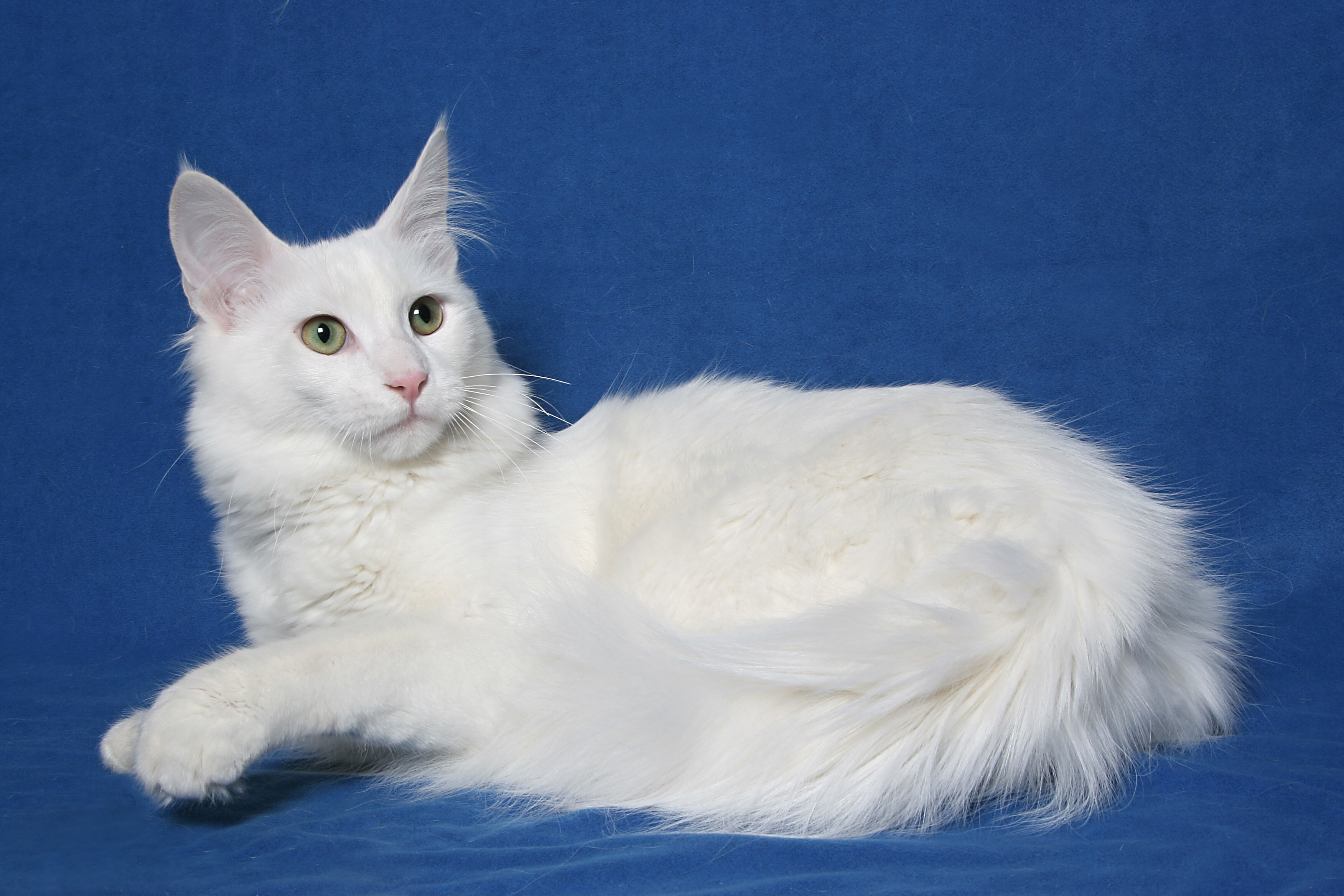
White Turkish Angoras may have blue, amber, green, green-gold, or odd-colored eyes. An odd-eyed cat has one blue eye and one eye of another accepted color. This dramatic combination is strongly associated with the breed, but it is not required.
White fur does not automatically make a cat a Turkish Angora. Many domestic longhaired cats can be white and slender. A documented pedigree is the most dependable way to confirm breed ancestry.
White cats, especially some blue-eyed individuals, have an increased risk of congenital deafness. A veterinary hearing assessment, such as a BAER test, can determine whether a cat hears normally in both ears.
2. Black Turkish Angora
A black Turkish Angora has a rich coal-black coat extending from the roots to the tips. The long, silky fur can make the color look especially glossy when the cat moves through bright natural light.

The nose leather is generally black, while the paw pads may be black or brown. Sun exposure can occasionally give black fur a temporary rusty appearance, but the ideal coat is evenly colored.
Black Turkish Angoras retain the breed’s characteristic fine bones, long legs, upright ears, plumed tail, and energetic personality. They are sometimes overlooked by people who associate the breed only with white cats.
3. Blue Turkish Angora
In cat terminology, “blue” means a cool gray color rather than literal blue. A blue Turkish Angora has an even coat that can range from pale bluish gray to a deeper slate tone. The nose leather and paw pads are normally blue-gray.
The dilute color can highlight the Turkish Angora’s silky coat texture and graceful body. Unlike a blue smoke cat, a solid blue cat should show color extending consistently toward the hair roots.
4. Red Turkish Angora
Red Turkish Angoras have warm orange-to-red coats. The preferred appearance is a rich, clear color with minimal visible shading. Nose leather and paw pads usually have a brick-red tone.
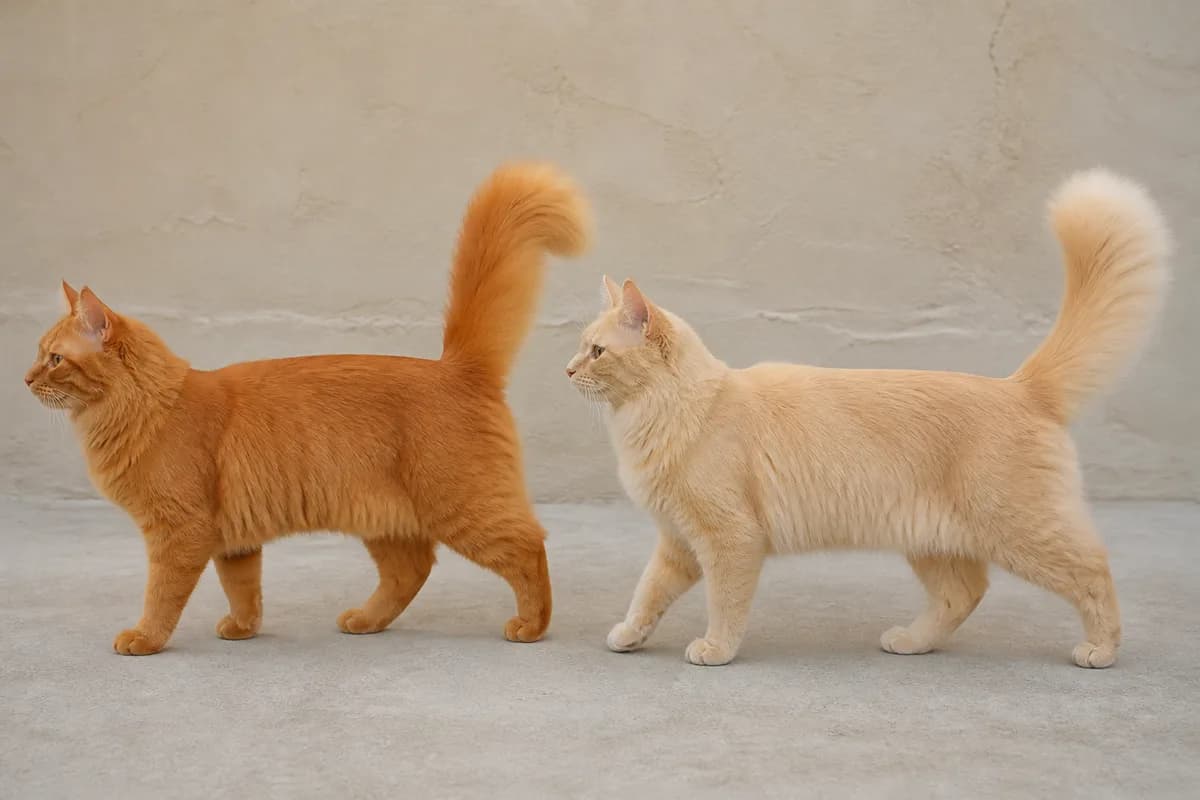
Genetics can make faint tabby markings visible in many red cats, even when they are classified as solid. Looking at the sides, legs, face, and tail under good light can help distinguish a solid red from a clearly patterned red tabby.
5. Cream Turkish Angora
Cream is the dilute form of red. A cream Turkish Angora displays a soft buff or pale peach coat, generally with pink nose leather and paw pads. Lighter, even coloring is especially admired.
Cream coats can show subtle “ghost” tabby markings, particularly in kittens. These markings may become less noticeable as the adult coat develops.
6. Brown Tabby Turkish Angora
A brown tabby Turkish Angora combines a warm brown ground color with dark brown or black markings. The contrast may appear as stripes, swirls, spots, or more delicate ticking.
Common identifying features include an “M” shape on the forehead, facial lines extending from the eyes, rings on the tail, and bars on the legs. The pattern gives this refined breed a more natural, woodland-like appearance.
7. Silver Tabby Turkish Angora
The silver tabby has a pale silver background with strong black markings. Its cool, high-contrast coat often makes the face and large almond-shaped eyes particularly striking.
Silver tabbies should not be confused with shaded silver cats. A tabby has definite pattern markings, while a shaded cat has a softer mantle of color over a pale base.
8. Blue Tabby Turkish Angora
A blue tabby Turkish Angora has deep blue-gray markings over a pale bluish or warm ivory ground. The result is softer than the contrast seen on a silver or brown tabby.
Look for facial markings, leg bars, tail rings, and a visible forehead “M.” Depending on the individual cat, the body pattern may be classic, mackerel, spotted, or ticked.
9. Red Tabby Turkish Angora
The red tabby carries deep red or orange markings over a lighter red ground. Its tabby pattern is generally easier to see than the faint markings that sometimes occur on cats registered as solid red.

Red tabbies often have brick-red nose leather and paw pads. Their pattern may include narrow vertical lines, bold swirls, distinct spots, or ticked body hairs.
10. Cream Tabby Turkish Angora
A cream tabby displays slightly darker cream markings on a pale cream background. The contrast is delicate, so the pattern may be easier to see on the face, legs, and tail than across the body.
This variety combines the airy appearance of a light coat with the additional detail of tabby markings. Pink nose leather and paw pads are common.
11. Blue-Silver Tabby Turkish Angora
The blue-silver tabby has deep blue markings over a pale, cool silver ground. It is a diluted alternative to the black-marked silver tabby and usually has a subtle, frosted appearance.
Blue-silver should show enough contrast to make the tabby pattern recognizable. Rose or blue-toned paw pads may complement the cool coat.
12. Red Silver Tabby Turkish Angora
A red silver tabby has red markings over an off-white or silver-white ground. The pale base creates brighter contrast than the warmer background of a conventional red tabby.
Examine the facial lines, tail rings, leg bars, and body markings when identifying this variety. The red areas should form a true tabby pattern rather than random patches.
13. Cream Silver Tabby Turkish Angora
The cream silver tabby combines gentle cream markings with an off-white ground. Both the color and contrast are subtle, creating a light, softly patterned coat.
Because the markings may be faint, natural daylight can help reveal the pattern without distorting the coat’s true color.
14. Blue-Silver Patched Tabby Turkish Angora
A blue-silver patched tabby has blue tabby markings over a pale silver ground, along with patches or intermingled areas of cream. This pattern is also informally called a dilute torbie.
The combination produces a complex coat with cool silver, blue-gray, and soft cream tones. The patches can be clearly defined or gently blended.
15. Classic Tabby Turkish Angora
Classic tabby describes a pattern rather than a specific color. It features broad, curved markings and bold swirls along the sides. A butterfly-like shape may appear across the shoulders, while the tail and legs display rings or bars.
This pattern can occur in several accepted colors, including brown, silver, blue, red, and cream. The wide markings distinguish it from the narrower lines of the mackerel pattern.
16. Mackerel Tabby Turkish Angora
A mackerel tabby has narrow vertical lines running from the spine toward the belly. The pattern resembles the bones of a fish, which explains its name.
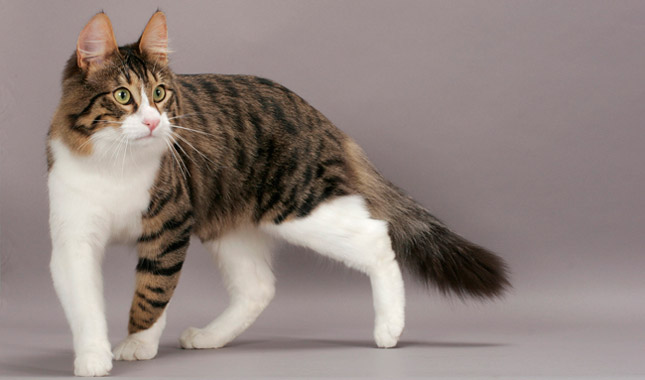
Turkish Angoras with this pattern generally show clear facial lines, neck markings, barred legs, and a ringed tail. The fine stripes complement the breed’s long body and flowing coat.
17. Spotted Tabby Turkish Angora
The spotted tabby has spots distributed across the body rather than continuous vertical stripes or broad swirls. Spots can vary in size and shape, but clearly separated markings are preferred.
The face still shows familiar tabby features, while the legs and tail are typically barred. Some cats may have spots that resemble broken mackerel stripes, so the distinction is not always obvious to an untrained observer.
18. Ticked Tabby Turkish Angora
A ticked tabby appears relatively plain across the torso because individual hairs contain alternating bands of color. More obvious tabby markings remain on the face, neck, legs, and tail.
When viewed from above, a well-defined ticked coat lacks the large body spots or swirls found in other patterns. This creates a refined, lightly textured appearance.
19. Tabby and White Turkish Angora
Tabby-and-white Turkish Angoras combine a recognized tabby color and pattern with areas of white. The amount and placement of white can vary considerably between individual cats.
Brown, silver, blue, blue-silver, red, cream, red silver, and cream silver tabby colors may occur with white. The tabby sections should still display recognizable markings.
20. Tortoiseshell Turkish Angora
A tortoiseshell Turkish Angora has black and red areas distributed across the coat. The colors may form clear patches or blend into a mottled pattern. Several shades of red may be present.
Because the genes responsible for black and red coat expression are linked to the X chromosome, nearly all tortoiseshell cats are female. Rare males can occur, but they frequently have unusual chromosomal genetics and may be infertile.
21. Blue-Cream Turkish Angora
Blue-cream is the dilute version of tortoiseshell. Instead of black and red, the coat combines blue-gray with soft cream. The colors may appear as distinct patches or as gently intermingled areas.
This variety has a quieter, pastel appearance while preserving the complex color distribution of a tortoiseshell coat.
22. Calico Turkish Angora
A calico Turkish Angora has white fur with distinct black and red patches. The amount of each color and the placement of the patches differ from cat to cat.
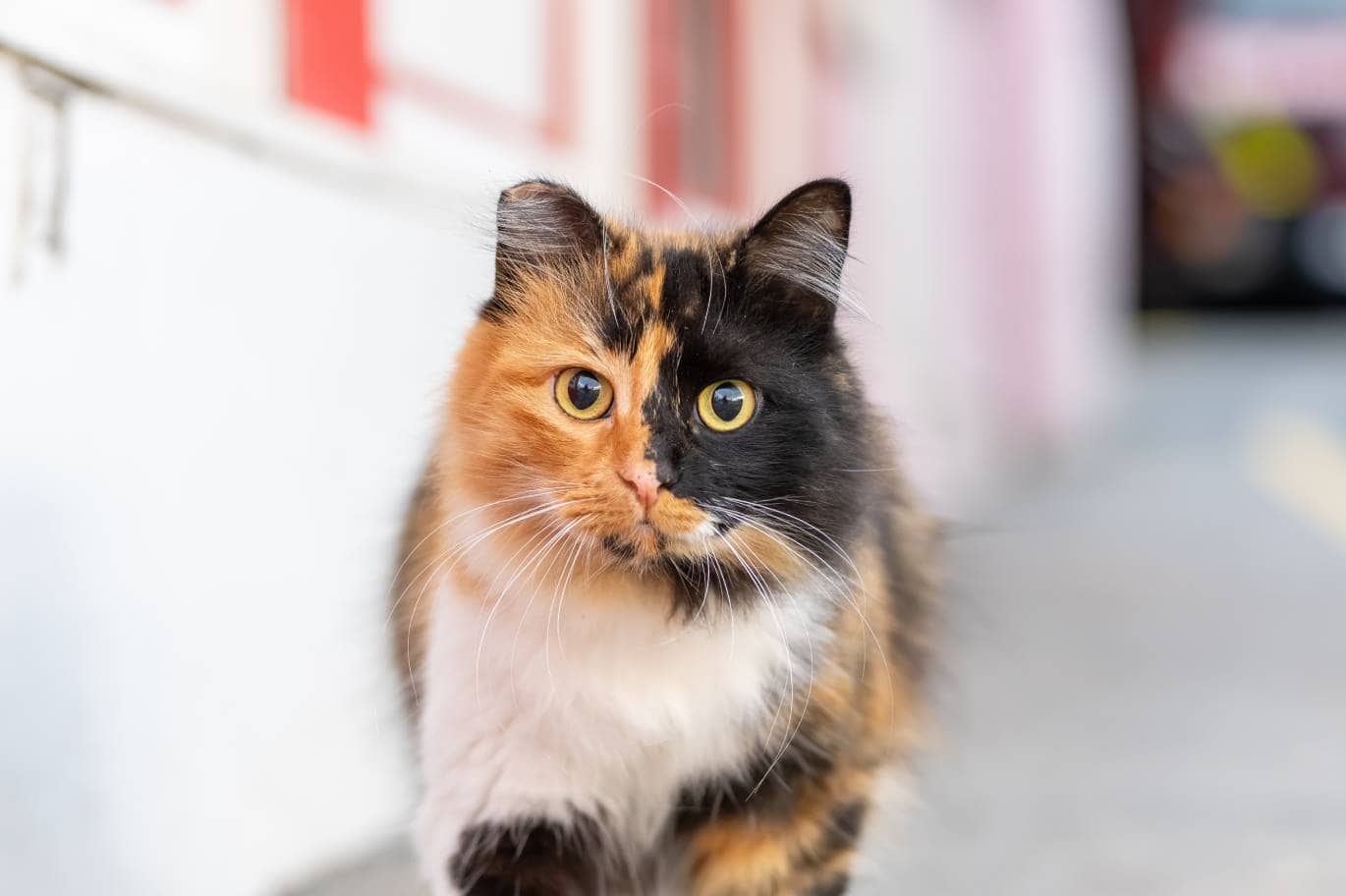
Tabby markings can occur within the red areas. As with tortoiseshell cats, calicos are overwhelmingly female because of the way red and black coat colors are inherited.
23. Dilute Calico Turkish Angora
The dilute calico replaces the black and red of a standard calico with blue-gray and cream. Both colors appear as patches against a white background.
This combination produces a softer pastel coat. A dilute calico is different from a blue-cream cat because a calico has a clearly significant white component.
24. Tortoiseshell and White Turkish Angora
This variety combines black and red tortoiseshell coloring with white. The black and red may be patched or intermingled, while the white sections create stronger separation and contrast.
Tortoiseshell-and-white coats can resemble calico coats. The distinction often depends on whether the black and red areas are mottled together or occur as more clearly separated patches.
25. Blue-Cream and White Turkish Angora
A blue-cream-and-white Turkish Angora has blue-gray and cream patches or blended areas combined with white. It is the dilute counterpart of tortoiseshell and white.
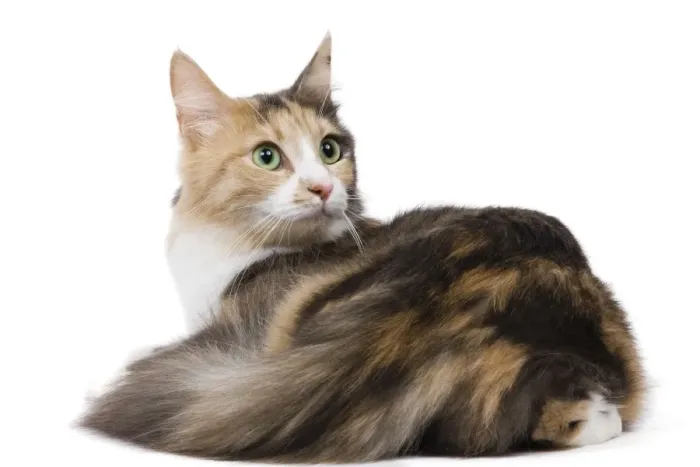
The precise arrangement of color is unique to each cat. Some individuals have large white areas, while others display white only on the chest, paws, belly, or face.
26. Black Smoke Turkish Angora
A black smoke Turkish Angora can look solid black while resting. When the cat moves or the coat is parted, a pale or white base becomes visible beneath the black-tipped hairs.
This hidden contrast can create a dramatic shimmering effect. Smoke coloration should not be confused with a black coat that has become lighter from sun exposure.
27. Blue Smoke Turkish Angora
The blue smoke variety has a pale base coat with blue-gray tipping. It may appear solid blue from a distance, but movement exposes the lighter roots.
Checking the hair near the skin is one of the easiest ways to distinguish a blue smoke from a solid blue Turkish Angora.
28. Red Smoke Turkish Angora
A red smoke Turkish Angora has a pale base beneath deeply red-tipped hairs. The light undercoat becomes most visible when the coat moves or is gently separated.
Young smoke cats can temporarily display tabby-like markings. Coat color and contrast may become clearer as the adult fur develops.
29. Cream Smoke Turkish Angora
Cream smoke combines a pale base with cream-colored tipping. Because both layers are light, the contrast is more understated than it is in a black smoke.
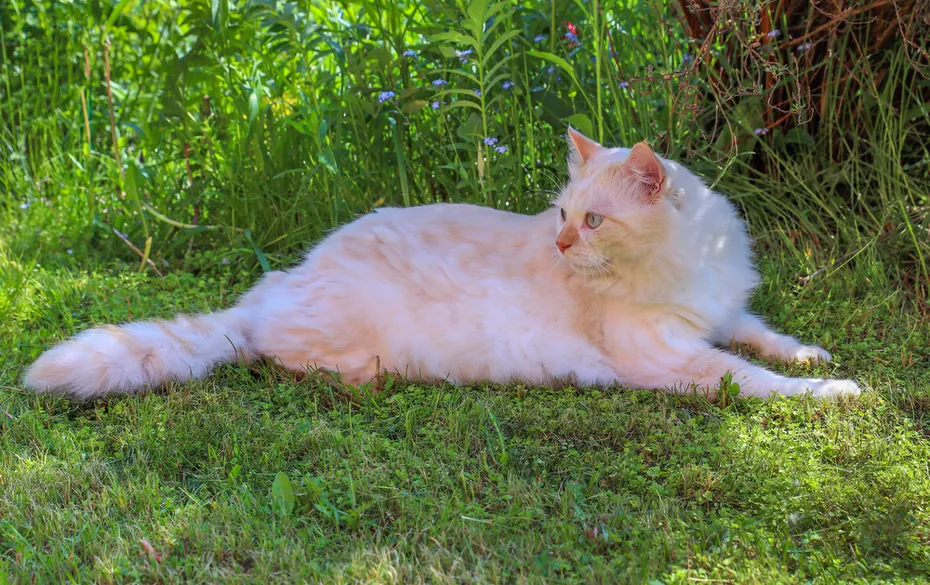
The smoke effect is often most visible along the ruff, sides, tail, and other areas where the long coat separates during movement.
30. Tortoiseshell Smoke Turkish Angora
A tortoiseshell smoke has a pale undercoat beneath black, red, and mixed red-toned tipping. At rest, it may resemble an ordinary tortoiseshell, while movement reveals the light roots.
This variety combines two visually complex traits: tortoiseshell color distribution and the contrasting base of a smoke coat.
31. Blue-Cream Smoke Turkish Angora
The blue-cream smoke has a pale base coat beneath blue and cream tipping. The combination produces a pastel tortoiseshell appearance with additional contrast near the roots.
Blue, rose, or patched nose leather and paw-pad colors may accompany this coat.
32. Shaded Silver Turkish Angora
A shaded silver Turkish Angora has a white base coat with black shading across the back, sides, face, and tail. The chin, chest, belly, and underside of the tail are generally lighter.

Unlike a smoke coat, which has deeper tipping, shaded silver creates a softer mantle of surface color. Dark outlining around the eyes, lips, and nose can make the facial expression especially distinctive.
33. Blue Shaded Silver Turkish Angora
Blue shaded silver features a white base with blue-gray shading. The color is usually stronger across the upper body and fades toward the chest, belly, and underside.
This delicate variety has less contrast than a standard shaded silver but retains the same gradual distribution of color.
34. Red Shaded Turkish Angora
A red shaded Turkish Angora has a white base coat covered by a mantle of red shading. The color becomes lighter along the chin, chest, belly, and underside of the tail.
The pattern should appear gradually shaded rather than distinctly striped. Visible tabby markings may occur in young cats and can become less noticeable with maturity.
35. Cream Shaded Turkish Angora
The cream shaded variety combines a white base with soft cream shading. The face and legs may carry slightly stronger color than the paler lower body.
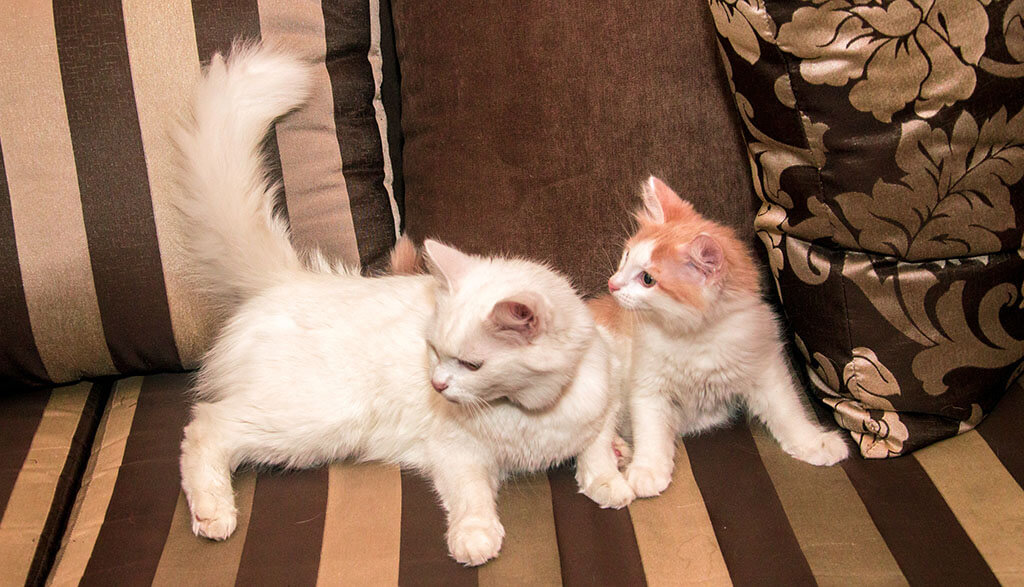
Its low-contrast coat can look almost white in certain lighting, so examining the back and tail in daylight helps reveal the cream mantle.
How Are the Types of Turkish Angora Cats Classified?
Turkish Angoras are first classified as members of one pedigree breed. Within that breed, registries organize cats according to coat color and pattern. A cat may therefore be described using several layers of information:
- Base color: White, black, blue, red, or cream.
- Pattern: Solid, classic tabby, mackerel tabby, spotted tabby, ticked tabby, smoke, or shaded.
- Color combination: Tortoiseshell, blue-cream, calico, or dilute calico.
- White spotting: A recognized color or pattern combined with white.
- Eye color: Blue, green, green-gold, amber, or odd-eyed.
Different cat registries may organize or name colors somewhat differently. Registration and show eligibility should therefore be checked against the current rules of the relevant organization.
Are Eye Colors Separate Types of Turkish Angora?
Eye colors are better described as variations within the breed rather than separate types. Turkish Angoras may have blue, green, green-gold, amber, or odd-colored eyes. Coat color does not reliably determine eye color.
Odd-eyed Turkish Angoras have one blue eye and one green, green-gold, or amber eye. While this look is highly recognizable, an odd-eyed cat is not a separate breed or a guarantee of Turkish Angora ancestry.
Where Did Turkish Angora Cats Originate?
The Turkish Angora is historically associated with Turkey, particularly the region around Ankara, formerly known as Angora. Longhaired cats from the area became known in Europe centuries ago. When extensive crossing with other longhaired cats threatened the breed’s distinct identity, preservation programs in Turkey helped protect it.
The breed later gained recognition outside Turkey. White cats were initially the main focus, but modern Turkish Angoras are now seen in a broad range of accepted colors and patterns.
How to Identify a Turkish Angora Cat
- Body: Long, balanced, finely boned, and muscular rather than heavy or bulky.
- Head: A smooth, medium-long wedge that remains proportional to the body.
- Ears: Large, upright, pointed, and set high on the head.
- Eyes: Large, expressive, and almond-shaped with a slight upward slant.
- Legs: Long and elegant, with the hind legs generally longer than the front legs.
- Paws: Small and rounded, sometimes with noticeable toe tufts.
- Tail: Long, tapered, and covered with a full plume of silky hair.
- Coat: Fine, silky, and single-layered, without the dense woolly undercoat seen in some other longhaired breeds.
- Movement: Graceful, light, athletic, and well balanced.
- Behavior: Curious, active, intelligent, people-oriented, and often interested in high places.
Physical resemblance cannot prove pedigree. If breed authenticity matters, request registration records and a documented family history from a responsible breeder.
Turkish Angora vs. Turkish Van
| Feature | Turkish Angora | Turkish Van |
|---|---|---|
| Typical build | Fine-boned, long, and elegant | Larger, broader, and more substantial |
| Coat | Fine, silky, and flowing | Fuller, water-resistant semi-long coat |
| Traditional appearance | Many colors and patterns | Color mainly on the head and tail |
| Historical association | Ankara and the broader Turkish Angora tradition | Eastern Turkey and the Lake Van region |
| Tail | Long, tapered plume | Full, brush-like, often colored tail |
These are two distinct breeds. A Turkish Angora with white fur and colored areas does not automatically become a Turkish Van.
Care Tips for Turkish Angora Cats
Provide Daily Activity
Turkish Angoras are athletic cats that often enjoy climbing, chasing toys, and exploring elevated spaces. A tall, stable cat tree and daily interactive play can help satisfy these natural behaviors.
Offer Mental Enrichment
Puzzle feeders, short training sessions, rotating toys, and safe observation spots near windows can keep an intelligent Turkish Angora engaged. Bored cats may create their own activities, which are not always convenient for their owners.
Comb the Coat Regularly
The breed’s single coat is less prone to heavy matting than many dense longhaired coats. Nevertheless, gentle combing once or twice a week helps remove loose hair and detect small tangles. Older cats and cats with especially full seasonal coats may need more frequent grooming.
Feed a Complete Feline Diet
Choose food that is complete and balanced for the cat’s life stage. Portion size should reflect age, body condition, activity level, and veterinary advice. Fresh water should always be available.
Protect the Cat Outdoors
A secure indoor environment, enclosed cat patio, or supervised harness walk is safer than unrestricted roaming. It lowers the risks posed by traffic, predators, poisons, parasites, disease, and theft.
Health and Responsible Ownership Notes
Color should never be valued above health, temperament, or responsible breeding. Anyone considering a kitten should look for a breeder who prioritizes veterinary care, suitable socialization, transparent records, and the long-term welfare of every cat.
- Ask for health information about the kitten and its parents.
- Request a hearing test for an at-risk white kitten, particularly one with blue eyes.
- Arrange routine veterinary examinations and vaccinations.
- Discuss parasite prevention with a veterinarian.
- Maintain good dental care and monitor body condition.
- Keep toxic plants, chemicals, strings, and unsafe small objects out of reach.
- Avoid breeders who guarantee health based only on appearance or coat color.
- Consider breed-specific rescue organizations and carefully verified adoption options.
Fun Facts About Turkish Angora Cats
- The Turkish Angora is one breed with many coat variations, not several separate breeds.
- White is famous, but it is not the breed’s only accepted color.
- The breed has a single, silky coat rather than a thick woolly undercoat.
- Turkish Angoras are known for their long, plumed tails.
- Many enjoy climbing and resting in high places.
- Their eyes may be blue, green, green-gold, amber, or odd-colored.
- An odd-eyed cat has two differently colored eyes.
- Some Turkish Angoras show a surprising interest in running water.
- Female Turkish Angoras are usually smaller than males.
- A white longhaired cat is not automatically a Turkish Angora.
Final Thoughts on Types of Turkish Angora Cats
The many types of Turkish Angora cats are best understood as coat and eye-color variations within one elegant, historic breed. White may be the iconic color, but black, blue, red, cream, tabby, tortoiseshell, calico, smoke, shaded, and white-combination coats reveal the breed’s impressive diversity.
When identifying or choosing a Turkish Angora, look beyond color. A verified pedigree, graceful structure, silky single coat, active temperament, responsible breeding history, and good health are much more meaningful than any one visual feature.
Frequently Asked Questions
1. How many types of Turkish Angora cats are there?
There is only one Turkish Angora breed. However, the breed appears in numerous recognized colors and patterns. The exact number of listed varieties depends on how a cat registry groups color, tabby pattern, smoke, shaded, and white combinations.
2. Are all Turkish Angora cats white?
No. White is the best-known color, but Turkish Angoras can also be black, blue, red, cream, tabby, tortoiseshell, calico, smoke, shaded, or colored and white.
3. What is the rarest Turkish Angora color?
Reliable worldwide population data for every color are not publicly standardized, so naming one definitive rarest color would be misleading. Availability varies by country, breeder, bloodline, and registry.
4. What is the most popular Turkish Angora color?
Solid white is the color most strongly associated with the breed. White cats, particularly odd-eyed examples, have played an important role in the Turkish Angora’s public image.
5. Can Turkish Angora cats be black?
Yes. Black is a recognized Turkish Angora color. A black Turkish Angora should have rich coloring and the same elegant structure and silky coat expected throughout the breed.
6. Can Turkish Angoras have tabby coats?
Yes. Turkish Angoras may have classic, mackerel, spotted, or ticked tabby patterns in several colors.
7. Can a Turkish Angora be calico?
Yes. Both standard calico and dilute calico coats can occur. A standard calico combines black, red, and white, while a dilute calico combines blue, cream, and white.
8. Are Turkish Angoras ever tortoiseshell?
Yes. Tortoiseshell Turkish Angoras have black and red areas that may form patches or an intermingled pattern. Blue-cream is the dilute form.
9. What is a smoke Turkish Angora?
A smoke Turkish Angora has pale hair near the roots and much stronger color toward the tips. The pale base becomes particularly noticeable when the coat moves or is parted.
10. What is a shaded Turkish Angora?
A shaded Turkish Angora has a pale base coat with a gentle mantle of color across the upper body. The effect is softer and less deeply tipped than a smoke coat.
11. What eye colors can Turkish Angoras have?
Eye colors can include blue, green, green-gold, amber, and odd-eyed combinations. The exact shades can vary as a cat matures.
12. What does odd-eyed mean?
Odd-eyed means the cat has two differently colored eyes. A Turkish Angora might have one blue eye and one green, green-gold, or amber eye.
13. Are odd-eyed Turkish Angoras a separate type?
No. Odd eyes are an eye-color variation within the Turkish Angora breed, not a separate breed or biological type.
14. Are white Turkish Angoras deaf?
Not all white Turkish Angoras are deaf. However, congenital deafness is more common in some white cats, especially those with blue eyes. A BAER hearing test can provide a reliable assessment.
15. Can an odd-eyed Turkish Angora hear normally?
Yes. An odd-eyed cat may hear normally in both ears, have hearing loss in one ear, or be deaf in both. Eye appearance alone cannot determine hearing ability.
16. How can I tell if my cat is a real Turkish Angora?
Look for a documented pedigree from a recognized registry. Body shape, coat texture, tail, ears, eyes, and behavior can suggest the breed, but appearance alone cannot establish ancestry.
17. Is every white longhaired cat a Turkish Angora?
No. White longhaired coats occur in mixed-breed domestic cats and several pedigree breeds. Color and hair length are not proof of Turkish Angora ancestry.
18. Are Turkish Angoras related to Turkish Vans?
Both breeds are associated with Turkey, but they are recognized as distinct breeds. They differ in build, coat characteristics, typical markings, and breed history.
19. Is a Turkish Angora the same as an Angora cat?
“Angora” has historically been used loosely for longhaired animals or cats. Turkish Angora refers to the specific recognized pedigree breed.
20. Do Turkish Angoras have an undercoat?
The breed is known for a fine single coat without the dense, woolly undercoat found in some longhaired breeds. This contributes to its light, silky texture.
21. Do Turkish Angora cats shed?
Yes. Their fine coats shed, and seasonal changes may increase loose hair. Regular combing helps manage shedding and keeps the coat in good condition.
22. Do Turkish Angoras need daily grooming?
Many healthy adults do well with combing once or twice a week. More frequent grooming may be useful during seasonal shedding or for older cats that groom themselves less effectively.
23. Should a Turkish Angora be shaved in summer?
Routine shaving is generally unnecessary. The coat offers protection from sunlight and environmental changes. Discuss severe matting or medical grooming needs with a veterinarian or qualified feline groomer.
24. Are Turkish Angora cats hypoallergenic?
No cat breed is completely hypoallergenic. Allergic reactions are usually triggered by proteins in saliva, skin secretions, and dander rather than by hair length alone.
25. How large do Turkish Angoras become?
They are generally small to medium-sized cats with long, finely boned bodies. Individual size varies, and males are commonly larger than females.
26. Are Turkish Angoras friendly?
Many are affectionate, interactive, and strongly interested in household activities. Personality varies by individual, socialization, health, and living environment.
27. Are Turkish Angoras good family cats?
They can be excellent family companions when treated respectfully and given enough activity. Introductions to children and other pets should be gradual and supervised.
28. Do Turkish Angoras like water?
Some show unusual curiosity about taps, sinks, or moving water, but this is not universal. A cat should never be forced into water simply because the breed has this reputation.
29. Are Turkish Angoras active cats?
Yes. They are typically athletic, playful, and interested in climbing. Daily interactive play and access to safe vertical spaces are beneficial.
30. Are Turkish Angoras intelligent?
They are often described as curious and quick to learn. Puzzle toys, reward-based training, and environmental enrichment can provide useful mental stimulation.
31. Can Turkish Angoras live indoors?
Yes. A well-enriched indoor home can meet their needs while protecting them from traffic, disease, predators, poisons, and other outdoor dangers.
32. What should a Turkish Angora eat?
It should eat a complete and balanced cat food appropriate for its age and health. A veterinarian can recommend portions and dietary adjustments for an individual cat.
33. How long do Turkish Angoras live?
Lifespan varies with genetics, veterinary care, nutrition, safety, and lifestyle. Responsible breeding and preventive care can support a long, healthy life, but no precise lifespan is guaranteed.
34. Are Turkish Angora cats rare?
They are less common than many widely available domestic and pedigree cats. Availability can be limited, especially when buyers want a specific coat or eye-color combination.
35. Where can I find a Turkish Angora?
Search recognized cat-registry breeder directories and breed-specific rescue organizations. Verify documentation, health practices, living conditions, and breeder reputation before making a commitment.
36. What colors are not typical of recognized Turkish Angoras?
Some registries exclude colors or patterns that suggest outcrossing, such as chocolate, lilac, and pointed patterns. Rules vary, so check the current breed standard of the relevant registry.
37. Can Turkish Angoras have colorpoint markings?
Colorpoint markings are generally not accepted in major Turkish Angora breed standards because they may indicate ancestry outside the recognized breeding population.
38. Does coat color affect a Turkish Angora’s personality?
There is no dependable evidence that a Turkish Angora’s coat color determines personality. Genetics, early socialization, health, experience, and environment are much more relevant.
39. Do different Turkish Angora colors require different grooming?
The basic grooming routine is similar across colors. White coats may show stains more easily, while dark coats may make loose pale hair more noticeable, but coat texture and health matter more than color.
40. Which type of Turkish Angora is best?
No coat color is inherently best. The ideal companion is a healthy, well-socialized cat whose energy level and temperament suit the household.