

People searching for types of Russian Blue cats often expect several distinct varieties. In major registries, however, the Russian Blue is one pedigree breed with a short, dense blue-gray coat, silver tipping, and vivid green eyes. The “types” commonly discussed are regional breeding styles, registry-dependent Russian colors, and cats that merely resemble the breed. This guide explains those differences without turning every gray cat into a Russian Blue.
What Are the Main Types of Russian Blue Cats?
There is only one standard Russian Blue in organizations such as CFA and TICA: a shorthaired blue cat with silver tipping. Informally, breeders may describe American, European, Scandinavian, or British lines because their proportions and expression can differ slightly. Some registries also recognize Russian Black and Russian White under the broader Russian breed name, but they are not accepted as Russian Blues everywhere.
Russian Blue Types at a Glance
| Common label | What it means | Official everywhere? | Typical clue |
|---|---|---|---|
| Standard Russian Blue | The recognized blue, shorthaired breed | Yes, as a breed | Even blue coat with silver sheen |
| American line | An informal regional breeding style | No separate variety | Often lighter color and open expression |
| European or Scandinavian line | An informal ancestry or show-style label | No separate variety | May appear darker or more angular |
| British line | A regional style shaped by local programs | No separate variety | May look somewhat more substantial |
| Russian Black | A black cat in the broader Russian group | Registry-dependent | Solid black coat |
| Russian White | A white cat in the broader Russian group | Registry-dependent | Solid white coat |
| Nebelung | A separate longhaired breed related in appearance | No | Long blue coat |
1. Standard Russian Blue
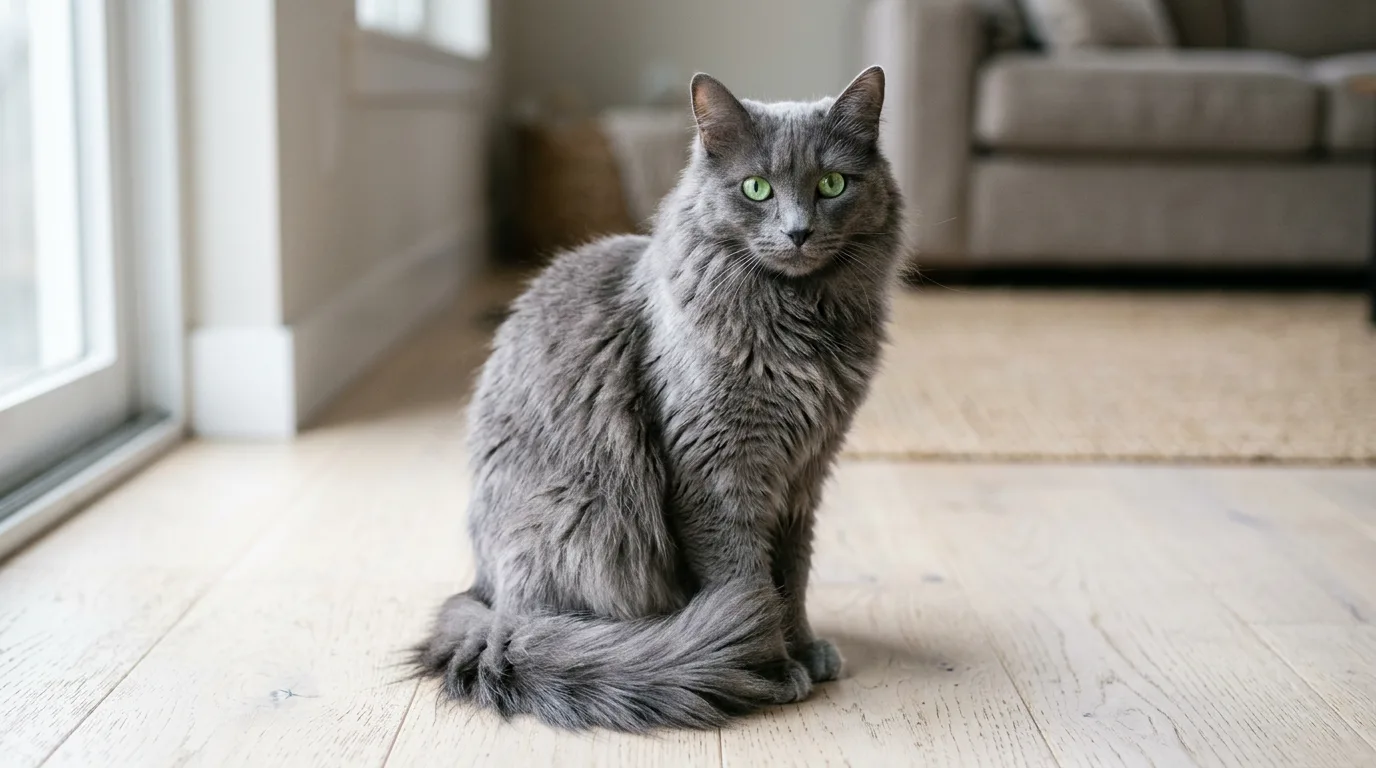
The standard Russian Blue is elegant, fine-boned, and muscular rather than bulky. Its coat is short but unusually dense because the undercoat and guard hairs are similar in length. Each blue-gray hair has pale silver tipping, creating the famous shimmering surface. Adult eye color should be green; kittens may begin with yellowish eyes that change as they mature.
A genuine pedigree cat should also show a wedge-shaped head, large ears, a straight nose, and a gentle expression. Coat shade varies naturally, but obvious patches, tabby striping in an adult, or a long coat are not standard features. Temperament cannot prove breed identity, although many Russian Blues are observant, affectionate with familiar people, and reserved during change.
2. American-Line Russian Blue
“American type” is breeder shorthand, not a second breed. Cats developed for American show standards are often described as graceful, light silver-blue, and open in expression, with large ears and bright green eyes. Individual cats vary, and a pedigree is more meaningful than a regional label.
3. European and Scandinavian-Line Russian Blue
European and Scandinavian lines may be described as slightly darker, more angular, or stronger in profile. Those descriptions reflect tendencies within breeding programs rather than fixed biological categories. Modern pedigrees frequently mix lines, so a cat may not fit a single regional look.

4. British-Line Russian Blue
British breeding history helped preserve and rebuild the breed, sometimes using other blue cats during difficult periods. Today, “British line” normally refers to ancestry or preferred style, not a recognized subtype. It should not be confused with the British Shorthair, which has a rounder head, stockier body, and plush but differently structured coat.
5. Russian Black
Russian Black cats have a solid black coat while retaining the graceful Russian body type. The GCCF and some other organizations recognize black within the Russian breed group, while CFA and TICA recognize only blue as the Russian Blue. Therefore, “black Russian Blue” is misleading under many standards; Russian Black is the clearer name where recognized.

6. Russian White
Russian White cats share the broader Russian type but have a pure white coat. Recognition depends on the registry and country. White cats also deserve responsible hearing evaluation because congenital deafness can occur in white cats of many breeds, especially those with blue eyes.
7. Nebelung: The Longhaired Look-Alike
The Nebelung resembles a longhaired Russian Blue, with a blue coat, silver tipping, and green eyes. It is nevertheless a separate breed, not a longhaired variety accepted within the Russian Blue standard. A longhaired blue kitten advertised as a Russian Blue should be verified through registration records rather than appearance alone.
How Are Russian Blue Cats Classified?
Cat registries classify pedigreed cats by ancestry and conformity to a written standard. For Russian Blues, coat color alone is insufficient. Registration, parentage, head shape, body structure, coat texture, eye color, and temperament all contribute to identification. Regional “lines” describe breeding history; they are not official taxonomic ranks.
How to Identify a Russian Blue
- Coat: short, dense, even blue-gray, with visible silver tipping.
- Eyes: vivid green in mature cats.
- Head: smooth wedge with large, upright ears.
- Body: long, graceful, and muscular without heaviness.
- Paws: small and rounded to slightly oval, depending on the standard.
- Proof: pedigree registration is the reliable way to confirm breed identity.
Russian Blue or Gray Domestic Shorthair?
Many mixed-breed cats carry the common blue dilution gene and can look remarkably similar. A gray domestic shorthair may have yellow or copper eyes, a woollier or flatter coat, a round head, faint tabby markings, or white patches. None of these makes the cat less appealing, but visual similarity does not establish Russian Blue ancestry.
Care Tips for Russian Blue Cats
- Comb the dense coat weekly and more often during seasonal shedding.
- Provide climbing furniture, puzzle feeders, and daily interactive play.
- Measure meals and monitor body condition because some individuals enjoy food enthusiastically.
- Keep litter boxes clean; many cats of this breed prefer a predictable environment.
- Arrange routine veterinary examinations, dental care, vaccination, and parasite prevention.
Responsible Breeding and Adoption
Choose breeders who provide registration records, explain health testing, allow you to meet the cats or view their environment, and never guarantee personality from color alone. Avoid sellers marketing rare longhaired, pointed, or unusual-color “Russian Blues” without registry documentation. Adoption is also an excellent option, but shelter labels based on appearance should be treated as descriptions rather than proof of pedigree.
Fun Facts About Russian Blue Cats
- The breed was historically associated with Russia’s northern port of Arkhangelsk.
- Its silver tipping reflects light and creates a luminous finish.
- The double coat can feel plush despite being short.
- Blue is the feline term for diluted black pigment.
- Adult green eyes are a hallmark of the standard.
- Kittens can show temporary ghost tabby markings.
- Regional styles are not separate breeds.
- Russian White and Black recognition varies by registry.
- The Nebelung is a separate longhaired breed.
- A pedigree, not coat color, confirms identity.
Final Thoughts on Types of Russian Blue Cats
The most accurate answer is that the Russian Blue is one breed, not a collection of many official types. Standard blue cats may reflect different regional lines, while Russian Black and Russian White belong to a broader Russian group only in certain registries. Understanding that distinction helps owners evaluate breeders, recognize look-alikes, and appreciate the breed without relying on misleading labels.
Frequently Asked Questions
1. How many types of Russian Blue cats are there?
Major registries recognize one Russian Blue breed rather than several official subtypes.
2. Are American and European Russian Blues different breeds?
No. These terms describe regional bloodlines or style tendencies.
3. Can a Russian Blue be black?
Some registries recognize Russian Black, but it is not called or accepted as a Russian Blue everywhere.
4. Can a Russian Blue be white?
Russian White exists in registry systems that recognize multiple Russian colors; CFA and TICA Russian Blues remain blue only.
5. Are Russian Blues always gray?
They are blue, the cat-fancy term for a diluted gray-black color, with silver tipping.
6. Do all Russian Blues have green eyes?
Mature pedigree Russian Blues should have green eyes, although kittens’ eye color develops gradually.
7. Can Russian Blue kittens have stripes?
Faint ghost markings may appear in kittens and usually fade; strong adult markings are not standard.
8. Is the Nebelung a longhaired Russian Blue?
It is a separate breed with a similar blue-and-silver appearance.
9. Are Russian Blues hypoallergenic?
No cat is truly hypoallergenic. Individual reactions vary, so allergy sufferers should spend time with the cat before adoption.
10. How can I prove my cat is a Russian Blue?
Reliable proof comes from pedigree and registration records, not appearance or a DNA breed estimate alone.
11. What is the difference from a British Shorthair?
The British Shorthair is rounder and stockier, while the Russian Blue is more angular and graceful.
12. What is the difference from a Chartreux?
Chartreux cats are robust and generally have copper-to-gold eyes rather than vivid green eyes.
13. Do Russian Blues shed?
Yes. Their dense double coat sheds, particularly during seasonal changes.
14. How often should they be groomed?
A gentle weekly combing is usually adequate, with extra sessions during shedding.
15. Are Russian Blues friendly?
Many bond closely with family but may be cautious around unfamiliar people.
16. Are they good indoor cats?
Yes, provided they receive exercise, climbing options, play, and mental enrichment.
17. Are male and female Russian Blues different types?
No. Sex can influence size, but it does not create a separate type.
18. Are light and dark Russian Blues separate types?
No. Shade varies, although show standards favor an even blue color with a clear silver sheen.
19. Can Russian Blues have white patches?
Visible white patches are not part of the standard Russian Blue appearance.
20. Why does my gray cat look like one?
The blue dilution color is common in mixed-breed cats, so similar coloring can occur without pedigree ancestry.
21. Are Russian Blues large?
They are usually medium-sized and can look lighter than they feel because of their fine-boned outline.
22. What coat texture should they have?
The coat should be short, dense, plush, and stand slightly away from the body.
23. Do they need baths?
Most healthy indoor cats rarely need bathing; routine combing is normally enough.
24. Are Russian Blues vocal?
Individuals vary, but many communicate quietly and rely heavily on body language.
25. Can they live with children?
Many can, when children handle them gently and the cat has quiet retreat spaces.
26. Can they live with dogs?
Careful introductions and a cat-friendly dog matter more than breed label.
27. What should I ask a breeder?
Ask about registration, health screening, socialization, veterinary care, and return policies.
28. Are unusual-colored kittens rare Russian Blues?
Not necessarily. Unusual color is often evidence of another breed or mixed ancestry.
29. How long do Russian Blues live?
Many live into their teens with good care, although lifespan varies by individual health and environment.
30. What is the best Russian Blue type for a home?
Choose a healthy, well-socialized individual whose temperament suits your household rather than selecting by regional label.