

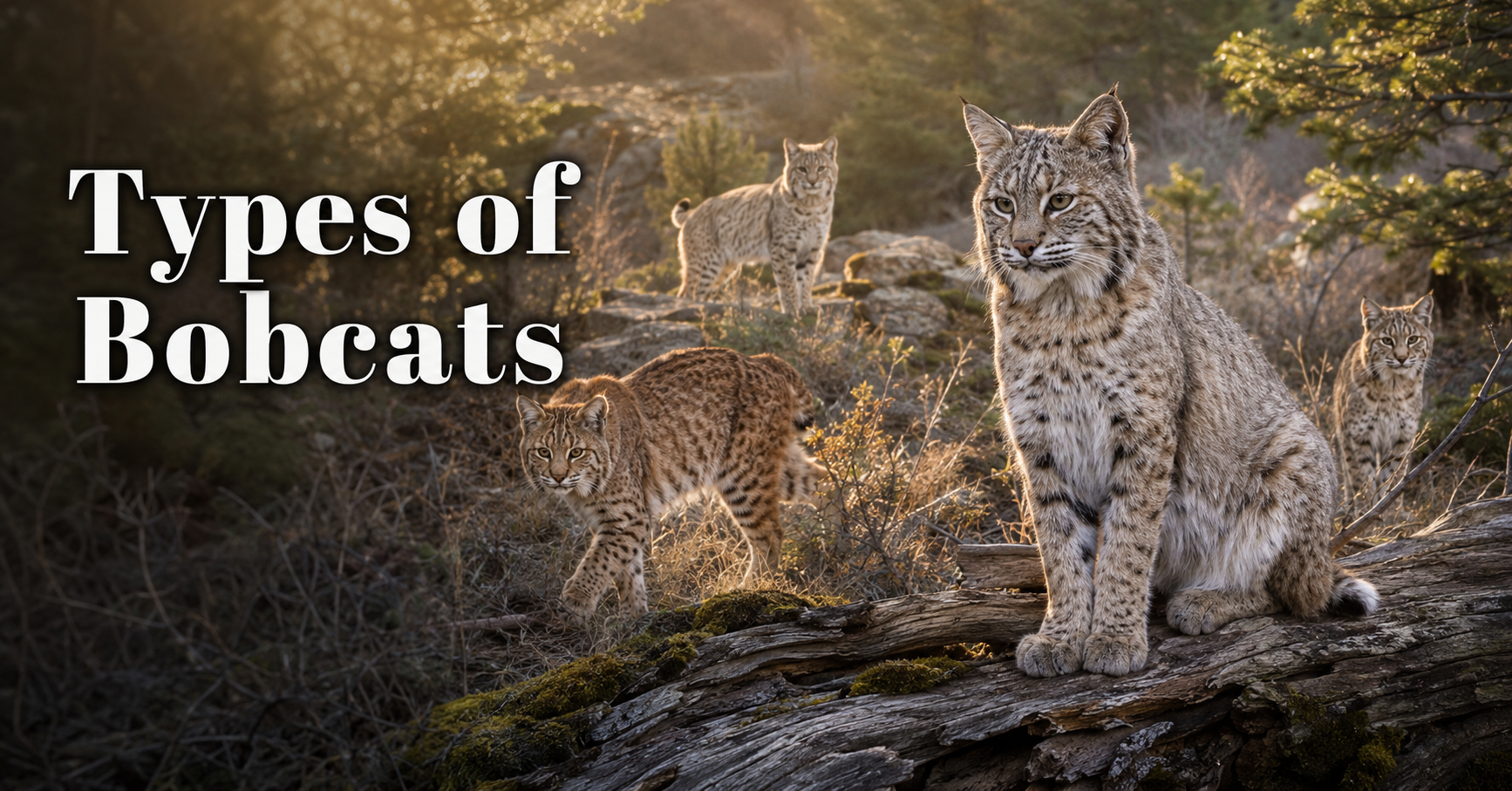
There are two currently recognized types of bobcats: the eastern bobcat and the western bobcat. Both are subspecies of the same North American wild cat, Lynx rufus, and they share the familiar short tail, spotted coat, facial ruff, and pointed ears that define a bobcat.
Older wildlife guides may list 11, 12, or 13 bobcat subspecies based mainly on regional differences in coat color, body size, and skull measurements. Modern taxonomic work has simplified that classification because many of those differences overlap. This guide explains the two recognized subspecies, their ranges, habitats, behavior, identification features, and the reason conflicting lists still appear online.
What Are the Main Types of Bobcats?
The two recognized bobcat subspecies are the eastern bobcat, Lynx rufus rufus, and the western bobcat, Lynx rufus fasciatus. They are generally separated geographically by the Great Plains. Their physical differences are subtle, so location is usually more useful than coat color when identifying a subspecies.
| Type | Scientific Name | General Range | Typical Habitats |
|---|---|---|---|
| Eastern bobcat | Lynx rufus rufus | Eastern North America, generally east of the Great Plains | Forests, swamps, brushlands, mountains, and agricultural edges |
| Western bobcat | Lynx rufus fasciatus | Western North America, generally west of the Great Plains | Chaparral, deserts, rocky canyons, forests, and mountain slopes |
The boundary between the two subspecies is not a sharp line that can be seen in the landscape. Bobcat populations may meet and exchange genes across broad transition zones, and populations in parts of Mexico require further taxonomic study.
1. Eastern Bobcat
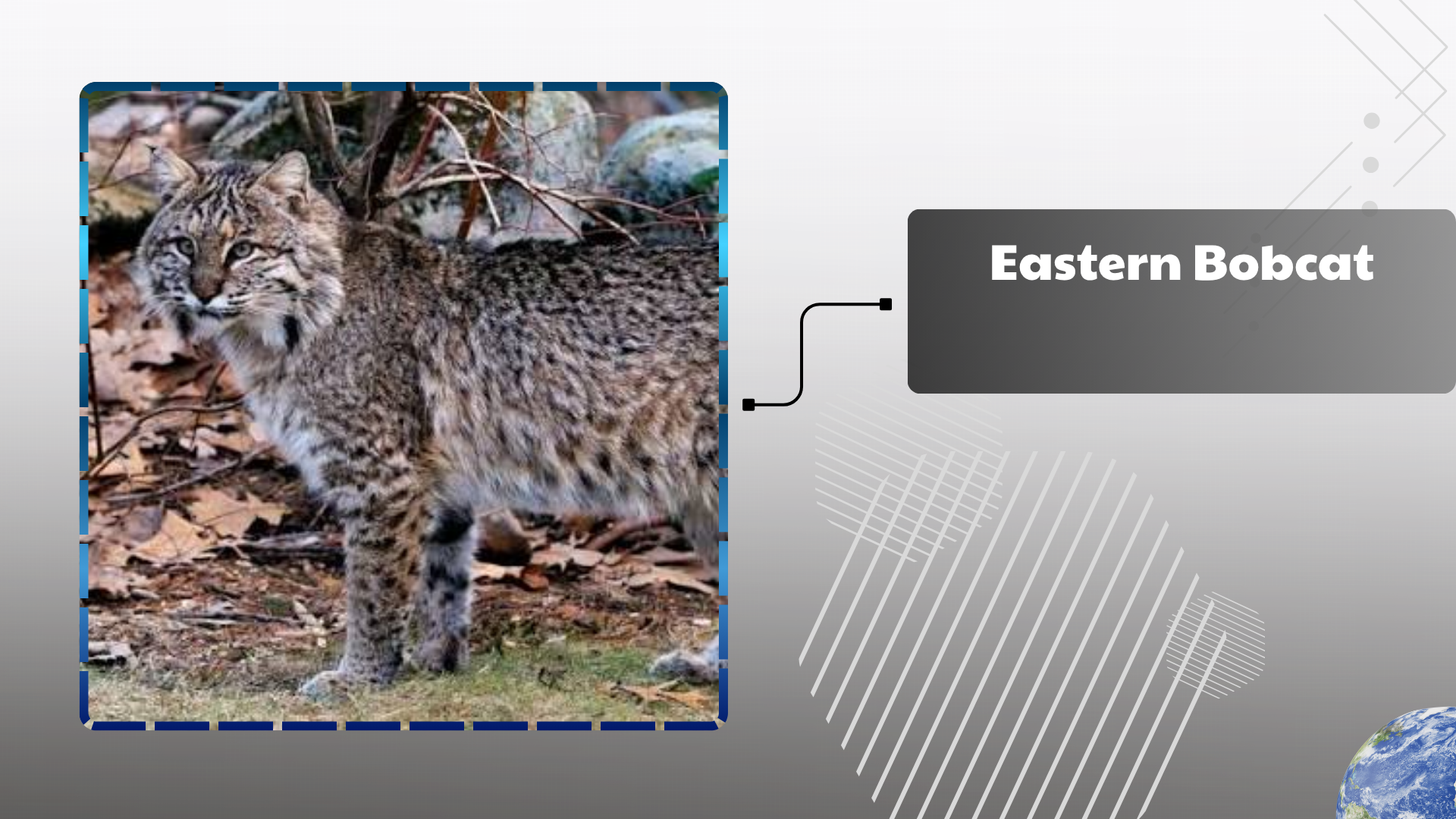
The eastern bobcat, Lynx rufus rufus, occupies much of North America east of the Great Plains. Its range includes large areas of the eastern and central United States and extends northward into southern Canada. Depending on the region, it may live in hardwood forests, conifer stands, wooded mountains, coastal wetlands, swamps, regenerating timberland, or brushy farmland.
An eastern bobcat normally has a muscular body, long legs, a broad face, pointed ears, and a short tail. The coat may be gray, buff, yellowish brown, reddish brown, or a mixture of these colors. Black or dark-brown spots can appear across the body, while the legs frequently carry stronger bars. Its pale underside is often marked with dark spots.
Eastern bobcats living in northern environments may develop thick gray-brown winter coats. Animals in warmer southeastern areas can look shorter-haired and more reddish. These are general environmental tendencies rather than dependable subspecies tests. Individual variation, age, season, lighting, and local habitat can dramatically affect a bobcat’s appearance.
Rabbits and hares are important prey, but the eastern bobcat is an adaptable hunter. Its diet can include squirrels, mice, rats, voles, birds, reptiles, and other available animals. It normally hunts alone, using dense cover to approach before making a short rush or pounce. Larger prey may occasionally be taken, particularly when smaller animals are scarce.
Eastern bobcats frequently use forest edges because these areas provide both concealment and access to prey. Rock ledges, hollow logs, thickets, fallen trees, and dense vegetation can serve as resting or denning cover. Some individuals also survive near suburban development when connected natural areas remain available.
Common historical names such as Florida bobcat, northern bobcat, and Texas bobcat may still appear in regional publications. Under the modern two-subspecies approach, several older eastern forms are grouped within Lynx rufus rufus rather than treated as separate valid subspecies.
2. Western Bobcat
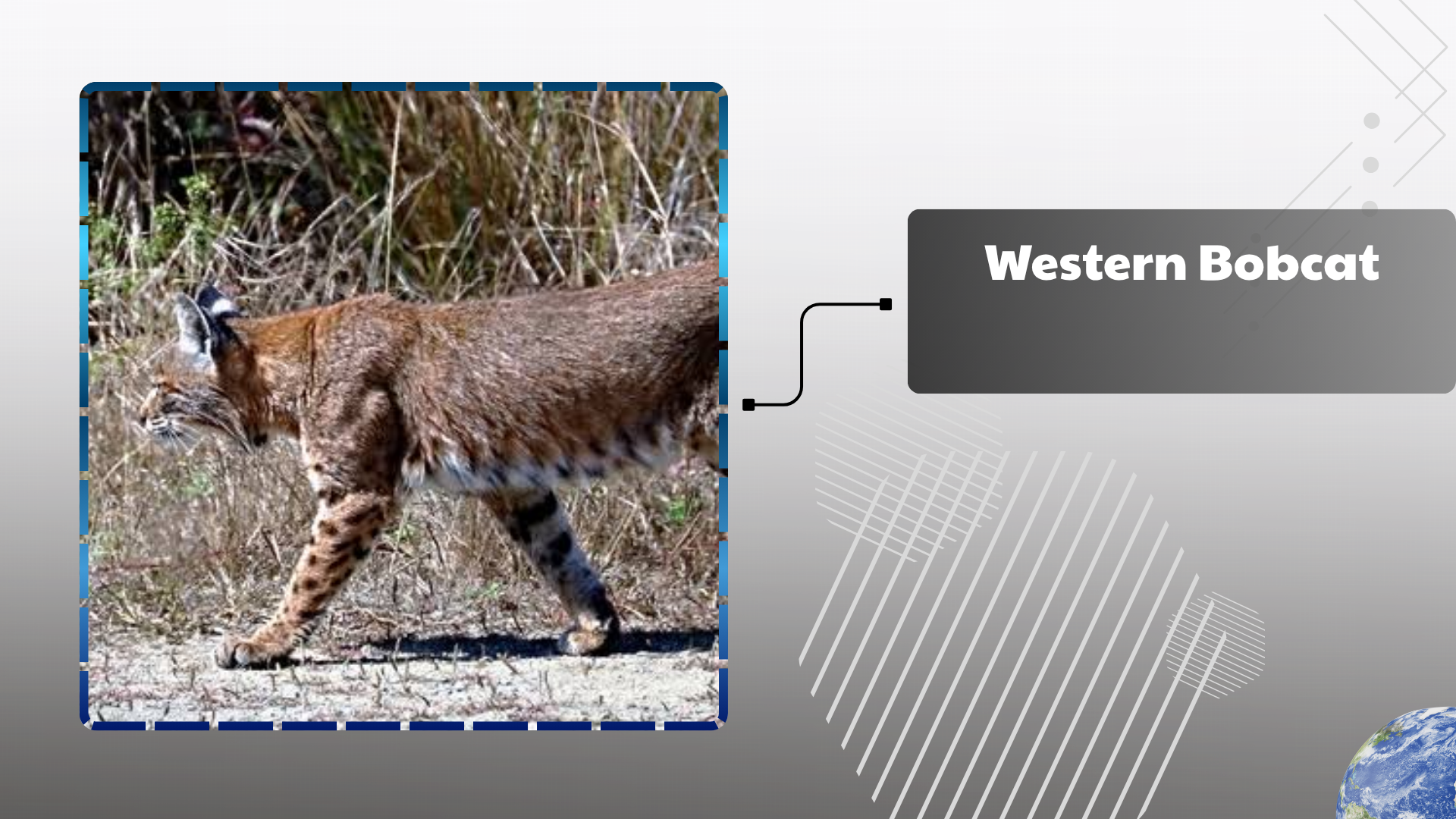
The western bobcat, Lynx rufus fasciatus, is generally associated with areas west of the Great Plains. It occurs across a remarkable selection of landscapes, including Pacific forests, dry chaparral, rocky foothills, desert scrub, wooded canyons, grassland edges, and mountain habitats.
Western bobcats share the same basic anatomy as eastern animals: a compact muscular body, relatively long hind legs, tufted ears, cheek ruffs, and a short bobbed tail. Coat color varies widely. A cat from a dry southwestern landscape may have pale buff or sandy fur, while one living in a cool northwestern forest may appear darker, grayer, and more heavily furred.
These regional appearances should not be treated as fixed identification rules. Pale bobcats are not automatically western, and dark bobcats are not automatically eastern. Coat color is influenced by habitat, season, genetics, age, and normal individual variation. Range information and genetic evidence provide a more reliable basis for classification.
Western bobcats often rest beneath rock overhangs, inside crevices, among boulders, under thick shrubs, or in other concealed locations. In open country, washes and vegetated drainage corridors can provide valuable travel routes. In forests, the cats may follow ridges, logging roads, game trails, or transitions between dense cover and clearings.
The western bobcat is an opportunistic predator. Depending on location, it may hunt rabbits, hares, rodents, ground squirrels, birds, reptiles, or other suitably sized prey. It relies on hearing, vision, concealment, and explosive short-distance movement instead of pursuing prey over long distances.
Names such as California bobcat, desert bobcat, plateau bobcat, and Baja California bobcat occur in older classifications. Many of these names represent historically proposed subspecies rather than separate bobcat species. Modern taxonomy places western populations primarily within Lynx rufus fasciatus, although the exact classification of some Mexican populations remains an area for further research.
Why Do Some Sources List 12 or 13 Types of Bobcats?
Early naturalists classified bobcats by comparing museum specimens from different parts of North America. Differences in fur color, spotting, body proportions, and skull shape led researchers to name numerous regional subspecies.
Frequently encountered historical names include:
- Lynx rufus baileyi
- Lynx rufus californicus
- Lynx rufus escuinapae
- Lynx rufus fasciatus
- Lynx rufus floridanus
- Lynx rufus gigas
- Lynx rufus oaxacensis
- Lynx rufus pallescens
- Lynx rufus peninsularis
- Lynx rufus rufus
- Lynx rufus superiorensis
- Lynx rufus texensis
Some lists contain an additional name or count synonyms differently, which explains why totals vary. Modern taxonomic reviews found that many supposed regional distinctions were too small, inconsistent, or overlapping to support so many subspecies.
Consequently, the two-subspecies classification recognizes a broad eastern form and a broad western form. The historical names remain useful for understanding older research and regional terminology, but they should not be presented as separate living species.
How Are Bobcats Classified?
| Taxonomic Rank | Classification |
|---|---|
| Kingdom | Animalia |
| Phylum | Chordata |
| Class | Mammalia |
| Order | Carnivora |
| Family | Felidae |
| Genus | Lynx |
| Species | Lynx rufus |
| Recognized subspecies | Lynx rufus rufus and Lynx rufus fasciatus |
The bobcat is one of four living species in the genus Lynx. The other three are the Canada lynx, Eurasian lynx, and Iberian lynx. Therefore, an eastern bobcat and a western bobcat are not separate species; both belong to Lynx rufus.
A species is a broader biological unit, while a subspecies describes a geographically structured population within a species. Subspecies usually show some genetic or physical distinction but remain closely related and capable of interbreeding where their populations meet.
Where Do Bobcats Live?
Bobcats are native to North America. Their overall distribution extends from southern Canada through much of the contiguous United States and into Mexico. They are adaptable enough to occupy environments that range from northern forests and humid southeastern wetlands to deserts and dry Mexican scrublands.
Successful bobcat habitat usually provides three basic resources: adequate prey, concealed resting areas, and cover for stalking. Dense vegetation, rocky terrain, forest edges, wooded waterways, brush piles, and uneven ground can all meet these needs.
Forests
Deciduous, coniferous, and mixed forests can support bobcats when openings and early-stage vegetation create good hunting areas. Bobcats often travel along edges rather than remaining exclusively in dense forest.
Deserts and Scrublands
In dry regions, bobcats use rocky slopes, washes, canyons, cactus communities, and dense desert shrubs. They may become especially active during cooler nighttime and twilight hours.
Wetlands and Swamps
Bobcats in southeastern North America occupy wooded wetlands, marsh edges, and swamps. Raised ground, dense plants, fallen timber, and dry resting sites are important within these environments.
Mountains and Rocky Country
Cliffs, boulder fields, ledges, and rugged slopes provide escape cover and sheltered resting places. Bobcats can climb well, although they spend most of their time on the ground.
Agricultural and Suburban Edges
Bobcats can live near people when development leaves sufficient connected habitat. Wooded corridors, undeveloped lots, parks, and drainage systems may allow them to move through suburban landscapes without being noticed.
How to Identify Different Types of Bobcats
The two subspecies cannot always be separated reliably from a photograph. Begin by confirming that the animal is a bobcat, then use geographic location to determine which subspecies is more likely.
- Tail: Look for a short bobbed tail with a dark upper tip and a paler underside.
- Body: Bobcats have muscular bodies, long legs, and hindquarters that may appear slightly elevated.
- Face: A broad face with noticeable cheek ruffs creates a rounded appearance.
- Ears: The pointed ears have dark markings and usually short tufts.
- Coat: Fur ranges from gray and buff to reddish brown, normally with spots or streaks.
- Leg markings: Dark bars are often visible on the front legs.
- Size: A bobcat is generally larger, taller, and more powerfully built than a domestic cat.
- Movement: Bobcats walk with a controlled, direct, and quiet gait.
- Range: A location east of the Great Plains suggests L. r. rufus; a western location suggests L. r. fasciatus.
- Habitat: Habitat affects appearance, so never identify a subspecies from coat color alone.
Bobcat Tracks and Other Field Signs
Tracks, droppings, scrapes, and trail-camera photographs often provide better evidence than a brief sighting. Bobcat footprints are broadly rounded and normally show four toes. Claw marks are usually absent because the claws are retractable.
The heel pad tends to show two lobes along its front edge and three along the rear edge. This structure helps distinguish a feline track from a canine track. Dog and coyote prints are generally more oval, often show claws, and have a different arrangement of open space between the toes and pad.
Bobcats may also leave scent scrapes, scratch logs, or deposit droppings along travel routes. A single track should be interpreted cautiously, especially when weather or soft soil has changed its shape.
Bobcat vs. Canada Lynx
| Feature | Bobcat | Canada Lynx |
|---|---|---|
| Range | Much of the United States, southern Canada, and Mexico | Primarily Canada, Alaska, and parts of the northern contiguous United States |
| Feet | Moderately sized paws | Exceptionally large, heavily furred paws adapted to snow |
| Legs | Relatively long but proportionate | Very long-legged appearance |
| Coat pattern | Often visibly spotted or barred | Usually grayer with less obvious spotting |
| Ear tufts | Generally short | Usually longer and more prominent |
| Tail tip | Dark mainly on top, with a paler underside | Appears black around the entire tip |
| Snow adaptation | Less efficient in deep, soft snow | Large paws function like natural snowshoes |
The tail pattern and paw size are among the most useful field marks. However, distance, snow, shadows, and partial views can make identification difficult.
Behavior Shared by Both Types of Bobcats
Eastern and western bobcats behave similarly. They are generally solitary, territorial, and secretive. Activity frequently peaks near dawn and dusk, although a bobcat may move during the day or at night depending on weather, prey, disturbance, and season.
Each animal uses a home range containing hunting areas, resting sites, water sources, and travel routes. Males commonly occupy larger areas than females, but home-range size varies substantially with habitat quality and prey availability.
Bobcats communicate through scent marking, urine, droppings, ground scrapes, and scratches. These signs allow individuals to advertise their presence without meeting directly.
When hunting, a bobcat usually listens and watches from cover before stalking. It then attacks with a quick rush or leap. This strategy works especially well in brush, forest edges, broken rock, and other habitats where the cat can approach unseen.
What Do Bobcats Eat?
Bobcats are carnivores with flexible diets. Rabbits and hares are particularly important in many regions, but the exact menu changes with location and season.
- Rabbits and hares
- Mice, rats, and voles
- Squirrels and other small mammals
- Ground-dwelling and nesting birds
- Reptiles in warmer regions
- Occasional insects
- Carrion when available
- Larger prey under certain conditions
This adaptability helps bobcats survive across very different ecosystems. It also means that diet alone cannot be used to distinguish the eastern and western subspecies.
Outdoor Tips for Finding and Observing Bobcats
- Search for signs first. Tracks, scrapes, droppings, and trail-camera images are more common than direct sightings.
- Explore habitat edges. Look where woods meet fields, where washes cross scrubland, or where rocky cover borders open ground.
- Visit during quiet hours. Dawn and dusk can be productive, although local activity patterns vary.
- Scan slowly. A resting bobcat’s spotted coat blends remarkably well with leaves, rocks, grass, and shadows.
- Use binoculars. Observe from a respectful distance instead of approaching.
- Keep dogs controlled. A loose dog can chase or corner wildlife and create a dangerous encounter.
- Avoid dens. Never investigate a suspected den or attempt to view kittens closely.
- Do not use bait. Feeding changes natural behavior and can draw bobcats toward homes or roads.
- Follow access rules. Respect private property, closures, and wildlife-area regulations.
- Record useful details. Note the location, habitat, tail pattern, apparent size, and behavior when documenting a sighting.
Safety, Sustainability, and Conservation Notes
Bobcats generally avoid people. If one appears nearby, give it space and provide a clear escape route. Never attempt to touch, corner, feed, or capture a wild bobcat.
People living in bobcat habitat can reduce conflicts by securing poultry, supervising small pets, feeding pets indoors, removing uneaten food, and avoiding wildlife feeding. Dense hiding areas immediately beside animal enclosures should be managed carefully.
If a bobcat behaves unusually, appears seriously injured, or remains in a crowded developed area, contact the appropriate local wildlife agency or animal-control authority. Regulations differ among states, provinces, and countries, so local official guidance should always be followed.
Bobcats remain widespread, but local populations can still be harmed by habitat fragmentation, vehicle collisions, illegal killing, and reduced landscape connectivity. Protecting natural corridors allows bobcats and their prey to move between suitable habitats.
Fun Facts About Bobcats
- The bobcat’s common name comes from its short, or “bobbed,” tail.
- Bobcats are one of four living species in the genus Lynx.
- They can live in forests, deserts, wetlands, mountains, and suburban-edge habitats.
- A bobcat’s spotted coat provides camouflage in both vegetation and broken shadows.
- Bobcats are capable climbers even though they spend most of their time on the ground.
- Their retractable claws usually do not appear in normal walking tracks.
- They hunt mainly by stalking and ambushing rather than by long-distance pursuit.
- A bobcat may maintain several resting places within its home range.
- Northern bobcats often grow thicker winter fur than animals in warm climates.
- Coat color alone cannot reliably identify a bobcat subspecies.
Final Thoughts on Types of Bobcats
Modern classification recognizes two types of bobcats: the eastern bobcat, Lynx rufus rufus, and the western bobcat, Lynx rufus fasciatus. Both belong to one species and share far more features than they differ in.
The Great Plains provide a useful general reference for their geographic division, but individual appearance varies substantially. Older lists of 11, 12, or 13 forms reflect historical taxonomy rather than 13 separate bobcat species. When observing bobcats, focus first on reliable species features such as the short tail, muscular build, facial ruff, leg bars, and feline tracks, then use location to estimate the likely subspecies.
Frequently Asked Questions
1. How many types of bobcats are there?
There are two currently recognized bobcat subspecies: Lynx rufus rufus and Lynx rufus fasciatus. They are commonly described as the eastern and western bobcats.
2. Are there really 13 types of bobcats?
Thirteen is an older or differently calculated total based on regional forms named from physical specimens. Modern taxonomic treatment combines most of those forms into two broadly recognized subspecies.
3. Are eastern and western bobcats separate species?
No. Both are populations of the species Lynx rufus. Their three-part scientific names identify them at the subspecies level.
4. What is the scientific name of the bobcat?
The bobcat’s scientific name is Lynx rufus. It belongs to the cat family Felidae and the genus Lynx.
5. What is an eastern bobcat?
Eastern bobcat is a practical common name for Lynx rufus rufus, the subspecies generally associated with North America east of the Great Plains.
6. What is a western bobcat?
Western bobcat usually refers to Lynx rufus fasciatus, the subspecies broadly distributed west of the Great Plains.
7. Can eastern and western bobcats interbreed?
They belong to the same species and can exchange genes where their populations meet. The boundary between them should be understood as a broad geographic transition rather than a rigid barrier.
8. Can you identify a bobcat subspecies by its coat?
Not reliably. Coat color and spotting vary with genetics, season, age, habitat, and the individual animal. Geographic location is generally a more useful clue.
9. Are desert bobcats a separate species?
No. “Desert bobcat” is usually an informal regional description or an older subspecies reference. Desert-dwelling bobcats remain members of Lynx rufus.
10. Is the Florida bobcat a separate subspecies?
Florida bobcats were historically described under the name Lynx rufus floridanus. Under the modern two-subspecies model, they are included within the broader eastern subspecies.
11. Is the Texas bobcat a separate type?
“Texas bobcat” may refer informally to bobcats living in Texas or to an older proposed form. Texas lies near an important geographic transition, so historical names should not be confused with separate species.
12. Are Mexican bobcats different?
Mexican bobcat populations show geographic variation, and several historical subspecies names came from Mexico. The precise taxonomic placement of some southern populations requires additional research.
13. Where are bobcats found?
Bobcats occur from southern Canada across much of the contiguous United States and into Mexico. Their habitats include forests, deserts, wetlands, scrublands, mountains, and developed edges with adequate cover.
14. Do bobcats live in every U.S. state?
Bobcats occur across most of the contiguous United States, but their population status and distribution differ by state. Official state wildlife resources provide the most accurate local information.
15. What does a bobcat look like?
A bobcat has a muscular body, long legs, a broad ruffed face, pointed ears, spotted or streaked fur, and a short tail with a dark upper tip.
16. How large is a bobcat?
Bobcat size varies by sex, age, region, and food availability. Adults are typically much larger and more muscular than domestic cats, and males are generally heavier than females.
17. What colors can bobcats be?
Bobcats may appear gray, buff, tan, yellowish brown, reddish brown, or combinations of these shades. Most have dark spots, streaks, or bars and paler underparts.
18. Can bobcats be black?
Very dark or melanistic bobcats have occasionally been documented, but they are rare. Spots may still be visible under suitable lighting.
19. Why do bobcats have short tails?
The short tail is a natural characteristic shared by members of the lynx group. It is also the feature that inspired the common name “bobcat.”
20. What is the difference between a bobcat and a Canada lynx?
Canada lynx generally have larger snow-adapted feet, longer legs, longer ear tufts, and a tail tip that appears black all around. Bobcats often show stronger spotting and have smaller paws.
21. How can you distinguish a bobcat from a domestic cat?
Bobcats are taller, heavier-boned, and more muscular. They also have a short tail, cheek ruffs, leg bars, and proportionally larger feet than most domestic cats.
22. What do bobcat tracks look like?
Bobcat tracks are rounded feline prints with four toes and usually no visible claw marks. The heel pad commonly shows two front lobes and three rear lobes.
23. Are bobcats nocturnal?
Bobcats can be active at night, but many show strong activity around dawn and dusk. Their schedule changes with prey behavior, weather, human disturbance, and season.
24. What do bobcats eat?
They commonly eat rabbits, hares, rodents, squirrels, and birds. Their flexible diet may also include reptiles, carrion, and occasionally larger animals.
25. Do bobcats hunt deer?
Bobcats can occasionally kill deer, especially young, weakened, or otherwise vulnerable animals. However, smaller mammals are more typical prey in many habitats.
26. Are bobcats dangerous to humans?
Healthy wild bobcats usually avoid people, and attacks are unusual. They should still be treated as wild predators and observed only from a safe distance.
27. Will a bobcat attack a pet?
A bobcat may view a small unattended animal as prey, although circumstances vary. Keeping pets indoors or supervised, especially near dawn and dusk, reduces risk.
28. What should you do if you see a bobcat?
Remain calm, keep your distance, control pets, and allow the animal to leave. Do not approach, feed, corner, or follow it.
29. Should you report a bobcat sighting?
A normal sighting may not require reporting, but wildlife agencies sometimes collect observations. Report injured, trapped, unusually aggressive, or repeatedly conflict-prone animals to local authorities.
30. Can bobcats climb trees?
Yes. Bobcats are skilled climbers and may climb to escape danger, rest, investigate prey, or move through complex terrain.
31. Can bobcats swim?
Bobcats can swim when necessary, but swimming is not usually their primary method of travel. They generally prefer land routes and covered crossings.
32. Where do bobcats sleep?
They rest in concealed places such as rock crevices, hollow logs, dense vegetation, brush piles, caves, and sheltered ledges. An individual may use multiple resting sites.
33. Do bobcats live in groups?
Bobcats are generally solitary. Adults usually travel and hunt alone, although females live with their dependent kittens for several months.
34. How do bobcats mark their territory?
They use urine, droppings, scent, ground scrapes, and scratches on natural objects. These signals communicate presence and reproductive information.
35. When do bobcats have kittens?
Timing varies by location, but mating often occurs in winter or early spring, with kittens commonly born in spring. Local climate and individual condition can affect the schedule.
36. How many kittens do bobcats have?
A litter usually contains several kittens, although litter size varies. The female raises them in a protected den and later teaches them to travel and hunt.
37. Do bobcats use the same den every year?
Some individuals may reuse suitable areas, but bobcats often maintain several shelters. Den choice depends on security, weather, disturbance, and the availability of cover.
38. How large is a bobcat’s territory?
Home-range size varies widely. Males generally use larger areas than females, and ranges expand where prey and secure habitat are more widely scattered.
39. Can bobcats live near cities?
Yes. Bobcats can survive along suburban and urban edges when parks, drainage corridors, wooded areas, and undeveloped land provide connected cover and prey.
40. Why are bobcats important?
Bobcats help regulate populations of rabbits, rodents, and other prey. Their presence can also indicate that a landscape retains functioning habitat and wildlife connections.
41. Are bobcats endangered?
The species is widespread and is not considered globally endangered. However, population status, protection, and management rules can differ substantially by jurisdiction.
42. Is it legal to hunt or trap bobcats?
Laws vary by country, state, province, season, and management area. Always consult the current official wildlife regulations rather than relying on a general online guide.
43. What threatens bobcat populations?
Important local threats can include habitat loss, fragmented travel corridors, road mortality, illegal killing, and changes in prey availability.
44. How can people help conserve bobcats?
Protecting connected habitat, driving carefully in wildlife areas, securing domestic animals, avoiding feeding, and supporting science-based management all benefit bobcats.
45. Are bobcats the same as wildcats?
“Wildcat” is an informal word used for several wild feline species. In parts of North America it may refer to a bobcat, but it is not a precise scientific name.
46. Is a bobcat a type of lynx?
Yes. The bobcat belongs to the genus Lynx, along with the Canada lynx, Eurasian lynx, and Iberian lynx.
47. What is a red lynx?
Red lynx is an alternative common name for the bobcat. It reflects the meaning of the scientific name Lynx rufus, but it does not identify a separate species.
48. Why do northern bobcats look different from desert bobcats?
Northern animals may have thicker, grayer winter coats, while desert animals often appear paler and shorter-haired. Climate, habitat, season, and individual genetics contribute to these differences.
49. What is the best way to photograph a bobcat?
Use a telephoto lens, remain quiet, keep a substantial distance, and avoid blocking its route. Never bait a bobcat or approach a den for a photograph.
50. What is the most reliable way to identify a bobcat subspecies?
Geographic location is the most practical starting point, while genetic analysis provides stronger scientific evidence. Visual appearance alone is usually insufficient.