

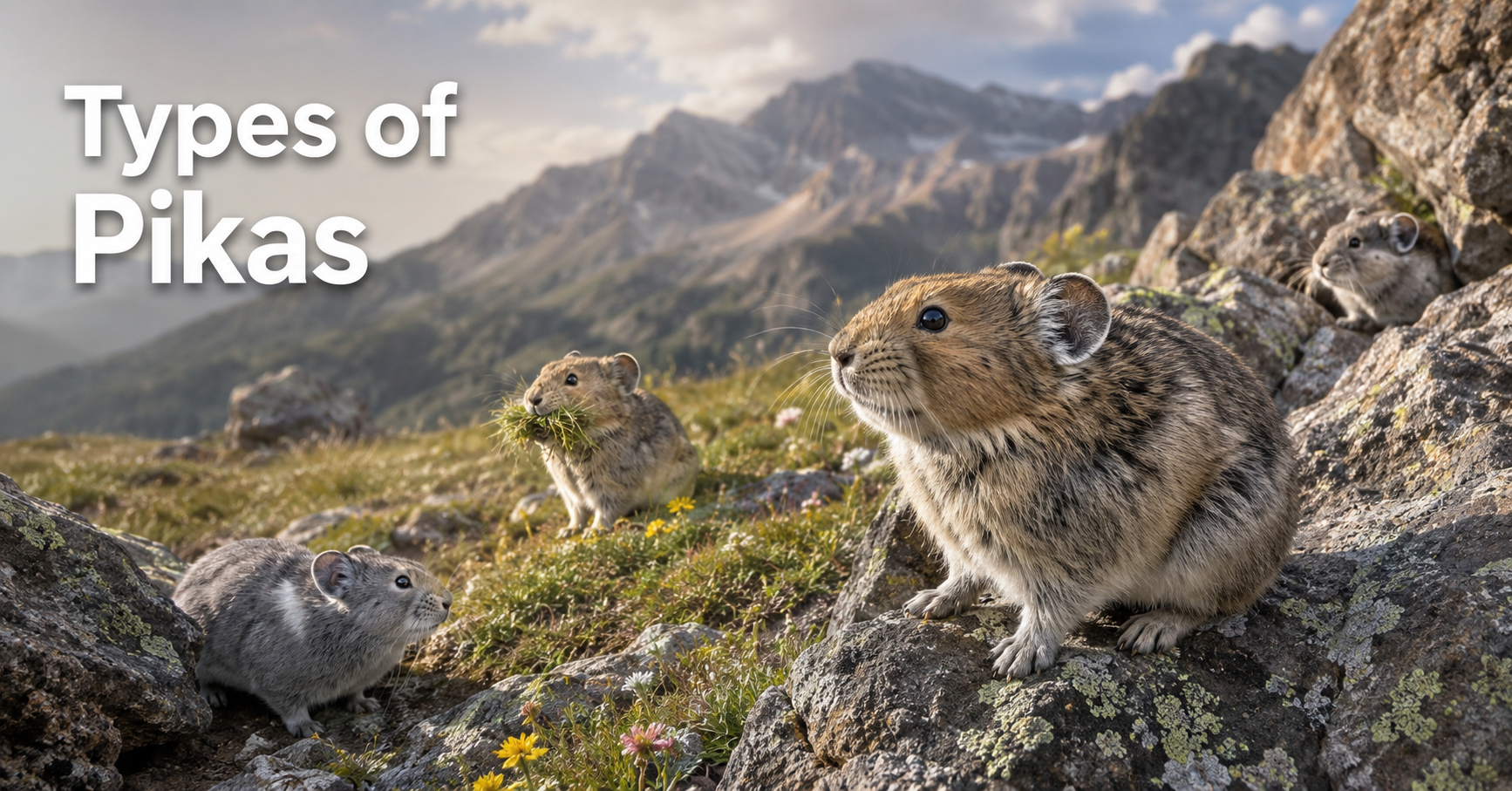
Small, round-eared, and almost tailless, pikas are often mistaken for rodents or tiny rabbits. In fact, these quick, vocal mammals are the third living branch of the lagomorph family tree alongside rabbits and hares. The world’s types of pikas occupy an extraordinary range of habitats, from North American talus slopes and Siberian rock fields to Tibetan meadows, Central Asian steppe, and isolated mountains in China.
This guide covers all 36 living species recognized in version 2.5 of the American Society of Mammalogists’ Mammal Diversity Database. That total is higher than the 29- or 34-species lists still common online because modern taxonomy recognizes several newly described or recently separated pikas. Each profile explains the species’ appearance, range, habitat, behavior, diet, field identification, and conservation context without pretending that every poorly studied species can be identified from color alone.
What Are the Main Types of Pikas?
The 36 living types of pikas all belong to the genus Ochotona and the family Ochotonidae. They include rock-dwelling mountain species that shelter in talus and burrowing species that create tunnel systems in meadow or steppe. Most live in Asia; only the American and collared pikas are native to North America. Taxonomists currently arrange them among the subgenera Alienauroa, Conothoa, Lagotona, Ochotona, and Pika.
36 Types of Pikas at a Glance
| No. | Common Name | Scientific Name | Primary Range | Global Status |
|---|---|---|---|---|
| 1 | Alpine pika | Ochotona alpina | Russia, Mongolia, China, and Kazakhstan | Least Concern |
| 2 | Silver pika | Ochotona argentata | Helan Mountains, China | Endangered |
| 3 | Gansu pika | Ochotona cansus | China | Least Concern |
| 4 | Collared pika | Ochotona collaris | Alaska and northwestern Canada | Least Concern |
| 5 | Korean pika | Ochotona coreana | North Korea and northeastern China | Data Deficient |
| 6 | Plateau pika | Ochotona curzoniae | Tibetan Plateau | Least Concern |
| 7 | Daurian pika | Ochotona dauurica | Mongolia, Russia, and China | Least Concern |
| 8 | Chinese red pika | Ochotona erythrotis | China | Least Concern |
| 9 | Flat-headed pika | Ochotona flatcalvariam | China | Not Evaluated |
| 10 | Forrest’s pika | Ochotona forresti | Southwestern China and Myanmar | Least Concern |
| 11 | Galungla Mountain pika | Ochotona galunglaensis | Tibet, China | Not Evaluated |
| 12 | Hoffmann’s pika | Ochotona hoffmanni | Mongolia and Russia | Endangered |
| 13 | Yellow pika | Ochotona huanglongensis | Sichuan, China | Not Evaluated |
| 14 | Northern pika | Ochotona hyperborea | Russia, Mongolia, and Japan | Least Concern |
| 15 | Ili pika | Ochotona iliensis | Tian Shan, China | Endangered |
| 16 | Kozlov’s pika | Ochotona koslowi | Qinghai-Tibet region, China | Endangered |
| 17 | Ladak pika | Ochotona ladacensis | Western Himalaya and Tibetan Plateau | Least Concern |
| 18 | Legbo Valley pika | Ochotona legbona | Tibet, China | Not Evaluated |
| 19 | Large-eared pika | Ochotona macrotis | Central Asian and Himalayan mountains | Least Concern |
| 20 | Manchurian pika | Ochotona mantchurica | Northeastern China and Russia | Least Concern |
| 21 | Nubra pika | Ochotona nubrica | India, Nepal, and China | Least Concern |
| 22 | Kazakh pika | Ochotona opaca | Kazakhstan | Least Concern |
| 23 | Pallas’s pika | Ochotona pallasii | Mongolia, China, and Russia | Least Concern |
| 24 | American pika | Ochotona princeps | Western Canada and United States | Least Concern |
| 25 | Steppe pika | Ochotona pusilla | Kazakhstan and Russia | Least Concern |
| 26 | Qionglai pika | Ochotona qionglaiensis | Sichuan, China | Not Evaluated |
| 27 | Royle’s pika | Ochotona roylii | Himalayas | Least Concern |
| 28 | Afghan pika | Ochotona rufescens | Afghanistan, Iran, Pakistan, and Turkmenistan | Least Concern |
| 29 | Turkestan red pika | Ochotona rutila | Central Asia | Least Concern |
| 30 | Sacred pika | Ochotona sacraria | China | Not Evaluated |
| 31 | Sijin pika | Ochotona sikimaria | Bhutan, China, and India | Not Evaluated |
| 32 | Tsing-ling pika | Ochotona syrinx | Central China | Least Concern |
| 33 | Moupin pika | Ochotona thibetana | China and Myanmar | Least Concern |
| 34 | Thomas’s pika | Ochotona thomasi | China | Least Concern |
| 35 | Turuchan pika | Ochotona turuchanensis | Central Siberia, Russia | Least Concern |
| 36 | Iranian pika | Ochotona vizier | Iran | Not Evaluated |
1. Alpine Pika
The alpine pika, Ochotona alpina, is a stocky northern Asian pika with rounded ears, no visible external tail, and dense gray-brown to rusty fur. Its underside is usually paler, and the coat thickens markedly for winter. It resembles the northern, Manchurian, and Pallas’s pikas, so range and skull or genetic evidence can matter more than a quick look.
This species occupies rocky mountain slopes, boulder fields, forest-edge talus, and alpine meadows across parts of Russia, Mongolia, China, and Kazakhstan. It shelters in deep rock crevices and feeds on grasses, sedges, flowers, and leafy plants. During summer it cuts vegetation, carries it in its mouth, and dries it in haypiles for winter. Sharp calls warn neighboring pikas about predators or intruders.
The alpine pika is assessed as Least Concern. Mining, roads, fire, and changes to mountain vegetation may still affect individual colonies. Current taxonomy removes some populations formerly included within O. alpina, so old maps can be broader than modern ones. Patient observers should sit below a talus edge and listen for calls rather than climbing through occupied rock piles.
2. Silver Pika
The silver pika, Ochotona argentata, is an isolated Chinese endemic known from the Helan Mountains. It has long, soft gray-brown fur that can create a silvery appearance, a rounded body, small round ears, and short limbs. Like all pikas, its tail is present but hidden within the fur. Appearance alone is not enough for identification outside its tiny range.
Silver pikas live among rocky mountain slopes where crevices provide cool refuges and nearby vegetation supplies grasses, herbs, and leafy stems. They remain active through winter rather than hibernating and are expected to rely on sheltered foraging and stored plant material. The narrow mountain distribution makes habitat continuity particularly important.
The species is Endangered. Its small range leaves it vulnerable to habitat disturbance, climate-driven changes, tourism pressure, grazing, and any event affecting a limited number of colonies. Observers should avoid publishing exact den or colony coordinates. A suspected record beyond the known Helan range needs expert verification rather than a confident identification based on gray fur.
3. Gansu Pika
The Gansu pika, Ochotona cansus, is a small burrowing pika of central China. It has muted brown or gray-brown fur, rounded ears, short legs, and the compact shape typical of meadow pikas. Compared with rock specialists, it has digging-adapted claws and is more likely to vanish into soil burrows than beneath a boulder.
It inhabits alpine meadow, grassland, shrub margins, and agricultural uplands. Burrow entrances connect to shelter and nesting chambers, while surrounding vegetation supplies grasses, sedges, herbs, and roots. Gansu pikas may live at higher densities than solitary talus species and can influence soil movement, plant patterns, and food availability for predators.
The Gansu pika is Least Concern, but its taxonomy is complex. Some forms formerly placed with it have been reassigned, and O. morosa has sometimes been treated separately. Location, calls, measurements, and genetics may be required where similar Chinese meadow pikas meet. Never block burrow entrances to obtain a photograph.
4. Collared Pika
The collared pika, Ochotona collaris, is one of only two pika species native to North America. A pale gray collar around the neck and shoulders gives it its name, though the marking varies. It has gray-brown upper fur, buffy sides, small rounded ears, short limbs, and a compact body that fits between rocks.
Its range extends through Alaska, Yukon, western Northwest Territories, and northern British Columbia. Colonies occupy talus, scree, lava-like rock, and boulder slopes near alpine vegetation. Individuals defend small territories, give high-pitched calls, and gather grasses and flowers into haypiles. They do not hibernate; snow-covered rock spaces provide insulated winter passageways.
The collared pika is globally Least Concern, but northern populations face rapid warming, altered snow, and changing plant communities. It differs from the American pika mainly by range; the two do not normally overlap. Scan the talus-meadow boundary and wait quietly for movement, because climbing over rocks can crush vegetation and disturb food stores.
5. Korean Pika
The Korean pika, Ochotona coreana, was formerly included within the northern pika but is now recognized as a separate species. It occurs in North Korea and adjoining northeastern China. The animal has dense brown-gray fur, rounded ears, and the typical short-limbed, nearly tailless pika form.
It is associated with cool rocky mountain habitat, talus, forested slopes, and nearby herbaceous vegetation. Crevices provide shelter from predators and temperature extremes. It feeds on grasses, leaves, flowers, and shoots and likely caches vegetation where winter limits fresh food. Vocal behavior and fine anatomical characters may help separate it from related northern pikas.
The Korean pika is Data Deficient, meaning available information is not sufficient for a confident global threat assessment. Restricted access, limited surveys, and its recent taxonomic separation complicate population estimates. Exact locality and genetic sampling are more dependable than coat color, particularly near the borders of northern and Manchurian pika ranges.
6. Plateau Pika
The plateau pika, Ochotona curzoniae, also called the black-lipped pika, is one of the best-known burrowing pikas. It has sandy to gray-brown fur, rounded ears, and often a dark margin around the mouth. Unlike talus species, it is strongly associated with open alpine meadow and lives in extensive burrow systems.
Across the Tibetan Plateau and adjoining high country, plateau pikas clip grasses, sedges, and herbs around their colonies. Their digging aerates soil and creates shelter used by other animals, while the pikas themselves are major prey for foxes, weasels, raptors, and other predators. They are active by day and use calls, upright scanning, and communal vigilance to detect danger.
The species is Least Concern but has often been poisoned as an alleged rangeland pest. Research shows its ecological role is complex: it can be abundant on degraded ground, yet its burrows and prey value also support plateau biodiversity. Management should be based on local evidence rather than automatic eradication. Visitors should watch from outside colonies to avoid collapsing tunnels.
7. Daurian Pika
The Daurian pika, Ochotona dauurica, is a burrowing species of Mongolia, Russia, and northern China. It is small and round-bodied with gray-brown or sandy fur, inconspicuous ears, and strong claws. Modern treatments include the former Huang River pika form huangensis within this species.
Daurian pikas live in steppe, meadow, semi-desert grassland, and upland pasture. They dig networks of burrows and feed on grasses, forbs, stems, and roots. Family groups may share parts of a colony, and alarm calls spread quickly when a fox, raptor, or person approaches. Stored vegetation helps bridge cold periods, though foraging strategy varies with climate.
The species is Least Concern across its broad range. Intensive grazing, cultivation, control campaigns, and climate shifts can nevertheless cause local change. It can be confused with steppe, Gansu, or Pallas’s pikas, so field identification should combine range, burrow form, call, habitat, and expert measurements.
8. Chinese Red Pika
The Chinese red pika, Ochotona erythrotis, is a colorful rock-dwelling pika of China. Rich chestnut or rusty-red areas on the head and sides contrast with darker gray-brown upperparts, especially in the summer coat. Small rounded ears and a stout body complete its rabbit-like but distinctly pika silhouette.
It inhabits high rocky slopes, cliffs, scree, and boulder fields beside alpine vegetation. Individuals retreat into crevices, call from lookout rocks, and collect grasses, herbs, and flowers. Current taxonomy places Glover’s and Muli pikas within the Chinese red pika, so older guides may show several species where the current database uses one.
The Chinese red pika is Least Concern, but range-wide security does not eliminate local risks from mining, roads, grazing, and climate change. Red fur is a useful clue only in the correct region because the Turkestan red pika and several other mountain pikas can show warm tones. Photograph the habitat and ear pattern as well as the body.
9. Flat-headed Pika
The flat-headed pika, Ochotona flatcalvariam, is a recently described Chinese species named for cranial features rather than an obvious field mark. It belongs to the subgenus Alienauroa and was distinguished using mitochondrial evidence and morphology. Public natural-history information remains limited.
Like related Chinese pikas, it is a small herbivorous lagomorph with rounded ears, short limbs, dense fur, and a concealed tail. Available taxonomic records place it in China, but its exact ecological limits and overlap with similar species require further study. It likely feeds on local grasses and herbs and uses burrows or natural shelter according to habitat.
The species is Not Evaluated by the IUCN. That label is an information gap, not evidence of either rarity or safety. Visual identification from photographs is unreliable because the diagnostic flat skull concerns measurements not visible on a living animal. Records should be treated cautiously and confirmed by specialists.
10. Forrest’s Pika
Forrest’s pika, Ochotona forresti, is a mountain pika of southwestern China and neighboring Myanmar. Its dense fur can appear dark reddish-brown, chestnut, or gray-brown depending on season and population, with rounded ears and pale underparts. Current taxonomy includes forms once described as Gaoligong and black pikas.
The species occupies steep rocky slopes, cliffs, forest-edge boulder fields, and alpine shrub or meadow in the Hengduan region. It feeds on grasses, herbs, leaves, and flowers and uses crevices for shelter. The rugged landscape can isolate colonies on separate mountains, helping explain geographic variation in coat and genetics.
Forrest’s pika is assessed as Least Concern, though road building, tourism, grazing, forest change, and warming may affect local colonies. Identification against Chinese red, large-eared, and newly described regional pikas may require exact locality and specialist review. An unusually dark coat does not by itself prove a separate species.
11. Galungla Mountain Pika
The Galungla Mountain pika, Ochotona galunglaensis, is a newly described species from the eastern Himalaya region of Tibet, China. Research describes it as a small pika with notably short ears and a body averaging under about 15 centimeters. Its recognition illustrates how remote mountain valleys can hold lineages overlooked within broader pika complexes.
The type locality lies around 3,000 meters in Motuo County near the eastern Yarlung Zangbo system. The species is associated with cool mountain habitat where rock, forest edge, shrub, and herbaceous plants form a fine-scale mosaic. As a herbivore, it depends on accessible leaves, stems, and grasses and on secure shelter from predators and weather.
The Galungla Mountain pika is Not Evaluated. Its range, population size, seasonal ecology, and sensitivity to disturbance remain poorly documented. Do not identify every small, short-eared pika from southeastern Tibet as this species. Location-supported photographs and noninvasive genetic samples collected by authorized researchers are needed to refine its boundaries.
12. Hoffmann’s Pika
Hoffmann’s pika, Ochotona hoffmanni, is a highly restricted rock-dwelling species of Mongolia and adjacent Russia. It resembles Pallas’s pika, with gray-brown fur, rounded ears, and a sturdy body, and was recognized as distinct through taxonomic study. Its tiny distribution makes geographic location the strongest field clue.
The species lives in dry mountain rock fields and talus where nearby steppe vegetation supplies food. It shelters in crevices, calls from rocks, and harvests grasses and herbs. Because suitable rock patches are isolated, movement among colonies may be difficult, increasing vulnerability to any local habitat disruption.
Hoffmann’s pika is Endangered. Mining, infrastructure, livestock effects, disturbance, and climate change can be important within such a narrow range. Observers should not remove rocks, approach haypiles, or publicize precise colony coordinates. Sightings beyond known sites require careful confirmation against Pallas’s pika.
13. Yellow Pika
The yellow pika, Ochotona huanglongensis, is a recently described species from Huanglong in Sichuan, China. Its diagnosis uses skull structure, genetic evidence, fur, ears, and foot characters. Published descriptions note coarse dorsal hair, gray-white ventral fur, and relatively large ears, but these details are not a simple stand-alone field key.
Huanglong’s mountainous landscape contains forest, shrub, meadow, rock, and high-elevation karst. The pika feeds on plant material and relies on sheltered microhabitats for protection from weather and predators. Its exact habitat preferences, seasonal behavior, and range beyond known localities still need focused study.
The yellow pika is Not Evaluated. Its restricted known distribution makes disturbance and environmental change relevant, but population claims should not be invented before surveys exist. Visitors should stay on designated routes in protected landscapes. A photograph labeled by color alone is not sufficient, because many pikas look yellowish in sun or worn summer fur.
14. Northern Pika
The northern pika, Ochotona hyperborea, is a widespread rock-dwelling pika of Russia, Mongolia, and northern Japan. It has dense gray-brown to reddish fur, small round ears, and a compact body. The current species is narrower than it once was because Korean and Manchurian pikas are now recognized separately.
Northern pikas inhabit rocky slopes, boulder streams, cliffs, forest talus, and alpine edges. They clip grasses, herbs, flowers, leaves, and twigs and commonly build hay stores. Calls help individuals maintain spacing and warn of sable, foxes, raptors, or other predators. Snow insulates crevice systems while cached plants provide winter food.
The species is Least Concern over its extensive range. Logging near talus, mining, roads, wildfire, and warming can affect individual colonies. In Japan it occurs in northern regions, while mainland identifications must account for alpine, Manchurian, and Turuchan pikas. Recording the call can sometimes add useful evidence to photographs.
15. Ili Pika
The Ili pika, Ochotona iliensis, is a large and unusually colorful pika endemic to the Tian Shan of Xinjiang, China. Rusty-red patches on the forehead, crown, and sides of the neck contrast with gray-brown fur, giving it a distinctive face. Its remote habitat and rarity have earned it the popular nickname “magic rabbit.”
It lives high on steep cliffs, talus, and rock faces with nearby alpine vegetation. Ili pikas feed on grasses and herbs and use rock crevices for shelter. Unlike abundant burrowing plateau pikas, they occur in small, separated mountain populations that are difficult to survey. Some historical localities no longer appear occupied.
The Ili pika is Endangered. Climate warming, shrinking cool habitat, grazing pressure, fragmentation, and low population density are major concerns. Photographers must not pursue animals across dangerous cliffs or reveal sensitive sites. A verified record should be shared with qualified conservation researchers, including date, elevation, habitat, and several images.
16. Kozlov’s Pika
Kozlov’s pika, Ochotona koslowi, is a rare Chinese pika associated with high, arid parts of the northern Tibetan Plateau. It has pale gray, sandy, or yellow-brown fur, rounded ears, and a compact build that blends into dry alpine ground. The common name is also spelled Koslov’s pika in some references.
This species lives in high-elevation desert, steppe, sandy flats, and sparse meadow where vegetation is low and patchy. It uses burrows or ground shelter and feeds on grasses, sedges, and alpine herbs. Extreme cold, wind, and limited plant growth define its environment more than rock-talus life typical of many famous pikas.
Kozlov’s pika is Endangered and known from a restricted, sparsely surveyed region. Grazing, land use, climate shifts, and disturbance of its limited habitat may matter. Pale color is not diagnostic because Ladak, plateau, and other high-country pikas can look similar. Reliable identification requires exact range information and specialist comparison.
17. Ladak Pika
The Ladak pika, Ochotona ladacensis, is a pale high-altitude species of India, Pakistan, and western China. It has sandy gray to buff fur, a lighter underside, small rounded ears, and a sturdy body. Its coloration matches the dry, open landscapes of Ladakh and the western Tibetan Plateau.
It occupies cold desert, alpine steppe, gravelly slopes, valley flats, and areas with scattered rock. Ladak pikas dig or use shallow shelters rather than depending exclusively on deep talus. They eat grasses, sedges, herbs, and low shrubs, remaining active through the short growing season and long winter.
The Ladak pika is Least Concern. Roads, military and tourism infrastructure, grazing, and climate change can alter local habitat. It may occur near large-eared, Nubra, Royle’s, and plateau pikas, making elevation and locality essential. Watch from a stationary position because quick movement near a colony sends animals underground.
18. Legbo Valley Pika
The Legbo Valley pika, Ochotona legbona, is another recently described species from Tibet, China. Its distinction is based on modern comparisons of morphology and genetic data. As with the Galungla Mountain pika, general field guides have not yet caught up with its recognition.
The known landscape includes a high mountain valley with rock, forest or shrub edges, and herbaceous feeding areas. The species is a small plant-eating lagomorph that likely depends on crevices or other protected spaces and cool microclimates. Detailed information on its calls, reproduction, haying, and seasonal movements remains limited.
The Legbo Valley pika is Not Evaluated. A narrow known range may create vulnerability, but it would be misleading to assign a threat category without assessment. Observations should be geographically precise and taxonomically cautious. Diagnostic research characters may not be visible in ordinary wildlife photographs.
19. Large-eared Pika
The large-eared pika, Ochotona macrotis, lives across the high mountains of Central and South Asia. Its ears are conspicuously large for a pika and often show pale margins; the coat ranges from sandy or gray-brown to rufous. The longer ears help separate it from compact-eared high-altitude neighbors when viewed clearly.
Its enormous range includes the Himalayas, Karakoram, Pamirs, Hindu Kush, and neighboring systems in nine countries. Large-eared pikas use talus, cliffs, boulder fields, and rocky alpine valleys, sometimes at extreme elevation. They feed on grasses, sedges, flowers, and low shrubs and retreat instantly into crevices when threatened.
The species is Least Concern, but regional taxonomy remains unsettled and the form chinensis may eventually prove distinct. Local colonies face road work, mining, grazing effects, and warming. Photographers should capture ear margins and habitat, while recognizing that ear size can look misleading from different angles.
20. Manchurian Pika
The Manchurian pika, Ochotona mantchurica, is a northeastern Asian rock pika split from the northern pika. It occurs in China and Russia and includes some populations historically placed with the alpine pika. Dense brown-gray fur, rounded ears, and a compact body offer few obvious characters for casual identification.
It lives among rocky slopes, forest talus, cliffs, and mountain boulder fields where nearby plants provide grasses, leaves, flowers, and twigs. Crevices act as shelter and winter passageways, and haypiles may be built during the brief productive season. Vocal and skull differences help researchers distinguish it from close relatives.
The Manchurian pika is Least Concern, but its revised range means older status and distribution information should be interpreted carefully. Forestry, mining, fire, and climate change can fragment cool rocky habitat. Geographic location, call recordings, and expert review are preferable to guessing from fur color.
21. Nubra Pika
The Nubra pika, Ochotona nubrica, is a small high-elevation pika of India, Nepal, and China. It usually has pale brown, buff, or gray fur, short rounded ears, and a compact profile. Current taxonomy includes the recently named Yarlung pika within this species, while the application of an older name, hodgsoni, remains uncertain.
Nubra pikas occupy alpine meadow, high plateau, cold desert, shrubland, and broken ground. They use soil burrows or natural spaces and feed on sedges, grasses, herbs, and low woody plants. Their ecology is adapted to thin air, a short growing season, and long periods when fresh food is limited.
The species is Least Concern, though grazing, road development, tourism, and climate change can affect valleys and plateau margins. It can be difficult to distinguish from Ladak, plateau, Sijin, or Royle’s pikas. Exact locality and current taxonomic references are essential for a defensible identification.
22. Kazakh Pika
The Kazakh pika, Ochotona opaca, is recognized as a species separate from Pallas’s pika. It occurs in Kazakhstan and is a gray-brown, round-eared pika associated with rocky or dry mountain landscapes. Its scientific name refers to an opaque or subdued appearance rather than a dramatic field marking.
The species uses talus, rocky ridges, and steppe-mountain mosaics where it feeds on grasses, herbs, and shrub leaves. Rock crevices provide shelter, and harvested vegetation may be stored for the cold season. Its behavior and general silhouette resemble Pallas’s pika, reflecting their close relationship.
The Kazakh pika is Least Concern. Because the split is taxonomic, older maps and reports may list the same populations under O. pallasii. Identification should begin with a modern range map and may require genetic or anatomical confirmation. Quarrying and infrastructure around isolated rocky colonies deserve attention.
23. Pallas’s Pika
Pallas’s pika, Ochotona pallasii, is a Central Asian species found in Mongolia, China, and Russia under current taxonomy. It has a compact body, small ears, and fur that varies from gray-brown to sandy or reddish tones. The Kazakh pika was formerly included, so contemporary boundaries are narrower than in some field guides.
This pika inhabits dry mountain talus, rocky steppe, boulder fields, and low cliffs. It gathers grasses, herbs, and shrub material into hay stores and calls from exposed rocks before diving into crevices. Colonies may be widely separated wherever suitable rock and forage occur together.
Pallas’s pika is Least Concern. Mining, road cuts, heavy disturbance, and vegetation change can still remove individual colonies. Hoffmann’s pika is a particularly important look-alike in a small Mongolia-Russia region. Location and expert comparison are more useful than a general gray-brown coat.
24. American Pika
The American pika, Ochotona princeps, is the better-known of North America’s two pika species. It is roughly hand-sized, with an egg-shaped body, large round ears, brown-gray fur, short legs, and no visible tail. Its sharp “eep” call often reveals it before a viewer spots it among gray rocks.
American pikas live in talus, scree, lava flows, and boulder fields across the mountains of western Canada and the United States. Each adult generally defends a territory and cuts meadow plants for a haypile beneath the rocks. It does not hibernate. During winter it feeds on stored vegetation and moves through insulated spaces under rock and snow.
The species is globally Least Concern, but some warm, low-elevation populations have disappeared and climate responses vary across the broad range. Heat can sharply limit daytime foraging because pikas have dense insulation and tolerate high body temperatures poorly. Observe from the talus edge, never rearrange rocks, and keep away from visible haypiles.
25. Steppe Pika
The steppe pika, Ochotona pusilla, is a small burrowing species of Kazakhstan and Russia and the only living member placed in the subgenus Lagotona. It has short rounded ears, sandy-gray fur, and strong digging claws. Its whistling call once carried across a much larger portion of Eurasia, as fossil records show.
Modern populations inhabit grass steppe, meadow, and semi-desert vegetation. They build burrow systems beneath soil and plant cover, feed on grasses and herbs, and cut material for storage. Family and colony behavior differs from the solitary territorial pattern familiar in North American talus pikas.
The steppe pika is currently Least Concern globally, although agriculture, plowing, grazing shifts, poisoning, and fragmentation can cause regional decline. A burrow colony should be watched from a distance to prevent trampling. Small size and steppe habitat help separate it from many larger rock species.
26. Qionglai Pika
The Qionglai pika, Ochotona qionglaiensis, is a Chinese species whose taxonomic history has changed several times. It was described as distinct, later treated as a synonym of the Moupin pika, and then restored after molecular studies using broader genetic datasets. That history explains why it is missing from many popular lists.
The species is associated with the Qionglai mountain region of Sichuan. Cool forest-edge, shrub, meadow, rock, and ground-shelter habitats occur across this complex landscape. It feeds on local plant material and likely uses burrows or protected spaces rather than remaining exposed.
The Qionglai pika is Not Evaluated. Its range, abundance, and precise field characters need more research. Photographs should not be labeled solely from the mountain name, because Moupin, Tsing-ling, yellow, and other Chinese pikas may occur within the broader region. Careful locality records are especially valuable.
27. Royle’s Pika
Royle’s pika, Ochotona roylii, is a common Himalayan rock pika. The scientific name is often misspelled roylei, but the current database retains the original spelling roylii. It has soft gray-brown or rufous fur, rounded ears with lighter margins, and a compact body adapted to rocky crevices.
It ranges through India, Nepal, and China, using forest-edge talus, cliffs, stone walls, boulder fields, and alpine slopes. Royle’s pikas feed on grasses, herbs, flowers, mosses, and leaves. In some areas they live surprisingly close to paths or buildings where broken rock offers shelter, but they remain wild and should not be fed.
The species is Least Concern. The Himalayan pika form is included within it in current treatment, although it may eventually be recognized again. Large-eared, Ladak, Nubra, and Sijin pikas can occur in adjacent settings. Ear size, elevation, habitat, and exact valley are more useful together than color.
28. Afghan Pika
The Afghan pika, Ochotona rufescens, is a warm-toned pika of Afghanistan, Iran, Pakistan, and Turkmenistan. Its coat ranges from gray-brown to rusty or sandy, with rounded ears and a pale underside. The Iranian pika is now separated from this species, so older references may show a broader Iranian range.
Afghan pikas use rocky hills, dry mountain slopes, steppe, scrub, fields, and ground burrows. They feed on grasses, herbs, crop plants, and shrub material and may store cut vegetation. Compared with cold alpine specialists, they tolerate relatively dry and warm conditions by using shelter and adjusting activity.
The species is Least Concern. Local control as an agricultural pest, hunting, land conversion, and conflict can affect surveys and populations. Identification near Iran’s separated O. vizier requires up-to-date range information and may need genetic evidence. Feeding roadside animals should be avoided because it changes behavior and increases risk.
29. Turkestan Red Pika
The Turkestan red pika, Ochotona rutila, is a richly colored mountain species of China, Kazakhstan, Kyrgyzstan, Tajikistan, and Uzbekistan. In summer it often shows bright rufous or chestnut fur, while the winter coat becomes longer, duller, and grayer. Rounded ears may have pale margins.
It occupies talus, cliffs, rocky ravines, and boulder slopes in the Tian Shan, Pamir-Alai, and related Central Asian ranges. Nearby meadow and shrub vegetation provides grasses, flowers, leaves, and twigs for immediate feeding and hay stores. Its calls echo through rock fields, where it can remain hidden despite vivid fur.
The Turkestan red pika is Least Concern. Mining, tourism, roads, grazing changes, and warming can affect colonies. Chinese red pikas live farther east, and several brown pikas share Central Asian mountains. Range and seasonal coat are essential to identification; bright red alone is not enough.
30. Sacred Pika
The sacred pika, Ochotona sacraria, is a Chinese species split from the Moupin pika and also historically associated with the Tsing-ling pika. Its type locality is on Mount Emei in Sichuan. This shifting placement reflects the difficulty of separating small, morphologically similar forest and shrub pikas.
It inhabits cool mountain environments with forest, shrub, rock, and herbaceous feeding patches. Like other pikas, it is a plant eater with rounded ears, dense fur, short limbs, and a concealed tail. It likely uses burrows or natural cavities, but accessible species-specific ecological details remain limited.
The sacred pika is Not Evaluated. Its population trend and exact limits cannot be inferred from older information about the larger Moupin pika concept. Exact locality, genetic data, and skull characters may be needed for confirmation. Visitors to sacred or protected mountains should remain on established trails.
31. Sijin Pika
The Sijin pika, Ochotona sikimaria, is a Himalayan species recognized after separation from the Moupin pika. The current Mammal Diversity Database places it in Bhutan, China, and India. Some sources use alternate spellings or older names, making scientific-name checking particularly important.
This small brown-gray pika lives in cool mountain landscapes that may include forest edges, rhododendron scrub, alpine meadow, rocks, and earthen shelter. It feeds on leaves, grasses, herbs, and other local plants. Dense vegetation and complex terrain can make visual surveys difficult even when calls are heard.
The Sijin pika is Not Evaluated. It may overlap in the broader Himalaya with Nubra, Royle’s, large-eared, and other pikas. No single coat mark offers safe identification. Records should include elevation, coordinates, call notes, multiple photographs, and habitat context for specialist review.
32. Tsing-ling Pika
The Tsing-ling pika, Ochotona syrinx, is a burrowing Chinese pika named for the Qinling mountain region. It has a rounded head, small ears, brown or gray-brown fur, and digging-adapted claws. The species has sometimes included the sacred pika, and older literature may use the name O. huangensis in confusing ways.
It uses montane forest openings, shrubland, meadow, farmland edges, and soil suitable for burrows. The pika eats grasses, herbs, roots, and leafy shoots and disappears rapidly into tunnel entrances when alarmed. Calls and colony signs may be easier to detect than the animal itself.
The Tsing-ling pika is Least Concern. Road building, cultivation, forest change, and control efforts can affect local groups. Because Chinese pika taxonomy has been repeatedly revised, observations should be checked against current species boundaries rather than copied from an older range map.
33. Moupin Pika
The Moupin pika, Ochotona thibetana, is a small, variable pika of China and Myanmar. It has brown to reddish-gray fur, small rounded ears, and a short, compact body. Sacred, Sijin, and Qionglai pikas have all been connected with or separated from this complex in different treatments.
Moupin pikas occupy mountain forest, bamboo or shrub understory, meadow edges, and areas with soil or natural cavities. They feed on grasses, leaves, herbs, and young shoots. Unlike highly visible talus species, forest-dwelling pikas may stay under dense cover and be detected mainly by calls or quick movement.
The species is Least Concern in its current sense, but taxonomic splits mean older ecological data may combine several lineages. Habitat conversion, roads, forest management, and climate shifts can matter locally. Accurate records should include locality and habitat rather than relying on the broad label “Moupin pika.”
34. Thomas’s Pika
Thomas’s pika, Ochotona thomasi, is a small Chinese pika with a compact body, rounded ears, and soft brown-gray fur. It is named after British zoologist Oldfield Thomas and occurs in central China. Fine cranial and dental details are more useful than obvious external markings.
The species inhabits high meadow, shrubland, grassy slopes, and burrow-friendly ground. It eats grasses, sedges, herbs, and low shoots and uses underground shelter against predators and weather. Its small size and secretive behavior make careful stationary observation more productive than active pursuit.
Thomas’s pika is Least Concern. Its distribution can approach those of Gansu, plateau, Moupin, and other Chinese pikas, so exact coordinates and elevation are essential. Burrowing species should never be trapped or dug out merely for casual identification.
35. Turuchan Pika
The Turuchan pika, Ochotona turuchanensis, is a Russian endemic of central Siberia. It was historically associated with the northern pika and remains externally similar, with dense gray-brown fur, rounded ears, and a compact cold-climate body. Its distinct range and genetic lineage support current species status.
It occupies rocky slopes, talus, cliffs, and cool forest or tundra edges in the Turukhansk region. Plants growing near the rocks supply grasses, leaves, flowers, and twigs, some of which may be cached. Deep crevices and snow provide insulation during long Siberian winters.
The Turuchan pika is Least Concern, but distribution is limited compared with the broader northern pika. Mining, fire, infrastructure, and rapid Arctic warming could alter colonies. Because the two species look alike, geographic evidence and expert taxonomic work are central to identification.
36. Iranian Pika
The Iranian pika, Ochotona vizier, is recognized in current taxonomy as a species split from the Afghan pika. It occurs in Iran and has the typical dry-country pika appearance: short rounded ears, a compact body, and gray-brown, sandy, or warm-toned fur. Older sources usually call these populations O. rufescens.
Its habitat includes rocky hills, mountain steppe, scrub, and burrow-suitable ground with grasses and herbs. It feeds on plant material and uses shelter to avoid heat, cold, and predators. Detailed boundaries, population structure, and ecological differences from the Afghan pika remain incompletely documented.
The Iranian pika is Not Evaluated separately by the IUCN. That status does not indicate security; it means a dedicated assessment is pending. Field photographs alone may not distinguish it from Afghan pika, so exact locality and, where appropriate, genetic evidence are necessary.
How Are These Wild Animals Classified?
Pikas belong to the order Lagomorpha, which also contains rabbits and hares. They are not rodents. One anatomical clue is the second small pair of upper incisors behind their main front teeth, a lagomorph feature. Living pikas form the family Ochotonidae and a single genus, Ochotona; rabbits and hares belong to the separate family Leporidae.
The 36 species in this guide are arranged into five subgenera in the current Mammal Diversity Database. Conothoa contains 12 mainly mountain pikas; Pika contains 11 northern and rock-associated species; Ochotona contains eight mainly shrub-steppe or burrowing species; Alienauroa contains four Chinese species; and Lagotona contains only the steppe pika. These groups reflect evolutionary relationships, not simple habitat rules, so a member of one subgenus can still differ greatly from its relatives.
Taxonomy remains active. Genetic studies have split Korean, Manchurian, Kazakh, Iranian, Sacred, and Sijin pikas from older species concepts, while other names have been combined. This is why reliable sources may report 29, 30, 34, 36, or 37 living species. The number 36 here follows one explicit, current authority rather than mixing incompatible checklists.
Where Do These Wild Animals Live?
Wild pikas are native only to Asia and North America. Asia holds 34 of the 36 recognized species, stretching from Iran and the Himalayas through Central Asia, China, Mongolia, Siberia, Korea, Myanmar, and northern Japan. North America has two: the American pika in western Canada and the western United States, and the collared pika farther north in Alaska and northwestern Canada.
- Talus and scree: American, collared, alpine, northern, Turkestan red, and many Himalayan pikas depend on cool spaces between rocks.
- Cliffs and boulder fields: Ili, Chinese red, large-eared, and Forrest’s pikas use broken mountain terrain with vegetation nearby.
- Alpine meadow: Plateau, Kozlov’s, Ladak, and several Chinese pikas live in high grass or sedge communities.
- Steppe and semi-desert: Steppe, Daurian, Pallas’s, Afghan, and Iranian pikas tolerate drier open landscapes.
- Forest and shrub mountains: Moupin, Sacred, Sijin, Tsing-ling, and related species use cover that makes them hard to observe.
- Isolated ranges: Silver, Hoffmann’s, Ili, and several new Chinese species occupy small mountain systems or valleys, increasing conservation concern.
Rock-Dwelling vs. Burrowing Pikas
| Feature | Rock-Dwelling Pikas | Burrowing Pikas |
|---|---|---|
| Main shelter | Natural crevices beneath talus and boulders | Self-dug tunnels in meadow or steppe soil |
| Typical social pattern | Often territorial and more solitary | Often live in family groups or colonies |
| Food storage | Frequently build visible haypiles | May cache food in burrows or forage near entrances |
| Escape response | Dive between rocks | Retreat into a burrow entrance |
| Body adaptations | Longer whiskers and feet suited to rock surfaces | Stronger digging claws and shorter whiskers in many species |
| Examples | American, collared, Ili, and large-eared pikas | Plateau, Daurian, Gansu, and steppe pikas |
The distinction is useful but not absolute. Some species use both broken rock and soil shelter, and behavior can change between regions. Habitat, range, calls, measurements, and genetics must all be considered for difficult identifications.
How to Identify Different Types of Pikas
Pikas share a conservative body shape, so identification requires more than finding a small round mammal. Start with the map, then build a case from several independent clues.
- Range: Country, mountain range, valley, and latitude immediately eliminate most species.
- Elevation: Record an accurate elevation; nearby species may occupy different vertical zones.
- Shelter: Note whether the animal used talus, a cliff crack, dense shrub, or a soil burrow.
- Ear size and margin: Large-eared pikas have conspicuous ears, while newly described Galungla Mountain pikas have very short ears.
- Coat pattern: Rusty patches support identification of Ili or red pikas, but light, season, and molt can create false impressions.
- Body size: Estimate against a rock or plant; avoid unsupported measurements from a photograph with no scale.
- Call: Short notes, long calls, and songs can differ among related species. Record audio without playback.
- Burrow and haypile: Colony layout and food-store placement help distinguish ecological types, though not always exact species.
- Season: Summer and winter coats can differ strongly in color and length.
- Expert characters: Closely related pikas may require skull, dental, chromosome, or DNA evidence and cannot be safely named in the field.
Outdoor Tips for Finding and Observing Pikas
- Listen before moving. Sit quietly near the base of a rock field. A whistle or sharp “eep” often reveals the colony.
- Scan lookout rocks. Pikas pause on prominent boulders to call, survey, or carry vegetation.
- Watch the vegetation edge. The boundary between talus and meadow combines quick refuge with accessible food.
- Look for haypiles. Cut grasses and flowers drying beneath an overhang show active food storage. View them without touching.
- Use binoculars and a long lens. Remaining still produces better behavior observations than following an animal from rock to rock.
- Avoid midday heat. Many pikas reduce surface activity when hot. Dawn, cool mornings, or late afternoon can be more productive.
- Do not use call playback. Repeated alarm or territorial sounds waste an animal’s limited foraging time.
- Protect the site. Do not move rocks, block crevices, dig burrows, leave food, or post exact locations for endangered colonies.
Safety, Sustainability, and Conservation Notes
Pikas normally flee rather than confront people, but handling any wild mammal creates stress and possible exposure to fleas, ticks, bites, or disease. Talus itself is a greater immediate hazard: loose rocks can shift, trap a foot, or cause a fall. Observe from stable trails or the outer edge of a rock field and never crawl into crevices.
Conservation status varies widely. Silver, Hoffmann’s, Ili, and Kozlov’s pikas are Endangered, while the Korean pika is Data Deficient and several newly recognized Chinese and Iranian species remain Not Evaluated. A global Least Concern category does not guarantee that every colony is stable. Climate warming, changing snow cover, mining, roads, tourism, grazing, poisoning, agriculture, and isolated habitat can produce local losses.
Pikas are sometimes killed as rangeland pests, especially burrowing plateau species. Their ecological role is more complex than the label suggests: they aerate soil, redistribute nutrients, create shelter used by other animals, and support predators. Effective management should distinguish cause from correlation and use local evidence. Wildlife watchers can help by staying off haypiles and burrows, documenting sightings carefully, and sending sensitive records directly to qualified researchers or conservation agencies.
Fun Facts About Pikas
- Pikas are lagomorphs, not rodents, and are close relatives of rabbits and hares.
- All living pika species belong to the genus Ochotona.
- Only two living species are native to North America; the other 34 occur in Asia.
- A pika has a short tail, but dense fur hides it from view.
- Many rock pikas collect and dry plants in haypiles for winter.
- Pikas do not hibernate, even in extremely cold mountain environments.
- Their high calls have inspired names such as whistling hare and piping hare.
- Burrowing pikas can function as ecosystem engineers by modifying soil and creating shelter.
- Rock crevices provide a cool microclimate that can differ greatly from the air above the talus.
- The current 36-species total includes several pikas absent from older 29- and 34-species lists.
Final Thoughts on Types of Pikas
The 36 recognized types of pikas are far more diverse than the familiar image of one tiny animal on an alpine boulder. Some defend solitary talus territories and build haypiles; others live socially in steppe burrows. Their ranges include polar-adjacent Siberia, warm Iranian hills, the Himalayas, Tibetan meadows, remote Chinese valleys, and the mountain West of North America.
Successful identification begins with geography and habitat, then adds ear size, coat, call, behavior, and season. For recently described or closely related species, a cautious genus-level record is more accurate than an unsupported guess. Watch quietly, protect food stores and shelters, and treat every well-documented encounter as a chance to improve knowledge of these remarkable mountain and steppe mammals.
Frequently Asked Questions
1. How many types of pikas are there?
The Mammal Diversity Database version 2.5 recognizes 36 living species of pika. Other sources may list 29, 30, 34, or 37 because they follow different taxonomic revisions. A species count should always name the checklist and date used.
2. What is a pika?
A pika is a small herbivorous mammal in the genus Ochotona, family Ochotonidae, and order Lagomorpha. It has short limbs, round ears, dense fur, and a tail hidden by its coat. Pikas are relatives of rabbits and hares.
3. Are pikas rodents?
No. Pikas belong to Lagomorpha, not Rodentia. Like rabbits and hares, they have a second small pair of upper incisors behind the main pair and other distinctive skull and dental features.
4. Are pikas rabbits?
Pikas are related to rabbits but belong to a separate family. Pikas are Ochotonidae, while rabbits and hares are Leporidae. Calling a pika a “rock rabbit” is a common nickname, not a scientific classification.
5. Where do pikas live?
Living pikas are native to Asia and North America. Many inhabit mountain talus, cliffs, and boulder fields, while others dig burrows in alpine meadow, grassland, steppe, shrubland, or semi-desert.
6. How many pika species live in North America?
Two species live in North America: the American pika and the collared pika. The American pika occupies western mountains farther south, while the collared pika occurs in Alaska and northwestern Canada.
7. Which continent has the most pika species?
Asia has by far the most, with 34 of the 36 species in the checklist used here. China, the Himalayas, Central Asia, Mongolia, and Russia contain especially high pika diversity.
8. What do pikas eat?
Pikas eat grasses, sedges, herbs, flowers, leaves, mosses, roots, and shrub twigs, depending on species and habitat. Like other lagomorphs, they also re-ingest nutrient-rich cecotropes produced during digestion.
9. What is a pika haypile?
A haypile is a cache of cut vegetation collected by a pika and dried near or beneath rocks. The stored plants provide food when snow or cold limits fresh forage. Haypiles are critical resources and should never be touched or moved.
10. Do all pikas make haypiles?
No. Haying is especially well known in many rock-dwelling pikas, but storage behavior varies by species, climate, and habitat. Some burrowing pikas cache plants underground, and others rely more heavily on winter foraging.
11. Do pikas hibernate?
No living pika is known to hibernate. They remain active through winter, moving beneath snow or rocks and eating cached vegetation or whatever plants remain accessible.
12. Why do pikas whistle?
Pika calls can warn of predators, defend territory, maintain contact, identify individuals, or attract mates. Call length and structure vary among species and regions, so recordings can assist taxonomic research.
13. Can pikas survive hot weather?
Some species tolerate dry and relatively warm environments, but many mountain pikas have dense insulation and depend on cool crevices. They reduce surface activity during heat. Thermal sensitivity varies by species, population, humidity, and access to shelter.
14. Why are pikas associated with climate change?
Many pikas depend on cool microclimates, seasonal snow, and alpine vegetation. Warming can reduce foraging time, alter plants, and isolate populations at high elevation. Responses are not identical everywhere, so local monitoring is more informative than one universal prediction.
15. What is the difference between an American and collared pika?
Their ranges are the easiest distinction. Collared pikas occur in Alaska and northwestern Canada and often show a pale neck collar. American pikas range farther south through western Canada and the western United States.
16. What is the rare Ili pika?
The Ili pika is an Endangered, colorful species restricted to parts of the Tian Shan in Xinjiang, China. It has rusty facial and neck patches and lives on high cliffs and talus in small, isolated populations.
17. Which pika species are Endangered?
The silver, Hoffmann’s, Ili, and Kozlov’s pikas are listed as Endangered in the status data used for this guide. Assessments can change, so consult the current IUCN record for formal conservation work.
18. What does Data Deficient mean for the Korean pika?
Data Deficient means researchers lack enough reliable information to determine its extinction risk. It does not mean the species is safe or threatened. Its recent separation and limited survey access contribute to uncertainty.
19. What does Not Evaluated mean?
Not Evaluated means no separate global IUCN assessment has been completed for that species. Several recently described or separated pikas have this status. It should never be translated as Least Concern.
20. Why do pika species totals differ?
Scientists revise species boundaries using DNA, chromosomes, skulls, calls, geography, and type specimens. Some populations are split into species while others are combined as synonyms. Websites updated at different times therefore show different totals.
21. What is the smallest pika?
Several burrowing and newly described Asian pikas are very small, but naming one absolute smallest is difficult because studies use different samples and seasonal weights. The steppe pika is among the smaller familiar species, while the new Galungla Mountain pika averages under about 15 centimeters in body length.
22. What is the largest pika?
The Ili pika is often described as one of the largest living pikas, and large-eared pikas can also be substantial. Body mass changes with sex, season, age, and location, so exact rankings depend on comparable measurements.
23. Do pikas have tails?
Yes. A pika has a very short tail, but thick fur hides it, creating the appearance of no tail. This contrasts with the more visible tails of many rabbits and hares.
24. Are pikas active during the day?
Many pikas are diurnal or crepuscular. Mountain species may forage in cool daylight but retreat into rocks when temperatures rise. Activity patterns vary with season, predators, disturbance, and climate.
25. Are pikas social?
Some burrowing Asian pikas live in family groups or colonies, while North American rock pikas are generally territorial and solitary outside breeding. Social behavior varies widely and cannot be generalized from one well-known species.
26. How do pikas survive winter?
Dense fur, insulated rock or burrow spaces, snow cover, stored vegetation, and continued winter foraging all help. Pikas remain awake and use protected routes beneath snow and rocks rather than hibernating.
27. What animals eat pikas?
Weasels, stoats, martens, foxes, wolves, cats, eagles, hawks, owls, and other predators eat pikas. In plateau ecosystems, abundant burrowing pikas can be a major food source supporting predator populations.
28. Can a pika be kept as a pet?
No. Pikas are undomesticated wild mammals with specialized temperature, habitat, diet, and territorial needs. Capturing one can be illegal and is likely to cause severe stress or death. Observe pikas in the wild without feeding or handling them.
29. What should I do if I find an injured pika?
Do not attempt long-term home care. Keep people and pets away, note the exact location, and contact a licensed wildlife rehabilitator, park ranger, or wildlife authority. Follow their instructions before moving the animal.
30. How can I find a pika in the wild?
Visit suitable habitat within a confirmed range, sit quietly near the talus-meadow boundary, and listen for sharp calls. Scan lookout rocks and watch for pikas carrying plants. Cool mornings and late afternoons are often productive.
31. Should I use recorded calls to attract pikas?
No. Playback can trigger alarm or territorial behavior, reducing time available for feeding and hay gathering. Natural observation and passive audio recording produce more ethical and useful records.
32. Can I touch a pika haypile?
No. A haypile is winter food gathered through substantial effort. Moving, photographing by rearrangement, or contaminating it can reduce survival. Remain at a distance and keep pets away.
33. How can I identify a pika species from a photo?
Start with exact location, elevation, date, and habitat. Then examine ear size, coat pattern, body proportions, shelter type, and call. Many Asian species cannot be confirmed from an ordinary photograph and should be recorded only as Ochotona species.
34. Are burrowing pikas harmful to grasslands?
High pika density can affect forage and soil, but pikas also aerate ground, create shelter, redistribute nutrients, and support predators. Abundance may be a response to degraded conditions rather than their sole cause. Management should use local ecological evidence.
35. Are pikas protected by law?
Legal protection differs by country, region, species, and land designation. Endangered species and protected-area wildlife may have strict rules, while other pikas do not. Check current local regulations before research, trapping, filming, or approaching sensitive colonies.