

Three living types of peccaries are widely recognized: the collared peccary, white-lipped peccary, and Chacoan peccary. These stocky, pig-like mammals are native to the Americas, but they are not true pigs or wild boars. They belong to their own family, Tayassuidae, and differ in appearance, habitat, herd behavior, and conservation status.
This field-friendly guide explains how to identify each species, where it lives, what it eats, and how it behaves. It also covers peccary classification, tracks and signs, safe wildlife viewing, ecological importance, and the taxonomic questions that can make online species lists confusing.
What Are the Main Types of Peccaries?
The three recognized living peccary species are the collared peccary (Dicotyles tajacu), white-lipped peccary (Tayassu pecari), and Chacoan peccary (Parachoerus wagneri). Some authorities still use Pecari tajacu for the collared species and Catagonus wagneri for the Chacoan species. These alternate genus names reflect taxonomic revision, not additional kinds of peccaries.
Peccary Species Comparison
| Species | Best Field Mark | General Range | Typical Habitat | Conservation Status |
|---|---|---|---|---|
| Collared peccary | Pale collar across shoulders and neck | Southwestern United States through Central and South America | Desert scrub, woodland, savanna, and forest | Least Concern |
| White-lipped peccary | White or pale hair around the mouth | Mexico through much of tropical South America | Large, connected tropical forests and wetlands | Vulnerable |
| Chacoan peccary | Large body, long ears, and pale shoulder band | Gran Chaco of Paraguay, Bolivia, and Argentina | Dry thorn forest and scrub | Endangered |
1. Collared Peccary
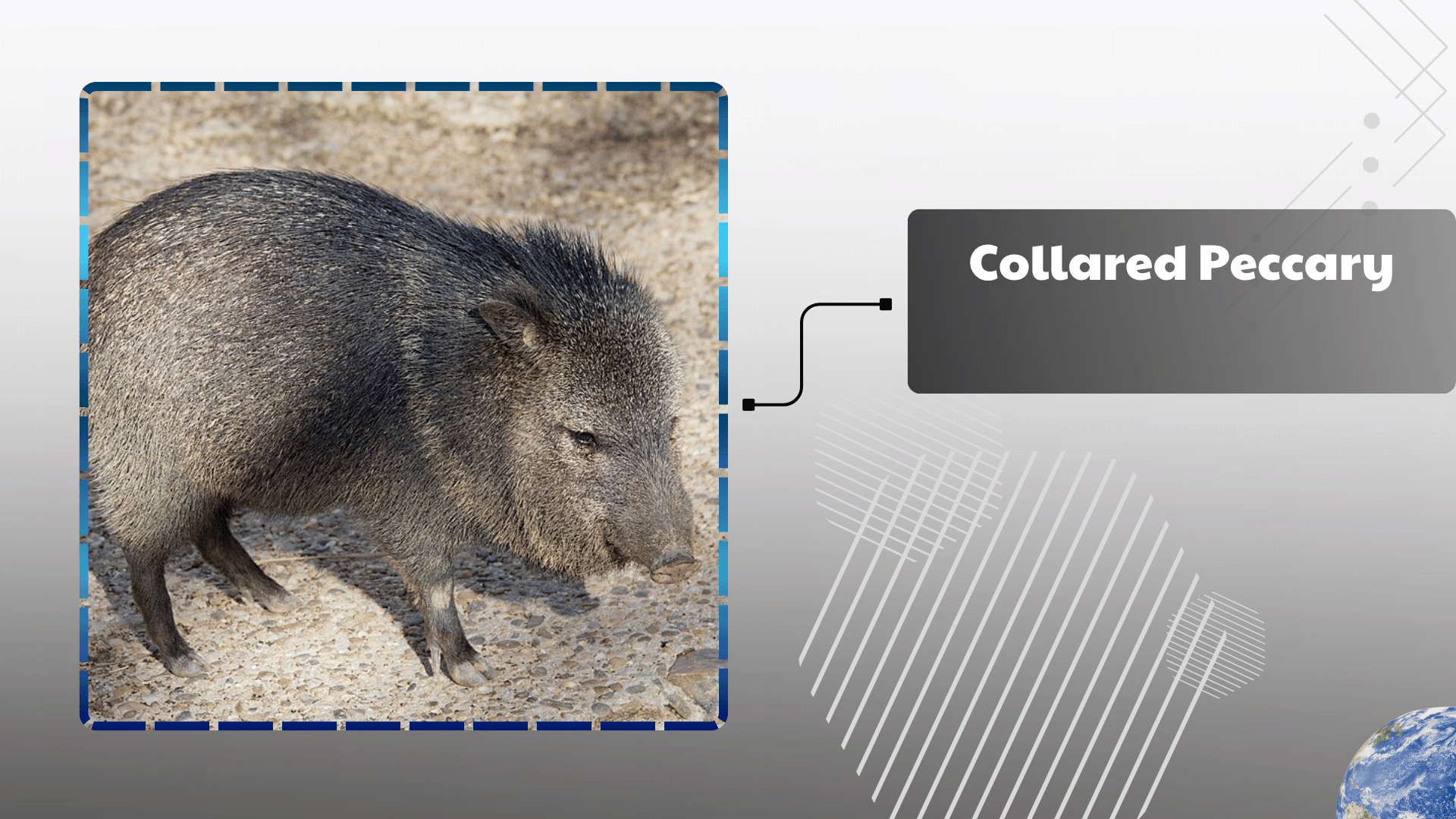
Scientific name: Dicotyles tajacu, also widely listed as Pecari tajacu.
The collared peccary is the most widespread and adaptable species. In the United States, it is commonly called a javelina, especially in Arizona, New Mexico, and Texas. Adults have a compact body, thin legs, small rounded ears, coarse gray-brown hair, and a short tail that is difficult to see. Its clearest field mark is a pale band of fur that curves from the chest across the shoulders like a loose collar.
This species occupies an unusually broad range of environments. It can live in Sonoran Desert scrub, thorn forest, tropical rainforest, savanna, dry woodland, and some agricultural or suburban edges. That flexibility helps explain why it has a much wider distribution than the other two peccaries. Its range extends from the southwestern United States through Mexico and Central America into much of South America.
Collared peccaries are omnivores, but plant material dominates most diets. In dry country, prickly pear pads and fruit can supply both food and moisture. Roots, bulbs, beans, seeds, fruits, grasses, and other vegetation are also eaten. Insects and other small animal matter may supplement the diet when available. The exact menu changes dramatically between deserts and tropical forests.
Most collared peccaries travel in social groups that are smaller than the enormous herds associated with white-lipped peccaries. They use scent from a dorsal gland to mark places and reinforce group identity. Mutual rubbing spreads the herd’s shared odor. Grunts, woofs, squeals, tooth clacking, posture, and scent all contribute to communication.
Although the species is globally listed as Least Concern, local populations can still be affected by habitat loss, roads, hunting, disease, and conflict near neighborhoods. Never corner or feed a javelina. Give the group an open escape route, keep dogs restrained, secure garbage and pet food, and observe from a distance.
2. White-Lipped Peccary
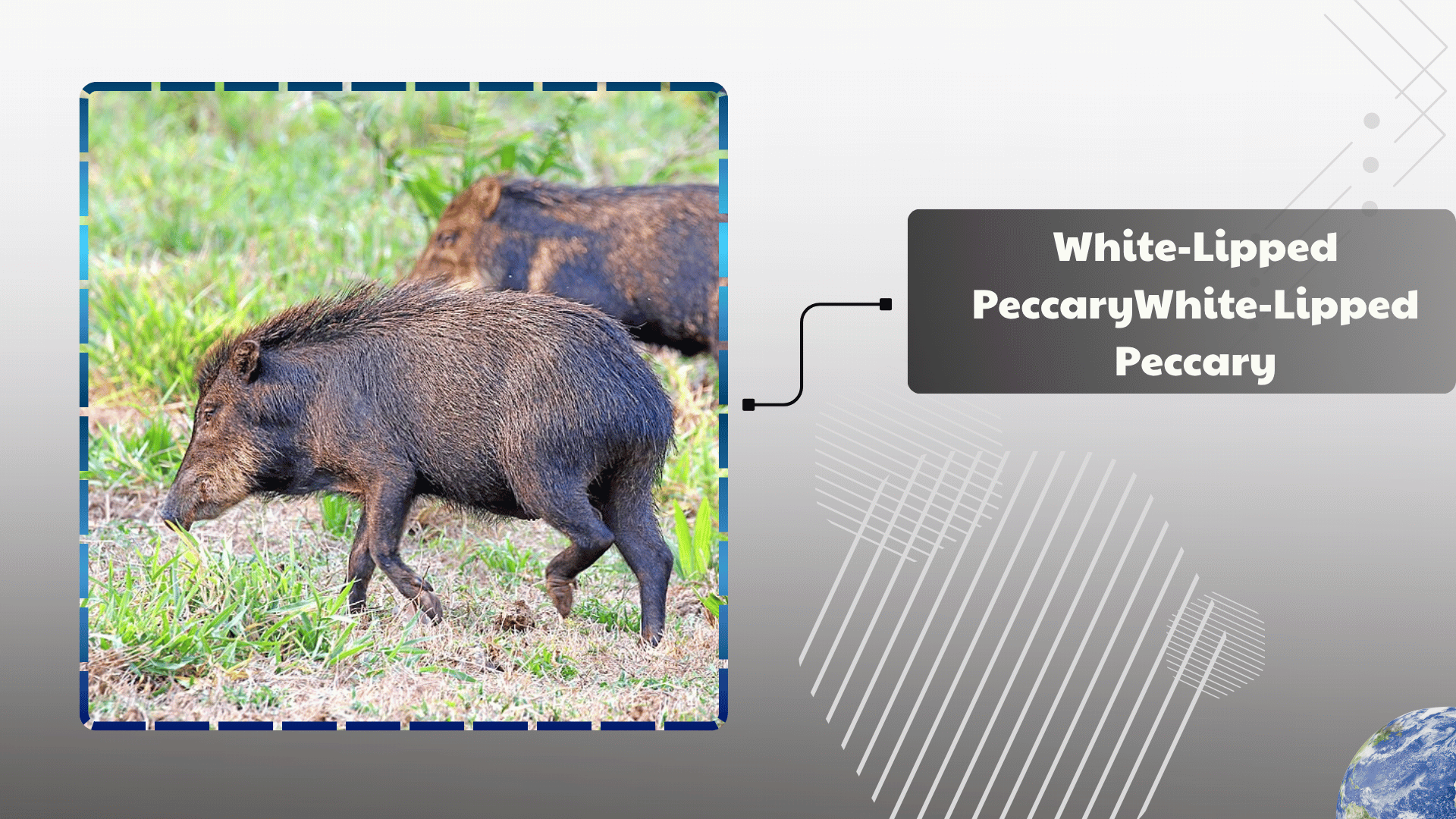
Scientific name: Tayassu pecari.
The white-lipped peccary is a dark, powerful forest animal named for the pale cream or white hair surrounding its mouth and lower face. It is generally larger and more heavily built than a collared peccary. The body is covered in coarse dark brown or blackish hair, and the pale muzzle can be visible even in dim forest conditions. Unlike the collared species, it does not have a complete light band around the shoulders.
Its range extends from southern Mexico through Central America and across much of tropical South America, but the distribution is increasingly fragmented. White-lipped peccaries favor extensive forest landscapes and also use seasonally flooded forest, wetlands, savannas, and other habitats where food, water, and safe travel routes remain available.
The species is famous for forming large, mobile herds. Group size varies with habitat quality, hunting pressure, season, and population condition. Historic or undisturbed herds may contain scores of animals, while fragmented landscapes often support much smaller groups. A moving herd can disturb leaf litter, turn soil, open trails, and influence plant regeneration over a broad area.
Observers may hear a herd before seeing it because many feet, feeding animals, and frequent contact calls create noticeable forest noise.
Fruit, seeds, palm nuts, roots, and other plant foods make up much of the diet. White-lipped peccaries have strong jaws that allow them to process hard foods, and their foraging can both destroy and disperse seeds. Earthworms, eggs, small vertebrates, and carrion may form a smaller portion of the diet.
The white-lipped peccary is classified as Vulnerable. Deforestation, fragmentation, hunting, roads, livestock interactions, and disease can disrupt its large-scale movements and social system. Its disappearance can signal that a forest has lost connectivity or faces intense human pressure. A white-lipped herd should never be approached on foot. Stay quiet, retreat without blocking its route, and follow local guides and protected-area rules.
3. Chacoan Peccary
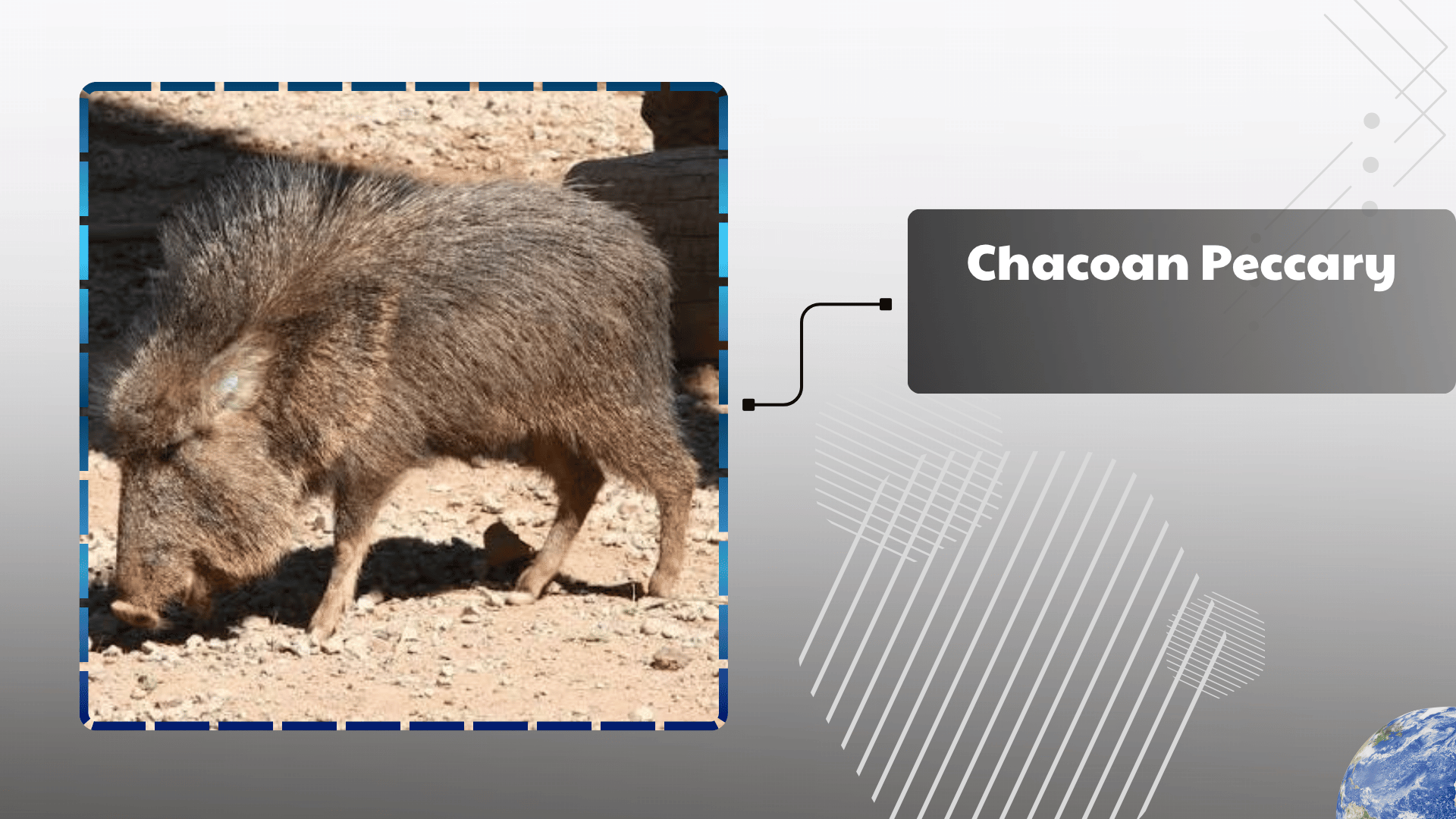
Scientific name: Parachoerus wagneri, also frequently listed as Catagonus wagneri.
The Chacoan peccary, or taguá, is the rarest of the three living species and is restricted to the Gran Chaco of Paraguay, Bolivia, and Argentina. It was first described scientifically from fossils and was believed to be extinct until researchers confirmed living animals in the 1970s. That history gives it an unusual place among modern mammal discoveries.
This is generally the largest living peccary. It has a heavy body, a long snout, relatively long ears and legs, coarse gray-brown fur, and a pale band over the shoulders. White hairs may occur around the mouth, which can cause confusion with the white-lipped species. Range is therefore an important clue: the Chacoan peccary is a specialist of the hot, dry thorn forests and scrub of the Gran Chaco, not a widespread humid-forest animal.
Its body is well suited to a dusty, thorn-filled landscape. The narrow feet help it move through dense vegetation, while the tough snout and strong teeth assist with handling fibrous plants. Cacti, roots, bromeliads, pods, fallen flowers, and other hardy vegetation are important foods. Chacoan peccaries may roll cactus pieces or manipulate them to reduce the spines before eating.
Chacoan peccaries usually occur in relatively small herds compared with the largest white-lipped groups. They mark vegetation and other objects with scent, visit mineral-rich sites, and use dust or mud wallows when conditions permit. Grunts, tooth clacking, scent, and body position help members coordinate and warn one another.
The species is listed as Endangered. Rapid conversion of Chaco forest to cattle pasture and cropland is a major threat, compounded by hunting, roads, isolation, and disease. Because its entire natural distribution is concentrated in one increasingly altered region, protecting connected native habitat is essential to its survival.
How Are These Wild Animals Classified?
Peccaries belong to the mammal order Artiodactyla, the group of even-toed hoofed mammals. Within that order, they form the family Tayassuidae. True pigs and wild boars belong to a different family, Suidae. The two families share an older evolutionary relationship, but they are distinct lineages.
| Classification Level | Peccary Classification |
|---|---|
| Class | Mammalia |
| Order | Artiodactyla |
| Suborder or clade | Suina |
| Family | Tayassuidae |
| Living species | Collared, white-lipped, and Chacoan peccaries |
Scientific names may differ among current databases. The collared peccary appears as either Dicotyles tajacu or Pecari tajacu. The Chacoan peccary appears as either Parachoerus wagneri or Catagonus wagneri. These are alternate combinations for the same animals, not separate species.
A proposed animal called the giant peccary was described from Brazil as Pecari maximus. It has not gained broad acceptance as a fourth living species, and standard modern mammal lists continue to recognize three. Articles that list four types should explain this taxonomic dispute rather than presenting the proposed species as settled fact.
Peccary vs. Pig: Key Differences
Peccaries resemble pigs because both are hoofed mammals adapted for rooting and omnivorous feeding. However, several features separate them:
- Native range: Living peccaries are native to the Americas; true pigs evolved in the Old World, although feral pigs now occur widely.
- Family: Peccaries belong to Tayassuidae, while pigs belong to Suidae.
- Canines: Peccary tusks are relatively short and point more vertically, meeting and sharpening against one another.
- Scent gland: Peccaries have a conspicuous scent gland on the rump or lower back.
- Tail: A peccary’s tail is very short and often hidden in the hair.
- Social scent: Herd members commonly rub against one another and share a recognizable group odor.
From a distance, use several traits together. A lone feral pig can overlap with a peccary in size or color, and poor light can hide the collar or pale lips.
Where Do These Wild Animals Live?
Peccaries occur only in the New World. The collared species has the broadest ecological tolerance, ranging from hot deserts and scrublands to tropical forests. It is the only peccary naturally found in the United States. White-lipped peccaries are associated mainly with tropical Central and South America and depend strongly on large connected landscapes. Chacoan peccaries are confined to dry Gran Chaco habitat in the center of South America.
Where two or three species overlap, they reduce direct competition through differences in herd movement, habitat use, jaw strength, and food selection. Seasonal fruiting, water availability, hunting pressure, fire, flooding, and forest cover can all change where animals are encountered.
How to Identify Different Types of Peccaries
- Shoulder marking: A clear pale collar favors the collared peccary. A light shoulder band on a large Gran Chaco animal may indicate the Chacoan species.
- Muzzle color: A strongly contrasting white mouth on a dark body points to a white-lipped peccary.
- Size: Chacoan and white-lipped peccaries are generally heavier than collared peccaries, but distance can make size unreliable.
- Ears and snout: The Chacoan species has relatively long ears and an elongated snout.
- Herd size: A very large tropical-forest herd suggests white-lipped peccaries, though group size varies and should not be used alone.
- Habitat: Desert or suburban scrub in the southwestern United States indicates collared peccaries. Dry Chaco thorn forest points toward the Chacoan species.
- Coat: All species have coarse, bristly hair, generally in gray, brown, or dark tones.
- Scent: A strong musky odor may reveal that a group recently passed, but observers should never move closer simply to confirm it.
Peccary Tracks, Droppings, and Other Signs
Peccary tracks usually show two main toes and can resemble small pig or deer prints. The toes tend to look compact and rounded, but mud, speed, substrate, and overlapping tracks create variation. Dewclaw marks may appear in soft ground. Track size alone is rarely enough to determine the species.
Look for clusters of prints on well-used paths, rooted soil, chewed cactus pads, opened fruit, wallows, hair on rough bark, and musky scent marks. Droppings vary with diet and moisture. Because feral pigs may occupy some of the same landscapes, combine signs with camera images, range, herd behavior, and local expertise.
What Do Peccaries Eat?
All three species are omnivorous, yet vegetation usually forms the bulk of their diets. Collared peccaries are dietary generalists that switch between cactus, fruit, seeds, roots, grasses, and invertebrates. White-lipped peccaries eat large quantities of forest fruits, seeds, and nuts and can crack foods unavailable to weaker-jawed competitors. Chacoan peccaries specialize on the tough plants of dry thorn forest, including cacti and bromeliads.
Feeding behavior affects entire ecosystems. Peccaries disperse some seeds, destroy others, disturb soil, create paths, and influence which seedlings survive. They also serve as prey for jaguars, pumas, and other large predators. Removing peccaries can therefore alter both vegetation and food webs.
Outdoor Tips for Finding and Observing Peccaries
- Search at dawn, dusk, or other locally active periods, adjusting for season and heat.
- Scan forest roads, game trails, water sources, fruiting trees, cactus patches, and muddy crossings from a safe distance.
- Listen for low grunts, rustling leaf litter, hoof movement, and tooth clacking.
- Stay downwind when practical, because peccaries depend heavily on scent.
- Use binoculars or a telephoto lens instead of approaching for a closer image.
- Never separate a young animal from its group or stand between herd members.
- Keep dogs leashed and far away; a barking or chasing dog can trigger a defensive response.
- Do not feed peccaries or leave food, garbage, compost, or pet food accessible.
- Follow hunting, photography, park, and protected-species rules in the exact location you visit.
- Report unusual sightings through an appropriate local wildlife agency or community-science program without broadcasting sensitive locations.
Safety, Sustainability, and Conservation Notes
Peccaries generally avoid people, but any wild animal can defend itself when trapped, injured, pursued by a dog, protecting young, or blocked from escape. If a herd is close, remain calm, create space, and move away slowly. Do not run toward the animals, imitate calls, attempt to touch them, or surround them for photographs.
Legal protection and hunting rules differ by country, state, province, protected area, species, and season. A collared peccary may be a regulated game animal in one location and protected in another. The white-lipped and Chacoan species face more serious conservation pressures, and illegal hunting can compound habitat loss. Always verify current local rules with the responsible wildlife authority.
Habitat protection is especially important for white-lipped peccaries because their large herds travel across extensive areas. Forest corridors allow feeding movements and gene flow. Chacoan peccaries require intact native thorn forest in a region undergoing rapid land conversion. Sustainable conservation should also involve local and Indigenous communities whose food security, rights, knowledge, and land stewardship are connected to peccary landscapes.
Fun Facts About Peccaries
- Peccaries are often called New World pigs, but they belong to a separate family from true pigs.
- The word javelina usually refers to the collared peccary in the southwestern United States.
- All living peccaries have a scent gland on the rump or lower back.
- Herd members rub against one another to share scent and reinforce group identity.
- White-lipped peccaries can travel in much larger groups than the other species.
- The Chacoan peccary was known from fossils before scientists confirmed that it was still alive.
- Peccary canines point downward more than the curved tusks of many true pigs.
- Collared peccaries can obtain moisture from succulent plants in dry environments.
- Peccary foraging can disperse seeds, kill seeds, turn soil, and shape plant communities.
- Three peccary species may share parts of the Gran Chaco, making habitat and field marks essential for identification.
Final Thoughts on Types of Peccaries
The three living types of peccaries are the collared peccary, white-lipped peccary, and Chacoan peccary. A pale neck collar identifies the widespread collared species, white fur around the mouth distinguishes the forest-dependent white-lipped species, and a large body with long ears helps identify the rare Chacoan species in its dry thorn-forest home. Learning their markings, range, and group behavior makes identification more reliable while encouraging safe observation and stronger protection for the landscapes they help shape.
Frequently Asked Questions
1. What is a peccary?
A peccary is a medium-sized, hoofed mammal native to the Americas. It resembles a pig but belongs to the separate family Tayassuidae. Peccaries are social, scent-oriented omnivores with short tails and compact bodies.
2. How many species of peccaries are there?
Modern standard references recognize three living species: the collared, white-lipped, and Chacoan peccaries. A proposed giant peccary has not been broadly accepted as a fourth species.
3. What are the three types of peccaries?
They are the collared peccary, Dicotyles tajacu; white-lipped peccary, Tayassu pecari; and Chacoan peccary, Parachoerus wagneri. Alternate genus names occur in older and current references.
4. Is a javelina a peccary?
Yes. In the southwestern United States, javelina is the common name for the collared peccary. The term does not usually refer to the white-lipped or Chacoan species.
5. Is a peccary a pig?
No. Peccaries and pigs are related even-toed mammals, but peccaries belong to Tayassuidae and true pigs belong to Suidae. Their teeth, scent glands, tails, and evolutionary histories differ.
6. Are peccaries wild boars?
No. A wild boar is Sus scrofa, a true pig native to Eurasia and introduced elsewhere. Peccaries are native American mammals in another family.
7. Where do peccaries live?
Peccaries live from the southwestern United States through Mexico, Central America, and much of South America. The exact range differs by species, with the Chacoan peccary restricted to the Gran Chaco.
8. Which peccary lives in the United States?
The collared peccary is the only species native to the United States. It occurs mainly in Arizona, New Mexico, and Texas, with local distribution shaped by habitat and water availability.
9. How can I identify a collared peccary?
Look for a stocky gray-brown animal with a pale line curving around the neck and shoulders. Its ears are small, its tail is nearly invisible, and it often travels in a modest-sized group.
10. How can I identify a white-lipped peccary?
Look for a dark, robust peccary with a contrasting pale or white area around the mouth. It is primarily a tropical species and may occur in large, noisy, mobile herds.
11. How can I identify a Chacoan peccary?
Look for a large peccary with long ears, a long snout, coarse gray-brown hair, and pale markings on the shoulders. Location in dry Gran Chaco thorn forest is one of the strongest clues.
12. Which is the largest peccary?
The Chacoan peccary is generally considered the largest living species. White-lipped peccaries can also be large, so body size should be combined with markings, ear shape, habitat, and range.
13. Which peccary is the rarest?
The Endangered Chacoan peccary has the most restricted range and is generally regarded as the rarest living species. It depends on native habitat within the Gran Chaco.
14. What do peccaries eat?
They eat mainly plant material, including fruits, seeds, roots, grasses, cactus, and other vegetation. Insects, eggs, small animals, and carrion may provide a smaller part of the diet.
15. Do peccaries eat cactus?
Yes. Cactus is important to collared peccaries in arid parts of their range and to Chacoan peccaries in dry thorn forest. It can supply food and, in some environments, moisture.
16. Do peccaries have tusks?
Peccaries have enlarged canine teeth that function as short tusks. They point more vertically than the curved tusks of many true pigs and can be used in defense.
17. Why do peccaries smell musky?
A gland on the rump or lower back produces a strong-smelling secretion. Peccaries use scent to mark objects, communicate, and maintain a shared herd odor through mutual rubbing.
18. Do peccaries travel in herds?
Yes. All three species are social, but herd size varies. Collared and Chacoan peccaries usually form smaller groups, while white-lipped peccaries can assemble in very large herds.
19. Are peccaries dangerous to people?
They usually avoid people, but they can bite or charge if cornered, threatened, injured, pursued by a dog, or prevented from escaping. Never approach, feed, chase, or surround them.
20. What should I do if I encounter a peccary?
Stay calm, keep your distance, and leave the animal a clear escape route. Restrain pets, move away slowly, and avoid getting between herd members or approaching young.
21. Why should people not feed javelinas?
Feeding teaches them to associate people and homes with food. This can increase property damage, disease risk, pet conflicts, and defensive encounters, often leading to poor outcomes for the animals.
22. Can peccaries see well?
They rely strongly on smell and hearing, while vision is generally less important. Their sensitivity to scent helps them locate food, recognize herd members, and detect threats.
23. What sounds do peccaries make?
Peccaries communicate with grunts, woofs, squeals, snorts, and tooth clacking. The meaning depends on context and may include contact, alarm, submission, or warning.
24. Are collared peccaries endangered?
The collared peccary is globally categorized as Least Concern, but that does not mean every local population is secure. Habitat loss, roads, disease, and excessive hunting can cause regional declines.
25. Are white-lipped peccaries endangered?
The species is globally listed as Vulnerable. It has disappeared from parts of its former range, and populations are threatened by forest loss, fragmentation, hunting, disease, and disrupted movement.
26. Why is the Chacoan peccary endangered?
Its natural range is limited to the Gran Chaco, where extensive native forest has been converted for ranching and agriculture. Hunting, roads, fragmentation, and disease add further pressure.
27. What is the giant peccary?
The giant peccary was proposed as Pecari maximus from Brazil. Its validity as a distinct species has been disputed, and it is not included as a fourth living species in widely used modern mammal classifications.
28. Why do scientific names for peccaries vary?
Taxonomists revise genus names as they study nomenclature, fossils, anatomy, and genetics. Thus, collared and Chacoan peccaries may appear under different genera even though the common species being discussed is the same.
29. What role do peccaries play in ecosystems?
They disperse and destroy seeds, turn soil, browse plants, make trails and wallows, and provide prey for large carnivores. These activities can influence forest structure and food webs.
30. Can peccaries and feral pigs live in the same area?
Yes, their ranges overlap in some places. Feral pigs may compete for food, damage habitat, or spread disease, making accurate identification and responsible invasive-species management important.