

Searching for the different types of mountain goats often leads to confusing lists filled with ibex, tahrs, wild sheep, and goat-antelopes. Scientifically, however, the answer is much simpler: there is only one living mountain goat species, Oreamnos americanus. Rocky Mountain goat, snow goat, and white goat are alternate names for the same North American animal, not separate species.
This field guide explains how to identify the true mountain goat, where it lives, what it eats, how it survives cliffs and severe winters, and how males, females, and kids differ. It also compares the animals most commonly mistaken for mountain goats so wildlife watchers can use the name accurately.
What Are the Main Types of Mountain Goats?
There is only one living type of mountain goat: the North American mountain goat, Oreamnos americanus. It is also known as the Rocky Mountain goat, snow goat, or white goat. Scientists currently place all living populations in this single species, without widely accepted living subspecies. Animals such as Alpine ibex, Himalayan tahr, chamois, and Dall sheep are mountain-dwelling relatives or lookalikes, not additional mountain goat species.
| Accepted Type | Scientific Name | Natural Range | Key Features | Conservation Status |
|---|---|---|---|---|
| North American mountain goat | Oreamnos americanus | Mountainous western North America | Shaggy white coat, black horns, black hooves, beard, muscular shoulders | Least Concern globally, with some vulnerable local populations |
1. North American Mountain Goat
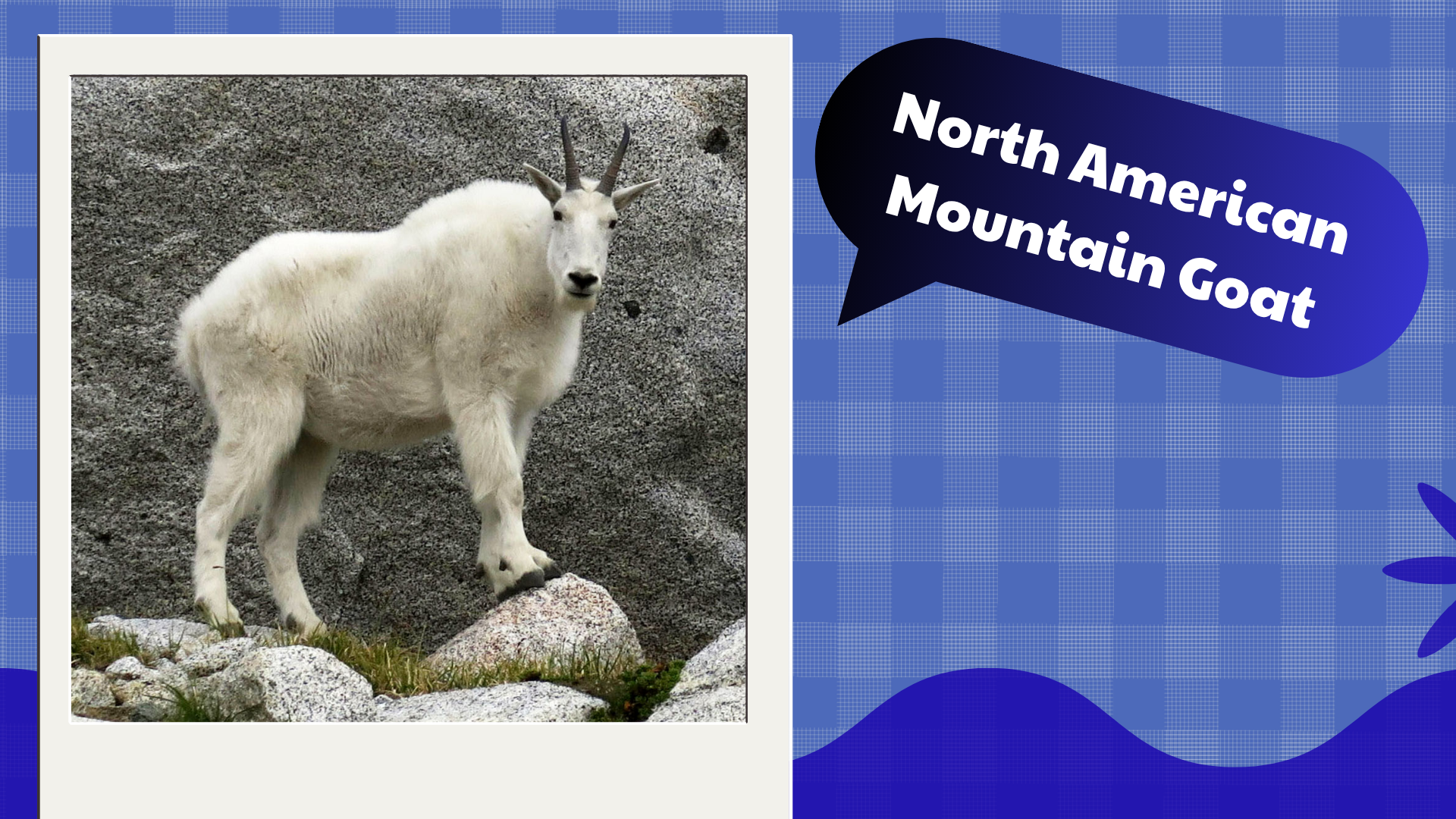
The North American mountain goat, Oreamnos americanus, is the only living species in its genus. Despite its name and goat-like appearance, it is not a true goat in the genus Capra. It belongs to the broader goat-and-antelope subfamily Caprinae and is more closely associated with goat-antelopes than with domestic goats. Its natural range follows the rugged western mountains of North America, from southeastern Alaska and parts of the Yukon through British Columbia and Alberta, then south into the northwestern United States.
An adult is easy to recognize when seen clearly. Both sexes have a bright white or cream-colored coat, a narrow black muzzle, black hooves, a short tail, and slender black horns that curve gently backward. A long beard hangs below the chin. The body looks front-heavy because powerful shoulders and forequarters help the animal climb. In winter, a dense woolly undercoat and long hollow guard hairs form a shaggy layer; in spring and early summer, loose patches of shedding hair may make an otherwise healthy goat look untidy.
Mountain goats occupy cliffs, rocky escape terrain, alpine meadows, and subalpine slopes. Their split hooves can spread for balance, while hard outer edges grip small projections and rubbery inner pads improve contact with rock. They eat grasses, sedges, herbs, mosses, lichens, leaves, twigs, and low-growing shrubs. Seasonal movements may take them to mineral licks or lower winter slopes, but access to steep refuge terrain remains central to their survival.
Females, called nannies, often form nursery groups with kids, while adult males, or billies, are more likely to live alone or in small groups outside the autumn rut. The species is globally categorized as Least Concern, yet that broad label can hide local declines. Slow reproduction, harsh winters, avalanches, hunting pressure, disease, recreation, habitat change, and disturbance around kidding areas can affect individual herds. Introduced populations may also damage sensitive alpine plants or compete with native ungulates, so a mountain goat can be a valued native species in one range and a management concern in another.
Why Is There Only One Living Type of Mountain Goat?
The common name mountain goat belongs specifically to Oreamnos americanus. Mammal taxonomists currently recognize Oreamnos as a genus with one living species. Several regional subspecies names appeared in older literature, but modern species databases generally treat those names as synonyms rather than accepted living subspecies.
Confusion develops because many unrelated or distantly related hoofed mammals live on mountains and resemble goats. A casual phrase such as “mountain goats of the world” may include true goats, ibex, tahrs, serows, gorals, chamois, and even wild sheep. That grouping is useful when discussing mountain-adapted hoofed mammals, but it is not a list of species within the animal properly named the mountain goat.
There was also an extinct species called Harrington’s mountain goat, Oreamnos harringtoni. It lived in western North America during the Pleistocene and disappeared thousands of years ago. It is a genuine former member of the mountain goat genus, but it should not be counted in a guide to living types.
Mountain Goat Names That Do Not Represent Different Types
| Name | What It Means | Separate Species? |
|---|---|---|
| Mountain goat | The standard common name for Oreamnos americanus | No |
| Rocky Mountain goat | An alternate common name for the same animal | No |
| Snow goat | An informal name referring to its white coat and alpine habitat | No |
| White goat | Another informal name based on coat color | No |
| Coastal mountain goat | A descriptive label for goats in coastal ranges | No |
Animals Commonly Mistaken for Mountain Goats
| Animal | Scientific Group | Main Difference |
|---|---|---|
| Alpine ibex | Capra ibex | Brown-gray true goat with massive, strongly ridged horns |
| Siberian ibex | Capra sibirica | Central Asian true goat with long scimitar-shaped horns |
| Himalayan tahr | Hemitragus jemlahicus | Brown Asian caprine; males have a long mane and shorter curved horns |
| Chamois | Rupicapra | Smaller Eurasian goat-antelope with hook-tipped horns |
| Goral | Naemorhedus | Compact Asian goat-antelope, usually gray or brown |
| Serow | Capricornis | Dark, shaggy Asian goat-antelope associated with forested slopes |
| Dall sheep | Ovis dalli | White wild sheep; mature rams have large curling amber horns |
| Bighorn sheep | Ovis canadensis | Brown wild sheep; rams carry massive curled horns |
How Are These Wild Animals Classified?
The mountain goat belongs to the kingdom Animalia, phylum Chordata, class Mammalia, order Artiodactyla, family Bovidae, subfamily Caprinae, genus Oreamnos, and species Oreamnos americanus. Bovids include cattle, antelopes, sheep, goats, and their relatives. Caprinae contains many stocky hoofed mammals adapted to cool, rocky, or mountainous environments.
A mountain goat is therefore not a deer and not a true goat. Deer belong to Cervidae and usually grow antlers that are shed and regrown. Mountain goats have permanent horns with a bony core covered by keratin. True goats belong to the genus Capra, whereas the mountain goat stands alone in the living genus Oreamnos.
Where Do Mountain Goats Live?
The native range of the mountain goat lies in western North America. It extends from southeastern and south-central Alaska through western Canada and into portions of Washington, Idaho, Montana, and nearby northern Rocky Mountain areas. British Columbia holds a particularly large share of the global population.
People have introduced mountain goats to additional ranges, including parts of Colorado, Utah, Wyoming, South Dakota, Nevada, Oregon, and Washington’s Olympic Peninsula. An introduced herd may look completely wild but still occur outside the species’ historical native distribution. This distinction matters because wildlife agencies may protect native herds while controlling or removing non-native ones to reduce damage to alpine vegetation or competition with native animals.
Within a mountain range, goats use steep cliffs and broken rock as escape terrain. Feeding areas may include alpine meadows, avalanche chutes, subalpine forest openings, windswept ridges, and coastal slopes. Elevation varies greatly: some coastal goats descend close to sea level, while interior herds can occupy terrain far above the tree line.
How to Identify Different Types of Mountain Goats
- Coat: Look for a white or creamy double coat that becomes long and shaggy in winter.
- Horns: Both sexes have slender black horns with a gentle backward curve.
- Face: The black nose and dark eyes contrast sharply with the white head.
- Body shape: High, muscular shoulders create a powerful, slightly hunched front profile.
- Legs and hooves: Dark hooves and sturdy legs are visible beneath the long coat.
- Beard: Adult males and females both develop a noticeable beard.
- Habitat: Cliffs, ledges, talus, and alpine slopes are more typical than open lowland fields.
- Movement: Mountain goats climb deliberately and confidently across steep broken rock.
- Season: Patchy hair in late spring or early summer usually indicates molting, not a separate color type.
- Range: A wild, native mountain goat should be in western North America, not Europe or Asia.
How to Tell a Billy From a Nanny
Sexing mountain goats at a distance can be difficult because both males and females are white, bearded, and horned. Adult billies are usually larger, with thicker horn bases, a heavier chest, and a longer beard. Their horns may curve more evenly along their length.
Nannies tend to have slimmer horns with a more abrupt curve near the tips. The gap between their horn bases can appear wider. Behavior provides another clue: a female accompanied by a kid is a nanny, while a large solitary adult in summer is more likely to be a billy. None of these clues is perfect from a single poor view, so observers should combine body shape, horn structure, group composition, and season.
Mountain Goat Adaptations for Climbing and Cold
A mountain goat’s hooves are specialized for rock. The two toes can spread to increase stability, hard outer walls catch narrow edges, and softer central pads add friction. Dewclaws may help on steep or loose surfaces. Strong forequarters allow the animal to pull upward, while a relatively low center of mass helps maintain balance.
The white coat is equally important. Fine insulating wool lies beneath long guard hairs that shed moisture and trap air. This combination protects goats from wind, snow, and severe cold. Their compact ears and sturdy body reduce exposure, but winter remains dangerous. Deep snow limits food, and avalanches can cause substantial mortality in some regions.
What Do Mountain Goats Eat?
Mountain goats are ruminant herbivores. Depending on season and location, they eat grasses, sedges, rushes, flowering herbs, ferns, mosses, lichens, leaves, twigs, and low shrubs. Summer offers the widest selection, while winter forces goats to paw through snow, browse exposed plants, or use windswept slopes where forage remains accessible.
Minerals are important, especially to females after giving birth. Goats may travel considerable distances to natural mineral licks. Human sweat, urine, food, and salted surfaces can also attract them, creating unsafe encounters near camps and trails. Visitors should keep food and salty equipment secured and never encourage a goat to approach.
Mountain Goat Behavior and Life Cycle
Mountain goat society differs from the head-butting image associated with wild sheep. Their sharp horns can be used in slashing or stabbing movements, and females may be particularly assertive when competing for space or protecting kids. Submissive animals reduce conflict by yielding rather than escalating every encounter.
The rut generally occurs in late autumn. Males display, follow females, and compete for breeding opportunities. After a gestation of roughly six months, most nannies give birth to a single kid in late spring, although twins sometimes occur. Young goats can stand and begin moving over broken ground soon after birth, but they depend on their mothers for protection and guidance.
Nannies often select steep nursery terrain that reduces access for many predators. Kids remain close to their mothers through their first year. Adult males are more solitary during much of the year, whereas females and young may gather in larger nursery groups.
Outdoor Tips for Finding and Observing Mountain Goats
- Check current park or wildlife-agency reports before choosing a viewing location.
- Scan light-colored rock carefully because a white goat may resemble a lingering snow patch.
- Look across valleys and below ridgelines with binoculars before hiking closer.
- Visit during cooler morning or evening periods when goats may be feeding.
- Stay on designated trails and viewpoints where required.
- Keep extra distance from nannies with kids and from goats using mineral licks.
- Never block the route between a goat and its escape terrain.
- Carry layers, navigation tools, water, and traction appropriate for sudden mountain weather.
- Use a telephoto lens instead of approaching for a close image.
- Turn around if terrain, snow, weather, or animal behavior becomes unsafe.
Safety, Sustainability, and Conservation Notes
Mountain goats may appear calm, but they are powerful wild animals with sharp horns. Never feed, touch, surround, or follow one. If a goat approaches, do not offer food or crouch for a photograph. Give it an open path, maintain awareness of cliff edges, and follow the distance guidance of the managing park or wildlife agency.
Signs of disturbance include repeated staring, stopping normal feeding, moving away, bunching tightly, or placing a nanny between a kid and the observer. Back away before the animal is forced to flee. Dogs can cause serious stress and may provoke defensive behavior, so obey leash restrictions and area closures.
Globally, the species is considered Least Concern, but local herds can decline because mountain goats reproduce slowly. Climate change, severe winters, avalanches, disease, roads, industrial development, habitat fragmentation, recreation, and poorly managed harvest can all matter. Introduced populations create a different conservation problem when they damage rare alpine vegetation or compete with native bighorn sheep. Sustainable management must therefore be specific to each herd and landscape.
Fun Facts About Mountain Goats
- There is only one living mountain goat species.
- The mountain goat is not a true goat in the genus Capra.
- Both males and females grow black horns and beards.
- A male is called a billy, a female a nanny, and a youngster a kid.
- Mountain goat horns are permanent and are not shed annually.
- Their hooves combine hard gripping edges with softer inner pads.
- Kids begin testing their climbing ability soon after birth.
- The white winter coat contains both dense insulating wool and longer guard hairs.
- Some populations live in wet coastal mountains, while others occupy high interior ranges.
- An extinct relative called Harrington’s mountain goat once lived farther south in western North America.
Final Thoughts on Types of Mountain Goats
The most accurate answer to the question about types of mountain goats is one: Oreamnos americanus. Rocky Mountain goat, snow goat, and white goat are names for that same remarkable species. Its shaggy white coat, slim black horns, muscular shoulders, and cliff-gripping hooves make it unlike any lookalike. Recognizing the difference between a true mountain goat and an ibex, tahr, chamois, or wild sheep improves field identification and helps travelers understand why local conservation rules vary from one mountain range to another.
Frequently Asked Questions
1. How many types of mountain goats are there?
There is one living mountain goat species, Oreamnos americanus. Different common names and regional populations do not represent separate accepted species.
2. What is the scientific name of the mountain goat?
The scientific name is Oreamnos americanus. It is the only living member of the genus Oreamnos.
3. Is a Rocky Mountain goat a separate type?
No. Rocky Mountain goat is an alternate common name for the North American mountain goat.
4. Is a snow goat a separate species?
No. Snow goat is an informal name inspired by the animal’s white coat and snowy habitat.
5. Are there mountain goat subspecies?
Older sources proposed several regional subspecies, but current major mammal references generally treat the living mountain goat as one species without accepted subspecies. Historic names are usually listed as synonyms.
6. Are mountain goats true goats?
No. True goats belong to the genus Capra. The mountain goat belongs to Oreamnos, although both are members of the caprine subfamily.
7. Are mountain goats antelopes?
They are often described as goat-antelopes because of their evolutionary relationships within Bovidae. That label is informal and does not make them members of a single scientific antelope group.
8. Are ibex types of mountain goats?
No. Ibex are true wild goats in the genus Capra. They also live in mountains, but they are not Oreamnos americanus.
9. Are Himalayan tahrs mountain goats?
No. The Himalayan tahr is a separate Asian caprine species with a brown coat, a heavy male mane, and different horns.
10. Are Dall sheep and mountain goats the same?
No. Both can be white and live in northwestern mountains, but Dall sheep are wild sheep. Mature rams have large curled horns, whereas mountain goats have slim black horns.
11. Are bighorn sheep mountain goats?
No. Bighorn sheep belong to the genus Ovis. Their brown coat and massive curled male horns differ from the white coat and slender horns of mountain goats.
12. Where do mountain goats live naturally?
They are native to rugged mountain systems of western North America, from parts of Alaska and the Yukon through western Canada and into the northwestern United States.
13. Do mountain goats live in Colorado?
Yes, mountain goats live in Colorado, but they were introduced there rather than forming part of the state’s original native fauna.
14. Do mountain goats live in Europe?
True mountain goats do not occur naturally in Europe. European climbers such as Alpine ibex and chamois are different animals.
15. Do mountain goats live in the Himalayas?
No. Himalayan mountains contain several goat-like mammals, but the North American mountain goat does not naturally live there.
16. What color are mountain goats?
Adults and kids are generally white to creamy white. Dirt, shade, shedding hair, and wet conditions can make the coat appear grayish or yellowish.
17. Why are mountain goats white?
The white coat is part of their cold-weather insulation and may also reduce visual contrast in snowy alpine landscapes. Its dense structure matters more for survival than color alone.
18. Do female mountain goats have horns?
Yes. Nannies have black horns just like billies, although their horn bases are usually slimmer and their body build is lighter.
19. How can you tell a male from a female mountain goat?
Billies are generally larger with thicker horn bases and heavier shoulders. Nannies tend to have slimmer horns, and an adult accompanying a kid is most likely female.
20. What is a baby mountain goat called?
A baby mountain goat is called a kid. Most births occur in late spring after approximately six months of gestation.
21. What do mountain goats eat?
They eat grasses, sedges, herbs, ferns, mosses, lichens, leaves, twigs, and shrubs. Diet changes with season and local plant availability.
22. How do mountain goats climb cliffs?
Their split hooves spread for balance. Hard outer edges grip small rock projections, while softer inner pads increase friction against uneven surfaces.
23. Do mountain goats ever fall?
Yes. Their climbing ability is exceptional but not perfect. Falls, rockslides, and avalanches can injure or kill them.
24. How high can mountain goats live?
They can occupy alpine areas well above the tree line, sometimes above 13,000 feet in southern parts of their range. Coastal populations may also use much lower elevations.
25. How long do mountain goats live?
Many live roughly 12 to 15 years in the wild, although survival varies with sex, location, weather, tooth wear, predation, disease, and hunting.
26. What predators hunt mountain goats?
Potential predators include cougars, wolves, bears, wolverines, lynxes, and golden eagles that may attack young kids. Cliffs provide essential refuge.
27. Are mountain goats dangerous?
They can be. Their sharp horns, strength, and defensive behavior make close encounters risky, particularly when goats are habituated to people or protecting young.
28. Why do mountain goats approach hikers?
Some seek salt from sweat, urine, food, or gear. Human feeding can reinforce this behavior, which is why food and salty items must be secured.
29. Should you feed a mountain goat?
No. Feeding changes natural behavior, brings goats dangerously close to people, and can contribute to illness, conflict, or the animal’s removal.
30. What should you do if a mountain goat approaches?
Stay calm, do not feed it, avoid crouching near the animal, and create distance without moving toward a cliff edge. Leave a clear route for the goat and follow local agency guidance.
31. When do mountain goats shed their coats?
They usually molt during spring and early summer. Loose sheets and patches of white hair are normal during this period.
32. Do mountain goats lose their horns?
No. Their horns are permanent and grow throughout life. They are not shed annually like deer antlers.
33. Can horn rings tell a mountain goat’s age?
Annual growth rings can help trained observers estimate age after the early years. Accurate counting requires a clear view and knowledge of false or partial rings.
34. Are mountain goats endangered?
The species is globally listed as Least Concern, but individual populations can be small, isolated, or declining. Local status is more useful than the global category when assessing a particular herd.
35. What threatens mountain goats?
Threats can include severe winters, avalanches, disease, habitat fragmentation, climate change, disturbance, development, and unsustainable harvest. The importance of each threat differs by region.
36. Why are introduced mountain goats a concern?
Outside their native range, dense goat populations may trample rare alpine plants, alter soils, or compete with native ungulates. Wildlife agencies may control or relocate them for ecosystem protection.
37. What was Harrington’s mountain goat?
Harrington’s mountain goat, Oreamnos harringtoni, was an extinct relative from the Pleistocene of western North America. It is not one of the living types of mountain goats.
38. What is the best way to photograph mountain goats?
Use binoculars to locate them and a telephoto lens for photographs. Stay on safe ground, avoid blocking travel routes, and stop approaching before the goat changes its behavior.
39. When is the best time to see mountain goats?
Morning and evening can be productive feeding periods, while summer often offers easier trail access. The best timing depends on local snow, seasonal closures, and herd movements.
40. Why is accurate mountain goat identification important?
Correct identification prevents confusion with protected, hunted, native, or introduced species. It also helps wildlife watchers report observations clearly and follow the right local rules.