

Understanding the types of Savannah cats requires two separate systems. Filial labels such as F1, F2, and F3 describe how many generations a cat is removed from a serval ancestor. Color labels describe the coat, while registration codes such as A, B, C, and SBT describe pedigree structure. These labels can affect appearance and breeding status, but they never guarantee an individual cat’s size, personality, or suitability for a home.
What Are the Main Types of Savannah Cats?
Savannahs are most commonly grouped as F1 through F5 and later generations. Earlier-generation cats generally have a closer serval ancestor and may show more pronounced hybrid traits, while later generations are more consistently domestic in ancestry and type. TICA’s standard colors are brown black spotted tabby, black silver spotted tabby, black, and black smoke.
Savannah Generations at a Glance
| Label | Serval relationship | General ownership note |
|---|---|---|
| F1 | One serval parent | Most specialized management and greatest legal concern |
| F2 | Serval grandparent | Still highly athletic and demanding |
| F3 | Serval great-grandparent | Often more practical, but individual variation remains |
| F4 | Four generations removed | Closer to established domestic breed generations |
| F5 and later | Five or more generations removed | Often selected for consistent Savannah type |
| SBT | Three preceding generations of Savannah-to-Savannah breeding | A pedigree status, not a serval-percentage claim |
1. F1 Savannah Cat
An F1 has a serval parent and a domestic-cat parent, making it the earliest Savannah generation. These cats can be exceptionally tall, athletic, powerful, and sensitive to environmental change. They require secure housing, extensive enrichment, an experienced veterinarian, and owners who understand hybrid behavior. Exact serval ancestry percentage varies; “F1” alone does not equal one fixed percentage. Laws may prohibit or restrict ownership, so prospective owners must verify national, state or provincial, and local rules before committing.
2. F2 Savannah Cat
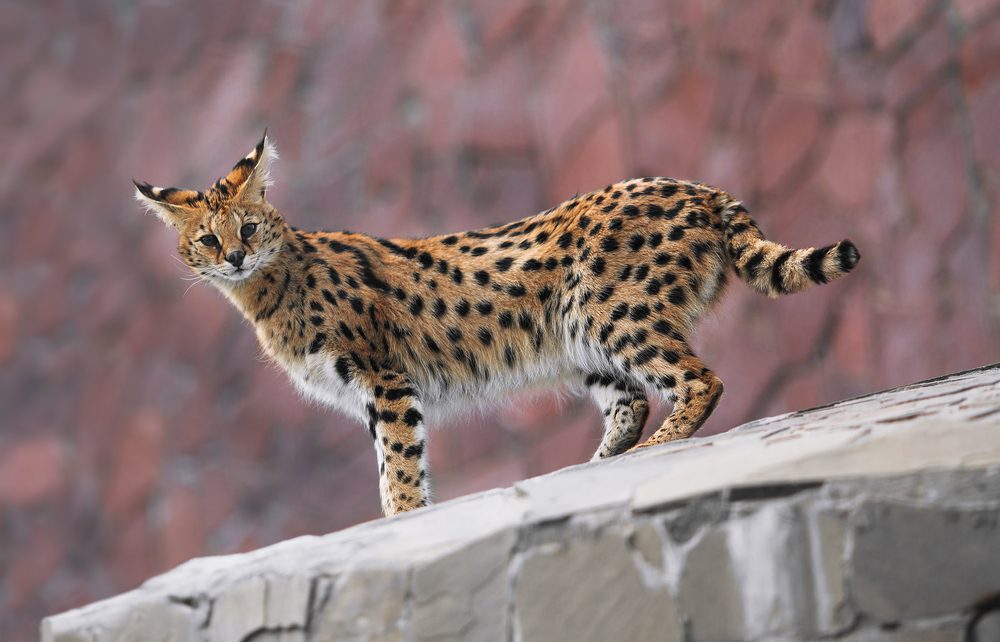
An F2 has a serval grandparent. It can retain dramatic height, large upright ears, long legs, bold spotting, and intense activity. Some are highly social, but no generation label promises an easy temperament. Secure doors, strong screens, tall climbing areas, and structured play are essential. Owners should also confirm that local veterinary practices will treat the cat.
3. F3 Savannah Cat
F3 Savannahs are three generations from a serval ancestor. Many combine the breed’s lean, spotted appearance with behavior that experienced cat owners find more manageable than earlier generations. They still need far more interaction and vertical space than a sedentary pet. Selection, early socialization, household routine, and the individual cat matter as much as the filial number.
4. F4 Savannah Cat
F4 cats are four generations removed from the serval. Their size may overlap substantially with ordinary domestic cats, although they often look taller because of long legs and a small, elongated head. A well-bred F4 may display clear tear-streak markings, ocelli on the backs of the ears, and solid dark spots. Legal treatment may be less restrictive in some places, but never assume legality from the label alone.
5. F5 and Later Savannah Cats
F5, F6, and later cats are further removed from the serval and are often a practical starting point for people who admire the Savannah look. Later generation does not mean low-energy: many remain intelligent jumpers that learn doors, seek interaction, and need daily challenges. Their size and personality vary widely, so meet the individual cat and discuss its socialization history.
6. SBT Savannah Cat
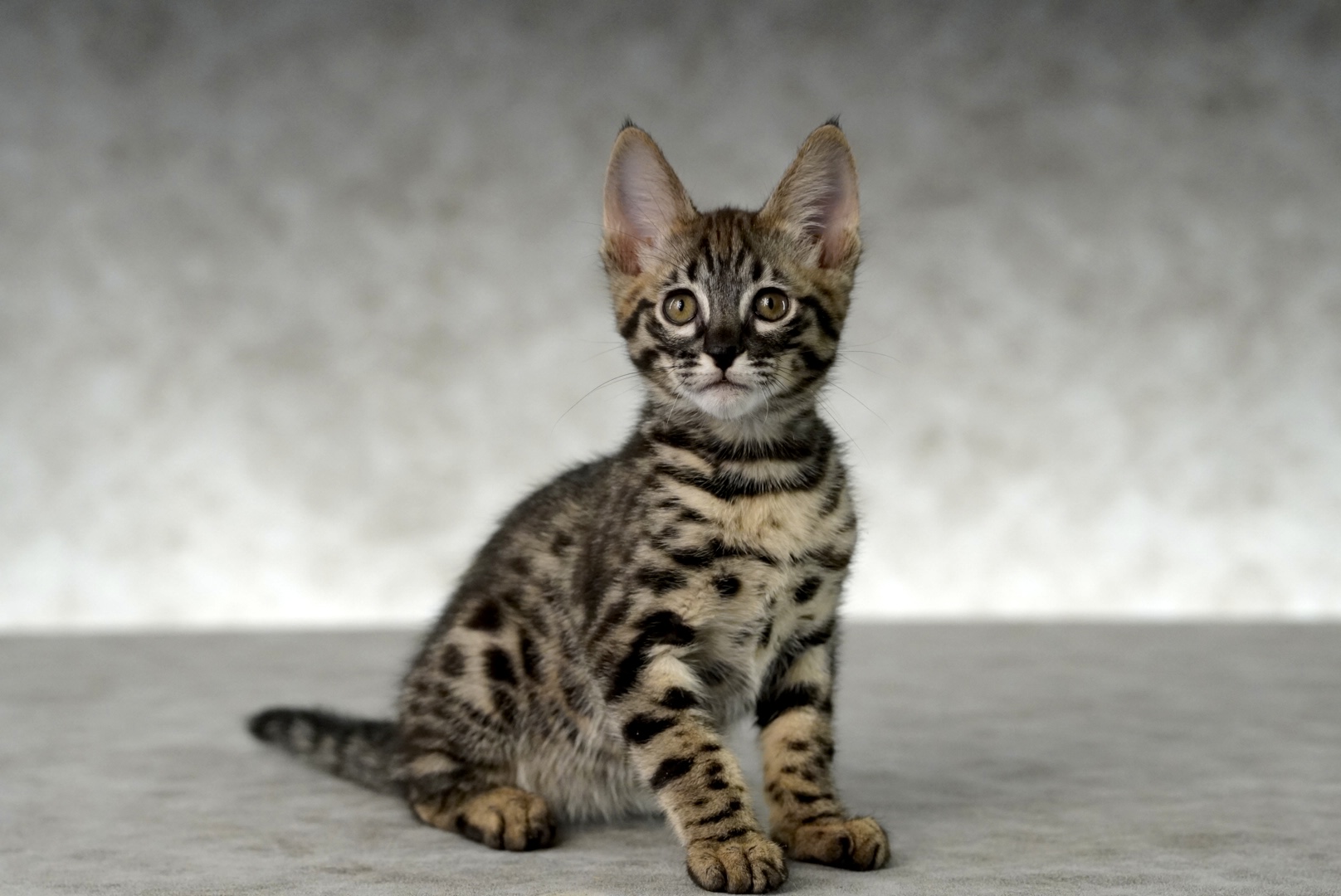
SBT means Stud Book Traditional. In TICA pedigree terminology, it indicates three generations of Savannah-to-Savannah breeding in the immediate pedigree. It does not simply mean F4, nor does it state an exact serval percentage. SBT cats are important to an established breed because generations of selection can make physical type and temperament more predictable.
Recognized Savannah Cat Colors
Brown Black Spotted Tabby
This classic coat ranges from cool beige to warm tan or gold, with black or dark brown solid spots. Strong contrast, a light underside, facial tear marks, and horizontal shoulder spotting contribute to the serval-like effect.
Black Silver Spotted Tabby
The silver variety has a pale silver ground with black or dark gray spots. Warm brown tones are undesirable in the show ideal. The crisp contrast makes body structure and spotting especially visible.
Black
Black Savannahs are melanistic. Their spots may appear as subtle “ghost” markings in bright light, but the overall impression is solid black. This is a recognized color, not evidence that the cat lacks Savannah ancestry.
Black Smoke
Black smoke cats have dark hair tips over pale silver roots. Spots can be visible through the smoky overlay, particularly in motion. Smoke differs from solid black most clearly when the coat is parted.
Nonstandard Colors and Patterns
Blue, chocolate, cinnamon, lilac, colorpoint or “snow,” rosetted, and marble coats can appear through domestic-cat color genes, but they do not meet the TICA Savannah show standard. “Rare” is a marketing description, not proof of quality. Buyers should prioritize health, stable temperament, documentation, and ethical breeding over novelty color.
How Are Savannah Cats Classified?
The F-number states the number of generations from a serval ancestor. TICA’s A, B, C, and SBT codes instead track the number of Savannah parents and the structure of the pedigree. Because an outcross or different pedigree path can alter letter codes, buyers should ask the breeder to explain both labels and provide registration documents.
How to Identify a Savannah Cat
- Body: tall, lean, and long-legged rather than simply heavy.
- Ears: large, high-set, and broad at the base, often with light-centered ocelli behind.
- Coat: short to medium with solid spots in recognized patterned colors.
- Face: elongated shape with dark tear-streak markings.
- Tail: relatively short to medium, thick, and ending in a dark tip.
- Movement: athletic and alert.
- Proof: registration and pedigree records are essential; appearance alone is inconclusive.
Savannah Cat Care and Enrichment
- Provide tall, load-rated cat trees, shelves, puzzle feeders, and multiple daily play sessions.
- Secure doors, windows, screens, and outdoor enclosures against a strong, intelligent jumper.
- Use positive reinforcement for harness, carrier, handling, and veterinary training.
- Feed a nutritionally complete diet appropriate for the cat’s life stage; raw meat alone is not balanced.
- Offer large litter boxes in quiet locations and address elimination problems promptly with a veterinarian.
- Introduce children and other animals gradually, with escape routes and active supervision.
Legal, Welfare, and Conservation Notes
Hybrid-cat regulations differ widely and can change. Some places prohibit early generations, require permits, or restrict all Savannahs. Check the exact law with the relevant authority before purchase or relocation, and consider future travel or housing changes. Never release a Savannah outdoors. Responsible ownership protects native wildlife, prevents loss or injury, and reduces pressure on rescues.
Fun Facts About Savannah Cats
- The breed traces to crosses between the African serval and domestic cats.
- F-numbers count generations; they do not guarantee an exact percentage.
- SBT is a pedigree code, not a coat type.
- Tall legs can make a cat look heavier than it is.
- Four colors are accepted by the TICA standard.
- Black Savannahs may show ghost spots in strong light.
- Many enjoy interactive water play, though not every cat does.
- Some learn to retrieve toys or walk on a harness.
- Later-generation cats can still be extremely energetic.
- Wild-looking appearance does not remove the need for ordinary preventive veterinary care.
Final Thoughts on Types of Savannah Cats
The main types of Savannah cats are best described by generation, pedigree status, and coat color. F1 through F5 labels explain ancestry distance, SBT describes an established Savannah pedigree, and four colors meet the TICA standard. None of these labels replaces careful evaluation of legality, welfare, health, socialization, and the needs of the individual cat.
Frequently Asked Questions
1. What is a Savannah cat?
It is a domestic cat breed developed from serval-domestic crosses and subsequent Savannah breeding.
2. What does F1 mean?
An F1 has a serval parent and is one generation removed from the serval.
3. What does F2 mean?
An F2 has a serval grandparent and is two generations removed.
4. What does F3 mean?
An F3 has a serval great-grandparent and is three generations removed.
5. What does SBT mean?
Stud Book Traditional indicates three preceding generations of Savannah-to-Savannah breeding.
6. Is SBT the same as F4?
No. One label describes pedigree structure and the other describes generational distance from a serval.
7. Which Savannah generation is largest?
F1 and F2 cats tend to be largest, but there is substantial overlap and no guaranteed size.
8. Which generation makes the easiest pet?
Later generations are often more practical, but temperament, socialization, health, and household fit remain decisive.
9. What colors are officially recognized?
Brown black spotted tabby, black silver spotted tabby, black, and black smoke are standard TICA colors.
10. Are snow Savannahs recognized?
Colorpoint or snow Savannahs are nonstandard for TICA exhibition.
11. Are blue Savannahs recognized?
Blue can occur but is not one of the four accepted TICA standard colors.
12. Can Savannahs have rosettes?
Rosettes may occur, but the standard calls for solid spots rather than Bengal-like rosettes.
13. Are black Savannahs spotted?
They can have ghost spots visible under suitable lighting, although the overall coat appears black.
14. Are Savannah cats legal?
Legality depends on country, state or province, municipality, and sometimes generation; verify locally before acquisition.
15. Do Savannah cats need permits?
Some jurisdictions require permits while others prohibit certain generations or impose no special rule.
16. Are Savannah cats dangerous?
Risk cannot be judged from a label alone. Early generations are powerful and demanding, so responsible selection and management are essential.
17. Are they good with children?
Some are, but introductions, supervision, the child’s behavior, and the individual cat’s history matter.
18. Are they good with other cats?
Many can live with compatible cats after a gradual introduction, but individual prey drive and sociability vary.
19. Can they live with dogs?
They may coexist with cat-safe dogs when introductions are slow and escape spaces are available.
20. Do they need a special diet?
They need a complete, balanced feline diet; the Savannah label does not make unbalanced raw meat appropriate.
21. How much exercise do they need?
Most need several energetic play and problem-solving sessions every day, plus substantial vertical space.
22. Do they like water?
Some play in water, but this is an individual preference rather than a guaranteed breed trait.
23. Can they walk on a leash?
Many can learn with gradual, reward-based harness training and secure equipment.
24. Are they indoor cats?
Secure indoor living with an enclosed catio or supervised harness time is safest.
25. Do Savannah cats spray?
Urine marking can occur in any cat and may be more challenging in some early-generation or intact individuals.
26. Are male Savannahs fertile?
Early-generation males are commonly infertile; fertility becomes more reliable in later generations.
27. How do I verify the generation?
Review the registered pedigree and ask the registry or a knowledgeable breeder to explain the lineage.
28. Can DNA tests identify an F-number?
Consumer breed tests should not replace an authenticated multigenerational pedigree for generation claims.
29. What should I ask a breeder?
Ask about registration, health screening, socialization, generation codes, contracts, legal restrictions, and lifetime return support.
30. Should a beginner choose an F1?
Usually not. An F1 requires specialized experience, legal preparation, secure facilities, and access to suitable veterinary care.