

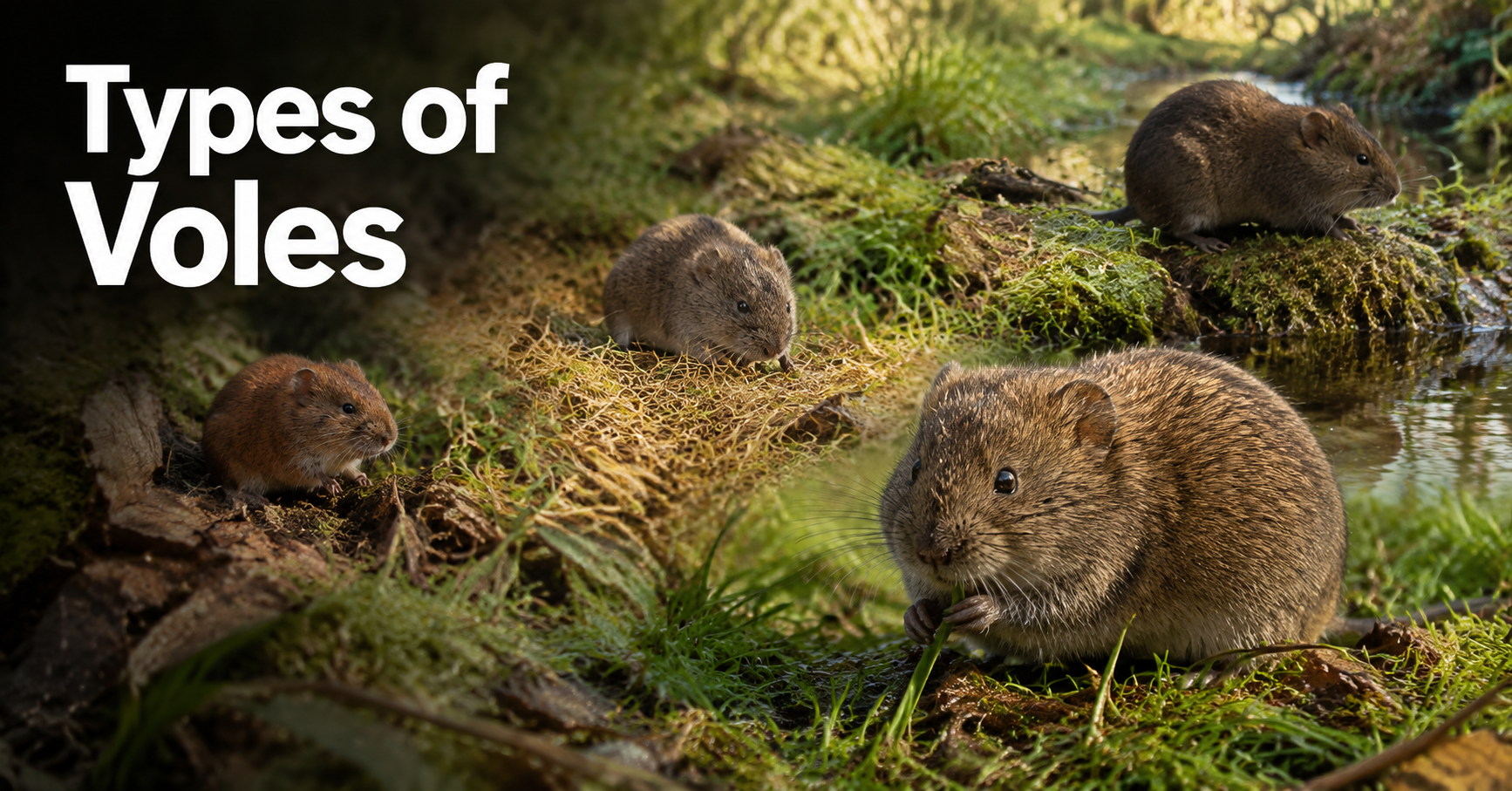
Voles are small, stocky rodents that quietly shape grasslands, wetlands, forests, tundra, and mountain ecosystems. Although people often call them field mice, the many types of voles include meadow runners, underground mole voles, water-edge swimmers, alpine rock specialists, red-backed forest voles, and species that live in trees. Their short tails and hidden ears may look simple, but their ecology is remarkably diverse.
This guide profiles 80 scientifically recognized vole species from North America, Europe, Asia, and nearby regions. Each account explains useful identification clues, habitat, distribution, behavior, field signs, and conservation context. It also separates voles from mice, moles, lemmings, and muskrats and offers practical, wildlife-conscious advice for observing voles or responding to genuine garden and orchard damage.
What Are the Main Types of Voles?
The main practical types are meadow and field voles, pine and woodland voles, water voles, mountain and snow voles, red-backed forest voles, mole voles, tree voles, and heather voles. Most belong to the arvicoline rodent radiation, which also contains lemmings and muskrats, but those animals are not automatically “voles” in everyday usage. More than 80 living species carry accepted vole common names, so this article presents the maximum 80 requested rather than implying that only 80 exist.
Quick Comparison of Major Vole Groups
| Vole Group | Useful Clues | Typical Habitat | Examples |
|---|---|---|---|
| Meadow and field voles | Stocky body, short tail, surface runways | Grassland, marsh, fields | Eastern meadow, common, field |
| Pine and woodland voles | Very short tail, small eyes, underground tunnels | Orchards, woods, deep soil | Woodland vole |
| Water voles | Larger body, dense fur, bank burrows | Rivers, canals, marshes | Eurasian and southwestern water voles |
| Mountain and snow voles | Thick coat; some have long ears and tails | Alpine turf, talus, rock fields | European snow, silver mountain |
| Red-backed voles | Rusty dorsal band, larger eyes | Forest, moss, shrubs | Bank and southern red-backed voles |
| Mole voles | Tiny eyes, hidden ears, cylindrical body | Underground steppe or mountain soil | Northern and long-clawed mole voles |
| Tree voles | Longer tail, arboreal nests | Pacific conifer forest | Red and Sonoma tree voles |
80 Types of Voles Around the World
The list uses current accepted scientific names. Because vole classification changes rapidly, some older books and websites may place the same animal in another genus or treat a recently split population under a broader species.
1. Eurasian Water Vole
The Eurasian Water Vole (Arvicola amphibius) shows how specialized a vole can become. A blunt muzzle, small ears, rich brown coat, and waterside burrows make this large vole look more like a compact muskrat than a field mouse.
Water-associated voles are among the largest and most conspicuous members of the group. Their compact bodies, dense fur, and strong swimming ability suit vegetated banks, marsh channels, wet meadows, or mountain streams. They eat grasses, sedges, roots, and other plant material, usually cutting vegetation cleanly rather than leaving the chaotic excavation of a mole. Tracks, droppings, feeding platforms, burrow openings, and waterside location are often more useful than a brief view.
Voles are primary consumers, turning grasses and other plants into prey for owls, hawks, foxes, snakes, mustelids, and many other hunters. Their digging aerates soil and their discarded food and droppings redistribute nutrients. High numbers can affect crops or young trees, but the same population pulse can support successful breeding by predators. Calling the species simply a pest misses this broader ecological role.
The current mammal database records this species from Albania, Austria, Azerbaijan, Belarus, Belgium, Bosnia and Herzegovina, Bulgaria, China, Croatia, Czech Republic, Denmark, Estonia, Finland, France, Georgia, Germany, Greece, Hungary, Iran, Italy, Kazakhstan, Kosovo, Latvia, Liechtenstein, Lithuania, Luxembourg, Moldova, Mongolia, Montenegro, Netherlands, North Macedonia, Norway, Poland, Portugal, Romania, Russia, Serbia, Slovakia, Slovenia, Spain, Sweden, Switzerland, Turkey, Ukraine, United Kingdom, and its listed assessment is Least Concern. That category needs context. A Least Concern species may still decline locally, while Data Deficient or Not Evaluated means uncertainty rather than safety. Relevant pressures can include drainage, plowing, overgrazing, forest loss, altered fire, roads, climate shifts, invasive predators, or poorly targeted rodent control, depending on the habitat and range.
For field identification, begin with the exact location and habitat, then note body shape, tail proportion, ear visibility, coat pattern, movement, burrow placement, and feeding signs. Do not handle a wild vole or dismantle an occupied nest. Many species cannot be confirmed from a photograph because their external features overlap; skull, molar, chromosome, or DNA evidence may be necessary. A careful genus-level record is better than an unsupported species label. Even when damage is present, identifying the ecological group first helps choose a response suited to the animal, setting, law, and conservation context.
2. Italian Water Vole
Among the most instructive types of voles is the Italian Water Vole (Arvicola destructor). This recently recognized Italian-centered water vole highlights how genetic work can divide what older guides treated as one widespread species.
Water-associated voles are among the largest and most conspicuous members of the group. Their compact bodies, dense fur, and strong swimming ability suit vegetated banks, marsh channels, wet meadows, or mountain streams. They eat grasses, sedges, roots, and other plant material, usually cutting vegetation cleanly rather than leaving the chaotic excavation of a mole. Tracks, droppings, feeding platforms, burrow openings, and waterside location are often more useful than a brief view.
Field signs should be interpreted as a pattern. A single hole proves little, whereas connected runways, clipped stems, droppings, and gnaw marks near cover strongly suggest vole activity. Teeth marks occur as paired grooves because voles are rodents. Moles, by contrast, hunt invertebrates and create raised tunnels; mice usually have longer tails and less compact bodies. Regional distribution should always be checked before assigning a species.
The current mammal database records this species from Italy, Slovenia, Switzerland, and its listed assessment is Near Threatened. That category needs context. A Least Concern species may still decline locally, while Data Deficient or Not Evaluated means uncertainty rather than safety. Relevant pressures can include drainage, plowing, overgrazing, forest loss, altered fire, roads, climate shifts, invasive predators, or poorly targeted rodent control, depending on the habitat and range.
For field identification, begin with the exact location and habitat, then note body shape, tail proportion, ear visibility, coat pattern, movement, burrow placement, and feeding signs. Do not handle a wild vole or dismantle an occupied nest. Many species cannot be confirmed from a photograph because their external features overlap; skull, molar, chromosome, or DNA evidence may be necessary. A careful genus-level record is better than an unsupported species label. Even when damage is present, identifying the ecological group first helps choose a response suited to the animal, setting, law, and conservation context.
3. Southwestern Water Vole
The Southwestern Water Vole, scientifically named Arvicola sapidus, is more than a generic “field mouse.” The southwestern water vole is closely tied to Iberian and French wetlands and is generally more aquatic than many grassland voles.
Water-associated voles are among the largest and most conspicuous members of the group. Their compact bodies, dense fur, and strong swimming ability suit vegetated banks, marsh channels, wet meadows, or mountain streams. They eat grasses, sedges, roots, and other plant material, usually cutting vegetation cleanly rather than leaving the chaotic excavation of a mole. Tracks, droppings, feeding platforms, burrow openings, and waterside location are often more useful than a brief view.
Season changes both appearance and behavior. Fur may become denser in cold weather, snow can hide an active runway network, and winter feeding may shift toward bark, roots, or stored vegetation. In spring, old pathways can appear suddenly as snow melts. These signs describe activity over time rather than guaranteeing that an animal is still present on the day they are found.
The current mammal database records this species from France, Portugal, Spain, and its listed assessment is Near Threatened. That category needs context. A Least Concern species may still decline locally, while Data Deficient or Not Evaluated means uncertainty rather than safety. Relevant pressures can include drainage, plowing, overgrazing, forest loss, altered fire, roads, climate shifts, invasive predators, or poorly targeted rodent control, depending on the habitat and range.
For field identification, begin with the exact location and habitat, then note body shape, tail proportion, ear visibility, coat pattern, movement, burrow placement, and feeding signs. Do not handle a wild vole or dismantle an occupied nest. Many species cannot be confirmed from a photograph because their external features overlap; skull, molar, chromosome, or DNA evidence may be necessary. A careful genus-level record is better than an unsupported species label. Even when damage is present, identifying the ecological group first helps choose a response suited to the animal, setting, law, and conservation context.
4. Burrowing Vole
Range, habitat, and body proportions are central to recognizing the Burrowing Vole (Hyperacrius fertilis). This Himalayan-region vole is a strong burrower of mountain meadows, where concealed ears and compact proportions suit life beneath turf.
This is a subterranean vole rather than a true mole. Small eyes, reduced external ears, a cylindrical body, and strong digging equipment reduce drag underground. The animal feeds mainly on roots, bulbs, and other plant parts reached from its tunnels. Surface mounds can resemble mole activity, but vole burrows are made by a rodent with gnawing incisors and may connect to feeding damage at roots or crowns.
Most voles are active in repeated bouts through day and night rather than being strictly nocturnal. Dense vegetation reduces exposure, and tunnels connect nests with feeding areas. Social organization varies from solitary or territorial species to colonial forms with shared runway systems. Even closely related voles can differ in mating system, dispersal, and population cycles, so behavior should not be generalized from one famous laboratory species.
The current mammal database records this species from India, Pakistan, and its listed assessment is Near Threatened. That category needs context. A Least Concern species may still decline locally, while Data Deficient or Not Evaluated means uncertainty rather than safety. Relevant pressures can include drainage, plowing, overgrazing, forest loss, altered fire, roads, climate shifts, invasive predators, or poorly targeted rodent control, depending on the habitat and range.
For field identification, begin with the exact location and habitat, then note body shape, tail proportion, ear visibility, coat pattern, movement, burrow placement, and feeding signs. Do not handle a wild vole or dismantle an occupied nest. Many species cannot be confirmed from a photograph because their external features overlap; skull, molar, chromosome, or DNA evidence may be necessary. A careful genus-level record is better than an unsupported species label. Even when damage is present, identifying the ecological group first helps choose a response suited to the animal, setting, law, and conservation context.
5. Murree Vole
The Murree Vole (Hyperacrius wynnei) shows how specialized a vole can become. The Murree vole is associated with Pakistan’s uplands and is best separated from similar mountain rodents through range and technical anatomy.
This is a subterranean vole rather than a true mole. Small eyes, reduced external ears, a cylindrical body, and strong digging equipment reduce drag underground. The animal feeds mainly on roots, bulbs, and other plant parts reached from its tunnels. Surface mounds can resemble mole activity, but vole burrows are made by a rodent with gnawing incisors and may connect to feeding damage at roots or crowns.
The incisors grow continuously and must be worn by feeding and gnawing. Behind them, high-crowned, ridged cheek teeth process abrasive vegetation. Scientists use the enamel pattern of these molars to identify species and trace arvicoline evolution. For a living animal, however, dental examination is not a casual field technique; photographs, measurements, habitat, and geography are safer starting points.
The current mammal database records this species from Pakistan, and its listed assessment is Least Concern. That category needs context. A Least Concern species may still decline locally, while Data Deficient or Not Evaluated means uncertainty rather than safety. Relevant pressures can include drainage, plowing, overgrazing, forest loss, altered fire, roads, climate shifts, invasive predators, or poorly targeted rodent control, depending on the habitat and range.
For field identification, begin with the exact location and habitat, then note body shape, tail proportion, ear visibility, coat pattern, movement, burrow placement, and feeding signs. Do not handle a wild vole or dismantle an occupied nest. Many species cannot be confirmed from a photograph because their external features overlap; skull, molar, chromosome, or DNA evidence may be necessary. A careful genus-level record is better than an unsupported species label. Even when damage is present, identifying the ecological group first helps choose a response suited to the animal, setting, law, and conservation context.
6. Reed Vole
Among the most instructive types of voles is the Reed Vole (Alexandromys fortis). The reed vole uses marshes, reed beds, wet meadows, and cultivated edges across northeastern Asia and can become locally numerous.
Grassland voles have stocky bodies, small rounded ears, short legs, and tails usually shorter than those of most mice. They feed mainly on grasses, sedges, herbs, roots, seeds, and bark, clipping plants with continuously growing incisors. Surface runways, grass clippings, small burrow entrances, and greenish cylindrical droppings reveal activity. Population density can change rapidly as weather, food, predators, and disease interact.
A compact body does not mean poor mobility. Young voles disperse through vegetation, along banks, beneath snow, or across open gaps when populations are crowded. These movements connect colonies but also expose animals to predators and roads. Maintaining strips of natural habitat can support wildlife connectivity, while orchard and garden managers may use vegetation-free buffers where crop protection is the goal.
The current mammal database records this species from China, Mongolia, North Korea, Russia, South Korea, and its listed assessment is Least Concern. That category needs context. A Least Concern species may still decline locally, while Data Deficient or Not Evaluated means uncertainty rather than safety. Relevant pressures can include drainage, plowing, overgrazing, forest loss, altered fire, roads, climate shifts, invasive predators, or poorly targeted rodent control, depending on the habitat and range.
For field identification, begin with the exact location and habitat, then note body shape, tail proportion, ear visibility, coat pattern, movement, burrow placement, and feeding signs. Do not handle a wild vole or dismantle an occupied nest. Many species cannot be confirmed from a photograph because their external features overlap; skull, molar, chromosome, or DNA evidence may be necessary. A careful genus-level record is better than an unsupported species label. Even when damage is present, identifying the ecological group first helps choose a response suited to the animal, setting, law, and conservation context.
7. Taiwan Vole
The Taiwan Vole, scientifically named Alexandromys kikuchii, is more than a generic “field mouse.” Endemic to Taiwan, this high-elevation grassland vole is one of the island’s distinctive native small mammals.
Grassland voles have stocky bodies, small rounded ears, short legs, and tails usually shorter than those of most mice. They feed mainly on grasses, sedges, herbs, roots, seeds, and bark, clipping plants with continuously growing incisors. Surface runways, grass clippings, small burrow entrances, and greenish cylindrical droppings reveal activity. Population density can change rapidly as weather, food, predators, and disease interact.
Population booms are real but not universal or perfectly regular. Productive vegetation, mild weather, snow cover, reproduction, predators, parasites, and disease all contribute. A sudden increase does not justify indiscriminate poisoning, which can expose predators and other wildlife. Correct identification and the smallest effective, legally permitted response are safer principles for managing genuine damage.
The current mammal database records this species from Taiwan, and its listed assessment is Least Concern. That category needs context. A Least Concern species may still decline locally, while Data Deficient or Not Evaluated means uncertainty rather than safety. Relevant pressures can include drainage, plowing, overgrazing, forest loss, altered fire, roads, climate shifts, invasive predators, or poorly targeted rodent control, depending on the habitat and range.
For field identification, begin with the exact location and habitat, then note body shape, tail proportion, ear visibility, coat pattern, movement, burrow placement, and feeding signs. Do not handle a wild vole or dismantle an occupied nest. Many species cannot be confirmed from a photograph because their external features overlap; skull, molar, chromosome, or DNA evidence may be necessary. A careful genus-level record is better than an unsupported species label. Even when damage is present, identifying the ecological group first helps choose a response suited to the animal, setting, law, and conservation context.
8. Lacustrine Vole
Range, habitat, and body proportions are central to recognizing the Lacustrine Vole (Alexandromys limnophilus). The lacustrine vole inhabits inland Asian wetlands and damp grasslands, with its name pointing to a strong association with lake-country habitats.
Grassland voles have stocky bodies, small rounded ears, short legs, and tails usually shorter than those of most mice. They feed mainly on grasses, sedges, herbs, roots, seeds, and bark, clipping plants with continuously growing incisors. Surface runways, grass clippings, small burrow entrances, and greenish cylindrical droppings reveal activity. Population density can change rapidly as weather, food, predators, and disease interact.
Measurements such as body length and weight overlap among species and change with age and condition. Tail-to-body ratio, hind-foot length, ear size, coat color, molar pattern, skull characters, and chromosomes may all be used in professional identification. A reliable observation therefore records scale and location instead of presenting one estimated body length as definitive.
The current mammal database records this species from China, Mongolia, and its listed assessment is Least Concern. That category needs context. A Least Concern species may still decline locally, while Data Deficient or Not Evaluated means uncertainty rather than safety. Relevant pressures can include drainage, plowing, overgrazing, forest loss, altered fire, roads, climate shifts, invasive predators, or poorly targeted rodent control, depending on the habitat and range.
For field identification, begin with the exact location and habitat, then note body shape, tail proportion, ear visibility, coat pattern, movement, burrow placement, and feeding signs. Do not handle a wild vole or dismantle an occupied nest. Many species cannot be confirmed from a photograph because their external features overlap; skull, molar, chromosome, or DNA evidence may be necessary. A careful genus-level record is better than an unsupported species label. Even when damage is present, identifying the ecological group first helps choose a response suited to the animal, setting, law, and conservation context.
9. Maximowicz’s Vole
The Maximowicz’s Vole (Alexandromys maximowiczii) shows how specialized a vole can become. Maximowicz’s vole is a northeastern Asian grassland species whose identification often depends on skull and chromosome evidence.
Grassland voles have stocky bodies, small rounded ears, short legs, and tails usually shorter than those of most mice. They feed mainly on grasses, sedges, herbs, roots, seeds, and bark, clipping plants with continuously growing incisors. Surface runways, grass clippings, small burrow entrances, and greenish cylindrical droppings reveal activity. Population density can change rapidly as weather, food, predators, and disease interact.
Burrows provide stable humidity and temperature, nesting chambers, and escape routes. Voles may line nests with shredded vegetation and create separate food stores or feeding stations. Not every tunnel was excavated by its current occupant; small mammals reuse existing passages. Disturbing a burrow to confirm identification can destroy shelter and expose young, so remote observation is preferable.
The current mammal database records this species from China, Mongolia, Russia, and its listed assessment is Least Concern. That category needs context. A Least Concern species may still decline locally, while Data Deficient or Not Evaluated means uncertainty rather than safety. Relevant pressures can include drainage, plowing, overgrazing, forest loss, altered fire, roads, climate shifts, invasive predators, or poorly targeted rodent control, depending on the habitat and range.
For field identification, begin with the exact location and habitat, then note body shape, tail proportion, ear visibility, coat pattern, movement, burrow placement, and feeding signs. Do not handle a wild vole or dismantle an occupied nest. Many species cannot be confirmed from a photograph because their external features overlap; skull, molar, chromosome, or DNA evidence may be necessary. A careful genus-level record is better than an unsupported species label. Even when damage is present, identifying the ecological group first helps choose a response suited to the animal, setting, law, and conservation context.
10. Middendorff’s Vole
Among the most instructive types of voles is the Middendorff’s Vole (Alexandromys middendorffii). This northern Russian vole occupies tundra and wet lowlands where dense cover persists through a short growing season.
Grassland voles have stocky bodies, small rounded ears, short legs, and tails usually shorter than those of most mice. They feed mainly on grasses, sedges, herbs, roots, seeds, and bark, clipping plants with continuously growing incisors. Surface runways, grass clippings, small burrow entrances, and greenish cylindrical droppings reveal activity. Population density can change rapidly as weather, food, predators, and disease interact.
Scientific names are especially valuable in this group because common names overlap and classifications change. Several species once placed in Microtus or Myodes now appear under Alexandromys, Clethrionomys, Craseomys, or other genera. Keeping the date and authority of a checklist with an observation prevents confusion when databases adopt a newer evolutionary arrangement.
The current mammal database records this species from Russia, and its listed assessment is Least Concern. That category needs context. A Least Concern species may still decline locally, while Data Deficient or Not Evaluated means uncertainty rather than safety. Relevant pressures can include drainage, plowing, overgrazing, forest loss, altered fire, roads, climate shifts, invasive predators, or poorly targeted rodent control, depending on the habitat and range.
For field identification, begin with the exact location and habitat, then note body shape, tail proportion, ear visibility, coat pattern, movement, burrow placement, and feeding signs. Do not handle a wild vole or dismantle an occupied nest. Many species cannot be confirmed from a photograph because their external features overlap; skull, molar, chromosome, or DNA evidence may be necessary. A careful genus-level record is better than an unsupported species label. Even when damage is present, identifying the ecological group first helps choose a response suited to the animal, setting, law, and conservation context.
11. Japanese Grass Vole
The Japanese Grass Vole, scientifically named Alexandromys montebelli, is more than a generic “field mouse.” The Japanese grass vole is widespread in grassy Japanese landscapes and is an important prey species for native predators.
Grassland voles have stocky bodies, small rounded ears, short legs, and tails usually shorter than those of most mice. They feed mainly on grasses, sedges, herbs, roots, seeds, and bark, clipping plants with continuously growing incisors. Surface runways, grass clippings, small burrow entrances, and greenish cylindrical droppings reveal activity. Population density can change rapidly as weather, food, predators, and disease interact.
Voles are primary consumers, turning grasses and other plants into prey for owls, hawks, foxes, snakes, mustelids, and many other hunters. Their digging aerates soil and their discarded food and droppings redistribute nutrients. High numbers can affect crops or young trees, but the same population pulse can support successful breeding by predators. Calling the species simply a pest misses this broader ecological role.
The current mammal database records this species from Japan, and its listed assessment is Least Concern. That category needs context. A Least Concern species may still decline locally, while Data Deficient or Not Evaluated means uncertainty rather than safety. Relevant pressures can include drainage, plowing, overgrazing, forest loss, altered fire, roads, climate shifts, invasive predators, or poorly targeted rodent control, depending on the habitat and range.
For field identification, begin with the exact location and habitat, then note body shape, tail proportion, ear visibility, coat pattern, movement, burrow placement, and feeding signs. Do not handle a wild vole or dismantle an occupied nest. Many species cannot be confirmed from a photograph because their external features overlap; skull, molar, chromosome, or DNA evidence may be necessary. A careful genus-level record is better than an unsupported species label. Even when damage is present, identifying the ecological group first helps choose a response suited to the animal, setting, law, and conservation context.
12. Root Vole
Range, habitat, and body proportions are central to recognizing the Root Vole (Alexandromys oeconomus). Also called the tundra or root vole, this remarkably widespread species reaches from Eurasia to northwestern North America.
Grassland voles have stocky bodies, small rounded ears, short legs, and tails usually shorter than those of most mice. They feed mainly on grasses, sedges, herbs, roots, seeds, and bark, clipping plants with continuously growing incisors. Surface runways, grass clippings, small burrow entrances, and greenish cylindrical droppings reveal activity. Population density can change rapidly as weather, food, predators, and disease interact.
Field signs should be interpreted as a pattern. A single hole proves little, whereas connected runways, clipped stems, droppings, and gnaw marks near cover strongly suggest vole activity. Teeth marks occur as paired grooves because voles are rodents. Moles, by contrast, hunt invertebrates and create raised tunnels; mice usually have longer tails and less compact bodies. Regional distribution should always be checked before assigning a species.
The current mammal database records this species from Austria, Belarus, Canada, China, Estonia, Finland, Germany, Hungary, Kazakhstan, Latvia, Lithuania, Mongolia, Netherlands, Norway, Poland, Russia, Slovakia, Sweden, Ukraine, United States, and its listed assessment is Least Concern. That category needs context. A Least Concern species may still decline locally, while Data Deficient or Not Evaluated means uncertainty rather than safety. Relevant pressures can include drainage, plowing, overgrazing, forest loss, altered fire, roads, climate shifts, invasive predators, or poorly targeted rodent control, depending on the habitat and range.
For field identification, begin with the exact location and habitat, then note body shape, tail proportion, ear visibility, coat pattern, movement, burrow placement, and feeding signs. Do not handle a wild vole or dismantle an occupied nest. Many species cannot be confirmed from a photograph because their external features overlap; skull, molar, chromosome, or DNA evidence may be necessary. A careful genus-level record is better than an unsupported species label. Even when damage is present, identifying the ecological group first helps choose a response suited to the animal, setting, law, and conservation context.
13. Sakhalin Vole
The Sakhalin Vole (Alexandromys sachalinensis) shows how specialized a vole can become. The Sakhalin vole is geographically restricted to Russia’s far eastern island region, making location a decisive clue.
Grassland voles have stocky bodies, small rounded ears, short legs, and tails usually shorter than those of most mice. They feed mainly on grasses, sedges, herbs, roots, seeds, and bark, clipping plants with continuously growing incisors. Surface runways, grass clippings, small burrow entrances, and greenish cylindrical droppings reveal activity. Population density can change rapidly as weather, food, predators, and disease interact.
Season changes both appearance and behavior. Fur may become denser in cold weather, snow can hide an active runway network, and winter feeding may shift toward bark, roots, or stored vegetation. In spring, old pathways can appear suddenly as snow melts. These signs describe activity over time rather than guaranteeing that an animal is still present on the day they are found.
The current mammal database records this species from Russia, and its listed assessment is Least Concern. That category needs context. A Least Concern species may still decline locally, while Data Deficient or Not Evaluated means uncertainty rather than safety. Relevant pressures can include drainage, plowing, overgrazing, forest loss, altered fire, roads, climate shifts, invasive predators, or poorly targeted rodent control, depending on the habitat and range.
For field identification, begin with the exact location and habitat, then note body shape, tail proportion, ear visibility, coat pattern, movement, burrow placement, and feeding signs. Do not handle a wild vole or dismantle an occupied nest. Many species cannot be confirmed from a photograph because their external features overlap; skull, molar, chromosome, or DNA evidence may be necessary. A careful genus-level record is better than an unsupported species label. Even when damage is present, identifying the ecological group first helps choose a response suited to the animal, setting, law, and conservation context.
14. Gudaur Snow Vole
Among the most instructive types of voles is the Gudaur Snow Vole (Chionomys gud). The Gudaur snow vole uses rocky Caucasus slopes where crevices supply shelter beyond the reach of many grassland rodents.
Mountain voles survive in landscapes where winter is long, vegetation is seasonal, and shelter is patchy. Many use rock crevices, alpine turf, low shrubs, or spaces beneath snow. Their thick coats and compact bodies conserve heat, while stores or hidden feeding sites help bridge poor weather. Elevation, mountain range, rock type, and surrounding plant community can narrow an identification more effectively than fur color alone.
Most voles are active in repeated bouts through day and night rather than being strictly nocturnal. Dense vegetation reduces exposure, and tunnels connect nests with feeding areas. Social organization varies from solitary or territorial species to colonial forms with shared runway systems. Even closely related voles can differ in mating system, dispersal, and population cycles, so behavior should not be generalized from one famous laboratory species.
The current mammal database records this species from Azerbaijan, Georgia, Russia, and its listed assessment is Least Concern. That category needs context. A Least Concern species may still decline locally, while Data Deficient or Not Evaluated means uncertainty rather than safety. Relevant pressures can include drainage, plowing, overgrazing, forest loss, altered fire, roads, climate shifts, invasive predators, or poorly targeted rodent control, depending on the habitat and range.
For field identification, begin with the exact location and habitat, then note body shape, tail proportion, ear visibility, coat pattern, movement, burrow placement, and feeding signs. Do not handle a wild vole or dismantle an occupied nest. Many species cannot be confirmed from a photograph because their external features overlap; skull, molar, chromosome, or DNA evidence may be necessary. A careful genus-level record is better than an unsupported species label. Even when damage is present, identifying the ecological group first helps choose a response suited to the animal, setting, law, and conservation context.
15. European Snow Vole
The European Snow Vole, scientifically named Chionomys nivalis, is more than a generic “field mouse.” The European snow vole has a long tail and large ears for a vole and lives among boulders, scree, and alpine rock fields.
Mountain voles survive in landscapes where winter is long, vegetation is seasonal, and shelter is patchy. Many use rock crevices, alpine turf, low shrubs, or spaces beneath snow. Their thick coats and compact bodies conserve heat, while stores or hidden feeding sites help bridge poor weather. Elevation, mountain range, rock type, and surrounding plant community can narrow an identification more effectively than fur color alone.
The incisors grow continuously and must be worn by feeding and gnawing. Behind them, high-crowned, ridged cheek teeth process abrasive vegetation. Scientists use the enamel pattern of these molars to identify species and trace arvicoline evolution. For a living animal, however, dental examination is not a casual field technique; photographs, measurements, habitat, and geography are safer starting points.
The current mammal database records this species from Armenia, Austria, Azerbaijan, Bosnia and Herzegovina, Bulgaria, Croatia, France, Georgia, Germany, Greece, Iran, Italy, Kosovo, Lebanon, Liechtenstein, Montenegro, North Macedonia, Palestine, Romania, Russia, Serbia, Slovakia, Slovenia, Spain, Switzerland, Syria, Turkey, Turkmenistan, Ukraine, Albania?, and its listed assessment is Least Concern. That category needs context. A Least Concern species may still decline locally, while Data Deficient or Not Evaluated means uncertainty rather than safety. Relevant pressures can include drainage, plowing, overgrazing, forest loss, altered fire, roads, climate shifts, invasive predators, or poorly targeted rodent control, depending on the habitat and range.
For field identification, begin with the exact location and habitat, then note body shape, tail proportion, ear visibility, coat pattern, movement, burrow placement, and feeding signs. Do not handle a wild vole or dismantle an occupied nest. Many species cannot be confirmed from a photograph because their external features overlap; skull, molar, chromosome, or DNA evidence may be necessary. A careful genus-level record is better than an unsupported species label. Even when damage is present, identifying the ecological group first helps choose a response suited to the animal, setting, law, and conservation context.
16. Robert’s Snow Vole
Range, habitat, and body proportions are central to recognizing the Robert’s Snow Vole (Chionomys roberti). Robert’s snow vole often occurs in moist rocky Caucasus valleys and can be more closely linked to forested stream corridors than other snow voles.
Mountain voles survive in landscapes where winter is long, vegetation is seasonal, and shelter is patchy. Many use rock crevices, alpine turf, low shrubs, or spaces beneath snow. Their thick coats and compact bodies conserve heat, while stores or hidden feeding sites help bridge poor weather. Elevation, mountain range, rock type, and surrounding plant community can narrow an identification more effectively than fur color alone.
A compact body does not mean poor mobility. Young voles disperse through vegetation, along banks, beneath snow, or across open gaps when populations are crowded. These movements connect colonies but also expose animals to predators and roads. Maintaining strips of natural habitat can support wildlife connectivity, while orchard and garden managers may use vegetation-free buffers where crop protection is the goal.
The current mammal database records this species from Azerbaijan, Georgia, Russia, Turkey, and its listed assessment is Least Concern. That category needs context. A Least Concern species may still decline locally, while Data Deficient or Not Evaluated means uncertainty rather than safety. Relevant pressures can include drainage, plowing, overgrazing, forest loss, altered fire, roads, climate shifts, invasive predators, or poorly targeted rodent control, depending on the habitat and range.
For field identification, begin with the exact location and habitat, then note body shape, tail proportion, ear visibility, coat pattern, movement, burrow placement, and feeding signs. Do not handle a wild vole or dismantle an occupied nest. Many species cannot be confirmed from a photograph because their external features overlap; skull, molar, chromosome, or DNA evidence may be necessary. A careful genus-level record is better than an unsupported species label. Even when damage is present, identifying the ecological group first helps choose a response suited to the animal, setting, law, and conservation context.
17. Stekolnikov’s Snow Vole
The Stekolnikov’s Snow Vole (Chionomys stekolnikovi) shows how specialized a vole can become. Known from Turkey and only recently distinguished, this snow vole demonstrates that even European-adjacent mammal diversity remains under revision.
Mountain voles survive in landscapes where winter is long, vegetation is seasonal, and shelter is patchy. Many use rock crevices, alpine turf, low shrubs, or spaces beneath snow. Their thick coats and compact bodies conserve heat, while stores or hidden feeding sites help bridge poor weather. Elevation, mountain range, rock type, and surrounding plant community can narrow an identification more effectively than fur color alone.
Population booms are real but not universal or perfectly regular. Productive vegetation, mild weather, snow cover, reproduction, predators, parasites, and disease all contribute. A sudden increase does not justify indiscriminate poisoning, which can expose predators and other wildlife. Correct identification and the smallest effective, legally permitted response are safer principles for managing genuine damage.
The current mammal database records this species from Turkey, and its listed assessment is Not Evaluated. That category needs context. A Least Concern species may still decline locally, while Data Deficient or Not Evaluated means uncertainty rather than safety. Relevant pressures can include drainage, plowing, overgrazing, forest loss, altered fire, roads, climate shifts, invasive predators, or poorly targeted rodent control, depending on the habitat and range.
For field identification, begin with the exact location and habitat, then note body shape, tail proportion, ear visibility, coat pattern, movement, burrow placement, and feeding signs. Do not handle a wild vole or dismantle an occupied nest. Many species cannot be confirmed from a photograph because their external features overlap; skull, molar, chromosome, or DNA evidence may be necessary. A careful genus-level record is better than an unsupported species label. Even when damage is present, identifying the ecological group first helps choose a response suited to the animal, setting, law, and conservation context.
18. Brandt’s Vole
Among the most instructive types of voles is the Brandt’s Vole (Lasiopodomys brandtii). Brandt’s vole is a colonial steppe grazer capable of major population fluctuations across Mongolian and northern Chinese grasslands.
Grassland voles have stocky bodies, small rounded ears, short legs, and tails usually shorter than those of most mice. They feed mainly on grasses, sedges, herbs, roots, seeds, and bark, clipping plants with continuously growing incisors. Surface runways, grass clippings, small burrow entrances, and greenish cylindrical droppings reveal activity. Population density can change rapidly as weather, food, predators, and disease interact.
Measurements such as body length and weight overlap among species and change with age and condition. Tail-to-body ratio, hind-foot length, ear size, coat color, molar pattern, skull characters, and chromosomes may all be used in professional identification. A reliable observation therefore records scale and location instead of presenting one estimated body length as definitive.
The current mammal database records this species from China, Mongolia, Russia, and its listed assessment is Least Concern. That category needs context. A Least Concern species may still decline locally, while Data Deficient or Not Evaluated means uncertainty rather than safety. Relevant pressures can include drainage, plowing, overgrazing, forest loss, altered fire, roads, climate shifts, invasive predators, or poorly targeted rodent control, depending on the habitat and range.
For field identification, begin with the exact location and habitat, then note body shape, tail proportion, ear visibility, coat pattern, movement, burrow placement, and feeding signs. Do not handle a wild vole or dismantle an occupied nest. Many species cannot be confirmed from a photograph because their external features overlap; skull, molar, chromosome, or DNA evidence may be necessary. A careful genus-level record is better than an unsupported species label. Even when damage is present, identifying the ecological group first helps choose a response suited to the animal, setting, law, and conservation context.
19. Mandarin Vole
The Mandarin Vole, scientifically named Lasiopodomys mandarinus, is more than a generic “field mouse.” The Mandarin vole is more subterranean than Brandt’s vole, with reduced eyes and ears and a strong dependence on burrow systems.
Grassland voles have stocky bodies, small rounded ears, short legs, and tails usually shorter than those of most mice. They feed mainly on grasses, sedges, herbs, roots, seeds, and bark, clipping plants with continuously growing incisors. Surface runways, grass clippings, small burrow entrances, and greenish cylindrical droppings reveal activity. Population density can change rapidly as weather, food, predators, and disease interact.
Burrows provide stable humidity and temperature, nesting chambers, and escape routes. Voles may line nests with shredded vegetation and create separate food stores or feeding stations. Not every tunnel was excavated by its current occupant; small mammals reuse existing passages. Disturbing a burrow to confirm identification can destroy shelter and expose young, so remote observation is preferable.
The current mammal database records this species from China, Mongolia, North Korea, Russia, South Korea, and its listed assessment is Least Concern. That category needs context. A Least Concern species may still decline locally, while Data Deficient or Not Evaluated means uncertainty rather than safety. Relevant pressures can include drainage, plowing, overgrazing, forest loss, altered fire, roads, climate shifts, invasive predators, or poorly targeted rodent control, depending on the habitat and range.
For field identification, begin with the exact location and habitat, then note body shape, tail proportion, ear visibility, coat pattern, movement, burrow placement, and feeding signs. Do not handle a wild vole or dismantle an occupied nest. Many species cannot be confirmed from a photograph because their external features overlap; skull, molar, chromosome, or DNA evidence may be necessary. A careful genus-level record is better than an unsupported species label. Even when damage is present, identifying the ecological group first helps choose a response suited to the animal, setting, law, and conservation context.
20. Sagebrush Vole
Range, habitat, and body proportions are central to recognizing the Sagebrush Vole (Lemmiscus curtatus). The sagebrush vole is a small, pale western North American specialist associated with sagebrush, rabbitbrush, and dry grass-forb cover.
Grassland voles have stocky bodies, small rounded ears, short legs, and tails usually shorter than those of most mice. They feed mainly on grasses, sedges, herbs, roots, seeds, and bark, clipping plants with continuously growing incisors. Surface runways, grass clippings, small burrow entrances, and greenish cylindrical droppings reveal activity. Population density can change rapidly as weather, food, predators, and disease interact.
Scientific names are especially valuable in this group because common names overlap and classifications change. Several species once placed in Microtus or Myodes now appear under Alexandromys, Clethrionomys, Craseomys, or other genera. Keeping the date and authority of a checklist with an observation prevents confusion when databases adopt a newer evolutionary arrangement.
The current mammal database records this species from Canada, United States, and its listed assessment is Least Concern. That category needs context. A Least Concern species may still decline locally, while Data Deficient or Not Evaluated means uncertainty rather than safety. Relevant pressures can include drainage, plowing, overgrazing, forest loss, altered fire, roads, climate shifts, invasive predators, or poorly targeted rodent control, depending on the habitat and range.
For field identification, begin with the exact location and habitat, then note body shape, tail proportion, ear visibility, coat pattern, movement, burrow placement, and feeding signs. Do not handle a wild vole or dismantle an occupied nest. Many species cannot be confirmed from a photograph because their external features overlap; skull, molar, chromosome, or DNA evidence may be necessary. A careful genus-level record is better than an unsupported species label. Even when damage is present, identifying the ecological group first helps choose a response suited to the animal, setting, law, and conservation context.
21. Singing Vole
The Singing Vole (Microtus abbreviatus) shows how specialized a vole can become. Now commonly called the singing vole, this northern species is noted for frequent vocal communication and life in open tundra and meadow habitats.
Grassland voles have stocky bodies, small rounded ears, short legs, and tails usually shorter than those of most mice. They feed mainly on grasses, sedges, herbs, roots, seeds, and bark, clipping plants with continuously growing incisors. Surface runways, grass clippings, small burrow entrances, and greenish cylindrical droppings reveal activity. Population density can change rapidly as weather, food, predators, and disease interact.
Voles are primary consumers, turning grasses and other plants into prey for owls, hawks, foxes, snakes, mustelids, and many other hunters. Their digging aerates soil and their discarded food and droppings redistribute nutrients. High numbers can affect crops or young trees, but the same population pulse can support successful breeding by predators. Calling the species simply a pest misses this broader ecological role.
The current mammal database records this species from Canada, United States, and its listed assessment is Least Concern. That category needs context. A Least Concern species may still decline locally, while Data Deficient or Not Evaluated means uncertainty rather than safety. Relevant pressures can include drainage, plowing, overgrazing, forest loss, altered fire, roads, climate shifts, invasive predators, or poorly targeted rodent control, depending on the habitat and range.
For field identification, begin with the exact location and habitat, then note body shape, tail proportion, ear visibility, coat pattern, movement, burrow placement, and feeding signs. Do not handle a wild vole or dismantle an occupied nest. Many species cannot be confirmed from a photograph because their external features overlap; skull, molar, chromosome, or DNA evidence may be necessary. A careful genus-level record is better than an unsupported species label. Even when damage is present, identifying the ecological group first helps choose a response suited to the animal, setting, law, and conservation context.
22. Short-tailed Field Vole
Among the most instructive types of voles is the Short-tailed Field Vole (Microtus agrestis). The short-tailed field vole has shaggy gray-brown fur and a tail shorter than that of the bank vole, helping with identification in Europe.
Grassland voles have stocky bodies, small rounded ears, short legs, and tails usually shorter than those of most mice. They feed mainly on grasses, sedges, herbs, roots, seeds, and bark, clipping plants with continuously growing incisors. Surface runways, grass clippings, small burrow entrances, and greenish cylindrical droppings reveal activity. Population density can change rapidly as weather, food, predators, and disease interact.
Field signs should be interpreted as a pattern. A single hole proves little, whereas connected runways, clipped stems, droppings, and gnaw marks near cover strongly suggest vole activity. Teeth marks occur as paired grooves because voles are rodents. Moles, by contrast, hunt invertebrates and create raised tunnels; mice usually have longer tails and less compact bodies. Regional distribution should always be checked before assigning a species.
The current mammal database records this species from Austria, Belarus, Belgium, China, Czech Republic, Denmark, Estonia, Finland, France, Germany, Hungary, Italy, Kazakhstan, Latvia, Liechtenstein, Lithuania, Luxembourg, Moldova, Mongolia, Netherlands, Norway, Poland, Romania, Russia, Slovakia, Sweden, Switzerland, Ukraine, United Kingdom, and its listed assessment is Least Concern. That category needs context. A Least Concern species may still decline locally, while Data Deficient or Not Evaluated means uncertainty rather than safety. Relevant pressures can include drainage, plowing, overgrazing, forest loss, altered fire, roads, climate shifts, invasive predators, or poorly targeted rodent control, depending on the habitat and range.
For field identification, begin with the exact location and habitat, then note body shape, tail proportion, ear visibility, coat pattern, movement, burrow placement, and feeding signs. Do not handle a wild vole or dismantle an occupied nest. Many species cannot be confirmed from a photograph because their external features overlap; skull, molar, chromosome, or DNA evidence may be necessary. A careful genus-level record is better than an unsupported species label. Even when damage is present, identifying the ecological group first helps choose a response suited to the animal, setting, law, and conservation context.
23. Common Vole
The Common Vole, scientifically named Microtus arvalis, is more than a generic “field mouse.” The common vole is a widespread Eurasian open-country species whose dense colonies and surface runways can strongly influence grassland ecology.
Grassland voles have stocky bodies, small rounded ears, short legs, and tails usually shorter than those of most mice. They feed mainly on grasses, sedges, herbs, roots, seeds, and bark, clipping plants with continuously growing incisors. Surface runways, grass clippings, small burrow entrances, and greenish cylindrical droppings reveal activity. Population density can change rapidly as weather, food, predators, and disease interact.
Season changes both appearance and behavior. Fur may become denser in cold weather, snow can hide an active runway network, and winter feeding may shift toward bark, roots, or stored vegetation. In spring, old pathways can appear suddenly as snow melts. These signs describe activity over time rather than guaranteeing that an animal is still present on the day they are found.
The current mammal database records this species from Albania, Austria, Belarus, Belgium, Bosnia and Herzegovina, Bulgaria, Croatia, Czech Republic, Denmark, Estonia, Finland, France, Germany, Hungary, Italy, Kosovo, Latvia, Liechtenstein, Lithuania, Luxembourg, Moldova, Montenegro, Netherlands, North Macedonia, Poland, Portugal, Romania, Russia, Serbia, Slovakia, Slovenia, Spain, Switzerland, Ukraine, and its listed assessment is Least Concern. That category needs context. A Least Concern species may still decline locally, while Data Deficient or Not Evaluated means uncertainty rather than safety. Relevant pressures can include drainage, plowing, overgrazing, forest loss, altered fire, roads, climate shifts, invasive predators, or poorly targeted rodent control, depending on the habitat and range.
For field identification, begin with the exact location and habitat, then note body shape, tail proportion, ear visibility, coat pattern, movement, burrow placement, and feeding signs. Do not handle a wild vole or dismantle an occupied nest. Many species cannot be confirmed from a photograph because their external features overlap; skull, molar, chromosome, or DNA evidence may be necessary. A careful genus-level record is better than an unsupported species label. Even when damage is present, identifying the ecological group first helps choose a response suited to the animal, setting, law, and conservation context.
24. Cabrera’s Vole
Range, habitat, and body proportions are central to recognizing the Cabrera’s Vole (Microtus cabrerae). Cabrera’s vole is an Iberian specialist of perennial grass patches and moist ground, with fragmented habitat driving conservation concern.
Grassland voles have stocky bodies, small rounded ears, short legs, and tails usually shorter than those of most mice. They feed mainly on grasses, sedges, herbs, roots, seeds, and bark, clipping plants with continuously growing incisors. Surface runways, grass clippings, small burrow entrances, and greenish cylindrical droppings reveal activity. Population density can change rapidly as weather, food, predators, and disease interact.
Most voles are active in repeated bouts through day and night rather than being strictly nocturnal. Dense vegetation reduces exposure, and tunnels connect nests with feeding areas. Social organization varies from solitary or territorial species to colonial forms with shared runway systems. Even closely related voles can differ in mating system, dispersal, and population cycles, so behavior should not be generalized from one famous laboratory species.
The current mammal database records this species from Portugal, Spain, and its listed assessment is Near Threatened. That category needs context. A Least Concern species may still decline locally, while Data Deficient or Not Evaluated means uncertainty rather than safety. Relevant pressures can include drainage, plowing, overgrazing, forest loss, altered fire, roads, climate shifts, invasive predators, or poorly targeted rodent control, depending on the habitat and range.
For field identification, begin with the exact location and habitat, then note body shape, tail proportion, ear visibility, coat pattern, movement, burrow placement, and feeding signs. Do not handle a wild vole or dismantle an occupied nest. Many species cannot be confirmed from a photograph because their external features overlap; skull, molar, chromosome, or DNA evidence may be necessary. A careful genus-level record is better than an unsupported species label. Even when damage is present, identifying the ecological group first helps choose a response suited to the animal, setting, law, and conservation context.
25. California Vole
The California Vole (Microtus californicus) shows how specialized a vole can become. The California vole thrives in coastal grasslands, valleys, marsh edges, and weedy fields, and its numbers can rise sharply after favorable rains.
Grassland voles have stocky bodies, small rounded ears, short legs, and tails usually shorter than those of most mice. They feed mainly on grasses, sedges, herbs, roots, seeds, and bark, clipping plants with continuously growing incisors. Surface runways, grass clippings, small burrow entrances, and greenish cylindrical droppings reveal activity. Population density can change rapidly as weather, food, predators, and disease interact.
The incisors grow continuously and must be worn by feeding and gnawing. Behind them, high-crowned, ridged cheek teeth process abrasive vegetation. Scientists use the enamel pattern of these molars to identify species and trace arvicoline evolution. For a living animal, however, dental examination is not a casual field technique; photographs, measurements, habitat, and geography are safer starting points.
The current mammal database records this species from Mexico, United States, and its listed assessment is Least Concern. That category needs context. A Least Concern species may still decline locally, while Data Deficient or Not Evaluated means uncertainty rather than safety. Relevant pressures can include drainage, plowing, overgrazing, forest loss, altered fire, roads, climate shifts, invasive predators, or poorly targeted rodent control, depending on the habitat and range.
For field identification, begin with the exact location and habitat, then note body shape, tail proportion, ear visibility, coat pattern, movement, burrow placement, and feeding signs. Do not handle a wild vole or dismantle an occupied nest. Many species cannot be confirmed from a photograph because their external features overlap; skull, molar, chromosome, or DNA evidence may be necessary. A careful genus-level record is better than an unsupported species label. Even when damage is present, identifying the ecological group first helps choose a response suited to the animal, setting, law, and conservation context.
26. Gray-tailed Vole
Among the most instructive types of voles is the Gray-tailed Vole (Microtus canicaudus). A gray tail and Pacific Northwest grassland distribution help separate the gray-tailed vole from neighboring meadow voles.
Grassland voles have stocky bodies, small rounded ears, short legs, and tails usually shorter than those of most mice. They feed mainly on grasses, sedges, herbs, roots, seeds, and bark, clipping plants with continuously growing incisors. Surface runways, grass clippings, small burrow entrances, and greenish cylindrical droppings reveal activity. Population density can change rapidly as weather, food, predators, and disease interact.
A compact body does not mean poor mobility. Young voles disperse through vegetation, along banks, beneath snow, or across open gaps when populations are crowded. These movements connect colonies but also expose animals to predators and roads. Maintaining strips of natural habitat can support wildlife connectivity, while orchard and garden managers may use vegetation-free buffers where crop protection is the goal.
The current mammal database records this species from United States, and its listed assessment is Least Concern. That category needs context. A Least Concern species may still decline locally, while Data Deficient or Not Evaluated means uncertainty rather than safety. Relevant pressures can include drainage, plowing, overgrazing, forest loss, altered fire, roads, climate shifts, invasive predators, or poorly targeted rodent control, depending on the habitat and range.
For field identification, begin with the exact location and habitat, then note body shape, tail proportion, ear visibility, coat pattern, movement, burrow placement, and feeding signs. Do not handle a wild vole or dismantle an occupied nest. Many species cannot be confirmed from a photograph because their external features overlap; skull, molar, chromosome, or DNA evidence may be necessary. A careful genus-level record is better than an unsupported species label. Even when damage is present, identifying the ecological group first helps choose a response suited to the animal, setting, law, and conservation context.
27. Rock Vole
The Rock Vole, scientifically named Microtus chrotorrhinus, is more than a generic “field mouse.” The rock vole favors cool talus, mossy boulder fields, and rocky forest edges in northeastern North America.
Grassland voles have stocky bodies, small rounded ears, short legs, and tails usually shorter than those of most mice. They feed mainly on grasses, sedges, herbs, roots, seeds, and bark, clipping plants with continuously growing incisors. Surface runways, grass clippings, small burrow entrances, and greenish cylindrical droppings reveal activity. Population density can change rapidly as weather, food, predators, and disease interact.
Population booms are real but not universal or perfectly regular. Productive vegetation, mild weather, snow cover, reproduction, predators, parasites, and disease all contribute. A sudden increase does not justify indiscriminate poisoning, which can expose predators and other wildlife. Correct identification and the smallest effective, legally permitted response are safer principles for managing genuine damage.
The current mammal database records this species from Canada, United States, and its listed assessment is Least Concern. That category needs context. A Least Concern species may still decline locally, while Data Deficient or Not Evaluated means uncertainty rather than safety. Relevant pressures can include drainage, plowing, overgrazing, forest loss, altered fire, roads, climate shifts, invasive predators, or poorly targeted rodent control, depending on the habitat and range.
For field identification, begin with the exact location and habitat, then note body shape, tail proportion, ear visibility, coat pattern, movement, burrow placement, and feeding signs. Do not handle a wild vole or dismantle an occupied nest. Many species cannot be confirmed from a photograph because their external features overlap; skull, molar, chromosome, or DNA evidence may be necessary. A careful genus-level record is better than an unsupported species label. Even when damage is present, identifying the ecological group first helps choose a response suited to the animal, setting, law, and conservation context.
28. Western Meadow Vole
Range, habitat, and body proportions are central to recognizing the Western Meadow Vole (Microtus drummondii). The western meadow vole occupies a broad northern and western North American range and was long grouped with the eastern meadow vole.
Grassland voles have stocky bodies, small rounded ears, short legs, and tails usually shorter than those of most mice. They feed mainly on grasses, sedges, herbs, roots, seeds, and bark, clipping plants with continuously growing incisors. Surface runways, grass clippings, small burrow entrances, and greenish cylindrical droppings reveal activity. Population density can change rapidly as weather, food, predators, and disease interact.
Measurements such as body length and weight overlap among species and change with age and condition. Tail-to-body ratio, hind-foot length, ear size, coat color, molar pattern, skull characters, and chromosomes may all be used in professional identification. A reliable observation therefore records scale and location instead of presenting one estimated body length as definitive.
The current mammal database records this species from Canada, United States, and its listed assessment is Not Evaluated. That category needs context. A Least Concern species may still decline locally, while Data Deficient or Not Evaluated means uncertainty rather than safety. Relevant pressures can include drainage, plowing, overgrazing, forest loss, altered fire, roads, climate shifts, invasive predators, or poorly targeted rodent control, depending on the habitat and range.
For field identification, begin with the exact location and habitat, then note body shape, tail proportion, ear visibility, coat pattern, movement, burrow placement, and feeding signs. Do not handle a wild vole or dismantle an occupied nest. Many species cannot be confirmed from a photograph because their external features overlap; skull, molar, chromosome, or DNA evidence may be necessary. A careful genus-level record is better than an unsupported species label. Even when damage is present, identifying the ecological group first helps choose a response suited to the animal, setting, law, and conservation context.
29. Florida Salt Marsh Vole
The Florida Salt Marsh Vole (Microtus dukecampbelli) shows how specialized a vole can become. The Florida salt marsh vole is confined to a tiny coastal marsh system and is one of the most geographically restricted voles in the United States.
Grassland voles have stocky bodies, small rounded ears, short legs, and tails usually shorter than those of most mice. They feed mainly on grasses, sedges, herbs, roots, seeds, and bark, clipping plants with continuously growing incisors. Surface runways, grass clippings, small burrow entrances, and greenish cylindrical droppings reveal activity. Population density can change rapidly as weather, food, predators, and disease interact.
Burrows provide stable humidity and temperature, nesting chambers, and escape routes. Voles may line nests with shredded vegetation and create separate food stores or feeding stations. Not every tunnel was excavated by its current occupant; small mammals reuse existing passages. Disturbing a burrow to confirm identification can destroy shelter and expose young, so remote observation is preferable.
The current mammal database records this species from United States, and its listed assessment is Not Evaluated. That category needs context. A Least Concern species may still decline locally, while Data Deficient or Not Evaluated means uncertainty rather than safety. Relevant pressures can include drainage, plowing, overgrazing, forest loss, altered fire, roads, climate shifts, invasive predators, or poorly targeted rodent control, depending on the habitat and range.
For field identification, begin with the exact location and habitat, then note body shape, tail proportion, ear visibility, coat pattern, movement, burrow placement, and feeding signs. Do not handle a wild vole or dismantle an occupied nest. Many species cannot be confirmed from a photograph because their external features overlap; skull, molar, chromosome, or DNA evidence may be necessary. A careful genus-level record is better than an unsupported species label. Even when damage is present, identifying the ecological group first helps choose a response suited to the animal, setting, law, and conservation context.
30. Guatemalan Vole
Among the most instructive types of voles is the Guatemalan Vole (Microtus guatemalensis). The Guatemalan vole occupies cool highland grass and forest-edge habitats in southern Mexico and Guatemala.
Grassland voles have stocky bodies, small rounded ears, short legs, and tails usually shorter than those of most mice. They feed mainly on grasses, sedges, herbs, roots, seeds, and bark, clipping plants with continuously growing incisors. Surface runways, grass clippings, small burrow entrances, and greenish cylindrical droppings reveal activity. Population density can change rapidly as weather, food, predators, and disease interact.
Scientific names are especially valuable in this group because common names overlap and classifications change. Several species once placed in Microtus or Myodes now appear under Alexandromys, Clethrionomys, Craseomys, or other genera. Keeping the date and authority of a checklist with an observation prevents confusion when databases adopt a newer evolutionary arrangement.
The current mammal database records this species from Guatemala, Mexico, and its listed assessment is Near Threatened. That category needs context. A Least Concern species may still decline locally, while Data Deficient or Not Evaluated means uncertainty rather than safety. Relevant pressures can include drainage, plowing, overgrazing, forest loss, altered fire, roads, climate shifts, invasive predators, or poorly targeted rodent control, depending on the habitat and range.
For field identification, begin with the exact location and habitat, then note body shape, tail proportion, ear visibility, coat pattern, movement, burrow placement, and feeding signs. Do not handle a wild vole or dismantle an occupied nest. Many species cannot be confirmed from a photograph because their external features overlap; skull, molar, chromosome, or DNA evidence may be necessary. A careful genus-level record is better than an unsupported species label. Even when damage is present, identifying the ecological group first helps choose a response suited to the animal, setting, law, and conservation context.
31. Levant Vole
The Levant Vole, scientifically named Microtus guentheri, is more than a generic “field mouse.” The Levant vole lives in eastern Mediterranean grasslands and farms, where colony systems may become conspicuous in productive years.
Grassland voles have stocky bodies, small rounded ears, short legs, and tails usually shorter than those of most mice. They feed mainly on grasses, sedges, herbs, roots, seeds, and bark, clipping plants with continuously growing incisors. Surface runways, grass clippings, small burrow entrances, and greenish cylindrical droppings reveal activity. Population density can change rapidly as weather, food, predators, and disease interact.
Voles are primary consumers, turning grasses and other plants into prey for owls, hawks, foxes, snakes, mustelids, and many other hunters. Their digging aerates soil and their discarded food and droppings redistribute nutrients. High numbers can affect crops or young trees, but the same population pulse can support successful breeding by predators. Calling the species simply a pest misses this broader ecological role.
The current mammal database records this species from Israel, Jordan, Lebanon, Palestine, Syria, Turkey, and its listed assessment is Least Concern. That category needs context. A Least Concern species may still decline locally, while Data Deficient or Not Evaluated means uncertainty rather than safety. Relevant pressures can include drainage, plowing, overgrazing, forest loss, altered fire, roads, climate shifts, invasive predators, or poorly targeted rodent control, depending on the habitat and range.
For field identification, begin with the exact location and habitat, then note body shape, tail proportion, ear visibility, coat pattern, movement, burrow placement, and feeding signs. Do not handle a wild vole or dismantle an occupied nest. Many species cannot be confirmed from a photograph because their external features overlap; skull, molar, chromosome, or DNA evidence may be necessary. A careful genus-level record is better than an unsupported species label. Even when damage is present, identifying the ecological group first helps choose a response suited to the animal, setting, law, and conservation context.
32. Long-tailed Vole
Range, habitat, and body proportions are central to recognizing the Long-tailed Vole (Microtus longicaudus). A tail noticeably longer than in most Microtus voles gives the long-tailed vole its best beginner-friendly field clue.
Grassland voles have stocky bodies, small rounded ears, short legs, and tails usually shorter than those of most mice. They feed mainly on grasses, sedges, herbs, roots, seeds, and bark, clipping plants with continuously growing incisors. Surface runways, grass clippings, small burrow entrances, and greenish cylindrical droppings reveal activity. Population density can change rapidly as weather, food, predators, and disease interact.
Field signs should be interpreted as a pattern. A single hole proves little, whereas connected runways, clipped stems, droppings, and gnaw marks near cover strongly suggest vole activity. Teeth marks occur as paired grooves because voles are rodents. Moles, by contrast, hunt invertebrates and create raised tunnels; mice usually have longer tails and less compact bodies. Regional distribution should always be checked before assigning a species.
The current mammal database records this species from Canada, United States, and its listed assessment is Least Concern. That category needs context. A Least Concern species may still decline locally, while Data Deficient or Not Evaluated means uncertainty rather than safety. Relevant pressures can include drainage, plowing, overgrazing, forest loss, altered fire, roads, climate shifts, invasive predators, or poorly targeted rodent control, depending on the habitat and range.
For field identification, begin with the exact location and habitat, then note body shape, tail proportion, ear visibility, coat pattern, movement, burrow placement, and feeding signs. Do not handle a wild vole or dismantle an occupied nest. Many species cannot be confirmed from a photograph because their external features overlap; skull, molar, chromosome, or DNA evidence may be necessary. A careful genus-level record is better than an unsupported species label. Even when damage is present, identifying the ecological group first helps choose a response suited to the animal, setting, law, and conservation context.
33. Mexican Vole
The Mexican Vole (Microtus mexicanus) shows how specialized a vole can become. The Mexican vole is a mountain grassland and open-forest rodent spread across Mexico and into Guatemala.
Grassland voles have stocky bodies, small rounded ears, short legs, and tails usually shorter than those of most mice. They feed mainly on grasses, sedges, herbs, roots, seeds, and bark, clipping plants with continuously growing incisors. Surface runways, grass clippings, small burrow entrances, and greenish cylindrical droppings reveal activity. Population density can change rapidly as weather, food, predators, and disease interact.
Season changes both appearance and behavior. Fur may become denser in cold weather, snow can hide an active runway network, and winter feeding may shift toward bark, roots, or stored vegetation. In spring, old pathways can appear suddenly as snow melts. These signs describe activity over time rather than guaranteeing that an animal is still present on the day they are found.
The current mammal database records this species from Guatemala, Mexico, and its listed assessment is Least Concern. That category needs context. A Least Concern species may still decline locally, while Data Deficient or Not Evaluated means uncertainty rather than safety. Relevant pressures can include drainage, plowing, overgrazing, forest loss, altered fire, roads, climate shifts, invasive predators, or poorly targeted rodent control, depending on the habitat and range.
For field identification, begin with the exact location and habitat, then note body shape, tail proportion, ear visibility, coat pattern, movement, burrow placement, and feeding signs. Do not handle a wild vole or dismantle an occupied nest. Many species cannot be confirmed from a photograph because their external features overlap; skull, molar, chromosome, or DNA evidence may be necessary. A careful genus-level record is better than an unsupported species label. Even when damage is present, identifying the ecological group first helps choose a response suited to the animal, setting, law, and conservation context.
34. Montane Vole
Among the most instructive types of voles is the Montane Vole (Microtus montanus). The montane vole is a western North American meadow specialist commonly associated with moist grassy valleys and mountain parks.
Grassland voles have stocky bodies, small rounded ears, short legs, and tails usually shorter than those of most mice. They feed mainly on grasses, sedges, herbs, roots, seeds, and bark, clipping plants with continuously growing incisors. Surface runways, grass clippings, small burrow entrances, and greenish cylindrical droppings reveal activity. Population density can change rapidly as weather, food, predators, and disease interact.
Most voles are active in repeated bouts through day and night rather than being strictly nocturnal. Dense vegetation reduces exposure, and tunnels connect nests with feeding areas. Social organization varies from solitary or territorial species to colonial forms with shared runway systems. Even closely related voles can differ in mating system, dispersal, and population cycles, so behavior should not be generalized from one famous laboratory species.
The current mammal database records this species from Canada, United States, and its listed assessment is Least Concern. That category needs context. A Least Concern species may still decline locally, while Data Deficient or Not Evaluated means uncertainty rather than safety. Relevant pressures can include drainage, plowing, overgrazing, forest loss, altered fire, roads, climate shifts, invasive predators, or poorly targeted rodent control, depending on the habitat and range.
For field identification, begin with the exact location and habitat, then note body shape, tail proportion, ear visibility, coat pattern, movement, burrow placement, and feeding signs. Do not handle a wild vole or dismantle an occupied nest. Many species cannot be confirmed from a photograph because their external features overlap; skull, molar, chromosome, or DNA evidence may be necessary. A careful genus-level record is better than an unsupported species label. Even when damage is present, identifying the ecological group first helps choose a response suited to the animal, setting, law, and conservation context.
35. Prairie Vole
The Prairie Vole, scientifically named Microtus ochrogaster, is more than a generic “field mouse.” The prairie vole is famous for social bonding research, but in the wild it is primarily a grassland herbivore living in runways and burrows.
Grassland voles have stocky bodies, small rounded ears, short legs, and tails usually shorter than those of most mice. They feed mainly on grasses, sedges, herbs, roots, seeds, and bark, clipping plants with continuously growing incisors. Surface runways, grass clippings, small burrow entrances, and greenish cylindrical droppings reveal activity. Population density can change rapidly as weather, food, predators, and disease interact.
The incisors grow continuously and must be worn by feeding and gnawing. Behind them, high-crowned, ridged cheek teeth process abrasive vegetation. Scientists use the enamel pattern of these molars to identify species and trace arvicoline evolution. For a living animal, however, dental examination is not a casual field technique; photographs, measurements, habitat, and geography are safer starting points.
The current mammal database records this species from Canada, United States, and its listed assessment is Least Concern. That category needs context. A Least Concern species may still decline locally, while Data Deficient or Not Evaluated means uncertainty rather than safety. Relevant pressures can include drainage, plowing, overgrazing, forest loss, altered fire, roads, climate shifts, invasive predators, or poorly targeted rodent control, depending on the habitat and range.
For field identification, begin with the exact location and habitat, then note body shape, tail proportion, ear visibility, coat pattern, movement, burrow placement, and feeding signs. Do not handle a wild vole or dismantle an occupied nest. Many species cannot be confirmed from a photograph because their external features overlap; skull, molar, chromosome, or DNA evidence may be necessary. A careful genus-level record is better than an unsupported species label. Even when damage is present, identifying the ecological group first helps choose a response suited to the animal, setting, law, and conservation context.
36. Creeping Vole
Range, habitat, and body proportions are central to recognizing the Creeping Vole (Microtus oregoni). The creeping vole is small, dark, and short-tailed, slipping through dense cover in Pacific coastal forests and adjacent openings.
Grassland voles have stocky bodies, small rounded ears, short legs, and tails usually shorter than those of most mice. They feed mainly on grasses, sedges, herbs, roots, seeds, and bark, clipping plants with continuously growing incisors. Surface runways, grass clippings, small burrow entrances, and greenish cylindrical droppings reveal activity. Population density can change rapidly as weather, food, predators, and disease interact.
A compact body does not mean poor mobility. Young voles disperse through vegetation, along banks, beneath snow, or across open gaps when populations are crowded. These movements connect colonies but also expose animals to predators and roads. Maintaining strips of natural habitat can support wildlife connectivity, while orchard and garden managers may use vegetation-free buffers where crop protection is the goal.
The current mammal database records this species from Canada, United States, and its listed assessment is Least Concern. That category needs context. A Least Concern species may still decline locally, while Data Deficient or Not Evaluated means uncertainty rather than safety. Relevant pressures can include drainage, plowing, overgrazing, forest loss, altered fire, roads, climate shifts, invasive predators, or poorly targeted rodent control, depending on the habitat and range.
For field identification, begin with the exact location and habitat, then note body shape, tail proportion, ear visibility, coat pattern, movement, burrow placement, and feeding signs. Do not handle a wild vole or dismantle an occupied nest. Many species cannot be confirmed from a photograph because their external features overlap; skull, molar, chromosome, or DNA evidence may be necessary. A careful genus-level record is better than an unsupported species label. Even when damage is present, identifying the ecological group first helps choose a response suited to the animal, setting, law, and conservation context.
37. Eastern Meadow Vole
The Eastern Meadow Vole (Microtus pennsylvanicus) shows how specialized a vole can become. The eastern meadow vole makes well-defined surface runways through grass and is one of the most familiar North American voles.
Grassland voles have stocky bodies, small rounded ears, short legs, and tails usually shorter than those of most mice. They feed mainly on grasses, sedges, herbs, roots, seeds, and bark, clipping plants with continuously growing incisors. Surface runways, grass clippings, small burrow entrances, and greenish cylindrical droppings reveal activity. Population density can change rapidly as weather, food, predators, and disease interact.
Population booms are real but not universal or perfectly regular. Productive vegetation, mild weather, snow cover, reproduction, predators, parasites, and disease all contribute. A sudden increase does not justify indiscriminate poisoning, which can expose predators and other wildlife. Correct identification and the smallest effective, legally permitted response are safer principles for managing genuine damage.
The current mammal database records this species from Canada, United States, and its listed assessment is Least Concern. That category needs context. A Least Concern species may still decline locally, while Data Deficient or Not Evaluated means uncertainty rather than safety. Relevant pressures can include drainage, plowing, overgrazing, forest loss, altered fire, roads, climate shifts, invasive predators, or poorly targeted rodent control, depending on the habitat and range.
For field identification, begin with the exact location and habitat, then note body shape, tail proportion, ear visibility, coat pattern, movement, burrow placement, and feeding signs. Do not handle a wild vole or dismantle an occupied nest. Many species cannot be confirmed from a photograph because their external features overlap; skull, molar, chromosome, or DNA evidence may be necessary. A careful genus-level record is better than an unsupported species label. Even when damage is present, identifying the ecological group first helps choose a response suited to the animal, setting, law, and conservation context.
38. Woodland Vole
Among the most instructive types of voles is the Woodland Vole (Microtus pinetorum). Also called the pine vole, this compact species spends much of its time in shallow underground tunnels and can gnaw orchard roots and bark.
Grassland voles have stocky bodies, small rounded ears, short legs, and tails usually shorter than those of most mice. They feed mainly on grasses, sedges, herbs, roots, seeds, and bark, clipping plants with continuously growing incisors. Surface runways, grass clippings, small burrow entrances, and greenish cylindrical droppings reveal activity. Population density can change rapidly as weather, food, predators, and disease interact.
Measurements such as body length and weight overlap among species and change with age and condition. Tail-to-body ratio, hind-foot length, ear size, coat color, molar pattern, skull characters, and chromosomes may all be used in professional identification. A reliable observation therefore records scale and location instead of presenting one estimated body length as definitive.
The current mammal database records this species from Canada, United States, and its listed assessment is Least Concern. That category needs context. A Least Concern species may still decline locally, while Data Deficient or Not Evaluated means uncertainty rather than safety. Relevant pressures can include drainage, plowing, overgrazing, forest loss, altered fire, roads, climate shifts, invasive predators, or poorly targeted rodent control, depending on the habitat and range.
For field identification, begin with the exact location and habitat, then note body shape, tail proportion, ear visibility, coat pattern, movement, burrow placement, and feeding signs. Do not handle a wild vole or dismantle an occupied nest. Many species cannot be confirmed from a photograph because their external features overlap; skull, molar, chromosome, or DNA evidence may be necessary. A careful genus-level record is better than an unsupported species label. Even when damage is present, identifying the ecological group first helps choose a response suited to the animal, setting, law, and conservation context.
39. North American Water Vole
The North American Water Vole, scientifically named Microtus richardsoni, is more than a generic “field mouse.” The North American water vole is a large mountain-stream vole that uses wet meadows and lush banks rather than swimming as constantly as Arvicola.
Water-associated voles are among the largest and most conspicuous members of the group. Their compact bodies, dense fur, and strong swimming ability suit vegetated banks, marsh channels, wet meadows, or mountain streams. They eat grasses, sedges, roots, and other plant material, usually cutting vegetation cleanly rather than leaving the chaotic excavation of a mole. Tracks, droppings, feeding platforms, burrow openings, and waterside location are often more useful than a brief view.
Burrows provide stable humidity and temperature, nesting chambers, and escape routes. Voles may line nests with shredded vegetation and create separate food stores or feeding stations. Not every tunnel was excavated by its current occupant; small mammals reuse existing passages. Disturbing a burrow to confirm identification can destroy shelter and expose young, so remote observation is preferable.
The current mammal database records this species from Canada, United States, and its listed assessment is Least Concern. That category needs context. A Least Concern species may still decline locally, while Data Deficient or Not Evaluated means uncertainty rather than safety. Relevant pressures can include drainage, plowing, overgrazing, forest loss, altered fire, roads, climate shifts, invasive predators, or poorly targeted rodent control, depending on the habitat and range.
For field identification, begin with the exact location and habitat, then note body shape, tail proportion, ear visibility, coat pattern, movement, burrow placement, and feeding signs. Do not handle a wild vole or dismantle an occupied nest. Many species cannot be confirmed from a photograph because their external features overlap; skull, molar, chromosome, or DNA evidence may be necessary. A careful genus-level record is better than an unsupported species label. Even when damage is present, identifying the ecological group first helps choose a response suited to the animal, setting, law, and conservation context.
40. Social Vole
Range, habitat, and body proportions are central to recognizing the Social Vole (Microtus socialis). The social vole forms colonies across steppe and semi-arid country, constructing networks of burrows beneath short vegetation.
Grassland voles have stocky bodies, small rounded ears, short legs, and tails usually shorter than those of most mice. They feed mainly on grasses, sedges, herbs, roots, seeds, and bark, clipping plants with continuously growing incisors. Surface runways, grass clippings, small burrow entrances, and greenish cylindrical droppings reveal activity. Population density can change rapidly as weather, food, predators, and disease interact.
Scientific names are especially valuable in this group because common names overlap and classifications change. Several species once placed in Microtus or Myodes now appear under Alexandromys, Clethrionomys, Craseomys, or other genera. Keeping the date and authority of a checklist with an observation prevents confusion when databases adopt a newer evolutionary arrangement.
The current mammal database records this species from Armenia, Azerbaijan, China, Georgia, Iran, Kazakhstan, Kyrgyzstan, Lebanon, Russia, Syria, Tajikistan, Turkey, Ukraine, Uzbekistan, and its listed assessment is Least Concern. That category needs context. A Least Concern species may still decline locally, while Data Deficient or Not Evaluated means uncertainty rather than safety. Relevant pressures can include drainage, plowing, overgrazing, forest loss, altered fire, roads, climate shifts, invasive predators, or poorly targeted rodent control, depending on the habitat and range.
For field identification, begin with the exact location and habitat, then note body shape, tail proportion, ear visibility, coat pattern, movement, burrow placement, and feeding signs. Do not handle a wild vole or dismantle an occupied nest. Many species cannot be confirmed from a photograph because their external features overlap; skull, molar, chromosome, or DNA evidence may be necessary. A careful genus-level record is better than an unsupported species label. Even when damage is present, identifying the ecological group first helps choose a response suited to the animal, setting, law, and conservation context.
41. Townsend’s Vole
The Townsend’s Vole (Microtus townsendii) shows how specialized a vole can become. Townsend’s vole is a large, dark meadow vole of the Pacific Northwest, especially common in wet fields and marshy grasslands.
Grassland voles have stocky bodies, small rounded ears, short legs, and tails usually shorter than those of most mice. They feed mainly on grasses, sedges, herbs, roots, seeds, and bark, clipping plants with continuously growing incisors. Surface runways, grass clippings, small burrow entrances, and greenish cylindrical droppings reveal activity. Population density can change rapidly as weather, food, predators, and disease interact.
Voles are primary consumers, turning grasses and other plants into prey for owls, hawks, foxes, snakes, mustelids, and many other hunters. Their digging aerates soil and their discarded food and droppings redistribute nutrients. High numbers can affect crops or young trees, but the same population pulse can support successful breeding by predators. Calling the species simply a pest misses this broader ecological role.
The current mammal database records this species from Canada, United States, and its listed assessment is Least Concern. That category needs context. A Least Concern species may still decline locally, while Data Deficient or Not Evaluated means uncertainty rather than safety. Relevant pressures can include drainage, plowing, overgrazing, forest loss, altered fire, roads, climate shifts, invasive predators, or poorly targeted rodent control, depending on the habitat and range.
For field identification, begin with the exact location and habitat, then note body shape, tail proportion, ear visibility, coat pattern, movement, burrow placement, and feeding signs. Do not handle a wild vole or dismantle an occupied nest. Many species cannot be confirmed from a photograph because their external features overlap; skull, molar, chromosome, or DNA evidence may be necessary. A careful genus-level record is better than an unsupported species label. Even when damage is present, identifying the ecological group first helps choose a response suited to the animal, setting, law, and conservation context.
42. Zempoaltepec Vole
Among the most instructive types of voles is the Zempoaltepec Vole (Microtus umbrosus). The Zempoaltepec vole has a very restricted Mexican mountain range and is associated with cool, dense high-elevation ground cover.
Grassland voles have stocky bodies, small rounded ears, short legs, and tails usually shorter than those of most mice. They feed mainly on grasses, sedges, herbs, roots, seeds, and bark, clipping plants with continuously growing incisors. Surface runways, grass clippings, small burrow entrances, and greenish cylindrical droppings reveal activity. Population density can change rapidly as weather, food, predators, and disease interact.
Field signs should be interpreted as a pattern. A single hole proves little, whereas connected runways, clipped stems, droppings, and gnaw marks near cover strongly suggest vole activity. Teeth marks occur as paired grooves because voles are rodents. Moles, by contrast, hunt invertebrates and create raised tunnels; mice usually have longer tails and less compact bodies. Regional distribution should always be checked before assigning a species.
The current mammal database records this species from Mexico, and its listed assessment is Endangered. That category needs context. A Least Concern species may still decline locally, while Data Deficient or Not Evaluated means uncertainty rather than safety. Relevant pressures can include drainage, plowing, overgrazing, forest loss, altered fire, roads, climate shifts, invasive predators, or poorly targeted rodent control, depending on the habitat and range.
For field identification, begin with the exact location and habitat, then note body shape, tail proportion, ear visibility, coat pattern, movement, burrow placement, and feeding signs. Do not handle a wild vole or dismantle an occupied nest. Many species cannot be confirmed from a photograph because their external features overlap; skull, molar, chromosome, or DNA evidence may be necessary. A careful genus-level record is better than an unsupported species label. Even when damage is present, identifying the ecological group first helps choose a response suited to the animal, setting, law, and conservation context.
43. Liangshan Vole
The Liangshan Vole, scientifically named Mictomicrotus liangshanensis, is more than a generic “field mouse.” The Liangshan vole is a poorly known Chinese mountain endemic whose modern generic placement reflects recent taxonomic reassessment.
Mountain voles survive in landscapes where winter is long, vegetation is seasonal, and shelter is patchy. Many use rock crevices, alpine turf, low shrubs, or spaces beneath snow. Their thick coats and compact bodies conserve heat, while stores or hidden feeding sites help bridge poor weather. Elevation, mountain range, rock type, and surrounding plant community can narrow an identification more effectively than fur color alone.
Season changes both appearance and behavior. Fur may become denser in cold weather, snow can hide an active runway network, and winter feeding may shift toward bark, roots, or stored vegetation. In spring, old pathways can appear suddenly as snow melts. These signs describe activity over time rather than guaranteeing that an animal is still present on the day they are found.
The current mammal database records this species from China, and its listed assessment is Data Deficient. That category needs context. A Least Concern species may still decline locally, while Data Deficient or Not Evaluated means uncertainty rather than safety. Relevant pressures can include drainage, plowing, overgrazing, forest loss, altered fire, roads, climate shifts, invasive predators, or poorly targeted rodent control, depending on the habitat and range.
For field identification, begin with the exact location and habitat, then note body shape, tail proportion, ear visibility, coat pattern, movement, burrow placement, and feeding signs. Do not handle a wild vole or dismantle an occupied nest. Many species cannot be confirmed from a photograph because their external features overlap; skull, molar, chromosome, or DNA evidence may be necessary. A careful genus-level record is better than an unsupported species label. Even when damage is present, identifying the ecological group first helps choose a response suited to the animal, setting, law, and conservation context.
44. Clarke’s Vole
Range, habitat, and body proportions are central to recognizing the Clarke’s Vole (Neodon clarkei). Clarke’s vole ranges through parts of the eastern Himalaya and adjacent mountains, using high grasslands and alpine vegetation.
Mountain voles survive in landscapes where winter is long, vegetation is seasonal, and shelter is patchy. Many use rock crevices, alpine turf, low shrubs, or spaces beneath snow. Their thick coats and compact bodies conserve heat, while stores or hidden feeding sites help bridge poor weather. Elevation, mountain range, rock type, and surrounding plant community can narrow an identification more effectively than fur color alone.
Most voles are active in repeated bouts through day and night rather than being strictly nocturnal. Dense vegetation reduces exposure, and tunnels connect nests with feeding areas. Social organization varies from solitary or territorial species to colonial forms with shared runway systems. Even closely related voles can differ in mating system, dispersal, and population cycles, so behavior should not be generalized from one famous laboratory species.
The current mammal database records this species from China, Myanmar, Vietnam, and its listed assessment is Least Concern. That category needs context. A Least Concern species may still decline locally, while Data Deficient or Not Evaluated means uncertainty rather than safety. Relevant pressures can include drainage, plowing, overgrazing, forest loss, altered fire, roads, climate shifts, invasive predators, or poorly targeted rodent control, depending on the habitat and range.
For field identification, begin with the exact location and habitat, then note body shape, tail proportion, ear visibility, coat pattern, movement, burrow placement, and feeding signs. Do not handle a wild vole or dismantle an occupied nest. Many species cannot be confirmed from a photograph because their external features overlap; skull, molar, chromosome, or DNA evidence may be necessary. A careful genus-level record is better than an unsupported species label. Even when damage is present, identifying the ecological group first helps choose a response suited to the animal, setting, law, and conservation context.
45. Forrest’s Mountain Vole
The Forrest’s Mountain Vole (Neodon forresti) shows how specialized a vole can become. Forrest’s mountain vole is known from southwestern Chinese and Myanmar uplands, where identification is complicated by similar Neodon species.
Mountain voles survive in landscapes where winter is long, vegetation is seasonal, and shelter is patchy. Many use rock crevices, alpine turf, low shrubs, or spaces beneath snow. Their thick coats and compact bodies conserve heat, while stores or hidden feeding sites help bridge poor weather. Elevation, mountain range, rock type, and surrounding plant community can narrow an identification more effectively than fur color alone.
The incisors grow continuously and must be worn by feeding and gnawing. Behind them, high-crowned, ridged cheek teeth process abrasive vegetation. Scientists use the enamel pattern of these molars to identify species and trace arvicoline evolution. For a living animal, however, dental examination is not a casual field technique; photographs, measurements, habitat, and geography are safer starting points.
The current mammal database records this species from China, Myanmar, and its listed assessment is Data Deficient. That category needs context. A Least Concern species may still decline locally, while Data Deficient or Not Evaluated means uncertainty rather than safety. Relevant pressures can include drainage, plowing, overgrazing, forest loss, altered fire, roads, climate shifts, invasive predators, or poorly targeted rodent control, depending on the habitat and range.
For field identification, begin with the exact location and habitat, then note body shape, tail proportion, ear visibility, coat pattern, movement, burrow placement, and feeding signs. Do not handle a wild vole or dismantle an occupied nest. Many species cannot be confirmed from a photograph because their external features overlap; skull, molar, chromosome, or DNA evidence may be necessary. A careful genus-level record is better than an unsupported species label. Even when damage is present, identifying the ecological group first helps choose a response suited to the animal, setting, law, and conservation context.
46. Smoky Mountain Vole
Among the most instructive types of voles is the Smoky Mountain Vole (Neodon fuscus). The smoky mountain vole has a dark coat suited to cool Chinese plateau habitats and was formerly shuffled among several vole genera.
Mountain voles survive in landscapes where winter is long, vegetation is seasonal, and shelter is patchy. Many use rock crevices, alpine turf, low shrubs, or spaces beneath snow. Their thick coats and compact bodies conserve heat, while stores or hidden feeding sites help bridge poor weather. Elevation, mountain range, rock type, and surrounding plant community can narrow an identification more effectively than fur color alone.
A compact body does not mean poor mobility. Young voles disperse through vegetation, along banks, beneath snow, or across open gaps when populations are crowded. These movements connect colonies but also expose animals to predators and roads. Maintaining strips of natural habitat can support wildlife connectivity, while orchard and garden managers may use vegetation-free buffers where crop protection is the goal.
The current mammal database records this species from China, and its listed assessment is Least Concern. That category needs context. A Least Concern species may still decline locally, while Data Deficient or Not Evaluated means uncertainty rather than safety. Relevant pressures can include drainage, plowing, overgrazing, forest loss, altered fire, roads, climate shifts, invasive predators, or poorly targeted rodent control, depending on the habitat and range.
For field identification, begin with the exact location and habitat, then note body shape, tail proportion, ear visibility, coat pattern, movement, burrow placement, and feeding signs. Do not handle a wild vole or dismantle an occupied nest. Many species cannot be confirmed from a photograph because their external features overlap; skull, molar, chromosome, or DNA evidence may be necessary. A careful genus-level record is better than an unsupported species label. Even when damage is present, identifying the ecological group first helps choose a response suited to the animal, setting, law, and conservation context.
47. Blyth’s Mountain Vole
The Blyth’s Mountain Vole, scientifically named Neodon leucurus, is more than a generic “field mouse.” Blyth’s mountain vole occupies high Himalayan and Tibetan landscapes, tolerating cold, wind, and a brief growing season.
Mountain voles survive in landscapes where winter is long, vegetation is seasonal, and shelter is patchy. Many use rock crevices, alpine turf, low shrubs, or spaces beneath snow. Their thick coats and compact bodies conserve heat, while stores or hidden feeding sites help bridge poor weather. Elevation, mountain range, rock type, and surrounding plant community can narrow an identification more effectively than fur color alone.
Population booms are real but not universal or perfectly regular. Productive vegetation, mild weather, snow cover, reproduction, predators, parasites, and disease all contribute. A sudden increase does not justify indiscriminate poisoning, which can expose predators and other wildlife. Correct identification and the smallest effective, legally permitted response are safer principles for managing genuine damage.
The current mammal database records this species from China, India, Nepal, and its listed assessment is Least Concern. That category needs context. A Least Concern species may still decline locally, while Data Deficient or Not Evaluated means uncertainty rather than safety. Relevant pressures can include drainage, plowing, overgrazing, forest loss, altered fire, roads, climate shifts, invasive predators, or poorly targeted rodent control, depending on the habitat and range.
For field identification, begin with the exact location and habitat, then note body shape, tail proportion, ear visibility, coat pattern, movement, burrow placement, and feeding signs. Do not handle a wild vole or dismantle an occupied nest. Many species cannot be confirmed from a photograph because their external features overlap; skull, molar, chromosome, or DNA evidence may be necessary. A careful genus-level record is better than an unsupported species label. Even when damage is present, identifying the ecological group first helps choose a response suited to the animal, setting, law, and conservation context.
48. Sikkim Mountain Vole
Range, habitat, and body proportions are central to recognizing the Sikkim Mountain Vole (Neodon sikimensis). The Sikkim mountain vole ranges across Himalayan countries and uses alpine or subalpine meadow vegetation.
Mountain voles survive in landscapes where winter is long, vegetation is seasonal, and shelter is patchy. Many use rock crevices, alpine turf, low shrubs, or spaces beneath snow. Their thick coats and compact bodies conserve heat, while stores or hidden feeding sites help bridge poor weather. Elevation, mountain range, rock type, and surrounding plant community can narrow an identification more effectively than fur color alone.
Measurements such as body length and weight overlap among species and change with age and condition. Tail-to-body ratio, hind-foot length, ear size, coat color, molar pattern, skull characters, and chromosomes may all be used in professional identification. A reliable observation therefore records scale and location instead of presenting one estimated body length as definitive.
The current mammal database records this species from Bhutan, China, India, Nepal, and its listed assessment is Least Concern. That category needs context. A Least Concern species may still decline locally, while Data Deficient or Not Evaluated means uncertainty rather than safety. Relevant pressures can include drainage, plowing, overgrazing, forest loss, altered fire, roads, climate shifts, invasive predators, or poorly targeted rodent control, depending on the habitat and range.
For field identification, begin with the exact location and habitat, then note body shape, tail proportion, ear visibility, coat pattern, movement, burrow placement, and feeding signs. Do not handle a wild vole or dismantle an occupied nest. Many species cannot be confirmed from a photograph because their external features overlap; skull, molar, chromosome, or DNA evidence may be necessary. A careful genus-level record is better than an unsupported species label. Even when damage is present, identifying the ecological group first helps choose a response suited to the animal, setting, law, and conservation context.
49. Duke of Bedford’s Vole
The Duke of Bedford’s Vole (Proedromys bedfordi) shows how specialized a vole can become. Duke of Bedford’s vole is a distinctive Chinese endemic with a narrow distribution and elevated conservation concern.
Mountain voles survive in landscapes where winter is long, vegetation is seasonal, and shelter is patchy. Many use rock crevices, alpine turf, low shrubs, or spaces beneath snow. Their thick coats and compact bodies conserve heat, while stores or hidden feeding sites help bridge poor weather. Elevation, mountain range, rock type, and surrounding plant community can narrow an identification more effectively than fur color alone.
Burrows provide stable humidity and temperature, nesting chambers, and escape routes. Voles may line nests with shredded vegetation and create separate food stores or feeding stations. Not every tunnel was excavated by its current occupant; small mammals reuse existing passages. Disturbing a burrow to confirm identification can destroy shelter and expose young, so remote observation is preferable.
The current mammal database records this species from China, and its listed assessment is Vulnerable. That category needs context. A Least Concern species may still decline locally, while Data Deficient or Not Evaluated means uncertainty rather than safety. Relevant pressures can include drainage, plowing, overgrazing, forest loss, altered fire, roads, climate shifts, invasive predators, or poorly targeted rodent control, depending on the habitat and range.
For field identification, begin with the exact location and habitat, then note body shape, tail proportion, ear visibility, coat pattern, movement, burrow placement, and feeding signs. Do not handle a wild vole or dismantle an occupied nest. Many species cannot be confirmed from a photograph because their external features overlap; skull, molar, chromosome, or DNA evidence may be necessary. A careful genus-level record is better than an unsupported species label. Even when damage is present, identifying the ecological group first helps choose a response suited to the animal, setting, law, and conservation context.
50. Narrow-headed Vole
Among the most instructive types of voles is the Narrow-headed Vole (Stenocranius gregalis). The narrow-headed vole has a slender skull and long body, adaptations that help it travel through dense grass and winter spaces beneath snow.
Grassland voles have stocky bodies, small rounded ears, short legs, and tails usually shorter than those of most mice. They feed mainly on grasses, sedges, herbs, roots, seeds, and bark, clipping plants with continuously growing incisors. Surface runways, grass clippings, small burrow entrances, and greenish cylindrical droppings reveal activity. Population density can change rapidly as weather, food, predators, and disease interact.
Scientific names are especially valuable in this group because common names overlap and classifications change. Several species once placed in Microtus or Myodes now appear under Alexandromys, Clethrionomys, Craseomys, or other genera. Keeping the date and authority of a checklist with an observation prevents confusion when databases adopt a newer evolutionary arrangement.
The current mammal database records this species from China, Kazakhstan, Kyrgyzstan, Mongolia, Russia, and its listed assessment is Least Concern. That category needs context. A Least Concern species may still decline locally, while Data Deficient or Not Evaluated means uncertainty rather than safety. Relevant pressures can include drainage, plowing, overgrazing, forest loss, altered fire, roads, climate shifts, invasive predators, or poorly targeted rodent control, depending on the habitat and range.
For field identification, begin with the exact location and habitat, then note body shape, tail proportion, ear visibility, coat pattern, movement, burrow placement, and feeding signs. Do not handle a wild vole or dismantle an occupied nest. Many species cannot be confirmed from a photograph because their external features overlap; skull, molar, chromosome, or DNA evidence may be necessary. A careful genus-level record is better than an unsupported species label. Even when damage is present, identifying the ecological group first helps choose a response suited to the animal, setting, law, and conservation context.
51. Radde’s Vole
The Radde’s Vole, scientifically named Stenocranius raddei, is more than a generic “field mouse.” Radde’s vole is a steppe species of Mongolia and Russia distinguished from the wider narrow-headed vole through modern taxonomic work.
Grassland voles have stocky bodies, small rounded ears, short legs, and tails usually shorter than those of most mice. They feed mainly on grasses, sedges, herbs, roots, seeds, and bark, clipping plants with continuously growing incisors. Surface runways, grass clippings, small burrow entrances, and greenish cylindrical droppings reveal activity. Population density can change rapidly as weather, food, predators, and disease interact.
Voles are primary consumers, turning grasses and other plants into prey for owls, hawks, foxes, snakes, mustelids, and many other hunters. Their digging aerates soil and their discarded food and droppings redistribute nutrients. High numbers can affect crops or young trees, but the same population pulse can support successful breeding by predators. Calling the species simply a pest misses this broader ecological role.
The current mammal database records this species from Mongolia, Russia, and its listed assessment is Least Concern. That category needs context. A Least Concern species may still decline locally, while Data Deficient or Not Evaluated means uncertainty rather than safety. Relevant pressures can include drainage, plowing, overgrazing, forest loss, altered fire, roads, climate shifts, invasive predators, or poorly targeted rodent control, depending on the habitat and range.
For field identification, begin with the exact location and habitat, then note body shape, tail proportion, ear visibility, coat pattern, movement, burrow placement, and feeding signs. Do not handle a wild vole or dismantle an occupied nest. Many species cannot be confirmed from a photograph because their external features overlap; skull, molar, chromosome, or DNA evidence may be necessary. A careful genus-level record is better than an unsupported species label. Even when damage is present, identifying the ecological group first helps choose a response suited to the animal, setting, law, and conservation context.
52. Sichuan Vole
Range, habitat, and body proportions are central to recognizing the Sichuan Vole (Volemys millicens). The Sichuan vole is a Chinese mountain-forest species in a small genus and remains uncommon in general field guides.
Mountain voles survive in landscapes where winter is long, vegetation is seasonal, and shelter is patchy. Many use rock crevices, alpine turf, low shrubs, or spaces beneath snow. Their thick coats and compact bodies conserve heat, while stores or hidden feeding sites help bridge poor weather. Elevation, mountain range, rock type, and surrounding plant community can narrow an identification more effectively than fur color alone.
Field signs should be interpreted as a pattern. A single hole proves little, whereas connected runways, clipped stems, droppings, and gnaw marks near cover strongly suggest vole activity. Teeth marks occur as paired grooves because voles are rodents. Moles, by contrast, hunt invertebrates and create raised tunnels; mice usually have longer tails and less compact bodies. Regional distribution should always be checked before assigning a species.
The current mammal database records this species from China, and its listed assessment is Near Threatened. That category needs context. A Least Concern species may still decline locally, while Data Deficient or Not Evaluated means uncertainty rather than safety. Relevant pressures can include drainage, plowing, overgrazing, forest loss, altered fire, roads, climate shifts, invasive predators, or poorly targeted rodent control, depending on the habitat and range.
For field identification, begin with the exact location and habitat, then note body shape, tail proportion, ear visibility, coat pattern, movement, burrow placement, and feeding signs. Do not handle a wild vole or dismantle an occupied nest. Many species cannot be confirmed from a photograph because their external features overlap; skull, molar, chromosome, or DNA evidence may be necessary. A careful genus-level record is better than an unsupported species label. Even when damage is present, identifying the ecological group first helps choose a response suited to the animal, setting, law, and conservation context.
53. Marie’s Vole
The Marie’s Vole (Volemys musseri) shows how specialized a vole can become. Marie’s vole is a poorly known Chinese endemic for which distribution and natural history remain less certain than the common name suggests.
Mountain voles survive in landscapes where winter is long, vegetation is seasonal, and shelter is patchy. Many use rock crevices, alpine turf, low shrubs, or spaces beneath snow. Their thick coats and compact bodies conserve heat, while stores or hidden feeding sites help bridge poor weather. Elevation, mountain range, rock type, and surrounding plant community can narrow an identification more effectively than fur color alone.
Season changes both appearance and behavior. Fur may become denser in cold weather, snow can hide an active runway network, and winter feeding may shift toward bark, roots, or stored vegetation. In spring, old pathways can appear suddenly as snow melts. These signs describe activity over time rather than guaranteeing that an animal is still present on the day they are found.
The current mammal database records this species from China, and its listed assessment is Data Deficient. That category needs context. A Least Concern species may still decline locally, while Data Deficient or Not Evaluated means uncertainty rather than safety. Relevant pressures can include drainage, plowing, overgrazing, forest loss, altered fire, roads, climate shifts, invasive predators, or poorly targeted rodent control, depending on the habitat and range.
For field identification, begin with the exact location and habitat, then note body shape, tail proportion, ear visibility, coat pattern, movement, burrow placement, and feeding signs. Do not handle a wild vole or dismantle an occupied nest. Many species cannot be confirmed from a photograph because their external features overlap; skull, molar, chromosome, or DNA evidence may be necessary. A careful genus-level record is better than an unsupported species label. Even when damage is present, identifying the ecological group first helps choose a response suited to the animal, setting, law, and conservation context.
54. White-tailed Mountain Vole
Among the most instructive types of voles is the White-tailed Mountain Vole (Alticola albicauda). The white-tailed mountain vole lives in high Asian mountains, where a pale tail and rocky-alpine setting support identification.
Mountain voles survive in landscapes where winter is long, vegetation is seasonal, and shelter is patchy. Many use rock crevices, alpine turf, low shrubs, or spaces beneath snow. Their thick coats and compact bodies conserve heat, while stores or hidden feeding sites help bridge poor weather. Elevation, mountain range, rock type, and surrounding plant community can narrow an identification more effectively than fur color alone.
Most voles are active in repeated bouts through day and night rather than being strictly nocturnal. Dense vegetation reduces exposure, and tunnels connect nests with feeding areas. Social organization varies from solitary or territorial species to colonial forms with shared runway systems. Even closely related voles can differ in mating system, dispersal, and population cycles, so behavior should not be generalized from one famous laboratory species.
The current mammal database records this species from India, Pakistan, and its listed assessment is Data Deficient. That category needs context. A Least Concern species may still decline locally, while Data Deficient or Not Evaluated means uncertainty rather than safety. Relevant pressures can include drainage, plowing, overgrazing, forest loss, altered fire, roads, climate shifts, invasive predators, or poorly targeted rodent control, depending on the habitat and range.
For field identification, begin with the exact location and habitat, then note body shape, tail proportion, ear visibility, coat pattern, movement, burrow placement, and feeding signs. Do not handle a wild vole or dismantle an occupied nest. Many species cannot be confirmed from a photograph because their external features overlap; skull, molar, chromosome, or DNA evidence may be necessary. A careful genus-level record is better than an unsupported species label. Even when damage is present, identifying the ecological group first helps choose a response suited to the animal, setting, law, and conservation context.
55. Silver Mountain Vole
The Silver Mountain Vole, scientifically named Alticola argentatus, is more than a generic “field mouse.” The silver mountain vole is widespread through Central Asian ranges and often shelters among rocks above or near the tree line.
Mountain voles survive in landscapes where winter is long, vegetation is seasonal, and shelter is patchy. Many use rock crevices, alpine turf, low shrubs, or spaces beneath snow. Their thick coats and compact bodies conserve heat, while stores or hidden feeding sites help bridge poor weather. Elevation, mountain range, rock type, and surrounding plant community can narrow an identification more effectively than fur color alone.
The incisors grow continuously and must be worn by feeding and gnawing. Behind them, high-crowned, ridged cheek teeth process abrasive vegetation. Scientists use the enamel pattern of these molars to identify species and trace arvicoline evolution. For a living animal, however, dental examination is not a casual field technique; photographs, measurements, habitat, and geography are safer starting points.
The current mammal database records this species from Afghanistan, China, India, Kazakhstan, Kyrgyzstan, Pakistan, Tajikistan, Uzbekistan, and its listed assessment is Least Concern. That category needs context. A Least Concern species may still decline locally, while Data Deficient or Not Evaluated means uncertainty rather than safety. Relevant pressures can include drainage, plowing, overgrazing, forest loss, altered fire, roads, climate shifts, invasive predators, or poorly targeted rodent control, depending on the habitat and range.
For field identification, begin with the exact location and habitat, then note body shape, tail proportion, ear visibility, coat pattern, movement, burrow placement, and feeding signs. Do not handle a wild vole or dismantle an occupied nest. Many species cannot be confirmed from a photograph because their external features overlap; skull, molar, chromosome, or DNA evidence may be necessary. A careful genus-level record is better than an unsupported species label. Even when damage is present, identifying the ecological group first helps choose a response suited to the animal, setting, law, and conservation context.
56. Lemming Mountain Vole
Range, habitat, and body proportions are central to recognizing the Lemming Mountain Vole (Alticola lemminus). Despite its name, the lemming mountain vole is treated as a vole and inhabits rocky northeastern Asian mountains.
Mountain voles survive in landscapes where winter is long, vegetation is seasonal, and shelter is patchy. Many use rock crevices, alpine turf, low shrubs, or spaces beneath snow. Their thick coats and compact bodies conserve heat, while stores or hidden feeding sites help bridge poor weather. Elevation, mountain range, rock type, and surrounding plant community can narrow an identification more effectively than fur color alone.
A compact body does not mean poor mobility. Young voles disperse through vegetation, along banks, beneath snow, or across open gaps when populations are crowded. These movements connect colonies but also expose animals to predators and roads. Maintaining strips of natural habitat can support wildlife connectivity, while orchard and garden managers may use vegetation-free buffers where crop protection is the goal.
The current mammal database records this species from Russia, and its listed assessment is Least Concern. That category needs context. A Least Concern species may still decline locally, while Data Deficient or Not Evaluated means uncertainty rather than safety. Relevant pressures can include drainage, plowing, overgrazing, forest loss, altered fire, roads, climate shifts, invasive predators, or poorly targeted rodent control, depending on the habitat and range.
For field identification, begin with the exact location and habitat, then note body shape, tail proportion, ear visibility, coat pattern, movement, burrow placement, and feeding signs. Do not handle a wild vole or dismantle an occupied nest. Many species cannot be confirmed from a photograph because their external features overlap; skull, molar, chromosome, or DNA evidence may be necessary. A careful genus-level record is better than an unsupported species label. Even when damage is present, identifying the ecological group first helps choose a response suited to the animal, setting, law, and conservation context.
57. Large-eared Vole
The Large-eared Vole (Alticola macrotis) shows how specialized a vole can become. Large rounded ears and a long tail make the large-eared vole look less compact than a typical meadow vole.
Mountain voles survive in landscapes where winter is long, vegetation is seasonal, and shelter is patchy. Many use rock crevices, alpine turf, low shrubs, or spaces beneath snow. Their thick coats and compact bodies conserve heat, while stores or hidden feeding sites help bridge poor weather. Elevation, mountain range, rock type, and surrounding plant community can narrow an identification more effectively than fur color alone.
Population booms are real but not universal or perfectly regular. Productive vegetation, mild weather, snow cover, reproduction, predators, parasites, and disease all contribute. A sudden increase does not justify indiscriminate poisoning, which can expose predators and other wildlife. Correct identification and the smallest effective, legally permitted response are safer principles for managing genuine damage.
The current mammal database records this species from China, Kazakhstan, Mongolia, Russia, and its listed assessment is Least Concern. That category needs context. A Least Concern species may still decline locally, while Data Deficient or Not Evaluated means uncertainty rather than safety. Relevant pressures can include drainage, plowing, overgrazing, forest loss, altered fire, roads, climate shifts, invasive predators, or poorly targeted rodent control, depending on the habitat and range.
For field identification, begin with the exact location and habitat, then note body shape, tail proportion, ear visibility, coat pattern, movement, burrow placement, and feeding signs. Do not handle a wild vole or dismantle an occupied nest. Many species cannot be confirmed from a photograph because their external features overlap; skull, molar, chromosome, or DNA evidence may be necessary. A careful genus-level record is better than an unsupported species label. Even when damage is present, identifying the ecological group first helps choose a response suited to the animal, setting, law, and conservation context.
58. Lake Baikal Mountain Vole
Among the most instructive types of voles is the Lake Baikal Mountain Vole (Alticola olchonensis). The Lake Baikal mountain vole is a localized and endangered rock-dweller associated with the Baikal region.
Mountain voles survive in landscapes where winter is long, vegetation is seasonal, and shelter is patchy. Many use rock crevices, alpine turf, low shrubs, or spaces beneath snow. Their thick coats and compact bodies conserve heat, while stores or hidden feeding sites help bridge poor weather. Elevation, mountain range, rock type, and surrounding plant community can narrow an identification more effectively than fur color alone.
Measurements such as body length and weight overlap among species and change with age and condition. Tail-to-body ratio, hind-foot length, ear size, coat color, molar pattern, skull characters, and chromosomes may all be used in professional identification. A reliable observation therefore records scale and location instead of presenting one estimated body length as definitive.
The current mammal database records this species from Russia, and its listed assessment is Endangered. That category needs context. A Least Concern species may still decline locally, while Data Deficient or Not Evaluated means uncertainty rather than safety. Relevant pressures can include drainage, plowing, overgrazing, forest loss, altered fire, roads, climate shifts, invasive predators, or poorly targeted rodent control, depending on the habitat and range.
For field identification, begin with the exact location and habitat, then note body shape, tail proportion, ear visibility, coat pattern, movement, burrow placement, and feeding signs. Do not handle a wild vole or dismantle an occupied nest. Many species cannot be confirmed from a photograph because their external features overlap; skull, molar, chromosome, or DNA evidence may be necessary. A careful genus-level record is better than an unsupported species label. Even when damage is present, identifying the ecological group first helps choose a response suited to the animal, setting, law, and conservation context.
59. Strelzov’s Mountain Vole
The Strelzov’s Mountain Vole, scientifically named Alticola strelzovi, is more than a generic “field mouse.” Strelzov’s mountain vole occupies arid rocky ranges across Central Asia and has a relatively flattened skull for crevice use.
Mountain voles survive in landscapes where winter is long, vegetation is seasonal, and shelter is patchy. Many use rock crevices, alpine turf, low shrubs, or spaces beneath snow. Their thick coats and compact bodies conserve heat, while stores or hidden feeding sites help bridge poor weather. Elevation, mountain range, rock type, and surrounding plant community can narrow an identification more effectively than fur color alone.
Burrows provide stable humidity and temperature, nesting chambers, and escape routes. Voles may line nests with shredded vegetation and create separate food stores or feeding stations. Not every tunnel was excavated by its current occupant; small mammals reuse existing passages. Disturbing a burrow to confirm identification can destroy shelter and expose young, so remote observation is preferable.
The current mammal database records this species from China, Kazakhstan, Mongolia, Russia, and its listed assessment is Least Concern. That category needs context. A Least Concern species may still decline locally, while Data Deficient or Not Evaluated means uncertainty rather than safety. Relevant pressures can include drainage, plowing, overgrazing, forest loss, altered fire, roads, climate shifts, invasive predators, or poorly targeted rodent control, depending on the habitat and range.
For field identification, begin with the exact location and habitat, then note body shape, tail proportion, ear visibility, coat pattern, movement, burrow placement, and feeding signs. Do not handle a wild vole or dismantle an occupied nest. Many species cannot be confirmed from a photograph because their external features overlap; skull, molar, chromosome, or DNA evidence may be necessary. A careful genus-level record is better than an unsupported species label. Even when damage is present, identifying the ecological group first helps choose a response suited to the animal, setting, law, and conservation context.
60. Western Red-backed Vole
Range, habitat, and body proportions are central to recognizing the Western Red-backed Vole (Clethrionomys californicus). The western red-backed vole has a warm dorsal stripe and is closely associated with moist coniferous forest in the Pacific states.
Red-backed and forest voles differ from many gray-brown meadow voles by showing warmer chestnut or rusty tones along the back, though the contrast varies. They use woodland litter, moss, logs, shrubs, and fungi-rich ground, eating seeds, berries, green plants, roots, and fungi. Larger eyes and ears may be noticeable. The former catch-all genus Myodes is no longer used in the latest database adopted for this guide.
Scientific names are especially valuable in this group because common names overlap and classifications change. Several species once placed in Microtus or Myodes now appear under Alexandromys, Clethrionomys, Craseomys, or other genera. Keeping the date and authority of a checklist with an observation prevents confusion when databases adopt a newer evolutionary arrangement.
The current mammal database records this species from United States, and its listed assessment is Least Concern. That category needs context. A Least Concern species may still decline locally, while Data Deficient or Not Evaluated means uncertainty rather than safety. Relevant pressures can include drainage, plowing, overgrazing, forest loss, altered fire, roads, climate shifts, invasive predators, or poorly targeted rodent control, depending on the habitat and range.
For field identification, begin with the exact location and habitat, then note body shape, tail proportion, ear visibility, coat pattern, movement, burrow placement, and feeding signs. Do not handle a wild vole or dismantle an occupied nest. Many species cannot be confirmed from a photograph because their external features overlap; skull, molar, chromosome, or DNA evidence may be necessary. A careful genus-level record is better than an unsupported species label. Even when damage is present, identifying the ecological group first helps choose a response suited to the animal, setting, law, and conservation context.
61. Tian Shan Red-backed Vole
The Tian Shan Red-backed Vole (Clethrionomys centralis) shows how specialized a vole can become. The Tian Shan red-backed vole is a Central Asian mountain species separated from other red-backed voles by geography and technical traits.
Red-backed and forest voles differ from many gray-brown meadow voles by showing warmer chestnut or rusty tones along the back, though the contrast varies. They use woodland litter, moss, logs, shrubs, and fungi-rich ground, eating seeds, berries, green plants, roots, and fungi. Larger eyes and ears may be noticeable. The former catch-all genus Myodes is no longer used in the latest database adopted for this guide.
Voles are primary consumers, turning grasses and other plants into prey for owls, hawks, foxes, snakes, mustelids, and many other hunters. Their digging aerates soil and their discarded food and droppings redistribute nutrients. High numbers can affect crops or young trees, but the same population pulse can support successful breeding by predators. Calling the species simply a pest misses this broader ecological role.
The current mammal database records this species from China, Kazakhstan, Kyrgyzstan, and its listed assessment is Least Concern. That category needs context. A Least Concern species may still decline locally, while Data Deficient or Not Evaluated means uncertainty rather than safety. Relevant pressures can include drainage, plowing, overgrazing, forest loss, altered fire, roads, climate shifts, invasive predators, or poorly targeted rodent control, depending on the habitat and range.
For field identification, begin with the exact location and habitat, then note body shape, tail proportion, ear visibility, coat pattern, movement, burrow placement, and feeding signs. Do not handle a wild vole or dismantle an occupied nest. Many species cannot be confirmed from a photograph because their external features overlap; skull, molar, chromosome, or DNA evidence may be necessary. A careful genus-level record is better than an unsupported species label. Even when damage is present, identifying the ecological group first helps choose a response suited to the animal, setting, law, and conservation context.
62. Southern Red-backed Vole
Among the most instructive types of voles is the Southern Red-backed Vole (Clethrionomys gapperi). The southern red-backed vole carries a rusty band along its back and is a familiar inhabitant of North American boreal and montane forests.
Red-backed and forest voles differ from many gray-brown meadow voles by showing warmer chestnut or rusty tones along the back, though the contrast varies. They use woodland litter, moss, logs, shrubs, and fungi-rich ground, eating seeds, berries, green plants, roots, and fungi. Larger eyes and ears may be noticeable. The former catch-all genus Myodes is no longer used in the latest database adopted for this guide.
Field signs should be interpreted as a pattern. A single hole proves little, whereas connected runways, clipped stems, droppings, and gnaw marks near cover strongly suggest vole activity. Teeth marks occur as paired grooves because voles are rodents. Moles, by contrast, hunt invertebrates and create raised tunnels; mice usually have longer tails and less compact bodies. Regional distribution should always be checked before assigning a species.
The current mammal database records this species from Canada, United States, and its listed assessment is Least Concern. That category needs context. A Least Concern species may still decline locally, while Data Deficient or Not Evaluated means uncertainty rather than safety. Relevant pressures can include drainage, plowing, overgrazing, forest loss, altered fire, roads, climate shifts, invasive predators, or poorly targeted rodent control, depending on the habitat and range.
For field identification, begin with the exact location and habitat, then note body shape, tail proportion, ear visibility, coat pattern, movement, burrow placement, and feeding signs. Do not handle a wild vole or dismantle an occupied nest. Many species cannot be confirmed from a photograph because their external features overlap; skull, molar, chromosome, or DNA evidence may be necessary. A careful genus-level record is better than an unsupported species label. Even when damage is present, identifying the ecological group first helps choose a response suited to the animal, setting, law, and conservation context.
63. Bank Vole
The Bank Vole, scientifically named Clethrionomys glareolus, is more than a generic “field mouse.” The bank vole is chestnut-backed, relatively large-eyed, and common in European woodland, hedgerows, parks, and gardens.
Red-backed and forest voles differ from many gray-brown meadow voles by showing warmer chestnut or rusty tones along the back, though the contrast varies. They use woodland litter, moss, logs, shrubs, and fungi-rich ground, eating seeds, berries, green plants, roots, and fungi. Larger eyes and ears may be noticeable. The former catch-all genus Myodes is no longer used in the latest database adopted for this guide.
Season changes both appearance and behavior. Fur may become denser in cold weather, snow can hide an active runway network, and winter feeding may shift toward bark, roots, or stored vegetation. In spring, old pathways can appear suddenly as snow melts. These signs describe activity over time rather than guaranteeing that an animal is still present on the day they are found.
The current mammal database records this species from Albania, Austria, Belarus, Belgium, Bosnia and Herzegovina, Bulgaria, Croatia, Czech Republic, Denmark, Estonia, Finland, France, Georgia, Germany, Greece, Hungary, Ireland, Italy, Kazakhstan, Kosovo, Latvia, Liechtenstein, Lithuania, Luxembourg, Moldova, Montenegro, Netherlands, North Macedonia, Norway, Poland, Romania, Russia, Serbia, Slovakia, Slovenia, Spain, Sweden, Switzerland, Turkey, Ukraine, United Kingdom, and its listed assessment is Least Concern. That category needs context. A Least Concern species may still decline locally, while Data Deficient or Not Evaluated means uncertainty rather than safety. Relevant pressures can include drainage, plowing, overgrazing, forest loss, altered fire, roads, climate shifts, invasive predators, or poorly targeted rodent control, depending on the habitat and range.
For field identification, begin with the exact location and habitat, then note body shape, tail proportion, ear visibility, coat pattern, movement, burrow placement, and feeding signs. Do not handle a wild vole or dismantle an occupied nest. Many species cannot be confirmed from a photograph because their external features overlap; skull, molar, chromosome, or DNA evidence may be necessary. A careful genus-level record is better than an unsupported species label. Even when damage is present, identifying the ecological group first helps choose a response suited to the animal, setting, law, and conservation context.
64. Northern Red-backed Vole
Range, habitat, and body proportions are central to recognizing the Northern Red-backed Vole (Clethrionomys rutilus). The northern red-backed vole is a circumpolar forest and tundra-edge species with a reddish back and compact body.
Red-backed and forest voles differ from many gray-brown meadow voles by showing warmer chestnut or rusty tones along the back, though the contrast varies. They use woodland litter, moss, logs, shrubs, and fungi-rich ground, eating seeds, berries, green plants, roots, and fungi. Larger eyes and ears may be noticeable. The former catch-all genus Myodes is no longer used in the latest database adopted for this guide.
Most voles are active in repeated bouts through day and night rather than being strictly nocturnal. Dense vegetation reduces exposure, and tunnels connect nests with feeding areas. Social organization varies from solitary or territorial species to colonial forms with shared runway systems. Even closely related voles can differ in mating system, dispersal, and population cycles, so behavior should not be generalized from one famous laboratory species.
The current mammal database records this species from Canada, China, Finland, Japan, Kazakhstan, Mongolia, North Korea, Norway, Russia, Sweden, United States, and its listed assessment is Least Concern. That category needs context. A Least Concern species may still decline locally, while Data Deficient or Not Evaluated means uncertainty rather than safety. Relevant pressures can include drainage, plowing, overgrazing, forest loss, altered fire, roads, climate shifts, invasive predators, or poorly targeted rodent control, depending on the habitat and range.
For field identification, begin with the exact location and habitat, then note body shape, tail proportion, ear visibility, coat pattern, movement, burrow placement, and feeding signs. Do not handle a wild vole or dismantle an occupied nest. Many species cannot be confirmed from a photograph because their external features overlap; skull, molar, chromosome, or DNA evidence may be necessary. A careful genus-level record is better than an unsupported species label. Even when damage is present, identifying the ecological group first helps choose a response suited to the animal, setting, law, and conservation context.
65. Anderson’s Red-backed Vole
The Anderson’s Red-backed Vole (Craseomys andersoni) shows how specialized a vole can become. Anderson’s red-backed vole is endemic to Japan and associated with cool forest and mountain habitats.
Red-backed and forest voles differ from many gray-brown meadow voles by showing warmer chestnut or rusty tones along the back, though the contrast varies. They use woodland litter, moss, logs, shrubs, and fungi-rich ground, eating seeds, berries, green plants, roots, and fungi. Larger eyes and ears may be noticeable. The former catch-all genus Myodes is no longer used in the latest database adopted for this guide.
The incisors grow continuously and must be worn by feeding and gnawing. Behind them, high-crowned, ridged cheek teeth process abrasive vegetation. Scientists use the enamel pattern of these molars to identify species and trace arvicoline evolution. For a living animal, however, dental examination is not a casual field technique; photographs, measurements, habitat, and geography are safer starting points.
The current mammal database records this species from Japan, and its listed assessment is Least Concern. That category needs context. A Least Concern species may still decline locally, while Data Deficient or Not Evaluated means uncertainty rather than safety. Relevant pressures can include drainage, plowing, overgrazing, forest loss, altered fire, roads, climate shifts, invasive predators, or poorly targeted rodent control, depending on the habitat and range.
For field identification, begin with the exact location and habitat, then note body shape, tail proportion, ear visibility, coat pattern, movement, burrow placement, and feeding signs. Do not handle a wild vole or dismantle an occupied nest. Many species cannot be confirmed from a photograph because their external features overlap; skull, molar, chromosome, or DNA evidence may be necessary. A careful genus-level record is better than an unsupported species label. Even when damage is present, identifying the ecological group first helps choose a response suited to the animal, setting, law, and conservation context.
66. Gray Red-backed Vole
Among the most instructive types of voles is the Gray Red-backed Vole (Craseomys rufocanus). The gray red-backed vole combines gray sides with a rusty back and occupies northern Eurasian forests and shrublands.
Red-backed and forest voles differ from many gray-brown meadow voles by showing warmer chestnut or rusty tones along the back, though the contrast varies. They use woodland litter, moss, logs, shrubs, and fungi-rich ground, eating seeds, berries, green plants, roots, and fungi. Larger eyes and ears may be noticeable. The former catch-all genus Myodes is no longer used in the latest database adopted for this guide.
A compact body does not mean poor mobility. Young voles disperse through vegetation, along banks, beneath snow, or across open gaps when populations are crowded. These movements connect colonies but also expose animals to predators and roads. Maintaining strips of natural habitat can support wildlife connectivity, while orchard and garden managers may use vegetation-free buffers where crop protection is the goal.
The current mammal database records this species from China, Finland, Japan, Kazakhstan, Mongolia, North Korea, Norway, Russia, Sweden, and its listed assessment is Least Concern. That category needs context. A Least Concern species may still decline locally, while Data Deficient or Not Evaluated means uncertainty rather than safety. Relevant pressures can include drainage, plowing, overgrazing, forest loss, altered fire, roads, climate shifts, invasive predators, or poorly targeted rodent control, depending on the habitat and range.
For field identification, begin with the exact location and habitat, then note body shape, tail proportion, ear visibility, coat pattern, movement, burrow placement, and feeding signs. Do not handle a wild vole or dismantle an occupied nest. Many species cannot be confirmed from a photograph because their external features overlap; skull, molar, chromosome, or DNA evidence may be necessary. A careful genus-level record is better than an unsupported species label. Even when damage is present, identifying the ecological group first helps choose a response suited to the animal, setting, law, and conservation context.
67. Smith’s Red-backed Vole
The Smith’s Red-backed Vole, scientifically named Craseomys smithii, is more than a generic “field mouse.” Smith’s red-backed vole is a Japanese endemic that uses forest floor cover and feeds on a mixture of green plants, seeds, and fungi.
Red-backed and forest voles differ from many gray-brown meadow voles by showing warmer chestnut or rusty tones along the back, though the contrast varies. They use woodland litter, moss, logs, shrubs, and fungi-rich ground, eating seeds, berries, green plants, roots, and fungi. Larger eyes and ears may be noticeable. The former catch-all genus Myodes is no longer used in the latest database adopted for this guide.
Population booms are real but not universal or perfectly regular. Productive vegetation, mild weather, snow cover, reproduction, predators, parasites, and disease all contribute. A sudden increase does not justify indiscriminate poisoning, which can expose predators and other wildlife. Correct identification and the smallest effective, legally permitted response are safer principles for managing genuine damage.
The current mammal database records this species from Japan, and its listed assessment is Least Concern. That category needs context. A Least Concern species may still decline locally, while Data Deficient or Not Evaluated means uncertainty rather than safety. Relevant pressures can include drainage, plowing, overgrazing, forest loss, altered fire, roads, climate shifts, invasive predators, or poorly targeted rodent control, depending on the habitat and range.
For field identification, begin with the exact location and habitat, then note body shape, tail proportion, ear visibility, coat pattern, movement, burrow placement, and feeding signs. Do not handle a wild vole or dismantle an occupied nest. Many species cannot be confirmed from a photograph because their external features overlap; skull, molar, chromosome, or DNA evidence may be necessary. A careful genus-level record is better than an unsupported species label. Even when damage is present, identifying the ecological group first helps choose a response suited to the animal, setting, law, and conservation context.
68. Ward’s Red-backed Vole
Range, habitat, and body proportions are central to recognizing the Ward’s Red-backed Vole (Anteliomys wardi). Ward’s red-backed vole is a localized Chinese mountain species whose genus assignment has changed in recent classifications.
Red-backed and forest voles differ from many gray-brown meadow voles by showing warmer chestnut or rusty tones along the back, though the contrast varies. They use woodland litter, moss, logs, shrubs, and fungi-rich ground, eating seeds, berries, green plants, roots, and fungi. Larger eyes and ears may be noticeable. The former catch-all genus Myodes is no longer used in the latest database adopted for this guide.
Measurements such as body length and weight overlap among species and change with age and condition. Tail-to-body ratio, hind-foot length, ear size, coat color, molar pattern, skull characters, and chromosomes may all be used in professional identification. A reliable observation therefore records scale and location instead of presenting one estimated body length as definitive.
The current mammal database records this species from China, and its listed assessment is Near Threatened. That category needs context. A Least Concern species may still decline locally, while Data Deficient or Not Evaluated means uncertainty rather than safety. Relevant pressures can include drainage, plowing, overgrazing, forest loss, altered fire, roads, climate shifts, invasive predators, or poorly targeted rodent control, depending on the habitat and range.
For field identification, begin with the exact location and habitat, then note body shape, tail proportion, ear visibility, coat pattern, movement, burrow placement, and feeding signs. Do not handle a wild vole or dismantle an occupied nest. Many species cannot be confirmed from a photograph because their external features overlap; skull, molar, chromosome, or DNA evidence may be necessary. A careful genus-level record is better than an unsupported species label. Even when damage is present, identifying the ecological group first helps choose a response suited to the animal, setting, law, and conservation context.
69. Gansu Red-backed Vole
The Gansu Red-backed Vole (Caryomys eva) shows how specialized a vole can become. The Gansu red-backed vole occurs in Chinese mountain forests and shrublands and is one of two living species in Caryomys.
Red-backed and forest voles differ from many gray-brown meadow voles by showing warmer chestnut or rusty tones along the back, though the contrast varies. They use woodland litter, moss, logs, shrubs, and fungi-rich ground, eating seeds, berries, green plants, roots, and fungi. Larger eyes and ears may be noticeable. The former catch-all genus Myodes is no longer used in the latest database adopted for this guide.
Burrows provide stable humidity and temperature, nesting chambers, and escape routes. Voles may line nests with shredded vegetation and create separate food stores or feeding stations. Not every tunnel was excavated by its current occupant; small mammals reuse existing passages. Disturbing a burrow to confirm identification can destroy shelter and expose young, so remote observation is preferable.
The current mammal database records this species from China, and its listed assessment is Least Concern. That category needs context. A Least Concern species may still decline locally, while Data Deficient or Not Evaluated means uncertainty rather than safety. Relevant pressures can include drainage, plowing, overgrazing, forest loss, altered fire, roads, climate shifts, invasive predators, or poorly targeted rodent control, depending on the habitat and range.
For field identification, begin with the exact location and habitat, then note body shape, tail proportion, ear visibility, coat pattern, movement, burrow placement, and feeding signs. Do not handle a wild vole or dismantle an occupied nest. Many species cannot be confirmed from a photograph because their external features overlap; skull, molar, chromosome, or DNA evidence may be necessary. A careful genus-level record is better than an unsupported species label. Even when damage is present, identifying the ecological group first helps choose a response suited to the animal, setting, law, and conservation context.
70. Pere David’s Red-backed Vole
Among the most instructive types of voles is the Pere David’s Red-backed Vole (Eothenomys melanogaster). Père David’s red-backed vole is a dark, short-tailed forest-floor vole of central and southern China.
Red-backed and forest voles differ from many gray-brown meadow voles by showing warmer chestnut or rusty tones along the back, though the contrast varies. They use woodland litter, moss, logs, shrubs, and fungi-rich ground, eating seeds, berries, green plants, roots, and fungi. Larger eyes and ears may be noticeable. The former catch-all genus Myodes is no longer used in the latest database adopted for this guide.
Scientific names are especially valuable in this group because common names overlap and classifications change. Several species once placed in Microtus or Myodes now appear under Alexandromys, Clethrionomys, Craseomys, or other genera. Keeping the date and authority of a checklist with an observation prevents confusion when databases adopt a newer evolutionary arrangement.
The current mammal database records this species from China, and its listed assessment is Least Concern. That category needs context. A Least Concern species may still decline locally, while Data Deficient or Not Evaluated means uncertainty rather than safety. Relevant pressures can include drainage, plowing, overgrazing, forest loss, altered fire, roads, climate shifts, invasive predators, or poorly targeted rodent control, depending on the habitat and range.
For field identification, begin with the exact location and habitat, then note body shape, tail proportion, ear visibility, coat pattern, movement, burrow placement, and feeding signs. Do not handle a wild vole or dismantle an occupied nest. Many species cannot be confirmed from a photograph because their external features overlap; skull, molar, chromosome, or DNA evidence may be necessary. A careful genus-level record is better than an unsupported species label. Even when damage is present, identifying the ecological group first helps choose a response suited to the animal, setting, law, and conservation context.
71. Southern Mole Vole
The Southern Mole Vole, scientifically named Bramus fuscocapillus, is more than a generic “field mouse.” The southern mole vole has tiny eyes, hidden ears, and strong incisors for an almost completely subterranean life in dry soils.
This is a subterranean vole rather than a true mole. Small eyes, reduced external ears, a cylindrical body, and strong digging equipment reduce drag underground. The animal feeds mainly on roots, bulbs, and other plant parts reached from its tunnels. Surface mounds can resemble mole activity, but vole burrows are made by a rodent with gnawing incisors and may connect to feeding damage at roots or crowns.
Voles are primary consumers, turning grasses and other plants into prey for owls, hawks, foxes, snakes, mustelids, and many other hunters. Their digging aerates soil and their discarded food and droppings redistribute nutrients. High numbers can affect crops or young trees, but the same population pulse can support successful breeding by predators. Calling the species simply a pest misses this broader ecological role.
The current mammal database records this species from Afghanistan, Iran, Pakistan, Turkmenistan, and its listed assessment is Least Concern. That category needs context. A Least Concern species may still decline locally, while Data Deficient or Not Evaluated means uncertainty rather than safety. Relevant pressures can include drainage, plowing, overgrazing, forest loss, altered fire, roads, climate shifts, invasive predators, or poorly targeted rodent control, depending on the habitat and range.
For field identification, begin with the exact location and habitat, then note body shape, tail proportion, ear visibility, coat pattern, movement, burrow placement, and feeding signs. Do not handle a wild vole or dismantle an occupied nest. Many species cannot be confirmed from a photograph because their external features overlap; skull, molar, chromosome, or DNA evidence may be necessary. A careful genus-level record is better than an unsupported species label. Even when damage is present, identifying the ecological group first helps choose a response suited to the animal, setting, law, and conservation context.
72. Northern Mole Vole
Range, habitat, and body proportions are central to recognizing the Northern Mole Vole (Ellobius talpinus). The northern mole vole constructs extensive burrow systems across Eurasian steppe and rarely needs to appear at the surface.
This is a subterranean vole rather than a true mole. Small eyes, reduced external ears, a cylindrical body, and strong digging equipment reduce drag underground. The animal feeds mainly on roots, bulbs, and other plant parts reached from its tunnels. Surface mounds can resemble mole activity, but vole burrows are made by a rodent with gnawing incisors and may connect to feeding damage at roots or crowns.
Field signs should be interpreted as a pattern. A single hole proves little, whereas connected runways, clipped stems, droppings, and gnaw marks near cover strongly suggest vole activity. Teeth marks occur as paired grooves because voles are rodents. Moles, by contrast, hunt invertebrates and create raised tunnels; mice usually have longer tails and less compact bodies. Regional distribution should always be checked before assigning a species.
The current mammal database records this species from Afghanistan, China, Iran, Kazakhstan, Mongolia, Russia, Turkmenistan, Ukraine, Uzbekistan, and its listed assessment is Least Concern. That category needs context. A Least Concern species may still decline locally, while Data Deficient or Not Evaluated means uncertainty rather than safety. Relevant pressures can include drainage, plowing, overgrazing, forest loss, altered fire, roads, climate shifts, invasive predators, or poorly targeted rodent control, depending on the habitat and range.
For field identification, begin with the exact location and habitat, then note body shape, tail proportion, ear visibility, coat pattern, movement, burrow placement, and feeding signs. Do not handle a wild vole or dismantle an occupied nest. Many species cannot be confirmed from a photograph because their external features overlap; skull, molar, chromosome, or DNA evidence may be necessary. A careful genus-level record is better than an unsupported species label. Even when damage is present, identifying the ecological group first helps choose a response suited to the animal, setting, law, and conservation context.
73. Eastern Mole Vole
The Eastern Mole Vole (Ellobius tancrei) shows how specialized a vole can become. The eastern mole vole is notable for unusual chromosome variation among populations as well as its specialized underground body plan.
This is a subterranean vole rather than a true mole. Small eyes, reduced external ears, a cylindrical body, and strong digging equipment reduce drag underground. The animal feeds mainly on roots, bulbs, and other plant parts reached from its tunnels. Surface mounds can resemble mole activity, but vole burrows are made by a rodent with gnawing incisors and may connect to feeding damage at roots or crowns.
Season changes both appearance and behavior. Fur may become denser in cold weather, snow can hide an active runway network, and winter feeding may shift toward bark, roots, or stored vegetation. In spring, old pathways can appear suddenly as snow melts. These signs describe activity over time rather than guaranteeing that an animal is still present on the day they are found.
The current mammal database records this species from China, Kazakhstan, Kyrgyzstan, Mongolia, Russia, Tajikistan, Turkmenistan, Uzbekistan, and its listed assessment is Least Concern. That category needs context. A Least Concern species may still decline locally, while Data Deficient or Not Evaluated means uncertainty rather than safety. Relevant pressures can include drainage, plowing, overgrazing, forest loss, altered fire, roads, climate shifts, invasive predators, or poorly targeted rodent control, depending on the habitat and range.
For field identification, begin with the exact location and habitat, then note body shape, tail proportion, ear visibility, coat pattern, movement, burrow placement, and feeding signs. Do not handle a wild vole or dismantle an occupied nest. Many species cannot be confirmed from a photograph because their external features overlap; skull, molar, chromosome, or DNA evidence may be necessary. A careful genus-level record is better than an unsupported species label. Even when damage is present, identifying the ecological group first helps choose a response suited to the animal, setting, law, and conservation context.
74. Martino’s Dinaric Vole
Among the most instructive types of voles is the Martino’s Dinaric Vole (Dinaromys bogdanovi). Martino’s Dinaric vole is a relict Balkan rock specialist and the surviving representative of an ancient arvicoline lineage.
This vole is a rock specialist that shelters in deep fissures and moves through broken limestone or talus. Its body is built for crevice travel rather than open-field runway systems. Patches of grass and herbs near rocks supply food, while the stone matrix moderates temperature and offers protection. Such habitat is naturally discontinuous, leaving isolated populations vulnerable to disturbance and long-term environmental change.
Most voles are active in repeated bouts through day and night rather than being strictly nocturnal. Dense vegetation reduces exposure, and tunnels connect nests with feeding areas. Social organization varies from solitary or territorial species to colonial forms with shared runway systems. Even closely related voles can differ in mating system, dispersal, and population cycles, so behavior should not be generalized from one famous laboratory species.
The current mammal database records this species from Albania, Bosnia and Herzegovina, Croatia, Kosovo, Montenegro, North Macedonia, Greece?, and its listed assessment is Vulnerable. That category needs context. A Least Concern species may still decline locally, while Data Deficient or Not Evaluated means uncertainty rather than safety. Relevant pressures can include drainage, plowing, overgrazing, forest loss, altered fire, roads, climate shifts, invasive predators, or poorly targeted rodent control, depending on the habitat and range.
For field identification, begin with the exact location and habitat, then note body shape, tail proportion, ear visibility, coat pattern, movement, burrow placement, and feeding signs. Do not handle a wild vole or dismantle an occupied nest. Many species cannot be confirmed from a photograph because their external features overlap; skull, molar, chromosome, or DNA evidence may be necessary. A careful genus-level record is better than an unsupported species label. Even when damage is present, identifying the ecological group first helps choose a response suited to the animal, setting, law, and conservation context.
75. White-footed Vole
The White-footed Vole, scientifically named Arborimus albipes, is more than a generic “field mouse.” The white-footed vole is more ground-oriented than red tree voles and inhabits moist forests of western Oregon and northwestern California.
Tree voles represent the most arboreal extreme of vole evolution. They climb conifers, feed heavily on needles or other tree foods, and use nests above ground. A long tail and grasping feet assist movement through branches. Because nests may be mistaken for squirrel structures or debris, observation should be left to trained surveyors; climbing to inspect a nest can damage habitat and disturb an animal that reproduces slowly.
The incisors grow continuously and must be worn by feeding and gnawing. Behind them, high-crowned, ridged cheek teeth process abrasive vegetation. Scientists use the enamel pattern of these molars to identify species and trace arvicoline evolution. For a living animal, however, dental examination is not a casual field technique; photographs, measurements, habitat, and geography are safer starting points.
The current mammal database records this species from United States, and its listed assessment is Least Concern. That category needs context. A Least Concern species may still decline locally, while Data Deficient or Not Evaluated means uncertainty rather than safety. Relevant pressures can include drainage, plowing, overgrazing, forest loss, altered fire, roads, climate shifts, invasive predators, or poorly targeted rodent control, depending on the habitat and range.
For field identification, begin with the exact location and habitat, then note body shape, tail proportion, ear visibility, coat pattern, movement, burrow placement, and feeding signs. Do not handle a wild vole or dismantle an occupied nest. Many species cannot be confirmed from a photograph because their external features overlap; skull, molar, chromosome, or DNA evidence may be necessary. A careful genus-level record is better than an unsupported species label. Even when damage is present, identifying the ecological group first helps choose a response suited to the animal, setting, law, and conservation context.
76. Red Tree Vole
Range, habitat, and body proportions are central to recognizing the Red Tree Vole (Arborimus longicaudus). The red tree vole spends much of its life in conifers, eating needles and building nests high above the forest floor.
Tree voles represent the most arboreal extreme of vole evolution. They climb conifers, feed heavily on needles or other tree foods, and use nests above ground. A long tail and grasping feet assist movement through branches. Because nests may be mistaken for squirrel structures or debris, observation should be left to trained surveyors; climbing to inspect a nest can damage habitat and disturb an animal that reproduces slowly.
A compact body does not mean poor mobility. Young voles disperse through vegetation, along banks, beneath snow, or across open gaps when populations are crowded. These movements connect colonies but also expose animals to predators and roads. Maintaining strips of natural habitat can support wildlife connectivity, while orchard and garden managers may use vegetation-free buffers where crop protection is the goal.
The current mammal database records this species from United States, and its listed assessment is Near Threatened. That category needs context. A Least Concern species may still decline locally, while Data Deficient or Not Evaluated means uncertainty rather than safety. Relevant pressures can include drainage, plowing, overgrazing, forest loss, altered fire, roads, climate shifts, invasive predators, or poorly targeted rodent control, depending on the habitat and range.
For field identification, begin with the exact location and habitat, then note body shape, tail proportion, ear visibility, coat pattern, movement, burrow placement, and feeding signs. Do not handle a wild vole or dismantle an occupied nest. Many species cannot be confirmed from a photograph because their external features overlap; skull, molar, chromosome, or DNA evidence may be necessary. A careful genus-level record is better than an unsupported species label. Even when damage is present, identifying the ecological group first helps choose a response suited to the animal, setting, law, and conservation context.
77. Sonoma Tree Vole
The Sonoma Tree Vole (Arborimus pomo) shows how specialized a vole can become. The Sonoma tree vole is an arboreal conifer specialist of northwestern California, separated from the red tree vole in modern treatments.
Tree voles represent the most arboreal extreme of vole evolution. They climb conifers, feed heavily on needles or other tree foods, and use nests above ground. A long tail and grasping feet assist movement through branches. Because nests may be mistaken for squirrel structures or debris, observation should be left to trained surveyors; climbing to inspect a nest can damage habitat and disturb an animal that reproduces slowly.
Population booms are real but not universal or perfectly regular. Productive vegetation, mild weather, snow cover, reproduction, predators, parasites, and disease all contribute. A sudden increase does not justify indiscriminate poisoning, which can expose predators and other wildlife. Correct identification and the smallest effective, legally permitted response are safer principles for managing genuine damage.
The current mammal database records this species from United States, and its listed assessment is Near Threatened. That category needs context. A Least Concern species may still decline locally, while Data Deficient or Not Evaluated means uncertainty rather than safety. Relevant pressures can include drainage, plowing, overgrazing, forest loss, altered fire, roads, climate shifts, invasive predators, or poorly targeted rodent control, depending on the habitat and range.
For field identification, begin with the exact location and habitat, then note body shape, tail proportion, ear visibility, coat pattern, movement, burrow placement, and feeding signs. Do not handle a wild vole or dismantle an occupied nest. Many species cannot be confirmed from a photograph because their external features overlap; skull, molar, chromosome, or DNA evidence may be necessary. A careful genus-level record is better than an unsupported species label. Even when damage is present, identifying the ecological group first helps choose a response suited to the animal, setting, law, and conservation context.
78. Western Heather Vole
Among the most instructive types of voles is the Western Heather Vole (Phenacomys intermedius). The western heather vole inhabits shrubby meadows, forest openings, and high-country heath across western North America.
Heather voles are secretive inhabitants of shrubby openings, heath, meadow edges, and northern ground cover. They feed on green vegetation, bark, berries, seeds, and other available plant foods. Their irregular distribution and low visibility make them easy to miss even where present. A short tail and soft gray-brown coat offer only general clues, so range and habitat remain essential.
Measurements such as body length and weight overlap among species and change with age and condition. Tail-to-body ratio, hind-foot length, ear size, coat color, molar pattern, skull characters, and chromosomes may all be used in professional identification. A reliable observation therefore records scale and location instead of presenting one estimated body length as definitive.
The current mammal database records this species from Canada, United States, and its listed assessment is Least Concern. That category needs context. A Least Concern species may still decline locally, while Data Deficient or Not Evaluated means uncertainty rather than safety. Relevant pressures can include drainage, plowing, overgrazing, forest loss, altered fire, roads, climate shifts, invasive predators, or poorly targeted rodent control, depending on the habitat and range.
For field identification, begin with the exact location and habitat, then note body shape, tail proportion, ear visibility, coat pattern, movement, burrow placement, and feeding signs. Do not handle a wild vole or dismantle an occupied nest. Many species cannot be confirmed from a photograph because their external features overlap; skull, molar, chromosome, or DNA evidence may be necessary. A careful genus-level record is better than an unsupported species label. Even when damage is present, identifying the ecological group first helps choose a response suited to the animal, setting, law, and conservation context.
79. Eastern Heather Vole
The Eastern Heather Vole, scientifically named Phenacomys ungava, is more than a generic “field mouse.” The eastern heather vole is a secretive northern species associated with heaths, forest ground cover, and berry-producing shrubs.
Heather voles are secretive inhabitants of shrubby openings, heath, meadow edges, and northern ground cover. They feed on green vegetation, bark, berries, seeds, and other available plant foods. Their irregular distribution and low visibility make them easy to miss even where present. A short tail and soft gray-brown coat offer only general clues, so range and habitat remain essential.
Burrows provide stable humidity and temperature, nesting chambers, and escape routes. Voles may line nests with shredded vegetation and create separate food stores or feeding stations. Not every tunnel was excavated by its current occupant; small mammals reuse existing passages. Disturbing a burrow to confirm identification can destroy shelter and expose young, so remote observation is preferable.
The current mammal database records this species from Canada, United States, and its listed assessment is Least Concern. That category needs context. A Least Concern species may still decline locally, while Data Deficient or Not Evaluated means uncertainty rather than safety. Relevant pressures can include drainage, plowing, overgrazing, forest loss, altered fire, roads, climate shifts, invasive predators, or poorly targeted rodent control, depending on the habitat and range.
For field identification, begin with the exact location and habitat, then note body shape, tail proportion, ear visibility, coat pattern, movement, burrow placement, and feeding signs. Do not handle a wild vole or dismantle an occupied nest. Many species cannot be confirmed from a photograph because their external features overlap; skull, molar, chromosome, or DNA evidence may be necessary. A careful genus-level record is better than an unsupported species label. Even when damage is present, identifying the ecological group first helps choose a response suited to the animal, setting, law, and conservation context.
80. Long-clawed Mole Vole
Range, habitat, and body proportions are central to recognizing the Long-clawed Mole Vole (Prometheomys schaposchnikowi). The long-clawed mole vole has remarkably long foreclaws and a compact body adapted to digging in moist Caucasus mountain soil.
This is a subterranean vole rather than a true mole. Small eyes, reduced external ears, a cylindrical body, and strong digging equipment reduce drag underground. The animal feeds mainly on roots, bulbs, and other plant parts reached from its tunnels. Surface mounds can resemble mole activity, but vole burrows are made by a rodent with gnawing incisors and may connect to feeding damage at roots or crowns.
Scientific names are especially valuable in this group because common names overlap and classifications change. Several species once placed in Microtus or Myodes now appear under Alexandromys, Clethrionomys, Craseomys, or other genera. Keeping the date and authority of a checklist with an observation prevents confusion when databases adopt a newer evolutionary arrangement.
The current mammal database records this species from Georgia, Russia, Turkey, and its listed assessment is Least Concern. That category needs context. A Least Concern species may still decline locally, while Data Deficient or Not Evaluated means uncertainty rather than safety. Relevant pressures can include drainage, plowing, overgrazing, forest loss, altered fire, roads, climate shifts, invasive predators, or poorly targeted rodent control, depending on the habitat and range.
For field identification, begin with the exact location and habitat, then note body shape, tail proportion, ear visibility, coat pattern, movement, burrow placement, and feeding signs. Do not handle a wild vole or dismantle an occupied nest. Many species cannot be confirmed from a photograph because their external features overlap; skull, molar, chromosome, or DNA evidence may be necessary. A careful genus-level record is better than an unsupported species label. Even when damage is present, identifying the ecological group first helps choose a response suited to the animal, setting, law, and conservation context.
How Are These Wild Animals Classified?
Voles are rodents in the family Cricetidae and subfamily Arvicolinae. Their close arvicoline relatives include lemmings and muskrats, but everyday common names do not treat every member of the subfamily as a vole. This guide includes living species whose current principal English name contains “vole” and excludes animals principally called lemmings or muskrats.
Many familiar open-country voles belong to the tribe Arvicolini, including Microtus, Alexandromys, Arvicola, and several Asian mountain genera. Red-backed voles and many Central Asian mountain voles belong to Clethrionomyini. Mole voles form specialized subterranean lineages, while tree and heather voles fall within Pliophenacomyini. The Dinaric vole and long-clawed mole vole represent additional distinctive branches.
Vole taxonomy changes because these rodents diversified rapidly and many species look similar externally. Modern researchers combine molar enamel patterns, skulls, chromosomes, DNA, fossils, and geographic sampling. The once-popular genus name Myodes has been replaced in current mammal taxonomy by genera including Clethrionomys and Craseomys.
Where Do Voles Live?
Voles are native mainly to the Northern Hemisphere. They occur across North America, Europe, and Asia, reaching tundra, Mediterranean grassland, Himalayan meadow, Central Asian steppe, Pacific forest, and subtropical mountain systems. Unlike true mice, most favor dense ground cover, moist soil, grass, sedges, shrubs, or protected spaces beneath snow.
Habitat is one of the best identification filters. Meadow voles create runways through grass; woodland voles tunnel around roots; water voles burrow into banks; snow and mountain voles use rocks and alpine turf; red-backed voles occupy mossy forest floors; and tree voles climb conifers. Several species are confined to a single island, mountain system, marsh, or coastal forest.
How to Identify Different Types of Voles
- Body shape: voles are usually rounder and more compact than mice, with short legs and blunt faces.
- Tail: most have a tail shorter than the head-and-body length, although tree, snow, and long-tailed voles are exceptions.
- Ears and eyes: meadow and mole voles often have small ears; forest voles may show larger eyes and ears.
- Coat: look for gray-brown grassland fur, a rusty red-backed stripe, or specialized pale mountain coloration.
- Runways: clipped grassy channels with small burrow entrances strongly suggest meadow-type voles.
- Gnawing: paired incisor grooves on bark, roots, or stems indicate a rodent, not an insect-eating mole.
- Habitat: record whether the animal was in grass, forest litter, rock, a stream bank, or a tree.
- Location: many species overlap in appearance but not geographic range.
Vole, Mouse, Mole, Lemming, or Muskrat?
| Animal | Key Shape | Typical Sign | Main Diet |
|---|---|---|---|
| Vole | Stocky, short-tailed, small ears | Grass runways and clipped stems | Mainly vegetation |
| Mouse | Slender, long-tailed, prominent ears | Droppings, seed feeding, climbing | Seeds and mixed foods |
| Mole | Cylindrical, broad digging forefeet | Raised tunnels and soil mounds | Earthworms and invertebrates |
| Lemming | Compact arvicoline; often very short-tailed | Tundra or bog runways | Vegetation |
| Muskrat | Much larger, laterally compressed tail | Lodges, bank dens, cut aquatic plants | Aquatic vegetation |
Outdoor Tips for Finding and Observing Voles
- Scan dense grass for narrow runways, clipped stems, small burrow entrances, and fresh droppings.
- Watch quietly at dawn, dusk, or after vegetation is wet, when movement may be easier to detect.
- Place a trail camera low beside a runway without blocking it or adding bait.
- For water voles, look for bank holes, feeding platforms, footprints, and neatly cut waterside plants.
- Record location, elevation, habitat, scale, coat, tail length, and behavior rather than relying on one blurry image.
- Do not open nests, flood tunnels, handle young, or climb to inspect tree-vole nests.
Garden and Orchard Tips for Managing Vole Damage
First confirm active vole signs; abandoned runways do not require control. Reduce dense weeds and excess mulch immediately beside vulnerable trunks, use properly fitted hardware-cloth guards where appropriate, protect roots during planting, and remove spilled seed. Habitat removal should be targeted around valued plants rather than clearing every natural patch.
If damage is serious, follow local wildlife and pesticide rules and use an integrated plan. Traps must be placed and protected to avoid children, pets, and non-target wildlife. Rodenticides can poison predators directly or through contaminated prey, so they should never be the automatic first step. A local extension office or licensed wildlife professional can identify the species, legal options, and least harmful control method.
Safety, Sustainability, and Conservation Notes
Wild voles normally flee people, but any rodent can bite when cornered. Avoid bare-handed contact with live animals, carcasses, nests, urine, or droppings; use appropriate hygiene and consult local public-health guidance when cleaning an infested building. Keep pet food secured and supervise cats, which kill voles and other small wildlife.
Not every vole is abundant. The Florida salt marsh vole, island and mountain endemics, tree voles, and several poorly known Asian species have small or vulnerable ranges. Protecting wetlands, native grasslands, connected forest, and rocky refuges preserves both voles and the predators that depend on them. Management should distinguish a locally damaging common species from a protected or conservation-sensitive one.
Fun Facts About Voles
- Voles are rodents, not moles, even though several species are called mole voles.
- Their ridged molars are among the most useful fossils for studying recent mammal evolution.
- Prairie voles are famous in research on pair bonding and social behavior.
- Red tree voles can spend most of their lives in conifer canopies.
- Water voles swim well but feed primarily on plants.
- Runways remain active beneath snow, where the snowpack offers insulation and predator cover.
- Some vole populations fluctuate dramatically, but cycles differ among species and regions.
- Red-backed voles eat fungi and can help disperse fungal spores through forests.
- Mole voles have reduced eyes and ears because they spend so much time underground.
- Modern taxonomy recognizes more than 80 living species whose common names include “vole.”
Final Thoughts on Types of Voles
The world’s types of voles extend far beyond the familiar meadow animal in a lawn. Tail length, ears, coat pattern, runways, burrow style, vegetation, elevation, and geographic range reveal field, forest, water, mountain, mole, heather, and tree specialists. Start with habitat and field signs, accept genus-level identification when photographs are insufficient, and respond to garden damage with targeted, legal methods that protect predators and non-target wildlife.
Frequently Asked Questions
1. What is a vole?
A vole is a stocky, mostly plant-eating rodent in the arvicoline group. Most have short legs, small ears, a blunt muzzle, and a tail shorter than that of a typical mouse.
2. How many types of voles are there?
The total depends on taxonomy and on whether “vole” is used informally or strictly by common name. The current mammal database lists more than 80 living species whose principal English names contain vole.
3. Are voles mice?
No. Both are rodents, but voles belong to Arvicolinae and generally have stockier bodies, shorter tails, smaller ears, and teeth specialized for fibrous vegetation.
4. Are voles moles?
No. Moles are insect-eating eulipotyphlan mammals with broad digging forefeet. Voles are rodents. Mole voles merely have an underground lifestyle that resembles that of moles.
5. How can I tell a vole from a mouse?
A vole usually looks compact and blunt-faced, with small ears and a short hairy tail. A mouse tends to be slimmer, with larger ears, a pointed face, and a tail close to or longer than its body.
6. How can I tell vole damage from mole damage?
Voles leave grass runways, clipped plants, burrow holes, and paired gnaw marks. Moles create raised soil ridges or mounds while hunting earthworms and insects and do not normally gnaw bark.
7. Are lemmings types of voles?
Lemmings and voles are close relatives within Arvicolinae. In evolutionary classification they are part of the same radiation, but common usage normally keeps animals named lemming separate from animals named vole.
8. Is a muskrat a large vole?
Muskrats are arvicolines and therefore close relatives, but they are conventionally treated as muskrats rather than voles. They are much larger and highly aquatic.
9. What do voles eat?
They mainly eat grasses, sedges, herbs, roots, bulbs, seeds, bark, and other plant parts. Forest species may consume berries and fungi, and occasional animal food may be taken.
10. Do voles eat tree bark?
Yes, especially when winter limits green vegetation. Gnawing around the full circumference can girdle young trees and interrupt the flow of water and nutrients.
11. Do voles damage plant roots?
Subterranean woodland and mole voles can feed on roots and crowns. Surface-active meadow voles may also damage roots near runway systems, particularly under dense cover.
12. What do vole runways look like?
They are narrow channels through grass or beneath matted vegetation, often connecting small holes and feeding sites. Fresh clippings and droppings indicate recent use.
13. How large are voles?
Size varies widely. Many familiar species are roughly mouse-sized, while water voles are substantially larger. Tail length and proportions are usually more informative than a rough size estimate.
14. Are voles active at night?
They can be active day and night in repeated feeding bouts. Cover, temperature, predators, season, and disturbance influence when a particular population is most visible.
15. Do voles hibernate?
No. Voles remain active in winter, often traveling beneath snow. They feed on stored vegetation, roots, bark, or plants accessible within the protected subnivean space.
16. Where do voles live?
They live across much of North America, Europe, and Asia in grassland, wetland, forest, tundra, steppe, alpine rock, farmland, and streamside habitat.
17. Are there voles in Australia?
No native vole radiation occurs in Australia. Native Australian rodents or small marsupials should not be identified as voles merely because they look compact.
18. Do voles live in trees?
Most do not, but tree voles in the genus Arborimus are specialized climbers. Red and Sonoma tree voles feed and nest in conifers.
19. Can voles swim?
Many can swim when necessary. Water voles are particularly capable and live along rivers, canals, ponds, marshes, or wet meadows.
20. Do voles burrow?
Yes. Some make shallow nests and tunnels linked to surface runways, while mole and woodland voles construct more extensive underground systems.
21. How many young do voles have?
Litter size and breeding frequency vary with species, season, latitude, food, and population density. Many mature quickly and can produce several litters during favorable conditions.
22. Why do vole populations boom?
Abundant food, protective snow, favorable weather, reproduction, dispersal, predator responses, disease, and stress can combine to drive rapid changes. Not every species follows a regular cycle.
23. What animals eat voles?
Owls, hawks, foxes, coyotes, snakes, weasels, martens, bobcats, and many other predators eat them. Voles are a central prey resource in numerous ecosystems.
24. Are voles dangerous to people?
They usually avoid people and are not aggressive. Like other wild rodents, they may bite when handled and can carry parasites or pathogens, so avoid direct contact and practice safe cleanup.
25. Are voles dangerous to pets?
Voles are unlikely to attack a pet. The greater concern is pets catching wildlife or encountering parasites, pathogens, traps, or poison intended for rodents.
26. Can voles be kept as pets?
Wild voles are unsuitable pets and may be legally protected. They have specialized social, dietary, housing, and welfare needs and should be left in the wild.
27. Are voles beneficial?
Yes. They aerate soil, influence vegetation, disperse nutrients and fungal spores, and support a wide range of predators, even though common species can damage crops locally.
28. How do I know if a vole tunnel is active?
Look for fresh clippings, recent droppings, cleared runway surfaces, and new gnaw marks. Recheck signs after a short interval without blocking or flooding the tunnel.
29. Does mulch attract voles?
Deep mulch and dense ground cover can provide concealment beside vulnerable plants. Keep mulch away from trunks and follow plant-care guidance so roots remain protected without creating hidden access to bark.
30. How can I protect young trees?
Reduce dense cover immediately around trunks and use correctly sized, properly installed physical guards where locally recommended. Inspect guards so they do not trap moisture or constrict growth.
31. Should I use poison for voles?
Poison should not be the automatic first choice. It can harm pets, predators, and non-target wildlife. Confirm the species, assess actual damage, follow law and labels, and seek extension or professional advice.
32. Do ultrasonic repellents stop voles?
Evidence for reliable outdoor control is weak. Habitat modification, exclusion, accurate monitoring, and legally appropriate targeted measures are generally more dependable.
33. Do coffee grounds repel voles?
Coffee grounds are not a proven stand-alone vole control. Large amounts can affect soil or plants, so use evidence-based exclusion and habitat management instead of relying on household remedies.
34. Will removing grass eliminate voles?
Reducing dense cover near valuable plants can lower risk, but clearing an entire property is unnecessary and harmful to habitat. Target the immediate protection zone and monitor activity.
35. Are water voles protected?
Legal status varies by country and species. Some water voles receive strong protection because of habitat loss and introduced predators. Check local rules before disturbing banks or burrows.
36. Why are tree voles sensitive to logging?
They depend on conifer canopies for food, nests, and movement. Removing mature trees can eliminate habitat and break connections between occupied forest patches.
37. What is a red-backed vole?
It is a forest-associated vole with reddish or chestnut coloring along the back. Current genera include Clethrionomys, Craseomys, and several Asian relatives.
38. What is a snow vole?
Snow voles are rocky mountain specialists in Chionomys. The name refers to alpine habitat, not a white winter coat in every species.
39. Why do vole scientific names change?
DNA, chromosomes, fossils, molar structure, and wider sampling can reveal hidden species or different relationships. Taxonomists then split, combine, or move species to better reflect evolution.
40. What is the best way to identify a vole?
Combine location, habitat, tail proportion, ears, coat, runways, burrows, feeding signs, and clear photographs. Accept uncertainty because many species require technical examination.