

Blue is one of the less common flower colors, and many plants sold as blue lean violet or lavender in certain light. These 25 choices were selected because they consistently produce clear blue, blue-violet, cobalt, powder-blue, or steel-blue effects. The guide labels those undertones instead of calling every purple flower blue.
Which Flowers Are Naturally Blue?
Cornflowers, many gentians, forget-me-nots, borage, blue flax, chicory, some delphiniums, Himalayan blue poppy, and several lobelias can produce convincing natural blue tones. Other plants, such as bigleaf hydrangeas, can shift toward blue only under specific soil-chemistry conditions. Steel-blue plants such as sea holly and globe thistle rely partly on colored bracts or structural tissues rather than soft petals alone.
Related Flower Guides
Quick Comparison
| Blue flower | Scientific name | Blue tone | Bloom season | Best use |
|---|---|---|---|---|
| Cornflower | Centaurea cyanus | clear blue to blue-violet | late spring to summer | meadows, cutting |
| Delphinium | Delphinium hybrids | sky blue, cobalt, violet-blue | late spring to summer | vertical borders, cut flowers |
| Himalayan Blue Poppy | Meconopsis betonicifolia | intense sky blue | late spring to early summer | cool woodland gardens |
| Gentian | Gentiana spp. | deep cobalt to royal blue | spring to fall by species | rock gardens, alpine beds |
| Forget-Me-Not | Myosotis sylvatica | sky blue with yellow eye | spring | woodland edges, spring companions |
| Borage | Borago officinalis | blue to violet | summer | herb gardens, pollinator gardens |
| Chicory | Cichorium intybus | clear blue | summer | meadow-style planting, roadsides |
| Blue Flax | Linum lewisii | pale to medium blue | late spring to summer | native-style dry gardens |
| Heavenly Blue Morning Glory | Ipomoea tricolor ‘Heavenly Blue’ | sky blue fading toward throat | summer to frost | trellises, fences |
| Blue Hydrangea | Hydrangea macrophylla cultivars | blue to blue-purple | summer | foundation planting, cutting |
| Siberian Iris | Iris sibirica | blue, violet-blue, white | late spring to early summer | moist borders, cutting |
| Blue Lobelia | Lobelia erinus | blue, violet-blue, white-eyed | spring to fall in cool conditions | edging, containers |
| Meadow Sage | Salvia nemorosa | violet-blue to indigo | late spring to summer | pollinator borders |
| Cape Leadwort | Plumbago auriculata | powder blue | warm season | warm-climate hedges, containers |
| Agapanthus | Agapanthus hybrids | blue, violet-blue | summer | containers, borders, cutting |
| Balloon Flower | Platycodon grandiflorus | blue-violet, white, pink | summer | borders, containers |
| Carpathian Bellflower | Campanula carpatica | blue-violet, white | late spring to summer | rock gardens, edging |
| Globe Thistle | Echinops ritro | steel blue | summer | dry borders, cut and dried flowers |
| Sea Holly | Eryngium planum | steel blue to blue-purple | summer | dry borders, cutting |
| Grape Hyacinth | Muscari armeniacum | deep blue | spring | edging, naturalizing |
| Pincushion Flower | Scabiosa caucasica | lavender-blue | summer | cutting, cottage borders |
| Blue Star | Amsonia tabernaemontana | powder blue | late spring | native-style borders |
| Siberian Bugloss | Brunnera macrophylla | clear blue | spring | woodland gardens |
| Blue Lace Flower | Trachymene coerulea | powder blue to lavender-blue | summer | cutting, airy borders |
| Blue-Eyed Grass | Sisyrinchium angustifolium | blue-violet with yellow eye | late spring to summer | native-style edging |
25 Types of blue flowers
The entries below are selected and labeled according to the article’s search intent. Names, botanical ranks, and horticultural categories are kept distinct so the list does not inflate the count with duplicate common names.
1. Cornflower
Scientific name: Centaurea cyanus

Cornflower is a annual with clear blue to blue-violet flowers, typically blooming late spring to summer. It generally performs best in full sun and is useful for meadows, cutting. The most reliable visual clue is fringed composite flowerheads on branching stems.
A classic source of true-looking cornflower blue. Bloom time, size, and garden performance can shift with cultivar, weather, soil, and region, so use the botanical name and plant label when making a final selection.
2. Delphinium
Scientific name: Delphinium hybrids

Delphinium is a perennial with sky blue, cobalt, violet-blue flowers, typically blooming late spring to summer. It generally performs best in full sun and is useful for vertical borders, cut flowers. The most reliable visual clue is tall densely flowered spikes with spurred florets.
Toxic if eaten. Bloom time, size, and garden performance can shift with cultivar, weather, soil, and region, so use the botanical name and plant label when making a final selection.
3. Himalayan Blue Poppy
Scientific name: Meconopsis betonicifolia

Himalayan Blue Poppy is a short-lived perennial with intense sky blue flowers, typically blooming late spring to early summer. It generally performs best in part shade in cool climates and is useful for cool woodland gardens. The most reliable visual clue is large silky blue poppy-like flowers with yellow stamens.
Difficult in hot or dry climates; not a universal garden plant. Bloom time, size, and garden performance can shift with cultivar, weather, soil, and region, so use the botanical name and plant label when making a final selection.
4. Gentian
Scientific name: Gentiana spp.

Gentian is a perennial with deep cobalt to royal blue flowers, typically blooming spring to fall by species. It generally performs best in sun to part shade by species and is useful for rock gardens, alpine beds. The most reliable visual clue is trumpet or funnel-shaped flowers with saturated blue pigment.
Species requirements vary from alpine scree to moist meadow conditions. Bloom time, size, and garden performance can shift with cultivar, weather, soil, and region, so use the botanical name and plant label when making a final selection.
5. Forget-Me-Not
Scientific name: Myosotis sylvatica
Forget-Me-Not is a biennial or short-lived perennial with sky blue with yellow eye flowers, typically blooming spring. It generally performs best in part shade to sun in cool climates and is useful for woodland edges, spring companions. The most reliable visual clue is small five-lobed blue flowers with yellow centers.
Can self-seed freely. Bloom time, size, and garden performance can shift with cultivar, weather, soil, and region, so use the botanical name and plant label when making a final selection.
6. Borage
Scientific name: Borago officinalis
Borage is a annual with blue to violet flowers, typically blooming summer. It generally performs best in full sun to part shade and is useful for herb gardens, pollinator gardens. The most reliable visual clue is star-shaped blue flowers above bristly leaves.
Flowers are used culinarily in some contexts, but exact identification and food-safe growing matter. Bloom time, size, and garden performance can shift with cultivar, weather, soil, and region, so use the botanical name and plant label when making a final selection.
7. Chicory
Scientific name: Cichorium intybus
Chicory is a perennial with clear blue flowers, typically blooming summer. It generally performs best in full sun and is useful for meadow-style planting, roadsides. The most reliable visual clue is flat blue composite flowers on wiry branching stems.
Naturalized widely; regional weed status varies. Bloom time, size, and garden performance can shift with cultivar, weather, soil, and region, so use the botanical name and plant label when making a final selection.
8. Blue Flax
Scientific name: Linum lewisii

Blue Flax is a short-lived perennial with pale to medium blue flowers, typically blooming late spring to summer. It generally performs best in full sun and is useful for native-style dry gardens. The most reliable visual clue is five satin-like petals on slender stems.
Native range and species identity should be checked for regional native planting. Bloom time, size, and garden performance can shift with cultivar, weather, soil, and region, so use the botanical name and plant label when making a final selection.
9. Heavenly Blue Morning Glory
Scientific name: Ipomoea tricolor ‘Heavenly Blue’
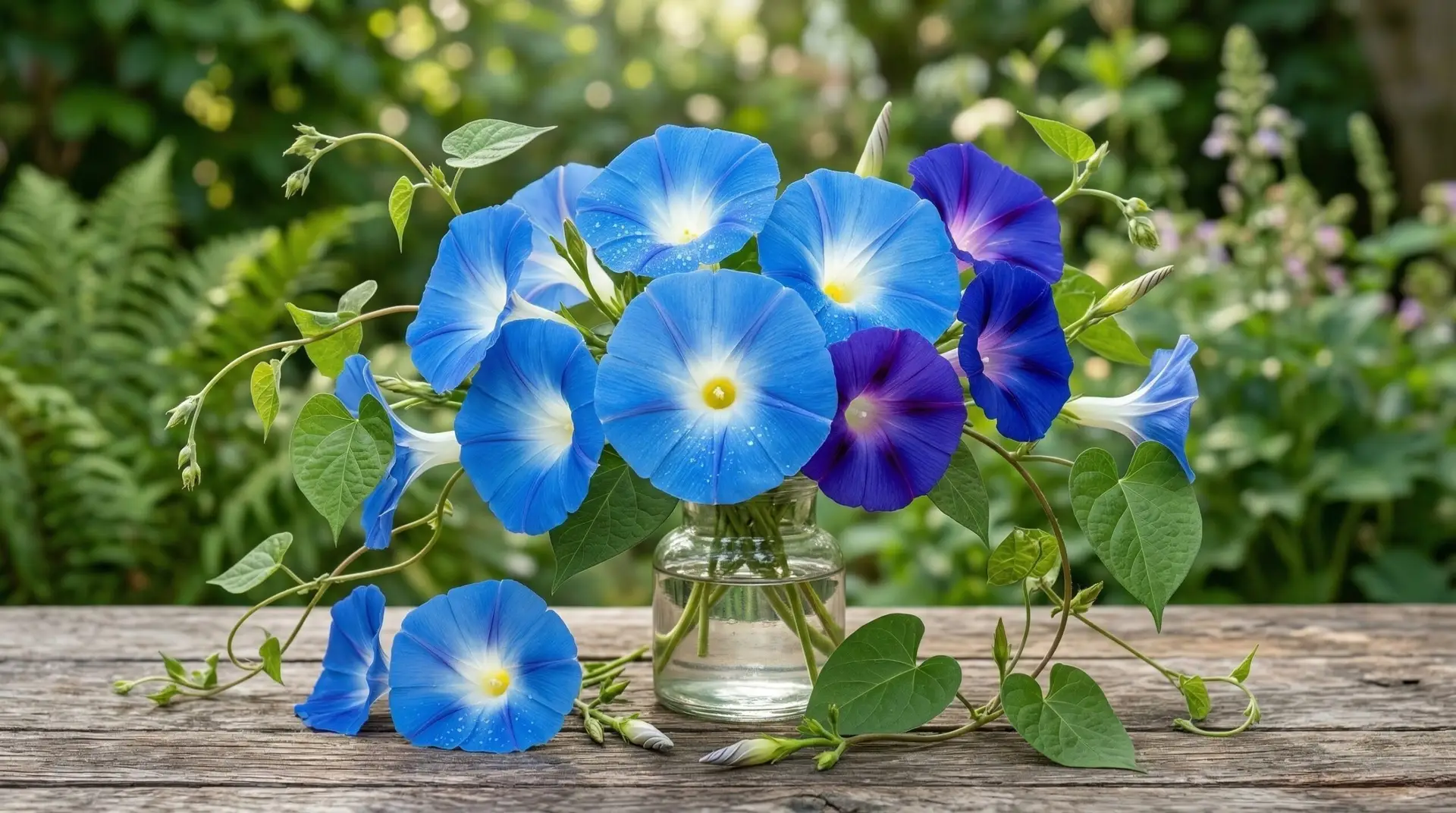
Heavenly Blue Morning Glory is a annual vine with sky blue fading toward throat flowers, typically blooming summer to frost. It generally performs best in full sun and is useful for trellises, fences. The most reliable visual clue is large funnel-shaped blue flowers with pale centers.
Seeds are not food and can be harmful if ingested. Bloom time, size, and garden performance can shift with cultivar, weather, soil, and region, so use the botanical name and plant label when making a final selection.
10. Blue Hydrangea
Scientific name: Hydrangea macrophylla cultivars
Blue Hydrangea is a deciduous shrub with blue to blue-purple flowers, typically blooming summer. It generally performs best in part sun and is useful for foundation planting, cutting. The most reliable visual clue is large mophead or lacecap clusters.
Blue color develops in suitable cultivars when soil chemistry makes aluminum available; not every hydrangea turns blue. Bloom time, size, and garden performance can shift with cultivar, weather, soil, and region, so use the botanical name and plant label when making a final selection.
11. Siberian Iris
Scientific name: Iris sibirica
:max_bytes(150000):strip_icc()/growing-siberian-iris-5089592-01-9721e91151bd477f98b15ec96a229e68.jpg)
Siberian Iris is a rhizomatous perennial with blue, violet-blue, white flowers, typically blooming late spring to early summer. It generally performs best in sun to part shade and is useful for moist borders, cutting. The most reliable visual clue is slender grasslike leaves and elegant blue iris flowers.
More moisture-tolerant than many bearded irises. Bloom time, size, and garden performance can shift with cultivar, weather, soil, and region, so use the botanical name and plant label when making a final selection.
12. Blue Lobelia
Scientific name: Lobelia erinus
Blue Lobelia is a annual with blue, violet-blue, white-eyed flowers, typically blooming spring to fall in cool conditions. It generally performs best in sun to part shade and is useful for edging, containers. The most reliable visual clue is masses of small fan-shaped two-lipped flowers.
Heat can reduce flowering. Bloom time, size, and garden performance can shift with cultivar, weather, soil, and region, so use the botanical name and plant label when making a final selection.
13. Meadow Sage
Scientific name: Salvia nemorosa

Meadow Sage is a perennial with violet-blue to indigo flowers, typically blooming late spring to summer. It generally performs best in full sun and is useful for pollinator borders. The most reliable visual clue is dense upright spikes of two-lipped flowers.
Deadheading often encourages additional bloom. Bloom time, size, and garden performance can shift with cultivar, weather, soil, and region, so use the botanical name and plant label when making a final selection.
14. Cape Leadwort
Scientific name: Plumbago auriculata
Cape Leadwort is a evergreen shrub or climber with powder blue flowers, typically blooming warm season. It generally performs best in sun to part shade and is useful for warm-climate hedges, containers. The most reliable visual clue is rounded clusters of five-lobed sky-blue flowers.
Frost tender in cold regions. Bloom time, size, and garden performance can shift with cultivar, weather, soil, and region, so use the botanical name and plant label when making a final selection.
15. Agapanthus
Scientific name: Agapanthus hybrids
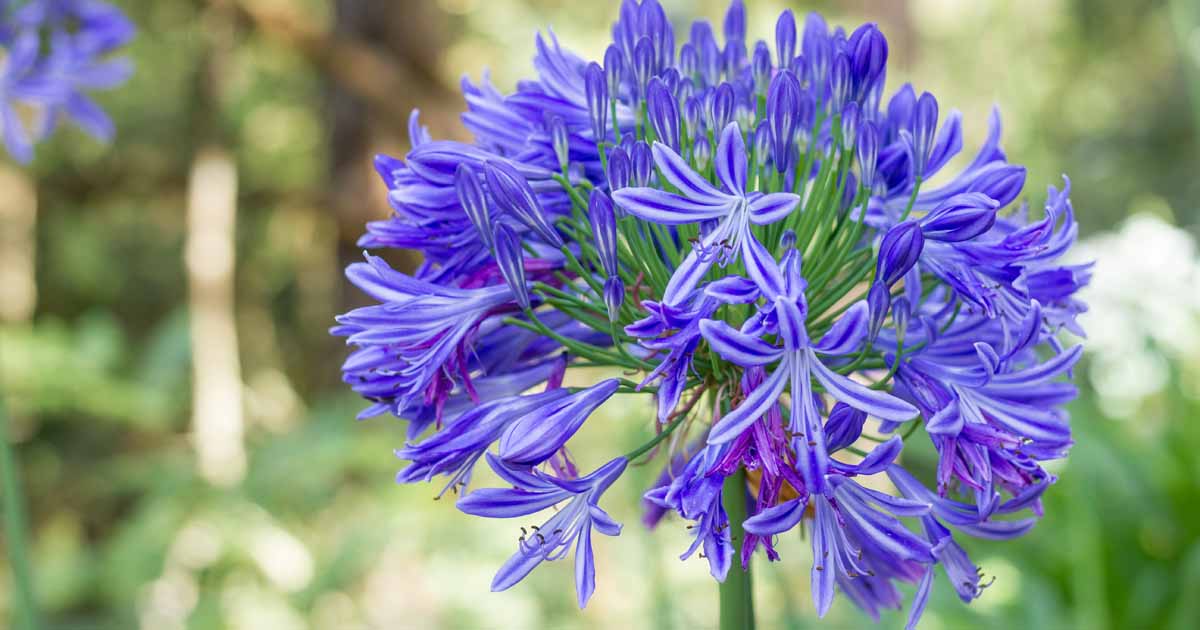
Agapanthus is a rhizomatous perennial with blue, violet-blue flowers, typically blooming summer. It generally performs best in full sun and is useful for containers, borders, cutting. The most reliable visual clue is spherical umbels of funnel-shaped blue flowers.
Hardiness varies by cultivar. Bloom time, size, and garden performance can shift with cultivar, weather, soil, and region, so use the botanical name and plant label when making a final selection.
16. Balloon Flower
Scientific name: Platycodon grandiflorus
Balloon Flower is a perennial with blue-violet, white, pink flowers, typically blooming summer. It generally performs best in full sun to part shade and is useful for borders, containers. The most reliable visual clue is inflated balloon-like buds open into five-pointed bells.
Late to emerge in spring, so mark the planting location. Bloom time, size, and garden performance can shift with cultivar, weather, soil, and region, so use the botanical name and plant label when making a final selection.
17. Carpathian Bellflower
Scientific name: Campanula carpatica

Carpathian Bellflower is a perennial with blue-violet, white flowers, typically blooming late spring to summer. It generally performs best in sun to part shade and is useful for rock gardens, edging. The most reliable visual clue is low mounds covered with open upward-facing bells.
Prefers good drainage and cooler conditions. Bloom time, size, and garden performance can shift with cultivar, weather, soil, and region, so use the botanical name and plant label when making a final selection.
18. Globe Thistle
Scientific name: Echinops ritro
Globe Thistle is a perennial with steel blue flowers, typically blooming summer. It generally performs best in full sun and is useful for dry borders, cut and dried flowers. The most reliable visual clue is spiky spherical blue flowerheads on upright stems.
Excellent textural contrast but physically prickly. Bloom time, size, and garden performance can shift with cultivar, weather, soil, and region, so use the botanical name and plant label when making a final selection.
19. Sea Holly
Scientific name: Eryngium planum
Sea Holly is a perennial with steel blue to blue-purple flowers, typically blooming summer. It generally performs best in full sun and is useful for dry borders, cutting. The most reliable visual clue is cone-like flowerheads surrounded by spiny metallic-blue bracts.
Needs drainage and full sun for strongest color. Bloom time, size, and garden performance can shift with cultivar, weather, soil, and region, so use the botanical name and plant label when making a final selection.
20. Grape Hyacinth
Scientific name: Muscari armeniacum
Grape Hyacinth is a bulb with deep blue flowers, typically blooming spring. It generally performs best in sun to light shade and is useful for edging, naturalizing. The most reliable visual clue is dense spikes of tiny urn-shaped blue florets.
Can spread through offsets and seed. Bloom time, size, and garden performance can shift with cultivar, weather, soil, and region, so use the botanical name and plant label when making a final selection.
21. Pincushion Flower
Scientific name: Scabiosa caucasica

Pincushion Flower is a perennial with lavender-blue flowers, typically blooming summer. It generally performs best in full sun and is useful for cutting, cottage borders. The most reliable visual clue is flat pincushion heads with a raised central texture.
Good drainage supports longevity. Bloom time, size, and garden performance can shift with cultivar, weather, soil, and region, so use the botanical name and plant label when making a final selection.
22. Blue Star
Scientific name: Amsonia tabernaemontana
Blue Star is a perennial with powder blue flowers, typically blooming late spring. It generally performs best in sun to part shade and is useful for native-style borders. The most reliable visual clue is clusters of narrow five-pointed star flowers above willow-like leaves.
Foliage often turns attractive yellow in fall. Bloom time, size, and garden performance can shift with cultivar, weather, soil, and region, so use the botanical name and plant label when making a final selection.
23. Siberian Bugloss
Scientific name: Brunnera macrophylla
:max_bytes(150000):strip_icc()/growing-brunnera-1402835_04-3c433b09b2844da3838ff60b22416e5d.jpg)
Siberian Bugloss is a perennial with clear blue flowers, typically blooming spring. It generally performs best in part shade and is useful for woodland gardens. The most reliable visual clue is tiny forget-me-not-like blue flowers above heart-shaped leaves.
Cultivars are also valued for silver-patterned foliage. Bloom time, size, and garden performance can shift with cultivar, weather, soil, and region, so use the botanical name and plant label when making a final selection.
24. Blue Lace Flower
Scientific name: Trachymene coerulea
Blue Lace Flower is a annual with powder blue to lavender-blue flowers, typically blooming summer. It generally performs best in full sun and is useful for cutting, airy borders. The most reliable visual clue is flat lacy umbels of tiny blue flowers.
Fine texture works well as filler in bouquets. Bloom time, size, and garden performance can shift with cultivar, weather, soil, and region, so use the botanical name and plant label when making a final selection.
25. Blue-Eyed Grass
Scientific name: Sisyrinchium angustifolium
Blue-Eyed Grass is a perennial with blue-violet with yellow eye flowers, typically blooming late spring to summer. It generally performs best in sun to part shade and is useful for native-style edging. The most reliable visual clue is small six-tepaled blue flowers above narrow iris-like leaves.
Despite the common name, it belongs to the iris family rather than grasses. Bloom time, size, and garden performance can shift with cultivar, weather, soil, and region, so use the botanical name and plant label when making a final selection.
What Makes a Flower Look Blue?
Blue appearance depends on pigment chemistry, cell structure, pH, metal ions, and how light is reflected through petal tissues. That is why “blue” cultivars may look violet in warm light or photographs. In bigleaf hydrangeas, available aluminum and soil chemistry can strongly influence sepal color in cultivars capable of changing color.
How to Identify Blue Flowers
Do not rely on color alone. Cornflower has fringed composite heads, borage is a bristly herb with star-shaped blooms, delphinium forms tall spurred spikes, gentians often have tubular flowers, and blue-eyed grass has small six-part blooms above narrow leaves. Compare leaves, flower arrangement, plant height, and season to avoid misidentification.
How to Design With Blue Flowers
Clear blue flowers pair easily with white, silver, pale yellow, apricot, or soft pink. Deep cobalt creates stronger contrast with orange and gold. Use steel-blue sea holly or globe thistle when you want texture, and low bellflowers or lobelia for edging. If your goal is a blue cutting garden, combine sturdy stem crops such as delphinium, cornflower, scabiosa, sea holly, and blue lace flower with softer foliage.
Choosing Blue Flowers by Climate
Cool climates favor plants such as delphiniums, Himalayan blue poppies, and many gentians. Hot sunny gardens may be better suited to globe thistle, sea holly, chicory, or heat-tolerant salvias. Blue hydrangeas need both an appropriate cultivar and suitable soil chemistry; simply adding an acidifying product does not guarantee blue flowers.
Safety and Ecology Notes
Blue color does not indicate safety. Delphinium is toxic if eaten, morning-glory seeds are not food, and ornamental flowers should not be consumed without exact species-level confirmation. For pollinator gardens, select species that fit your region and avoid broad-spectrum pesticides on open blooms.
Common Mistakes When Choosing or Identifying Types of blue flowers
- Calling lavender or purple flowers true blue without qualification.
- Trying to turn every hydrangea blue with soil amendments.
- Choosing color before checking heat and hardiness requirements.
- Identifying a plant from flower color alone.
- Assuming a blue flower is edible because another species in the genus is edible.
Fun Facts About Types of blue flowers
- Cornflower blue is a widely recognized horticultural color reference.
- Some gentians produce exceptionally saturated blue flowers.
- Bigleaf hydrangea color can respond to aluminum availability.
- Steel-blue sea holly color involves bracts as well as flowers.
- Borage flowers often age from pinkish tones toward blue as chemistry changes.
- Forget-me-nots are identified by both their blue petals and yellow centers.
- Blue-eyed grass is in the iris family.
- Many so-called blue salvias are actually blue-violet.
- There is no common naturally true-blue tulip.
- Light quality can make the same flower look bluer or more violet.
Final Thoughts on Types of blue flowers
When comparing types of blue flowers, pay attention to the exact shade and the plant’s climate needs. A true-looking blue that thrives in your site will create a stronger garden effect than a cultivar labeled blue but stressed by unsuitable heat, shade, or soil.
Frequently Asked Questions
1. What are the main types covered in this guide?
This guide compares 25 factual, useful examples, including Cornflower, Delphinium, Himalayan Blue Poppy, Gentian. The entries may be species, cultivars, or horticultural groups depending on what the search term actually describes.
2. Are all of these entries separate botanical species?
No. Where a named cultivar or horticultural form is used, it is labeled as such rather than being presented as a species. Botanical rank matters for accurate identification.
3. Which types are easiest for beginners?
Beginner-friendly choices depend on climate, but Cornflower, Delphinium, Himalayan Blue Poppy are useful starting points when their light, soil, and temperature needs match the site.
4. Which types are best for full sun?
Many flowering plants in the list prefer full sun, but the exact requirement varies. Check the individual entry and local heat conditions before planting.
5. Which types tolerate part shade?
Several species tolerate some shade, especially woodland or cool-climate plants. Part shade should be interpreted in the context of local sun intensity.
6. When do these flowers bloom?
Bloom time ranges from spring through fall depending on species. Climate, latitude, elevation, cultivar, and weather can shift the stated season.
7. Are these flowers annuals or perennials?
The list can include annuals, perennials, bulbs, shrubs, or vines when they genuinely fit the topic. Each entry identifies its growth habit.
8. Can these flowers grow in containers?
Many can, provided the container is large enough and drains well. Match pot size to mature root system and plant height.
9. Which flowers are good for cutting?
Flowers with strong stems and good postharvest performance are best for cutting. The individual entries note arrangement or cutting value where it is important.
10. Which flowers attract pollinators?
Open, accessible flowers often provide nectar or pollen to bees, butterflies, or other visitors, but pollinator value varies by species and region.
11. How should I choose flowers for my climate?
Use local hardiness, summer heat, winter moisture, frost dates, and rainfall as filters. USDA zones are useful for cold hardiness in the United States but do not describe every climate factor.
12. What soil do these flowers need?
Most garden flowers benefit from well-drained soil, but moisture and pH preferences vary. Some species prefer consistently moist soil while others resent wet roots.
13. How often should flowering plants be watered?
Water according to plant type, soil, weather, and establishment stage rather than a fixed weekly rule. Deep, less frequent irrigation is appropriate for many established garden plants.
14. Should these flowers be deadheaded?
Many repeat-blooming annuals and perennials benefit from deadheading, while plants grown for seed, wildlife value, or ornamental seed heads may be left standing.
15. Can I grow these flowers from seed?
Many species can be seed-grown, but named cultivars may not come true from seed. Bulbs, divisions, cuttings, or tissue culture are used when clonal consistency is needed.
16. What is the difference between a species and a cultivar?
A species is a botanical taxonomic unit. A cultivar is a named plant selected and maintained for particular horticultural traits.
17. What is a hybrid flower?
A hybrid results from crossing genetically distinct parents. Horticultural hybrids may occur between species, cultivars, or breeding lines and should not be described as separate wild species.
18. Why do common names cause confusion?
One common name can refer to several unrelated plants, and one plant can have several common names. Scientific names help resolve that ambiguity.
19. Can flower color change with soil or climate?
Color can shift with temperature, light, plant age, and genetics. In a few plants such as some hydrangeas, soil chemistry also influences pigment expression.
20. Are all varieties the same height?
No. Cultivars within one species can differ dramatically in height and spread. Use the specific plant label rather than a genus-wide size assumption.
21. Can I use these flowers in bouquets?
Many can be cut, but vase life and stem strength vary. Harvest stage and conditioning are important for good performance.
22. Are any of these flowers edible?
Do not infer edibility from a general flower guide. Edibility must be confirmed for the exact species and plant part, with food-safe growing conditions.
23. Are any of these flowers toxic to pets?
Some ornamental flowers can be harmful to cats, dogs, horses, or livestock. Check species-specific veterinary guidance before planting or arranging flowers around animals.
24. Can these flowers become invasive?
Some ornamental plants spread aggressively or are invasive in particular regions. Invasiveness is location-specific, so check state or regional invasive-plant guidance.
25. How can I identify an unknown flower?
Compare flower shape, petal or floret arrangement, leaves, stems, growth habit, bloom season, and habitat. Avoid identifying from color alone.
26. What are the best flowers for a low-maintenance garden?
Choose species adapted to the site’s light, soil, moisture, and winter conditions. A well-matched plant is usually lower maintenance than one that must be constantly corrected.
27. How can I extend the bloom season?
Combine early-, mid-, and late-season plants, select long-blooming cultivars, deadhead where appropriate, and maintain steady nutrition and moisture without overfeeding.
28. Do flowers need fertilizer to bloom?
Many benefit from adequate nutrients, but excessive nitrogen can produce leaves instead of flowers. Test soil when possible and fertilize according to plant needs.
29. How far apart should flowers be planted?
Spacing depends on mature width, airflow needs, and design goals. Follow species- or cultivar-specific guidance rather than using one spacing for all flowers.
30. How do I choose the best type for my garden?
Start with site conditions—sun, drainage, climate, available space—then choose for bloom season, color, pollinator value, cut-flower use, maintenance, and safety.
SEO Title
Meta Description
Suggested URL Slug
types-of-blue-flowers