

Lakes support very different fish communities depending on latitude, depth, water temperature, oxygen, vegetation, food supply, and whether the lake connects to rivers or the sea. This guide to types of lake fish covers 40 representative species from warm ponds and reservoirs to deep northern lakes and European coarse-fishing waters.
What Are the Main Types Of Lake Fish?
The main types of lake fish include bass, sunfish, crappie, perch, walleye, pike, trout, salmon, whitefish, catfish, carp, sturgeon, gar, bowfin, and other regional species. Warm shallow lakes favor bass, sunfish, carp, and catfish, while deep cold lakes may support lake trout, salmon, whitefish, cisco, and burbot.
Quick Comparison of Types Of Lake Fish
| # | Common Name | Scientific Name | Group | Typical Habitat |
|---|---|---|---|---|
| 1 | Largemouth Bass | Micropterus salmoides | Warmwater predator | Vegetated lakes, reservoirs, ponds, and shallow coves |
| 2 | Smallmouth Bass | Micropterus dolomieu | Cooler-water black bass | Clear rocky lakes, reservoirs, and current-influenced shorelines |
| 3 | Spotted Bass | Micropterus punctulatus | Black bass | Reservoirs, rocky lakes, and river-fed impoundments |
| 4 | Striped Bass | Morone saxatilis | Open-water temperate bass | Large reservoirs and landlocked lake systems |
| 5 | White Bass | Morone chrysops | Schooling temperate bass | Reservoirs, natural lakes, and tributaries |
| 6 | Bluegill | Lepomis macrochirus | Sunfish | Ponds, lakes, shallow bays, and weed edges |
| 7 | Pumpkinseed | Lepomis gibbosus | Sunfish | Clear vegetated lakes and quiet bays |
| 8 | Green Sunfish | Lepomis cyanellus | Sunfish | Warm shallow lakes, ponds, and rocky margins |
| 9 | Redear Sunfish | Lepomis microlophus | Sunfish | Warm lakes and ponds with firm bottoms and vegetation |
| 10 | Black Crappie | Pomoxis nigromaculatus | Sunfish family | Clearer lakes, brush, docks, and vegetated coves |
| 11 | White Crappie | Pomoxis annularis | Sunfish family | Murky reservoirs, lakes, brush piles, and standing timber |
| 12 | Yellow Perch | Perca flavescens | Perch | Cool lakes, reservoirs, and vegetated shallows |
| 13 | European Perch | Perca fluviatilis | Perch | Lakes and slow rivers across Europe and introduced regions |
| 14 | Walleye | Sander vitreus | Perch family | Cool large lakes, reservoirs, rocky reefs, and drop-offs |
| 15 | Sauger | Sander canadensis | Perch family | Turbid reservoirs, river-influenced lakes, and current zones |
| 16 | Northern Pike | Esox lucius | Pike | Weedy cool lakes, shallow bays, and river-connected waters |
| 17 | Muskellunge | Esox masquinongy | Pike | Large cool lakes, reservoirs, and weed-rock transitions |
| 18 | Lake Trout | Salvelinus namaycush | Char | Deep cold oxygen-rich lakes |
| 19 | Rainbow Trout | Oncorhynchus mykiss | Trout | Cold lakes, reservoirs, and connected streams |
| 20 | Brown Trout | Salmo trutta | Trout | Cool lakes, tributaries, and rocky shore zones |
| 21 | Brook Trout | Salvelinus fontinalis | Char | Cold clear lakes, spring ponds, and tributaries |
| 22 | Kokanee Salmon | Oncorhynchus nerka | Landlocked salmon | Cold deep lakes |
| 23 | Landlocked Atlantic Salmon | Salmo salar | Salmon | Cold deep lakes connected to suitable spawning tributaries |
| 24 | Lake Whitefish | Coregonus clupeaformis | Whitefish | Deep cold lakes of northern North America |
| 25 | Cisco | Coregonus artedi | Whitefish | Open water of cool northern lakes |
| 26 | Burbot | Lota lota | Freshwater cod | Deep cool lakes, rocky bottoms, and connected rivers |
| 27 | Channel Catfish | Ictalurus punctatus | Catfish | Warm lakes, reservoirs, channels, and flats |
| 28 | Blue Catfish | Ictalurus furcatus | Catfish | Large reservoirs, river-fed lakes, and deep channels |
| 29 | Flathead Catfish | Pylodictis olivaris | Catfish | Warm reservoirs, woody cover, rock ledges, and deep holes |
| 30 | Black Bullhead | Ameiurus melas | Bullhead catfish | Muddy ponds, shallow lakes, and vegetated backwaters |
| 31 | Common Carp | Cyprinus carpio | Carp | Warm lakes, reservoirs, shallow bays, and slow rivers |
| 32 | Grass Carp | Ctenopharyngodon idella | Carp | Warm lakes and reservoirs, often introduced for vegetation control |
| 33 | Tench | Tinca tinca | Cyprinid | Slow, weedy lakes and ponds |
| 34 | Common Bream | Abramis brama | Cyprinid | Large European lakes and slow rivers |
| 35 | Roach | Rutilus rutilus | Cyprinid | European lakes, canals, and slow rivers |
| 36 | Rudd | Scardinius erythrophthalmus | Cyprinid | Weedy European lakes and quiet backwaters |
| 37 | Freshwater Drum | Aplodinotus grunniens | Drum | Large North American lakes and reservoirs |
| 38 | Bowfin | Amia calva | Ancient ray-finned fish | Warm vegetated lakes, swamps, and backwaters |
| 39 | Longnose Gar | Lepisosteus osseus | Gar | Large lakes, reservoirs, and slow river margins |
| 40 | Lake Sturgeon | Acipenser fulvescens | Sturgeon | Large lakes and river-connected systems of North America |
1. Largemouth Bass
Largemouth Bass (Micropterus salmoides) belongs to the warmwater predator group. It is most closely associated with vegetated lakes, reservoirs, ponds, and shallow coves. Look for a large mouth extending beyond the eye and a dark side stripe when making an identification.
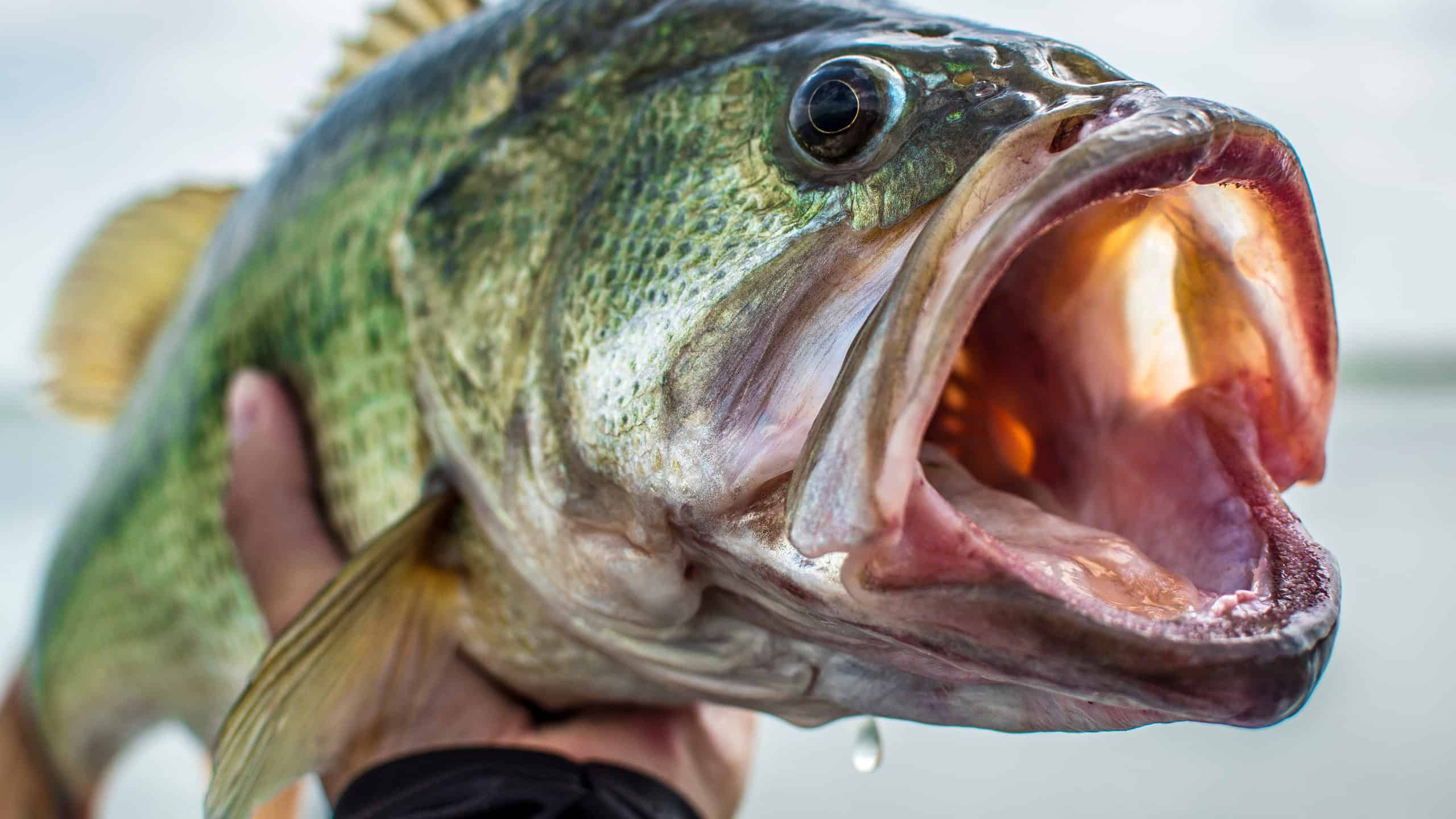
This ambush predator uses weeds, wood, docks, and shade as cover. It is one of the world’s best-known freshwater sport fish.
2. Smallmouth Bass
The Smallmouth Bass, scientifically known as Micropterus dolomieu, is a cooler-water black bass. It is most closely associated with clear rocky lakes, reservoirs, and current-influenced shorelines. Look for bronze coloring, vertical bars, and a jaw ending near the eye when making an identification.
Smallmouth bass commonly feed on crayfish and small fish. They favor rock, gravel, points, and drop-offs.
3. Spotted Bass
Among the most recognizable fish in this guide is the Spotted Bass (Micropterus punctulatus), a black bass. It is most closely associated with reservoirs, rocky lakes, and river-fed impoundments. Look for rows of small dark spots below the side stripe and a rough tongue patch when making an identification.
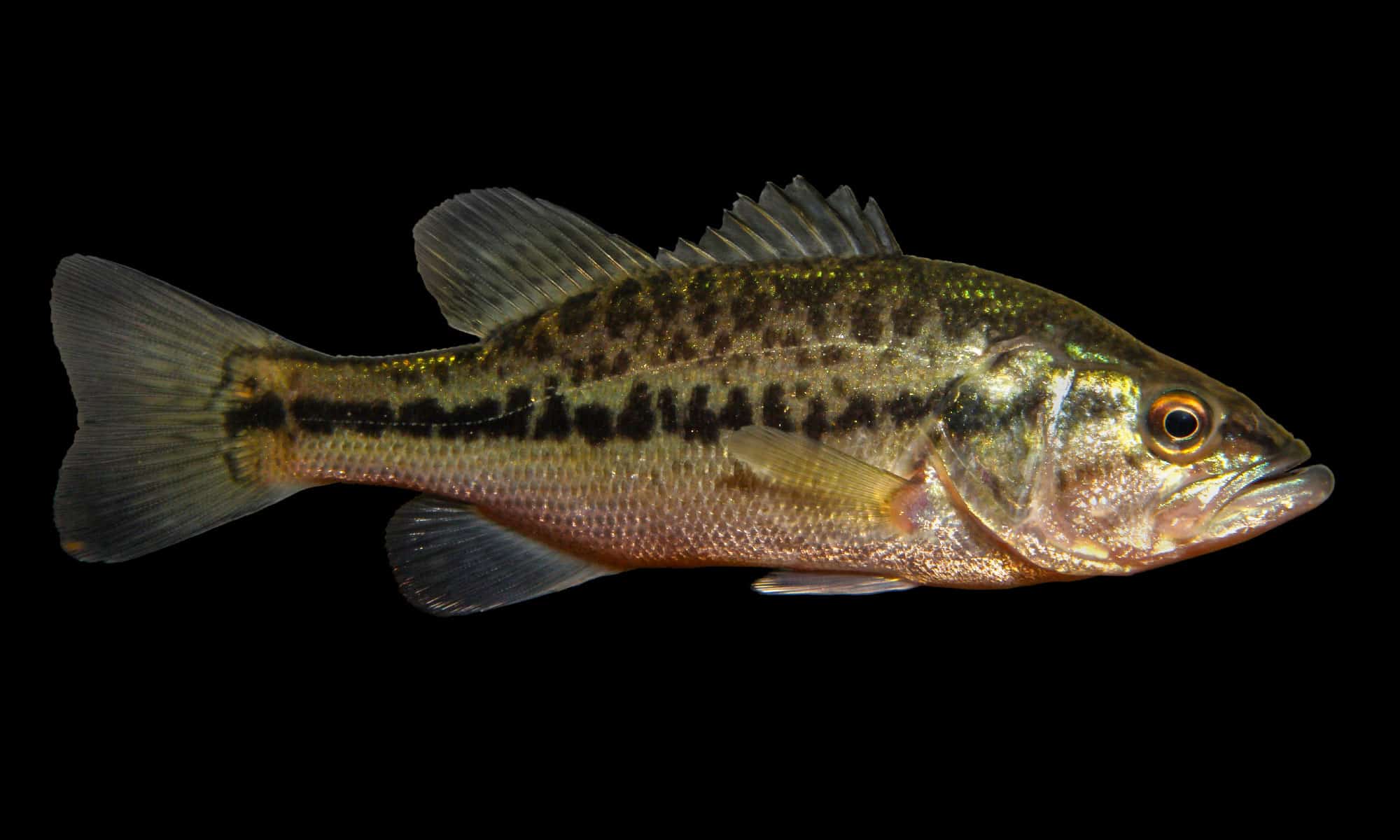
Spotted bass often suspend in open water or hold along channels. They are usually more streamlined than largemouth bass.
4. Striped Bass
Striped Bass is the common name used here for Morone saxatilis, a member of the open-water temperate bass group. It is most closely associated with large reservoirs and landlocked lake systems. Look for a silver body marked by several dark horizontal stripes when making an identification.

Landlocked striped bass follow schools of shad and other baitfish. They need cool, oxygenated water during warm seasons.
5. White Bass
White Bass (Morone chrysops) belongs to the schooling temperate bass group. It is most closely associated with reservoirs, natural lakes, and tributaries. Look for a deep silver body with horizontal stripes when making an identification.
White bass often feed in large surface schools. Spring spawning runs can concentrate them in tributaries.
6. Bluegill
The Bluegill, scientifically known as Lepomis macrochirus, is a sunfish. It is most closely associated with ponds, lakes, shallow bays, and weed edges. Look for a small mouth, dark ear flap, and deep blue-green body when making an identification.
Bluegill eat insects and small aquatic animals. They are important prey for larger fish and a friendly starting point for new anglers.
7. Pumpkinseed
Among the most recognizable fish in this guide is the Pumpkinseed (Lepomis gibbosus), a sunfish. It is most closely associated with clear vegetated lakes and quiet bays. Look for bright orange spots, blue facial lines, and a red-orange mark on the ear flap when making an identification.
Pumpkinseed often feed on snails, insects, and crustaceans. Their vivid pattern makes them easy to recognize.
8. Green Sunfish
Green Sunfish is the common name used here for Lepomis cyanellus, a member of the sunfish group. It is most closely associated with warm shallow lakes, ponds, and rocky margins. Look for a large mouth, blue facial streaks, and pale fin edges when making an identification.
This aggressive, hardy sunfish tolerates conditions that challenge more sensitive species.
9. Redear Sunfish
Redear Sunfish (Lepomis microlophus) belongs to the sunfish group. It is most closely associated with warm lakes and ponds with firm bottoms and vegetation. Look for a dark ear flap edged in red or orange when making an identification.
Often called shellcracker, it uses strong throat teeth to crush snails and mollusks.
10. Black Crappie
The Black Crappie, scientifically known as Pomoxis nigromaculatus, is a sunfish family. It is most closely associated with clearer lakes, brush, docks, and vegetated coves. Look for random dark speckles on a deep silvery body when making an identification.
Black crappie form schools and relate strongly to cover. Spring is a popular season because adults move shallower to spawn.
11. White Crappie
Among the most recognizable fish in this guide is the White Crappie (Pomoxis annularis), a sunfish family. It is most closely associated with murky reservoirs, lakes, brush piles, and standing timber. Look for distinct dark vertical bars rather than scattered speckles when making an identification.
White crappie tolerate turbid water well and commonly suspend around submerged structure.
12. Yellow Perch
Yellow Perch is the common name used here for Perca flavescens, a member of the perch group. It is most closely associated with cool lakes, reservoirs, and vegetated shallows. Look for golden-yellow sides with dark vertical bars and orange lower fins when making an identification.
Yellow perch school by size and feed on insects, crustaceans, and small fish. They are valued both as food and sport.
13. European Perch
European Perch (Perca fluviatilis) belongs to the perch group. It is most closely associated with lakes and slow rivers across europe and introduced regions. Look for dark vertical bars, red-orange fins, and a spiny first dorsal fin when making an identification.
European perch are visual predators that move between vegetation, structure, and open water as they grow.
14. Walleye
The Walleye, scientifically known as Sander vitreus, is a perch family. It is most closely associated with cool large lakes, reservoirs, rocky reefs, and drop-offs. Look for glassy eyes, canine teeth, olive-gold sides, and a white lower tail tip when making an identification.
Walleye feed effectively in dim light. Windblown shorelines, night periods, and deep edges are productive places to search.
15. Sauger
Among the most recognizable fish in this guide is the Sauger (Sander canadensis), a perch family. It is most closely associated with turbid reservoirs, river-influenced lakes, and current zones. Look for dark saddle marks, spotted dorsal fin, and no strong white tail tip when making an identification.\
Sauger tolerate current and muddy water better than walleye and often stay close to the bottom.
16. Northern Pike
Northern Pike is the common name used here for Esox lucius, a member of the pike group. It is most closely associated with weedy cool lakes, shallow bays, and river-connected waters. Look for a long green body with pale spots and a duckbill snout when making an identification.
Northern pike wait motionless near vegetation before bursting toward prey. Their teeth require careful handling.
17. Muskellunge
Muskellunge (Esox masquinongy) belongs to the pike group. It is most closely associated with large cool lakes, reservoirs, and weed-rock transitions. Look for a long heavy body with bars or spots and a pointed head when making an identification.
Muskellunge are low-density apex predators. Anglers often practice careful catch and release because these fish grow slowly.
18. Lake Trout
The Lake Trout, scientifically known as Salvelinus namaycush, is a char. It is most closely associated with deep cold oxygen-rich lakes. Look for a gray-green body with pale spots and a deeply forked tail when making an identification.
Lake trout occupy deep cool water for much of the year. They feed on ciscoes, smelt, and other fish.
19. Rainbow Trout
Among the most recognizable fish in this guide is the Rainbow Trout (Oncorhynchus mykiss), a trout. It is most closely associated with cold lakes, reservoirs, and connected streams. Look for a pink side stripe and dark spots on the back and tail when making an identification.
Rainbow trout may be native, introduced, or stocked depending on the lake. They eat insects, crustaceans, and small fish.
20. Brown Trout
Brown Trout is the common name used here for Salmo trutta, a member of the trout group. It is most closely associated with cool lakes, tributaries, and rocky shore zones. Look for golden-brown sides with black and red spots when making an identification.
Large lake-dwelling brown trout become strong fish predators. They often feed in low light near shore or along deep edges.
21. Brook Trout
Brook Trout (Salvelinus fontinalis) belongs to the char group. It is most closely associated with cold clear lakes, spring ponds, and tributaries. Look for worm-like markings on the back, red spots with blue halos, and white fin edges when making an identification.
Brook trout require clean, cool, oxygen-rich water and can indicate high-quality habitat.
22. Kokanee Salmon
The Kokanee Salmon, scientifically known as Oncorhynchus nerka, is a landlocked salmon. It is most closely associated with cold deep lakes. Look for silver in open water and bright red with a green head during spawning when making an identification.
Kokanee are landlocked sockeye salmon that feed mainly on zooplankton. They are important forage for large lake trout in some systems.
23. Landlocked Atlantic Salmon
Among the most recognizable fish in this guide is the Landlocked Atlantic Salmon (Salmo salar), a salmon. It is most closely associated with cold deep lakes connected to suitable spawning tributaries. Look for a streamlined silver body with scattered dark spots when making an identification.
These Atlantic salmon populations complete their life cycle without entering the sea. Clean tributaries are critical for reproduction.
24. Lake Whitefish
Lake Whitefish is the common name used here for Coregonus clupeaformis, a member of the whitefish group. It is most closely associated with deep cold lakes of northern north america. Look for a silver body, small head, forked tail, and subterminal mouth when making an identification.
Lake whitefish feed near the bottom on insects, mollusks, and small organisms. They support important commercial and subsistence fisheries.
25. Cisco
Cisco (Coregonus artedi) belongs to the whitefish group. It is most closely associated with open water of cool northern lakes. Look for a slender silver body, large eye, and forked tail when making an identification.
Ciscoes are schooling plankton feeders and a key prey fish for lake trout, salmon, and walleye.
26. Burbot
The Burbot, scientifically known as Lota lota, is a freshwater cod. It is most closely associated with deep cool lakes, rocky bottoms, and connected rivers. Look for an elongated mottled body and a single chin barbel when making an identification.
Burbot are the only freshwater members of the cod family. They become active in cold weather and may spawn under winter ice.
27. Channel Catfish
Among the most recognizable fish in this guide is the Channel Catfish (Ictalurus punctatus), a catfish. It is most closely associated with warm lakes, reservoirs, channels, and flats. Look for a forked tail, barbels, and spots on younger fish when making an identification.
Channel catfish are adaptable omnivores and widely stocked sport fish. They feed heavily at night and in stained water.
28. Blue Catfish
Blue Catfish is the common name used here for Ictalurus furcatus, a member of the catfish group. It is most closely associated with large reservoirs, river-fed lakes, and deep channels. Look for a blue-gray body, forked tail, and long anal fin when making an identification.
Blue catfish roam widely and feed on fish, mussels, and carrion. In some introduced lakes they can affect native food webs.
29. Flathead Catfish
Flathead Catfish (Pylodictis olivaris) belongs to the catfish group. It is most closely associated with warm reservoirs, woody cover, rock ledges, and deep holes. Look for a broad flat head, squared tail, and mottled yellow-brown body when making an identification.
Adult flatheads are active predators that strongly favor live fish. They usually hide in cover during daylight.
30. Black Bullhead
The Black Bullhead, scientifically known as Ameiurus melas, is a bullhead catfish. It is most closely associated with muddy ponds, shallow lakes, and vegetated backwaters. Look for a dark compact body, rounded tail, and barbels when making an identification.
Black bullheads tolerate warm, low-oxygen water and feed on almost anything available near the bottom.
31. Common Carp
Among the most recognizable fish in this guide is the Common Carp (Cyprinus carpio), a carp. It is most closely associated with warm lakes, reservoirs, shallow bays, and slow rivers. Look for a heavy bronze body, large scales, and two pairs of mouth barbels when making an identification.
Common carp root through bottom sediments for food. They are valued sport fish in some regions but invasive or disruptive in others.
32. Grass Carp
Grass Carp is the common name used here for Ctenopharyngodon idella, a member of the carp group. It is most closely associated with warm lakes and reservoirs, often introduced for vegetation control. Look for a long cylindrical body, large crosshatched scales, and no mouth barbels when making an identification.
Grass carp eat aquatic plants. Sterile fish are sometimes stocked for management, but unauthorized movement can create ecological problems.
33. Tench
Tench (Tinca tinca) belongs to the cyprinid group. It is most closely associated with slow, weedy lakes and ponds. Look for an olive-green body, tiny scales, rounded fins, and small mouth barbels when making an identification.
Tench are bottom feeders that search soft sediment for insects, snails, and plant material. They are most active in warm conditions.
34. Common Bream
The Common Bream, scientifically known as Abramis brama, is a cyprinid. It is most closely associated with large european lakes and slow rivers. Look for a very deep silver-bronze body with a long anal fin when making an identification.
Common bream gather in schools and feed over soft bottoms. Anglers often use groundbait and small hook baits.
35. Roach
Among the most recognizable fish in this guide is the Roach (Rutilus rutilus), a cyprinid. It is most closely associated with european lakes, canals, and slow rivers. Look for silver sides, red-orange fins, and a red eye when making an identification.

Roach are adaptable schooling fish and an important prey species. They feed on plants, insects, and small invertebrates.
36. Rudd
Rudd is the common name used here for Scardinius erythrophthalmus, a member of the cyprinid group. It is most closely associated with weedy european lakes and quiet backwaters. Look for golden sides, bright red fins, and an upturned mouth when making an identification.
Rudd often feed near the surface among vegetation. The upturned mouth helps separate them from similar roach.
37. Freshwater Drum
Freshwater Drum (Aplodinotus grunniens) belongs to the drum group. It is most closely associated with large north american lakes and reservoirs. Look for a high-backed silver body and long dorsal fin when making an identification.
Freshwater drum crush snails and mussels with powerful throat teeth and can produce drumming sounds.
38. Bowfin
The Bowfin, scientifically known as Amia calva, is a ancient ray-finned fish. It is most closely associated with warm vegetated lakes, swamps, and backwaters. Look for a long dorsal fin, rounded tail, and mottled green-brown body when making an identification.
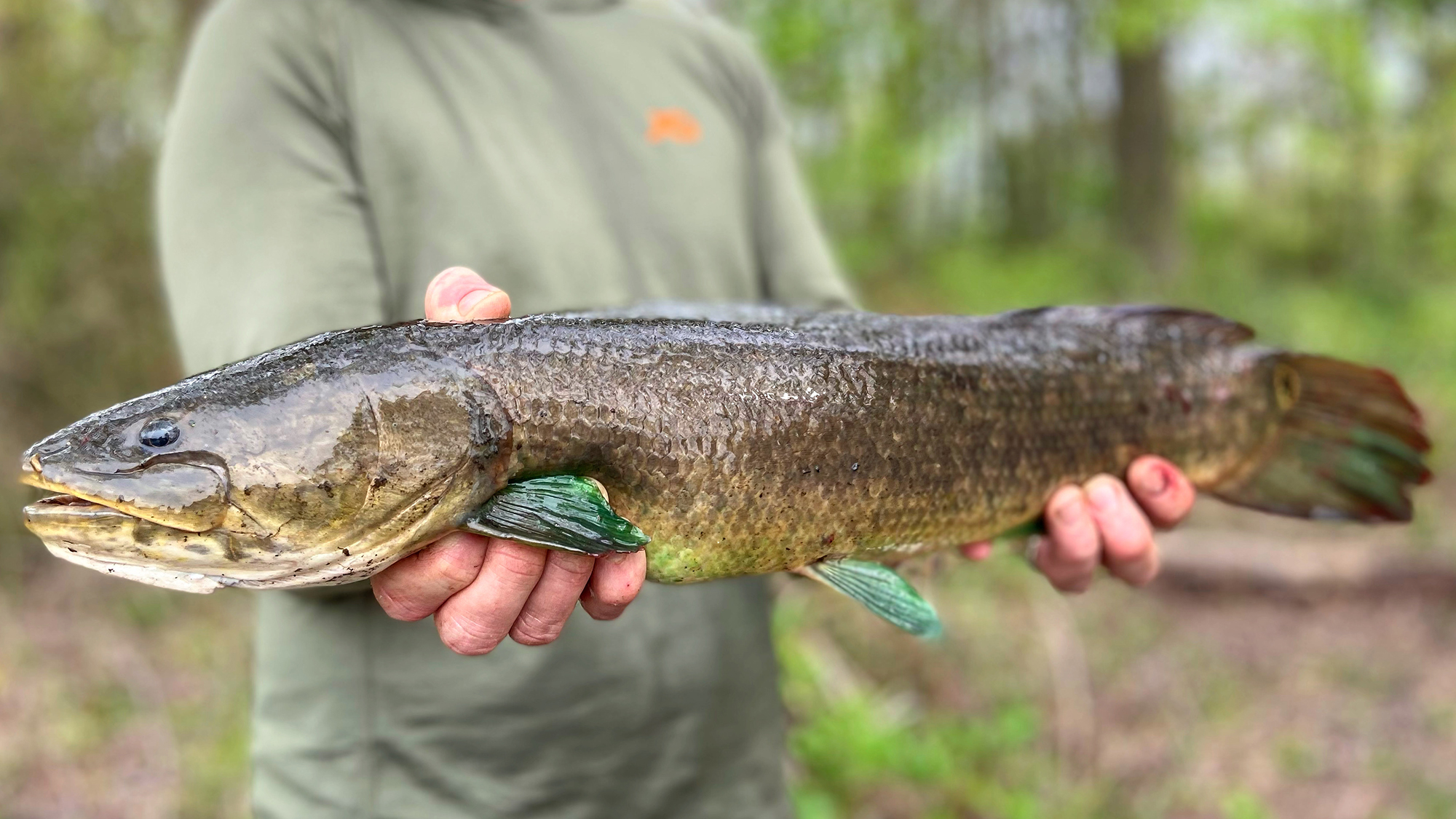
Bowfin breathe air when oxygen is low and are strong native predators. They are sometimes mistaken for invasive snakeheads.
39. Longnose Gar
Among the most recognizable fish in this guide is the Longnose Gar (Lepisosteus osseus), a gar. It is most closely associated with large lakes, reservoirs, and slow river margins. Look for a very long narrow snout, armored scales, and elongated body when making an identification.
Longnose gar often bask near the surface and ambush fish. Their tough scales and sharp teeth require careful handling.
40. Lake Sturgeon
Lake Sturgeon is the common name used here for Acipenser fulvescens, a member of the sturgeon group. It is most closely associated with large lakes and river-connected systems of north america. Look for an elongated body with bony scutes, barbels, and a shark-like tail when making an identification.
Lake sturgeon can live for many decades and mature late. Many populations are protected or tightly managed.
How Are These Types of Fish Classified?
Lake fish can be grouped by temperature preference, feeding zone, and family. Warmwater fish include many bass, sunfish, catfish, and carp. Coolwater fish include walleye, perch, pike, and muskellunge. Coldwater fish include trout, salmon, whitefish, and cisco. Bottom feeders, open-water schoolers, shoreline ambush predators, and deep-water specialists may all share one lake.
Where Do These Fish Live?
Lake habitat is layered. The littoral zone near shore contains plants, wood, insects, and nursery cover. Open water supports plankton, baitfish, and roaming predators. Deep zones provide cold refuge but may lose oxygen in productive lakes. Seasonal turnover, inflowing rivers, spawning shoals, reefs, and submerged channels all influence where fish gather.
How to Identify Different Types of Fish
- Body shape: Decide whether the fish is deep-bodied, eel-like, torpedo-shaped, flattened, or armored.
- Mouth and teeth: Note whether the mouth points upward, forward, or downward and whether teeth or barbels are visible.
- Tail shape: Forked, rounded, squared, and three-lobed tails are valuable clues.
- Fin pattern: Count separate dorsal fins and look for spines, spots, colored margins, or long filaments.
- Color and markings: Use bars, spots, stripes, mottling, and breeding colors, but do not rely on color alone.
- Habitat: Match the fish to water temperature, depth, current, vegetation, reef, or bottom type.
- Range: Confirm that the species is documented in the state, country, drainage, lake, or ocean region.
Fishing and Outdoor Observation Tips
- Begin by learning whether the lake is warmwater, coolwater, or coldwater.
- Study a contour map to find points, humps, creek channels, flats, and deep basins.
- Use seasonal behavior: spawning fish move shallow, summer fish may follow oxygen and temperature layers, and autumn predators often chase baitfish.
- Match bait size to local forage such as shad, cisco, perch, crayfish, or insects.
- Check local rules because one lake may contain protected sturgeon, stocked trout, or invasive carp.
Safety, Sustainability, and Conservation Notes
Lake fisheries depend on clean water, connected spawning habitat, balanced food webs, and responsible harvest. Prevent invasive species by cleaning, draining, and drying boats and gear. Never transfer fish, plants, water, or live bait between lakes. Follow consumption advisories and give slow-growing fish such as lake sturgeon, muskellunge, and some lake trout extra care.
Fun Facts About Types Of Lake Fish
- A single large lake can contain warm shoreline habitat and cold deep-water habitat.
- Lake turnover redistributes oxygen and temperature through the water column.
- Ciscoes and other open-water forage fish support large predators.
- Burbot are the only freshwater members of the cod family.
- Bowfin and gar are native ancient lineages, not automatically invasive fish.
- Lake sturgeon can live for many decades.
- Walleye have light-sensitive eyes that help them feed in dim conditions.
- Sunfish build and guard shallow nests.
- Kokanee complete the sockeye salmon life cycle without entering the ocean.
- A reservoir is human-made, but it can develop many natural lake-like fish habitats.
Final Thoughts on types of lake fish
The 40 types of lake fish in this guide illustrate how strongly temperature, depth, cover, food, and geography shape a fish community. Identify the lake type first, then use body shape, fins, mouth, markings, and habitat to narrow down the species.
Frequently Asked Questions
1. How many fish are included in this types of lake fish guide?
This guide covers 40 carefully selected fish. The number is kept below 50 and focuses on species or common-name groups that directly match the topic.
2. What are the best-known types of lake fish?
Widely recognized examples include Largemouth Bass, Smallmouth Bass, Spotted Bass, Striped Bass, White Bass. Which fish is best known depends on location, fishing culture, and whether the reader is interested in food, sport, aquariums, or conservation.
3. Why do common fish names sometimes cause confusion?
A single common name may refer to different species in different countries, while one species may have several local names. Scientific names are included where useful to reduce confusion.
4. How can beginners identify a fish accurately?
Start with body shape, fin placement, mouth size, color pattern, tail shape, scales or skin, and habitat. Then compare those features with a trusted regional field guide.
5. Does habitat help with fish identification?
Yes. A fish seen on a coral reef, in a cold deep lake, in a muddy pond, or in a fast river belongs to a very different set of likely species.
6. Can fish color change?
Yes. Color can vary with age, sex, breeding condition, stress, water clarity, depth, and lighting. Shape and fin features are often more reliable than color alone.
7. Why is fish size not always a reliable clue?
Young fish may look very different from adults, and growth depends on food, temperature, habitat, and age. Use size together with several other traits.
8. What is the safest way to handle an unfamiliar fish?
Keep hands wet, support the body, avoid gills and eyes, and watch for sharp teeth, fin spines, or venomous spines. When uncertain, minimize contact and use appropriate tools.
9. Should every caught fish be released?
Release decisions depend on local regulations, species status, harvest goals, and whether the fish is invasive. Learn the rules before fishing and never release a prohibited invasive species where regulations forbid it.
10. Why are fishing regulations different between waters?
Fish populations and habitat conditions vary across natural lakes, reservoirs, bays, and connected tributaries. Managers adjust seasons, size limits, bag limits, and permitted methods to protect breeding stocks and balance fisheries.
11. What equipment helps with identification?
A regional fish guide, measuring board, camera, polarized glasses, and small notebook are useful. Photograph both sides, the mouth, fins, and distinctive markings when legal and safe.
12. Can an aquarium fish be released into the wild?
No. Aquarium releases can introduce disease, invasive populations, and genetic problems. Rehome unwanted fish through responsible aquarium channels instead.
13. What do these fish eat?
Diets range from plankton and algae to insects, mollusks, crustaceans, and other fish. Mouth position and tooth shape often provide clues to feeding style.
14. Why do some fish school?
Schooling can reduce predation risk, improve feeding efficiency, and help fish find mates. Open-water species are especially likely to form large coordinated groups.
15. Why do some fish stay near the bottom?
Bottom habitats provide insects, mollusks, shelter, and cooler or calmer water. Catfish, loaches, suckers, and many reef fish are adapted to feeding near the substrate.
16. What is the difference between freshwater and marine fish?
Freshwater fish maintain body salts in water with very low salinity, while marine fish manage water loss in salty environments. Some species move between both and are called diadromous or euryhaline.
17. Can the same fish live in rivers and lakes?
Many species use both. Rivers may provide spawning habitat, while lakes offer feeding and nursery areas. Dams and barriers can interrupt these movements.
18. Why are wetlands important to fish?
Wetlands provide nursery habitat, shelter, seasonal food, and flood connections. Losing wetlands can reduce recruitment even when the main lake or river remains.
19. What are the biggest threats to fish diversity?
Common threats include habitat loss, pollution, excessive harvest, dams, water withdrawal, climate change, and invasive species. The most important threat differs by region.
20. How can anglers support conservation?
Follow regulations, prevent litter, clean and dry gear, avoid moving live bait, report tagged or unusual fish, and handle released fish quickly and gently.
21. Why should live bait not be moved between waters?
Bait buckets can carry invasive fish, plants, parasites, and pathogens. Use bait legally and dispose of unused bait on land where required.
22. Are all fish safe to eat?
No. Some species may be protected, too small, contaminated, naturally toxic, or subject to local health advisories. Check current regional guidance before keeping fish for food.
23. How should a fish photograph be taken for identification?
Use natural light, include a size reference, and capture the side profile, head, tail, and fins. Avoid delaying release merely to obtain a perfect photo.
24. What is a native fish?
A native fish occurs naturally in a region without human introduction. Native status can be specific to a drainage basin, not just a country or state.
25. What is an introduced fish?
An introduced fish has been moved by people beyond its natural range, intentionally or accidentally. Some introductions support fisheries, while others damage native ecosystems.
26. What is an invasive fish?
An invasive fish is a non-native species that spreads and causes ecological, economic, or social harm. Not every introduced species becomes invasive.
27. Why are scientific names useful?
Scientific names identify one species consistently across languages and regions. They are especially valuable when common names overlap or change.
28. Can hybrids be included in fish guides?
Yes, when they are common, stocked, or important to anglers. Hybrids should be labeled clearly because they are not the same as naturally occurring parent species.
29. What season is best for observing fish?
Spring and early summer often bring fish into shallow water for spawning, while hot or cold periods may push them deeper. Timing varies by climate and species.
30. What is the main lesson from this guide to types of lake fish?
Use several identification clues, respect local rules, and consider habitat and conservation status. A careful observer learns more than someone relying on color or a single common name.