

The phrase types of flat fish usually refers to flatfish: bottom-dwelling fishes that lie on one side as adults and have both eyes on the upper side of the head. The group includes halibut, plaice, flounder, sole, turbot, brill, megrim, sanddab, and many lesser-known species. This guide covers 40 practical examples, showing how eye side, body shape, spots, fins, habitat, range, and mouth size help separate similar species.
What Are the Main Types of Flat Fish?
The most familiar flatfish groups are halibuts, flounders, plaices, soles, turbots, brills, megrims, and sanddabs. Halibuts are large predatory right-eyed flatfish. Soles tend to have smaller mouths and elongated or oval bodies. Many Paralichthys flounders are left-eyed predators, while plaices and several northern flounders are right-eyed. These common names are useful for cooking and fishing, but they do not always match exact family relationships.
Quick Comparison of 40 Flatfish Species
| No. | Common Name | Scientific Name | Main Range |
|---|---|---|---|
| 1 | Atlantic Halibut | Hippoglossus hippoglossus | North Atlantic |
| 2 | Pacific Halibut | Hippoglossus stenolepis | North Pacific |
| 3 | Greenland Halibut | Reinhardtius hippoglossoides | Arctic and North Atlantic |
| 4 | European Plaice | Pleuronectes platessa | Northeastern Atlantic |
| 5 | American Plaice | Hippoglossoides platessoides | Northwestern Atlantic |
| 6 | Alaska Plaice | Pleuronectes quadrituberculatus | North Pacific |
| 7 | Starry Flounder | Platichthys stellatus | North Pacific |
| 8 | European Flounder | Platichthys flesus | Europe and western Asia |
| 9 | Winter Flounder | Pseudopleuronectes americanus | Northwestern Atlantic |
| 10 | Summer Flounder | Paralichthys dentatus | Western Atlantic |
| 11 | Southern Flounder | Paralichthys lethostigma | Western Atlantic and Gulf of Mexico |
| 12 | Gulf Flounder | Paralichthys albigutta | Gulf of Mexico and nearby Atlantic |
| 13 | Olive Flounder | Paralichthys olivaceus | Northwestern Pacific |
| 14 | California Halibut | Paralichthys californicus | California and Baja California |
| 15 | Yellowtail Flounder | Limanda ferruginea | Northwestern Atlantic |
| 16 | Yellowfin Sole | Limanda aspera | North Pacific |
| 17 | Dover Sole | Microstomus pacificus | Northeastern Pacific |
| 18 | Common Sole | Solea solea | Eastern Atlantic and Mediterranean |
| 19 | Senegalese Sole | Solea senegalensis | Eastern Atlantic and western Mediterranean |
| 20 | Lemon Sole | Microstomus kitt | Northeastern Atlantic |
| 21 | English Sole | Parophrys vetulus | Northeastern Pacific |
| 22 | Petrale Sole | Eopsetta jordani | Northeastern Pacific |
| 23 | Rex Sole | Glyptocephalus zachirus | Northeastern Pacific |
| 24 | Rock Sole | Lepidopsetta bilineata | North Pacific |
| 25 | Butter Sole | Isopsetta isolepis | Northeastern Pacific |
| 26 | Turbot | Scophthalmus maximus | Northeastern Atlantic, Baltic, and Mediterranean |
| 27 | Brill | Scophthalmus rhombus | Northeastern Atlantic and Mediterranean |
| 28 | Megrim | Lepidorhombus whiffiagonis | Northeastern Atlantic and Mediterranean |
| 29 | Four-spot Megrim | Lepidorhombus boscii | Eastern Atlantic and Mediterranean |
| 30 | Witch Flounder | Glyptocephalus cynoglossus | North Atlantic |
| 31 | Arrowtooth Flounder | Atheresthes stomias | North Pacific |
| 32 | Kamchatka Flounder | Atheresthes evermanni | North Pacific |
| 33 | Pacific Sanddab | Citharichthys sordidus | Northeastern Pacific |
| 34 | Speckled Sanddab | Citharichthys stigmaeus | Northeastern Pacific |
| 35 | Longfin Sanddab | Citharichthys xanthostigma | Northeastern Pacific |
| 36 | Peacock Flounder | Bothus mancus | Indo-Pacific |
| 37 | Eyed Flounder | Bothus ocellatus | Western Atlantic and Caribbean |
| 38 | Hogchoker | Trinectes maculatus | Atlantic coast of the Americas |
| 39 | Lined Sole | Achirus lineatus | Western Atlantic |
| 40 | Black Sole | Brachirus orientalis | Indo-West Pacific |
1. Atlantic Halibut
Scientific name: Hippoglossus hippoglossus. Range: North Atlantic. Key identification: Very large right-eyed flatfish with a broad mouth and dark upper side.

Like other flatfish, the adult rests with its pale blind side against the bottom and its pigmented eye side facing upward. It uses camouflage to avoid predators and approach prey. Diet commonly includes worms, crustaceans, mollusks, or fish, with larger-mouthed species tending to be more strongly predatory. For reliable identification, compare eye orientation, lateral-line shape, mouth size, fin pattern, skin texture, spots, and geographic range rather than relying on the market name alone.
2. Pacific Halibut
Scientific name: Hippoglossus stenolepis. Range: North Pacific. Key identification: Large diamond-shaped right-eyed fish with an arched lateral line.
Like other flatfish, the adult rests with its pale blind side against the bottom and its pigmented eye side facing upward. It uses camouflage to avoid predators and approach prey. Diet commonly includes worms, crustaceans, mollusks, or fish, with larger-mouthed species tending to be more strongly predatory. For reliable identification, compare eye orientation, lateral-line shape, mouth size, fin pattern, skin texture, spots, and geographic range rather than relying on the market name alone.
3. Greenland Halibut
Scientific name: Reinhardtius hippoglossoides. Range: Arctic and North Atlantic. Key identification: Elongate dark flatfish adapted to cold deep water; often called Greenland turbot.
Like other flatfish, the adult rests with its pale blind side against the bottom and its pigmented eye side facing upward. It uses camouflage to avoid predators and approach prey. Diet commonly includes worms, crustaceans, mollusks, or fish, with larger-mouthed species tending to be more strongly predatory. For reliable identification, compare eye orientation, lateral-line shape, mouth size, fin pattern, skin texture, spots, and geographic range rather than relying on the market name alone.
4. European Plaice
Scientific name: Pleuronectes platessa. Range: Northeastern Atlantic. Key identification: Right-eyed fish with bright orange or red spots on the upper side.
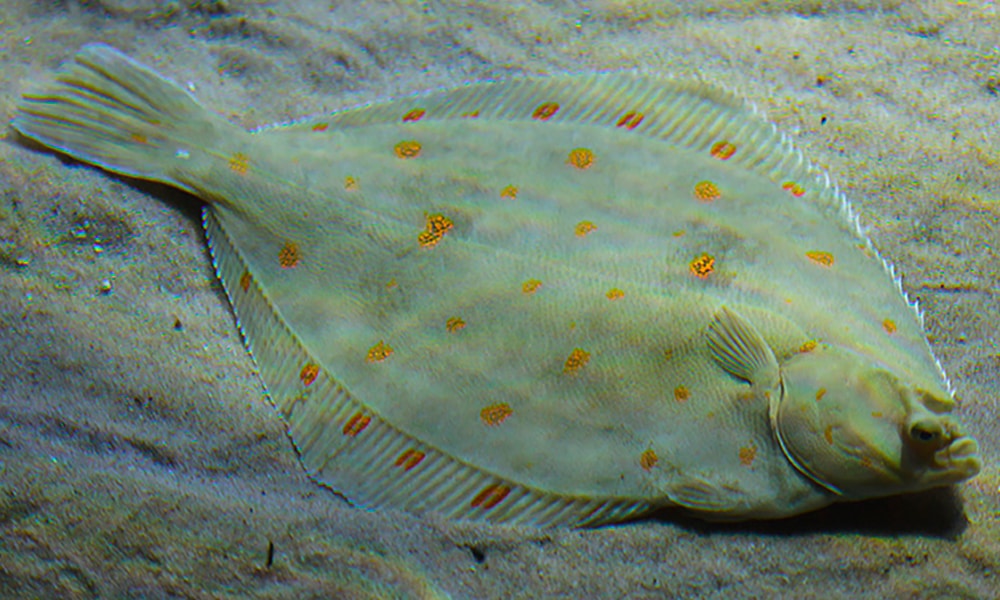
Like other flatfish, the adult rests with its pale blind side against the bottom and its pigmented eye side facing upward. It uses camouflage to avoid predators and approach prey. Diet commonly includes worms, crustaceans, mollusks, or fish, with larger-mouthed species tending to be more strongly predatory. For reliable identification, compare eye orientation, lateral-line shape, mouth size, fin pattern, skin texture, spots, and geographic range rather than relying on the market name alone.
5. American Plaice
Scientific name: Hippoglossoides platessoides. Range: Northwestern Atlantic. Key identification: Thin right-eyed flatfish with rough scales and a relatively small mouth.

Like other flatfish, the adult rests with its pale blind side against the bottom and its pigmented eye side facing upward. It uses camouflage to avoid predators and approach prey. Diet commonly includes worms, crustaceans, mollusks, or fish, with larger-mouthed species tending to be more strongly predatory. For reliable identification, compare eye orientation, lateral-line shape, mouth size, fin pattern, skin texture, spots, and geographic range rather than relying on the market name alone.
6. Alaska Plaice
Scientific name: Pleuronectes quadrituberculatus. Range: North Pacific. Key identification: Right-eyed flatfish with prominent bony bumps behind the eyes.
Like other flatfish, the adult rests with its pale blind side against the bottom and its pigmented eye side facing upward. It uses camouflage to avoid predators and approach prey. Diet commonly includes worms, crustaceans, mollusks, or fish, with larger-mouthed species tending to be more strongly predatory. For reliable identification, compare eye orientation, lateral-line shape, mouth size, fin pattern, skin texture, spots, and geographic range rather than relying on the market name alone.
7. Starry Flounder
Scientific name: Platichthys stellatus. Range: North Pacific. Key identification: Rough star-like scales and bold dark-and-light bars on the fins.
Like other flatfish, the adult rests with its pale blind side against the bottom and its pigmented eye side facing upward. It uses camouflage to avoid predators and approach prey. Diet commonly includes worms, crustaceans, mollusks, or fish, with larger-mouthed species tending to be more strongly predatory. For reliable identification, compare eye orientation, lateral-line shape, mouth size, fin pattern, skin texture, spots, and geographic range rather than relying on the market name alone.
8. European Flounder
Scientific name: Platichthys flesus. Range: Europe and western Asia. Key identification: Rough skin and variable eye orientation; often enters brackish and fresh water.
Like other flatfish, the adult rests with its pale blind side against the bottom and its pigmented eye side facing upward. It uses camouflage to avoid predators and approach prey. Diet commonly includes worms, crustaceans, mollusks, or fish, with larger-mouthed species tending to be more strongly predatory. For reliable identification, compare eye orientation, lateral-line shape, mouth size, fin pattern, skin texture, spots, and geographic range rather than relying on the market name alone.
9. Winter Flounder
Scientific name: Pseudopleuronectes americanus. Range: Northwestern Atlantic. Key identification: Right-eyed coastal flounder with a small mouth and dark mottled upper side.
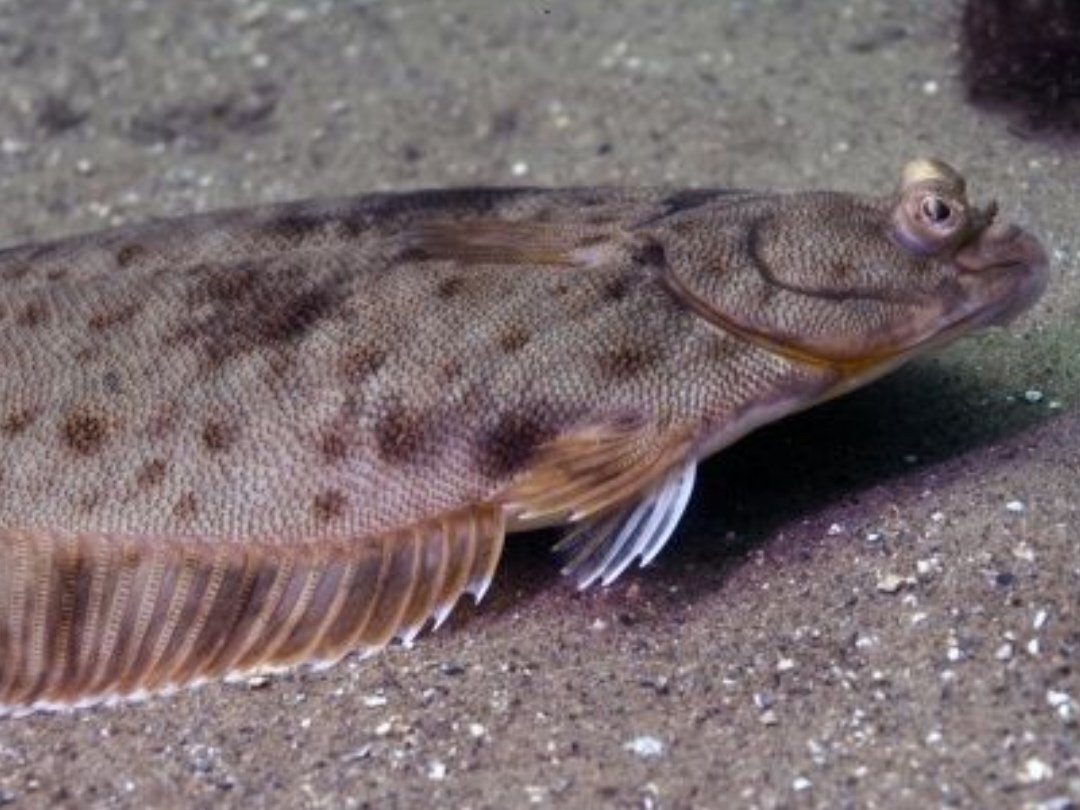
Like other flatfish, the adult rests with its pale blind side against the bottom and its pigmented eye side facing upward. It uses camouflage to avoid predators and approach prey. Diet commonly includes worms, crustaceans, mollusks, or fish, with larger-mouthed species tending to be more strongly predatory. For reliable identification, compare eye orientation, lateral-line shape, mouth size, fin pattern, skin texture, spots, and geographic range rather than relying on the market name alone.
10. Summer Flounder
Scientific name: Paralichthys dentatus. Range: Western Atlantic. Key identification: Left-eyed predator with a large toothed mouth; widely called fluke.
Like other flatfish, the adult rests with its pale blind side against the bottom and its pigmented eye side facing upward. It uses camouflage to avoid predators and approach prey. Diet commonly includes worms, crustaceans, mollusks, or fish, with larger-mouthed species tending to be more strongly predatory. For reliable identification, compare eye orientation, lateral-line shape, mouth size, fin pattern, skin texture, spots, and geographic range rather than relying on the market name alone.
11. Southern Flounder
Scientific name: Paralichthys lethostigma. Range: Western Atlantic and Gulf of Mexico. Key identification: Large left-eyed estuarine flounder with scattered spots and no strong ring pattern.
Like other flatfish, the adult rests with its pale blind side against the bottom and its pigmented eye side facing upward. It uses camouflage to avoid predators and approach prey. Diet commonly includes worms, crustaceans, mollusks, or fish, with larger-mouthed species tending to be more strongly predatory. For reliable identification, compare eye orientation, lateral-line shape, mouth size, fin pattern, skin texture, spots, and geographic range rather than relying on the market name alone.
12. Gulf Flounder
Scientific name: Paralichthys albigutta. Range: Gulf of Mexico and nearby Atlantic. Key identification: Left-eyed fish with three distinct dark ringed spots.
Like other flatfish, the adult rests with its pale blind side against the bottom and its pigmented eye side facing upward. It uses camouflage to avoid predators and approach prey. Diet commonly includes worms, crustaceans, mollusks, or fish, with larger-mouthed species tending to be more strongly predatory. For reliable identification, compare eye orientation, lateral-line shape, mouth size, fin pattern, skin texture, spots, and geographic range rather than relying on the market name alone.
13. Olive Flounder
Scientific name: Paralichthys olivaceus. Range: Northwestern Pacific. Key identification: Large left-eyed flatfish with olive-brown mottling; important in aquaculture.

Like other flatfish, the adult rests with its pale blind side against the bottom and its pigmented eye side facing upward. It uses camouflage to avoid predators and approach prey. Diet commonly includes worms, crustaceans, mollusks, or fish, with larger-mouthed species tending to be more strongly predatory. For reliable identification, compare eye orientation, lateral-line shape, mouth size, fin pattern, skin texture, spots, and geographic range rather than relying on the market name alone.
14. California Halibut
Scientific name: Paralichthys californicus. Range: California and Baja California. Key identification: Large predatory flounder that may be left- or right-eyed.
Like other flatfish, the adult rests with its pale blind side against the bottom and its pigmented eye side facing upward. It uses camouflage to avoid predators and approach prey. Diet commonly includes worms, crustaceans, mollusks, or fish, with larger-mouthed species tending to be more strongly predatory. For reliable identification, compare eye orientation, lateral-line shape, mouth size, fin pattern, skin texture, spots, and geographic range rather than relying on the market name alone.
15. Yellowtail Flounder
Scientific name: Limanda ferruginea. Range: Northwestern Atlantic. Key identification: Right-eyed fish with yellowish fins and a rusty-brown upper side.
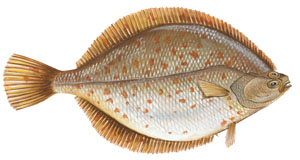
Like other flatfish, the adult rests with its pale blind side against the bottom and its pigmented eye side facing upward. It uses camouflage to avoid predators and approach prey. Diet commonly includes worms, crustaceans, mollusks, or fish, with larger-mouthed species tending to be more strongly predatory. For reliable identification, compare eye orientation, lateral-line shape, mouth size, fin pattern, skin texture, spots, and geographic range rather than relying on the market name alone.
16. Yellowfin Sole
Scientific name: Limanda aspera. Range: North Pacific. Key identification: Oval right-eyed flatfish with bright yellow fin margins.
Like other flatfish, the adult rests with its pale blind side against the bottom and its pigmented eye side facing upward. It uses camouflage to avoid predators and approach prey. Diet commonly includes worms, crustaceans, mollusks, or fish, with larger-mouthed species tending to be more strongly predatory. For reliable identification, compare eye orientation, lateral-line shape, mouth size, fin pattern, skin texture, spots, and geographic range rather than relying on the market name alone.
17. Dover Sole
Scientific name: Microstomus pacificus. Range: Northeastern Pacific. Key identification: Slender right-eyed sole with soft flesh and a small mouth.

Like other flatfish, the adult rests with its pale blind side against the bottom and its pigmented eye side facing upward. It uses camouflage to avoid predators and approach prey. Diet commonly includes worms, crustaceans, mollusks, or fish, with larger-mouthed species tending to be more strongly predatory. For reliable identification, compare eye orientation, lateral-line shape, mouth size, fin pattern, skin texture, spots, and geographic range rather than relying on the market name alone.
18. Common Sole
Scientific name: Solea solea. Range: Eastern Atlantic and Mediterranean. Key identification: Long oval right-eyed fish with a small curved mouth and dark pectoral tip.
Like other flatfish, the adult rests with its pale blind side against the bottom and its pigmented eye side facing upward. It uses camouflage to avoid predators and approach prey. Diet commonly includes worms, crustaceans, mollusks, or fish, with larger-mouthed species tending to be more strongly predatory. For reliable identification, compare eye orientation, lateral-line shape, mouth size, fin pattern, skin texture, spots, and geographic range rather than relying on the market name alone.
19. Senegalese Sole
Scientific name: Solea senegalensis. Range: Eastern Atlantic and western Mediterranean. Key identification: Oval right-eyed sole with fine mottling; important in European aquaculture.

Like other flatfish, the adult rests with its pale blind side against the bottom and its pigmented eye side facing upward. It uses camouflage to avoid predators and approach prey. Diet commonly includes worms, crustaceans, mollusks, or fish, with larger-mouthed species tending to be more strongly predatory. For reliable identification, compare eye orientation, lateral-line shape, mouth size, fin pattern, skin texture, spots, and geographic range rather than relying on the market name alone.
20. Lemon Sole
Scientific name: Microstomus kitt. Range: Northeastern Atlantic. Key identification: Thick oval body, small head, and warm brown marbled coloration.
Like other flatfish, the adult rests with its pale blind side against the bottom and its pigmented eye side facing upward. It uses camouflage to avoid predators and approach prey. Diet commonly includes worms, crustaceans, mollusks, or fish, with larger-mouthed species tending to be more strongly predatory. For reliable identification, compare eye orientation, lateral-line shape, mouth size, fin pattern, skin texture, spots, and geographic range rather than relying on the market name alone.
21. English Sole
Scientific name: Parophrys vetulus. Range: Northeastern Pacific. Key identification: Right-eyed fish with a pointed snout and curved lateral line.
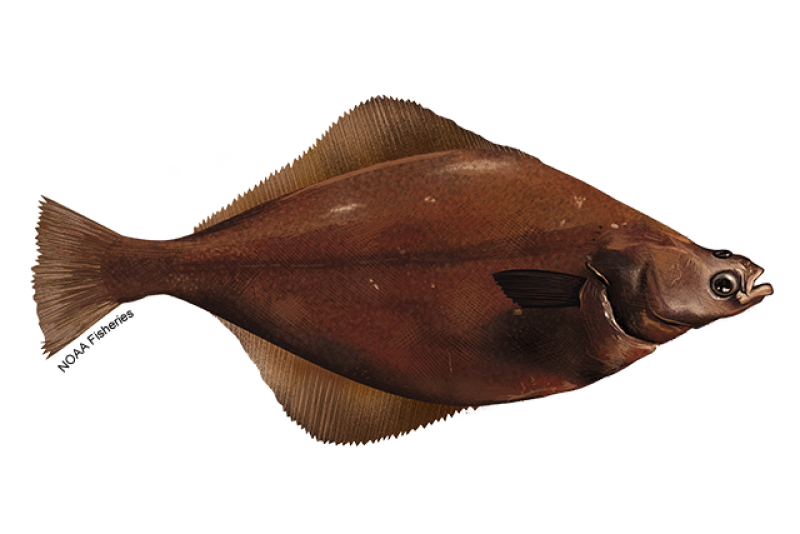
Like other flatfish, the adult rests with its pale blind side against the bottom and its pigmented eye side facing upward. It uses camouflage to avoid predators and approach prey. Diet commonly includes worms, crustaceans, mollusks, or fish, with larger-mouthed species tending to be more strongly predatory. For reliable identification, compare eye orientation, lateral-line shape, mouth size, fin pattern, skin texture, spots, and geographic range rather than relying on the market name alone.
22. Petrale Sole
Scientific name: Eopsetta jordani. Range: Northeastern Pacific. Key identification: Right-eyed flatfish with a large mouth and firm, valued flesh.
Like other flatfish, the adult rests with its pale blind side against the bottom and its pigmented eye side facing upward. It uses camouflage to avoid predators and approach prey. Diet commonly includes worms, crustaceans, mollusks, or fish, with larger-mouthed species tending to be more strongly predatory. For reliable identification, compare eye orientation, lateral-line shape, mouth size, fin pattern, skin texture, spots, and geographic range rather than relying on the market name alone.
23. Rex Sole
Scientific name: Glyptocephalus zachirus. Range: Northeastern Pacific. Key identification: Long slender body, large eyes, and very small mouth.
Like other flatfish, the adult rests with its pale blind side against the bottom and its pigmented eye side facing upward. It uses camouflage to avoid predators and approach prey. Diet commonly includes worms, crustaceans, mollusks, or fish, with larger-mouthed species tending to be more strongly predatory. For reliable identification, compare eye orientation, lateral-line shape, mouth size, fin pattern, skin texture, spots, and geographic range rather than relying on the market name alone.
24. Rock Sole
Scientific name: Lepidopsetta bilineata. Range: North Pacific. Key identification: Right-eyed flatfish with a rough upper surface and arched lateral line.

Like other flatfish, the adult rests with its pale blind side against the bottom and its pigmented eye side facing upward. It uses camouflage to avoid predators and approach prey. Diet commonly includes worms, crustaceans, mollusks, or fish, with larger-mouthed species tending to be more strongly predatory. For reliable identification, compare eye orientation, lateral-line shape, mouth size, fin pattern, skin texture, spots, and geographic range rather than relying on the market name alone.
25. Butter Sole
Scientific name: Isopsetta isolepis. Range: Northeastern Pacific. Key identification: Oval right-eyed fish with smooth-looking mottled brown upper side.
Like other flatfish, the adult rests with its pale blind side against the bottom and its pigmented eye side facing upward. It uses camouflage to avoid predators and approach prey. Diet commonly includes worms, crustaceans, mollusks, or fish, with larger-mouthed species tending to be more strongly predatory. For reliable identification, compare eye orientation, lateral-line shape, mouth size, fin pattern, skin texture, spots, and geographic range rather than relying on the market name alone.
26. Turbot
Scientific name: Scophthalmus maximus. Range: Northeastern Atlantic, Baltic, and Mediterranean. Key identification: Large nearly circular left-eyed flatfish with bony knobs and no scales.
Like other flatfish, the adult rests with its pale blind side against the bottom and its pigmented eye side facing upward. It uses camouflage to avoid predators and approach prey. Diet commonly includes worms, crustaceans, mollusks, or fish, with larger-mouthed species tending to be more strongly predatory. For reliable identification, compare eye orientation, lateral-line shape, mouth size, fin pattern, skin texture, spots, and geographic range rather than relying on the market name alone.
27. Brill
Scientific name: Scophthalmus rhombus. Range: Northeastern Atlantic and Mediterranean. Key identification: Diamond-shaped left-eyed fish with smooth skin and spotted upper side.
Like other flatfish, the adult rests with its pale blind side against the bottom and its pigmented eye side facing upward. It uses camouflage to avoid predators and approach prey. Diet commonly includes worms, crustaceans, mollusks, or fish, with larger-mouthed species tending to be more strongly predatory. For reliable identification, compare eye orientation, lateral-line shape, mouth size, fin pattern, skin texture, spots, and geographic range rather than relying on the market name alone.
28. Megrim
Scientific name: Lepidorhombus whiffiagonis. Range: Northeastern Atlantic and Mediterranean. Key identification: Thin left-eyed flatfish with a large mouth and translucent brown body.

Like other flatfish, the adult rests with its pale blind side against the bottom and its pigmented eye side facing upward. It uses camouflage to avoid predators and approach prey. Diet commonly includes worms, crustaceans, mollusks, or fish, with larger-mouthed species tending to be more strongly predatory. For reliable identification, compare eye orientation, lateral-line shape, mouth size, fin pattern, skin texture, spots, and geographic range rather than relying on the market name alone.
29. Four-spot Megrim
Scientific name: Lepidorhombus boscii. Range: Eastern Atlantic and Mediterranean. Key identification: Slender megrim with four distinct dark spots near the rear dorsal and anal fins.
Like other flatfish, the adult rests with its pale blind side against the bottom and its pigmented eye side facing upward. It uses camouflage to avoid predators and approach prey. Diet commonly includes worms, crustaceans, mollusks, or fish, with larger-mouthed species tending to be more strongly predatory. For reliable identification, compare eye orientation, lateral-line shape, mouth size, fin pattern, skin texture, spots, and geographic range rather than relying on the market name alone.
30. Witch Flounder
Scientific name: Glyptocephalus cynoglossus. Range: North Atlantic. Key identification: Long narrow right-eyed flatfish with a small mouth and deepwater habits.

Like other flatfish, the adult rests with its pale blind side against the bottom and its pigmented eye side facing upward. It uses camouflage to avoid predators and approach prey. Diet commonly includes worms, crustaceans, mollusks, or fish, with larger-mouthed species tending to be more strongly predatory. For reliable identification, compare eye orientation, lateral-line shape, mouth size, fin pattern, skin texture, spots, and geographic range rather than relying on the market name alone.
31. Arrowtooth Flounder
Scientific name: Atheresthes stomias. Range: North Pacific. Key identification: Large-mouthed right-eyed predator with sharp arrow-like teeth.
Like other flatfish, the adult rests with its pale blind side against the bottom and its pigmented eye side facing upward. It uses camouflage to avoid predators and approach prey. Diet commonly includes worms, crustaceans, mollusks, or fish, with larger-mouthed species tending to be more strongly predatory. For reliable identification, compare eye orientation, lateral-line shape, mouth size, fin pattern, skin texture, spots, and geographic range rather than relying on the market name alone.
32. Kamchatka Flounder
Scientific name: Atheresthes evermanni. Range: North Pacific. Key identification: Deepwater relative of arrowtooth flounder with a large toothed mouth.
Like other flatfish, the adult rests with its pale blind side against the bottom and its pigmented eye side facing upward. It uses camouflage to avoid predators and approach prey. Diet commonly includes worms, crustaceans, mollusks, or fish, with larger-mouthed species tending to be more strongly predatory. For reliable identification, compare eye orientation, lateral-line shape, mouth size, fin pattern, skin texture, spots, and geographic range rather than relying on the market name alone.
33. Pacific Sanddab
Scientific name: Citharichthys sordidus. Range: Northeastern Pacific. Key identification: Small left-eyed flatfish with mottled brown coloration and a curved lateral line.
Like other flatfish, the adult rests with its pale blind side against the bottom and its pigmented eye side facing upward. It uses camouflage to avoid predators and approach prey. Diet commonly includes worms, crustaceans, mollusks, or fish, with larger-mouthed species tending to be more strongly predatory. For reliable identification, compare eye orientation, lateral-line shape, mouth size, fin pattern, skin texture, spots, and geographic range rather than relying on the market name alone.
34. Speckled Sanddab
Scientific name: Citharichthys stigmaeus. Range: Northeastern Pacific. Key identification: Small left-eyed sanddab with fine dark speckles.
Like other flatfish, the adult rests with its pale blind side against the bottom and its pigmented eye side facing upward. It uses camouflage to avoid predators and approach prey. Diet commonly includes worms, crustaceans, mollusks, or fish, with larger-mouthed species tending to be more strongly predatory. For reliable identification, compare eye orientation, lateral-line shape, mouth size, fin pattern, skin texture, spots, and geographic range rather than relying on the market name alone.
35. Longfin Sanddab
Scientific name: Citharichthys xanthostigma. Range: Northeastern Pacific. Key identification: Elongate sanddab with relatively long fins and a large mouth.
Like other flatfish, the adult rests with its pale blind side against the bottom and its pigmented eye side facing upward. It uses camouflage to avoid predators and approach prey. Diet commonly includes worms, crustaceans, mollusks, or fish, with larger-mouthed species tending to be more strongly predatory. For reliable identification, compare eye orientation, lateral-line shape, mouth size, fin pattern, skin texture, spots, and geographic range rather than relying on the market name alone.
36. Peacock Flounder
Scientific name: Bothus mancus. Range: Indo-Pacific. Key identification: Color-changing left-eyed reef flounder with vivid blue rings.
Like other flatfish, the adult rests with its pale blind side against the bottom and its pigmented eye side facing upward. It uses camouflage to avoid predators and approach prey. Diet commonly includes worms, crustaceans, mollusks, or fish, with larger-mouthed species tending to be more strongly predatory. For reliable identification, compare eye orientation, lateral-line shape, mouth size, fin pattern, skin texture, spots, and geographic range rather than relying on the market name alone.
37. Eyed Flounder
Scientific name: Bothus ocellatus. Range: Western Atlantic and Caribbean. Key identification: Small reef flatfish with ring-like spots and strong camouflage.
Like other flatfish, the adult rests with its pale blind side against the bottom and its pigmented eye side facing upward. It uses camouflage to avoid predators and approach prey. Diet commonly includes worms, crustaceans, mollusks, or fish, with larger-mouthed species tending to be more strongly predatory. For reliable identification, compare eye orientation, lateral-line shape, mouth size, fin pattern, skin texture, spots, and geographic range rather than relying on the market name alone.
38. Hogchoker
Scientific name: Trinectes maculatus. Range: Atlantic coast of the Americas. Key identification: Small right-eyed sole with a round body and rough texture; enters fresh water.

Like other flatfish, the adult rests with its pale blind side against the bottom and its pigmented eye side facing upward. It uses camouflage to avoid predators and approach prey. Diet commonly includes worms, crustaceans, mollusks, or fish, with larger-mouthed species tending to be more strongly predatory. For reliable identification, compare eye orientation, lateral-line shape, mouth size, fin pattern, skin texture, spots, and geographic range rather than relying on the market name alone.
39. Lined Sole
Scientific name: Achirus lineatus. Range: Western Atlantic. Key identification: Round right-eyed sole marked with dark wavy lines across the upper side.
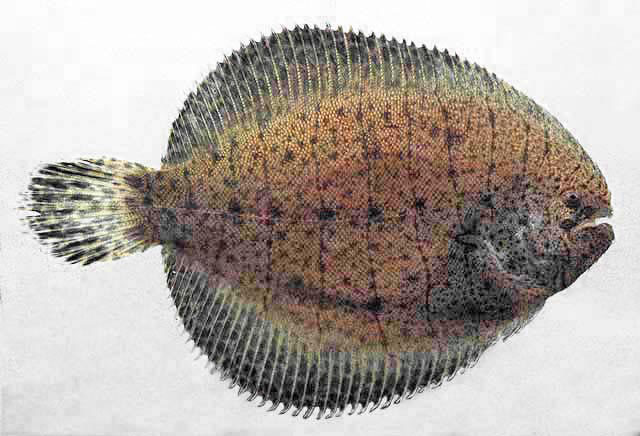
Like other flatfish, the adult rests with its pale blind side against the bottom and its pigmented eye side facing upward. It uses camouflage to avoid predators and approach prey. Diet commonly includes worms, crustaceans, mollusks, or fish, with larger-mouthed species tending to be more strongly predatory. For reliable identification, compare eye orientation, lateral-line shape, mouth size, fin pattern, skin texture, spots, and geographic range rather than relying on the market name alone.
40. Black Sole
Scientific name: Brachirus orientalis. Range: Indo-West Pacific. Key identification: Broad oval sole with dark mottling, found in marine and brackish habitats.
Like other flatfish, the adult rests with its pale blind side against the bottom and its pigmented eye side facing upward. It uses camouflage to avoid predators and approach prey. Diet commonly includes worms, crustaceans, mollusks, or fish, with larger-mouthed species tending to be more strongly predatory. For reliable identification, compare eye orientation, lateral-line shape, mouth size, fin pattern, skin texture, spots, and geographic range rather than relying on the market name alone.
How Are These Types of Fish Classified?
Flatfish are classified within the flatfish lineage of carangiform fishes, traditionally treated as the order Pleuronectiformes. Major families include right-eye flounders, left-eye flounders, true soles, American soles, tonguefishes, large-tooth flounders, and spiny turbots. Eye side is helpful but not absolute: most species in a family favor one orientation, yet exceptions occur. Common names such as sole and flounder are used broadly in seafood markets and may cover species from different families.
Where Do These Fish Live?
Flatfish occur in oceans from the Arctic to the tropics and around Antarctica. Most species live on sand, mud, gravel, shell, or mixed seafloor from shallow estuaries to the continental slope. Some enter brackish water, and a few soles and tonguefishes live entirely in fresh water. Juveniles of commercial species often depend on shallow nursery habitat, while adults may migrate offshore or into deeper water as temperatures change.
How to Identify Different Types of Flat Fish
- Determine whether the eyes are usually on the right or left side of the adult fish.
- Compare body outline: halibut are elongated and powerful, turbot is nearly round, and many soles are oval or tongue-shaped.
- Check mouth size and teeth; predatory flounders and halibuts generally have larger mouths.
- Look for diagnostic spots, such as orange spots on European plaice or three ringed spots on Gulf flounder.
- Inspect the lateral line for strong curves, straight sections, or branching.
- Note skin texture, scales, bony knobs, and fin bars.
- Confirm habitat, depth, and geographic range because market names frequently overlap.
Fishing and Cooking Tips
- Use bottom rigs, jigs, or drifting baits close to sand, mud, channel edges, and drop-offs.
- Live baitfish, shrimp, squid, worms, and soft-plastic lures can be effective depending on species.
- Flatfish often strike upward from camouflage, so keep the bait near the bottom without burying it.
- Handle legal catches carefully because teeth can be sharp and some species have abrasive skin.
- For cooking, thin fillets suit quick pan-frying or baking, while thick halibut portions tolerate grilling and roasting.
- Avoid overcooking lean flatfish; stop when the flesh turns opaque and flakes with gentle pressure.
- Check local catch limits and seafood sustainability advice because stocks differ by region and fishing method.
Safety, Sustainability, and Conservation Notes
Flatfish fisheries range from carefully managed and abundant to depleted or rebuilding. Bottom trawling can affect seafloor habitat and generate bycatch, while poorly controlled coastal development can damage nursery areas. Choose traceable seafood, follow current regional advice, and avoid assuming that every product sold under a broad name such as sole or flounder has the same sustainability status. Anglers should identify the species before keeping it because size limits and seasons can differ among similar flatfish.
Fun Facts About Flatfish
- Flatfish larvae begin life swimming upright with one eye on each side.
- During metamorphosis, one eye moves across the top of the head.
- The blind side is usually pale, while the eye side is colored for camouflage.
- Some flatfish can change shade and pattern to match the seafloor.
- Pacific and Atlantic halibut are among the largest flatfish.
- California halibut may be either left-eyed or right-eyed.
- Some tropical soles produce defensive skin secretions.
- Flatfish bury themselves by flicking sand over the body.
- The name Dover sole can mean different species in Europe and North America.
- Several flatfish species regularly enter estuaries and fresh water.
Final Thoughts on Types of Flat Fish
Learning the major types of flat fish becomes easier when you focus on eye side, body outline, mouth size, lateral line, spots, fin pattern, and location. Halibut, plaice, flounder, sole, turbot, and sanddab may share a flattened lifestyle, but they differ greatly in size, habitat, behavior, food value, and conservation status. A regional field guide and a verified scientific name are the best tools for anglers, cooks, divers, and nature learners.
Frequently Asked Questions
1. Is flat fish the same as flatfish?
Flatfish is the standard biological term for the group. “Flat fish” is a common search phrase and may also loosely describe any fish that looks flat.
2. Why do flatfish have both eyes on one side?
They hatch with one eye on each side. During metamorphosis, one eye migrates as the young fish changes into a bottom-dwelling adult.
3. Are all flatfish born flat?
No. Larvae are initially symmetrical and swim upright. The flattened adult form develops later.
4. What are the main flatfish groups?
Common groups include halibut, flounder, plaice, sole, turbot, brill, megrim, tonguefish, and sanddab.
5. What is the difference between flounder and sole?
Flounder is a broad common name used for many flatfish. True soles generally have smaller mouths and belong to different families, but seafood labels vary by region.
6. What is the difference between halibut and flounder?
Halibut are large predatory members of the right-eye flounder family. Many fish called flounder are smaller and have more delicate flesh.
7. Is turbot a flatfish?
Yes. True turbot is a large left-eyed flatfish with a nearly round body and bony knobs on the upper surface.
8. Is plaice a flatfish?
Yes. European plaice is a right-eyed flatfish recognized by orange-red spots.
9. Which side are flatfish eyes on?
It depends on the family and species. Some are normally right-eyed, some left-eyed, and a few may occur in either orientation.
10. Can flatfish change color?
Many can adjust their upper-side pigmentation to match the bottom, although speed and accuracy vary by species.
11. Where do flatfish live?
Most live on marine bottoms from shallow estuaries to deep continental slopes. Some enter brackish or fresh water.
12. What do flatfish eat?
Small species eat worms and crustaceans, while larger flounders and halibuts also hunt fish, squid, and larger invertebrates.
13. How do flatfish hide?
They match bottom color and may bury most of the body beneath sand or sediment, leaving only the eyes exposed.
14. What is the largest flatfish?
Atlantic and Pacific halibut are the largest commonly recognized flatfish, reaching far greater sizes than most soles or flounders.
15. Are flatfish bottom feeders?
Most feed on or near the bottom, but predatory species may rise from the seabed to attack swimming prey.
16. Are all flatfish edible?
Many are eaten, but not every species is commonly harvested. Legal status, size, local contaminants, toxins, and sustainability must be considered.
17. What does flatfish taste like?
Most have mild white flesh. Texture ranges from delicate in small sole and flounder to firm and meaty in halibut and turbot.
18. What is the best way to cook thin flatfish fillets?
Quick pan-frying, broiling, steaming, baking, or poaching works well. Thin fillets cook rapidly and dry out if left too long.
19. Can flatfish be grilled?
Thick halibut, turbot, or skin-on portions grill well. Very thin flounder and sole fillets are easier in a pan, basket, or foil.
20. How do anglers catch flounder?
Keep bait or a lure close to the bottom around channels, sand edges, estuary drains, docks, and drop-offs. Slow movement is often effective.
21. Why is summer flounder called fluke?
Fluke is a regional common name for summer flounder along the Atlantic coast of North America.
22. Is Greenland halibut a true halibut?
It is a close relative in the right-eye flounder family, but it belongs to a different genus and is also marketed as Greenland turbot.
23. Why is Dover sole confusing?
In Europe the name usually refers to common sole. On the Pacific coast of North America, Dover sole refers to a different species, Microstomus pacificus.
24. Can flatfish live in fresh water?
Some marine species enter rivers, and a smaller number of soles and tonguefishes are fully freshwater.
25. Are any flatfish poisonous?
A few tropical sole species have defensive skin secretions. Do not handle or eat unidentified species based only on a general flatfish appearance.
26. Do flatfish have scales?
Many have scales, but their size and texture vary. Turbot is notable for bony knobs rather than ordinary smooth scales.
27. How can I distinguish Gulf flounder from southern flounder?
Gulf flounder usually shows three prominent ringed spots. Southern flounder has a different, less organized spotting pattern.
28. Why are nursery habitats important?
Shallow bays, marsh edges, and estuaries provide young flatfish with food and shelter during vulnerable early life stages.
29. Are flatfish fisheries sustainable?
Some are well managed, while others are depleted or affected by habitat damage and bycatch. Check species- and region-specific advice.
30. What is the safest way to identify a flatfish?
Use eye side, mouth size, lateral line, body outline, spots, fin markings, skin texture, and geographic range together, then confirm with a regional guide.
Read more:
25 Types of Flathead Fish: Species and Identification