

Africa is home to an extraordinary variety of monkeys, from colorful mandrills and agile guenons to leaf-eating colobus monkeys and fast-running patas monkeys. This guide to the types of monkeys in Africa introduces 37 real species and species groups, including their scientific names, appearance, habitats, diets, behavior, and conservation concerns.
What Are the Main Types of Monkeys in Africa?
The main types of monkeys in Africa include baboons, guenons, vervet monkeys, colobus monkeys, mangabeys, macaques, mandrills, drills, talapoins, patas monkeys, and red colobus monkeys. Most are Old World monkeys, which generally have narrow nostrils, strong social systems, and tails that may be used for balance but are not usually prehensile. African monkeys occupy habitats ranging from rainforests and wetlands to savannas, mountains, and coastal forests.
1. Olive Baboon
Scientific name: Papio anubis
The olive baboon is one of Africa’s most widespread monkeys. Its coarse coat has an olive-gray appearance, while its long muzzle gives the face a doglike profile. Adult males are much larger than females and develop prominent canine teeth.
Olive baboons live in savannas, open woodland, grassland, and forest edges across much of sub-Saharan Africa. They eat fruits, seeds, grasses, roots, insects, eggs, and small animals. Large troops communicate through calls, facial expressions, and body movements. They spend time both on the ground and in trees, often sleeping in elevated locations for safety.
2. Yellow Baboon
Scientific name: Papio cynocephalus
Yellow baboons have yellowish or golden-brown coats, dark faces, and long limbs suited to walking across open ground. They are generally slimmer in appearance than some other baboon species.
This species occurs in eastern Africa, especially in Kenya, Tanzania, and nearby regions. Yellow baboons use savannas, dry woodland, river margins, and forest edges. Their flexible diet includes fruit, leaves, seeds, insects, and small vertebrates. Troops are led by complex social relationships, and members cooperate in grooming, warning calls, and defense.
3. Chacma Baboon
Scientific name: Papio ursinus
The chacma baboon is a large, powerful monkey of southern Africa. Its coat ranges from gray to brown, and its long face, sturdy body, and extended tail make it easy to recognize. Adult males can be considerably larger than females.
Chacma baboons inhabit savannas, mountains, deserts, woodland, and coastal areas. They eat roots, fruits, seeds, grass, insects, and occasionally small animals. Their troops may travel long distances while searching for food and water. Although usually cautious, they can become bold around campsites when people leave food accessible.
4. Hamadryas Baboon
Scientific name: Papio hamadryas
Hamadryas baboons are recognizable because adult males have pale silver-gray hair forming a mane around the shoulders and back. Females are smaller and brown. Their faces are dark, and their tails are long.
They live mainly in the dry regions of northeastern Africa, including Ethiopia, Eritrea, Sudan, and parts of Somalia. Hamadryas baboons eat grasses, seeds, fruits, roots, and insects. Their social organization is especially complex, with smaller family units joining larger groups. They often sleep on rocky cliffs, where steep surfaces help protect them from predators.
5. Guinea Baboon
Scientific name: Papio papio
The Guinea baboon is a relatively small baboon with reddish-brown or gray-brown fur, a dark face, and a shorter muzzle than some related species. It is found in western Africa.
Guinea baboons use woodland, grassland, savanna, and forest margins. Their diet includes fruits, seeds, roots, leaves, insects, and small animals. They live in social groups and are often more secretive than the large baboon troops seen in open safari landscapes. Habitat loss and hunting affect populations in parts of their range.
6. Vervet Monkey
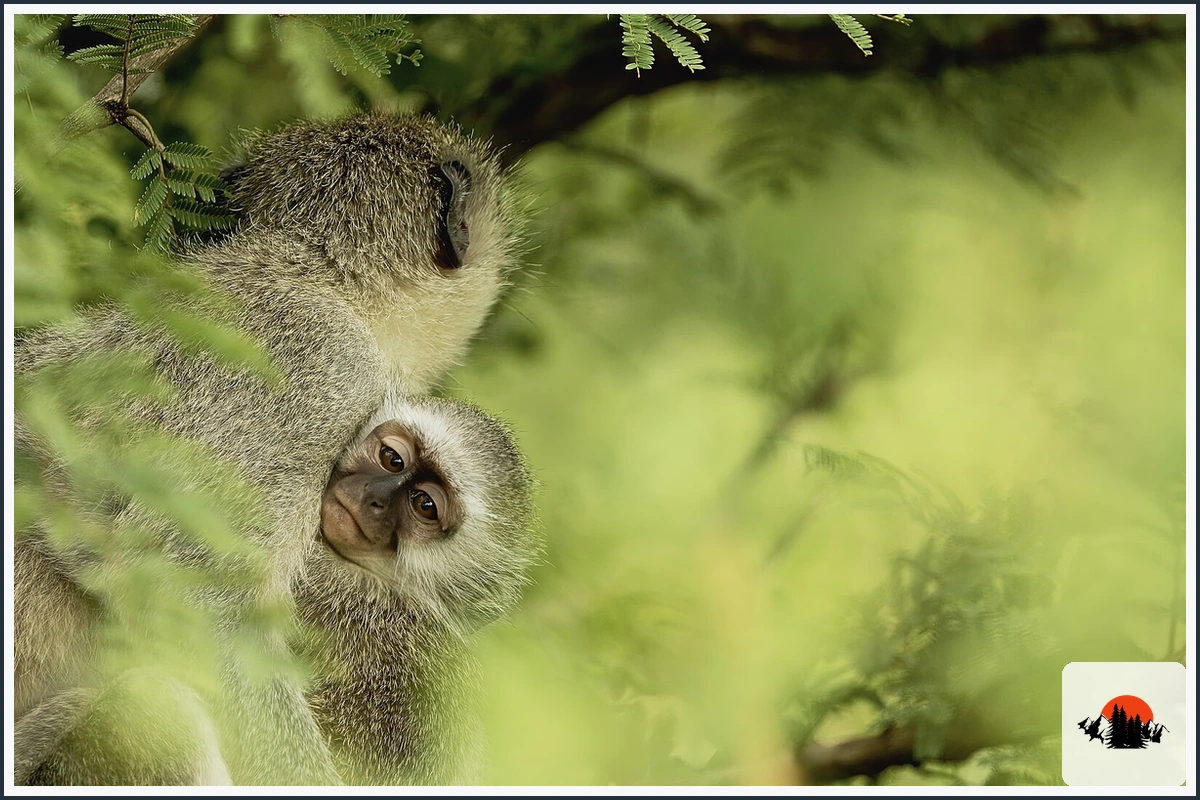
Scientific name: Chlorocebus pygerythrus
Vervet monkeys have gray coats, black faces, pale bellies, and distinctive blue or blue-gray skin around the eyes and genitals. Their long tails help them balance as they move through trees and across the ground.
They occur widely across eastern and southern Africa in woodland, savanna, riverine forest, and urban-edge habitats. Vervets eat fruit, flowers, leaves, seeds, insects, bird eggs, and occasional small animals. They produce different alarm calls for threats such as snakes, birds of prey, and leopards. Their adaptability sometimes brings them into conflict with people.
7. Malbrouck Monkey
Scientific name: Chlorocebus cynosuros
The malbrouck monkey resembles other vervet monkeys but is generally associated with central and southern African woodland habitats. It has a grayish coat, dark face, pale underside, and long tail.
Malbroucks live in miombo woodland, savanna, forest edges, and river corridors. They eat fruits, leaves, seeds, flowers, insects, and other small food items. These active monkeys travel in social groups and use sharp warning calls when predators approach. Their exact identification can be difficult where several Chlorocebus species overlap.
8. Grivet Monkey
Scientific name: Chlorocebus aethiops
Grivets are medium-sized monkeys with gray-green fur, white cheek whiskers, a dark face, and a pale belly. They are closely related to other African vervet monkeys.
Grivets occur mainly in northeastern Africa, including Ethiopia, Eritrea, Sudan, and nearby areas. They use dry woodland, savanna, river edges, and cultivated landscapes. Their varied diet contains fruit, leaves, seeds, flowers, insects, and small vertebrates. Grivets are alert, social animals that often forage on the ground but retreat into trees when threatened.
9. Bale Monkey
Scientific name: Chlorocebus djamdjamensis
The Bale monkey is a localized Ethiopian species with a dark body, lighter chest, and relatively short facial hair. It is strongly associated with highland bamboo forests.
This monkey lives in the Bale Mountains and nearby highland habitats. Bamboo leaves and shoots form an important part of its diet, although it also eats fruits, herbs, and other plant material. Bale monkeys are threatened by habitat loss because their restricted range depends on mountain forest and bamboo ecosystems. Protecting these forests is essential for their survival.
10. Sykes’s Monkey
Scientific name: Cercopithecus mitis
Sykes’s monkey is a blue monkey found in eastern Africa. Its coat is usually dark gray or bluish, with a pale throat and subtle facial markings. The name “blue monkey” refers to the gray-blue appearance rather than bright blue fur.
It inhabits forests, plantations, highland woodland, and coastal forest from Kenya and Tanzania into nearby regions. Fruits are important, but the species also eats leaves, flowers, seeds, and insects. Sykes’s monkeys are agile climbers and usually remain in trees, where their quiet movements can make them difficult to spot.
11. Zanzibar Red Colobus
Scientific name: Piliocolobus kirkii
The Zanzibar red colobus has a reddish-brown back, dark limbs, and a pale or grayish face framed by longer hair. It is endemic to Zanzibar’s main island, meaning it naturally occurs nowhere else.
These monkeys live in coastal forests, scrub, and agricultural landscapes. Their diet consists largely of leaves, flowers, seeds, and unripe fruit. Unlike many monkeys, red colobus monkeys have specialized digestive systems that help them process fibrous plant food. Habitat fragmentation, dogs, road traffic, and human disturbance remain important threats.
12. Mantled Guereza
Scientific name: Colobus guereza
The mantled guereza is one of Africa’s most striking monkeys. Its black coat is framed by long white hair along the shoulders and sides, and its tail usually ends in a prominent white tuft.
It lives in forests, woodland, and riverine habitats across central and eastern Africa. Leaves make up much of its diet, supplemented by flowers, seeds, and unripe fruit. Guerezas are excellent climbers and often rest quietly in the canopy. Their reduced thumbs help them move efficiently through branches, but they do not grip objects like humans do.
13. Angola Colobus
Scientific name: Colobus angolensis
The Angola colobus has dark fur with contrasting white whiskers, shoulder markings, and tail hair. Its appearance varies among regional forms, but the black-and-white pattern is a useful field clue.
This forest-dwelling monkey occurs in parts of central and eastern Africa, including Angola, Tanzania, Kenya, and neighboring regions. It feeds mainly on leaves, flowers, and fruit. Angola colobus monkeys spend much of their lives in the canopy and are vulnerable to logging and forest conversion.
14. Western Red Colobus
Scientific name: Piliocolobus badius
The western red colobus has reddish or chestnut-colored fur mixed with darker limbs and back. Its face is often dark, and its body is adapted for careful movement through forest canopies.
It inhabits the tropical forests of western Africa, where it eats leaves, fruit, flowers, and seeds. Western red colobus monkeys are highly social but can be sensitive to hunting pressure and habitat disturbance. In several areas, populations have declined sharply because of forest loss and bushmeat hunting.
15. Miss Waldron’s Red Colobus
Scientific name: Piliocolobus waldronae
Miss Waldron’s red colobus is one of Africa’s most threatened primates. It is associated with the forests of southeastern Côte d’Ivoire and southwestern Ghana. The coat is predominantly dark with reddish or chestnut tones.
Very little is known about surviving populations because the monkey is extremely rare and difficult to locate. It eats leaves, fruit, and other plant material in the forest canopy. Illegal hunting and the loss of mature forest are major dangers. Protecting remaining forest fragments is vital.
16. L’Hoest’s Monkey
Scientific name: Allochrocebus lhoesti
L’Hoest’s monkey has dark fur, a pale bib on the chest, and a distinctive white beard or cheek fringe. It often carries its tail upright while moving on the ground.
This species lives in montane forests, bamboo zones, and dense woodland in central and eastern Africa. Its diet includes fruit, leaves, seeds, fungi, insects, and other small foods. L’Hoest’s monkeys may form smaller groups than many guenons and spend considerable time foraging on the forest floor.
17. De Brazza’s Monkey
Scientific name: Cercopithecus neglectus
De Brazza’s monkey is easy to recognize by its white beard, reddish-brown forehead patch, dark body, and pale rump. It is sometimes called the swamp monkey because it favors wet habitats.
It occurs in central and eastern African forests, especially along rivers, swamps, and flooded woodland. De Brazza’s monkeys eat fruit, seeds, leaves, flowers, and insects. They are cautious and can remain motionless for long periods when danger is near, making them surprisingly difficult to observe.
18. Diana Monkey
Scientific name: Cercopithecus diana
The Diana monkey has a dark body, a white throat and chest, and a pale stripe extending along the sides of the face. Its elegant markings make it one of the most recognizable forest guenons.
It lives in upper-canopy rainforest in western Africa. Fruits, young leaves, flowers, and insects form its diet. Diana monkeys are vocal and social, using loud calls to communicate across dense forest. Logging, hunting, and habitat fragmentation have reduced populations in many parts of their range.
19. Roloway Monkey
Scientific name: Cercopithecus roloway
The roloway monkey resembles the Diana monkey but has a longer white beard and distinctive facial markings. It is one of the rarest monkeys in western Africa.
Roloways inhabit mature lowland rainforest in Ghana and Côte d’Ivoire. They eat fruit, leaves, seeds, flowers, and insects while moving through the canopy. Hunting and forest loss have made this species critically endangered. Sightings are uncommon, even in suitable habitat.
20. Wolf’s Mona Monkey
Scientific name: Cercopithecus wolfi
Wolf’s mona monkey has a patterned coat with reddish, gray, and dark tones, often including a pale chest and distinctive facial markings. It is a forest canopy specialist.
This monkey is found in the Democratic Republic of the Congo and nearby central African forests. It feeds on fruits, leaves, seeds, flowers, and insects. Wolf’s mona monkeys live in social groups and use calls to maintain contact in dense vegetation. Their populations are affected by forest clearing and hunting.
21. Mona Monkey
Scientific name: Cercopithecus mona
The mona monkey is a colorful West African guenon with gray or brown fur, a pale underside, and contrasting facial markings. Its appearance can vary across its range.
It lives in rainforest, secondary forest, mangroves, and plantations. Mona monkeys eat fruit, leaves, flowers, seeds, and insects. They are active, vocal climbers that often travel through the middle and upper levels of the forest. Because they can tolerate modified habitats, they may remain near farms and villages.
22. Red-Tailed Monkey
Scientific name: Cercopithecus ascanius
The red-tailed monkey has a dark body, white cheek markings, a coppery or reddish tail, and a pale nose patch. It is also known as Schmidt’s guenon in some references.
This species occurs in central and eastern African forests. It eats fruit, leaves, flowers, insects, and occasionally small animals. Red-tailed monkeys are agile canopy travelers and may associate with other monkey species while foraging. Forest loss and hunting are ongoing concerns.
23. Putty-Nosed Monkey
Scientific name: Cercopithecus nictitans
The putty-nosed monkey gets its name from the conspicuous white or pale patch around its nose. Its body is generally gray, black, and brown, with a pale underside.
It inhabits rainforests and forest edges in western and central Africa. Fruits, seeds, leaves, flowers, and insects make up its varied diet. Putty-nosed monkeys are known for loud calls that help groups stay together. They spend much of their time in the canopy but may descend when feeding.
24. Sclater’s Monkey
Scientific name: Cercopithecus sclateri
Sclater’s monkey is a small, pale-faced forest monkey native to southern Nigeria. It has a grayish coat, light underside, and delicate facial features.
The species lives in lowland rainforest, riverine forest, and some fragmented woodland. It eats fruits, leaves, flowers, and insects. Sclater’s monkeys are threatened by habitat loss and hunting, but community-based conservation projects have helped protect some local populations.
25. Talapoin Monkey
Scientific names: Miopithecus talapoin and Miopithecus ogouensis
Talapoins are Africa’s smallest monkeys. They have compact bodies, rounded faces, short muzzles, and gray-green or olive coats. Their small size and sharp movements distinguish them from larger guenons.
Talapoins live near rivers, swamps, mangroves, and lowland forest in central and western Africa. They eat fruit, seeds, leaves, aquatic plants, and insects. These monkeys are comfortable near water and may swim between forest patches when escaping danger.
26. Sooty Mangabey
Scientific name: Cercocebus atys
The sooty mangabey has dark gray or brown fur, a grayish face, and a sturdy body. Its cheek hair is less dramatic than that of some mangabeys, but its strong build and ground-foraging habits are useful identification clues.
It lives in western African forests, swamps, and secondary woodland. Sooty mangabeys eat fruit, seeds, nuts, leaves, fungi, and insects. They often forage on the ground in large groups and use powerful jaws to open hard food items.
27. Collared Mangabey
Scientific name: Cercocebus torquatus
The collared mangabey has reddish-brown or chestnut fur, dark limbs, and a pale collar-like area around the neck. Its long face and strong body reflect a lifestyle that includes extensive ground foraging.
This monkey is found in coastal and lowland forests of western Africa. It eats fruit, seeds, nuts, leaves, and insects. Collared mangabeys are social and vocal, using calls to coordinate movement through thick vegetation. Coastal forest destruction is a serious threat.
28. Agile Mangabey
Scientific name: Cercocebus agilis
The agile mangabey has olive-gray fur, a pale face, and a lean, athletic build. Despite its name, it is often recognized more by its long limbs and ground-oriented behavior than by rapid movement.
It inhabits swamp forests and lowland rainforest in central Africa. Its diet includes fruit, seeds, leaves, fungi, insects, and other small foods. Agile mangabeys can travel through flooded forest and spend considerable time searching leaf litter for food.
29. Mandrill
Scientific name: Mandrillus sphinx
The mandrill is famous for its vivid appearance. Adult males have blue and red facial skin, a red nose, golden beard, olive-brown body, and colorful rump. They are among the largest living monkeys.
Mandrills live in the rainforests of central and western Africa, especially Cameroon, Gabon, and nearby regions. They eat fruit, seeds, fungi, roots, insects, and small vertebrates. Large groups may contain hundreds of animals, although they often spread out while feeding. Forest loss and hunting threaten wild populations.
30. Drill
Scientific name: Mandrillus leucophaeus
Drills are closely related to mandrills but have darker faces and less spectacular facial coloration. Adult males have blue and purple facial skin, while their bodies are dark brown or black.
Drills inhabit limited areas of Cameroon, Nigeria, and Bioko Island. They prefer lowland rainforest and forest edges. Their diet includes fruits, seeds, roots, leaves, insects, and small animals. Drills are highly threatened by hunting and habitat destruction and are among Africa’s most endangered monkeys.
31. Patas Monkey
Scientific name: Erythrocebus patas
The patas monkey has a reddish-brown back, white underparts, long legs, and a slim body built for speed. It is one of the fastest monkeys and is more terrestrial than most guenons.
Patas monkeys live in dry savanna, open woodland, and grassland across parts of western, eastern, and central Africa. They eat grasses, seeds, fruit, gum, insects, and small animals. Their speed helps them escape predators, while trees and dense shrubs provide refuge.
32. Barbary Macaque
Scientific name: Macaca sylvanus
The Barbary macaque is Africa’s only wild macaque and the only monkey native to northern Africa. It has thick brown-gray fur, a pinkish face, and no visible tail, although a small vestigial tail is present.
It lives in the Atlas Mountains of Morocco and Algeria, especially in cedar, oak, and mixed mountain forests. Its diet includes fruit, leaves, seeds, bark, roots, and insects. Habitat loss, illegal capture, and human disturbance threaten populations. The species is also famous for its introduced population on Gibraltar, outside Africa.
33. Allen’s Swamp Monkey
Scientific name: Allenopithecus nigroviridis
Allen’s swamp monkey has a stocky body, gray-green fur, webbed fingers and toes, and a relatively short face. Its partially webbed hands and feet help it move through wet habitats.
It lives in swamp forests and riverine areas of the Congo Basin. Allen’s swamp monkeys eat fruit, leaves, aquatic plants, insects, and small aquatic animals. They are strong swimmers and may escape predators by entering the water. Wetland destruction and hunting affect local populations.
34. Diana Roloway Hybrid Zone Guenons
Scientific name: Cercopithecus species group
Several African guenons can occur near one another and sometimes show overlapping features or hybridization in contact zones. These monkeys often have complex facial markings, contrasting beards, and patterned coats.
They inhabit tropical forests of western and central Africa, where they feed on fruit, leaves, flowers, seeds, and insects. Identification may require location, behavior, and facial pattern rather than coat color alone. Field observers should avoid assigning a species name from a distant glimpse when several similar guenons share the same forest.
35. Black-and-White Colobus
Scientific name: Colobus species group
Black-and-white colobus monkeys have striking dark coats with white mantles, whiskers, or tail sections. Different species and regional forms vary in the amount and shape of white hair.
They live mainly in African forests and woodland. Their leaf-heavy diets are supported by specialized stomachs that ferment fibrous plant matter. Colobus monkeys are quiet, canopy-dwelling animals that often leap between branches. Logging, hunting, and fragmentation are important conservation concerns.
36. Red Colobus Monkey
Scientific name: Piliocolobus species group
Red colobus monkeys include several closely related African species with reddish, chestnut, or orange-brown fur. They generally have dark faces and long tails, although appearance varies by species.
These monkeys occupy tropical forests, coastal forests, and island habitats. Their diets are dominated by leaves, flowers, seeds, and unripe fruit. Red colobus species are among the most threatened African primates because they are hunted and depend heavily on intact forest canopies.
37. Guenon Monkeys
Scientific name: Cercopithecus species group
Guenon is a broad name for many colorful African forest monkeys. Common features include long tails, contrasting facial markings, pale cheek hair, and agile climbing ability. Examples include the putty-nosed, mona, De Brazza’s, Diana, red-tailed, and blue monkeys.
Guenons live mostly in tropical forests, but some also use woodland, wetlands, plantations, and forest edges. They eat fruit, leaves, flowers, seeds, insects, and occasionally small animals. Because several guenon species look alike, reliable identification should consider geographic range, habitat, face pattern, tail color, and vocal behavior.
How Are These Monkeys Classified?
Most monkeys in Africa belong to the Old World monkey family Cercopithecidae. They can be grouped informally by body form, habitat, and evolutionary relationships.
- Baboons: Large, ground-oriented monkeys with long muzzles and powerful jaws.
- Guenons: Usually agile forest monkeys with colorful faces and long tails.
- Colobus monkeys: Leaf-eating canopy specialists with reduced thumbs.
- Mangabeys: Strong-bodied forest monkeys that often forage on the ground.
- Mandrills and drills: Large forest monkeys with bold facial coloration.
- Vervet relatives: Adaptable monkeys that use savanna, woodland, and forest-edge habitats.
- Macaques: Robust monkeys represented in Africa by the Barbary macaque.
Chimpanzees and bonobos are African primates, but they are apes rather than monkeys. The easiest visual distinction is that apes do not have tails, while nearly all African monkeys have visible tails.
Where Do These Monkeys Live?
African monkeys occupy nearly every major habitat on the continent except the driest deserts. Rainforest species such as mandrills, drills, guenons, and red colobus monkeys depend on dense vegetation and connected canopy. Baboons and patas monkeys are better adapted to open savanna, grassland, and woodland.
- West Africa: Diana monkeys, drills, mangabeys, guenons, and red colobus monkeys.
- Central Africa: Mandrills, Allen’s swamp monkeys, guerezas, mangabeys, and many forest guenons.
- East Africa: Vervets, blue monkeys, red-tailed monkeys, baboons, and L’Hoest’s monkeys.
- Southern Africa: Chacma baboons, vervets, and several woodland monkey populations.
- North Africa: Barbary macaques in mountain forests.
- Wetlands and rivers: Talapoins and Allen’s swamp monkeys.
What Do African Monkeys Eat?
African monkeys have flexible diets, but feeding habits differ by species. Leaf-eating colobus monkeys have specialized digestive systems for processing tough vegetation. Mandrills, baboons, and mangabeys use strong jaws to open seeds, nuts, and other hard foods. Guenons commonly focus on fruit but also eat leaves, flowers, insects, and seeds.
- Fruit specialists: Many guenons and mandrills depend heavily on seasonal fruit.
- Leaf eaters: Colobus and red colobus monkeys consume large amounts of leaves and flowers.
- Omnivores: Baboons, mangabeys, vervets, and macaques eat both plant and animal foods.
- Wetland feeders: Talapoins and swamp monkeys may consume aquatic plants and small water animals.
How Do African Monkeys Behave?
Most African monkeys are social and live in groups called troops, bands, or parties. Group size varies from small family units to gatherings of hundreds. Grooming strengthens relationships, while alarm calls warn companions about predators.
Some species, including patas monkeys and baboons, spend much of their time on the ground. Others, such as guenons and colobus monkeys, remain mainly in the canopy. Many monkeys communicate with calls, facial expressions, postures, touch, and movements of the tail.
How to Identify Different Types of Monkeys in Africa
- Face: Look for beards, white nose patches, colored cheeks, facial stripes, or bright skin.
- Coat: Note whether the fur is black, white, red, olive, gray, brown, or patterned.
- Tail: Check its length, color, tip, and whether it is carried upright or curved.
- Body shape: Large muzzles suggest baboons, while long legs and slim bodies suggest patas monkeys.
- Habitat: Forest canopy, open savanna, mountain woodland, swamp, and coastal forest each narrow the possibilities.
- Movement: Ground walking, fast running, climbing, leaping, and swimming can be useful clues.
- Social group: Large troops are common among baboons and mandrills, while some forest species form smaller groups.
- Location: Geographic range is often essential because many guenons look similar.
Outdoor Tips for Finding and Observing African Monkeys
- Use binoculars instead of approaching monkeys closely.
- Observe quietly and avoid sudden movements.
- Never feed wild monkeys, even when they appear accustomed to people.
- Secure food, bags, and vehicle windows in areas known for bold baboons or vervets.
- Look for movement in the canopy, broken branches, feeding sounds, and alarm calls.
- Record the habitat and location before assigning a species name.
- Use a field guide that covers the specific country or region you are visiting.
- Follow park rules and maintain a respectful distance from troops.
Safety, Sustainability, and Conservation Notes
Wild monkeys can bite, scratch, and carry diseases, so visitors should never touch, chase, corner, or feed them. Human food can also change natural behavior and increase conflict around camps, roads, and homes.
Many African monkeys face threats from deforestation, logging, agricultural expansion, hunting, illegal pet capture, mining, and road construction. Travelers can help by choosing responsible wildlife operators, supporting protected areas, avoiding products made from threatened wildlife, and respecting local conservation rules.
Never release an unwanted pet monkey into the wild. Captive primates have complex social, dietary, and medical needs and are not suitable pets for most households.
Fun Facts About Types of Monkeys in Africa
- Mandrills are among the most colorful mammals in the world.
- The Barbary macaque is Africa’s only wild macaque.
- Colobus monkeys have reduced thumbs that help them move through branches.
- Patas monkeys are built for speed and spend more time on the ground than many guenons.
- Allen’s swamp monkeys have partially webbed fingers and toes.
- Some baboon troops contain many dozens of individuals.
- Talapoins are among the smallest monkeys in Africa.
- Red colobus monkeys rely heavily on leaves and other plant material.
- De Brazza’s monkeys can remain motionless when they sense danger.
- Vervet monkeys use different alarm calls for different predators.
Final Thoughts on Types of Monkeys in Africa
The types of monkeys in Africa range from colorful rainforest specialists to fast-moving savanna animals and adaptable woodland species. Learning their facial markings, body shapes, habitats, diets, and behaviors makes wildlife watching more rewarding while encouraging respectful observation and conservation. Whether you are planning a safari or studying African wildlife at home, these monkeys offer an excellent introduction to the continent’s remarkable primate diversity.
Frequently Asked Questions
1. How many types of monkeys live in Africa?
Africa has many dozens of monkey species and subspecies. The 37 entries in this guide represent notable species, groups, and commonly recognized types rather than every taxonomic form.
2. What is the largest monkey in Africa?
Adult male mandrills are generally considered the largest living monkeys. Large male baboons are also among Africa’s biggest monkeys.
3. What is the smallest monkey in Africa?
Talapoins are among the smallest African monkeys. They have compact bodies and are often associated with rivers, swamps, and lowland forests.
4. Are chimpanzees monkeys?
No. Chimpanzees are apes. Monkeys generally have tails, while chimpanzees and other great apes do not.
5. What is the most colorful monkey in Africa?
The mandrill is usually considered the most colorful because adult males have vivid blue and red facial skin, a red nose, and a golden beard.
6. Which African monkeys live in savannas?
Baboons, vervet monkeys, patas monkeys, and some grivets commonly use savanna, grassland, woodland, or forest-edge habitats.
7. Which African monkeys live in rainforests?
Mandrills, drills, guenons, mangabeys, colobus monkeys, and red colobus monkeys are strongly associated with tropical forests.
8. What do African monkeys eat?
Their diets vary but commonly include fruits, leaves, flowers, seeds, roots, insects, fungi, eggs, and small animals.
9. Do all African monkeys live in groups?
Most are social and live in groups, although group size and structure vary. Social living helps with predator detection, feeding, grooming, and caring for young.
10. Which African monkey has a blue and red face?
The mandrill has a bright blue and red face. Adult males also have a red nose and colorful rump.
11. What is the difference between a mandrill and a drill?
Mandrills usually have more vivid facial coloration and an olive-brown body. Drills have darker faces and are generally associated with smaller parts of western-central Africa.
12. Which African monkeys have white mantles?
Mantled guerezas and several black-and-white colobus monkeys have long white hair along the shoulders, sides, or tail.
13. Are baboons dangerous?
Baboons are powerful wild animals that can bite or scratch, especially when threatened or fed. Keeping distance and securing food greatly reduces risk.
14. Do vervet monkeys make good pets?
No. Vervet monkeys have complex social, dietary, behavioral, and veterinary needs and are not appropriate household pets.
15. Where can I see vervet monkeys?
Vervet monkeys occur widely in eastern and southern Africa, especially in savanna, woodland, riverine forest, and urban-edge habitats.
16. What is Africa’s only wild macaque?
The Barbary macaque is Africa’s only wild macaque. It lives in mountain forests of Morocco and Algeria.
17. Are red colobus monkeys endangered?
Many red colobus species are threatened, and some are critically endangered. Hunting and forest loss are major causes of decline.
18. Why do colobus monkeys eat so many leaves?
Colobus monkeys have specialized digestive systems that allow them to ferment and process fibrous plant material more effectively than many other monkeys.
19. Can African monkeys swim?
Some can swim well. Allen’s swamp monkeys and talapoins are particularly associated with wet habitats and may enter water to escape danger or travel.
20. What is the fastest monkey in Africa?
The patas monkey is widely regarded as one of the fastest monkeys. Its long legs and slim body help it run across open ground.
21. What is a guenon monkey?
Guenon is a broad term for many African forest monkeys in the genus Cercopithecus and related groups. They often have colorful facial markings and long tails.
22. How can I identify a monkey on safari?
Note the location, habitat, facial markings, coat color, tail shape, body size, movement, and group behavior. Geographic range is especially helpful for similar guenons.
23. Do monkeys have predators in Africa?
Yes. Leopards, large eagles, snakes, hyenas, crocodiles, and humans can prey on or threaten African monkeys, depending on the habitat and species.
24. Why do monkeys groom one another?
Grooming removes parasites and dirt, but it also strengthens social bonds and helps reduce tension within a group.
25. What is the rarest monkey in Africa?
Several species are extremely rare, including Miss Waldron’s red colobus and the roloway monkey. Exact population estimates are difficult because these animals live in dense forests.
26. Are monkeys and apes different?
Yes. Most monkeys have tails, while apes do not. Apes also generally have broader shoulders, more flexible arms, and larger brains relative to body size.
27. Which monkeys live in North Africa?
The Barbary macaque is the best-known native monkey of North Africa. It lives mainly in mountain forests of Morocco and Algeria.
28. Which monkeys live in southern Africa?
Chacma baboons, vervet monkeys, and several regional monkey populations live in southern Africa. Habitat and country determine which species are present.
29. Do monkeys eat meat?
Some African monkeys occasionally eat insects, eggs, lizards, birds, or small mammals, but most also depend heavily on plant foods.
30. Why are mandrills colorful?
The bright facial and rump colors of adult male mandrills may help with recognition, communication, and social display. Color intensity can also reflect maturity and condition.
31. Are African monkeys protected?
Many species are protected by national laws, international agreements, or conservation programs. Rules vary by country, so visitors should follow local regulations.
32. What threatens African monkey populations?
Major threats include habitat loss, logging, agriculture, hunting, illegal pet trade, mining, roads, disease, and conflict with people.
33. Should tourists feed monkeys?
No. Feeding wildlife can cause aggression, disease transmission, nutritional problems, and dependence on humans.
34. Where do drills live?
Drills live in limited areas of Cameroon, Nigeria, and Bioko Island, mainly in lowland rainforest and forest-edge habitats.
35. What is the difference between a monkey troop and a family?
A family is usually a smaller related unit, while a troop is a larger social group that may contain several families and unrelated individuals.
36. Can I use coat color alone to identify an African monkey?
No. Lighting, age, sex, seasonal changes, and regional variation can alter appearance. Habitat, range, facial markings, and behavior should also be considered.
37. Why are African monkeys important?
They disperse seeds, influence forest growth, form important parts of food webs, and help scientists understand social behavior, evolution, and ecosystem health.