

The phrase types of Norwegian Forest cats usually refers to coat colors and patterns, not separate breeds. Every pedigreed Norwegian Forest Cat belongs to the same naturally developed Scandinavian breed, recognized by its triangular head, straight profile, strong body, long bushy tail, and weather-resistant double coat. What changes dramatically is the coat: solids, tabbies, tortoiseshells, silvers, smokes, ambers, and many white-marked combinations can all occur.
What Are the Main Types of Norwegian Forest Cats?
Useful visual groups include solid, tabby, tortoiseshell, silver, smoke, amber, and cats with white. Registry rules differ slightly, so not every color is accepted by every organization. Color does not create a different temperament or breed subtype, and patterns such as colorpoint are excluded by major standards.
Norwegian Forest Cat Types at a Glance
| Group | Examples | Identification clue |
|---|---|---|
| Solid | Black, blue, red, cream, white | One main color without tabby pattern |
| Tabby | Brown, blue, red, cream | Striped, swirled, or spotted markings |
| Tortoiseshell | Black tortie, blue-cream | Mottled dark and red or cream areas |
| Silver | Silver tabby, silver tortie | Pale hair bases and high contrast |
| Smoke | Black smoke, blue smoke | Solid-looking tips with pale roots |
| Amber | Amber, light amber | Color changes as the cat matures |
| With white | Bicolor, mitted, van-like distribution | Any accepted color plus white spotting |
1. Solid Norwegian Forest Cats
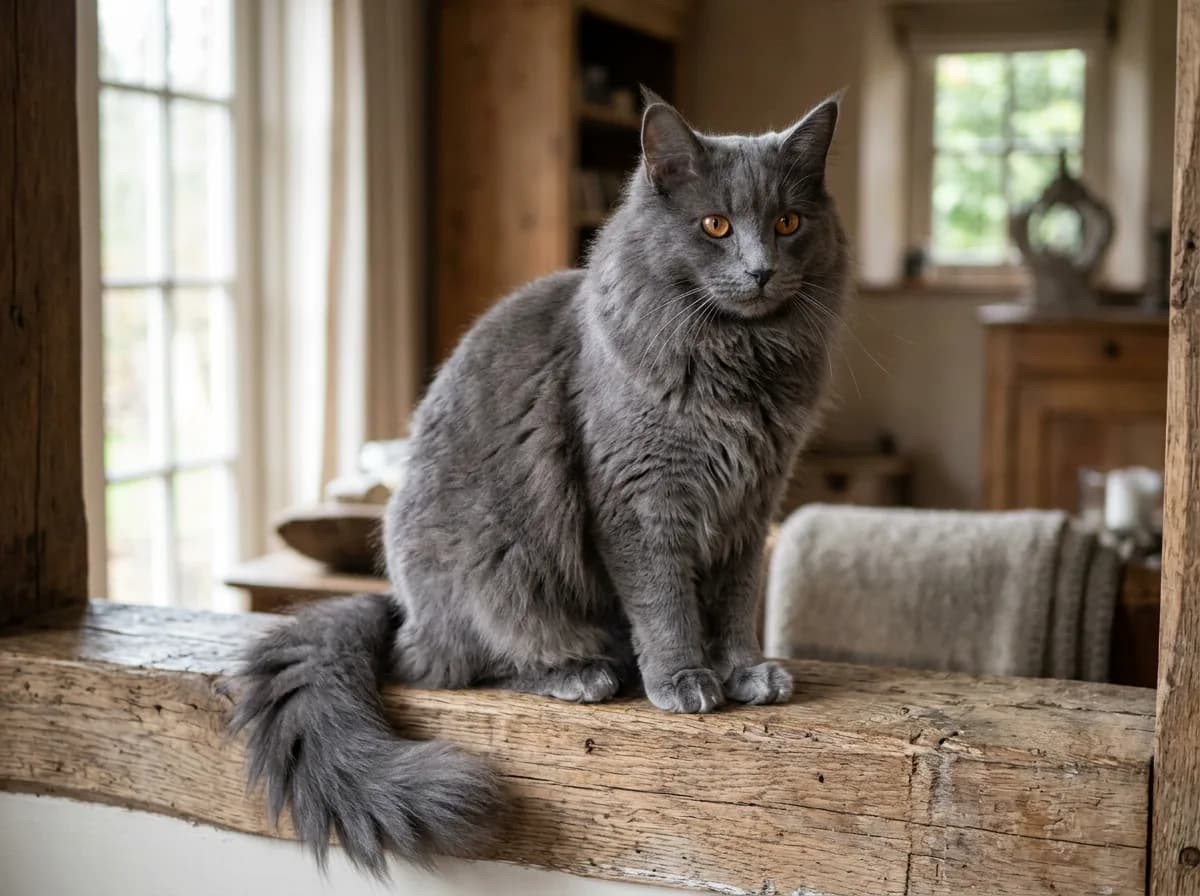
Solid cats display one primary color from root to tip, apart from natural variation caused by light and coat texture. Black cats can look especially dramatic when their long guard hairs move over a dense undercoat. Blue is the diluted form of black, producing a cool gray appearance. Red and cream solids may retain faint tabby markings because the genetics of red often makes pattern difficult to hide. Solid white cats lack visible pigment and may have blue, gold, green, or odd-colored eyes depending on registry rules.
2. Tabby Norwegian Forest Cats
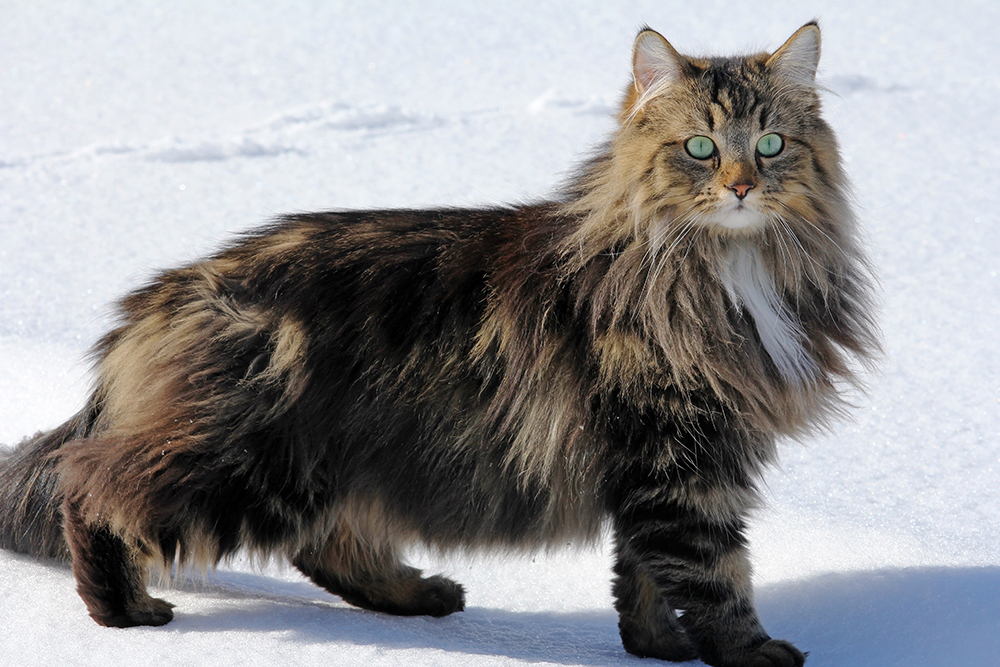
Tabby is among the breed’s most familiar looks. Mackerel tabbies have narrow vertical stripes, classic tabbies show broad swirls and a side “bull’s-eye,” spotted tabbies have separated spots, and ticked cats carry banding on individual hairs with fewer body markings. Brown tabby is the wild-looking favorite, while blue, red, cream, silver, and amber versions broaden the palette. The face commonly shows an M-shaped forehead mark and lines around the eyes and cheeks.
3. Tortoiseshell Norwegian Forest Cats
Tortoiseshell coats combine black-based color with red-based patches. Dilute tortoiseshell, often called blue-cream, replaces black with blue and red with cream. The distribution may be finely mingled or occur in larger patches, so no two coats look identical. Because the relevant color genes are linked to the X chromosome, tortoiseshell cats are overwhelmingly female; a male tortie is unusual and should be discussed with a veterinarian if breeding is contemplated.
4. Silver Norwegian Forest Cats

Silver inhibits warm pigment near the hair base, giving tabbies a pale ground color and strong dark markings. Black silver tabbies are especially high-contrast, while blue silver and silver tortie combinations appear softer. Silver describes color distribution in the hair, not a separate lineage, and it can be difficult to distinguish from smoke in kittens.
5. Smoke Norwegian Forest Cats
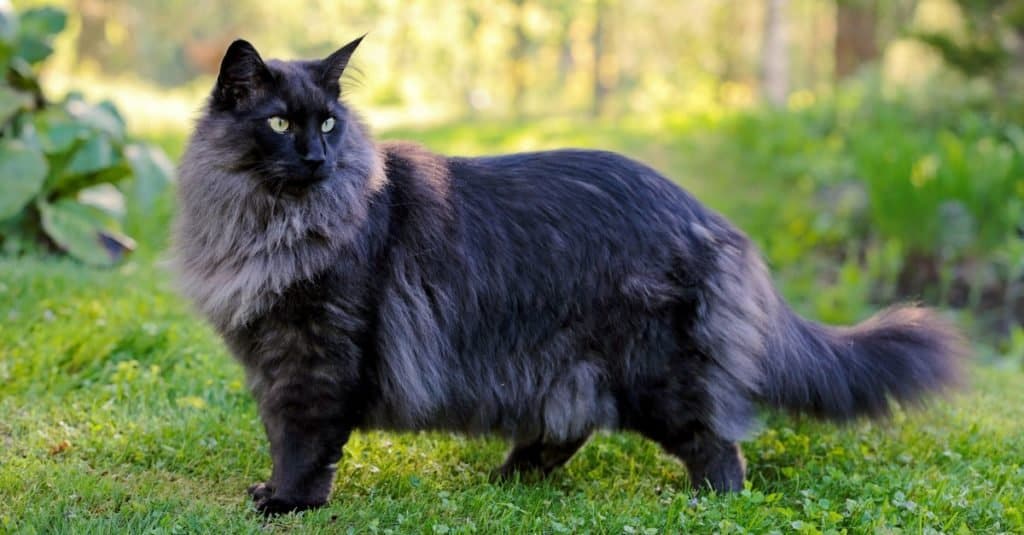
A smoke cat may look nearly solid while resting, but movement parts the coat and reveals pale or silvery roots. Black smoke is the boldest example; blue, red, cream, and tortie smoke combinations may also occur under some standards. The breed’s long coat exaggerates the shifting contrast, creating a theatrical effect around the ruff, tail, and britches.
6. Amber Norwegian Forest Cats

Amber is a distinctive color associated with the Norwegian Forest Cat and linked to variants of the MC1R gene. Kittens can be born dark and gradually develop warm amber tones as they mature, while light amber is the dilute form. Because the transformation takes time and may overlap visually with other colors, pedigree records and genetic testing can assist breeders with classification.
7. Norwegian Forest Cats With White

White spotting can accompany many accepted colors and patterns. A cat may have a small white locket, white chest and feet, a balanced bicolor coat, or extensive white over most of the body. Descriptive labels such as mitted or van-patterned refer to distribution; they do not turn the cat into a separate type. In judging, overall breed structure remains more important than perfectly symmetrical markings.
How Are Norwegian Forest Cats Classified?
Registries organize entries by base color, dilution, silver or smoke expression, tabby pattern, tortoiseshell combination, and amount of white. Standards do not always use identical terminology. In general, chocolate, lilac, cinnamon, fawn, and pointed patterns are excluded by leading European standards because they suggest outside ancestry.
How to Identify a Norwegian Forest Cat
- Head: an equilateral triangular outline with a strong chin.
- Profile: long and straight from brow to nose, without a pronounced stop.
- Body: large, sturdy, and substantial, with hind legs often higher than the front.
- Coat: dense undercoat beneath glossy, water-resistant guard hairs.
- Tail: long, broad, and heavily furnished.
- Season: the winter coat is much fuller; summer shedding can change the silhouette.
- Proof: only pedigree records reliably distinguish the breed from look-alikes.
Norwegian Forest Cat or Maine Coon?
The Norwegian typically has a triangular head and straight profile, whereas the Maine Coon tends to have a squarer muzzle and a gently concave profile. Both are large, longhaired breeds with tufted ears and bushy tails, so casual visual identification is unreliable. Siberians are another common comparison, but generally show a rounder overall head and body impression.
Care Tips for Every Coat Type
- Comb once or twice weekly and more frequently during the spring shed.
- Work gently through the ruff, armpits, belly, and hind-leg furnishings where mats form.
- Provide tall, stable climbing structures that support a large cat safely.
- Use interactive play to satisfy climbing, stalking, and problem-solving behavior.
- Ask responsible breeders about GSD IV testing and other health screening used in their program.
- Maintain dental care, healthy body condition, routine veterinary checks, and parasite prevention.
Safety and Responsible Ownership
A thick coat does not make a pet immune to dangerous cold, heat, traffic, predators, or infectious disease. A secure home or enclosed outdoor area is safer than unrestricted roaming. White cats with blue eyes may have a higher risk of congenital deafness, while all coat colors need the same preventive healthcare and attention to heat stress.
Fun Facts About Norwegian Forest Cats
- The breed is called Norsk skogkatt in Norway.
- Its coat changes noticeably with the seasons.
- Long guard hairs help shed moisture.
- The bushy tail can be carried like a plume.
- Brown tabby creates a classic forest-camouflage look.
- Amber color may transform as a kitten grows.
- Tortoiseshell cats are usually female.
- White spotting can occur with many base colors.
- Color does not predict personality.
- Pedigree documentation distinguishes the breed from fluffy domestic cats.
Final Thoughts on Types of Norwegian Forest Cats
The many types of Norwegian Forest cats are best understood as coat groups within one breed. Solids, tabbies, torties, silvers, smokes, ambers, and white-marked cats can look remarkably different while sharing the same essential structure and double coat. Choose for health, temperament, and responsible breeding first; color is the finishing detail.
Frequently Asked Questions
1. How many types of Norwegian Forest cats are there?
There is one breed with many accepted color-and-pattern combinations rather than a fixed number of subtypes.
2. What is the most common color?
Brown tabby, with or without white, is widely seen and gives the breed its familiar woodland appearance.
3. Can they be black?
Yes. Solid black, black tabby, black smoke, and black-based tortie combinations can occur.
4. Can they be white?
Yes. A cat can be solid white or have white spotting combined with another accepted color.
5. Can they be orange?
Yes. The formal color term is usually red, with cream as its dilute form.
6. Do they come in gray?
Yes. Cat registries normally call this color blue, the diluted form of black.
7. What is an amber Norwegian Forest Cat?
It is a recognized color in some registries that changes toward warm amber as the cat matures.
8. What is a smoke coat?
Smoke hairs have pale bases and strongly colored tips, revealed when the coat moves.
9. What is a silver tabby?
It has dark tabby markings over a pale, silvery ground rather than a warm brown ground.
10. Are colorpoint Norwegian Forest Cats accepted?
Pointed patterns are excluded by major breed standards.
11. Are chocolate or lilac colors accepted?
Major standards commonly exclude chocolate, lilac, cinnamon, and fawn.
12. Does coat color affect temperament?
No reliable evidence allows personality to be predicted from coat color.
13. Are males larger than females?
Males are often larger, but individual size varies and sex does not create a separate type.
14. How big do they become?
They are a large, slow-maturing breed; exact adult weight depends on sex, lineage, nutrition, and health.
15. How long do they take to mature?
They can take several years to reach full physical maturity and coat development.
16. Do they shed heavily?
Yes, especially when the dense winter undercoat is released in spring.
17. How often should they be brushed?
Once or twice weekly is a useful baseline, with more frequent grooming during seasonal sheds.
18. Are they hypoallergenic?
No. They produce allergens like other cats, and their abundant coat can distribute dander.
19. Are they waterproof?
The glossy guard coat resists moisture, but it is not completely waterproof.
20. How can I identify one?
Look for the triangular head, straight profile, substantial body, long tail, and double coat, then confirm with pedigree records.
21. How are they different from Maine Coons?
Norwegians have a more triangular head and straight profile; Maine Coons usually have a squarer muzzle.
22. How are they different from Siberians?
Siberians generally present a rounder head and body, while Norwegians have a clearer triangle and straighter profile.
23. Are they good climbers?
Yes. Their strong build and claws make stable vertical space particularly valuable.
24. Can they live indoors?
Yes, with climbing structures, daily play, windows, scratching surfaces, and adequate space.
25. Are they good family cats?
Many are social and adaptable, but individual temperament and respectful handling matter most.
26. What is GSD IV?
Glycogen storage disease type IV is an inherited disorder for which responsible breeding programs can use DNA testing.
27. Do white cats need special care?
They need normal care, plus awareness that some white, blue-eyed cats can be congenitally deaf.
28. Can a shelter cat be a Norwegian Forest Cat?
It may resemble one, but without pedigree documentation it is more accurate to call it a domestic longhair.
29. Which coat is easiest to maintain?
Grooming needs depend more on coat density and the individual than on color or pattern.
30. Which type is best?
The best match is a healthy, well-socialized cat suited to your household; no color group is inherently superior.