

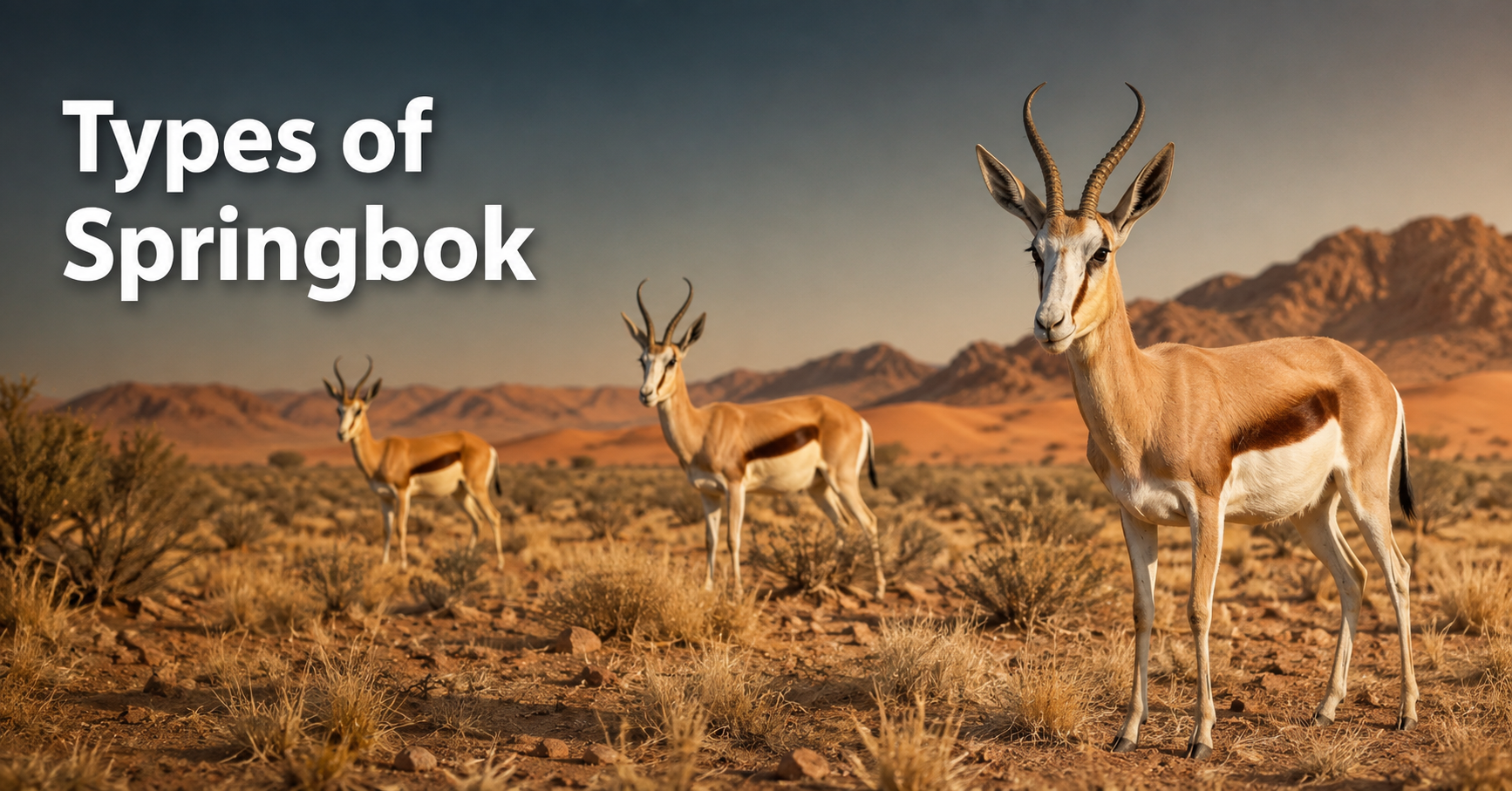
There are three traditionally recognized types of springbok, all belonging to the species Antidorcas marsupialis. These graceful antelopes inhabit the dry grasslands, shrublands, and semi-desert regions of southern and southwestern Africa. They are famous for their distinctive brown-and-white coats, curved horns, remarkable speed, and spectacular jumping display known as pronking.
This guide explains the appearance, size, habitat, geographic range, diet, behavior, and identification features of all three springbok subspecies. It also separates naturally occurring geographic forms from black, white, and copper color variants produced or maintained through selective breeding.
What Are the Main Types of Springbok?
The three commonly recognized springbok subspecies are the Angolan springbok, Kalahari springbok, and South African springbok. They differ mainly in geographic distribution, average size, coat shade, and facial markings. Some taxonomists have proposed treating these forms as separate species, but many current authorities continue to include them within the single species Antidorcas marsupialis.
| Springbok Type | Scientific Name | Key Feature | Main Range |
|---|---|---|---|
| Angolan springbok | Antidorcas marsupialis angolensis | Tawny coat with strong facial and flank stripes | Southwestern Angola |
| Kalahari springbok | Antidorcas marsupialis hofmeyri | Largest form with a light fawn coat | Namibia, Botswana, and the Kalahari region |
| South African springbok | Antidorcas marsupialis marsupialis | Rich chestnut coat and relatively small build | South Africa and nearby dry regions |
1. Angolan Springbok
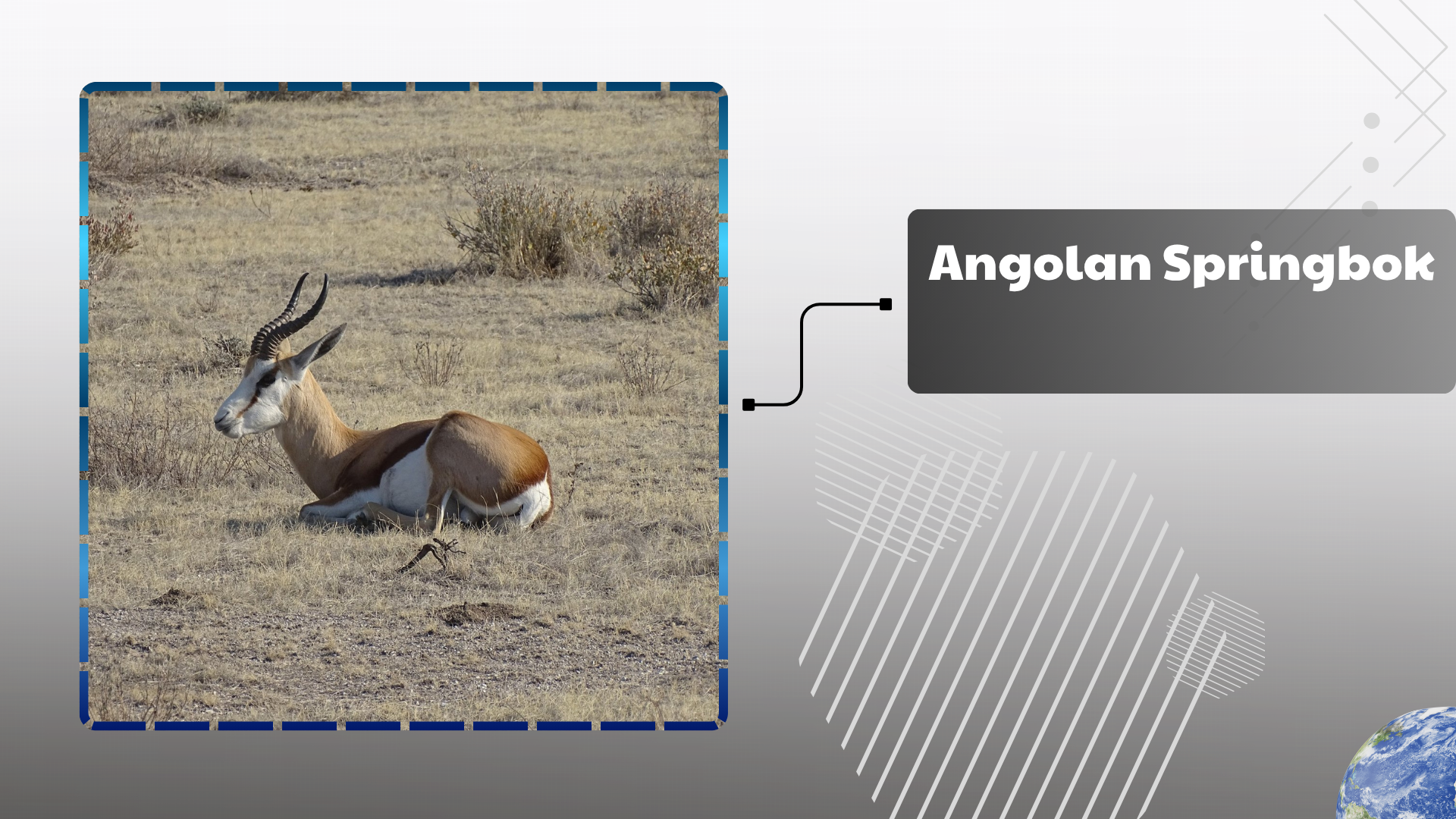
The Angolan springbok, Antidorcas marsupialis angolensis, is the northernmost of the three traditional springbok subspecies. Its natural distribution is centered in the dry southwestern part of Angola, especially landscapes influenced by the Namib and adjoining arid savannas. It has historically occurred in areas with sparse grass, open ground, low shrubs, and scattered sources of seasonal vegetation.
This springbok generally has a brown to warm tawny coat. Its dark facial stripes are comparatively thick and may extend much of the way down the muzzle. The face between the stripes is bright white, creating stronger contrast than is typically seen in the South African springbok. A brown patch may appear on the nose, while the dark band along the sides can look nearly black.
Both males and females carry horns. Male horns are normally thicker, longer, and more strongly ridged, while female horns are usually thinner and more delicate. The horns curve backward and then turn inward near their tips. This feature immediately separates springboks from female impalas, which are naturally hornless.
Angolan springboks are adapted to dry environments where rainfall and plant growth can be unpredictable. They feed on young grasses when conditions are favorable but also browse on leaves, low shrubs, herbs, flowers, and succulent vegetation. Moisture obtained from plants helps them survive where open water is limited, although they will drink when water is readily available.
Like other springboks, they may form groups that change in size according to food, rain, breeding activity, and seasonal movement. Their main defenses against predators are alertness, speed, sharp changes of direction, and pronking. During this display, an animal bounds into the air with relatively stiff legs while exposing a crest of white hair along its back.
The Angolan population has a more restricted distribution than springboks farther south. Habitat disturbance, fencing, hunting, drought, and limited population connectivity can therefore have a greater local effect. Reliable identification should combine coat pattern with geographic location rather than relying on color alone.
2. Kalahari Springbok
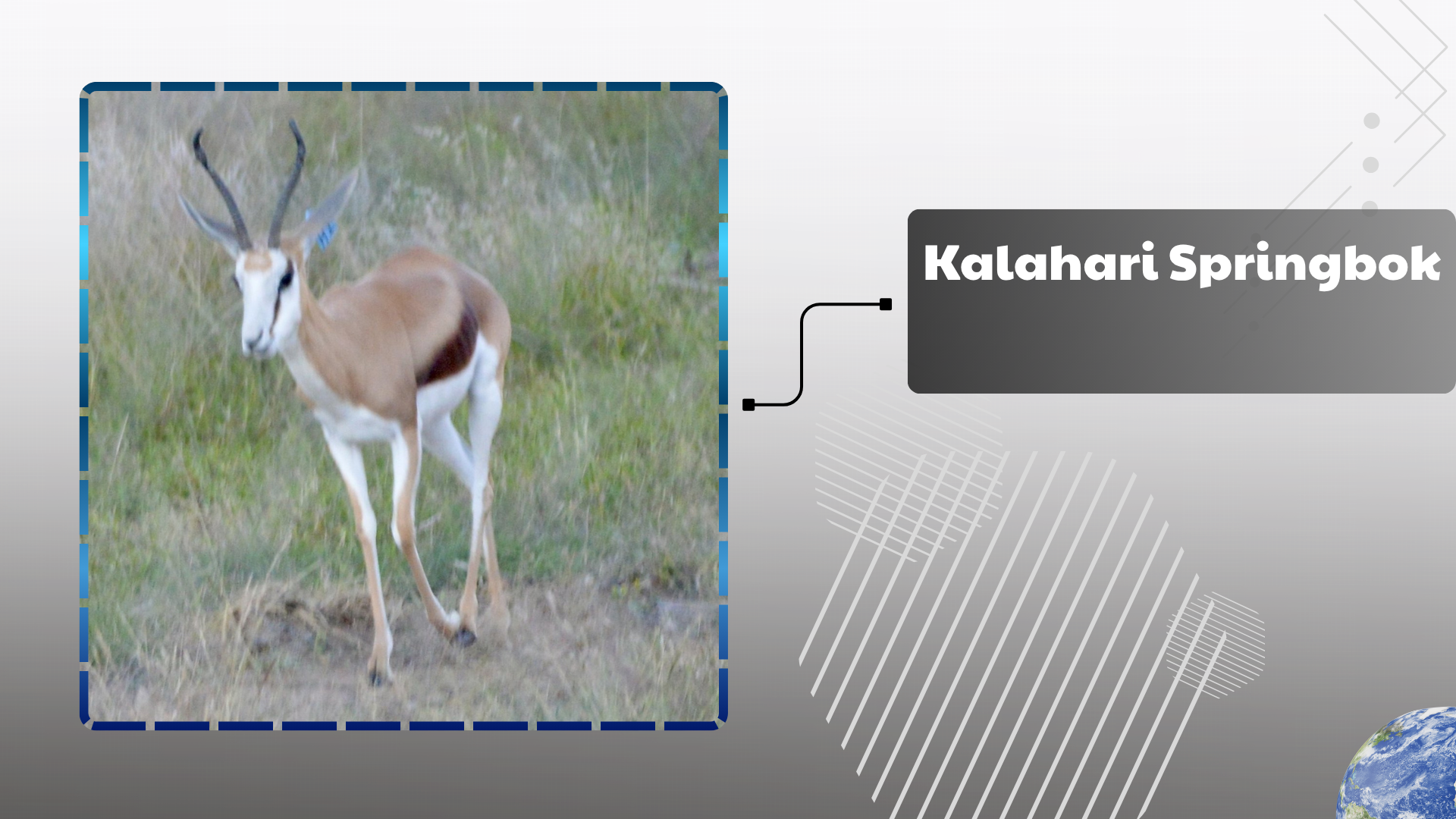
The Kalahari springbok, Antidorcas marsupialis hofmeyri, is associated with the dry interior of southern Africa. It occurs principally in Namibia, Botswana, and the wider Kalahari region, including cross-border conservation areas. This is generally regarded as the largest of the three springbok subspecies.
Its coat is usually light fawn or sandy brown, which blends effectively with pale Kalahari grasslands and open desert-edge environments. Narrow dark-brown stripes run from the eyes toward the mouth. The band along each flank ranges from dark brown to almost black and separates the upper coat from the white belly.
The forehead patch may extend beyond the level of the eyes and blend into the white face without a sharply defined border. Because coat shade varies with age, season, lighting, and individual condition, facial details and location are more dependable than a simple impression of light or dark coloration.
Kalahari springboks have long legs, slender bodies, pointed ears, white rumps, and dark-tipped tails. Both sexes grow horns, but males usually have heavier and more strongly curved horns. Their relatively large bodies may help them cope with environmental conditions, although individual measurements vary substantially.
These springboks are mixed feeders. They graze on short, fresh grass following rainfall and browse on dwarf shrubs, herbs, seedpods, and succulents when grass quality declines. They are well suited to arid environments and can obtain considerable moisture from their food. Rainfall may trigger rapid changes in movement as herds search for newly available vegetation.
Social groups range from small parties to much larger herds. During historical periods, vast numbers of springboks sometimes moved across the interior in mass migrations known as treks. Modern fencing, agriculture, roads, and other landscape changes have largely prevented movements on that scale.
The Kalahari springbok can be observed in major protected landscapes such as the Kgalagadi region. Visitors should use binoculars and avoid pressuring animals near waterholes, where wildlife may already be stressed by heat, drought, and predators.
3. South African Springbok
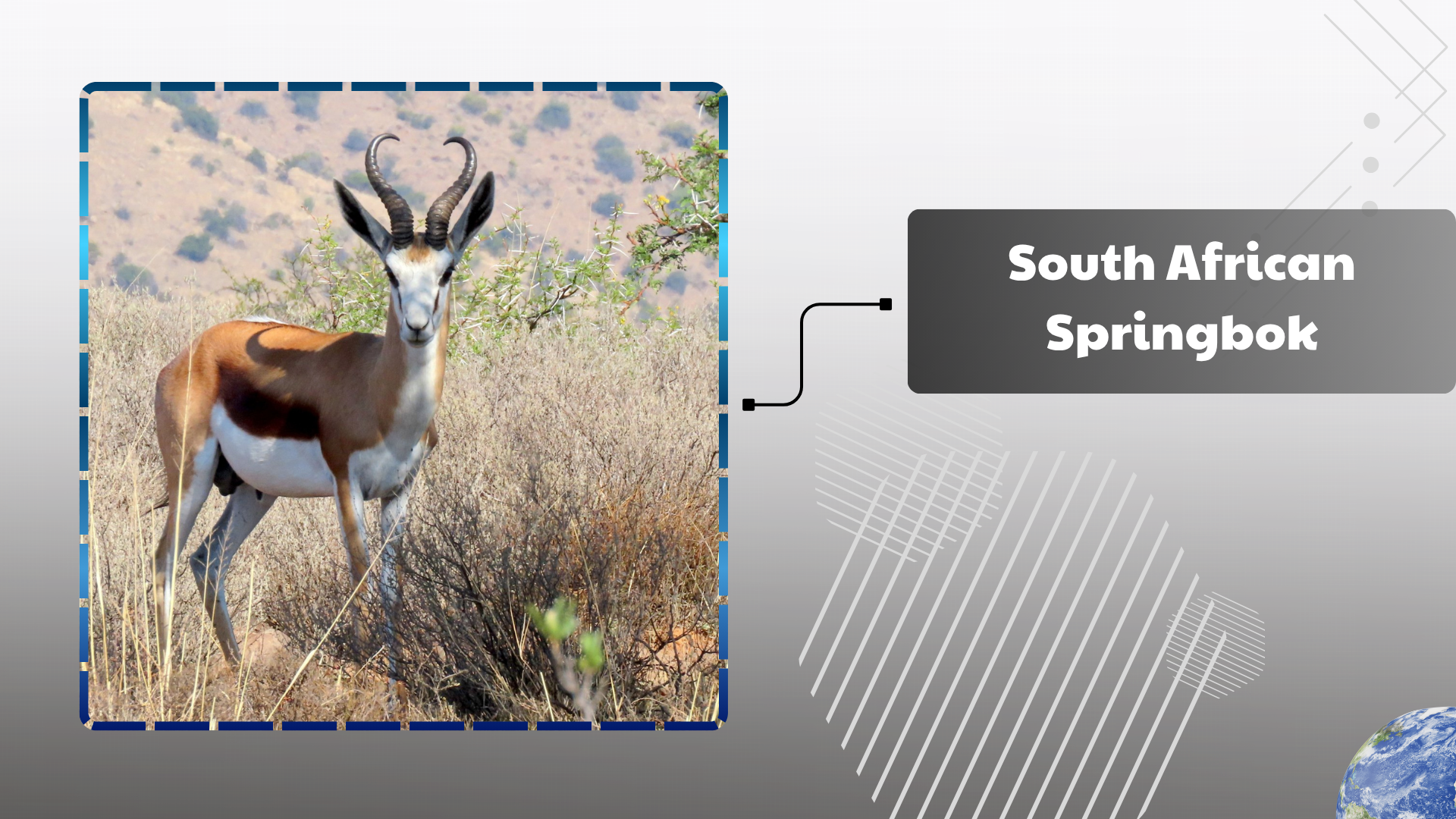
The South African springbok, Antidorcas marsupialis marsupialis, is the nominate subspecies, meaning it carries the same subspecies name as the species. It is widespread in suitable dry environments of South Africa and is especially associated with the Karoo, Northern Cape, western grasslands, and other open, semi-arid landscapes.
This form is generally considered the smallest of the three traditional subspecies. Its coat is commonly a rich chestnut or warm cinnamon brown. A dark reddish-brown stripe runs along each side of the body, dividing the brown upperparts from the white belly and inner legs.
The face is mostly white, with thin brown lines extending from the eyes toward the mouth. Its forehead may be brown, fawn, or partly white, but the forehead patch normally does not extend as far down as it does in the Kalahari form. A dark mark may occasionally appear on the nose.
South African springboks inhabit open plains, short grassland, dry shrubland, and Karoo vegetation. They generally avoid dense woodland, continuously wet ground, and tall grass that restricts visibility or movement. Their slender legs and light build are well suited to fast running across open terrain.
Young grass is an important food after rainfall, but these springboks readily browse on low shrubs and succulent Karoo plants during dry periods. Their flexible diet and ability to obtain moisture from vegetation allow them to occupy areas where permanent surface water is scarce.
Both sexes have horns, although male horns are normally thicker and more developed. Males may defend breeding territories or gather females during favorable conditions. Females commonly produce one lamb, and breeding can respond to rainfall and food availability rather than following exactly the same schedule in every region.
The South African springbok is culturally significant and is South Africa’s national animal. It also gives its name to several South African national sports teams. Although the subspecies remains numerous, responsible habitat management is still important. Artificially selected color variants should not be released into protected wild populations where they could influence natural genetic patterns.
Are There Three Springbok Species or Three Subspecies?
The most familiar classification recognizes one living species, Antidorcas marsupialis, with three geographic subspecies:
- Antidorcas marsupialis angolensis
- Antidorcas marsupialis hofmeyri
- Antidorcas marsupialis marsupialis
Some taxonomic studies have proposed recognizing these forms as three full species: Antidorcas angolensis, Antidorcas hofmeyri, and Antidorcas marsupialis. Other authorities retain one species because the differences may not be sufficient or consistently supported for a three-species arrangement.
For a practical wildlife identification guide, presenting them as three traditional subspecies is the clearest approach. Readers should understand that scientific classifications can change as researchers evaluate genetic evidence, skull measurements, geographic separation, and variation among populations.
Are Black, White, and Copper Springboks Separate Types?
Black, white, and copper springboks are color variants rather than separate wild species or scientifically recognized geographic subspecies. They have become particularly visible on game ranches where unusual coat colors may be maintained through selective breeding.
Black Springbok
Black springboks have dark brown to nearly black coats. Adults may retain white facial or rump markings, so they are not always uniformly black. This coloration does not make them a separate species.
White Springbok
White springboks have predominantly white or cream coats, sometimes with a faint tan stripe along the sides. Not every white springbok is a true albino. Non-albino white animals may retain dark eyes, skin pigment, and normally colored horns.
Copper Springbok
Copper springboks have unusually rich reddish, bronze, or copper-colored coats. They are selectively maintained color morphs rather than an additional natural subspecies.
| Name | Scientific Status | Main Characteristic |
|---|---|---|
| Angolan springbok | Traditional geographic subspecies | Strong facial markings and southwestern Angolan range |
| Kalahari springbok | Traditional geographic subspecies | Large build and pale fawn coloration |
| South African springbok | Traditional geographic subspecies | Chestnut coat and southern distribution |
| Black springbok | Color variant | Dark brown or blackish coat |
| White springbok | Color variant | White or cream coat |
| Copper springbok | Color variant | Deep reddish or copper coat |
How Are These Wild Animals Classified?
| Taxonomic Level | Classification |
|---|---|
| Kingdom | Animalia |
| Phylum | Chordata |
| Class | Mammalia |
| Order | Artiodactyla |
| Family | Bovidae |
| Subfamily | Antilopinae |
| Genus | Antidorcas |
| Species | Antidorcas marsupialis |
The springbok is the only living member of the genus Antidorcas. It belongs to Bovidae, the same family as cattle, sheep, goats, gazelles, and many other antelopes. Springboks are ruminants with specialized digestive systems that allow them to extract nutrients from grasses, leaves, and other fibrous plant material.
Where Do These Wild Animals Live?
Springboks are native to southern and southwestern Africa. Their range includes South Africa, Namibia, Botswana, and southwestern Angola. They are particularly well adapted to the dry interior and western regions of the continent.
Preferred habitats include:
- Open semi-desert plains
- Short grasslands
- Dry savannas
- Karoo shrublands
- Arid scrub
- Desert-edge environments
- Open pans and dune valleys
Springboks do not thrive equally well in every landscape. Persistently wet soil and dense stands of tall grass are generally unsuitable. Open habitats allow the animals to detect predators and use speed effectively.
How to Identify Different Types of Springbok
- Body shape: Look for a slender antelope with a long neck and narrow legs.
- Face: The face is mostly white with dark stripes from the eyes toward the mouth.
- Flank pattern: A dark horizontal band divides the brown back from the white underside.
- Horns: Both males and females have dark, ridged horns that curve backward.
- Rump: The rump is white and contains a special dorsal skin fold.
- Pronking: A springbok may leap stiff-legged while exposing a crest of white hair.
- Size: Kalahari springboks are generally the largest, while South African springboks are usually the smallest.
- Coat shade: Angolan springboks are tawny, Kalahari springboks are pale fawn, and South African springboks are often chestnut.
- Forehead pattern: The shape and reach of the forehead patch can help separate the subspecies.
- Location: Geographic range is essential because individual coloration can vary.
How to Tell a Springbok From Similar Antelopes
Springbok vs. Impala
A springbok has horns in both sexes, while female impalas are hornless. Springboks also have a bold flank stripe and a white dorsal crest used during pronking. Impalas typically inhabit more wooded environments and have different rump markings.
Springbok vs. Thomson’s Gazelle
Both animals have prominent dark side stripes, but Thomson’s gazelles occur mainly in East Africa. The springbok’s expandable white dorsal crest and southern African range are decisive clues.
Springbok vs. Blesbok
Blesbok are larger and heavier, with distinctive white blazes on their faces. They lack the springbok’s expandable dorsal crest and have differently shaped horns.
Springbok vs. Steenbok
Steenbok are much smaller, usually solitary, and lack the springbok’s strong flank stripe. Only male steenbok normally have horns.
Springbok Size and Appearance
An adult springbok normally stands about 70–90 centimeters at the shoulder. Most adults weigh approximately 27–48 kilograms, although size varies by sex, subspecies, habitat, and physical condition.
Males are generally heavier than females and have thicker horns. However, both sexes share the characteristic facial stripes, flank band, pale underside, white rump, pointed ears, and dark-tipped tail.
What Is Pronking?
Pronking is the springbok’s most famous behavior. During a pronk, the animal launches itself into the air with its back arched and its legs held relatively stiff. At the same time, a fold of skin along the back opens to reveal a crest of bright white hair.
Springboks may pronk when alarmed, excited, playing, or moving with a herd. The display may communicate physical fitness, help group members detect danger, confuse predators, or improve the animal’s view over low vegetation. Pronking is different from ordinary running because it emphasizes vertical, stiff-legged bounds.
What Do Springboks Eat?
Springboks are mixed-feeding herbivores. Their diet changes according to rainfall and plant availability.
- Young grasses
- Low-growing shrubs
- Leaves
- Herbs
- Flowers
- Seeds and seedpods
- Succulent plants
- Soft shoots
They often graze after rain produces fresh grass. During dry periods, they browse more heavily on shrubs and succulents. This flexible feeding strategy is one reason springboks can survive in unpredictable arid environments.
Do Springboks Need to Drink Water?
Springboks can survive for extended periods without drinking when their food contains sufficient moisture. Succulents, fresh leaves, and newly growing grasses provide water as well as nutrients. They may also feed during cooler periods when plants retain more moisture.
This adaptation does not mean springboks never drink. They use available water when conditions make it beneficial, especially during extreme heat or when dry food contains little moisture.
Springbok Social Behavior
Springbok group size varies considerably. Females and young may form herds, while males can establish territories or gather in bachelor groups. Rainfall may draw animals toward areas of fresh plant growth, producing temporary concentrations.
Territorial males mark and defend areas during breeding opportunities. They may use scent, posture, horn displays, and physical contests to challenge rivals. Outside these periods, social arrangements can become more flexible.
Springbok Reproduction
Springboks can reproduce throughout the year when conditions are favorable, although births may peak after seasonal rains. Following a gestation of approximately five to six months, a female usually gives birth to one lamb.
A newborn may remain hidden briefly before joining its mother and other herd members. Both male and female lambs eventually develop horns. Young animals have softer facial markings that become more defined as they mature.
Springbok Predators
Springboks are hunted by several African predators, including:
- Cheetahs
- Leopards
- Lions
- Spotted hyenas
- Brown hyenas
- African wild dogs
- Black-backed jackals, particularly when lambs are available
- Caracals, especially when targeting young or vulnerable animals
Speed, agility, group vigilance, camouflage, and pronking help springboks reduce the risk of capture. They are especially effective runners in open terrain where they can detect danger at a distance.
Outdoor Tips for Finding and Observing Springboks
- Search open plains, short grasslands, dry pans, and semi-desert shrublands.
- Visit during early morning or late afternoon when feeding activity is high.
- Use binoculars to examine facial patterns without disturbing the herd.
- Watch for white dorsal crests when the animals become excited or alarmed.
- Scan around areas of recent rainfall where fresh vegetation is developing.
- Approach waterholes slowly and never block access to water.
- Remain inside designated vehicles when required by park regulations.
- Avoid loud noises, sudden movements, and attempts to trigger pronking.
- Do not feed springboks or encourage them to approach people.
- Follow all instructions provided by wildlife guides and park staff.
Safety, Sustainability, and Conservation Notes
The springbok is generally classified as a species of Least Concern and remains common in many parts of southern Africa. Large populations occur on protected land, wildlife ranches, and privately managed properties.
Despite this overall security, local populations can be affected by drought, unsuitable fencing, habitat conversion, disease, overharvesting, and disruption of traditional movement routes. Southwestern Angolan populations may be more vulnerable because they are smaller and less continuous.
Artificial color breeding also creates management concerns. Black, white, and copper springboks may have commercial value, but animals selected primarily for appearance should not be introduced into wild conservation populations without appropriate scientific review.
Visitors can support springbok conservation by choosing responsible wildlife operators, respecting reserve rules, avoiding stressful interactions, and supporting the protection of connected arid landscapes.
Fun Facts About Springbok
- The springbok is the national animal of South Africa.
- Both male and female springboks grow horns.
- The name springbok comes from Afrikaans words referring to jumping and antelope.
- Pronking exposes a hidden crest of white hair along the back.
- Springboks can graze and browse depending on seasonal food supplies.
- They obtain much of their moisture from succulent plants and fresh vegetation.
- The springbok is the only living member of the genus Antidorcas.
- Historical springbok treks reportedly involved enormous moving herds.
- Black and white springboks are color variants rather than separate species.
- Several South African national sports teams are known as the Springboks.
Final Thoughts on Types of Springbok
The three traditionally recognized types of springbok are the Angolan, Kalahari, and South African springboks. They are geographic forms of Antidorcas marsupialis that differ in range, average size, coat shade, and facial pattern. The Kalahari form is generally the largest, the South African form is usually the smallest, and the Angolan form has especially strong facial markings.
Black, white, and copper springboks should be described as color variants rather than additional scientific types. When identifying springboks outdoors, combine location with size, facial markings, coat color, and forehead pattern. Responsible observation and habitat protection will help these remarkable antelopes continue to thrive across southern Africa’s dry landscapes.
Frequently Asked Questions
1. How many types of springbok are there?
There are three traditionally recognized geographic subspecies: the Angolan springbok, Kalahari springbok, and South African springbok.
2. What are the three springbok subspecies?
They are Antidorcas marsupialis angolensis, Antidorcas marsupialis hofmeyri, and Antidorcas marsupialis marsupialis.
3. Are the three springbok forms separate species?
Some taxonomists have proposed treating them as separate species. However, many major references continue to recognize one species containing the three traditional forms.
4. What is the scientific name of the springbok?
The generally accepted scientific name is Antidorcas marsupialis.
5. Which springbok type is the largest?
The Kalahari springbok, A. m. hofmeyri, is generally considered the largest of the three traditional subspecies.
6. Which springbok type is the smallest?
The South African springbok, A. m. marsupialis, is normally described as the smallest subspecies.
7. Where does the Angolan springbok live?
It is native primarily to dry areas of southwestern Angola, with its distribution associated with the South West Arid Zone.
8. Where does the Kalahari springbok live?
It occurs mainly in Namibia, Botswana, and the broader Kalahari region, including some adjoining parts of South Africa.
9. Where does the South African springbok live?
It occupies suitable dry and open landscapes in South Africa, especially the Karoo, Northern Cape, and surrounding regions.
10. How can you identify an Angolan springbok?
Look for a tawny coat, strong dark facial stripes, a bright white face, and a dark flank band. Geographic location is also important.
11. How can you identify a Kalahari springbok?
The Kalahari form is relatively large and commonly has a light fawn coat, narrow facial stripes, and a forehead patch that may extend beyond the eyes.
12. How can you identify a South African springbok?
It is usually smaller and has a rich chestnut coat, thin facial lines, and a forehead patch that generally does not extend beyond the eyes.
13. Is a black springbok a separate species?
No. A black springbok is a coat-color variant, often maintained through selective breeding.
14. Is a white springbok an albino?
Not necessarily. Some white springboks retain normal pigment in their eyes, skin, and horns and are therefore not true albinos.
15. What is a copper springbok?
A copper springbok is a selectively maintained color variant with a deep reddish or bronze coat. It is not a separate subspecies.
16. Are springboks antelopes or gazelles?
Springboks are antelopes in the family Bovidae. They are related to gazelles but belong to the separate genus Antidorcas.
17. Do female springboks have horns?
Yes. Both sexes grow horns, although female horns are normally thinner and less heavily developed than male horns.
18. How big is a springbok?
Adults generally stand about 70–90 centimeters at the shoulder and weigh approximately 27–48 kilograms.
19. What color is a normal springbok?
A typical springbok has a light brown to chestnut back, dark reddish flank stripes, a white underside, and a mostly white face marked with darker lines.
20. What do springboks eat?
They eat fresh grass, shrubs, herbs, leaves, flowers, seedpods, and succulent plants. Their diet changes with rainfall and plant availability.
21. Are springboks grazers or browsers?
They are mixed feeders. Springboks graze when young grass is available and browse more heavily during dry conditions.
22. Can springboks survive without water?
They can survive for extended periods without drinking when moisture-rich plants are available. However, they may drink when accessible water is beneficial.
23. What is pronking?
Pronking is a stiff-legged jumping display during which a springbok arches its back and reveals a crest of white hair.
24. Why do springboks pronk?
They may pronk to signal fitness, warn herd members, confuse predators, improve visibility, or express excitement.
25. How fast can springboks run?
Springboks are exceptionally fast runners capable of rapid acceleration and sharp turns. Exact maximum-speed claims vary, so speed alone should not be used for identification.
26. What predators hunt springboks?
Predators include cheetahs, leopards, lions, African wild dogs, hyenas, jackals, and caracals.
27. Do springboks live in herds?
Yes. They form herds whose size and structure change with rainfall, food, breeding activity, and local conditions.
28. What is a male springbok called?
A male springbok is commonly called a ram.
29. What is a female springbok called?
A female springbok is commonly called a ewe.
30. What is a baby springbok called?
A young springbok is called a lamb.
31. How many young does a springbok have?
A female normally gives birth to one lamb after a gestation of approximately five to six months.
32. Are springboks endangered?
The species is generally classified as Least Concern. Nevertheless, some local and regional populations face greater pressures than the species as a whole.
33. What threats do springboks face?
Local threats may include habitat conversion, poorly planned fencing, drought, disease, excessive harvesting, and the loss of movement routes.
34. Can springboks be kept as pets?
No. They are active wild herd animals requiring specialized habitat, social management, veterinary care, permits, and extensive space.
35. Are springboks dangerous to people?
They normally avoid humans, but frightened animals can kick or cause injury with their horns. Wild springboks should never be cornered or handled.
36. Where is the best place to observe springboks?
Good viewing opportunities occur in dry protected areas of South Africa, Namibia, and Botswana, particularly open landscapes in the Kalahari and Karoo regions.
37. When is the best time to see springboks?
Early morning and late afternoon are often best because temperatures are cooler and feeding activity is usually higher.
38. How should springboks be photographed responsibly?
Use binoculars or a telephoto lens, remain at a respectful distance, stay on designated routes, and never frighten an animal to make it pronk.
39. What makes a springbok different from an impala?
Female springboks have horns, while female impalas do not. Springboks also have bold flank stripes and an expandable white dorsal crest.
40. Why is the springbok important to South Africa?
It is the country’s national animal and an important cultural symbol. The name is also used by several South African national sports teams.